
War Photographer By Carol Ann Duffy The Terror
War Photographer By Carol Ann Duffy
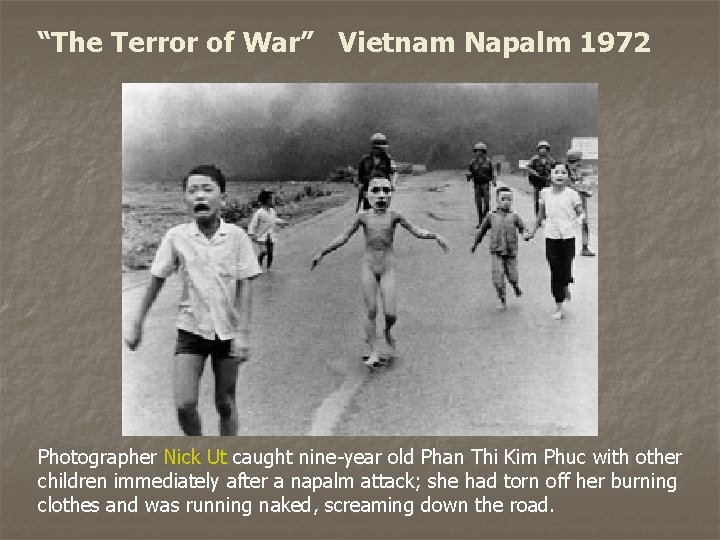
“The Terror of War” Vietnam Napalm 1972 Photographer Nick Ut caught nine-year old Phan Thi Kim Phuc with other children immediately after a napalm attack; she had torn off her burning clothes and was running naked, screaming down the road.
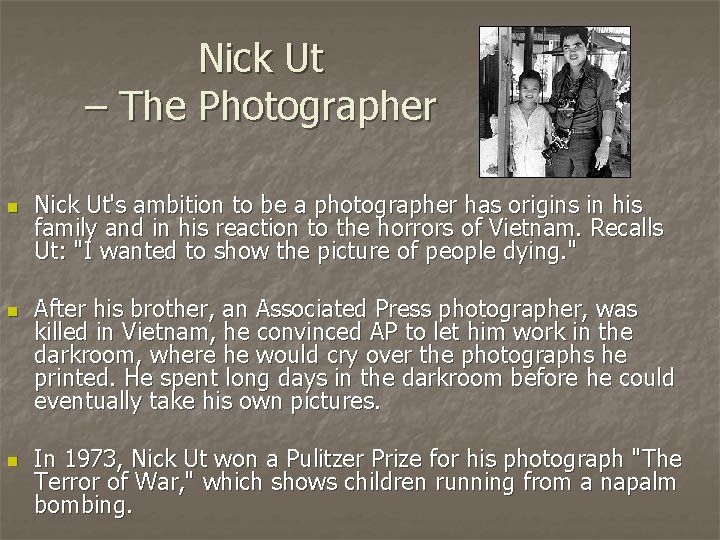
Nick Ut – The Photographer n n n Nick Ut's ambition to be a photographer has origins in his family and in his reaction to the horrors of Vietnam. Recalls Ut: "I wanted to show the picture of people dying. " After his brother, an Associated Press photographer, was killed in Vietnam, he convinced AP to let him work in the darkroom, where he would cry over the photographs he printed. He spent long days in the darkroom before he could eventually take his own pictures. In 1973, Nick Ut won a Pulitzer Prize for his photograph "The Terror of War, " which shows children running from a napalm bombing.
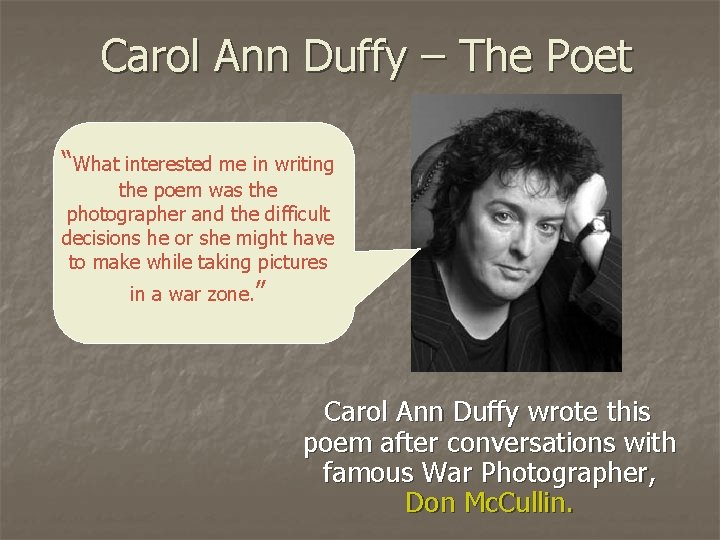
Carol Ann Duffy – The Poet “What interested me in writing the poem was the photographer and the difficult decisions he or she might have to make while taking pictures in a war zone. ” Carol Ann Duffy wrote this poem after conversations with famous War Photographer, Don Mc. Cullin.

“War Photographer” In his darkroom he is finally alone with spools of suffering set out in ordered rows. The only light is red and softly glows, as though this were a church and he a priest preparing to intone a Mass. Belfast. Beirut. Phnom Penh. All flesh is grass. He has a job to do. Solutions slop in trays beneath his hands which did not tremble then though seem to now. Rural England. Home again to ordinary pain which simple weather can dispel, to fields which don't explode beneath the feet of running children in a nightmare heat. Something is happening. A stranger's features faintly start to twist before his eyes, a half-formed ghost. He remembers the cries of this man's wife, how he sought approval without words to do what someone must and how the blood stained into foreign dust. A hundred agonies in black-and-white from which his editor will pick out five or six for Sunday's supplement. The reader's eyeballs prick with tears between bath and pre-lunch beers. From aeroplane he stares impassively at where he earns a living and they do not care.
Theme n n n Shows contrast between the reality of war zones and safety of home. Photographer moves between these two worlds but belongs to neither Photographer is shown as a conscious recorder of the truth.
Form and Structure n n Poem is set out in 4 six line stanzas of equal length. Each stanza ends with a rhyming couplet. The structure follows the process of photographic development and the thought process that accompanies it. Poem moves from series of observations to a clear conclusion.
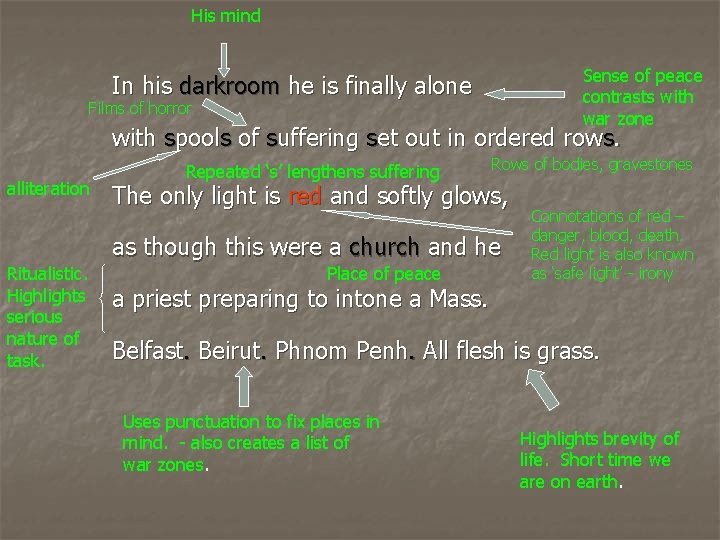
His mind Sense of peace contrasts with war zone In his darkroom he is finally alone Films of horror with spools of suffering set out in ordered rows. alliteration Repeated ‘s’ lengthens suffering Rows of bodies, gravestones The only light is red and softly glows, as though this were a church and he Ritualistic. Highlights serious nature of task. Place of peace Connotations of red – danger, blood, death. Red light is also known as ‘safe light’ - irony a priest preparing to intone a Mass. Belfast. Beirut. Phnom Penh. All flesh is grass. Uses punctuation to fix places in mind. - also creates a list of war zones. Highlights brevity of life. Short time we are on earth.
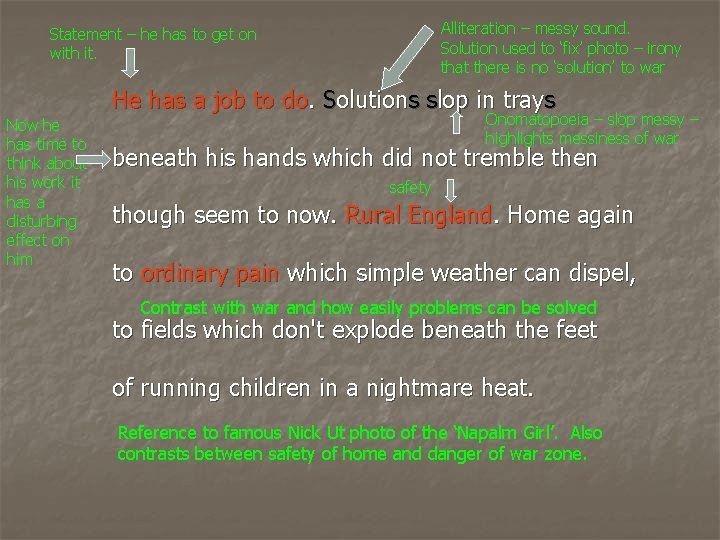
Alliteration – messy sound. Solution used to ‘fix’ photo – irony that there is no ‘solution’ to war Statement – he has to get on with it. He has a job to do. Solutions slop in trays Now he has time to think about his work it has a disturbing effect on him Onomatopoeia – slop messy – highlights messiness of war beneath his hands which did not tremble then safety though seem to now. Rural England. Home again to ordinary pain which simple weather can dispel, Contrast with war and how easily problems can be solved to fields which don't explode beneath the feet of running children in a nightmare heat. Reference to famous Nick Ut photo of the ‘Napalm Girl’. Also contrasts between safety of home and danger of war zone.
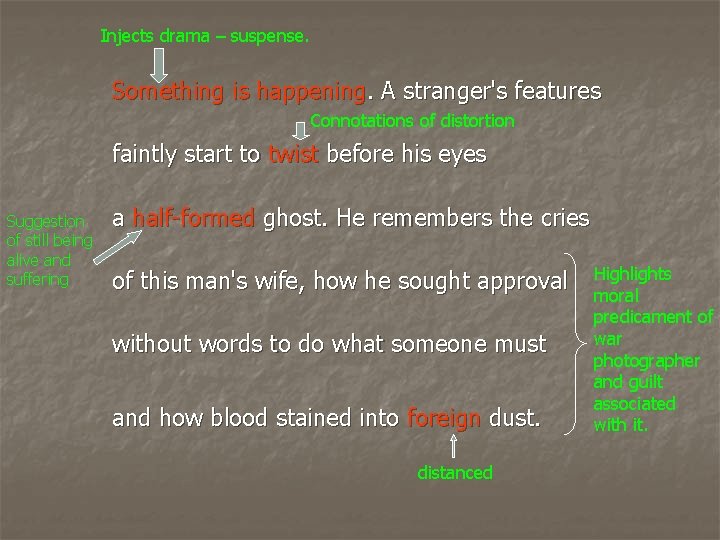
Injects drama – suspense. Something is happening. A stranger's features Connotations of distortion faintly start to twist before his eyes Suggestion of still being alive and suffering a half-formed ghost. He remembers the cries of this man's wife, how he sought approval without words to do what someone must and how blood stained into foreign dust. distanced Highlights moral predicament of war photographer and guilt associated with it.
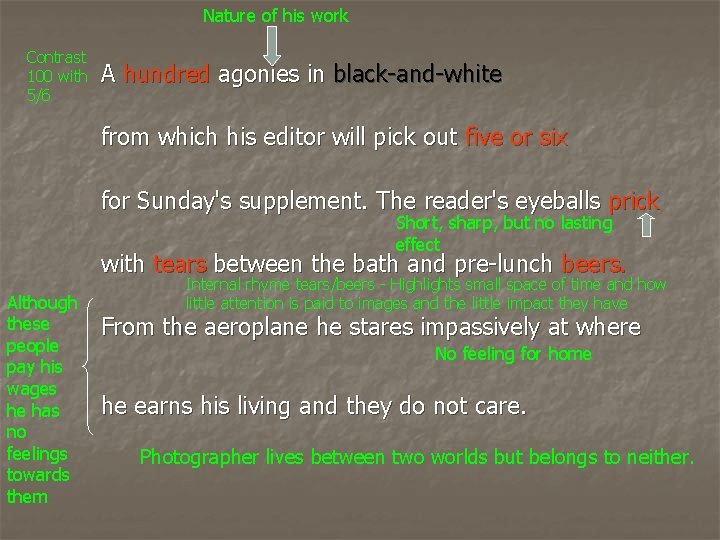
Nature of his work Contrast 100 with 5/6 A hundred agonies in black-and-white from which his editor will pick out five or six for Sunday's supplement. The reader's eyeballs prick Short, sharp, but no lasting effect with tears between the bath and pre-lunch beers. Although these people pay his wages he has no feelings towards them Internal rhyme tears/beers - Highlights small space of time and how little attention is paid to images and the little impact they have From the aeroplane he stares impassively at where No feeling for home he earns his living and they do not care. Photographer lives between two worlds but belongs to neither.
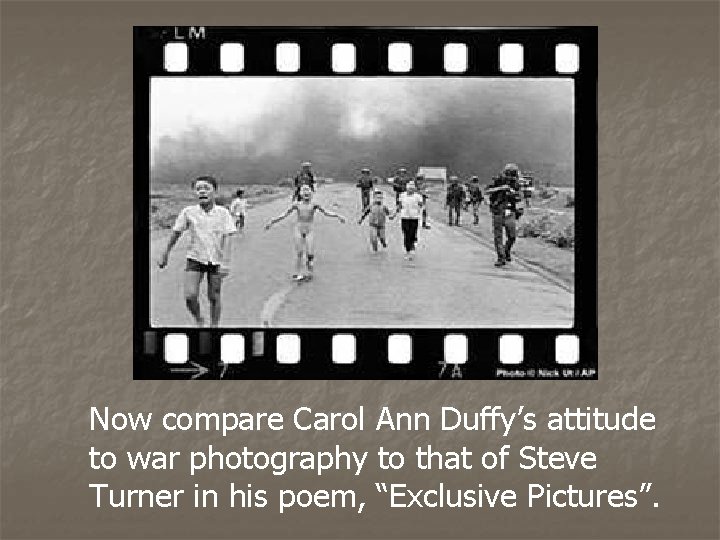
Now compare Carol Ann Duffy’s attitude to war photography to that of Steve Turner in his poem, “Exclusive Pictures”.
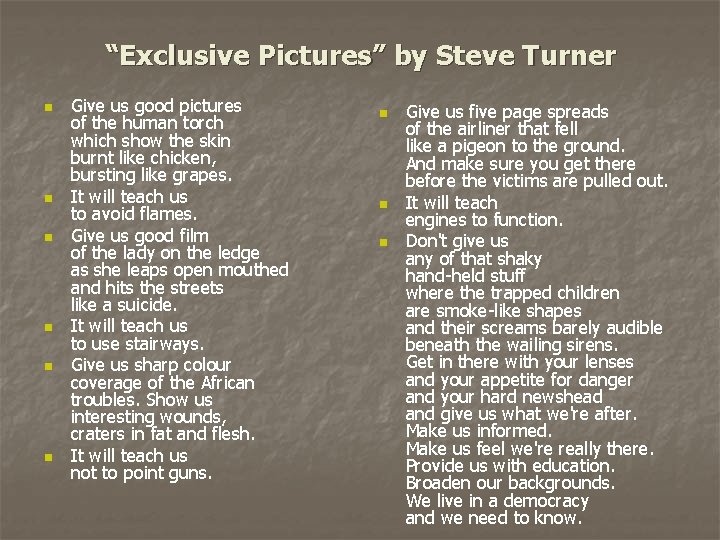
“Exclusive Pictures” by Steve Turner n n n Give us good pictures of the human torch which show the skin burnt like chicken, bursting like grapes. It will teach us to avoid flames. Give us good film of the lady on the ledge as she leaps open mouthed and hits the streets like a suicide. It will teach us to use stairways. Give us sharp colour coverage of the African troubles. Show us interesting wounds, craters in fat and flesh. It will teach us not to point guns. n n n Give us five page spreads of the airliner that fell like a pigeon to the ground. And make sure you get there before the victims are pulled out. It will teach engines to function. Don't give us any of that shaky hand-held stuff where the trapped children are smoke-like shapes and their screams barely audible beneath the wailing sirens. Get in there with your lenses and your appetite for danger and your hard newshead and give us what we're after. Make us informed. Make us feel we're really there. Provide us with education. Broaden our backgrounds. We live in a democracy and we need to know.
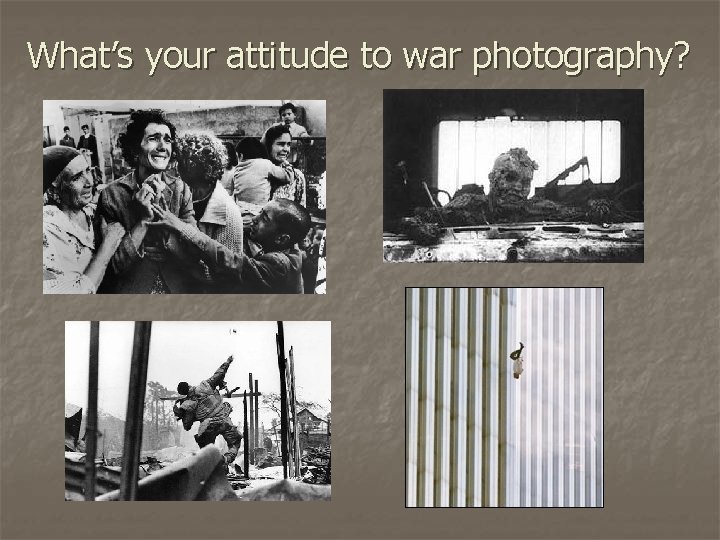
What’s your attitude to war photography?
- Slides: 14