
War and the US Military Reality of Warfare
- Slides: 30
War and the US Military
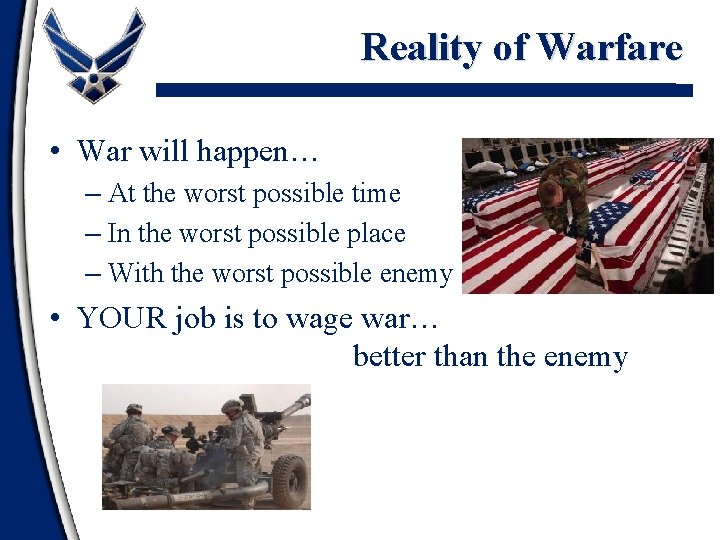
Reality of Warfare • War will happen… – At the worst possible time – In the worst possible place – With the worst possible enemy • YOUR job is to wage war… better than the enemy
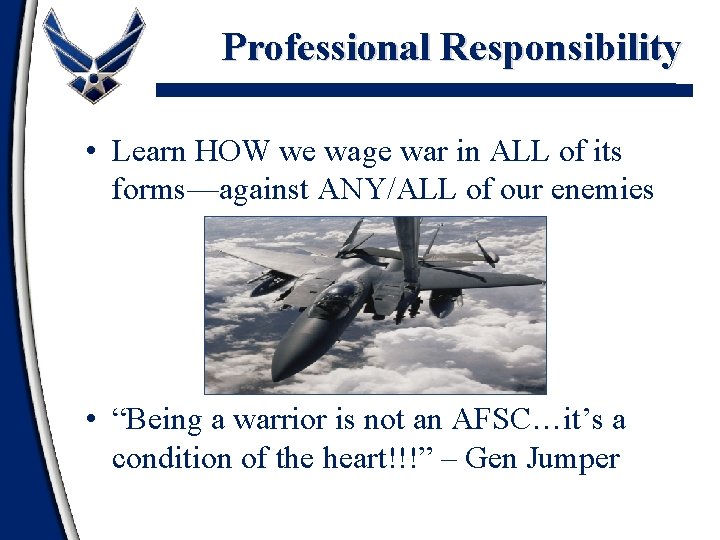
Professional Responsibility • Learn HOW we wage war in ALL of its forms—against ANY/ALL of our enemies • “Being a warrior is not an AFSC…it’s a condition of the heart!!!” – Gen Jumper
Overview • • • The Nature of War Definitions and Basic Themes of War Viewpoints on War Categories and Levels of War Factors that Dominate War Evolution of Warfare
SOBs Cognitive Samples of Behavior: 1. State three enduring truths that describe the fundamental nature of war. 2. Define war according to Clausewitz. 3. Identify the basic themes of war. 4. Differentiate among the four viewpoints on war: Pacifism, Realism, Holy War, and Just War Theory. 5. List the three factors that dominate war. 6. Describe the evolution of warfare according to Alan Beyerchen’s taxonomy of four world wars.
Enduring Truths of War • War is… – an instrument of policy, strategy, or culture. – a complex and chaotic human endeavor. – a clash of opposing wills.
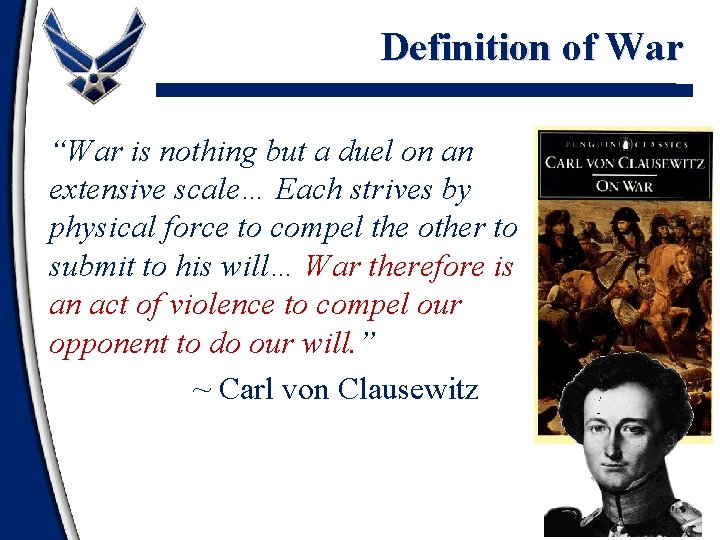
Definition of War “War is nothing but a duel on an extensive scale… Each strives by physical force to compel the other to submit to his will… War therefore is an act of violence to compel our opponent to do our will. ” ~ Carl von Clausewitz
Enduring Truth #1 War is an instrument of policy, strategy, or culture.
Basic Themes of War • Politics and violence are intertwined • War is policy “…that fights battles instead of writing notes” • War is the continuation of politics with the addition of other means
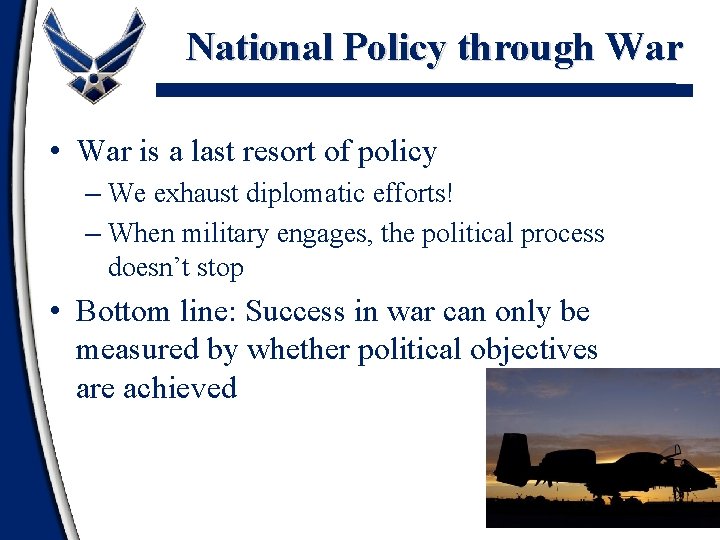
National Policy through War • War is a last resort of policy – We exhaust diplomatic efforts! – When military engages, the political process doesn’t stop • Bottom line: Success in war can only be measured by whether political objectives are achieved
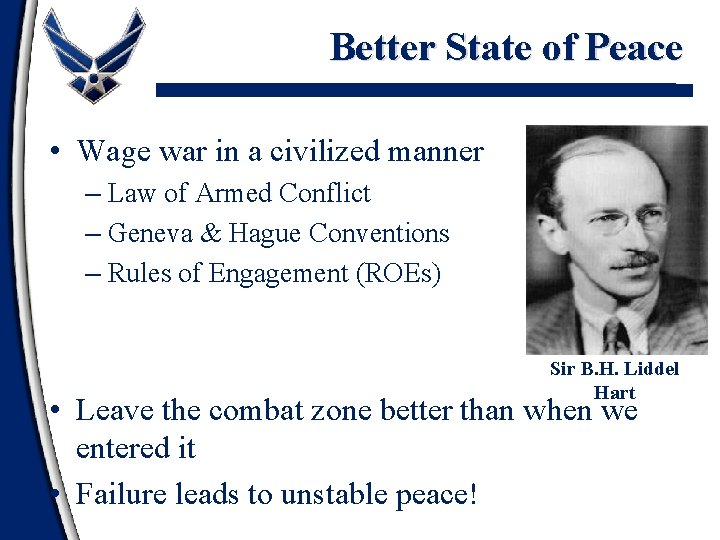
Better State of Peace • Wage war in a civilized manner – Law of Armed Conflict – Geneva & Hague Conventions – Rules of Engagement (ROEs) Sir B. H. Liddel Hart • Leave the combat zone better than when we entered it • Failure leads to unstable peace!
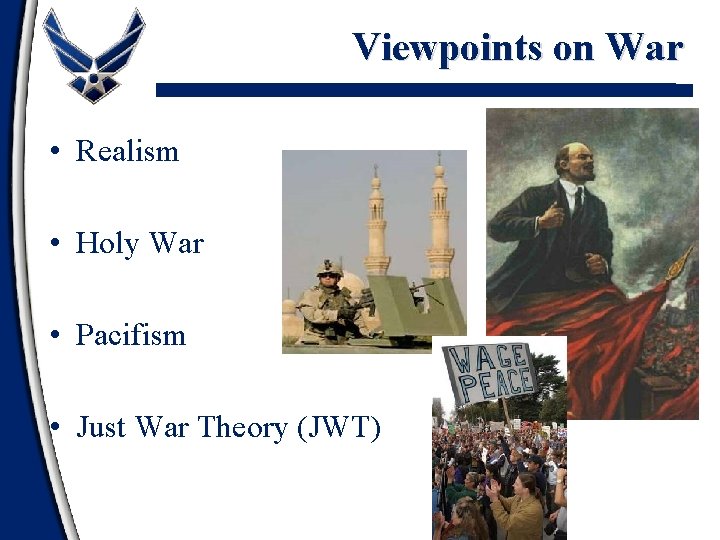
Viewpoints on War • Realism • Holy War • Pacifism • Just War Theory (JWT)
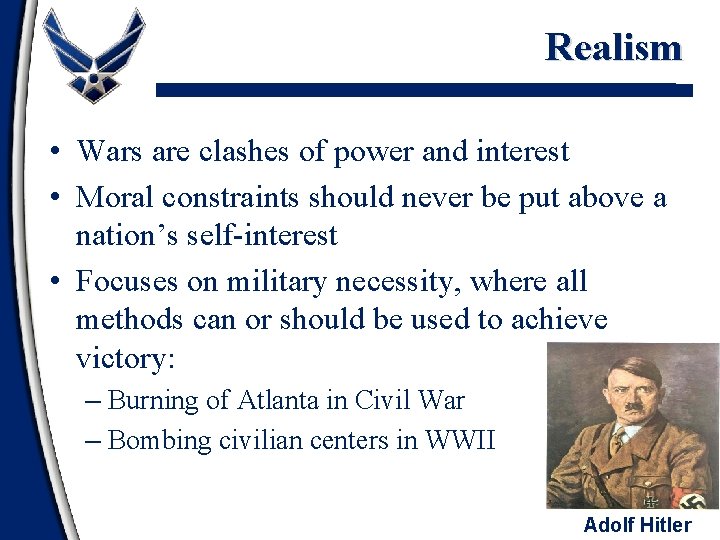
Realism • Wars are clashes of power and interest • Moral constraints should never be put above a nation’s self-interest • Focuses on military necessity, where all methods can or should be used to achieve victory: – Burning of Atlanta in Civil War – Bombing civilian centers in WWII Adolf Hitler
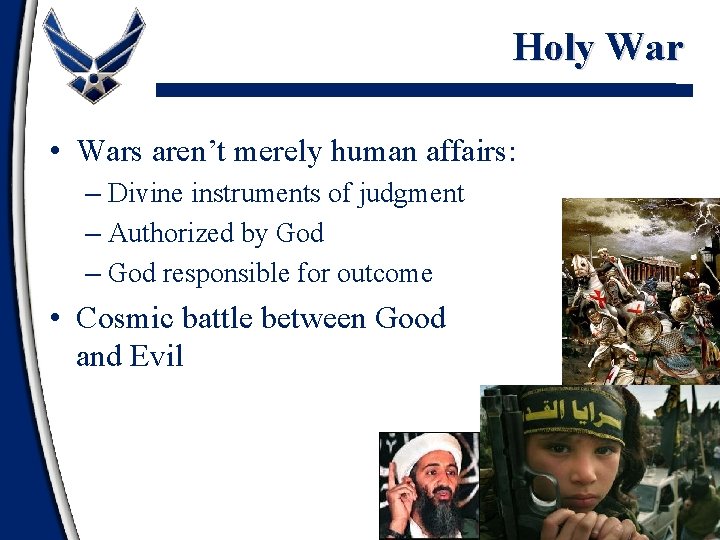
Holy War • Wars aren’t merely human affairs: – Divine instruments of judgment – Authorized by God – God responsible for outcome • Cosmic battle between Good and Evil
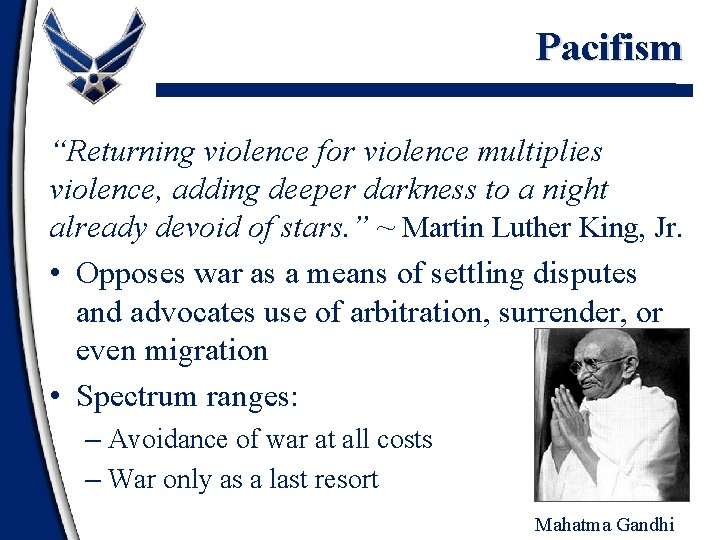
Pacifism “Returning violence for violence multiplies violence, adding deeper darkness to a night already devoid of stars. ” ~ Martin Luther King, Jr. • Opposes war as a means of settling disputes and advocates use of arbitration, surrender, or even migration • Spectrum ranges: – Avoidance of war at all costs – War only as a last resort Mahatma Gandhi
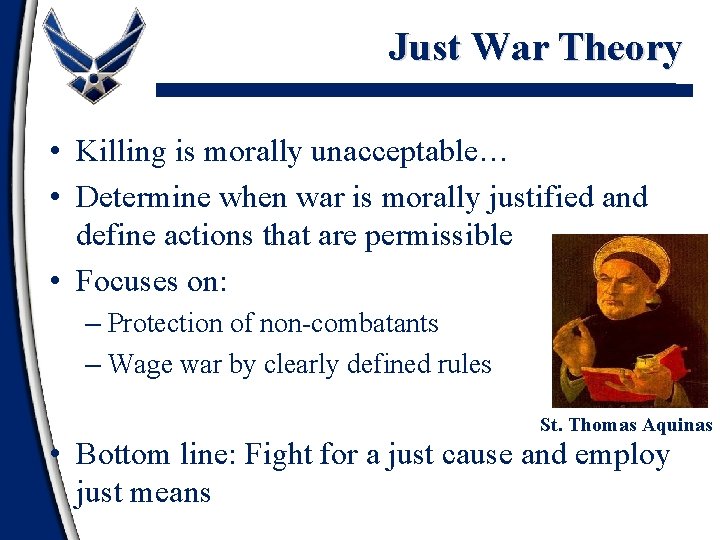
Just War Theory • Killing is morally unacceptable… • Determine when war is morally justified and define actions that are permissible • Focuses on: – Protection of non-combatants – Wage war by clearly defined rules St. Thomas Aquinas • Bottom line: Fight for a just cause and employ just means
Categories of War • Traditional Warfare: Force-on-force military operations using conventional capabilities. • Irregular Warfare: Struggle for influence over relevant populations which favors indirect and asymmetric approaches
Levels of War • Strategic – Addresses the issues of WHY and WITH WHAT we will fight and WHY the enemy fights against us • Operational – Determines WHAT we will affect, with WHAT courses of action, in WHAT order, for WHAT duration, and with WHAT RESOURCES • Tactical – Deals with HOW we fight
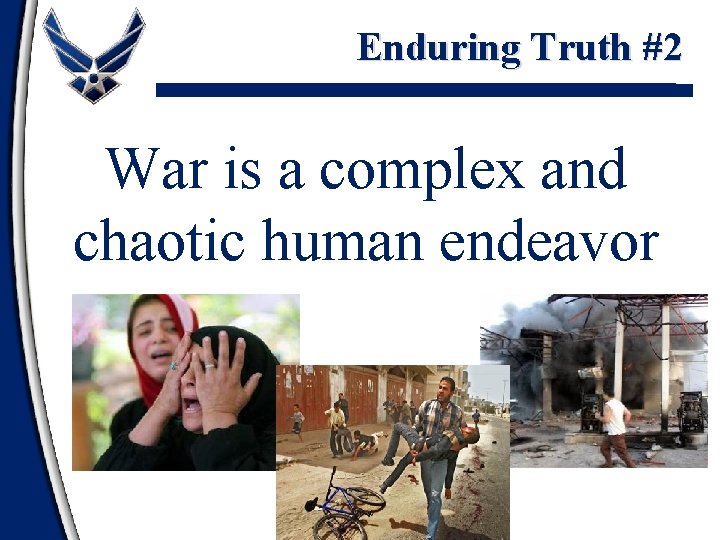
Enduring Truth #2 War is a complex and chaotic human endeavor
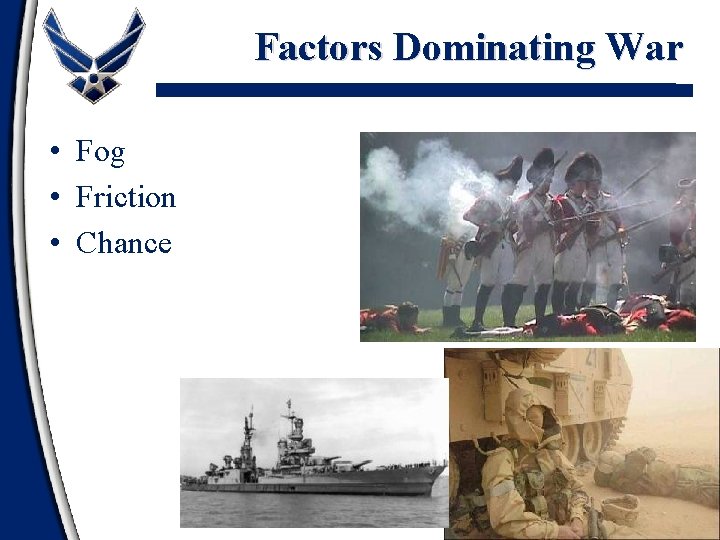
Factors Dominating War • Fog • Friction • Chance
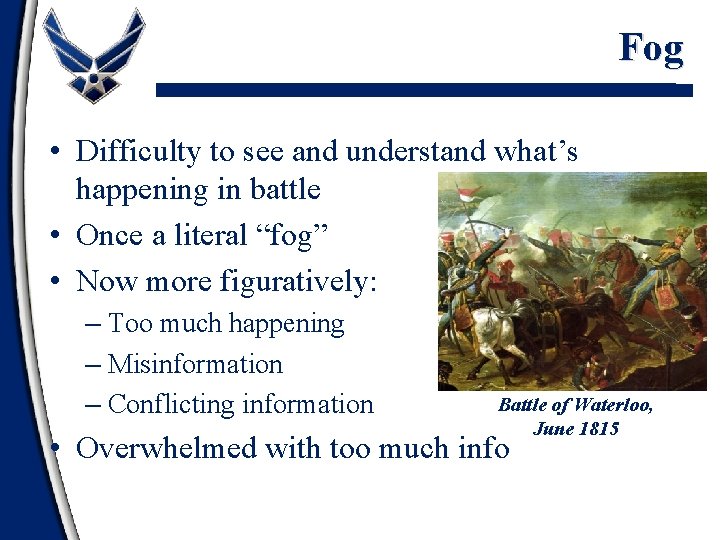
Fog • Difficulty to see and understand what’s happening in battle • Once a literal “fog” • Now more figuratively: – Too much happening – Misinformation – Conflicting information Battle of Waterloo, June 1815 • Overwhelmed with too much info
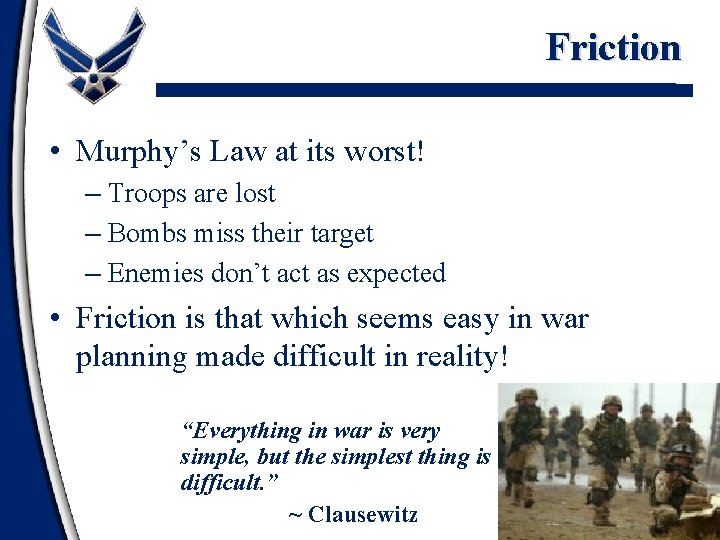
Friction • Murphy’s Law at its worst! – Troops are lost – Bombs miss their target – Enemies don’t act as expected • Friction is that which seems easy in war planning made difficult in reality! “Everything in war is very simple, but the simplest thing is difficult. ” ~ Clausewitz
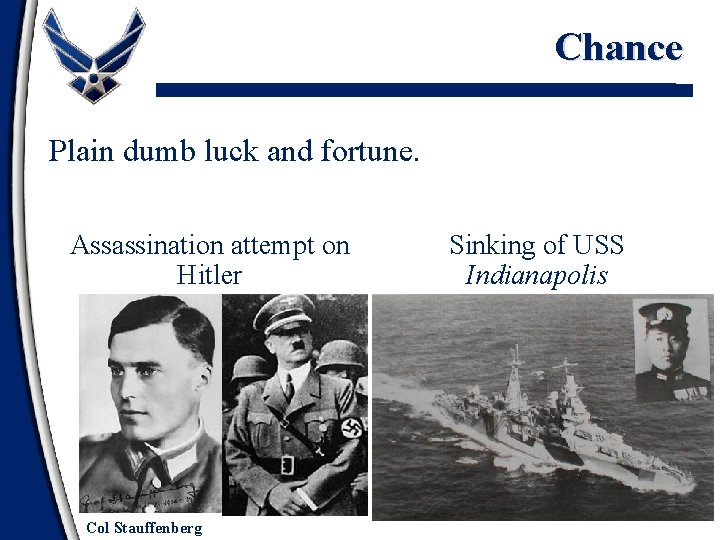
Chance Plain dumb luck and fortune. Assassination attempt on Hitler Col Stauffenberg Sinking of USS Indianapolis
Enduring Truth #3 War is a clash of opposing wills
Evolution of Warfare • World War I—The Chemists’ War • World War II—The Physicists’ War • World War III—The Information Researchers’ War • World War IV—The Social Scientists’ War
World War I—The Chemists’ War • Decisive factor: New applications of chemistry and chemical engineering – Synthesis of gunpowder allowed war to continue long after natural supply of nitrates was exhausted – Development of weapons like poison gas was necessitated by stalemate of trench warfare
World War II—The Physicists’ War • Application of physics theories allowed for development of radar • Physics allowed for advancements in wireless communications • One major result—The atomic bomb!
World War III—The Information Researchers’ War • Investment in developing more effective information gathering capabilities • Exploitation of intelligence gathering systems played vital role • US ability to exploit intelligence led to the winning of the Cold War
World War IV—The Social Scientists’ War • Social sciences are becoming the difference makers – Knowledge about other cultures will be vital to winning this war – Winning the hearts and minds means winning the war – The focus must be on capturing the psychocultural high ground – Allows us to access new “weapons of war” like understanding and empathy
Summary • • • The Nature of War Definitions and Basic Themes of War Viewpoints on War Categories and Levels of War Factors that Dominate War Evolution of Warfare