
Walter Infant School To be the best I
Walter Infant School To be the best I can be Key Stage One National Curriculum Assessments
National Curriculum Changes • • In 2014 a New National Curriculum was published. The current National Curriculum is significantly different. Children in Years 2 and 6, end of KS 1 and KS 2, are expected to complete assessments based on the current curriculum. Part of this assessment includes the use of tests; more commonly referred to as SATs.
Assessment Without Levels • • • The previous National Curriculum was judged against ‘levels’. These were abolished with the publishing of the current National Curriculum in 2014. Year 2 is now teacher assessed. We plan, teach, assess and track the children’s work alongside a set of objectives taken from the National Curriculum for Year 2. This is referred to as the Teacher Assessment Framework 2017/18. The tests, often referred to as SATs, form a part of this assessment. We do not assess the children exclusively using these tests. We use these alongside the children’s work to make a judgement.
Teacher Assessment Framework • • The Department for Education has annually released a focused and objective led assessment framework. We assess the children’s work using these objectives and standards in English (Reading and Writing), Mathematics and Science (there are no tests for Science). We gather evidence from the children’s work in the classroom and from the SATs tests. We then decide if the children are: working towards; working at; or working at greater depth for the expected standard. We look at the children’s work across the year to gather this evidence.
Teacher Assessment Framework • • • We provided a copy of the Teacher Assessment Framework for working at the expected standard in the ‘Year Two Parents’ Information’ booklet at the start of the year. You can also download these from https: //www. gov. uk/government/publications/teacher -assessment-frameworks-at-the-end-of-key-stage-1 These are also available on Walter Infant School’s website.
Year 2 Tests or SATs • • • The children will complete the tests in May. These consist of up to six tests. Two for Mathematics, two for Reading and two for Spelling and Grammar. All children are expected to sit all, if not most of the tests. Some children may be exempt from some or all of the tests. We have not seen this years tests, as they are confidential until the end of May. We do not know the pass mark for the tests. This is released in June after everyone in the country has completed the tests.
Reading Tests • • The Reading test consists of two papers. The questions are designed to check the children’s comprehension of the text. Paper One: is made up of three different text types: a short narrative; an information text; and a poem. The questions are presented alongside the text. This is considered a slightly easier paper. Paper Two: is made up of a longer narrative text, and an information text. It consists of a reading booklet and separate question booklet. However, it tells the children which page they will find the answer on. It is considered a more challenging paper.
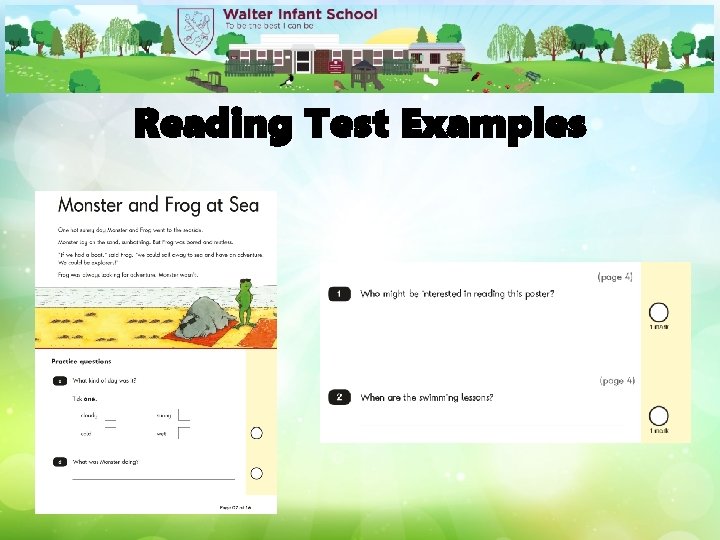
Reading Test Examples
Mathematics Tests • • • The Mathematics test consists of two papers. Paper One: is an arithmetic test. This paper consists of 25 questions involving all four operations, fractions and missing number problems. Paper Two: is made up of reasoning and problem solving questions. The questions are based on all of the objectives within the Year 2 Mathematics Curriculum.
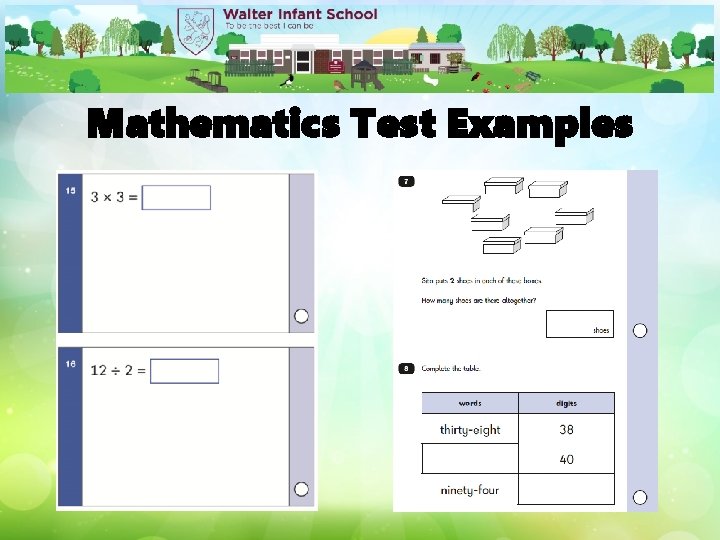
Mathematics Test Examples
English Grammar, Punctuation and Spelling Tests (SPa. G) • • The English Grammar, Punctuation and Spelling test consists of two papers. Paper One: is a spelling test, which consists of 20 words. They are based on spelling patterns that are taught in Year 2. Paper Two: are questions to assess the children’s understanding of punctuation and grammar. Unlike the Mathematics and Reading papers, which are mandatory, the English Grammar, Punctuation and Spelling tests are optional. As a school, we will decide if the children are ready for these tests.
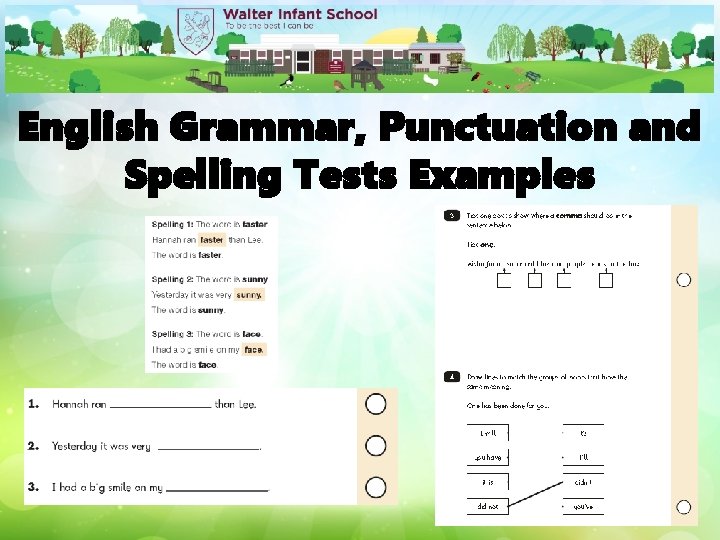
English Grammar, Punctuation and Spelling Tests Examples
Scaled Scoring • • We do not know what the pass mark is for any of the tests. We combine the scores from both tests. The raw score is converted into a scaled score. These are released early June. Once converted into a scaled score the pass mark is 100. A scaled score of 100 means that the children are operating at age related expectations. A scaled score below 100 means that the children are operating below age related expectations. A scaled score above 100 means that the children are operating above age related expectations.
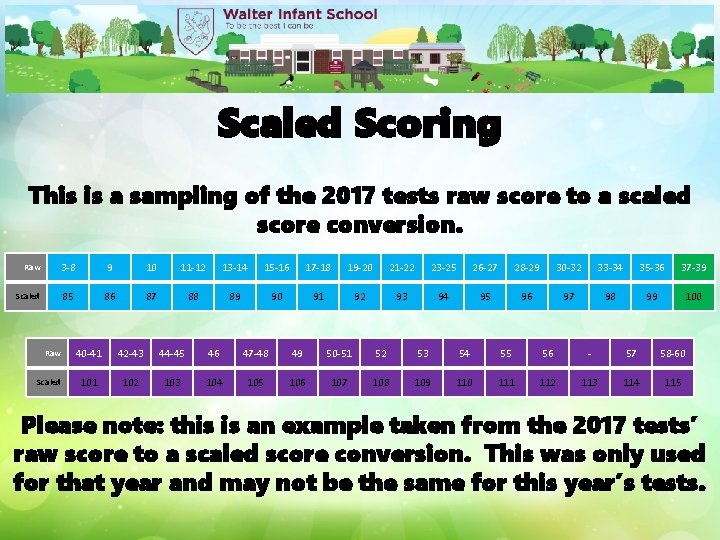
Scaled Scoring This is a sampling of the 2017 tests raw score to a scaled score conversion. Raw 3 -8 9 10 11 -12 13 -14 15 -16 17 -18 19 -20 21 -22 23 -25 26 -27 28 -29 30 -32 33 -34 35 -36 37 -39 Scaled 85 86 87 88 89 90 91 92 93 94 95 96 97 98 99 100 Raw Scaled 40 -41 42 -43 44 -45 46 47 -48 49 50 -51 52 53 54 55 56 - 57 58 -60 101 102 103 104 105 106 107 108 109 110 111 112 113 114 115 Please note: this is an example taken from the 2017 tests’ raw score to a scaled score conversion. This was only used for that year and may not be the same for this year’s tests.
Coming to a Final Decision • • • The scaled scores are used alongside the children’s work in their books and records that we have kept for English and Mathematics. We do not make our final decision based solely on the tests. We use the evidence in the children’s books and the tests to come to a professional judgement on whether your child is: • Working towards the expected standard (WTS); • Working at the expected standard (EXS); • Working at greater depth (GDS).
How to Help Your Child • • • First and foremost reassure your child that there is nothing to worry about. They should always try their best and be praised. Practising spellings and arithmetic work at home will always help with the children’s learning and understanding, as well as reading with them each day. Discuss with your child what they have learned at school today. Make sure your child goes to bed at a suitable time to ensure a good night’s sleep and plenty of rest. They will benefit from a healthy breakfast before coming to school and a relaxing start to the day.
Helping Your Child with Reading • • • Listening to your child read on a daily basis, at least 1015 minutes every day. Enjoy stories and sharing books together. Choose from a wide range of texts, which includes fiction, non-fiction and poetry. Talk about the text before, during and after reading. Discuss the character’s feelings and actions, the plot, try to predict events and discuss new vocabulary. All reading is valuable. This could be books, magazines, newspapers, poetry, comic books and the internet. Encourage free choice. Don’t just read books taken home from school; visit the local library or bookshop.
Helping Your Child with Writing • • • Practise the spellings they are given every week – try to make it fun. Encourage opportunities for writing. Write letters, shopping lists, notes, stories, diaries or poems. Write together. This will help the children see writing for a purpose and allow them to have a role model for writing. Read through the writing with the children. Discuss how they can edit mistakes. Always show praise and encouragement for their writing. Mistakes are okay to make, as writing can always be edited. Practise joined up handwriting.
Helping Your Child with Mathematics • • Count and Play games involving the multiples of 2, 3, 5 and 10. Play mental games, including counting different amounts forwards and backwards. Encourage children to read and tell the time to the nearest five minutes. Counting, including money. Taking children and involving them in shopping. This can involve many aspects of mathematics. Look for and identify 2 D and 3 D shapes at home or when out and about. Cooking involves the application of many areas of mathematics. Play board games.
Any Questions
- Slides: 20