
WALT Investigate variables that affect pulse rate WILF
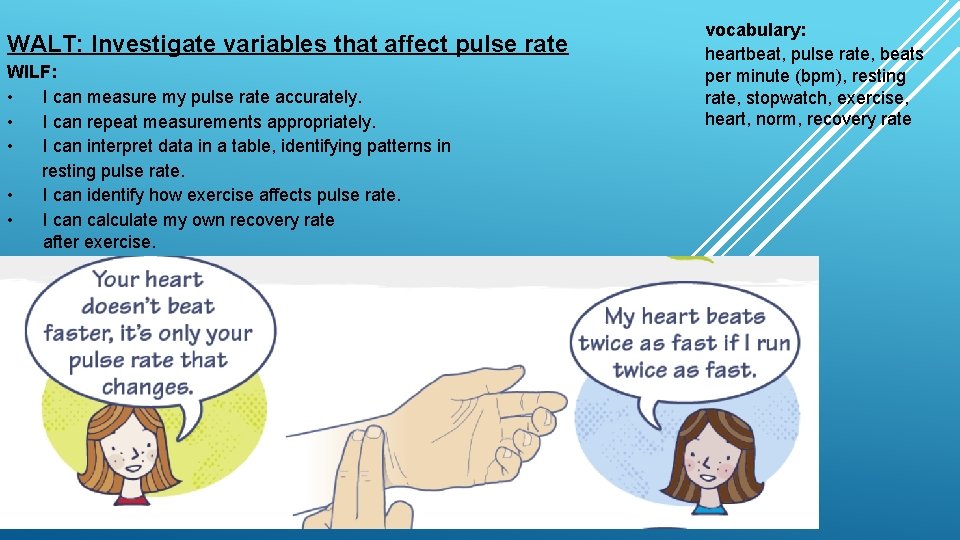
WALT: Investigate variables that affect pulse rate WILF: • I can measure my pulse rate accurately. • I can repeat measurements appropriately. • I can interpret data in a table, identifying patterns in resting pulse rate. • I can identify how exercise affects pulse rate. • I can calculate my own recovery rate after exercise. vocabulary: heartbeat, pulse rate, beats per minute (bpm), resting rate, stopwatch, exercise, heart, norm, recovery rate
WALT: Investigate variables that affect pulse rate WILF: • I can measure my pulse rate accurately. • I can repeat measurements appropriately. • I can interpret data in a table, identifying patterns in resting pulse rate. • I can identify how exercise affects pulse rate. • I can calculate my own recovery rate after exercise. vocabulary: heartbeat, pulse rate, beats per minute (bpm), resting rate, stopwatch, exercise, heart, norm, recovery rate
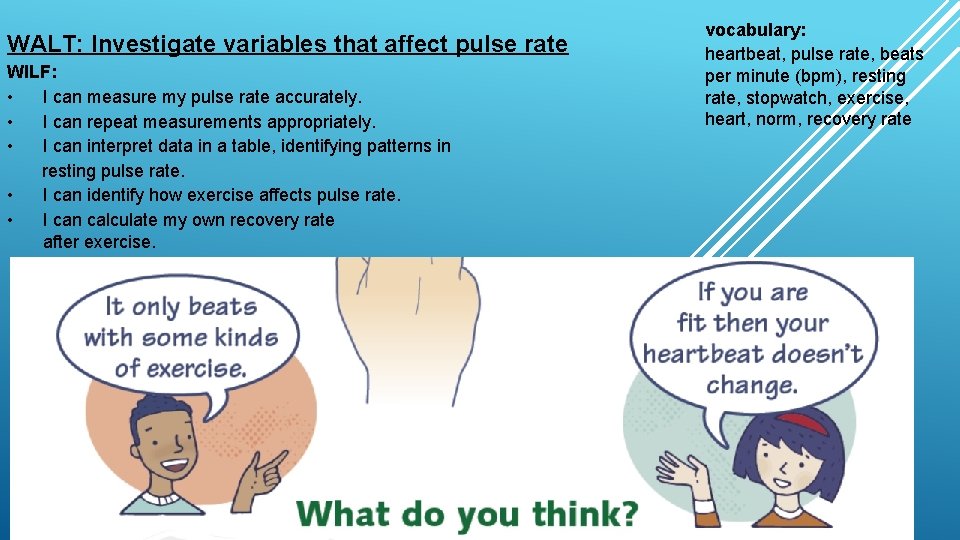
WALT: Investigate variables that affect pulse rate WILF: • I can measure my pulse rate accurately. • I can repeat measurements appropriately. • I can interpret data in a table, identifying patterns in resting pulse rate. • I can identify how exercise affects pulse rate. • I can calculate my own recovery rate after exercise. vocabulary: heartbeat, pulse rate, beats per minute (bpm), resting rate, stopwatch, exercise, heart, norm, recovery rate Do you agree with the statements on the previous 2 slides? What factors do you think affect your pulse rate? Thinking about our lessons on the heart, what do we know about the job of our hearts and how to keep them healthy?
WALT: Investigate variables that affect pulse rate WILF: • I can measure my pulse rate accurately. • I can repeat measurements appropriately. • I can interpret data in a table, identifying patterns in resting pulse rate. • I can identify how exercise affects pulse rate. • I can calculate my own recovery rate after exercise. vocabulary: heartbeat, pulse rate, beats per minute (bpm), resting rate, stopwatch, exercise, heart, norm, recovery rate What is a pulse rate? Why is it important to take your pulse rate? Watch this video and try to take your own pulse!! Remember, this can be very tricky so you may have to try a few times. https: //www. google. com/search? q=ks 2+video+how+to+tak e+your+pulse&oq=ks 2+video+how+to+take+your+pulse& aqs=chrome. . 69 i 57 j 33. 5967 j 0 j 8&sourceid=chrome&ie=UT F-8#kpvalbx=_4 re. NXo. L 8 Ksfyg. Qb. Vyrag. BQ 41
WALT: Investigate variables that affect pulse rate WILF: • I can measure my pulse rate accurately. • I can repeat measurements appropriately. • I can interpret data in a table, identifying patterns in resting pulse rate. • I can identify how exercise affects pulse rate. • I can calculate my own recovery rate after exercise. vocabulary: heartbeat, pulse rate, beats per minute (bpm), resting rate, stopwatch, exercise, heart, norm, recovery rate Your pulse must be taken on an artery not a vein – why do you think this is? Think back to what we learnt about the heart – what do the arteries do in our bodies? Can you remember the names of any of the arteries in our bodies? A resting pulse rate for babies and children is usually between 80 – 110 bpm and for adults usually 60 -100 bpm.
WALT: Investigate variables that affect pulse rate WILF: • I can measure my pulse rate accurately. • I can repeat measurements appropriately. • I can interpret data in a table, identifying patterns in resting pulse rate. • I can identify how exercise affects pulse rate. • I can calculate my own recovery rate after exercise. vocabulary: heartbeat, pulse rate, beats per minute (bpm), resting rate, stopwatch, exercise, heart, norm, recovery rate Once you have managed to record your pulse, repeat this a further 2 times. Why do you think it is important to repeat a pulse reading? You should notice that your resting pulse remains fairly consistent if you are doing it correctly. You should now find some space (inside or outside) and complete the 5 a day exercise on the next slide.
WALT: Investigate variables that affect pulse rate WILF: • I can measure my pulse rate accurately. • I can repeat measurements appropriately. • I can interpret data in a table, identifying patterns in resting pulse rate. • I can identify how exercise affects pulse rate. • I can calculate my own recovery rate after exercise. vocabulary: heartbeat, pulse rate, beats per minute (bpm), resting rate, stopwatch, exercise, heart, norm, recovery rate https: //www. google. com/search? q=5+a+day+exercise&oq =5+a+day+exercise&aqs=chrome. 0. 0 l 7. 3265 j 0 j 8&sourcei d=chrome&ie=UTF 8#kpvalbx=_UMu. NXo. Cm. NIqug. Qa. Rlpa. ABQ 27 As soon as you have finished, record your pulse rate again to compare it to your resting pulse rate. For challenge 1, this is the information that you need to complete your task – challenge 2 and 3 see next slide.
WALT: Investigate variables that affect pulse rate WILF: • I can measure my pulse rate accurately. • I can repeat measurements appropriately. • I can interpret data in a table, identifying patterns in resting pulse rate. • I can identify how exercise affects pulse rate. • I can calculate my own recovery rate after exercise. vocabulary: heartbeat, pulse rate, beats per minute (bpm), resting rate, stopwatch, exercise, heart, norm, recovery rate For challenge 1 and 2, you must continue to record your pulse rate over the next 10 minutes (recording your reading every minute). How long does it take for your pulse to return to your resting pulse rate following the exercise that you have just carried out? As you are young, fit and healthy, you should see your pulse rate return to the normal resting rate during this time. What do you think will happen to the pulse rate of someone who is older or unfit?
WALT: Investigate variables that affect pulse rate WILF: • I can measure my pulse rate accurately. • I can repeat measurements appropriately. • I can interpret data in a table, identifying patterns in resting pulse rate. • I can identify how exercise affects pulse rate. • I can calculate my own recovery rate after exercise. vocabulary: heartbeat, pulse rate, beats per minute (bpm), resting rate, stopwatch, exercise, heart, norm, recovery rate Task: Challenge 1 Using the numbered challenge sheets attached, record your resting pulse rate (repeat 3 times to check for accuracy). Next, carry out the ‘ 5 a day’ task and record your pulse rate again. Explain why you think that your pulse has changed. Challenge 2 and 3. Use the sheet attached to record your resting pulse rate (repeat 3 times for accuracy). Next carry out the ‘ 5 a day’ activity then record your pulse every minute for the next 10 minutes (or until your pulse rate returns to your resting pulse rate). Explain why your pulse rate changes during exercise. Extension: Predict the pulse rate of a fit 40 year old and then what you predict their pulse rate would be following exercise. Do you think their pulse rate would return to its resting pulse rate in the same way as your own? Explain fully.
- Slides: 9