
Wallersteins World System Theory Under development and dependency
- Slides: 12
Wallerstein’s World System Theory Under development and dependency theory continued 03 b Moore
World Systems theory • Dependency theorists e. g Frank, were criticised by later Marxists because • It only describes the relationship between the core and periphery as a two tier model nor does it explain fully. • Wallerstein refined Frank’s dependency theory in his World Systems Theory
Four aspects of Wallerstein’s World Systems Theory 1. Developing countries are not exploited by individual countries but by the whole capitalist, profit-seeking system in a A Modern World System. The MWS is a unified system of capitalism
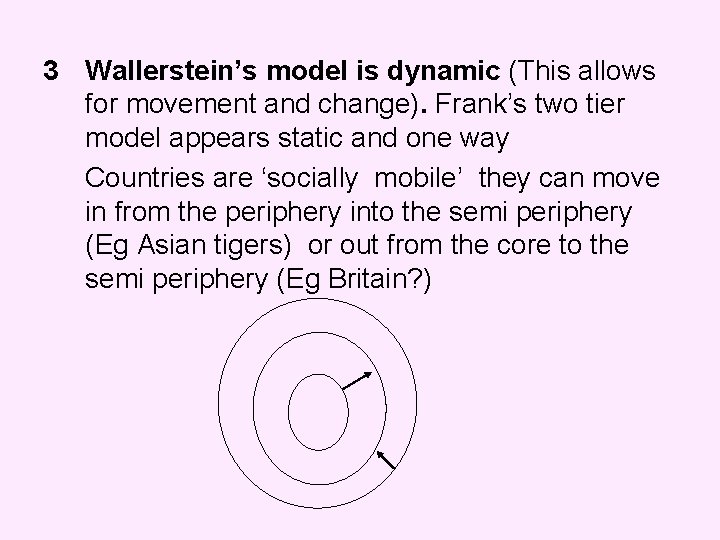
2. Three zones in the MWS i. The core/developed nations – these control world trade and monopolise manufactured goods ii. The semi-peripheral zone e. g. Brazil, South Africa, urban areas like the core but large areas of rural poverty like the periphery iii. The peripheral countries e. g. . Most of Africa – they provide primary products for both the semi periphery and the core
3 Wallerstein’s model is dynamic (This allows for movement and change). Frank’s two tier model appears static and one way Countries are ‘socially mobile’ they can move in from the periphery into the semi periphery (Eg Asian tigers) or out from the core to the semi periphery (Eg Britain? )
4 While Wallerstein refines Frank’ theory there are still similarities • Both show surplus value created in the periphery is appropriated by the semi periphery and especially the core • Both see the origins of exploitation of some countries by others to have originated in slavery, colonialism and neo-colonialism
Modern World System of capitalism is profit seeking • The pursuit of profit by capitalism results in exploitation between classes • Commodification – everything is turned into a commodity to be bought and sold
Modern World System of capitalism is profit seeking • De-skilling of labour • Proletarianisation occurs (E. g. The nature of call centres? ) • Marx • Wallerstein argues that this process also occurs between nations
Evaluation of World Systems Theory Weaknesses I. Both Frank and Wallerstein are economically deterministic II. Wallerstein does not say how capitalism can be overcome as Marx said it would
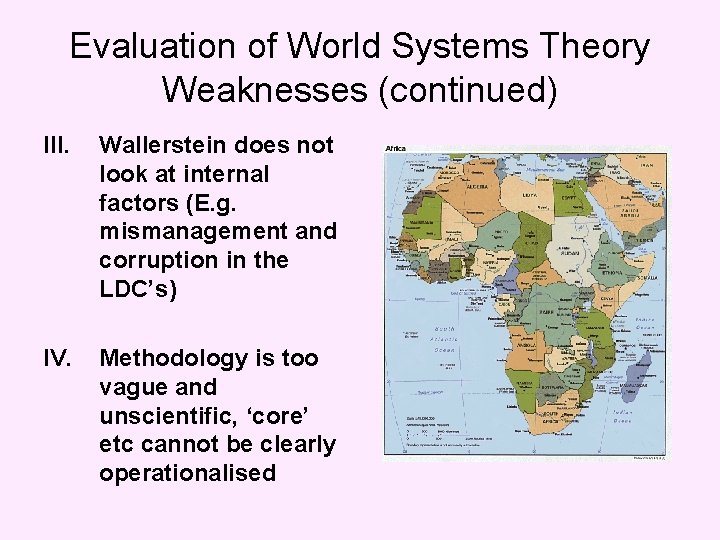
Evaluation of World Systems Theory Weaknesses (continued) III. Wallerstein does not look at internal factors (E. g. mismanagement and corruption in the LDC’s) IV. Methodology is too vague and unscientific, ‘core’ etc cannot be clearly operationalised
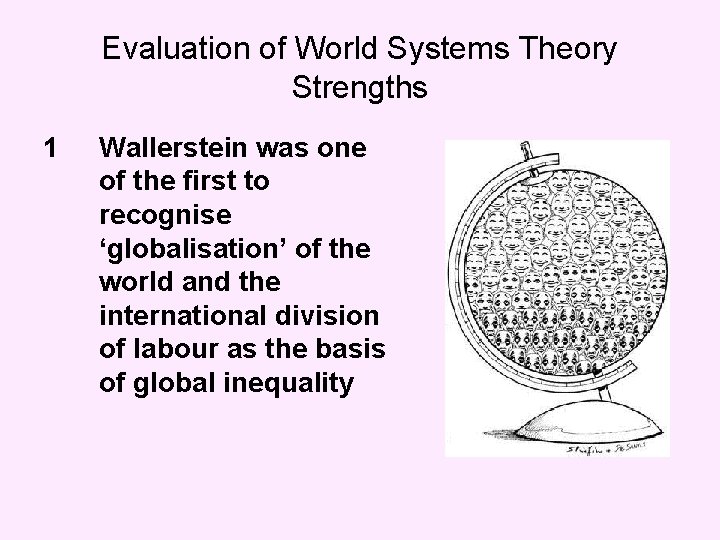
Evaluation of World Systems Theory Strengths 1 Wallerstein was one of the first to recognise ‘globalisation’ of the world and the international division of labour as the basis of global inequality
Evaluation of World Systems Theory Strengths 2 Globalisation theorists also show dependency is not a one way process, there is inter-dependency between the developing and western world. (E. g. economic crisis caused by debt can ripple out and affect core nations – unemployment and destabilisation of western currencies)