
Wall Murals in Belfast and Derry n Mural
Wall Murals in Belfast and Derry
n Mural painting has been a feature of unionist popular culture since the early years of this century when images of King William III and other Orange symbols began to adorn the gable walls of the working-class areas of Belfast. They appeared as part of an assertion of the Protestant people's sense of British identity during an extended period of political crisis.
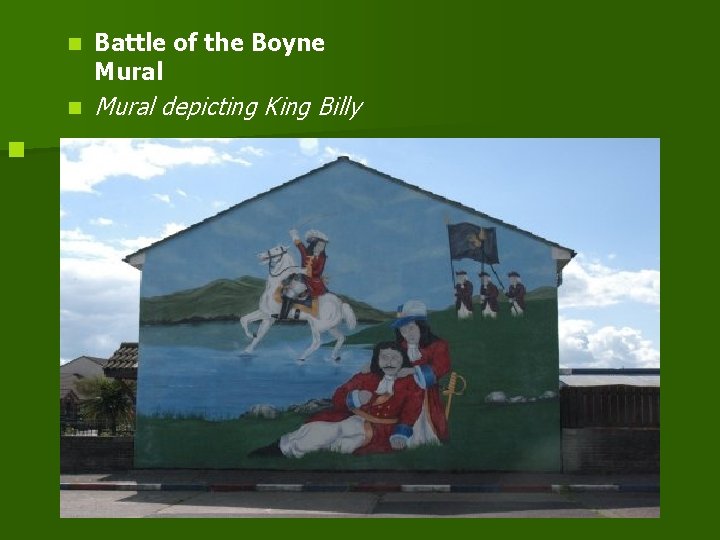
n n Battle of the Boyne Mural n Mural depicting King Billy
The Red Hand of Ulster also figured prominently, whether traditionally represented, or clenched in a fist, a symbol of the UFF, Ulster Freedom Fighters, or encircled in barbed wire, the preferred depiction of the LPA, Loyalist Prisoners' Association. The Red Hand could also appear with other heraldic devices. n The most noteworthy fact about these murals depicting inanimate symbols was the stark absence of human beings. It was as if loyalist mural painters no longer knew where loyalist people fitted. Moreover, the flags, shields, etc. seemed sure, indisputable, immovable. Yet the very robustness of this representation again disguises an underlying identity problem. These murals protest their confidence too much. As James Hawthorne, then Controller of BBC Northern Ireland put it: n "The more the majority - or at least the highly loyal section of it waves the Union flag and talks of loyalty, the more it strives to cover up its identity problem. ” n
n By the early 1990 s loyalists were killing more people than republicans were, and military imagery was the most common theme in loyalist murals. Balaclavas and automatic weapons abounded, whether the military men were shown in action or posing with their weapons. Sometimes the weapons could stand alone as mute testimony to loyalist military action. These military murals did not obviously reveal the purpose of loyalist military action, nor against whom the weapons were directed. There was no hint that during "the troubles" overall loyalists killed more civilians than republicans did, or that by the 1990 s they were killing more people each year than republicans were, despite official assertions of republicanism as the main problem. 4 But, to the nationalist or republican potentially at the receiving end of loyalist bullets, these murals were often sinister or threatening.
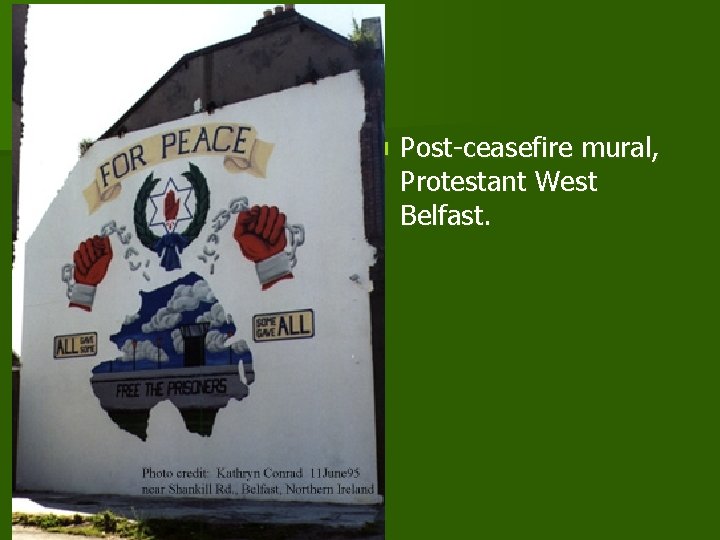
n Post-ceasefire mural, Protestant West Belfast.
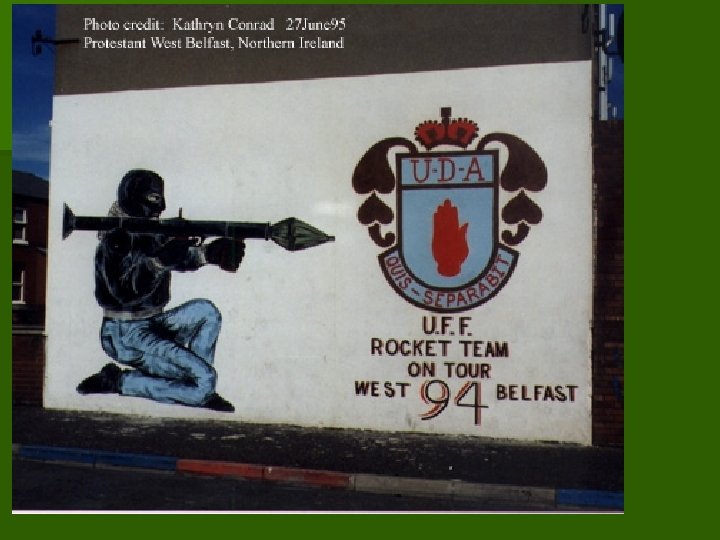
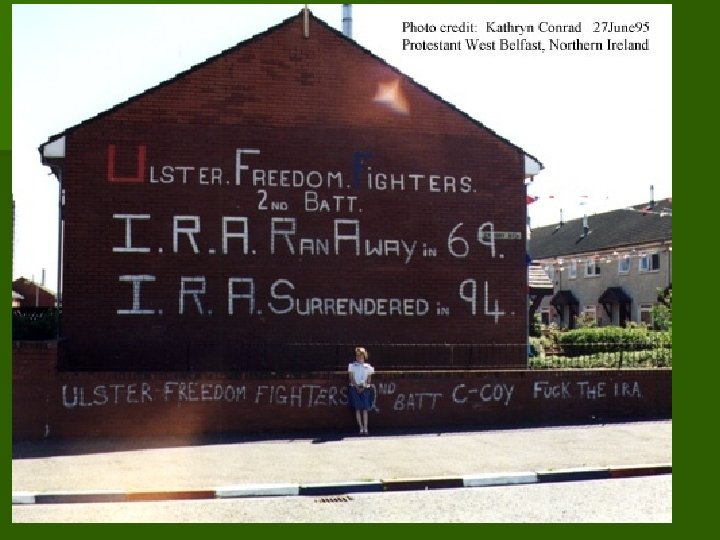
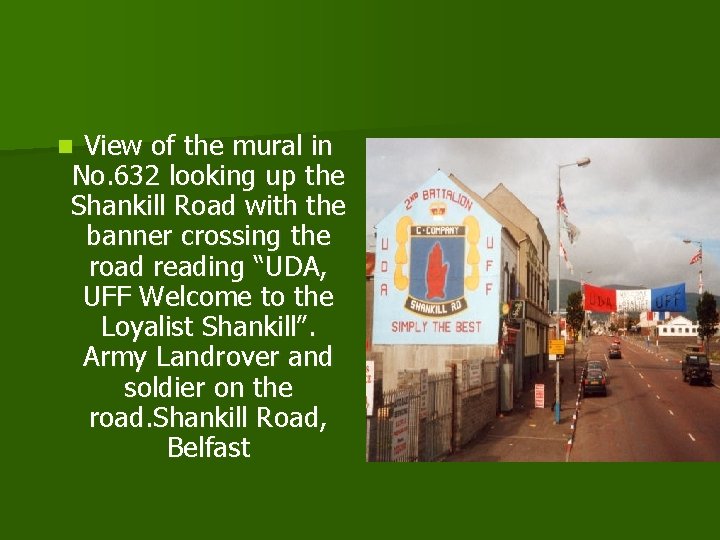
View of the mural in No. 632 looking up the Shankill Road with the banner crossing the road reading “UDA, UFF Welcome to the Loyalist Shankill”. Army Landrover and soldier on the road. Shankill Road, Belfast n
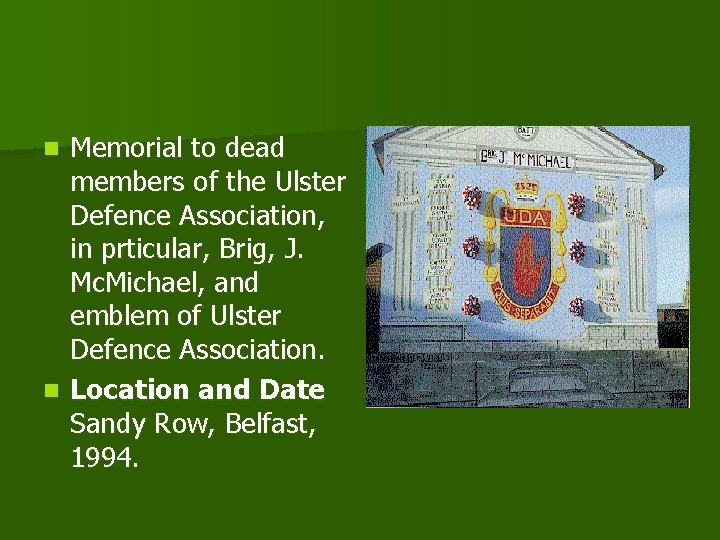
Memorial to dead members of the Ulster Defence Association, in prticular, Brig, J. Mc. Michael, and emblem of Ulster Defence Association. n Location and Date Sandy Row, Belfast, 1994. n
In 1990, Bobby Jackson, then 63 years old, articulated his disdain for such paramilitary murals and the young loyalists who painted them. n "I don't like them at all because they're very political and it seems as if there's death about the town and destruction more than anything else. There's nothing beautiful about them. It's always something political. They can't think about their own town; they've lost out on history. It's a very sad thing. "[1] n
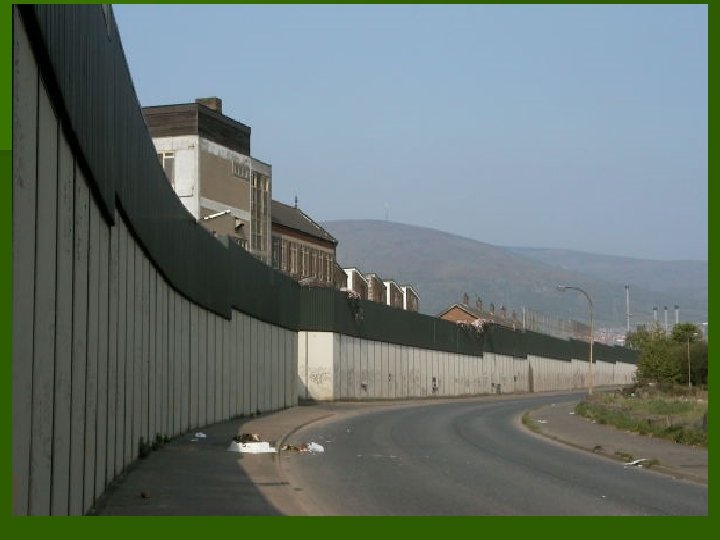
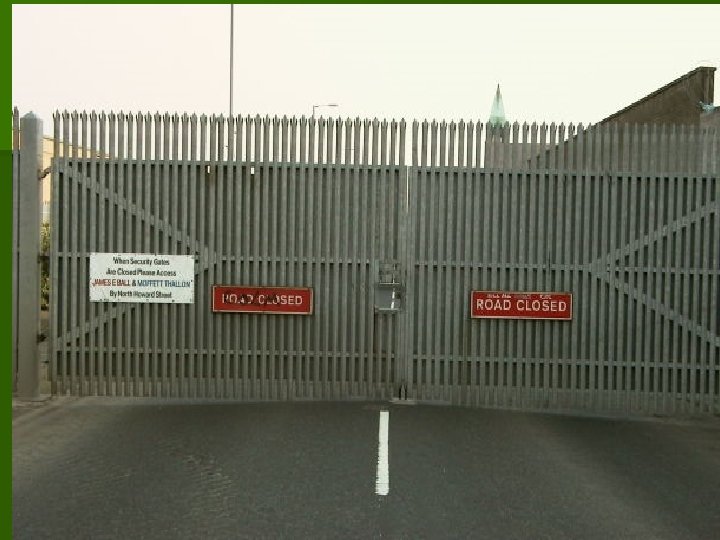
n It was not until the early 1980 s that murals became a prominent form of street display in nationalist areas and the brush joined the armalite and the ballot box as a facet of political strategy. Republican strategy changed after the hunger strikes: the military campaign continued, but at the same time a more open political movement began, culminating in the success of Sinn Féin at the polls. This movement tried to emphasise the distinctive cultural base of nationalism, which was deemed to provide the secure foundations for the political movement. Numerous murals and political slogans appeared across nationalist Belfast, kerbstones and lamp-posts were painted, streets were renamed in Irish, and the tricolour flew freely to assert a permanent and visible, political and cultural dominance over the area.
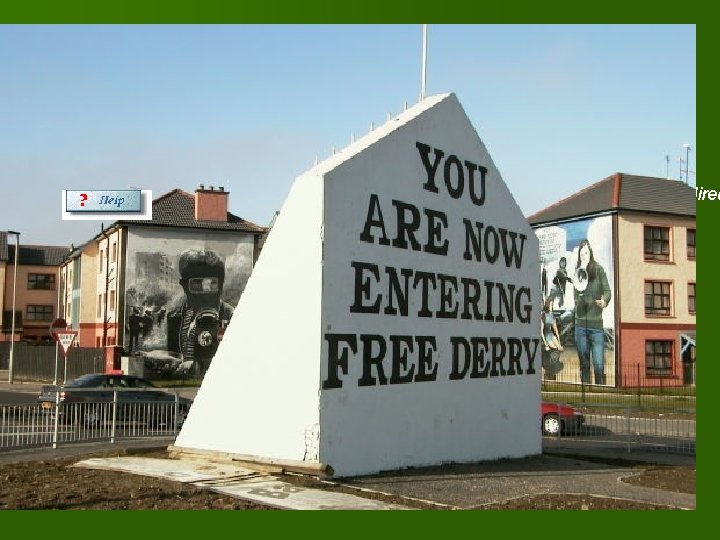
n When the first barricades were erected in the Bogside in Derry, in January 1969, the act of excluding the forces of the state, was proclaimed by the slogan 'You Are Now Entering Free Derry' painted on a gable wall in St Columb's Street. By the time the painting was re-done, professionally, for the visit of the Home Secretary, James Callaghan, in August that year it had become emblematic of communal attitudes and collective resistance
n The mural is repainted regularly and Free Derry Corner has been established as the focal point for republican commemorations within the city: the annual Bloody Sunday Commemoration march terminates in a rally in front of the wall. In the past few years several other large murals, some related to the early events of the troubles, others linked to the opposition to loyalist parades, have been painted nearby. Although the barricades are long gone and the original buildings are no more, Free Derry Corner remains a defiant public space.
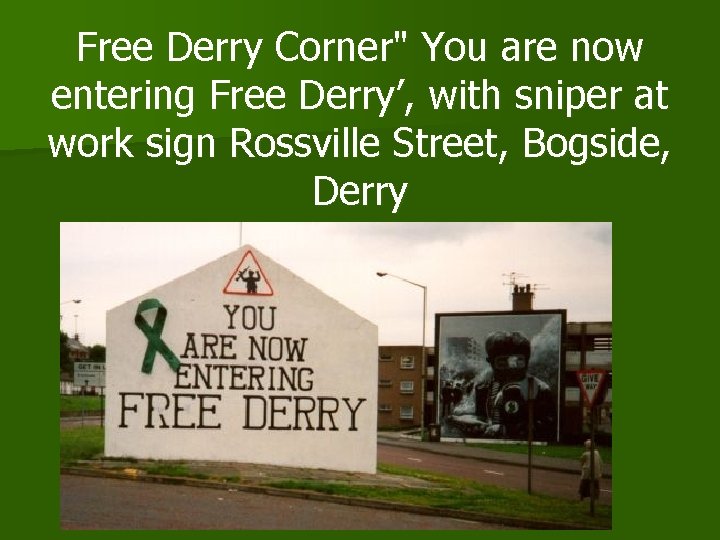
Free Derry Corner" You are now entering Free Derry’, with sniper at work sign Rossville Street, Bogside, Derry
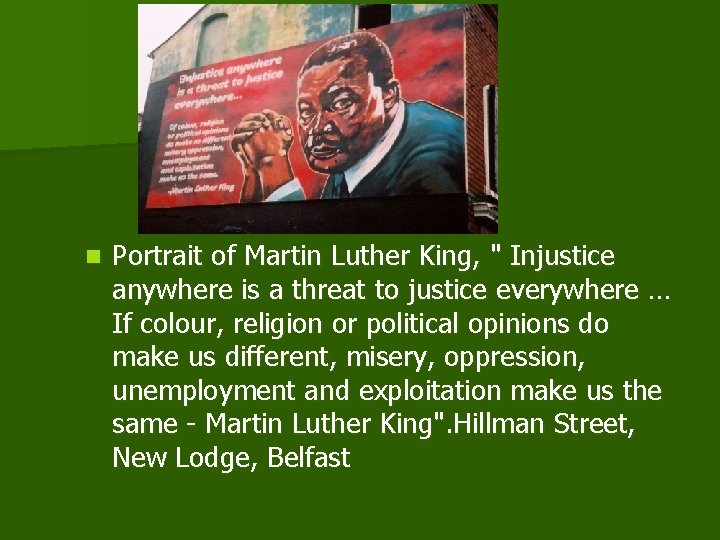
n Portrait of Martin Luther King, " Injustice anywhere is a threat to justice everywhere … If colour, religion or political opinions do make us different, misery, oppression, unemployment and exploitation make us the same - Martin Luther King". Hillman Street, New Lodge, Belfast
n For tourists, many of the murals may suggest a romanticised view of the violence of recent years, even a nostalgia for the imagined sense of community which has provided the base for resistance and struggle, and at times encouraged sacrifice for the cause. For the communities themselves the walls have long been regarded as an appropriate place on which to honour and remember the dead and imprisoned. The workingclass areas contain many small memorials which record the names of local individuals who have been killed during the Troubles. Although some will include the name of relevant paramilitary organisations many commemorate those not killed by chance or misfortune. A diverse array of small plaques, formal marble memorials, murals and free-standing Celtic crosses is scattered across the city, and permanent reminders to the price of the cause. While all of these memorials have an impact on the sense of place, the murals are probably the most assertive in demanding acknowledgement of their presence.
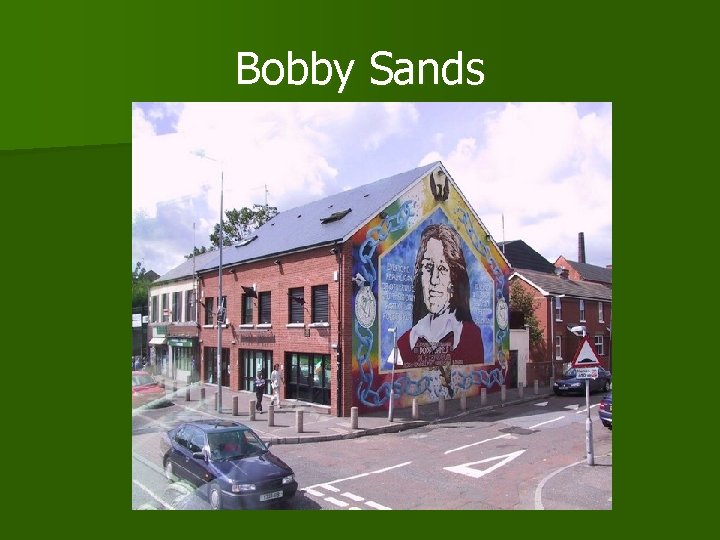
Bobby Sands
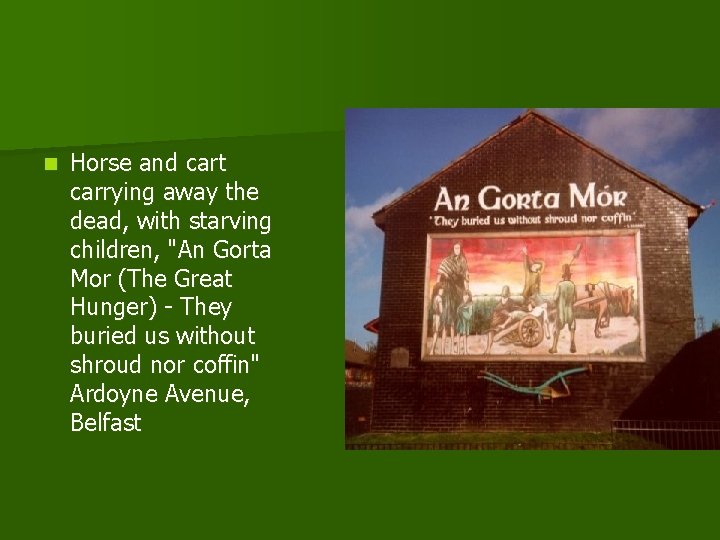
n Horse and cart carrying away the dead, with starving children, "An Gorta Mor (The Great Hunger) - They buried us without shroud nor coffin" Ardoyne Avenue, Belfast
n Overall, as numerous murals declared, the ultimate aim of republicanism was "Brits Out" and "free Ireland"
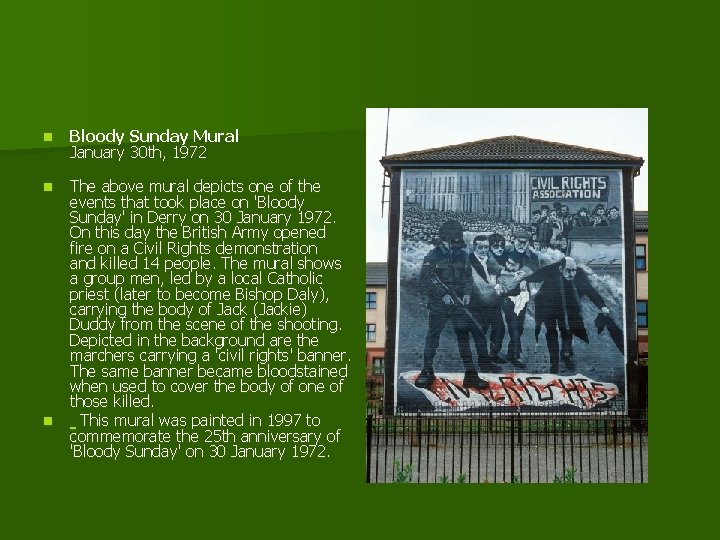
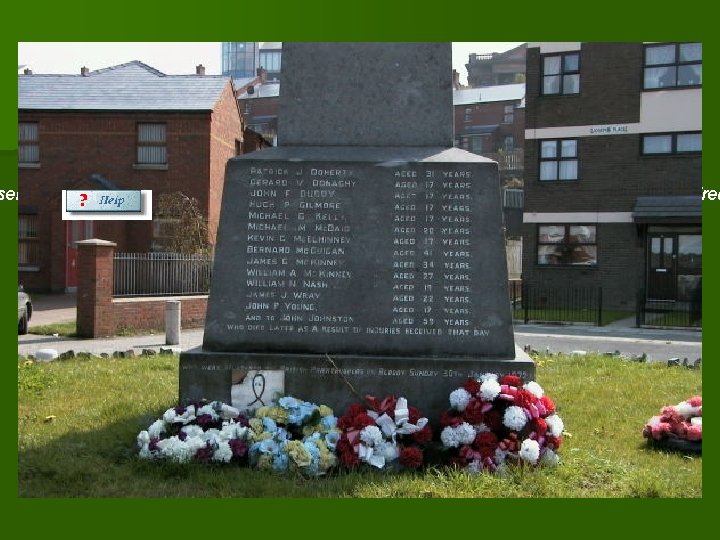
n Bloody Sunday Mural January 30 th, 1972 n The above mural depicts one of the events that took place on 'Bloody Sunday' in Derry on 30 January 1972. On this day the British Army opened fire on a Civil Rights demonstration and killed 14 people. The mural shows a group men, led by a local Catholic priest (later to become Bishop Daly), carrying the body of Jack (Jackie) Duddy from the scene of the shooting. Depicted in the background are the marchers carrying a 'civil rights' banner. The same banner became bloodstained when used to cover the body of one of those killed. This mural was painted in 1997 to commemorate the 25 th anniversary of 'Bloody Sunday' on 30 January 1972. n
n Despite its origins in a prison hunger strike, an event which could have been depicted solely in humanitarian terms, the republican mural tradition had from the start refused to distance itself from the reason the prisoners had ended up in prison. Murals portraying the "armed struggle" were common from 1981 on, but were less so in the 1990 s.
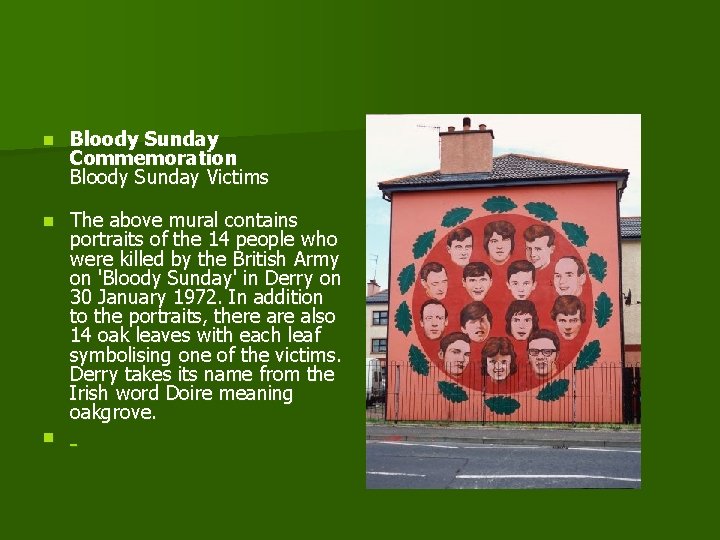
n Bloody Sunday Commemoration Bloody Sunday Victims n The above mural contains portraits of the 14 people who were killed by the British Army on 'Bloody Sunday' in Derry on 30 January 1972. In addition to the portraits, there also 14 oak leaves with each leaf symbolising one of the victims. Derry takes its name from the Irish word Doire meaning oakgrove. n
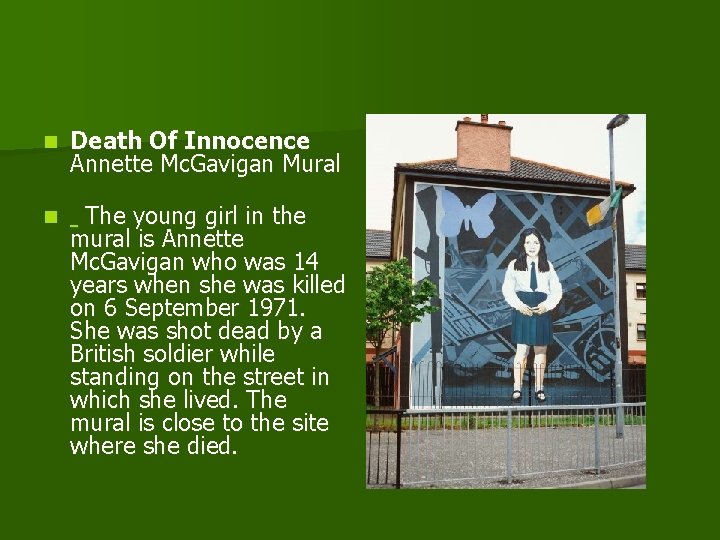
n Death Of Innocence Annette Mc. Gavigan Mural n The young girl in the mural is Annette Mc. Gavigan who was 14 years when she was killed on 6 September 1971. She was shot dead by a British soldier while standing on the street in which she lived. The mural is close to the site where she died.
The first of the two major hunger strikes began on 27 October 1980 and ended on 18 December 1980 after a period of 53 days. Raymond Mc Cartney, the main subject in the mural, was one of those who took part. Initally seven Republican prisoners in the Hblocks of the Maze Prison volunteered to go on hunger strike. They were followed on 1 December 1980 by 3 women prisoners in Armagh prison. A further 23 Republican prisoners joined the strike on 15 December 1980. The first hunger strike was called off when the prisoners thought that the government had conceded on the issue of political status. n The entire episode together with the second hunger strike in 1981 when ten men, including Bobby Sands, lost their lives left an indelible scar on the Bogside psyche. Raymond Mc Cartney's face is emblazoned on many peoples minds to this day because his photograph smuggled out of 'the Maze' seemed to tell the whole story of the grief and suffering of the inmates. n
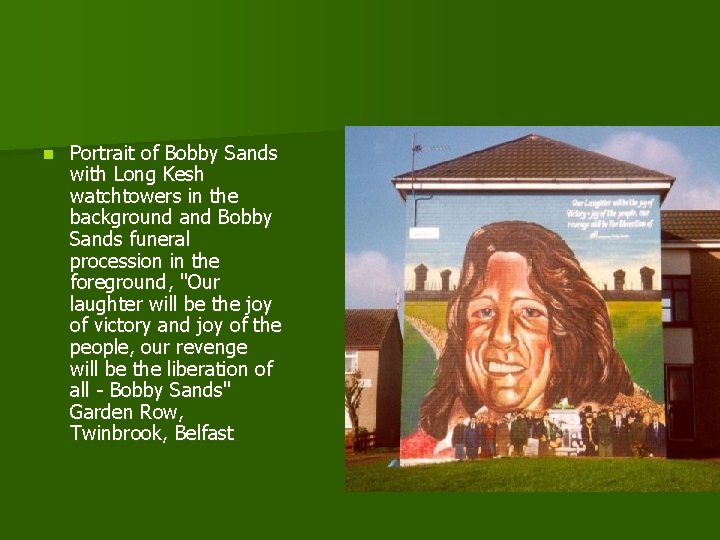
n Portrait of Bobby Sands with Long Kesh watchtowers in the background and Bobby Sands funeral procession in the foreground, "Our laughter will be the joy of victory and joy of the people, our revenge will be the liberation of all - Bobby Sands" Garden Row, Twinbrook, Belfast
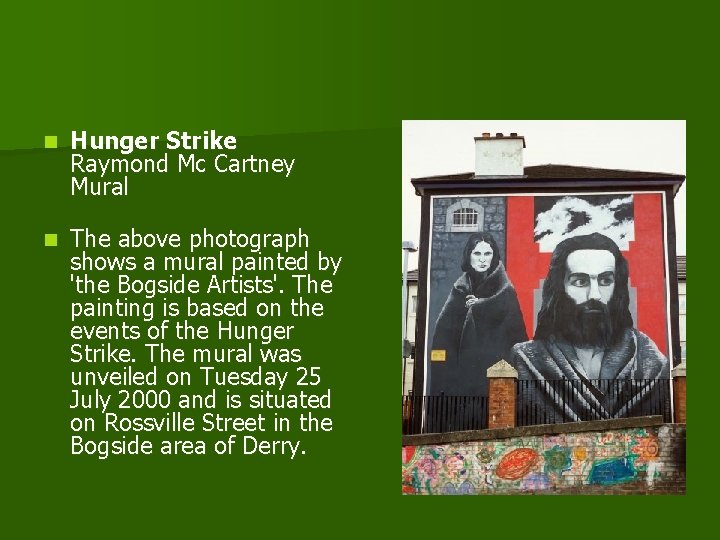
n Hunger Strike Raymond Mc Cartney Mural n The above photograph shows a mural painted by 'the Bogside Artists'. The painting is based on the events of the Hunger Strike. The mural was unveiled on Tuesday 25 July 2000 and is situated on Rossville Street in the Bogside area of Derry.
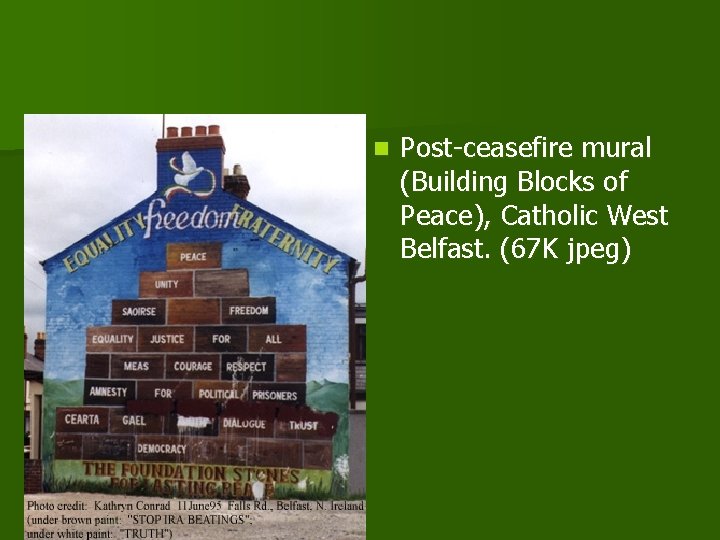
n Post-ceasefire mural (Building Blocks of Peace), Catholic West Belfast. (67 K jpeg)
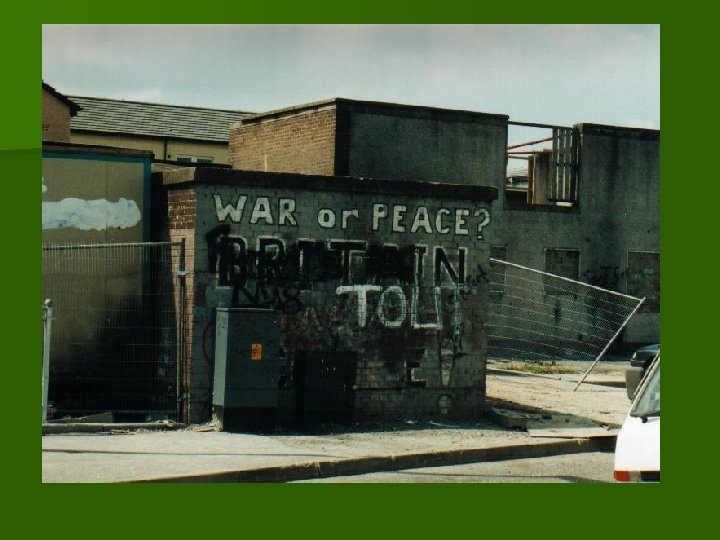
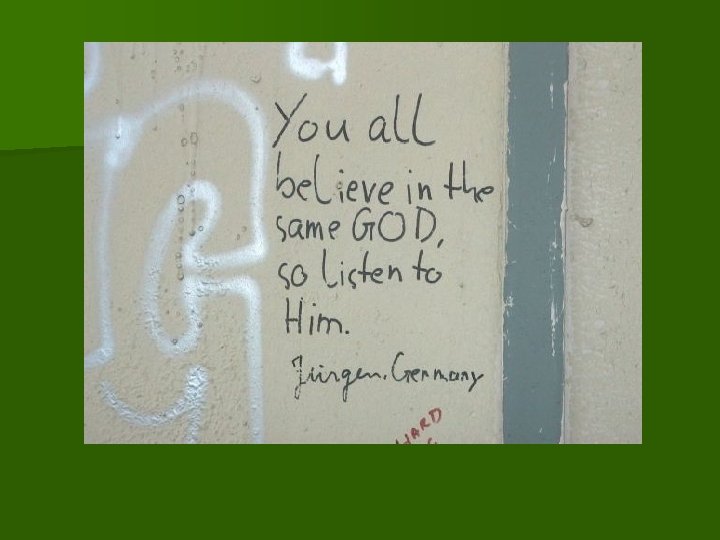
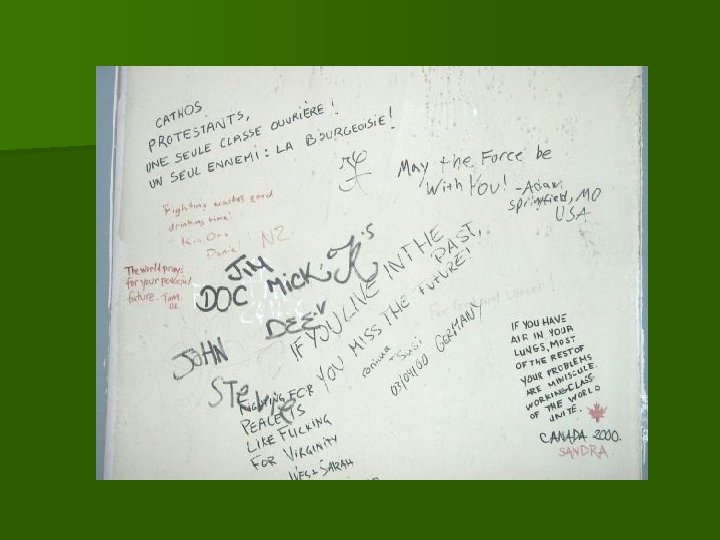
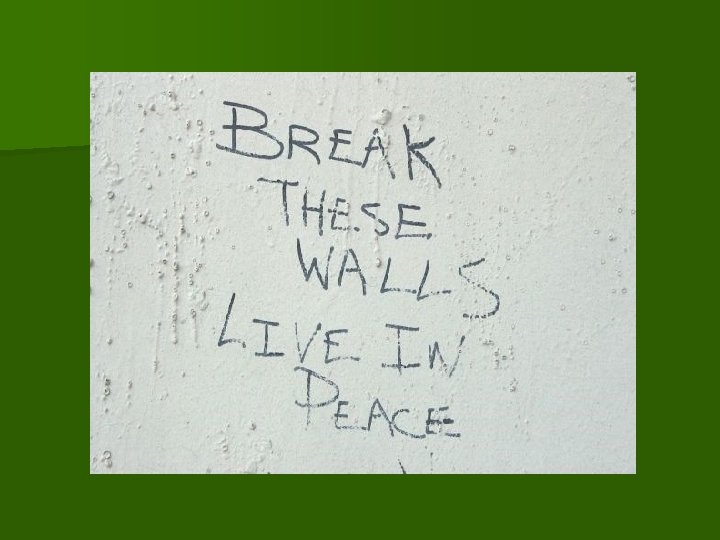
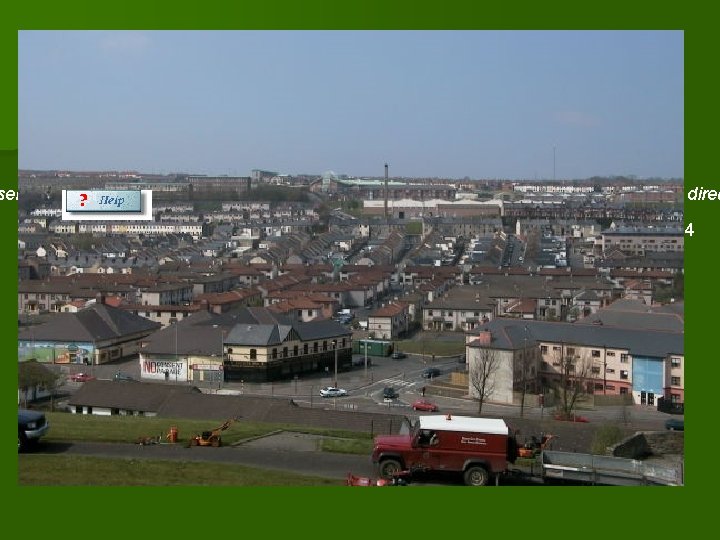
n. Images of Derry
service please send an email message. Or you can contact the CAIN Project Manager direc © 1996 -2004 CAIN (Conflict Archive on the INternet) Last Modified by Dr Martin Melaugh : 01/07/2004 22: 58: 35 Back to the top of this page < previous. . . index page. . . next >
service please send an email message. Or you can contact the CAIN Project Manager direc © 1996 -2004 CAIN (Conflict Archive on the INternet) Last Modified by Dr Martin Melaugh : 01/07/2004 22: 58: 35 Back to the top of this page < previous. . . index page. . . next >
service please send an email message. Or you can contact the CAIN Project Manager direc © 1996 -2004 CAIN (Conflict Archive on the INternet) Last Modified by Dr Martin Melaugh : 01/07/2004 22: 58: 35 Back to the top of this page < previous. . . index page. . . next >
service please send an email message. Or you can contact the CAIN Project Manager direc © 1996 -2000 CAIN Project Last Modified by Dr Martin Melaugh : 01/07/2004 22: 58: 39 Back to the top of this page < previous. . . index page. . . next >
Background Information ‘The Troubles’
Act Of Union and Great Famine n The drastic action that was taken was the Act of Union, passed in 1800. It formed a new country ("The United Kingdom of Great Britain and Ireland") by uniting England, Wales, Ireland Scotland. A new flag - the Union Jack - was created for it which had components from the flags of each member state. All regional parliaments were abolished, and instead the entire UK was to be ruled from a centralised London parliament. For most Irish, there wasn't a noticeable difference, but it meant the Irish government representatives could not pass laws on their own. In 1813, a man named Sir Robert Peel set up a law-enforcing force in Ireland. Its job was to arrest those who broke the law and generally manage crime prevention. This force was known as the 'Peelers' or the 'Bobbies', and later became known as the Police. It was the world's first Police force and, by 1822, most countries has followed suit and set up their own.
The hated penal laws were still in force in Ireland in the early 1800 s. These discriminated against non-Anglicans, principally Catholics and Presbyterians. It had been promised that they would be abolished with the Act of Union. However, this did not happen and it took the actions of Daniel O'Connell to lead a campaign for emancipation that captured the English public's imagination and led to the necessary legislation being passed in 1829. The importance of emancipation to the Irish people was recognised when the main street in Dublin was re-named after O'Connell after independence in 1921. n In 1800 the population of Ireland was between 4 and 5 million, with 200, 000 in Dublin. However the Industrial revolution and especially the Irish Linen industry expanded explosively in the first half of the century, and this allowed the population to increase dramatically. By 1841, there were 8, 175, 000 people in Ireland. (This compares to the 1996 figure of 5, 162, 535. ) Most Irish landlords were Protestants, simply because the law forbade Catholics from owning land. The Irish peasants themselves, who were both Protestant and Catholic, ate potatoes almost exclusively, since land was scarce and potatoes were an intensive crop. n
However, in 1845 a fungal disease called 'phytophthora infestans', or 'potato blight' struck and wiped out a third of the potato crop in Ireland. This was a disaster to the peasants who relied upon it. Those who lived near towns were better off, since towns had other sources of food, but things got very bad for those living in rural areas. n By 1846, potato supplies had sold out and many people began to slowly starve. The British government stepped in and imported £ 100, 000 worth of maize from America to feed the starving, and this helped prevent mass death for the first year of the Famine. However, the crop of 1846 also failed and this time wiped out almost all the potatoes in Ireland. Thousands of people simply starved, particularly in rural areas. Many also died from typhus, scurvy and dysentery. The British set up soup-kitchens and workhouses for the poor but they drastically underestimated the scale of the disaster, and many people did not receive any aid at all. The problem was compounded by landlords who evicted Peasants who could not pay the rent because they had no potatoes to sell. n
Many thousands of Irish decided to cut their losses and set sail on emigration boats to America. This is the origin of about half of what is now referred to as 'Irish America'. Hundreds of Irish died on the ships which were so overcrowded that they became known as 'coffin ships'. By 1851, the population had fallen 25% to 6, 000 and the emigration continued until around 1900, by which time only 4, 500, 000 Irish remained in Ireland. This left huge chunks of abandoned farmland even today, large areas of derelict farmland can be seen in Mayo and Galway. Many Irish felt that the British could have done more and this caused a lot of anti-British sentiment to arise, particularly in Ireland among the Irish who had gone to America. n While there is little doubt that the British could have done more to prevent the mass deaths in Ireland, some blame must also be attributed to the over-reliance of the rural Irish on a single food crop and on the lack of communication routes with England, meaning that many in Britain were genuinely unaware of what was happening in rural Ireland. Most visitors to Ireland stayed in the cities, which were largely unaffected by the famine. n
n Internment refers to the arrest and detention without trial of people suspected of being members of illegal paramilitary groups. The policy of internment had been used a number of times during Northern Ireland's history. It was reintroduced on Monday 9 August 1971 and continued in use until Friday 5 December 1975. During this period a total of 1, 981 people were detained; 1, 874 were Catholic / Republican, while 107 were Protestant / Loyalist.
n The Unionist controlled Stormont Government convinced the British Government of the need, and the advantages, of introducing internment as a means of countering rising levels of paramilitary violence. The policy proved however to be a disastrous mistake. The measure was only used against the Irish Republican Army (IRA) and the Catholic community. Although Loyalist paramilitaries had been responsible for some of the violence no Protestants were arrested (the first Protestant internees were detained on 2 February 1973). The crucial intelligence on which the success of the operation depended was flawed and many of those arrested had to be subsequently released because they were not involved in any paramilitary activity.
n In response to internment the Northern Ireland Civil Rights Association began a campaign of civil disobedience which culminated in a 'rent and rates strike' by those in public sector houses. The Social Democratic and Labour Party (SDLP) was forced to end co-operation with the Northern Ireland government. In addition many commentators are of the opinion that internment resulted in increased support, active and tacit, among the Catholic community for the IRA. The level of civil unrest and the level of IRA violence surged. n While unionists would have initially welcomed the stronger security measures represented by internment they would perhaps have been less enthusiastic for the policy if they had foreseen the consequences for the Northern Ireland parliament.
n http: //cain. ulst. ac. uk/bibdbs/murals/jarman. htm n Symbols in Northern Ireland Edited by Anthony Buckley (1998) ISBN 0 85389 692 5 Paperback 198 pp (£ 8. 50) n Painting landscapes: the place of murals in the symbolic construction of urban space Neil Jarman
n http: //cain. ulst. ac. uk/bibdbs/murals/rolsto n 2. htm n Murals of War and Peace by Bill Rolston (1995) ISBN 0 9514229 7 9
- Slides: 50