
Walking Working Surfaces Bassam Albukhaytan Dominic Guevara Benjamin
Walking Working Surfaces Bassam Albukhaytan, Dominic Guevara, Benjamin Klebs, Maggie Krawczyk, Jonte Lane
Objectives ● To identify key points within the 29 CFR 1926 Standards involving walking/working surfaces ● To address common issues within each standard along with mitigation strategies ● To inform employees on employer obligations within the standards
Agenda of Training 1926. 1060 - Training Requirements 1926. 1051 - General 1926. 1052 - Stairways 1926. 1053 - Ladders 1926 - Appendix A
1926. 1060 - Training Requirements ● Employer shall provide a training program for employees using ladders and stairways ● Program should enable employees to recognize hazards with stairways/ladders ● Train employees on procedures to be followed to minimize hazards
1926. 1060 - Training Requirements 1926. 1060(a)(1) ● Nature of fall hazards in the work area ● Procedures for building, maintaining, and disassembling the fall protection system used ● Proper construction, use, placement, and care in handling stairways/ladders
1926. 1060 - Training Requirements 1926. 1060(a)(1)- Continued ● Maximum intended load-carrying capacities of ladders ● Standards contained in this subpart
1926. 1060 - Training Requirements 1926. 1060(b) ● Retraining shall be provided for each employee as necessary so that the employee maintains the understanding and knowledge acquired through compliance with this section
1926. 1060 - Training Requirements Why retrain? ● Helps update skills ● Increase long term productivity ● Helps reduce mistakes
1926. 1051 - General Requirements This standard requires: ● A ladder to be provided if there is a change in elevation more than 48 inches ● The passage for movement to be kept clear at all times ● Employers to provide and install stairway and ladder fall protection systems within compliance
1926. 1051 - General Requirements Common issues ● Fall protection systems are not deployed by every employee ● Stairways missing handrails ● Personal Fall Arrest Systems are not used properly by employee
1926. 1051 - General Requirements Mitigation Strategies ● Provide Personal Fall Arrest Systems to employees working at height ● Proper training ● Provide guardrails and handrails to any platform or staircase
1926. 1052 - Stairways This standard requires ● Stairs must be installed at 30° - 50° ● Uniform riser height and tread depth, free of projection hazards ● Extended platform where door/gate swings into, effective width at least 20”
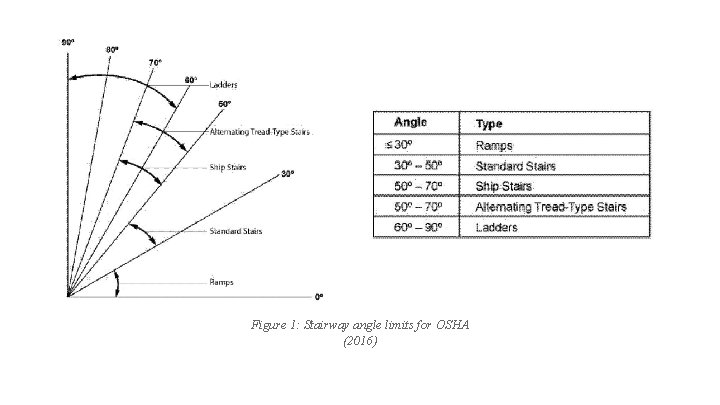
Figure 1: Stairway angle limits for OSHA (2016)
1926. 1052 - Stairways Requirements Cont. ● Over 4 steps or 30 “ vertical rise, at least 1 handrail ● Stair rails along sides, at least 36” above tread, no greater than 37” if used as handrail
1926. 1052 - Stairways Requirements Cont. ● Mid rail, screen/mesh, or vertical member required ● Mid rails must be midway, screen/mesh must entirely cover opening, vertical members 19” apart
1926. 1052 - Stairways Requirements Cont. ● Handrails/stair rails must withstand 200 lb force ● Handrail height range 30” - 37” ● Stair rails/handrails must be surfaced and installed to allow thorough grasping, be hazard free, ● Unprotected sides of landings must be guarded
1926. 1052 - Stairways Common Issues ● Effective width of platforms not reaching 20” when door/gate open ● Mid rails not midway ● Hand railing not providing adequate handhold
1926. 1052 - Stairways Mitigation Strategies ● Competent installation crew, inspected by safety professional ● Test rails prior to purchase, have safety professional inspect selection
1926. 1053 - Ladders This standard requires: ● Each portable ladder should hold at least four times the maximum intended load. (a)(1)(i) ● Ladder rungs, cleats, and steps shall be parallel, level, and uniformly spaced when the ladder is in position for use. (a)(2)
1926. 1053 - Ladders Common Issues: ● ● Worn out rungs Using ladders on uneven surfaces Climbing ladders with loads in hands Absence of ladder safety devices
1926. 1053 - Ladders Mitigation Strategies: ● ● ● Cover rungs with slip-resistant material Use ladders only on flat service Climb ladders with at least one hand Do not carry load while climbing Install cages for ladders about 24 ft.
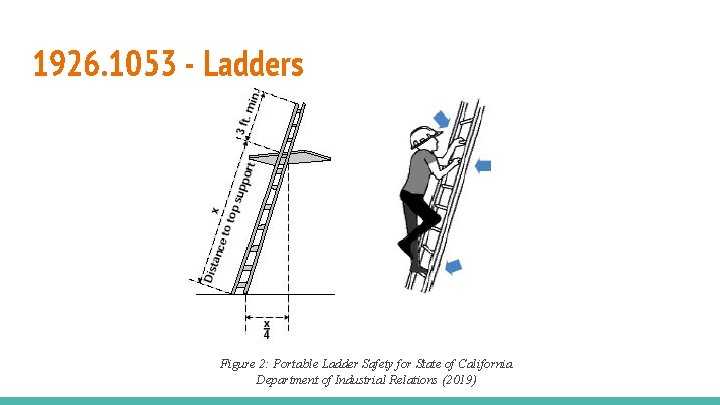
1926. 1053 - Ladders Figure 2: Portable Ladder Safety for State of California Department of Industrial Relations (2019)
1926 - Ladders - Subpart X App A ● Appendix A brings more stringent standards with ladder loading and strength requirements of 1926. 1053(a)(1). ○ ○ ○ Manufactured portable wood ladders: ANSI A 14. 1 -1982 Manufactured portable metal ladders: ANSI A 14. 2 -1982 Manufactured fixed ladders: ANSI A 14. 3 -1984 Job-made ladders: ANSI A 14. 4 -1979 Plastic ladders: ANSI A 14. 5 -1982
References OSHA. (1990). Training Requirements (Standard No. 1926. 1060). Retrieved from https: //www. osha. gov/lawsregs/regulations/standardnumber/1926. 1060 OSHA. (1990) General Requirements (Standard No. 1926. 1051). Retrieved from https: //www. osha. gov/lawsregs/regulations/standardnumber/1926. 1051 OSHA. (1991). Stairways and Ladders (Standard No. 1926. 1052). Retrieved from https: //www. osha. gov/lawsregs/regulations/standardnumber/1926. 1052 OSHA. (2014). Ladders (Standard No. 1926. 1053). Retrieved from https: //www. osha. gov/lawsregs/regulations/standardnumber/1926. 1053 OSHA. (1990). Ladders (Standard No. 1926 Subpart X App A) Retrieved from https: //www. osha. gov/lawsregs/regulations/standardnumber/1926 Subpart. XApp. A
References Cont. Figure 1 - OSHA. (2016). Stairway angle limit. Occupational Safety and Health Administration Reprinted from https: //www. osha. gov/laws-regs/regulations/standardnumber/1910. 25 . [Graphic]. Figure 2 - State of California Department of Industrial Relations. (2019). Portable Ladder Safety. State of California Department of Industrial Relations. [Graphic] Redistributed from https: //www. dir. ca. gov/dosh/etools/08 -001/regs. htm
- Slides: 25