
Walking and Working Surfaces including Fall Protection OSHA
- Slides: 66
Walking and Working Surfaces, including Fall Protection OSHA 10 -hour Outreach Training General Industry PPT 10 -hr. General Industry – Walking/Working Surfaces v. 03. 01. 17 1 Created by OTIEC Outreach Resources Workgroup
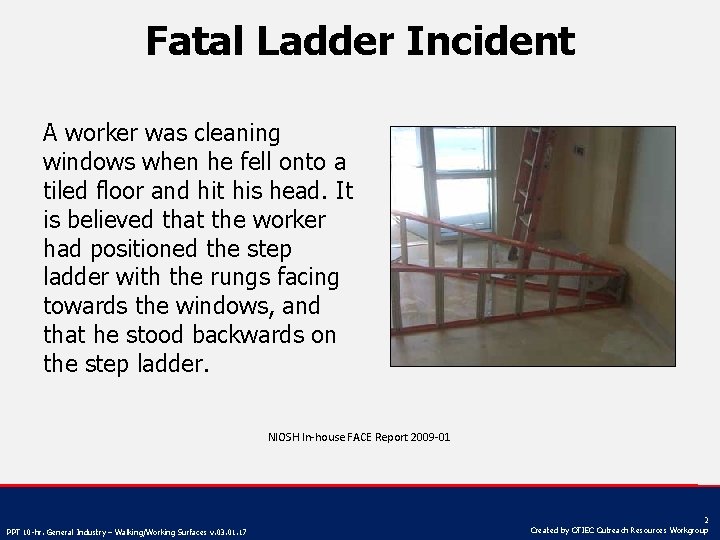
Fatal Ladder Incident A worker was cleaning windows when he fell onto a tiled floor and hit his head. It is believed that the worker had positioned the step ladder with the rungs facing towards the windows, and that he stood backwards on the step ladder. NIOSH In-house FACE Report 2009 -01 PPT 10 -hr. General Industry – Walking/Working Surfaces v. 03. 01. 17 2 Created by OTIEC Outreach Resources Workgroup
Introduction Slips, trips, and falls: • make up the majority of general industry accidents; and • cause 15% of all accidental deaths, second only to motor vehicle crashes. PPT 10 -hr. General Industry – Walking/Working Surfaces v. 03. 01. 17 3 Created by OTIEC Outreach Resources Workgroup
Introduction Lesson objectives: 1. Identify hazards in the workplace associated with walking and working surfaces. 2. Identify best practices for eliminating or controlling hazards associated with walking and working surfaces in the workplace. 3. Recognize employer requirements to protect workers from walking and working surface hazards. PPT 10 -hr. General Industry – Walking/Working Surfaces v. 03. 01. 17 4 Created by OTIEC Outreach Resources Workgroup
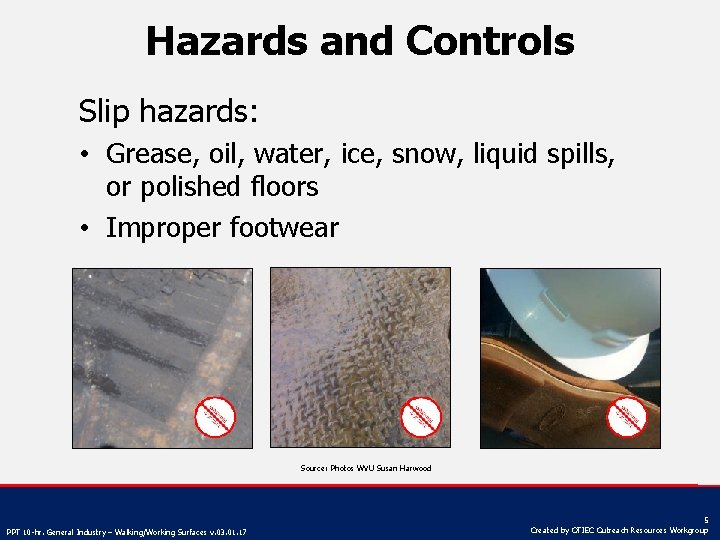
Hazards and Controls Slip hazards: • Grease, oil, water, ice, snow, liquid spills, or polished floors • Improper footwear Source: Photos WVU Susan Harwood PPT 10 -hr. General Industry – Walking/Working Surfaces v. 03. 01. 17 5 Created by OTIEC Outreach Resources Workgroup
Hazards and Controls Controlling slip hazards: • Keep walking/working surfaces as clean and dry as possible. • Make sure your footwear is as slip resistant as possible. • Require drainage for wet operations. • Clean up or mark and report spills. • Remove ice and snow frequently and regularly. PPT 10 -hr. General Industry – Walking/Working Surfaces v. 03. 01. 17 6 Created by OTIEC Outreach Resources Workgroup
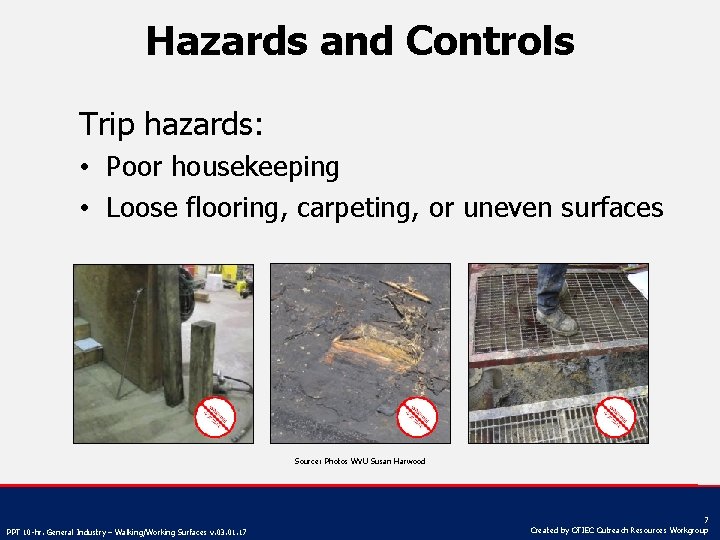
Hazards and Controls Trip hazards: • Poor housekeeping • Loose flooring, carpeting, or uneven surfaces Source: Photos WVU Susan Harwood PPT 10 -hr. General Industry – Walking/Working Surfaces v. 03. 01. 17 7 Created by OTIEC Outreach Resources Workgroup
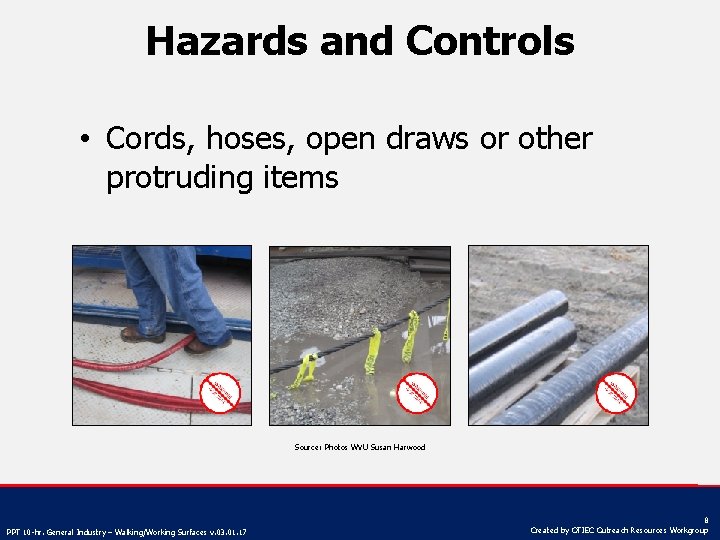
Hazards and Controls • Cords, hoses, open draws or other protruding items Source: Photos WVU Susan Harwood PPT 10 -hr. General Industry – Walking/Working Surfaces v. 03. 01. 17 8 Created by OTIEC Outreach Resources Workgroup
Hazards and Controls Controlling trip hazards: • Aisles and passageways should be well-lit, clean, and marked. • Material storage and work-related scraps shouldn’t create trip hazards. • Trip hazards, such as loose flooring, carpeting, uneven surfaces, and protrusion hazards, should be repaired or reported. • Hoses and cables should be routed away from active work zones and walkways. PPT 10 -hr. General Industry – Walking/Working Surfaces v. 03. 01. 17 9 Created by OTIEC Outreach Resources Workgroup
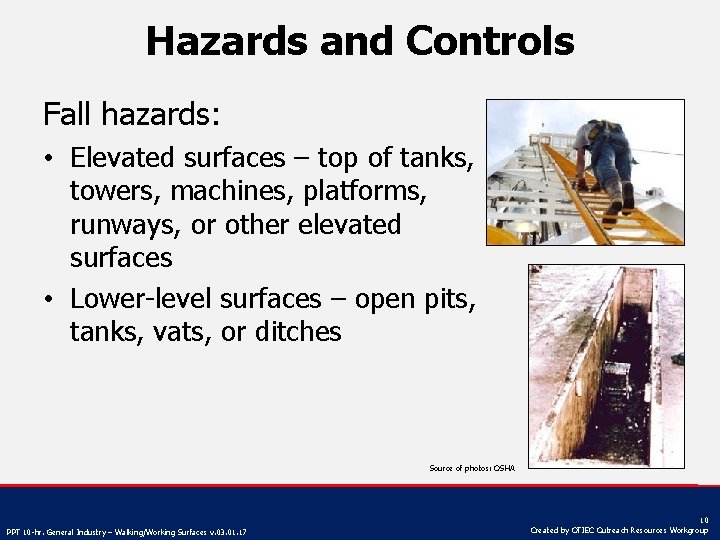
Hazards and Controls Fall hazards: • Elevated surfaces – top of tanks, towers, machines, platforms, runways, or other elevated surfaces • Lower-level surfaces – open pits, tanks, vats, or ditches Source of photos: OSHA PPT 10 -hr. General Industry – Walking/Working Surfaces v. 03. 01. 17 10 Created by OTIEC Outreach Resources Workgroup
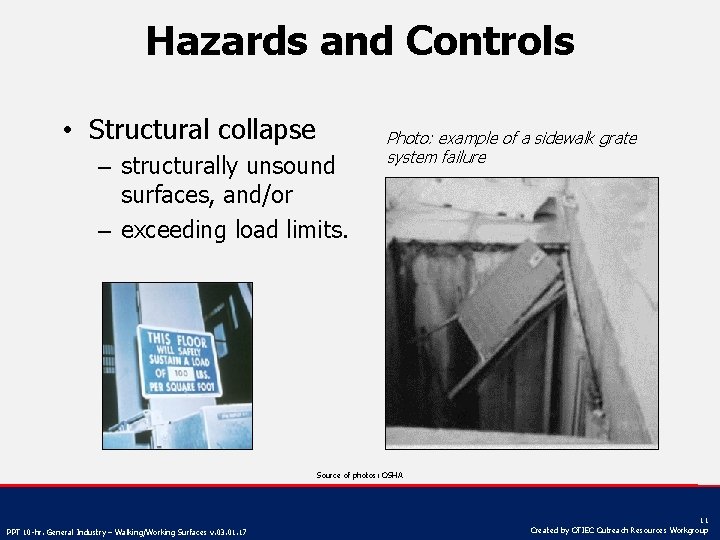
Hazards and Controls • Structural collapse – structurally unsound surfaces, and/or – exceeding load limits. Photo: example of a sidewalk grate system failure Source of photos: OSHA PPT 10 -hr. General Industry – Walking/Working Surfaces v. 03. 01. 17 11 Created by OTIEC Outreach Resources Workgroup
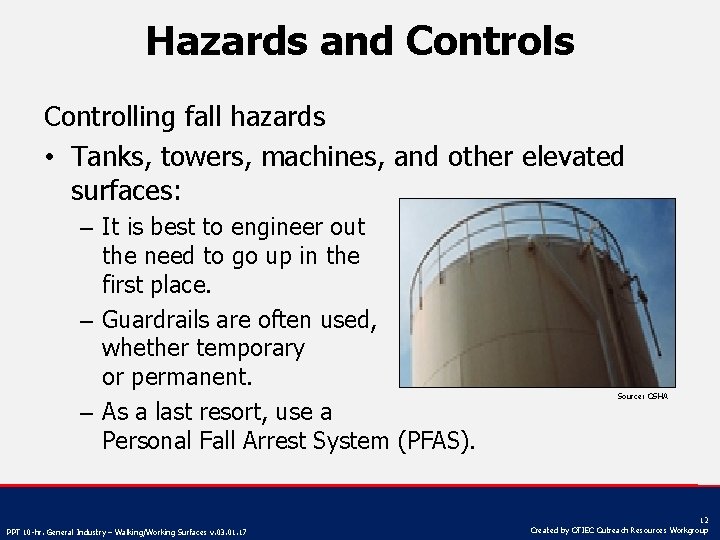
Hazards and Controls Controlling fall hazards • Tanks, towers, machines, and other elevated surfaces: – It is best to engineer out the need to go up in the first place. – Guardrails are often used, whether temporary or permanent. – As a last resort, use a Personal Fall Arrest System (PFAS). PPT 10 -hr. General Industry – Walking/Working Surfaces v. 03. 01. 17 Source: OSHA 12 Created by OTIEC Outreach Resources Workgroup
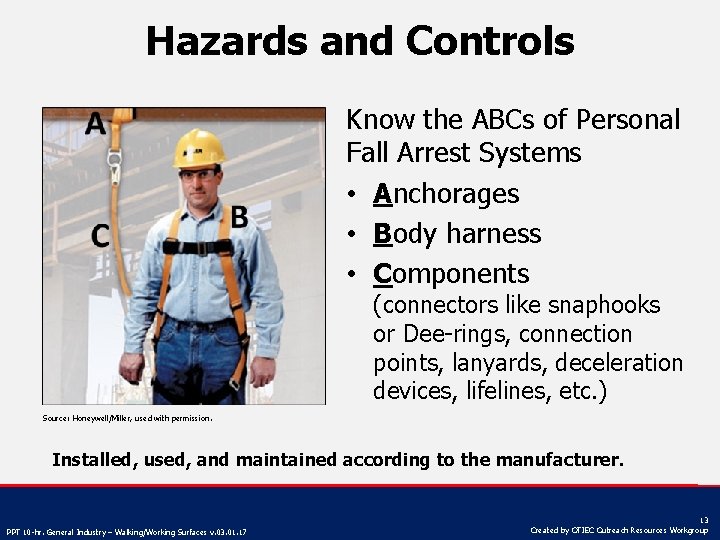
Hazards and Controls Know the ABCs of Personal Fall Arrest Systems • Anchorages • Body harness • Components (connectors like snaphooks or Dee-rings, connection points, lanyards, deceleration devices, lifelines, etc. ) Source: Honeywell/Miller, used with permission. Installed, used, and maintained according to the manufacturer. PPT 10 -hr. General Industry – Walking/Working Surfaces v. 03. 01. 17 13 Created by OTIEC Outreach Resources Workgroup
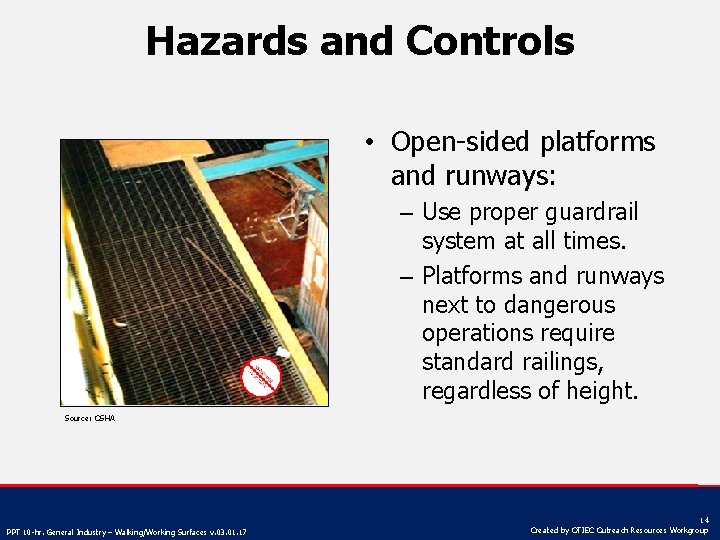
Hazards and Controls • Open-sided platforms and runways: – Use proper guardrail system at all times. – Platforms and runways next to dangerous operations require standard railings, regardless of height. Source: OSHA PPT 10 -hr. General Industry – Walking/Working Surfaces v. 03. 01. 17 14 Created by OTIEC Outreach Resources Workgroup
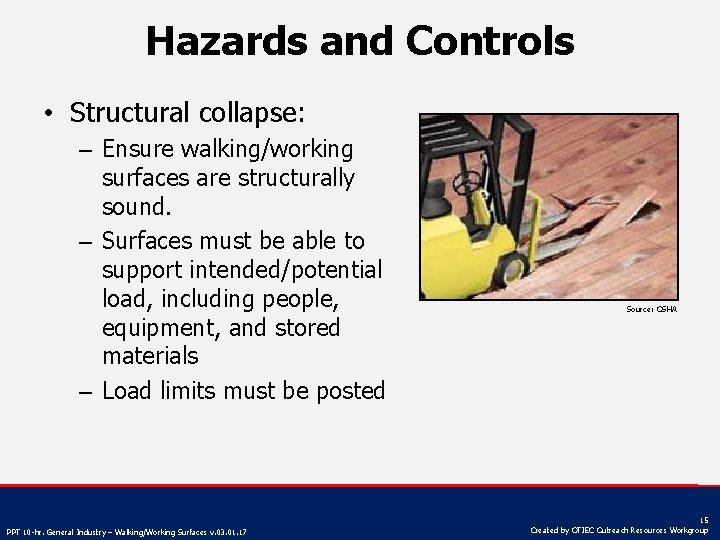
Hazards and Controls • Structural collapse: – Ensure walking/working surfaces are structurally sound. – Surfaces must be able to support intended/potential load, including people, equipment, and stored materials – Load limits must be posted PPT 10 -hr. General Industry – Walking/Working Surfaces v. 03. 01. 17 Source: OSHA 15 Created by OTIEC Outreach Resources Workgroup
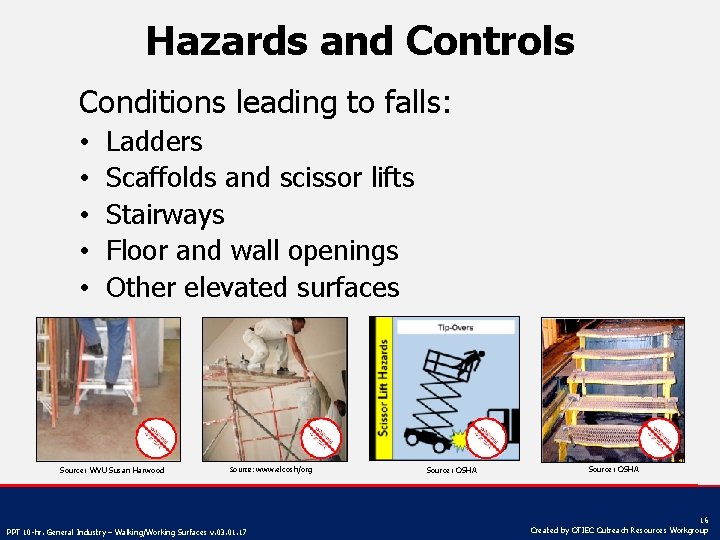
Hazards and Controls Conditions leading to falls: • • • Ladders Scaffolds and scissor lifts Stairways Floor and wall openings Other elevated surfaces Source: WVU Susan Harwood Source: www. elcosh/org PPT 10 -hr. General Industry – Walking/Working Surfaces v. 03. 01. 17 Source: OSHA 16 Created by OTIEC Outreach Resources Workgroup
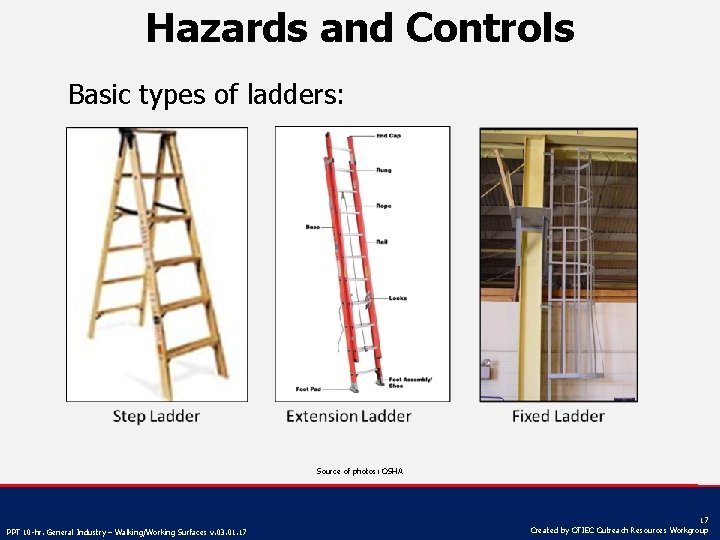
Hazards and Controls Basic types of ladders: Source of photos: OSHA PPT 10 -hr. General Industry – Walking/Working Surfaces v. 03. 01. 17 17 Created by OTIEC Outreach Resources Workgroup
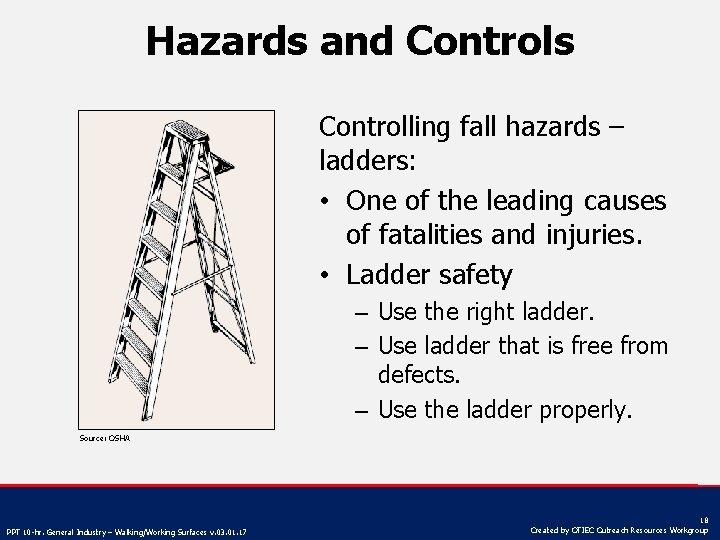
Hazards and Controls Controlling fall hazards – ladders: • One of the leading causes of fatalities and injuries. • Ladder safety – Use the right ladder. – Use ladder that is free from defects. – Use the ladder properly. Source: OSHA PPT 10 -hr. General Industry – Walking/Working Surfaces v. 03. 01. 17 18 Created by OTIEC Outreach Resources Workgroup
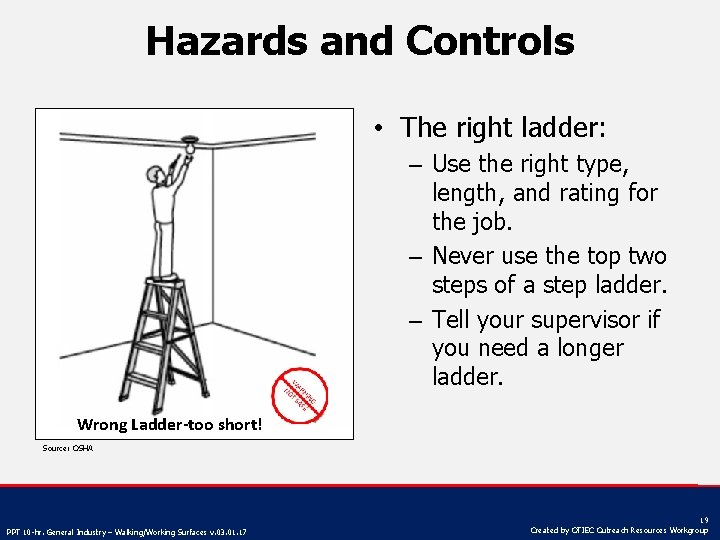
Hazards and Controls • The right ladder: – Use the right type, length, and rating for the job. – Never use the top two steps of a step ladder. – Tell your supervisor if you need a longer ladder. Wrong Ladder-too short! Source: OSHA PPT 10 -hr. General Industry – Walking/Working Surfaces v. 03. 01. 17 19 Created by OTIEC Outreach Resources Workgroup
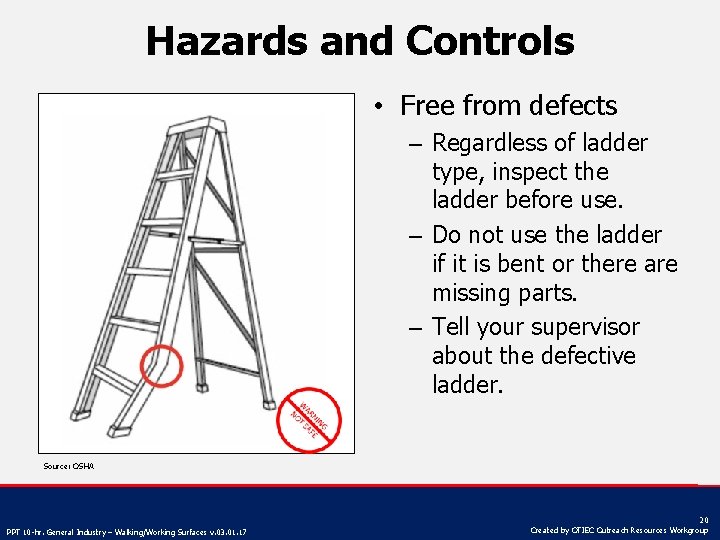
Hazards and Controls • Free from defects – Regardless of ladder type, inspect the ladder before use. – Do not use the ladder if it is bent or there are missing parts. – Tell your supervisor about the defective ladder. Source: OSHA PPT 10 -hr. General Industry – Walking/Working Surfaces v. 03. 01. 17 20 Created by OTIEC Outreach Resources Workgroup
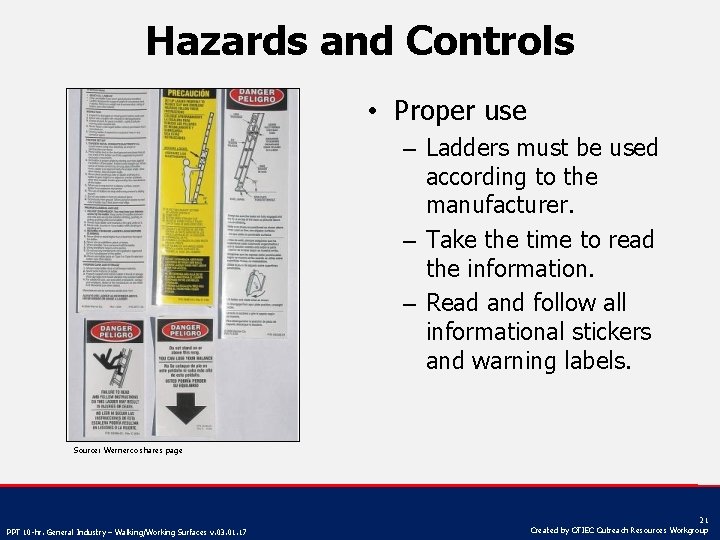
Hazards and Controls • Proper use – Ladders must be used according to the manufacturer. – Take the time to read the information. – Read and follow all informational stickers and warning labels. Source: Wernerco shares page PPT 10 -hr. General Industry – Walking/Working Surfaces v. 03. 01. 17 21 Created by OTIEC Outreach Resources Workgroup
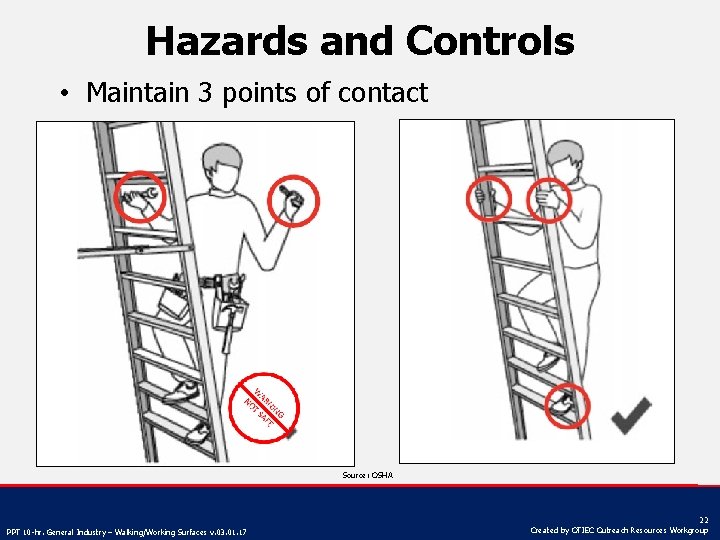
Hazards and Controls • Maintain 3 points of contact Source: OSHA PPT 10 -hr. General Industry – Walking/Working Surfaces v. 03. 01. 17 22 Created by OTIEC Outreach Resources Workgroup
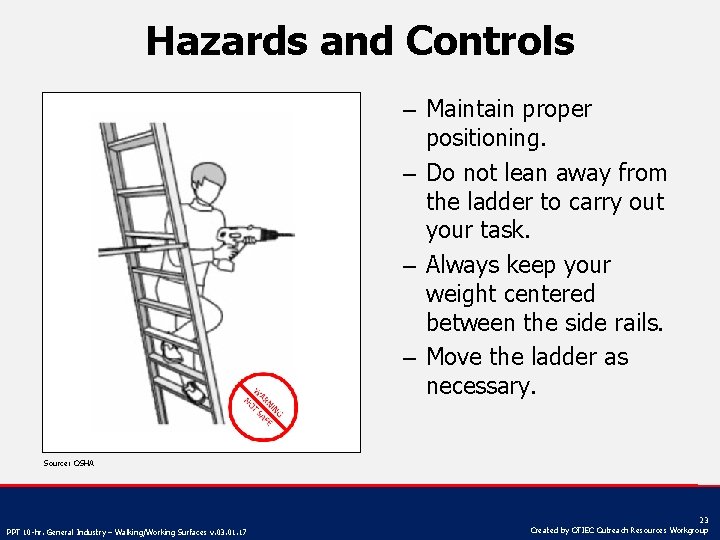
Hazards and Controls – Maintain proper positioning. – Do not lean away from the ladder to carry out your task. – Always keep your weight centered between the side rails. – Move the ladder as necessary. Source: OSHA PPT 10 -hr. General Industry – Walking/Working Surfaces v. 03. 01. 17 23 Created by OTIEC Outreach Resources Workgroup
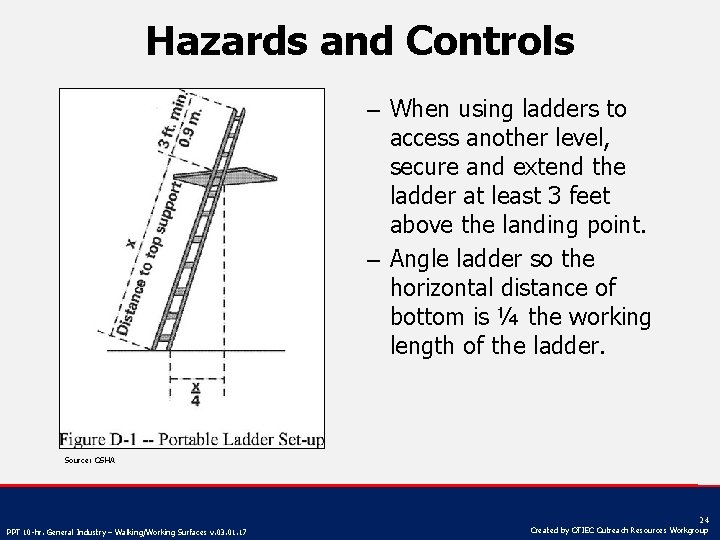
Hazards and Controls 3 feet – When using ladders to access another level, secure and extend the ladder at least 3 feet above the landing point. – Angle ladder so the horizontal distance of bottom is ¼ the working length of the ladder. Source: OSHA PPT 10 -hr. General Industry – Walking/Working Surfaces v. 03. 01. 17 24 Created by OTIEC Outreach Resources Workgroup
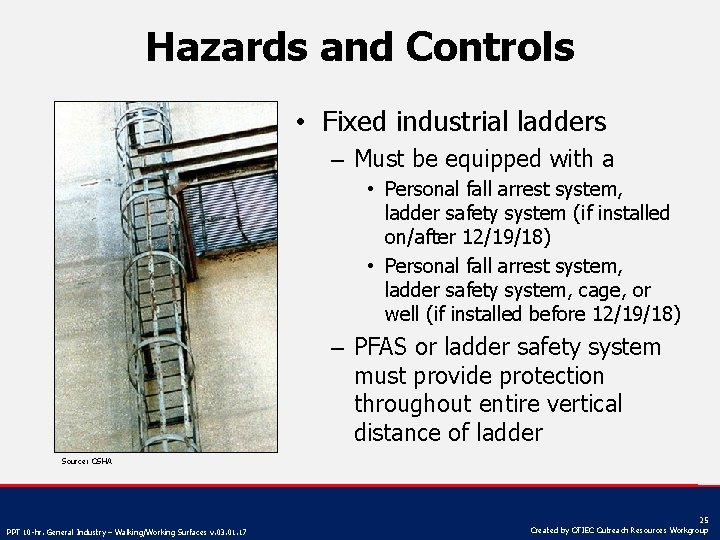
Hazards and Controls • Fixed industrial ladders – Must be equipped with a • Personal fall arrest system, ladder safety system (if installed on/after 12/19/18) • Personal fall arrest system, ladder safety system, cage, or well (if installed before 12/19/18) – PFAS or ladder safety system must provide protection throughout entire vertical distance of ladder Source: OSHA PPT 10 -hr. General Industry – Walking/Working Surfaces v. 03. 01. 17 25 Created by OTIEC Outreach Resources Workgroup
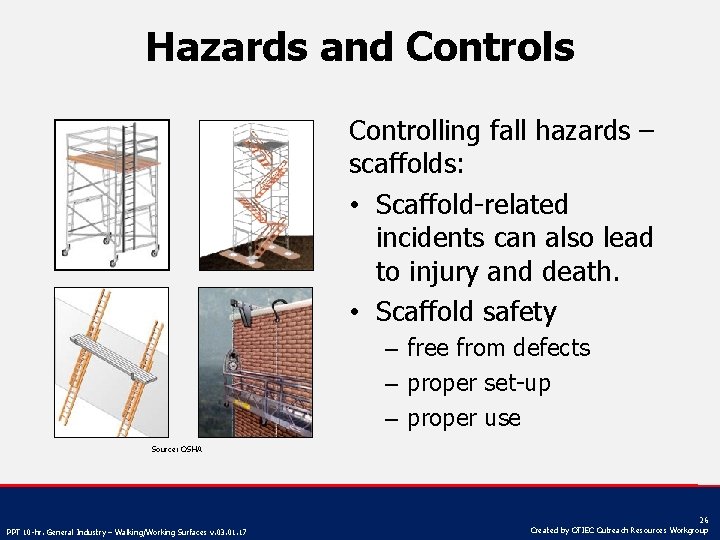
Hazards and Controls Controlling fall hazards – scaffolds: • Scaffold-related incidents can also lead to injury and death. • Scaffold safety – free from defects – proper set-up – proper use Source: OSHA PPT 10 -hr. General Industry – Walking/Working Surfaces v. 03. 01. 17 26 Created by OTIEC Outreach Resources Workgroup
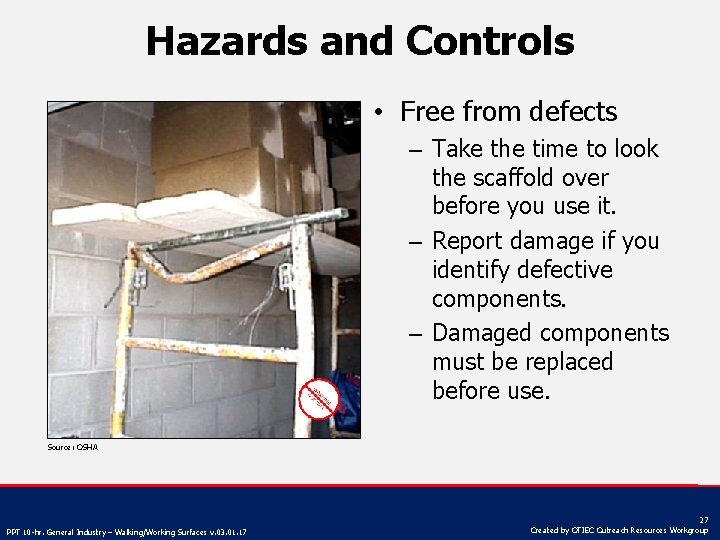
Hazards and Controls • Free from defects – Take the time to look the scaffold over before you use it. – Report damage if you identify defective components. – Damaged components must be replaced before use. Source: OSHA PPT 10 -hr. General Industry – Walking/Working Surfaces v. 03. 01. 17 27 Created by OTIEC Outreach Resources Workgroup
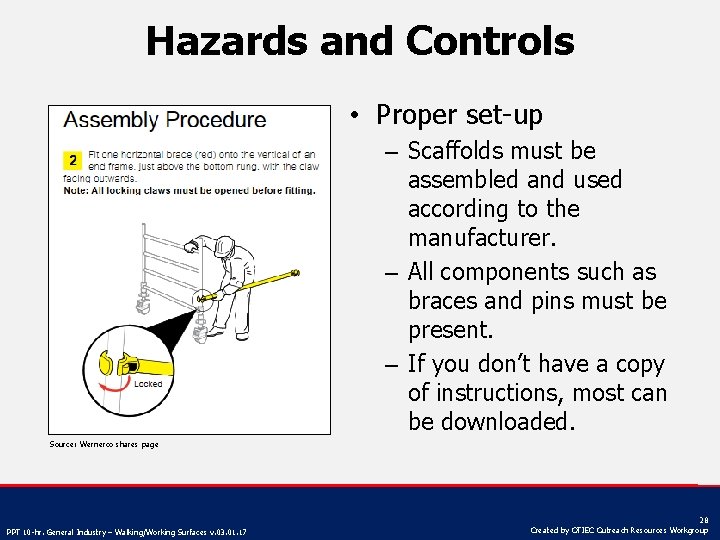
Hazards and Controls • Proper set-up – Scaffolds must be assembled and used according to the manufacturer. – All components such as braces and pins must be present. – If you don’t have a copy of instructions, most can be downloaded. Source: Wernerco shares page PPT 10 -hr. General Industry – Walking/Working Surfaces v. 03. 01. 17 28 Created by OTIEC Outreach Resources Workgroup
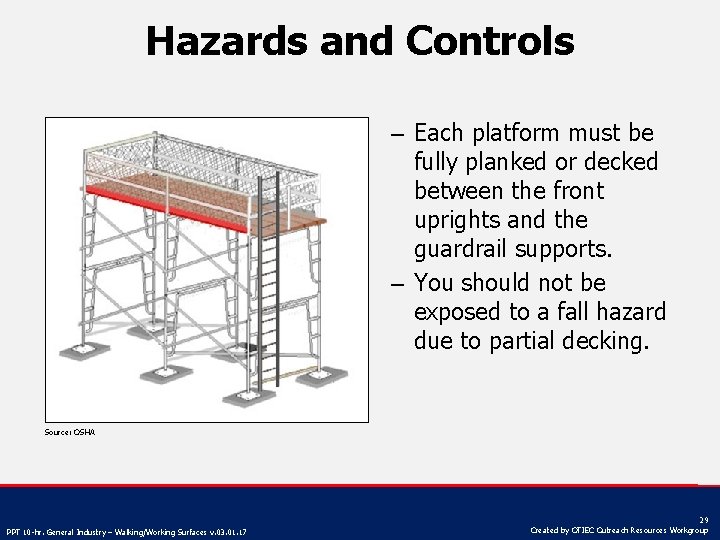
Hazards and Controls – Each platform must be fully planked or decked between the front uprights and the guardrail supports. – You should not be exposed to a fall hazard due to partial decking. Source: OSHA PPT 10 -hr. General Industry – Walking/Working Surfaces v. 03. 01. 17 29 Created by OTIEC Outreach Resources Workgroup
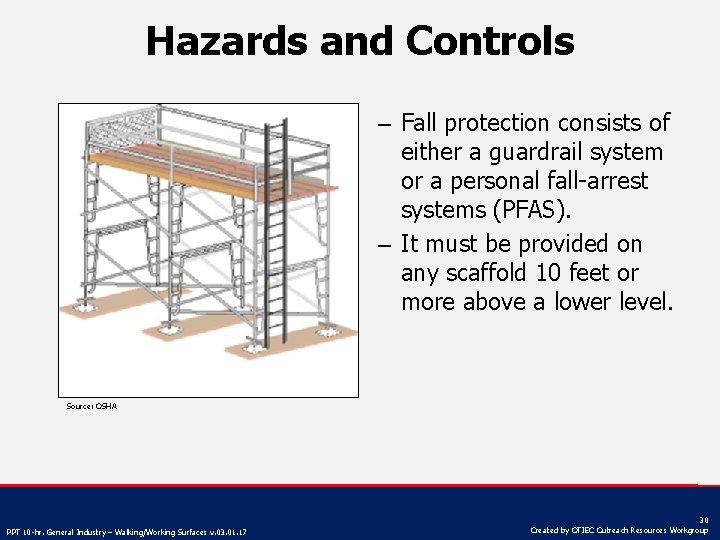
Hazards and Controls – Fall protection consists of either a guardrail system or a personal fall-arrest systems (PFAS). – It must be provided on any scaffold 10 feet or more above a lower level. Source: OSHA PPT 10 -hr. General Industry – Walking/Working Surfaces v. 03. 01. 17 30 Created by OTIEC Outreach Resources Workgroup
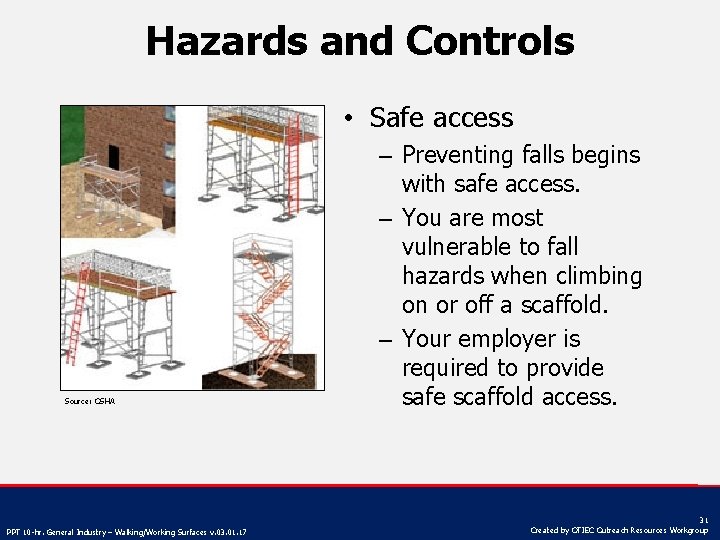
Hazards and Controls • Safe access Source: OSHA PPT 10 -hr. General Industry – Walking/Working Surfaces v. 03. 01. 17 – Preventing falls begins with safe access. – You are most vulnerable to fall hazards when climbing on or off a scaffold. – Your employer is required to provide safe scaffold access. 31 Created by OTIEC Outreach Resources Workgroup
Hazards and Controls • Proper use – Make sure you are a properly trained scaffold user. – Use scaffolds according to the manufacturer. – Follow your company’s scaffold safety policy. – Report scaffold-related safety issues to your employer. PPT 10 -hr. General Industry – Walking/Working Surfaces v. 03. 01. 17 32 Created by OTIEC Outreach Resources Workgroup
Hazards and Controls – Never climb the bracing. – Never climb the frame unless designed to be a ladder. – Don’t carry tools or materials while climbing. – Never use a ladder or other device to increase your reach from platform. PPT 10 -hr. General Industry – Walking/Working Surfaces v. 03. 01. 17 33 Created by OTIEC Outreach Resources Workgroup
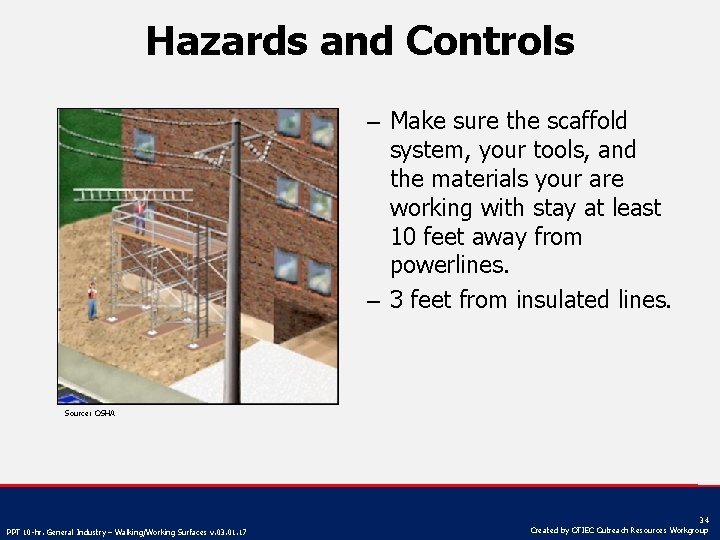
Hazards and Controls – Make sure the scaffold system, your tools, and the materials your are working with stay at least 10 feet away from powerlines. – 3 feet from insulated lines. Source: OSHA PPT 10 -hr. General Industry – Walking/Working Surfaces v. 03. 01. 17 34 Created by OTIEC Outreach Resources Workgroup
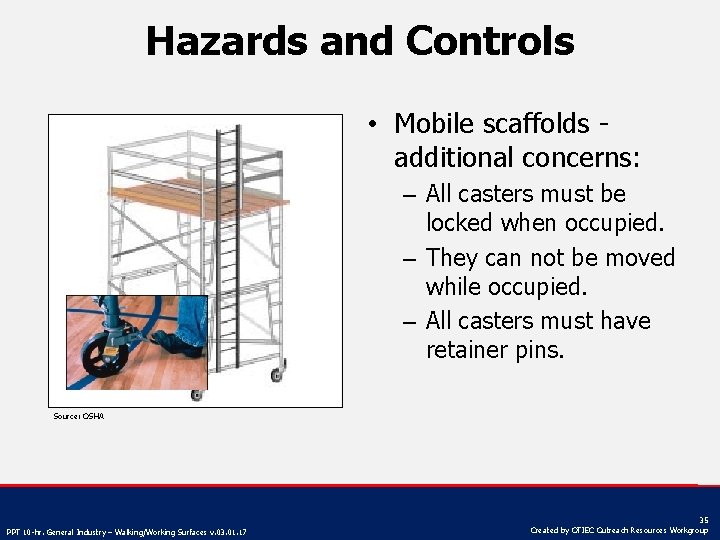
Hazards and Controls • Mobile scaffolds additional concerns: – All casters must be locked when occupied. – They can not be moved while occupied. – All casters must have retainer pins. Source: OSHA PPT 10 -hr. General Industry – Walking/Working Surfaces v. 03. 01. 17 35 Created by OTIEC Outreach Resources Workgroup
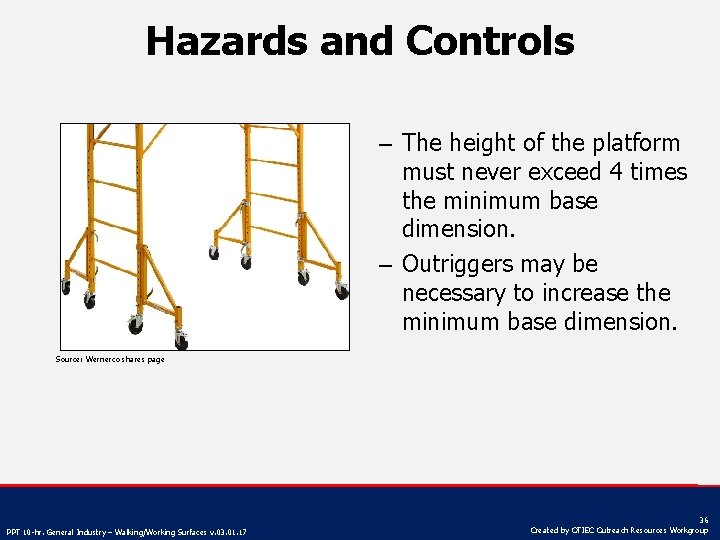
Hazards and Controls – The height of the platform must never exceed 4 times the minimum base dimension. – Outriggers may be necessary to increase the minimum base dimension. Source: Wernerco shares page PPT 10 -hr. General Industry – Walking/Working Surfaces v. 03. 01. 17 36 Created by OTIEC Outreach Resources Workgroup
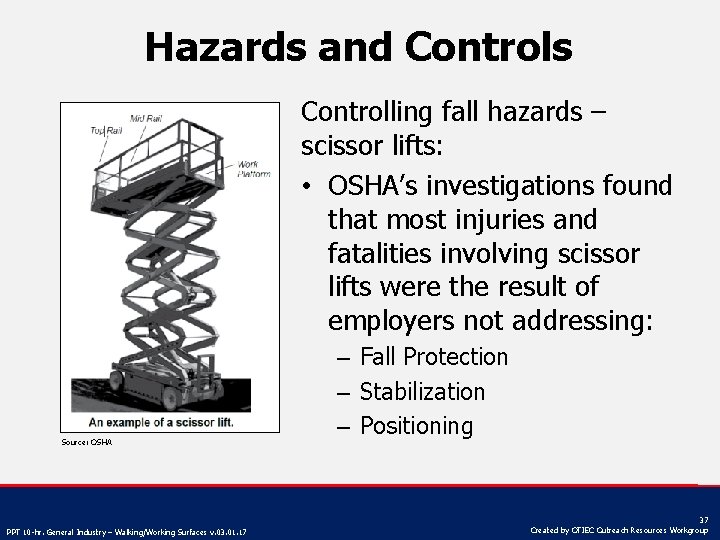
Hazards and Controls Controlling fall hazards – scissor lifts: • OSHA’s investigations found that most injuries and fatalities involving scissor lifts were the result of employers not addressing: Source: OSHA PPT 10 -hr. General Industry – Walking/Working Surfaces v. 03. 01. 17 – Fall Protection – Stabilization – Positioning 37 Created by OTIEC Outreach Resources Workgroup
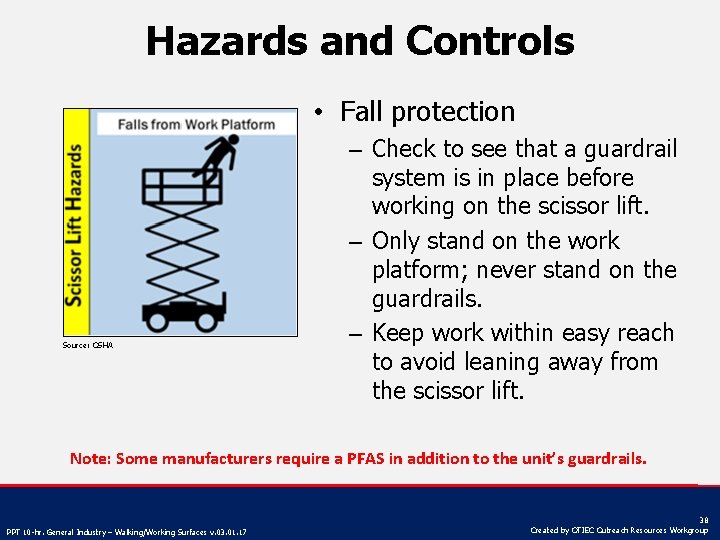
Hazards and Controls • Fall protection Source: OSHA – Check to see that a guardrail system is in place before working on the scissor lift. – Only stand on the work platform; never stand on the guardrails. – Keep work within easy reach to avoid leaning away from the scissor lift. Note: Some manufacturers require a PFAS in addition to the unit’s guardrails. PPT 10 -hr. General Industry – Walking/Working Surfaces v. 03. 01. 17 38 Created by OTIEC Outreach Resources Workgroup
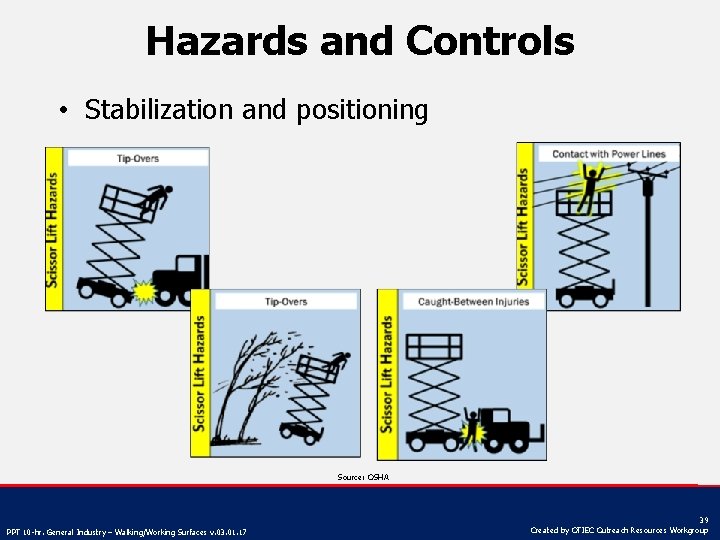
Hazards and Controls • Stabilization and positioning Source: OSHA PPT 10 -hr. General Industry – Walking/Working Surfaces v. 03. 01. 17 39 Created by OTIEC Outreach Resources Workgroup
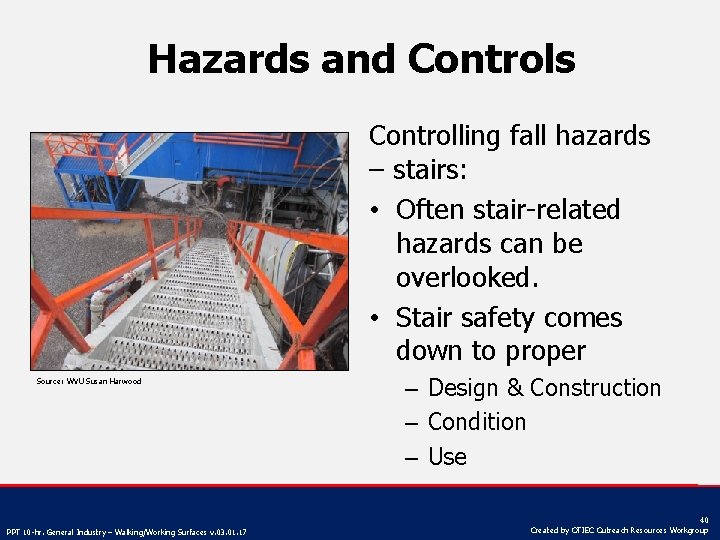
Hazards and Controls Controlling fall hazards – stairs: • Often stair-related hazards can be overlooked. • Stair safety comes down to proper Source: WVU Susan Harwood PPT 10 -hr. General Industry – Walking/Working Surfaces v. 03. 01. 17 – Design & Construction – Condition – Use 40 Created by OTIEC Outreach Resources Workgroup
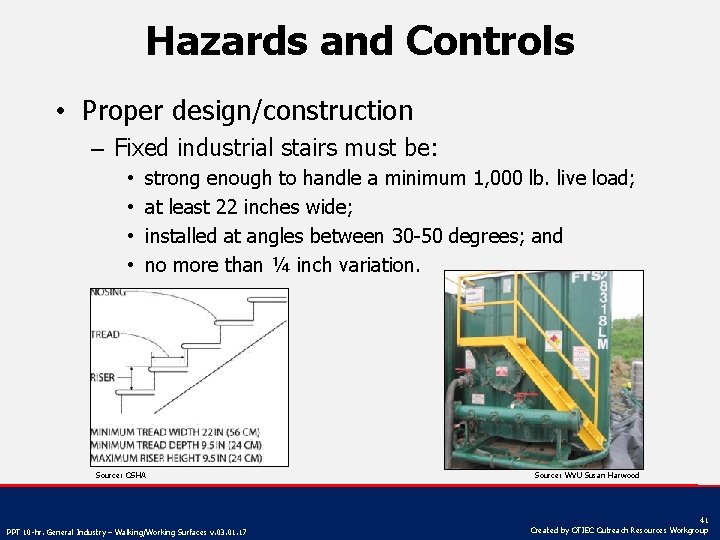
Hazards and Controls • Proper design/construction – Fixed industrial stairs must be: • • strong enough to handle a minimum 1, 000 lb. live load; at least 22 inches wide; installed at angles between 30 -50 degrees; and no more than ¼ inch variation. Source: OSHA PPT 10 -hr. General Industry – Walking/Working Surfaces v. 03. 01. 17 Source: WVU Susan Harwood 41 Created by OTIEC Outreach Resources Workgroup
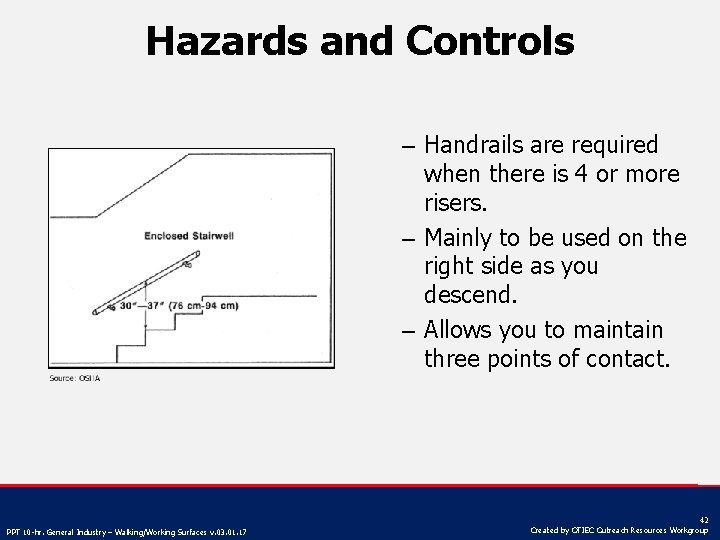
Hazards and Controls – Handrails are required when there is 4 or more risers. – Mainly to be used on the right side as you descend. – Allows you to maintain three points of contact. PPT 10 -hr. General Industry – Walking/Working Surfaces v. 03. 01. 17 42 Created by OTIEC Outreach Resources Workgroup
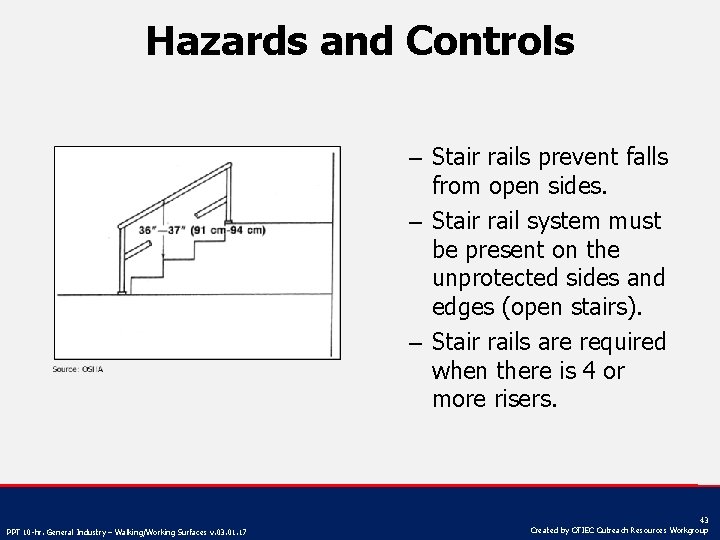
Hazards and Controls – Stair rails prevent falls from open sides. – Stair rail system must be present on the unprotected sides and edges (open stairs). – Stair rails are required when there is 4 or more risers. PPT 10 -hr. General Industry – Walking/Working Surfaces v. 03. 01. 17 43 Created by OTIEC Outreach Resources Workgroup
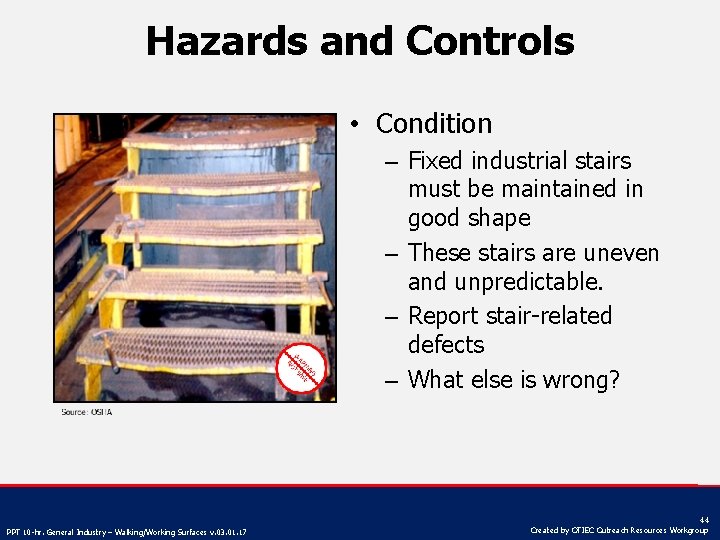
Hazards and Controls • Condition – Fixed industrial stairs must be maintained in good shape – These stairs are uneven and unpredictable. – Report stair-related defects – What else is wrong? PPT 10 -hr. General Industry – Walking/Working Surfaces v. 03. 01. 17 44 Created by OTIEC Outreach Resources Workgroup
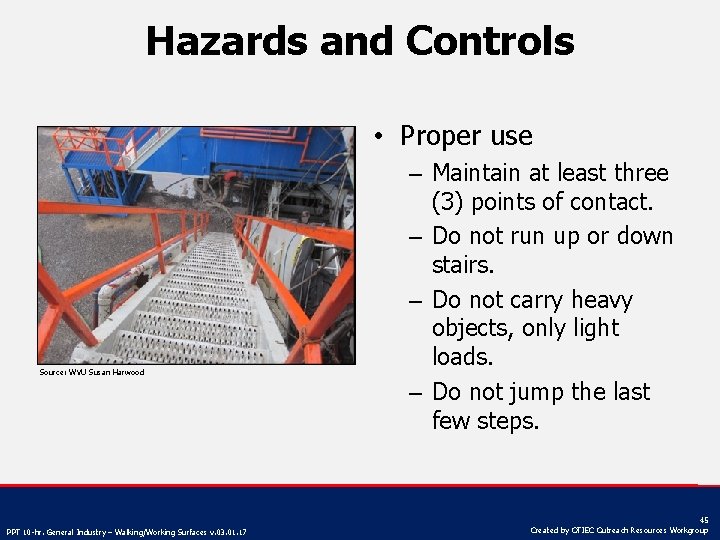
Hazards and Controls • Proper use Source: WVU Susan Harwood PPT 10 -hr. General Industry – Walking/Working Surfaces v. 03. 01. 17 – Maintain at least three (3) points of contact. – Do not run up or down stairs. – Do not carry heavy objects, only light loads. – Do not jump the last few steps. 45 Created by OTIEC Outreach Resources Workgroup
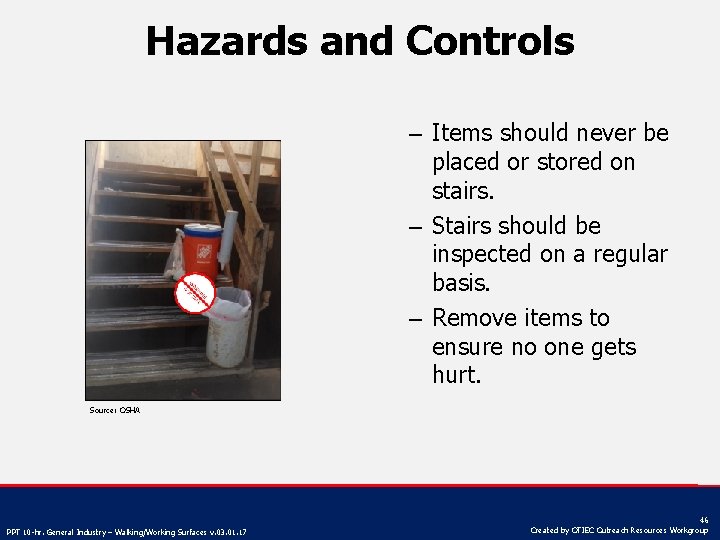
Hazards and Controls – Items should never be placed or stored on stairs. – Stairs should be inspected on a regular basis. – Remove items to ensure no one gets hurt. Source: OSHA PPT 10 -hr. General Industry – Walking/Working Surfaces v. 03. 01. 17 46 Created by OTIEC Outreach Resources Workgroup
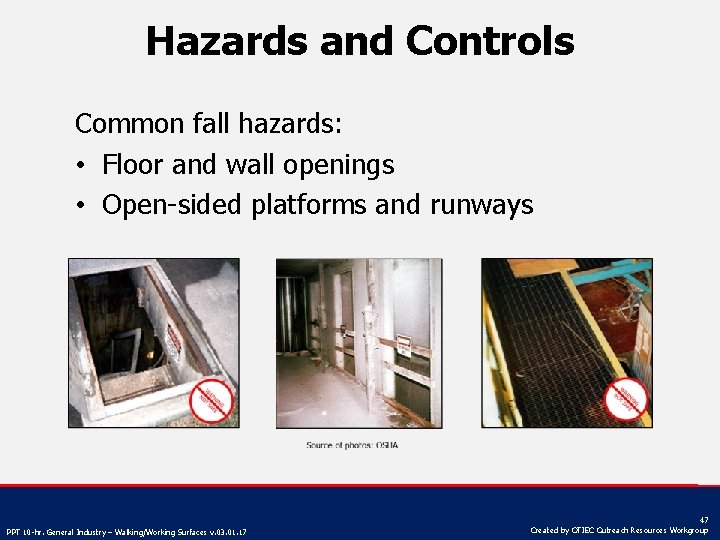
Hazards and Controls Common fall hazards: • Floor and wall openings • Open-sided platforms and runways PPT 10 -hr. General Industry – Walking/Working Surfaces v. 03. 01. 17 47 Created by OTIEC Outreach Resources Workgroup
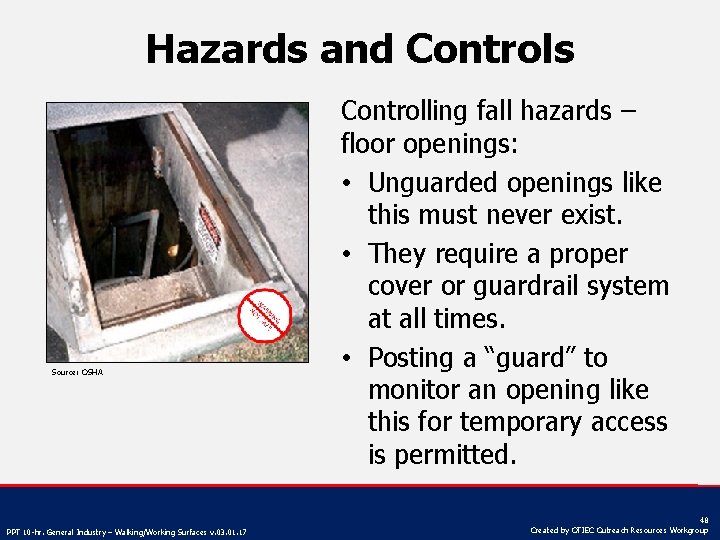
Hazards and Controls Source: OSHA PPT 10 -hr. General Industry – Walking/Working Surfaces v. 03. 01. 17 Controlling fall hazards – floor openings: • Unguarded openings like this must never exist. • They require a proper cover or guardrail system at all times. • Posting a “guard” to monitor an opening like this for temporary access is permitted. 48 Created by OTIEC Outreach Resources Workgroup
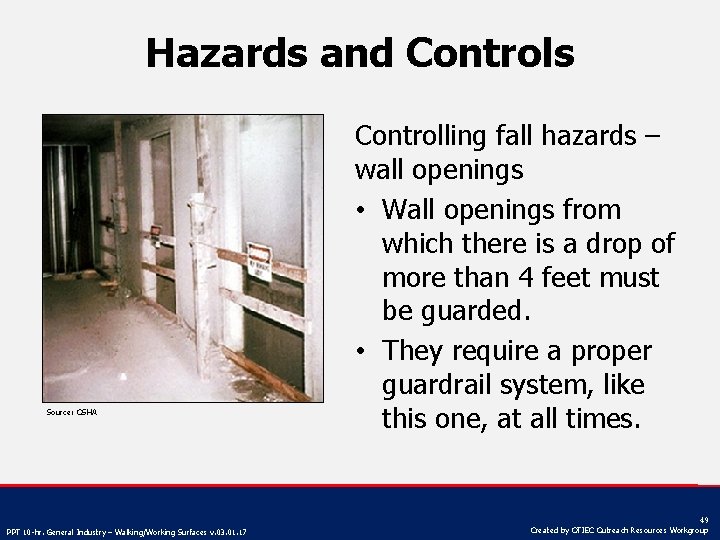
Hazards and Controls Source: OSHA PPT 10 -hr. General Industry – Walking/Working Surfaces v. 03. 01. 17 Controlling fall hazards – wall openings • Wall openings from which there is a drop of more than 4 feet must be guarded. • They require a proper guardrail system, like this one, at all times. 49 Created by OTIEC Outreach Resources Workgroup
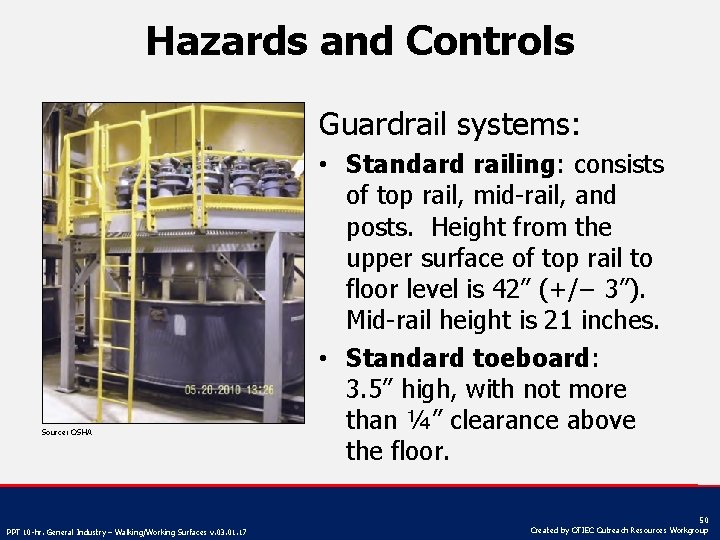
Hazards and Controls Guardrail systems: Source: OSHA PPT 10 -hr. General Industry – Walking/Working Surfaces v. 03. 01. 17 • Standard railing: consists of top rail, mid-rail, and posts. Height from the upper surface of top rail to floor level is 42” (+/− 3”). Mid-rail height is 21 inches. • Standard toeboard: 3. 5” high, with not more than ¼” clearance above the floor. 50 Created by OTIEC Outreach Resources Workgroup
Employer Requirements To prevent employees from being injured from falls, employers must: • Guard every floor hole into which a worker can accidentally walk. • Provide a guardrail and toeboard around every open-sided platform, floor or runway that is 4 feet or higher off the ground or next level. PPT 10 -hr. General Industry – Walking/Working Surfaces v. 03. 01. 17 51 Created by OTIEC Outreach Resources Workgroup
Employer Requirements • Regardless of height, if a worker can fall into or onto dangerous machines or equipment, employers must provide guardrails and toeboards. • Other means of fall protection that may be required on certain jobs include safety harness and line, safety nets, stair railings and handrails. PPT 10 -hr. General Industry – Walking/Working Surfaces v. 03. 01. 17 52 Created by OTIEC Outreach Resources Workgroup
Employer Requirements • Provide working conditions that are free of known dangers. • Keep floors in work areas in a clean and sanitary condition. • Select and provide required personal protective equipment at no cost to workers. • Train workers about job hazards in a language that they can understand. PPT 10 -hr. General Industry – Walking/Working Surfaces v. 03. 01. 17 53 Created by OTIEC Outreach Resources Workgroup
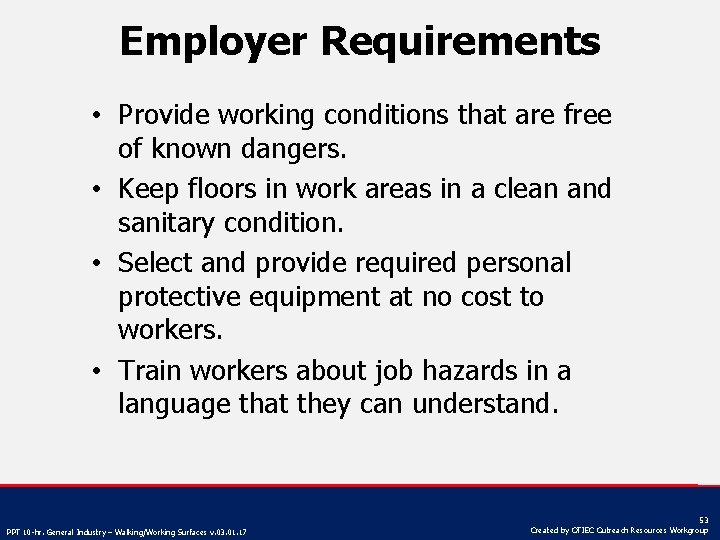
Hazard Recognition Identify hazards and what should be done to control them. Source of photos: WVU PPT 10 -hr. General Industry – Walking/Working Surfaces v. 03. 01. 17 54 Created by OTIEC Outreach Resources Workgroup
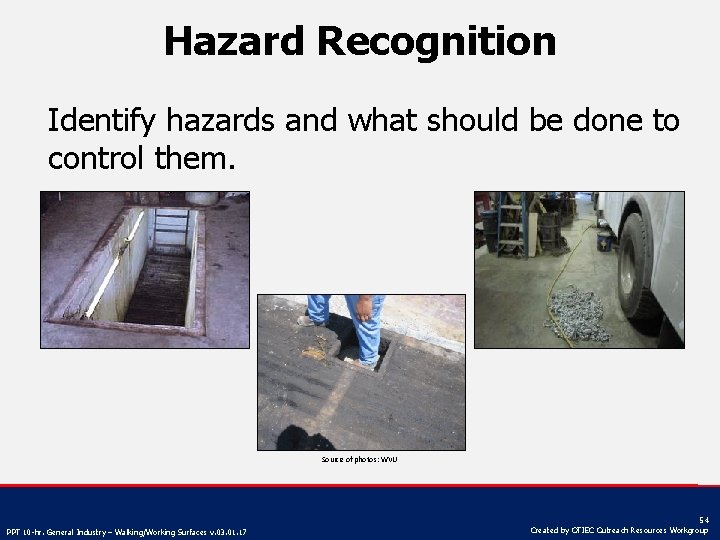
Hazard Recognition Identify hazards and what should be done to control them. Source : WVU Source: OSHA Source: WVU PPT 10 -hr. General Industry – Walking/Working Surfaces v. 03. 01. 17 55 Created by OTIEC Outreach Resources Workgroup
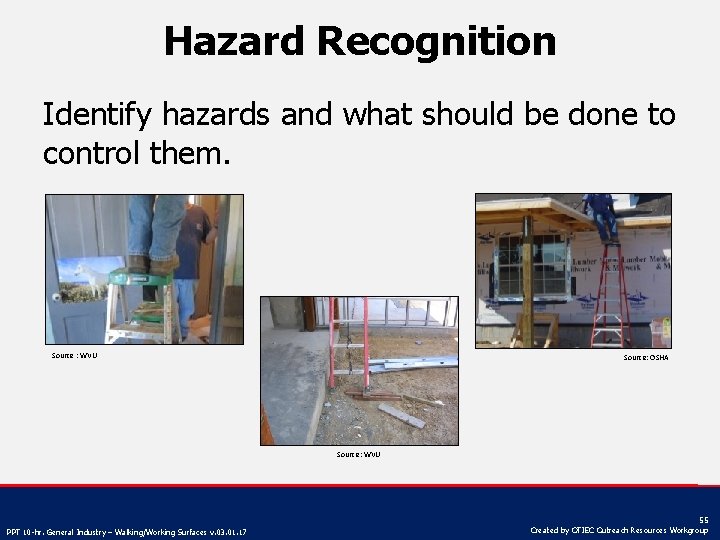
Hazard Recognition Identify hazards and what should be done to control them. Source of photos: OSHA PPT 10 -hr. General Industry – Walking/Working Surfaces v. 03. 01. 17 56 Created by OTIEC Outreach Resources Workgroup
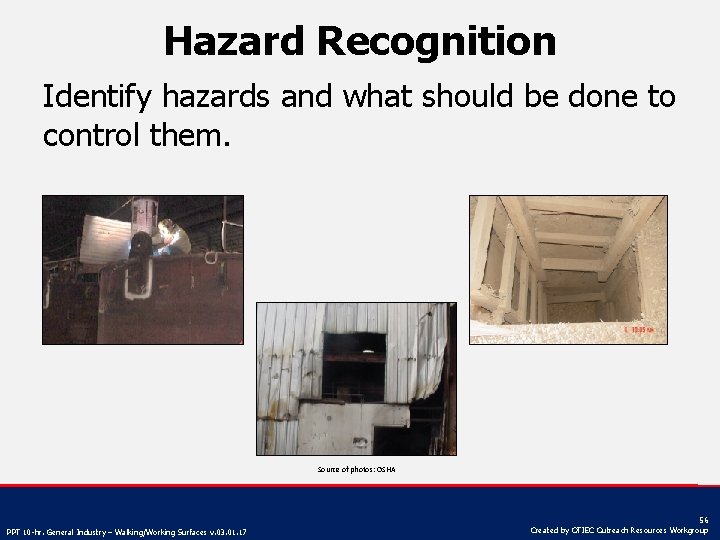
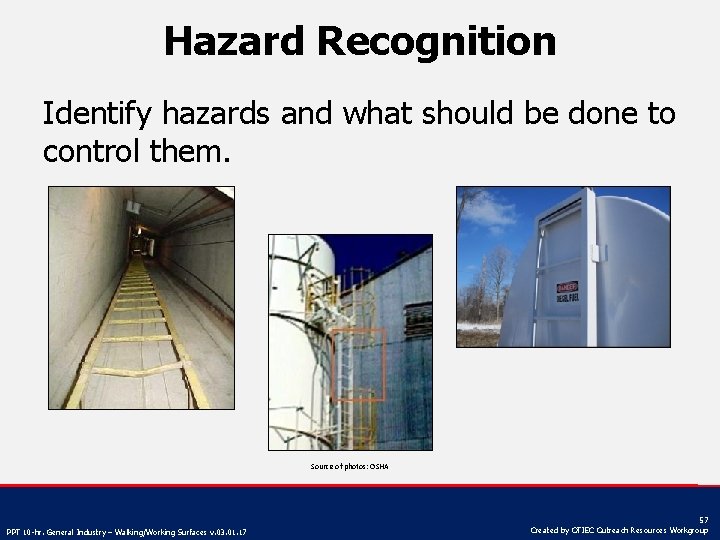
Hazard Recognition Identify hazards and what should be done to control them. Source of photos: OSHA PPT 10 -hr. General Industry – Walking/Working Surfaces v. 03. 01. 17 57 Created by OTIEC Outreach Resources Workgroup
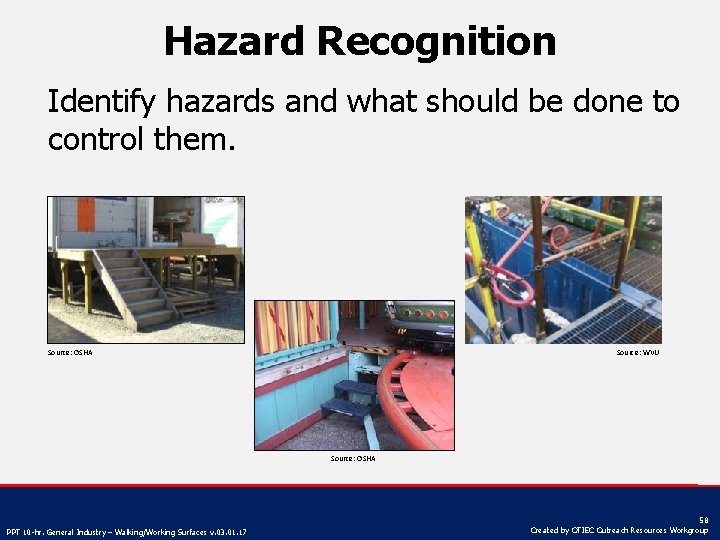
Hazard Recognition Identify hazards and what should be done to control them. Source: OSHA Source: WVU Source: OSHA PPT 10 -hr. General Industry – Walking/Working Surfaces v. 03. 01. 17 58 Created by OTIEC Outreach Resources Workgroup
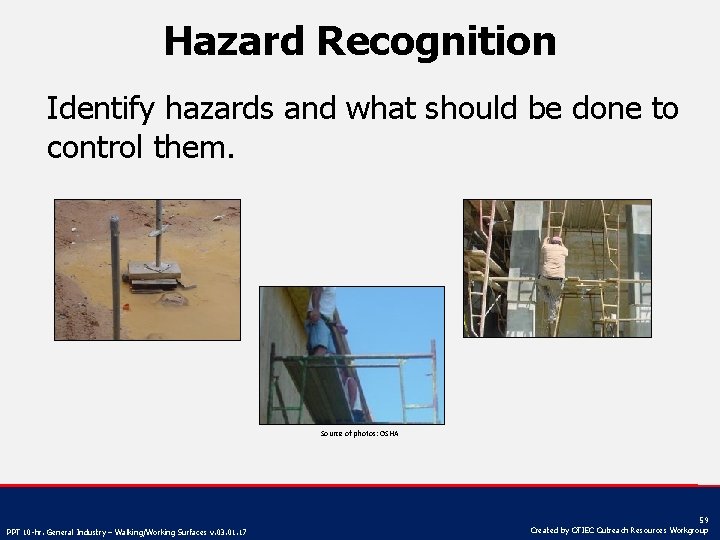
Hazard Recognition Identify hazards and what should be done to control them. Source of photos: OSHA PPT 10 -hr. General Industry – Walking/Working Surfaces v. 03. 01. 17 59 Created by OTIEC Outreach Resources Workgroup
Knowledge Check 1. Slips, trips, and falls make up what percent of all accidental deaths? a. 2% b. 15% c. 36% d. 50% Answer: b. 15% PPT 10 -hr. General Industry – Walking/Working Surfaces v. 03. 01. 17 60 Created by OTIEC Outreach Resources Workgroup
Knowledge Check 2. What is the easiest and most accurate way to use a portable ladder according to the manufacturer? a. Contact the manufacturer via cell phone b. Download the material from the internet. c. Read and follow all warning labels and stickers. d. Ask a fellow worker. Answer: c. Read and follow all warning labels and stickers. PPT 10 -hr. General Industry – Walking/Working Surfaces v. 03. 01. 17 61 Created by OTIEC Outreach Resources Workgroup
Knowledge Check 3. When using a portable ladder to access another level, which statement is true? a. A step ladder may be used if long enough. b. Portable ladders may never be used. c. The ladder should be secured and extend 3 feet above the level you are accessing. d. Carrying tools and materials is permitted. Answer: c. The ladder should be secured and extend 3 feet above the level you are accessing. PPT 10 -hr. General Industry – Walking/Working Surfaces v. 03. 01. 17 62 Created by OTIEC Outreach Resources Workgroup
Knowledge Check 4. The maximum work level height of a freestanding scaffold’s platform should never exceed ___ times the minimum base dimension. a. 2 b. 3 c. 4 d. 5 Answer: c. 4 PPT 10 -hr. General Industry – Walking/Working Surfaces v. 03. 01. 17 63 Created by OTIEC Outreach Resources Workgroup
Knowledge Check 5. Which best describes a safe scaffold? a. Placed on a firm foundation and is plumb and level b. Has proper access and is fully decked c. Has proper guardrail system d. All of the above Answer: d. All of the above PPT 10 -hr. General Industry – Walking/Working Surfaces v. 03. 01. 17 64 Created by OTIEC Outreach Resources Workgroup
Knowledge Check 6. Scissor lifts rated for outdoor use are generally limited to wind speeds below __. a. 28 MPH b. 50 MPH c. 60 MPH d. 75 MPH Answer: a. 28 MPH PPT 10 -hr. General Industry – Walking/Working Surfaces v. 03. 01. 17 65 Created by OTIEC Outreach Resources Workgroup
Knowledge Check 7. The height of a proper guardrail system is __ (+/− 3”) from the walking/working surface. a. 30 inches b. 42 inches c. 60 inches d. None of the above Answer: b. 42 inches PPT 10 -hr. General Industry – Walking/Working Surfaces v. 03. 01. 17 66 Created by OTIEC Outreach Resources Workgroup