
WALK THE LINE STEPHANIE DONALDSON GOVERNMENT INTERNAL AUDIT
- Slides: 24
WALK THE LINE STEPHANIE DONALDSON GOVERNMENT INTERNAL AUDIT AGENCY 3 March 2019
WALK THE LINE • INTRODUCTION • ORGANISATIONAL POSITION OF INTERNAL AUDIT • CIPFA STATEMENT: ROLE OF THE HEAD OF INTERNAL AUDIT (Revised 2019) • CIPFA ETHICS SURVEY / ETHICS WORKING GROUP • DRAWING “THE LINE”
INTRODUCTION
INTRODUCTION • CIPFA NW Vice President • Chair CIPFA TIS Editorial Board • CIPFA IA Special Interest Group (SIG) Member – CIPFA Statement on Role of the Ho. IA • CIPFA Ethics Working Group Member – Ethics Survey (2018) – SOPP on Ethics (2018)
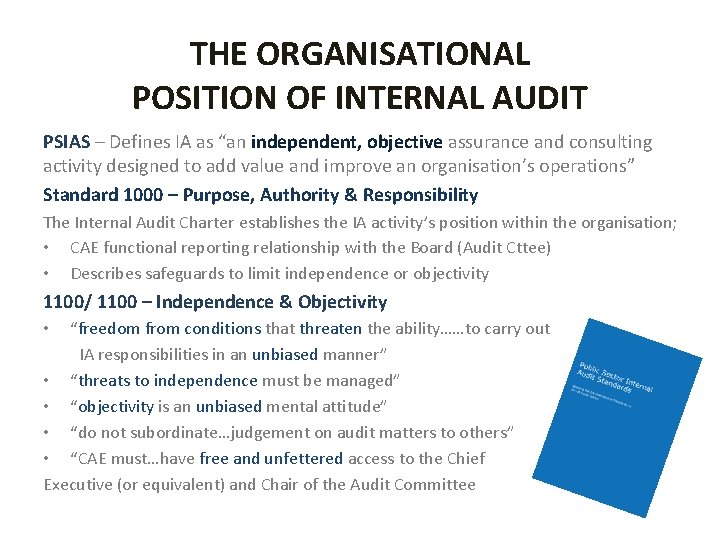
THE ORGANISATIONAL POSITION OF INTERNAL AUDIT PSIAS – Defines IA as “an independent, objective assurance and consulting activity designed to add value and improve an organisation’s operations” Standard 1000 – Purpose, Authority & Responsibility The Internal Audit Charter establishes the IA activity’s position within the organisation; • CAE functional reporting relationship with the Board (Audit Cttee) • Describes safeguards to limit independence or objectivity 1100/ 1100 – Independence & Objectivity “freedom from conditions that threaten the ability……to carry out IA responsibilities in an unbiased manner” • “threats to independence must be managed” • “objectivity is an unbiased mental attitude” • “do not subordinate…judgement on audit matters to others” • “CAE must…have free and unfettered access to the Chief Executive (or equivalent) and Chair of the Audit Committee •
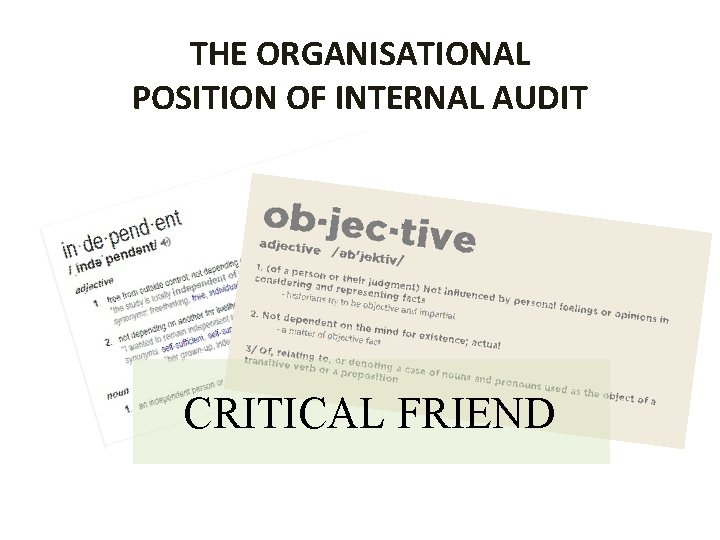
THE ORGANISATIONAL POSITION OF INTERNAL AUDIT CRITICAL FRIEND
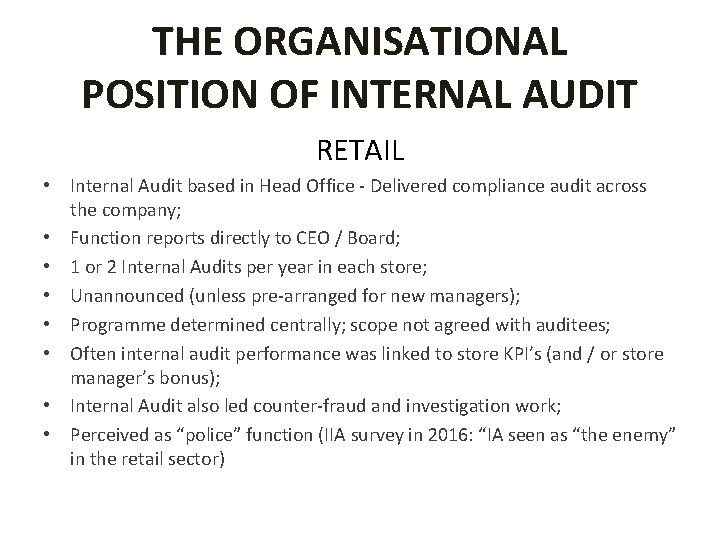
THE ORGANISATIONAL POSITION OF INTERNAL AUDIT RETAIL • Internal Audit based in Head Office - Delivered compliance audit across the company; • Function reports directly to CEO / Board; • 1 or 2 Internal Audits per year in each store; • Unannounced (unless pre-arranged for new managers); • Programme determined centrally; scope not agreed with auditees; • Often internal audit performance was linked to store KPI’s (and / or store manager’s bonus); • Internal Audit also led counter-fraud and investigation work; • Perceived as “police” function (IIA survey in 2016: “IA seen as “the enemy” in the retail sector)
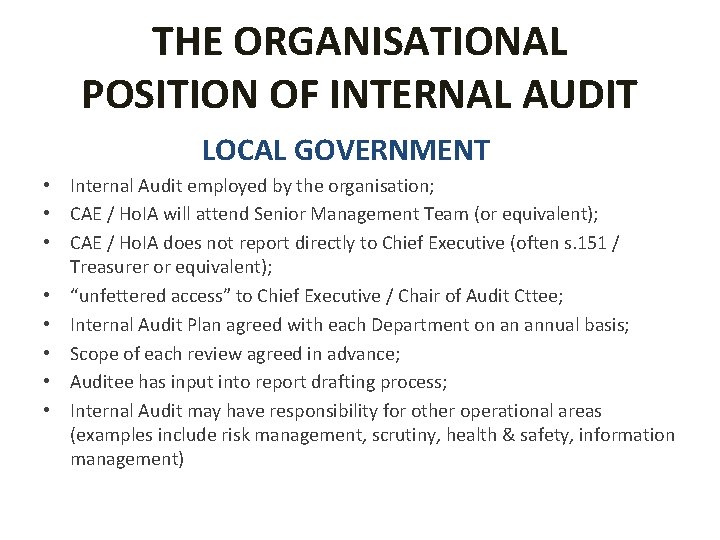
THE ORGANISATIONAL POSITION OF INTERNAL AUDIT LOCAL GOVERNMENT • Internal Audit employed by the organisation; • CAE / Ho. IA will attend Senior Management Team (or equivalent); • CAE / Ho. IA does not report directly to Chief Executive (often s. 151 / Treasurer or equivalent); • “unfettered access” to Chief Executive / Chair of Audit Cttee; • Internal Audit Plan agreed with each Department on an annual basis; • Scope of each review agreed in advance; • Auditee has input into report drafting process; • Internal Audit may have responsibility for other operational areas (examples include risk management, scrutiny, health & safety, information management)
THE ORGANISATIONAL POSITION OF INTERNAL AUDIT CENTRAL GOVERNMENT (GIAA) • • Provide IA services to 14 Government Departments (and over 120 ALB’s); GIAA is an ALB of HM Treasury; Not employed by the customers we provide services to; Do not attend Ex. Co, Op. Co, Board meetings or equivalent (unless requested); Plans are agreed on an annual basis (and associated fees); Consultancy work provided if requested (chargeable time); Operate in compliance with the PSIAS; Stakeholder Engagement Plans agreed to manage customer relationships
CIPFA STATEMENT: THE ROLE OF THE HEAD OF INTERNAL AUDIT Revised 2018/19 Launch date 9 April 2019 Updated to reflect the revised PSIAS Defines five principles for the core activities and behaviours of the role of the Ho. IA in public service organisations • Considers the organisational arrangements needed to support them • Sets out the governance arrangements required within an organisation to ensure that HIAs are able to operate effectively and perform their core duties • Details personal skills, professional standards, leadership skills and technical expertise organisations can expect from their HIA • •
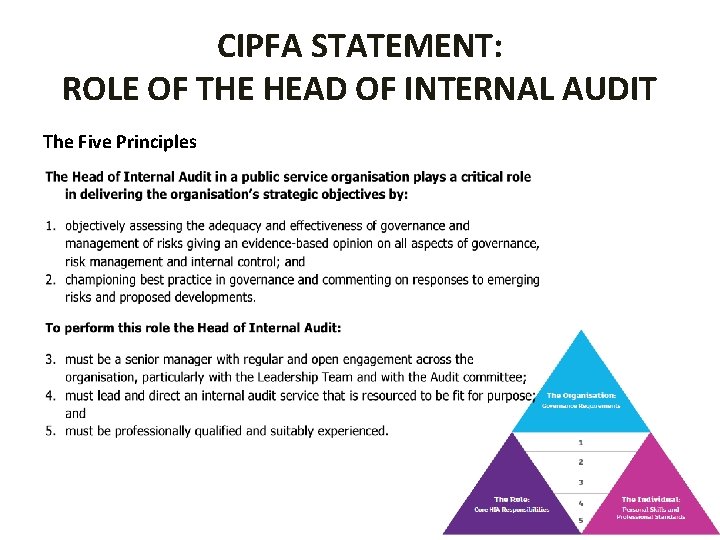
CIPFA STATEMENT: ROLE OF THE HEAD OF INTERNAL AUDIT The Five Principles
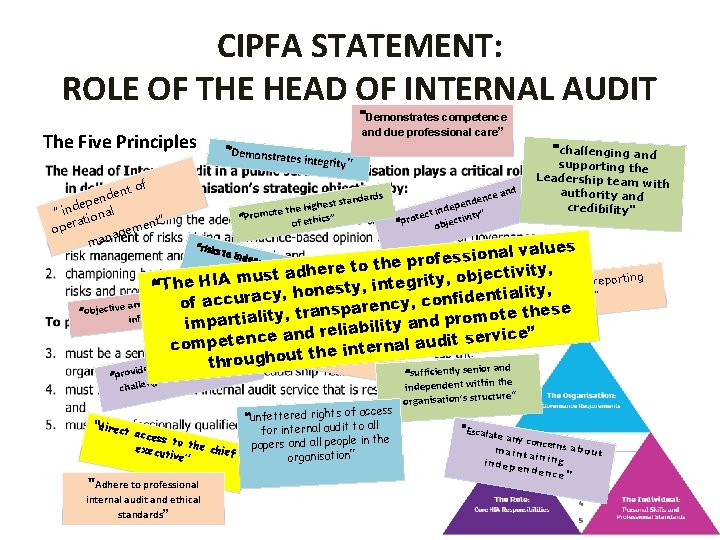
CIPFA STATEMENT: ROLE OF THE HEAD OF INTERNAL AUDIT The Five Principles of ent d n e dep “ in tional ra ent” m ope e ag man “Demonstrates competence and due professional care” “Demonstra te s integrity” ards st stand e h ig h e e th “Promot ” of ethics nd ce a nden e p e nd tect i ectivity” “pro obj “challenging an d supporting the Leadership team with authority and credibility” alues v l a n o i s s e prof to th“e integrity, ctivity, e j ob, jeo b c ti y A eporting v I t c it i o r H y m , g pette e n r, opriate r nce and c i “The e p , p y a “ t s e y onfidene lit du curacy, hon alit lines” mfuna tyi”a fid tin n o ee froo c fr c d , n y a c e v n ti e r “objec te these y, transpa o t i l m influence” a o i r t p r a d p n “Is appr im opn ls iability a riad telyrpe a e o c service” itioned t i tvee n adequately d u a a l n a comptre d n res inter cti ons u roughout theourced” c y l b i h ” tment e cred nior and “risks to ind epend ce m ere recog ena hst be isetd” du muns d age “provi to man e g n e chall access “unfettered rights of “direc all for internal audit to t acce ss to the in the c papers and all people execu h i e f tive” organisation” “Adhere to professional internal audit and ethical standards” “sufficiently se the independent within e” ur ct organisation’s stru “Escalat e any con cerns a bout maint aining indepe ndenc e”
CIPFA STATEMENT: THE ROLE OF THE HEAD OF INTERNAL AUDIT BIGGEST CHALLENGES? Assurance v. Consultancy Detachment v. Customer Intimacy “Insider” v. “Outsider” • Other operational Roles • Direct Line Management • Maintaining objectivity • Other influences / factors
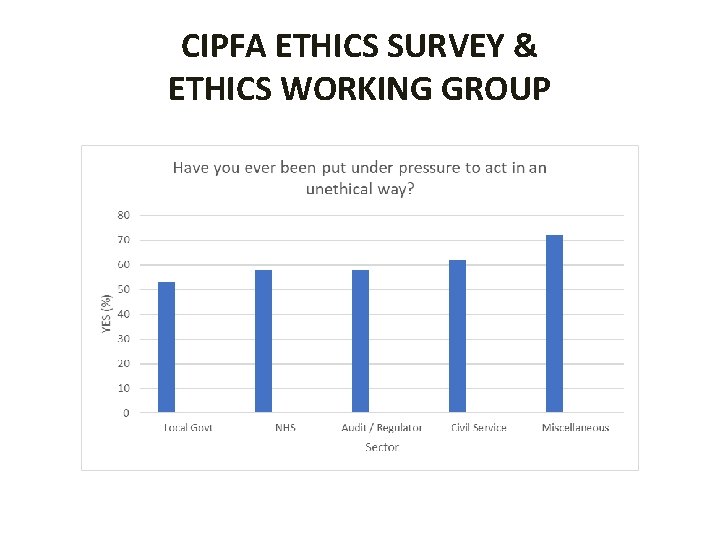
CIPFA ETHICS SURVEY & ETHICS WORKING GROUP CIPFA Ethics Survey of members and other public sector accountants about ethical in Summer 2018 The results found that 57% of the 487 respondents said they had been put under pressure or felt under pressure to act in a professionally unethical way. Of those who felt under pressure, 8% said they had fully carried out an unethical action, and 28% had done so partially. “Top 3” most cited unethical actions were: 1. Supporting excessively optimistic budgets and business cases (179) 2. Dodging policies, standing orders and other regulations (164) 3. Unreasonably downplaying risks (132) 88 respondents said that they had been asked not to disclose material facts in a report
CIPFA ETHICS SURVEY & ETHICS WORKING GROUP 487 RESPONDENTS • CIPFA 77% • Qualified 86% • 70% qualified 10+ years Sectors: Local Government 239 NHS 52 Civil Service / Regulator 41 Charity / Nf. P / Housing 23 FE / HE / Schools 15 Police / Fire 14 Audit Firm 12 Other incl Consultants, Commercial 56 Retired / not working / break 35
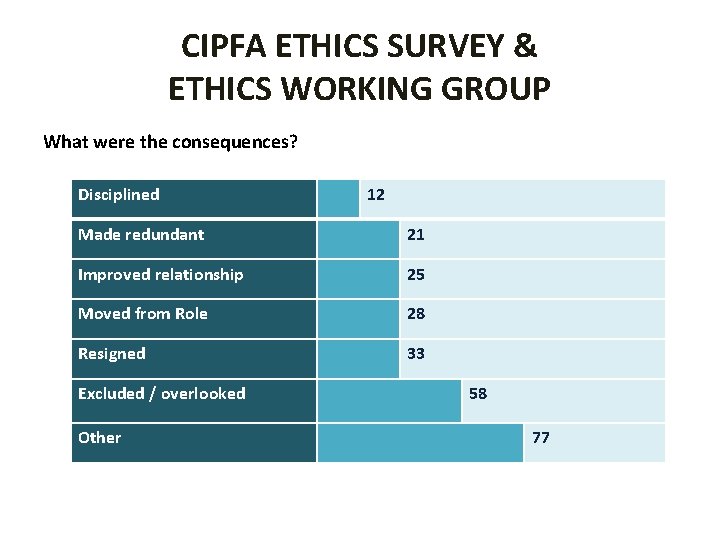
CIPFA ETHICS SURVEY & ETHICS WORKING GROUP 18 Questions in total Have you ever been put or felt under pressure to act unethically? How many times? Who put you under pressure? What were you asked to do? Were you offered incentives? Did you feel under threat? Did you undertake the unethical task? What consequences did you experience? Have you read your Institute’s Code of Ethics in last 3 years?
CIPFA ETHICS SURVEY & ETHICS WORKING GROUP
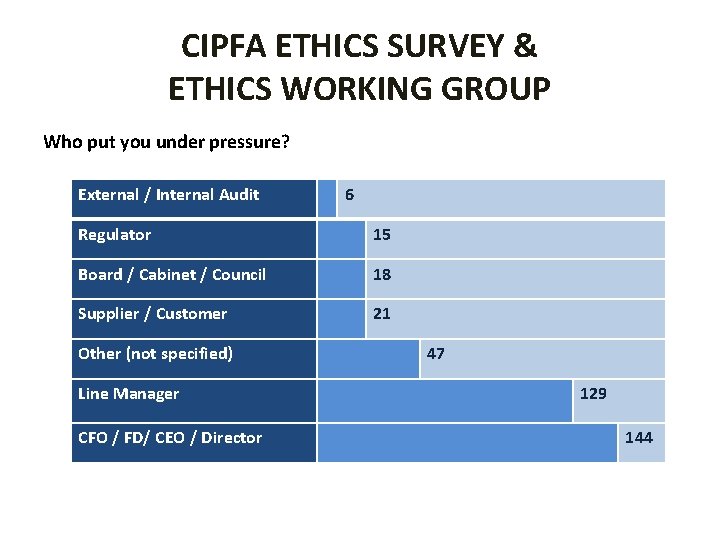
CIPFA ETHICS SURVEY & ETHICS WORKING GROUP Who put you under pressure? External / Internal Audit 6 Regulator 15 Board / Cabinet / Council 18 Supplier / Customer 21 Other (not specified) Line Manager CFO / FD/ CEO / Director 47 129 144
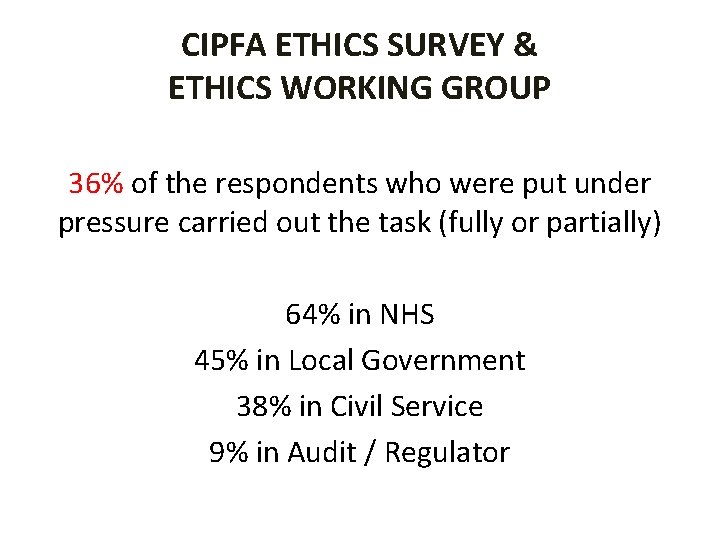
CIPFA ETHICS SURVEY & ETHICS WORKING GROUP 36% of the respondents who were put under pressure carried out the task (fully or partially) 64% in NHS 45% in Local Government 38% in Civil Service 9% in Audit / Regulator
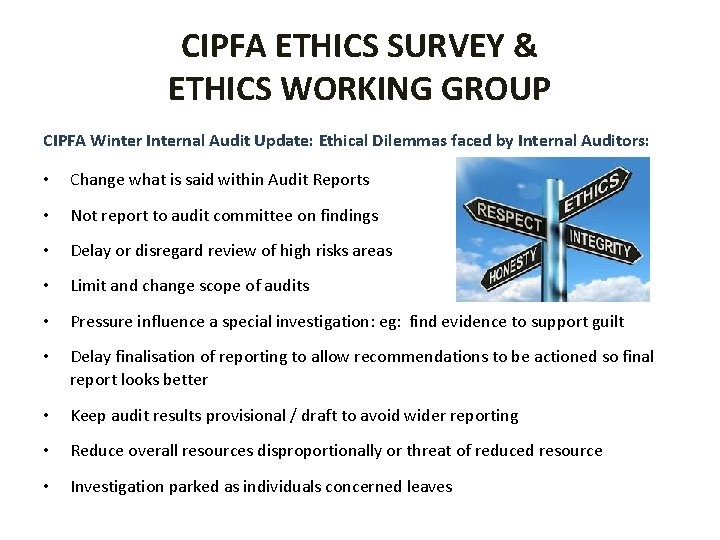
CIPFA ETHICS SURVEY & ETHICS WORKING GROUP CIPFA Winter Internal Audit Update: Ethical Dilemmas faced by Internal Auditors: • Change what is said within Audit Reports • Not report to audit committee on findings • Delay or disregard review of high risks areas • Limit and change scope of audits • Pressure influence a special investigation: eg: find evidence to support guilt • Delay finalisation of reporting to allow recommendations to be actioned so final report looks better • Keep audit results provisional / draft to avoid wider reporting • Reduce overall resources disproportionally or threat of reduced resource • Investigation parked as individuals concerned leaves
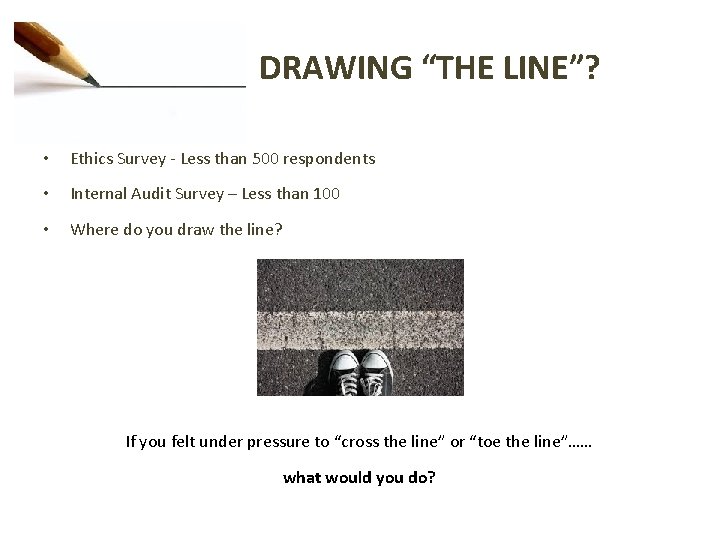
DRAWING “THE LINE”? • Ethics Survey - Less than 500 respondents • Internal Audit Survey – Less than 100 • Where do you draw the line? If you felt under pressure to “cross the line” or “toe the line”…… what would you do?
CIPFA ETHICS SURVEY & ETHICS WORKING GROUP What were the consequences? Disciplined 12 Made redundant 21 Improved relationship 25 Moved from Role 28 Resigned 33 Excluded / overlooked Other 58 77
CIPFA ETHICS SURVEY & ETHICS WORKING GROUP CIPFA adopted a new Statement of Professional Practice (SOPP) in line with the International Ethics Standards Board for Accountants (IESBA) Code of Ethics on 1 November 2018. As the only body specifically for public finance professionals worldwide, CIPFA brings together an international network able to offer support to these individuals as they face ethical dilemmas. Any public finance professional concerned about an ethical dilemma they are facing at their work can get in touch with experts via the Ethics Helpline: Ethics@cipfa. org For guidance and other information: https: //www. cipfa. org/members/conduct-and-ethics
THANKYOU Questions? STEPHANIE DONALDSON GOVERNMENT INTERNAL AUDIT AGENCY Stephanie. Donaldson@giaa. gov. uk