
Walk In Take out notebook agenda folder pencil

Walk In… • Take out notebook, agenda, folder, pencil box. • Answer at the back in sentences: • Why is it important to make a hypothesis (prediction) before doing an experiment?

Possible Answers • Scientists make a hypothesis or educated guess so they know what they are trying to find out. • By the end of the experiment, they realize their hypothesis was either SUPPORTED or NOT SUPPORTED (not right or wrong).
The Scientiic Method Scientists use this method as a set of steps to follow, to do an experiment in a logical way that someone else could duplicate. Let’s follow the steps through this experiment!

Does Practice Make Perfect?

Learning Target • Students will follow the Scientific Method as we perform a class experiment! • We will make a hypothesis, identify variables, and analyze our results.

The old saying is… • Practice makes perfect • What do you think that means? • What things have you practiced that you have improved on?
Practice Makes Perfect • Purpose: Does doing a task over and over improve your ability to perform the task? THE TASK: In today’s lab, you will be provided a number chart with numbers 1 -80 on them but mixed up. You will have to point to the numbers in order. Your goal is to get to the highest number in 1 minute. You will repeat the experiment 5 times. The goal of the experiment is to investigate how practice affects performance.
Hypothesis • Hypothesis: • If I repeat the same task 5 times, then my results will (improve, stay the same, or get worse) each time because ______.
Variables • Independent Variable (what we change): – amount of practice • Dependent Variable (what we measure): – The highest number reached in one minute
Variables • Control (what we keep the same to make it a “fair” experiment) • Same number chart each time • Same amount of time to count
Procedure 1. Keep the Number Chart face down. 2. At the teacher’s signal, turn the Number Chart over. 3. Place your finger on #1, the #2, and so on until time is called (1 minute). You MUST TOUCH EACH NUMBER as you count it. 4. Keep your finger on the last number you reached when the timer goes off. 5. Record the number in your data chart.
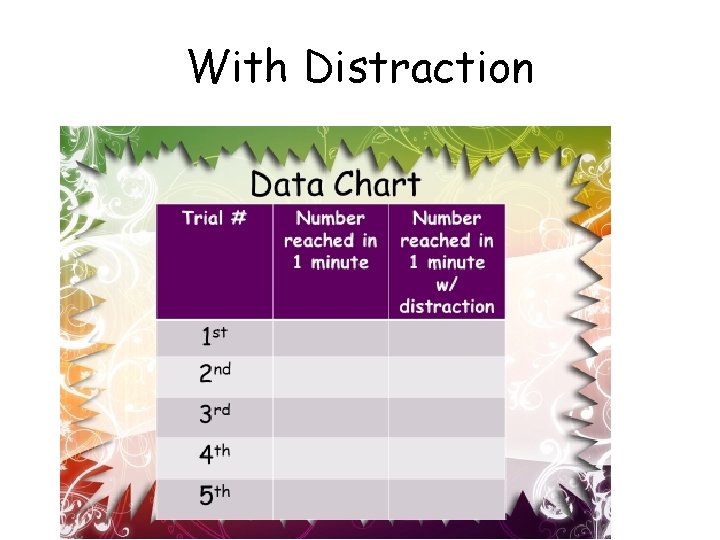
Data Chart Trial # 1 st 2 nd 3 rd 4 th 5 th Number reached in 1 minute
Ready to try it? • Ready to count? Wait until you are told to turn your paper over!
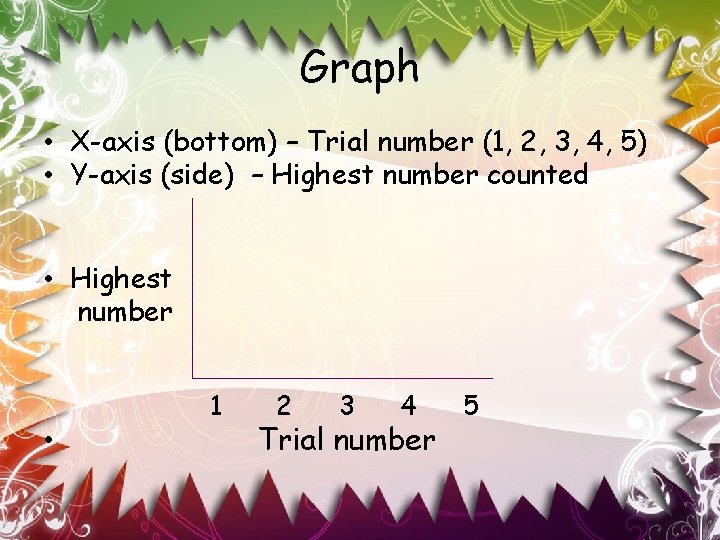
Graph • X-axis (bottom) – Trial number (1, 2, 3, 4, 5) • Y-axis (side) – Highest number counted • Highest number 1 • 2 3 4 Trial number 5
Conclusion 1. Was your hypothesis supported? 2. Why or why not? Use data from your chart to answer this question.
Conclusion continued 3. What other experiments could you create using this number chart?
For Fun 1. See how a distraction affects your results. 2. Record your time. Number reached with distraction: _____ 3. Set the time to count up. 4. Find all the numbers from 1 -100. 5. Record your time Time to reach 100: ______
With Distraction
- Slides: 18