
Wales Safeguarding Procedures Consent and capacity Seeking consent
- Slides: 20
Wales Safeguarding Procedures Consent and capacity
Seeking consent to a report Obtaining consent to report from the adult at risk means they are much more likely to engage in the safeguarding process, have effective outcomes and a more effective working partnership with you Try to obtain consent from the adult at risk However, the overriding consideration when you decide whether to try to get consent before making a report is the level of harm present to the adult at risk
What is consent? Consent means that a person makes an informed decision to give their permission For consent to be valid, it must be voluntary and informed, and the person consenting must have the freedom and capacity to consent The decision to either consent or not to consent to something must be made by the person, and must not be influenced by pressure from practitioners, friends or family members
What is consent? Consent means that a person makes an informed decision to give their permission For consent to be valid, it must be voluntary and informed, and the person consenting must have the freedom and capacity to consent The person must have all the information about what is involved with making a report, including the benefits and risks, whethere are reasonable alternatives, and what could happen if the practitioner did not make a report
What is consent? Consent means that a person makes an informed decision to give their permission For consent to be valid, it must be voluntary and informed, and the person consenting must have the freedom and capacity to consent The adult at risk has freedom to consent and is not: • being subjected to violence or fear of violence • being unlawfully detained • being intentionally deceived
What is mental capacity? For consent to be valid, a person must have the mental capacity to consent Mental capacity is specific to a particular decision at a particular time This means a person may have capacity: • to make some decisions but not others • to make decisions on some occasions, but not others
What is mental capacity? For consent to be valid, a person must have the mental capacity to consent In order to make a decision some adults at risk may require additional support such as advocacy, simplified explanations, visual aids and additional time They are entitled in law to receive this support
What is mental capacity? There are two tests that must be undertaken to assess capacity: 1. Diagnostic test – looking for evidence that the person is suffering from: “an impairment of, or a disturbance in, the functioning of the mind or brain” 2. Functional test
What is mental capacity? To have capacity, a person must be able to: • understand the information about the decision (explained in a way that is appropriate to them) • retain the information long enough to make that decision, even if that is only for a short period • use or weigh-up the information to make a choice (for instance, understanding the consequences of deciding one choice over another or of not making a choice) • communicate their decision
Principles of capacity You cannot establish capacity based only on a person’s age, appearance, condition, or behaviour. With an adult at risk you must: • assume they have capacity unless/until established that they don’t • treat them as able to make a decision unless/until you have taken all practical steps to help them decide without success • not treat them as unable to make a decision because their decision may seem unwise
Lack of capacity A person lacks capacity if their mind is impaired or disturbed in some way that means they are unable to make a decision at that time This includes being: • under the influence of a substance to the degree that they can’t make decisions • asleep or otherwise unconscious • unable to communicate in any way
Assessing capacity When assessing whether an adult at risk can give consent, consider: • is there evidence they do not have mental capacity? • are you making assumptions about a person’s capacity based on their age, appearance, condition or behaviour? • can the adult make decisions about any part of the process?
Assessing capacity • Have you made every attempt to encourage and enable the adult at risk to take part in making a decision? • Have you given the adult at risk appropriate methods of communication? • Is their loss of capacity temporary? Would a delay put them at increased risk of harm?
Any act or decision you make on behalf of a person who does not have capacity must be in their best interests When deciding whether a decision is in someone’s best interest: • consider all relevant circumstances about the person • encourage and enable the person to participate as fully as possible in the decision-making process • consider any of the person’s past and present wishes, feelings, beliefs and values which would likely influence their decision
Any act or decision you make on behalf of a person who does not have capacity must be in their best interests When deciding whether a decision is in someone’s best interest: • consider the views of: o anyone the adult at risk has identified as a person you should consult o anyone who is caring for the person or interested in their welfare, including anyone with a ‘power of attorney’ and any deputy appointed by the court
Any act or decision you make on behalf of a person who does not have capacity must be in their best interests When deciding whether a decision is in someone’s best interest: • weigh the likely advantages for the person of making the decision against the likely disadvantages – it is only in the person’s best interests if the advantages significantly outweigh the disadvantages
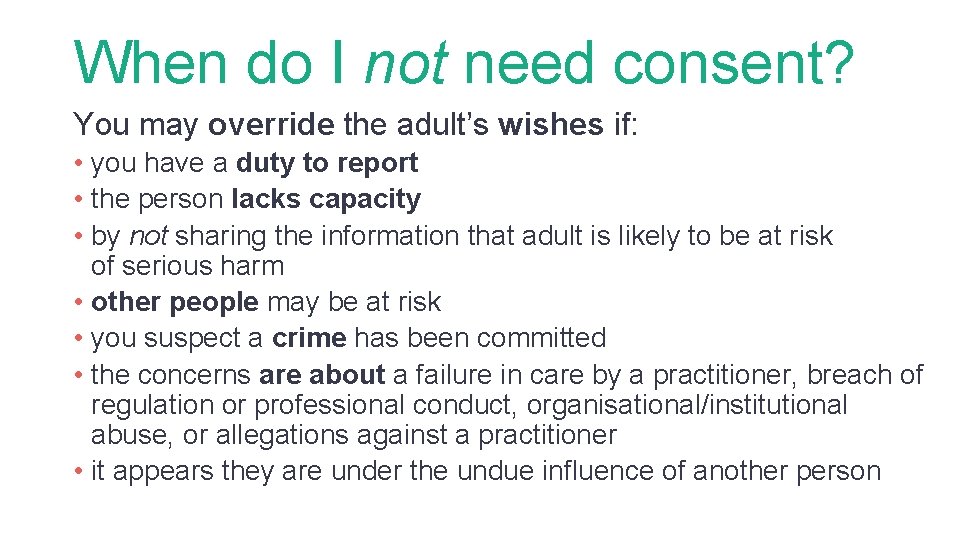
When do I not need consent? You may override the adult’s wishes if: • you have a duty to report • the person lacks capacity • by not sharing the information that adult is likely to be at risk of serious harm • other people may be at risk • you suspect a crime has been committed • the concerns are about a failure in care by a practitioner, breach of regulation or professional conduct, organisational/institutional abuse, or allegations against a practitioner • it appears they are under the undue influence of another person
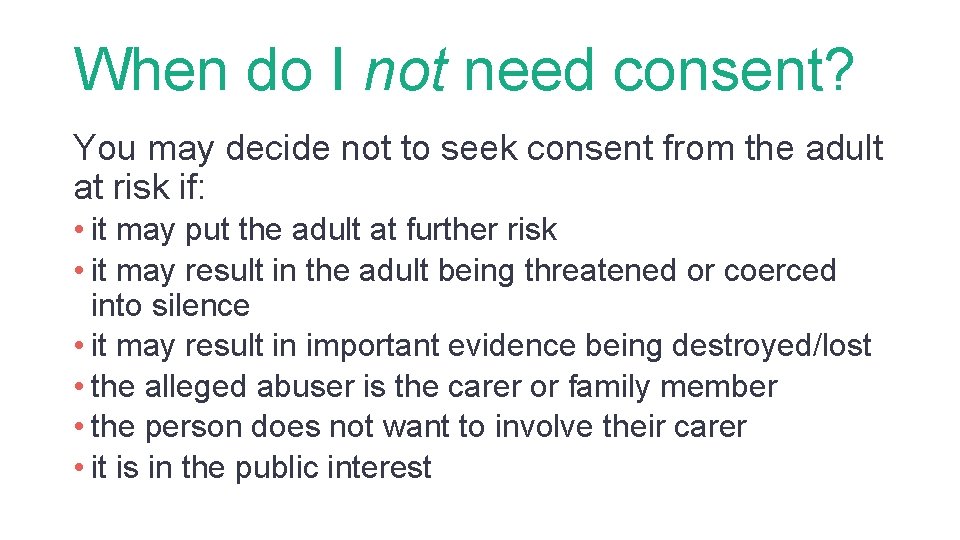
When do I not need consent? You may decide not to seek consent from the adult at risk if: • it may put the adult at further risk • it may result in the adult being threatened or coerced into silence • it may result in important evidence being destroyed/lost • the alleged abuser is the carer or family member • the person does not want to involve their carer • it is in the public interest
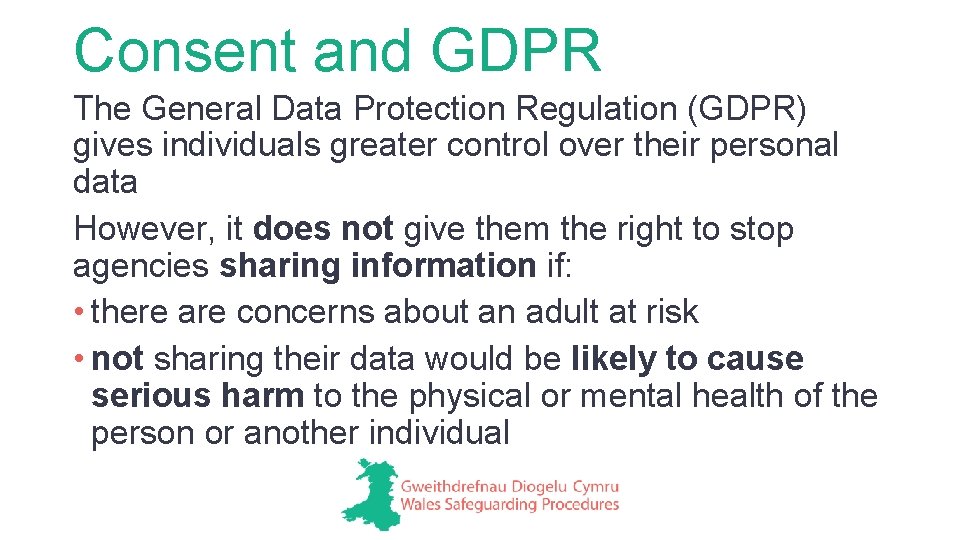
Consent and GDPR The General Data Protection Regulation (GDPR) gives individuals greater control over their personal data However, it does not give them the right to stop agencies sharing information if: • there are concerns about an adult at risk • not sharing their data would be likely to cause serious harm to the physical or mental health of the person or another individual
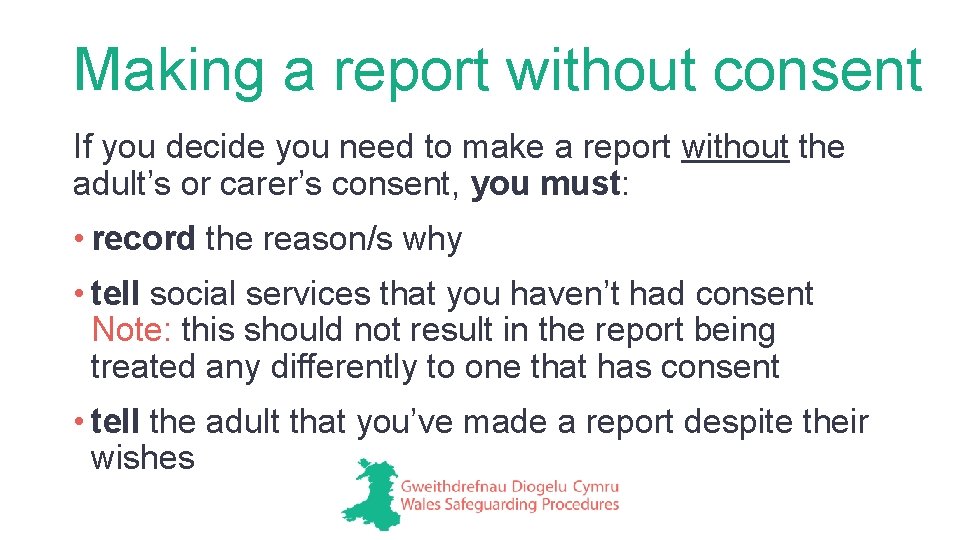
Making a report without consent If you decide you need to make a report without the adult’s or carer’s consent, you must: • record the reason/s why • tell social services that you haven’t had consent Note: this should not result in the report being treated any differently to one that has consent • tell the adult that you’ve made a report despite their wishes