
Waiting line Models Some Examples Situation Arriving customers
- Slides: 23
Waiting line Models
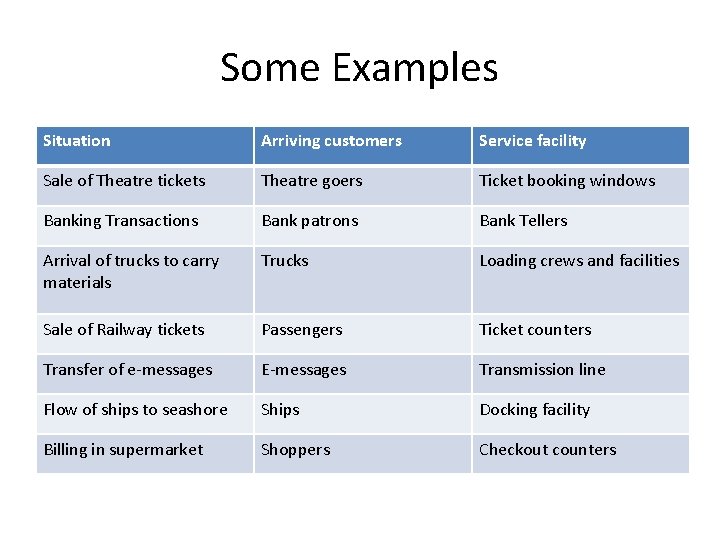
Some Examples Situation Arriving customers Service facility Sale of Theatre tickets Theatre goers Ticket booking windows Banking Transactions Bank patrons Bank Tellers Arrival of trucks to carry materials Trucks Loading crews and facilities Sale of Railway tickets Passengers Ticket counters Transfer of e-messages E-messages Transmission line Flow of ships to seashore Ships Docking facility Billing in supermarket Shoppers Checkout counters
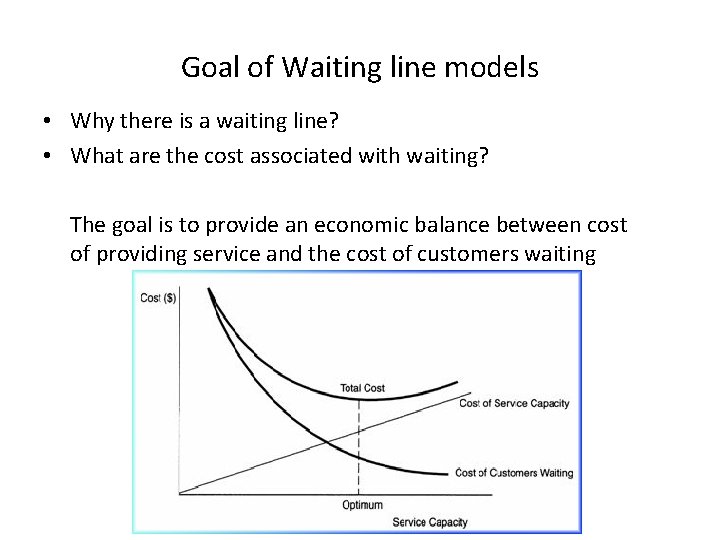
Goal of Waiting line models • Why there is a waiting line? • What are the cost associated with waiting? The goal is to provide an economic balance between cost of providing service and the cost of customers waiting
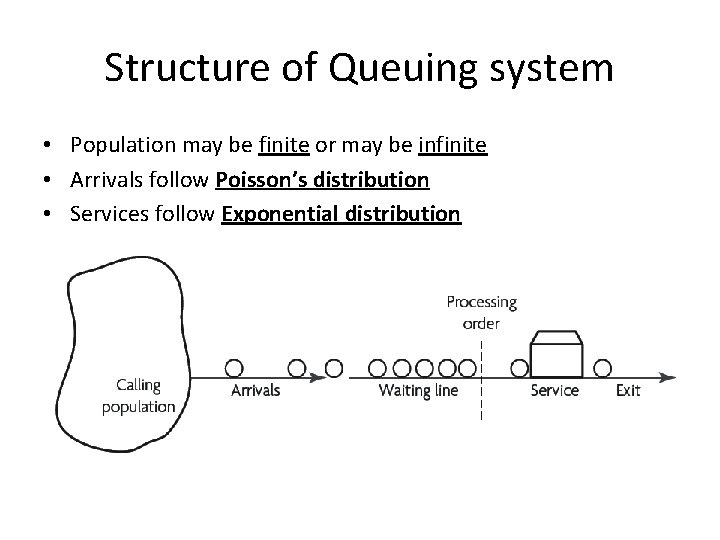
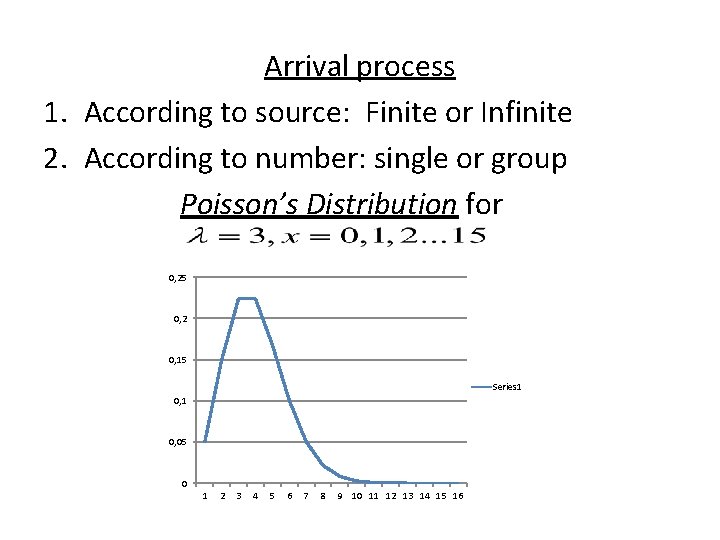
Structure of Queuing system • Population may be finite or may be infinite • Arrivals follow Poisson’s distribution • Services follow Exponential distribution
Arrival process 1. According to source: Finite or Infinite 2. According to number: single or group Poisson’s Distribution for 0, 25 0, 2 0, 15 Series 1 0, 05 0 1 2 3 4 5 6 7 8 9 10 11 12 13 14 15 16
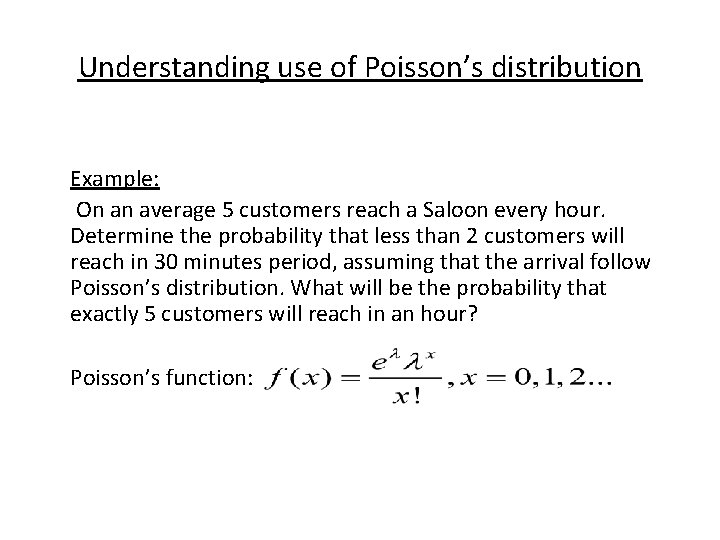
Understanding use of Poisson’s distribution Example: On an average 5 customers reach a Saloon every hour. Determine the probability that less than 2 customers will reach in 30 minutes period, assuming that the arrival follow Poisson’s distribution. What will be the probability that exactly 5 customers will reach in an hour? Poisson’s function:
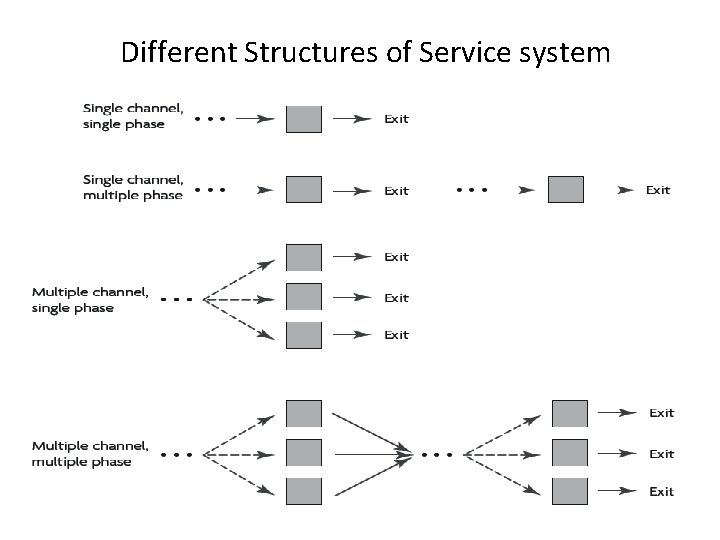
Different Structures of Service system
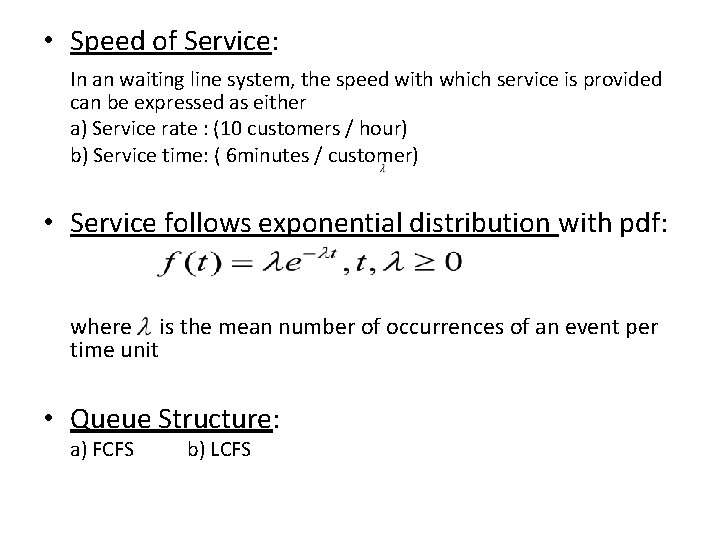
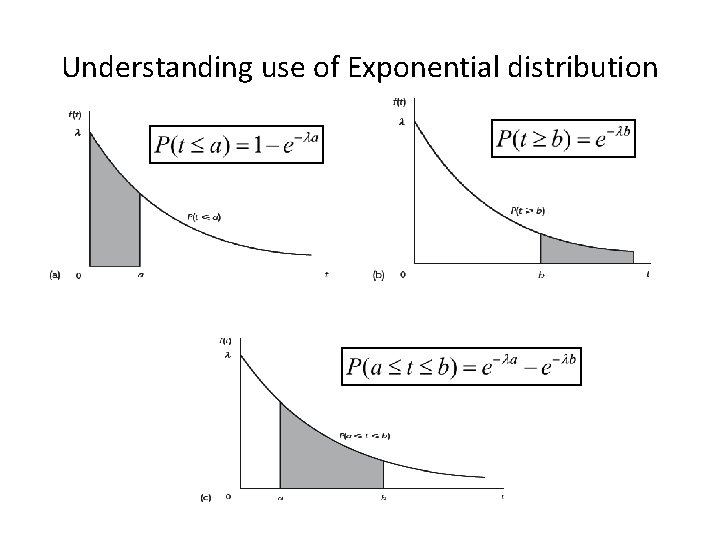
• Speed of Service: In an waiting line system, the speed with which service is provided can be expressed as either a) Service rate : (10 customers / hour) b) Service time: ( 6 minutes / customer) • Service follows exponential distribution with pdf: where is the mean number of occurrences of an event per time unit • Queue Structure: a) FCFS b) LCFS
Understanding use of Exponential distribution
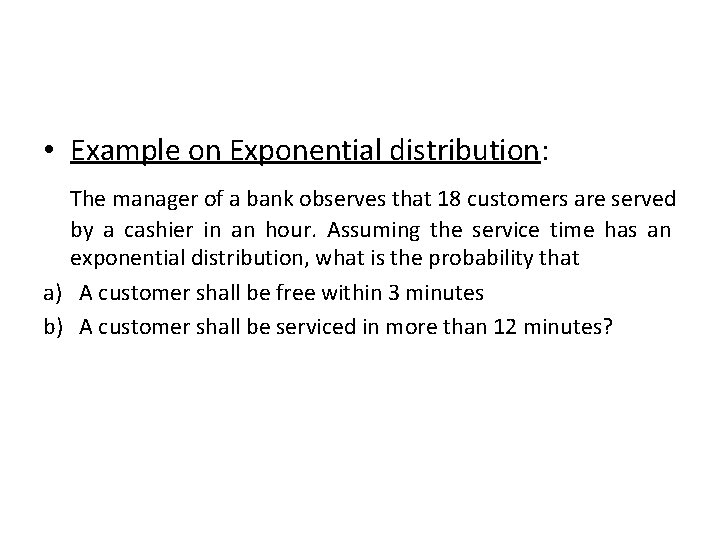
• Example on Exponential distribution: The manager of a bank observes that 18 customers are served by a cashier in an hour. Assuming the service time has an exponential distribution, what is the probability that a) A customer shall be free within 3 minutes b) A customer shall be serviced in more than 12 minutes?
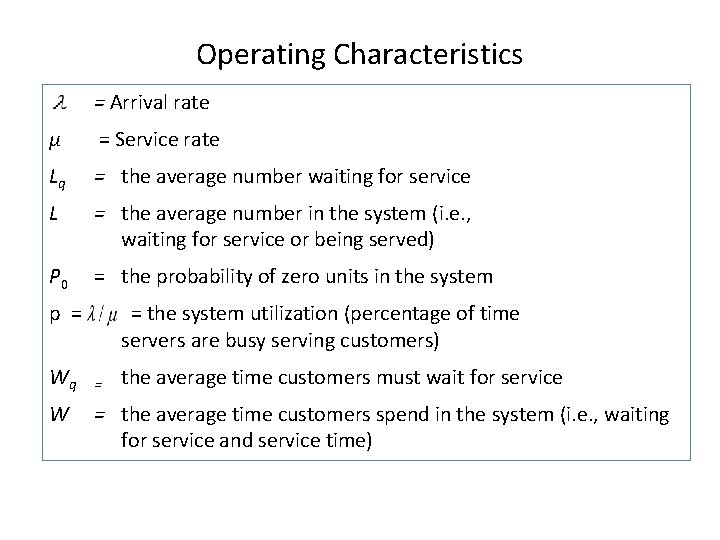
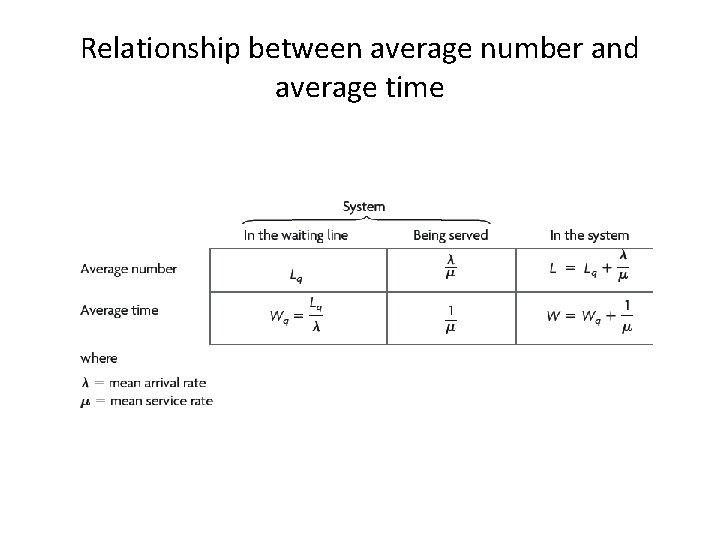
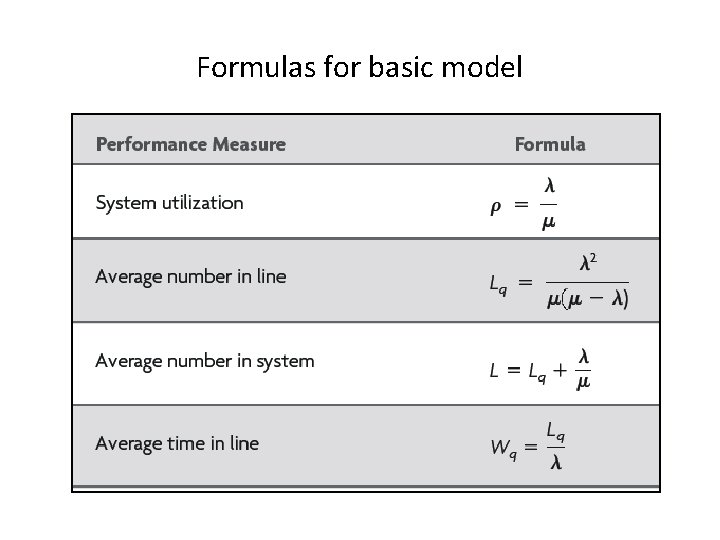
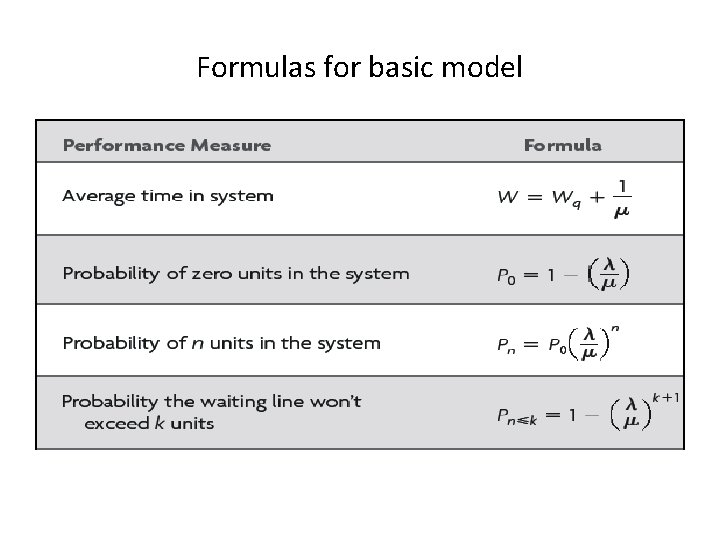
Operating Characteristics = Arrival rate µ = Service rate Lq = the average number waiting for service L = the average number in the system (i. e. , waiting for service or being served) P 0 = the probability of zero units in the system p = Wq W = the system utilization (percentage of time servers are busy serving customers) = the average time customers must wait for service = the average time customers spend in the system (i. e. , waiting for service and service time)
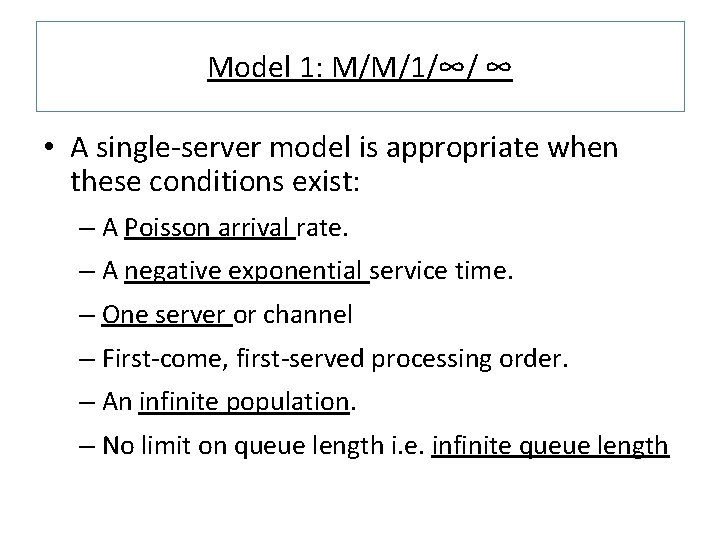
Model 1: M/M/1/∞/ ∞ • A single-server model is appropriate when these conditions exist: – A Poisson arrival rate. – A negative exponential service time. – One server or channel – First-come, first-served processing order. – An infinite population. – No limit on queue length i. e. infinite queue length
Relationship between average number and average time
Formulas for basic model
Formulas for basic model
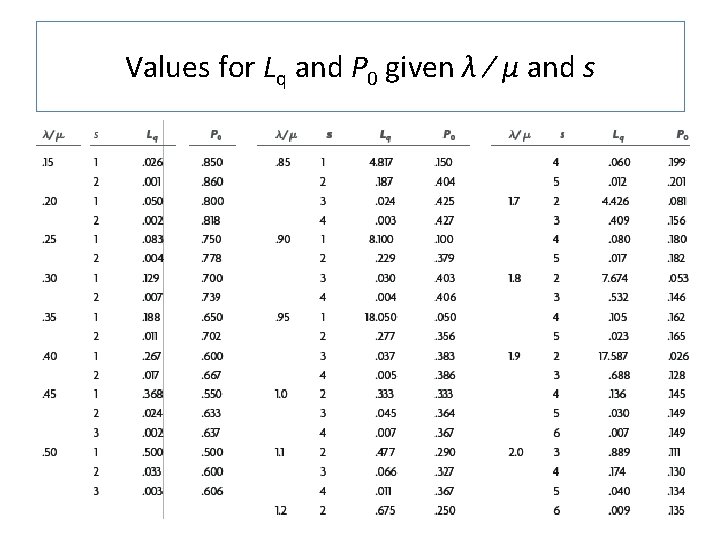
Values for Lq and P 0 given λ ⁄ μ and s
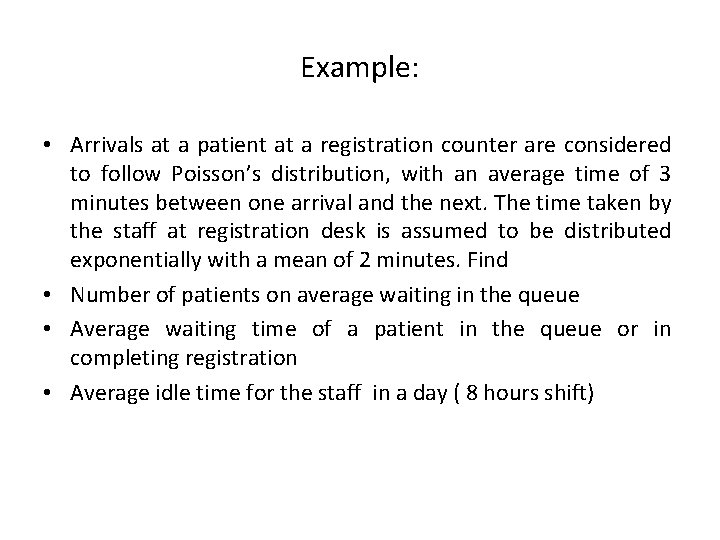
Example: • Arrivals at a patient at a registration counter are considered to follow Poisson’s distribution, with an average time of 3 minutes between one arrival and the next. The time taken by the staff at registration desk is assumed to be distributed exponentially with a mean of 2 minutes. Find • Number of patients on average waiting in the queue • Average waiting time of a patient in the queue or in completing registration • Average idle time for the staff in a day ( 8 hours shift)
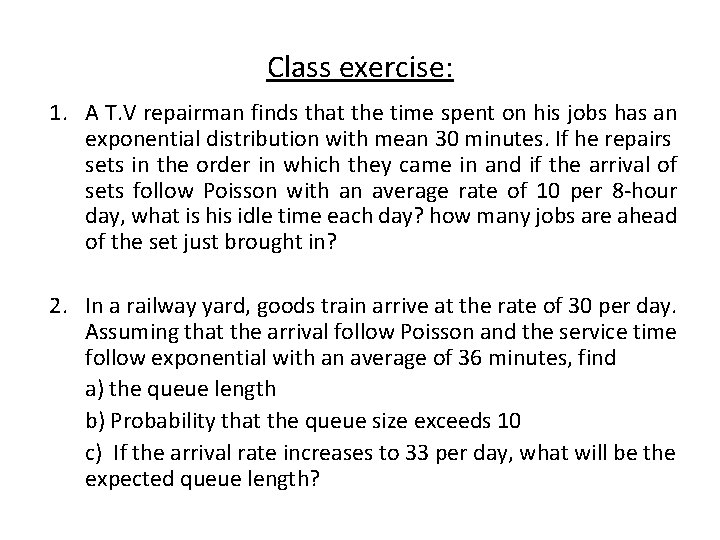
Class exercise: 1. A T. V repairman finds that the time spent on his jobs has an exponential distribution with mean 30 minutes. If he repairs sets in the order in which they came in and if the arrival of sets follow Poisson with an average rate of 10 per 8 -hour day, what is his idle time each day? how many jobs are ahead of the set just brought in? 2. In a railway yard, goods train arrive at the rate of 30 per day. Assuming that the arrival follow Poisson and the service time follow exponential with an average of 36 minutes, find a) the queue length b) Probability that the queue size exceeds 10 c) If the arrival rate increases to 33 per day, what will be the expected queue length?
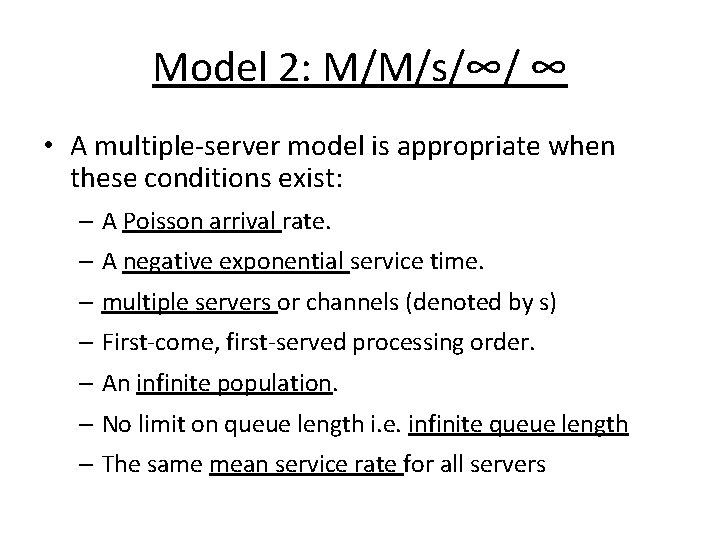
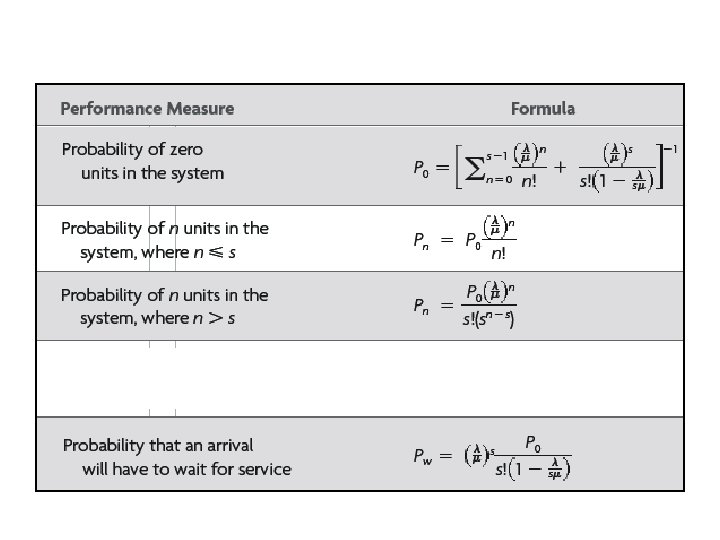
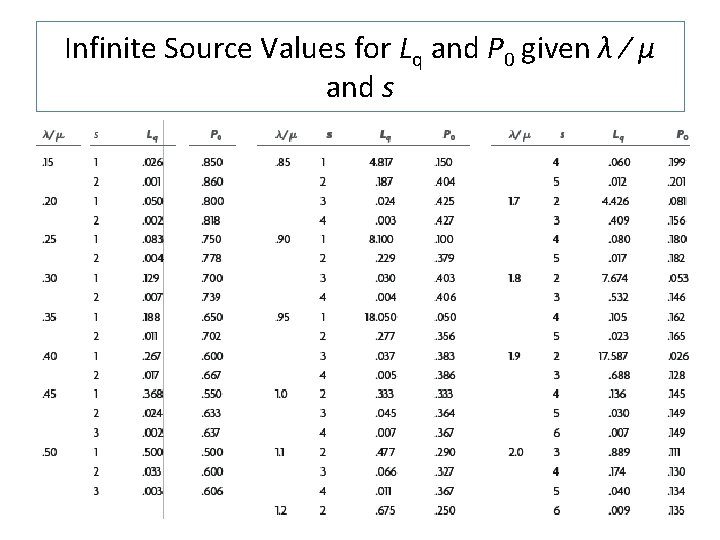
Model 2: M/M/s/∞/ ∞ • A multiple-server model is appropriate when these conditions exist: – A Poisson arrival rate. – A negative exponential service time. – multiple servers or channels (denoted by s) – First-come, first-served processing order. – An infinite population. – No limit on queue length i. e. infinite queue length – The same mean service rate for all servers
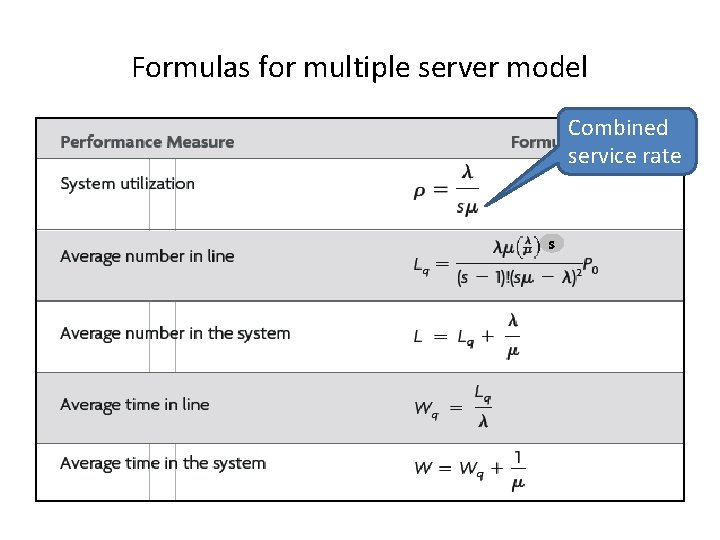
Formulas for multiple server model Combined service rate s
Infinite Source Values for Lq and P 0 given λ ⁄ μ and s
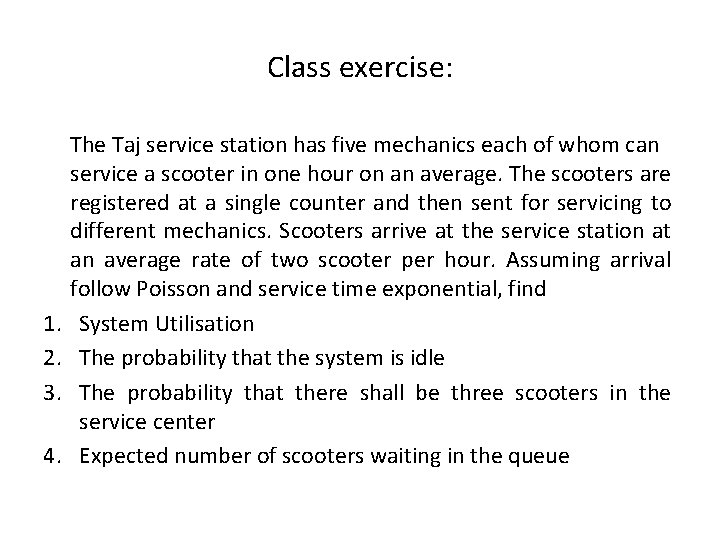
Class exercise: 1. 2. 3. 4. The Taj service station has five mechanics each of whom can service a scooter in one hour on an average. The scooters are registered at a single counter and then sent for servicing to different mechanics. Scooters arrive at the service station at an average rate of two scooter per hour. Assuming arrival follow Poisson and service time exponential, find System Utilisation The probability that the system is idle The probability that there shall be three scooters in the service center Expected number of scooters waiting in the queue