
Waiting For Godot By Samuel Beckett Samuel Beckett
Waiting For Godot By Samuel Beckett
Samuel Beckett • He was born on the 13 th of April 1906 in Dublin and died in 1989. • Young Samuel attended Earlsfort House School in Dublin, then at 14, he went to Portora Royal School. • He received his Bachelor’s degree from Trinity College in 1927 • Samuel Beckett, once stated, “I had little talent for happiness. ” In his youth he would periodically experience severe depression keeping him in bed until mid-day. This experience would later influence his writing. • In 1928, Samuel Beckett found a welcome home in Paris where he met and became a devoted student of James Joyce. In 1931, he embarked on a restless sojourn through Britain, France and Germany. He wrote poems and stories and did odd jobs to support himself. On his journey, he came across many individuals who would inspire some of his most interesting characters.
• he met Suzanne Dechevaux-Dumesnuil and the two would become life-long companions and eventually marry. During their stay in Paris, he began his most prolific period as a writer. In five years, he wrote Eleutheria, Waiting for Godot, Endgame, the novels Malloy, Malone Dies, The Unnamable, and Mercier et Camier, two books of short stories, and a book of criticism. • By the late 1980 s, Samuel Beckett was in failing health and had moved to a small nursing home. Suzanne, his wife, had died in July 1989. His life was confined to a small room where he would receive visitors and write. He died on December 22, 1989, in a hospital of respiratory problems just months after his wife.
Theatre of the Absurd • Theatre of the Absurd is a theatrical style originating in France in the late 1940 s. It relies heavily on Existentialist philosophy, and is a category of or plays of absurdist fiction, written by a number of playwrights from the late 1940 s to the 1960 s, as well as theatre which has evolved from their work. It expresses the belief that, in a godless universe, human existence has no meaning or purpose and therefore all communication breaks down. Logical construction and argument give way to irrational and illogical speech and as its ultimate conclusion, silence. • Theater of the Absurd follows the concepts of existential philosophy. The theatrical style aims to show a world where man is born with only himself and nothing else (no God). So, it means {and keep it in mind} : GODOT is not GOD! • Martin Esslin coined the term "Theatre of the Absurd" in his 1960 essay and, later, a book of the same name. He related these plays based on a broad theme of the Absurd. The Absurd in these plays takes the form of man’s reaction to a world apparently without meaning, and/or man as a puppet controlled or menaced by invisible outside forces.
Existentialism • Existentialism in the broader sense is a philosophy that is centered upon the analysis of the existence and of the way human beings find themselves existing in the world. • The notion is that humans exist first and then each individual spends a lifetime changing their essence of nature. • A philosophy concerned with finding self and the meaning of life through free will, choice, and personal responsibility. • Defining existentialism is difficult as its philosophers not only contradict each other, but individuals tend to contradict their own stated beliefs both in writings and in actions. • Those most often associated with existentialism failed to form a cohesive philosophical discipline based on existential theories. • Existentialism is multi form and mutable to be compressed into a line. Existentialism is not a philosophy but a label for several widely different revolts against traditional philosophy • Though existentialism is a term applied loosely to range of philosophies, there are unifying themes in the writings of the existentialists.
• it is a philosophy that emphasizes individual existence, freedom and choice. • It is the view that humans define their own meaning in life, and try to make rational decisions despite existing in an irrational universe. • It focuses on the question of human existence, and the feeling that there is no purpose or explanation at the core of existence. • It holds that, as there is no God or any other.
What is not existentialism? • Wealth, pleasures or honor make the good life. • Social values and structure control the individual. • Accept what is and that is enough in life. • Science can and will make everything better. • People are basically good but ruined by society or external forces.
• Existentialism originated with the 19 th Century philosophers Søren Kierkegaard and Friedrich Nietzsche, although neither used the term in their work. • In the 1940 s and 1950 s, French existentialists such as Jean-Paul Sartre, Albert Camus (1913 1960), and Simone de Beauvoir (1908 - 1986) wrote scholarly and fictional works that popularized existential themes, such as dread, boredom, alienation, the absurd, freedom, commitment and nothingness.
• Søren Kierkegaard is generally considered to have been the first existentialist philosopher, though he did not use the term existentialism. • He proposed that each individual—not society or religion—is solely responsible for giving meaning to life and living it passionately and sincerely.
• Jean-Paul Sartre : Existence precedes essence : existence: means that the most important consideration for individuals is that they are individuals—independently acting and responsible, conscious beings. Essence: rather than what labels, roles, stereotypes, definitions, or other preconceived categories the individuals fit. Thus, human beings, through their own consciousness, create their own values and determine a meaning to their life.
• As Sartre writes in his work “Existentialism is a Humanism”. . . man first of all exists, encounters himself, surges up in the world—and defines himself afterwards. " • Of course, the more positive, therapeutic aspect of this is also implied: A person can choose to act in a different way, and to be a good person instead of a cruel person. Here it is also clear that since humans can choose to be either cruel or good, they are, in fact, neither of these things essentially.
Key themes of Existentialism • 1. The Absurd : • the idea here is that there is no meaning in the world beyond what meaning we give it. • This meaninglessness also encompasses the "unfairness" of the world. • This contrasts with the notion that "bad things don't happen to good people" • To the world, metaphorically speaking, there is no such thing as a good person or a bad person; what happens, and it may just as well happen to a "good" person as to a "bad"
• 2. Facticity : Facticity is both a limitation and a condition of freedom. • It is a limitation in that a large part of one's facticity consists of things one couldn't have chosen (birthplace, etc. ), but a condition in the sense that one's values most likely depend on it. • However, even though one's facticity is "set in stone" (as being past, for instance), it cannot determine a person. • As an example, consider two men, one of whom has no memory of his past and the other remembers everything. They have both committed many crimes, but the first man, knowing nothing about this, leads a rather normal life while the second man, feeling trapped by his own past, continues a life of crime, blaming his own past for "trapping" him in this life. •
• 3. Authenticity : • Authentic existence involves the idea that one has to "create oneself" and then live in accordance with this self. • The authentic act is one that is in accordance with one's freedom. Of course, as a condition of freedom is facticity, this includes one's facticity, but not to the degree that this facticity can in any way determine one's choices (in the sense that one could then blame one's background for making the choice one made). • The role of facticity in relation to authenticity involves letting one's actual values come into play when one makes a choice, so that one also takes responsibility for the act instead of choosing either-or without allowing the options to have different values.
• 5. Angst and Dread : • "Existential angst", sometimes called dread, anxiety, or anguish, is a term that is common to many existentialist thinkers. • It is generally held to be a negative feeling arising from the experience of human freedom and responsibility. • The archetypal example is the experience one has when standing on a cliff where one not only fears falling off it, but also dreads the possibility of throwing oneself off. • In this experience that "nothing is holding me back", one senses the lack of anything that predetermines one to either throw oneself off or to stand still, and one
• In the case of fear, one can take definitive measures to remove the object of fear, in the case of angst, no such "constructive" measures are possible. • There is nothing in people (genetically, for instance) that acts in their stead—that they can blame if something goes wrong. Therefore, not every choice is perceived as having dreadful possible consequences (and, it can be claimed, human lives would be unbearable if every choice facilitated dread). • However, this doesn't change the fact that freedom remains a condition of every action.
• 6. Despair : • Despair, in existentialism, is generally defined as a loss of hope. More specifically, it is a loss of hope in reaction to a breakdown in one or more of the defining qualities of one's self or identity. • For example, a singer who loses the ability to sing may despair if she has nothing else to fall back on—nothing to rely on for her identity. • So long as a person's identity depends on qualities that can crumble, he is in perpetual despair. • In Sartrean terms, no human essence found in conventional reality on which to constitute the individual's sense of identity, despair is a universal human condition. • Kierkegaard defines it as : "Let each one learn what he can; both of us can learn that a person’s unhappiness never lies in his lack of control”
Opposition to positivism and rationalism • Existentialists oppose definitions of human beings as primarily rational and therefore oppose positivism and rationalism. • Existentialism asserts that people actually make decisions based on subjective meaning rather than pure rationality. • Kierkegaard advocated rationality as means to interact with the objective world (e. g. in the natural sciences), but when it comes to existential problems, reason is insufficient: "Human reason has boundaries".
• Opposition to positivism and rationalism • Like Kierkegaard, Sartre saw problems with rationality, calling it a form of "bad faith", an attempt by the self to impose structure on a world of phenomena—"the Other"—that is fundamentally irrational and random. • According to Sartre, rationality and other forms of bad faith hinder people from finding meaning in freedom. • To try to suppress their feelings of anxiety and dread, people confine themselves within everyday experience, Sartre asserts, thereby giving up their freedom and accepting to being possessed.
• Theatre of the Absurd
Characteristics of Theatre of the Absurd • Broad comedy mixed with horrific or tragic images • Characters caught in hopeless situations forced to do repetitive or meaningless actions • Dialogue full of clichés, wordplay, and nonsense. • Either a parody or dismissal of realism and the concept of the wellmade play • Theatre of the Absurd shows the failure of man without recommending a solution. • Absurdist works utilize theatrical conventions such as: • Mime, Gibberish Heightened Language, short impressionistic scenes that focus on one moment or give a particular insight into a character, idea, or setting. • These characteristics will provoke the absurdity in the play as the plays generally lack conflict, they use these characteristics to provoke some high levels of contrast, alienation, and irony. For example, a funeral scene performed by actors happily, or a birthday scene performed somberly.
• The Plays within this group are absurd in that they focus not on logical acts, realistic occurrences, or traditional character development; they, instead, focus on human beings trapped in an incomprehensible world subject to any occurrence, no matter how illogical. The theme of incomprehensibility is coupled with the inadequacy of language to form meaningful human connections. • According to Martin Esslin, Absurdism is "the inevitable devaluation of ideals, purity, and purpose. Absurdist drama asks its viewer to draw his own conclusions, make his own errors". Though Theatre of the Absurd may be seen as nonsense, they have something to say and can be understood. Esslin makes a distinction between the dictionary definition of absurd ("out of harmony" in the musical sense) and dramas understanding of the Absurd: "Absurd is that which is devoid of purpose. . Cut off from his religious, metaphysical, and transcendental roots, man is lost; all his actions become senseless, absurd, useless".
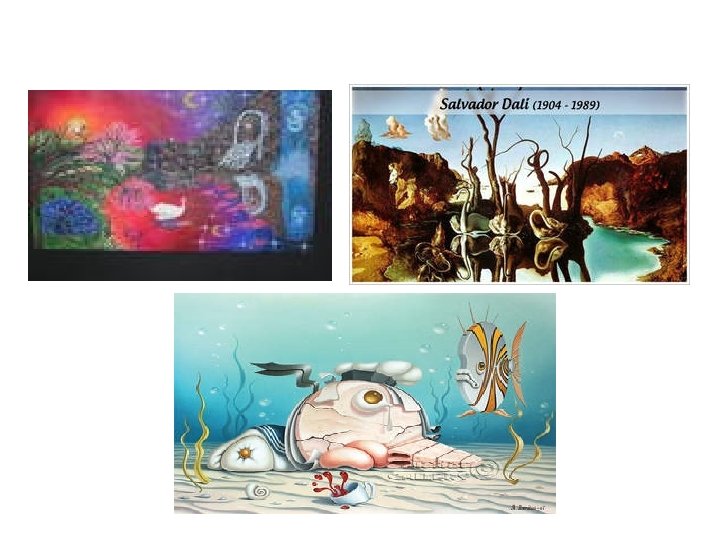
• Theater of the Absurd relies on the use of - Tragicomedy -Surrealism and Dadaism -Existentialism
Review of the Play • Vladimir (Didi) and Estragon (Gogo) meet near a tree beside a country road to wait for the arrival of the ambiguous Godot. In order to pass the time, the two companions complain of physical and spiritual ailments, wonder about the likelihood of salvation, abuse and comfort each other, try in vain to remember their past and present purposes, and consider the merits of leaving or of hanging each other. The first act concludes with the arrival of a little boy who brings Godot’s regrets: He cannot come today, but he will certainly come tomorrow. The second act, in which the tramps go through the same routines (perhaps a bit more desperately), concludes with the same disappointment. They decide to leave, but neither can move. • Beckett has dramatized the act of waiting, showing how hope can be sustained even in the face of the dimmest prospects. It becomes increasingly clear that Godot, whatever he is or represents--God, death, meaning, or simply an end to waiting--will never come, and that Vladimir and Estragon themselves do not know what to expect of him or how to recognize him if he did come. Yet together they sustain the fiction of purpose and take what little comfort they can in their common predicament.
• Two other characters arrive to help the tramps occupy themselves: Pozzo, a pompous slave driver, and Lucky, his decrepit servant. At Pozzo’s brutal command, Lucky rouses himself from his stupor to produce a crazy monologue of mangled learning until he is tackled back into silence. They travel off, leaving the tramps a chance to play at mimicking master and slave; at their second appearance, Pozzo is blind and Lucky mute. Little is remembered. No cause is clear. • The events of this play are singularly uneventful, and it is repetition, rather than progress, which keys the action. It is as if we were witnessing actors who were forced to extemporize eternally while dreaming of the day their script might be delivered. In short, Beckett captures the existential condition of modern man.
Characters • Estragon is one of the two protagonists. He is a bum and sleeps in a ditch where he is beaten each night. He has no memory beyond what is immediately said to him, and relies on Vladimir to remember for him. Estragon is impatient and constantly wants to leave Vladimir, but is restrained from leaving by the fact that he needs Vladimir. It is Estragons’ idea for the bums to pass their time by hanging themselves.
• Estragon has been compared to a body without an intellect, which therefore needs Vladimir to provide the intellect. Vladimir has been compared to the intellect which provides for the body, represented by Estragon. • In this play, action is unimportant; the characters remain undeveloped as they wait impatiently for Godot, who remains a mysterious entity, possibly a local landowner but also a symbol of spiritual seeking. They gnaw carrots, rest their tired feet, and engage in other simple activities while their conversations reveal the helplessness of their situation. Throughout the play, there is every suggestion that the two live estranged from a state of grace that is hoped for but never realized. Often considering suicide, they are caught in a calm of inactivity between hope and despair in their longing for salvation, which is linked somehow with Godot. When the play ends, the two are still waiting for the promised appearance of Godot.
• Vladimir is one of the two protagonists. He is a bumlike Estragon, but retains a memory of most events. However, he is often unsure whether his memory is playing tricks on him. Vladimir is friendly to Estragon because Estragon provides him with the chance to remember past events. Vladimir is the one who makes Estragon wait with him for Mr. Godots imminent arrival throughout the play.
• Pozzo (poh-ZOH), a materialist. A rich, boisterous tyrant, he is obviously an expounder of Nietzschean doctrines and materialistic concepts. Pozzo admits that Lucky has taught him all the beautiful things he knows, but now his servant has become unbearable and is driving him mad. At first, he drives his servant with a rope. Later, when Pozzo reappears, blinded in symbolic fashion by his own worldly successes and romantic pessimism, he must be led by his mute servant. • He is the master who rules over Lucky. He stops and talks to the two bums in order to have some company. In the second act Pozzo is blind and requires their help. He, like Estragon, cannot remember people he has met. • Lucky is the slave of Pozzo. He is tied to Pozzo via a rope around his neck and he carries Pozzos bags. Lucky is only allowed to speak twice during the entire play, but his long monologue is filled with incomplete ideas. He is silenced only by the other characters who fight with him to take of his hat. Born a peasant, he gives the impression of a new proletarian, the symbol of modern people’s belief in the promises and miracles of science. Lucky first appears driven by Pozzo at the end of a rope. Ordered to think for the group, he delivers the wildest, most brilliantly sustained monologue of the play. When he next appears, he is leading the blind Pozzo, but he is mute.
• The boy is a servant of Mr. Godot. He plays an identical role in both acts by coming to inform Vladimir and Estragon that Mr. Godot will not be able to make it that night, but will surely come the next day. The boy never remembers having met Vladimir and Estragon before. He has a brother who is mentioned but who never appears.
Who is Godot? • Beckett is believed to have said that the name Godot comes from the French "godillot" meaning a military boot. Beckett fought in the warand so spending long periods of time waiting for messages to arrive would have been commonplace for him. The more common interpretation that it might mean "God" is almost certainly wrong. Beckett apparently stated that if he had meant "God, " he would have written "God".
Setting and Time • The setting is the same, and the time is the same in both acts. Each act begins early in the morning, just as the tramps are awakening, and both acts close with the moon having risen. The action takes place in exactly the same landscape—a lonely, isolated road with one single tree. (In the second act, there are some leaves on the tree, but from the viewpoint of the audience, the setting is exactly the same. ) We are never told where this road is located; all we know is that the action of the play unfolds on this lonely road. Thus, from Act I to Act II, there is no difference in either the setting or in the time and, thus, instead of a progression of time within an identifiable setting, we have a repetition in the second act of the same things that wesaw and heard in the first act.
Places Discussed • Country road Unnamed road, alongside which Vladimir and Estragon await the arrival of Godot. No clues are given to identify the location, whose terrain is a flat and unbroken plain to the distant horizon. In a ditch nearby, Estragon has spent the night, despite beatings by an unknown “they. ” In effect, the road stretches to and from nowhere in particular, although Pozzo says he is leading his servant, Lucky, down the road to a fair. Pozzo’s claim that he owns the land is not necessarily true. Although Vladimir refers to past experiences together atop the Eiffel Tower in Paris and grape-picking “in the Macon country, ” Estragon claims that he has never been in Macon country and has “puked [his] puke of a life away here. . . in the Cackon country. ” None of these claims is verifiable. • Despite Beckett’s insistence that productions of his plays should always adhere to his specifications, the austere set he intended for this play has occasionally been radically altered by stage designers. For example, the set of the 1988 Broadway production of Waiting for Godot designed by Tony Walton was a stretch of Nevada highway, cluttered with debris and abandoned car parts.
• Tree. Sole landmark by the road that helps direct Vladimir and Estragon to where they are to meet Godot. The scraggly tree is bare in the play’s first act. Although no other trees can be seen, Vladimir and Estragon are uncertain that this is the correct tree by which they should be waiting. Indeed, they think it might not be a tree at all, but rather a shrub or a bush. Vladimir suggests that it might be a willow but admits that he does not know. He also suggests that the tree may be dead. However, when the second act opens there are four or five leaves on the tree, proving that the tree is alive and that an indeterminable length of time has passed. • Beckett reportedly told a biographer that Waiting for Godot was inspired by Kaspar David Friedrich’s painting Two Men Observing the Moon, in which such a tree figures prominently. • Low mound. Slight slope of land on which Estragon sits at the beginning of the play, struggling to remove his boot. This is the only other feature of the landscape mentioned in the stage directions.
Structure/organisation of the play • Even though the drama is divided into two acts, there are othernatural divisions. For the sake of discussion, the following, rather obvious, scene divisions will be referred to: ACT I: (1)Vladimir and Estragon Alone(2) Arrival of Pozzo and Lucky: (3) Departure of Pozzo and Lucky: Vladimir and Estragon Alone(4) Arrival of Boy Messenger(5) Departure of Boy Messenger: Vladimir and Estragon Alone ACT II: (1)Vladimir and Estragon Alone(2) Arrival of Pozzo and Lucky(3) Departure of Pozzo and Lucky: Vladimir and Estragon Alone(4) Arrival of Boy Messenger(5) Departure of Boy Messenger: Vladimir and Estragon Alone. The above divisions of the play are Beckett’s way of making a statement about the nature of the play—that is, the play is circular in structure, and a third act (or even a fourth or fifth act, etc. ) could be added, having the exact same structure.
• But what does it all mean? A traditional play, in contrast, has an introduction of the characters and the exposition; then, there is a statement of the problem of the play in relationship to its settings and characters. (In Waiting for Godot, we never know where the play takes place, except that it is set on “a countryroad. ”) Furthermore, in a traditional play, the characters are developed, and gradually we come to see the dramatist’s world view; the play then rises to a climax, and there is a conclusion. This type of development is called a linear development. In the plays of the Theater of the Absurd, the structure is often exactly the opposite. We have, instead, a circular structure, and most aspects of this drama support this circular structure in one way or another.
Contexts/interpretations of the play • Religious interpretations posit Vladimir and Estragon as humanity waiting for the elusive return of a savior. An extension of this makes Pozzo into the Pope and Lucky into the faithful. The faithful are then viewed as a cipher of God cut short by human intolerance. The twisted tree can alternatively represent either the tree of death, the tree of life, the tree of Judas or the tree of knowledge.
• Although Beckett claimed he was not a Christian, the quest for salvation is the cornerstone of the play and frequent Christian allusions serve as its subtext. However, in Waiting for Godot, these allusions serve not to assert belief, but to dramatize its decadence. Once Christianity provided Western civilization with a construct of meaning and hope, but now, decimated by the horrors of two world wars and the deconstruction of reality and meaning in modern philosophy, it is no longer credible. Because the characters no longer believe in Christianity or in anything, they are helpless and alone in a meaningless universe. Yet because the language and values of Christianity are the only ones they know, it serves them as a point of reference for their urgent need to find meaning and purpose. Thus, Estragon compares himself to Christ as the model for his own suffering. Waiting for the mysterious Godot can be understood as humankind waiting for redemption from an otherwise unbearable life. Although Beckett strenuously denied that Godot was God, in Waiting for Godot, as the object of the characters’ ultimate longings and their hope for salvation, he serves a similar function as God. In act 1, Vladimir and Estragon speak of addressing Godot with a kind of prayer. At the end of act 2, the boy-messenger — a possible allusion to Christ — describes him as an old man with a white beard. This description evokes from Vladimir the plaintive cry, “Christ have mercy on us!” an echo of one made by Estragon in act 1 when he and Vladimir ask God and Christ to have mercy on them.
• Other references to the Gospels abound. Early in the play, Vladimir speaks of the Gospel of John in which one of the thieves crucified with Jesus was saved, one damned. Although Vladimir does not say so, this Gospel represents the possibility that he and Estragon might also be saved. The tree is the most prominent Christian symbol. Much of the action centers around the tramps’ desire to hang themselves from it, an allusion to crucifixion. Another Christian reference occurs in act 1, when Vladimir alludes to Proverbs 13: 12. He tries to recall the lines that speak of hope as a “tree of life, ” an allusion that relates directly to the play’s tree. In another example, Vladimir asks Estragon whether he has ever read the Bible. In act 2, frustrated by the inability to identify Pozzo and Lucky, Estragon calls Pozzo “Abel, ” and Lucky “Cain. ” Taken together, these and many more similar references tell us that Beckett’s characters struggle to find meaning through the only language they know.
• Political interpretations also abound. Some reviewers hold that the relationship between Pozzo and Lucky is that of a capitalist to his labor. This Marxist interpretation is understandable given that in the second act Pozzo is blind to what is happening around him and Lucky is mute to protest his treatment. • An interesting interpretation argues that Lucky receives his name because he is lucky in the context of the play. Since most of the play is spent trying to find things to do to pass the time, Lucky is lucky because his actions are determined absolutely by Pozzo on the other hand is unlucky because he not only needs to pass his own time but must find things for Lucky to do.
An existential Play • The philosophical orientation of Waiting for Godot is another matter, however, for the years of Beckett’s residence in France coincided with a period of great ferment in existential philosophy, most of it centered in Paris. Beckett is not a formal or doctrinaire existentialist, but he could hardly avoid being affected by existentialism, for such ideas were part of his cultural milieu. There is no systematically existential point of view in Waiting for Godot — as there is in, for example, the plays of Jean-Paul Sartre and the novels of Albert Camus — but a generally existential and absurdist view of the human condition comes through very clearly in the play. Vladimir and Estragon, and Lucky and Pozzo, are psychically isolated from one another; despite physical proximity, they are alienated and lonely, as indicated by their failure to communicate meaningfully. In that state of mind, each despairs, feeling helpless in the face of an immutable destiny. Unlike the formal existentialists, however, Estragon and Vladimir hope, and it is that hope that sustains them through their monotonous and immobile existence. They wait for Godot, who will surely bring them words of comfort and advice, and who will intervene to alter their destinies. By maintaining this hope, by waiting for Godot to come, Vladimir and Estragon avoid facing the logic of existential philosophy, which postulates hopelessness followed by a sense of futility, reducing humankind to absurdity. In this way, Vladimir and Estragon attain truly heroic proportions; they endure.
• Beckett’s play has been criticized, even by Estragon, because, as the tramp puts it, “Nothing happens. ” In fact, however, a great deal does happen: There is a lot of action, much coming and going. However, action in this sense is quite superficial, for all of it is meaningless. That very action assumes a rhythm and a pattern that constitute the structure of the play. The repetitious movements and dialogue reinforce the existential theme of the play: that life is a meaningless and monotonous performance of endlessly repeated routine. The pattern established in the first act is recapitulated in the second act, with only slight variation. Obviously the action in Waiting for Godot is not the action of conventional drama, but it is this unique fusion of theme and structure that accounts for the startling originality of the play and that rightly earns Beckett a place as one of the few genuine innovators in modern drama.
- Slides: 43