
Wait for it THE MONGOLS Who were the


- Slides: 26
Wait for it….
THE MONGOLS
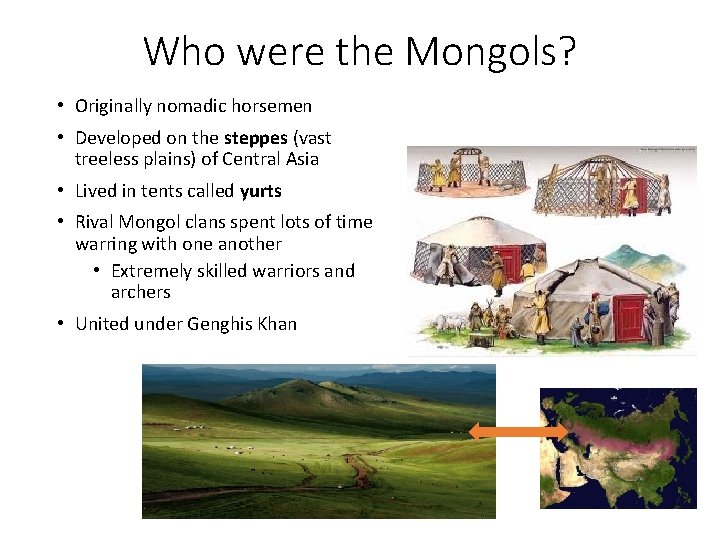
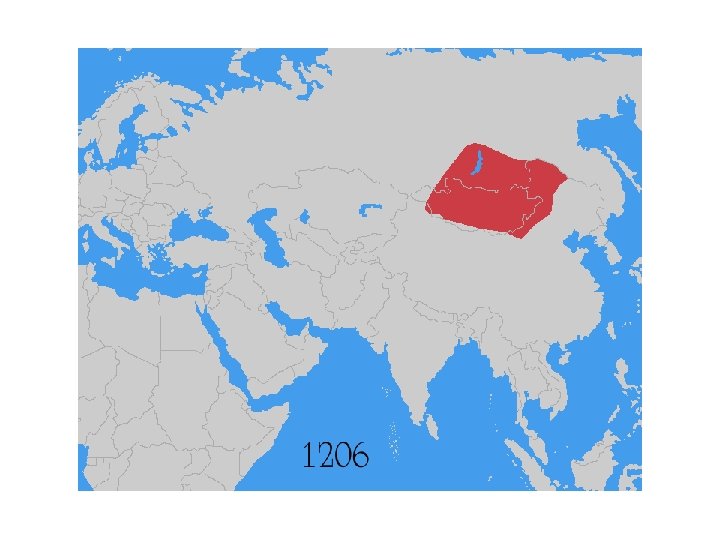
Who were the Mongols? • Originally nomadic horsemen • Developed on the steppes (vast treeless plains) of Central Asia • Lived in tents called yurts • Rival Mongol clans spent lots of time warring with one another • Extremely skilled warriors and archers • United under Genghis Khan
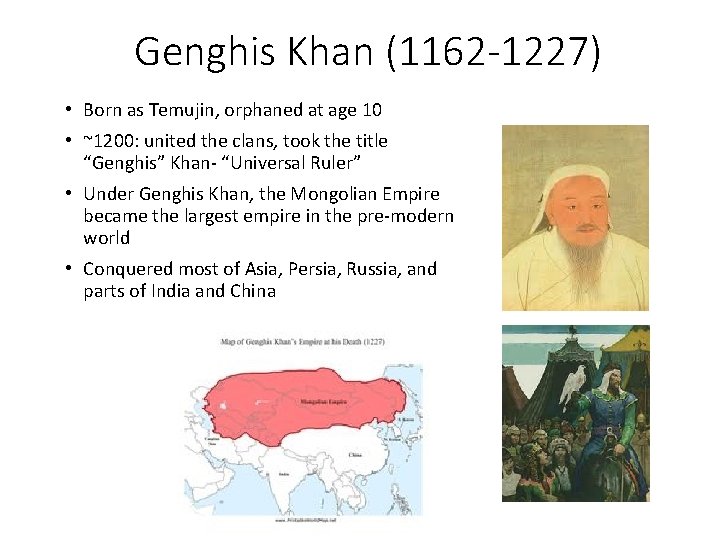
Genghis Khan (1162 -1227) • Born as Temujin, orphaned at age 10 • ~1200: united the clans, took the title “Genghis” Khan- “Universal Ruler” • Under Genghis Khan, the Mongolian Empire became the largest empire in the pre-modern world • Conquered most of Asia, Persia, Russia, and parts of India and China
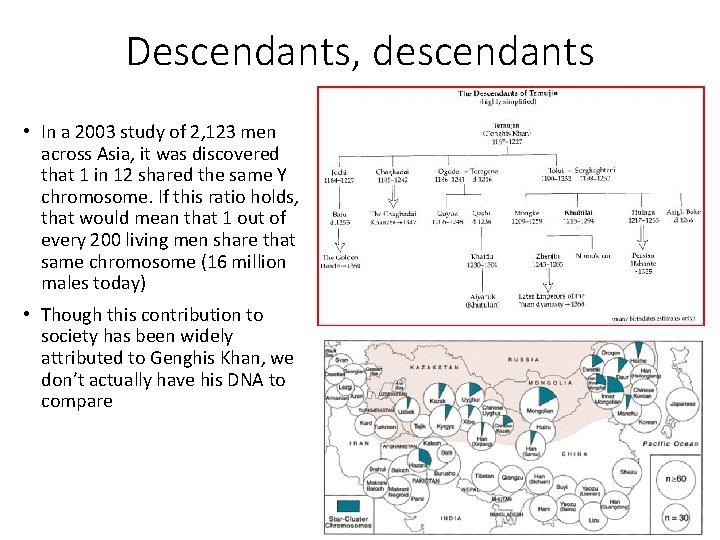
Descendants, descendants • In a 2003 study of 2, 123 men across Asia, it was discovered that 1 in 12 shared the same Y chromosome. If this ratio holds, that would mean that 1 out of every 200 living men share that same chromosome (16 million males today) • Though this contribution to society has been widely attributed to Genghis Khan, we don’t actually have his DNA to compare
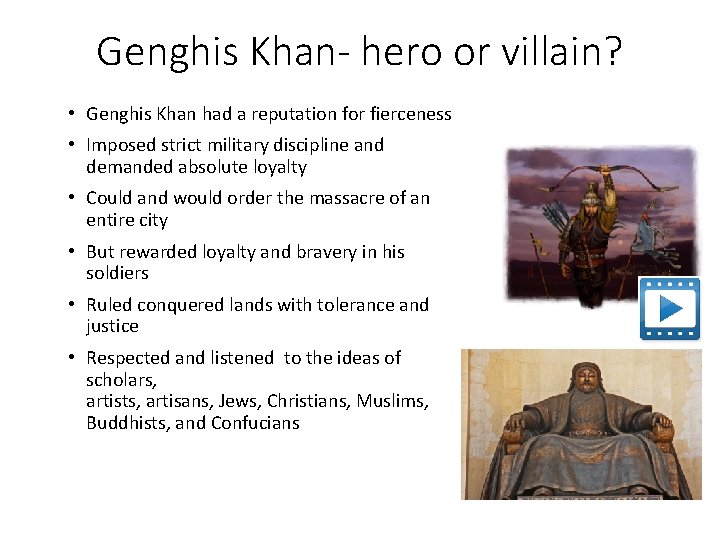
Genghis Khan- hero or villain? • Genghis Khan had a reputation for fierceness • Imposed strict military discipline and demanded absolute loyalty • Could and would order the massacre of an entire city • But rewarded loyalty and bravery in his soldiers • Ruled conquered lands with tolerance and justice • Respected and listened to the ideas of scholars, artists, artisans, Jews, Christians, Muslims, Buddhists, and Confucians
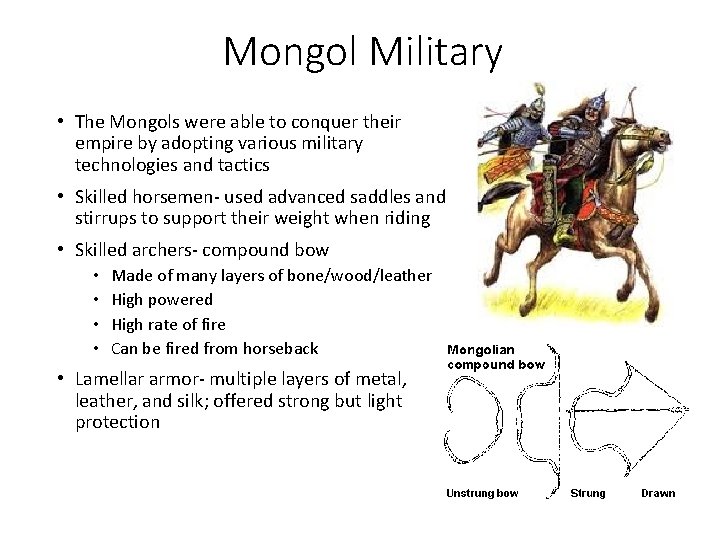
Mongol Military • The Mongols were able to conquer their empire by adopting various military technologies and tactics • Skilled horsemen- used advanced saddles and stirrups to support their weight when riding • Skilled archers- compound bow • • Made of many layers of bone/wood/leather High powered High rate of fire Can be fired from horseback • Lamellar armor- multiple layers of metal, leather, and silk; offered strong but light protection
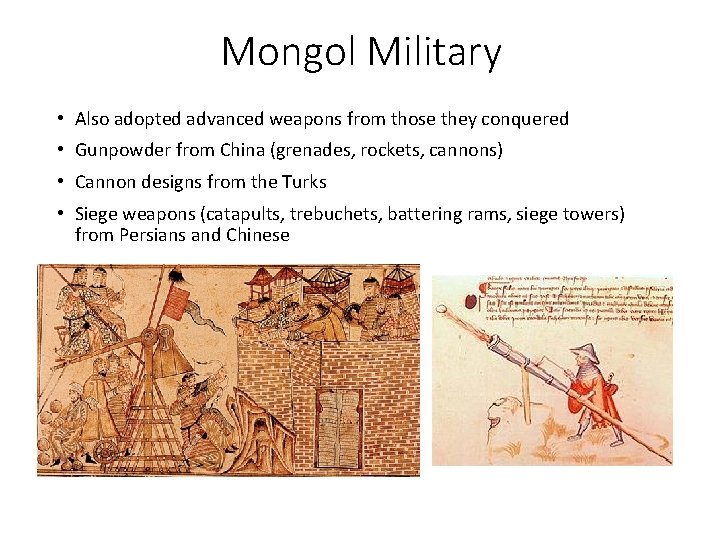
Mongol Military • Also adopted advanced weapons from those they conquered • Gunpowder from China (grenades, rockets, cannons) • Cannon designs from the Turks • Siege weapons (catapults, trebuchets, battering rams, siege towers) from Persians and Chinese
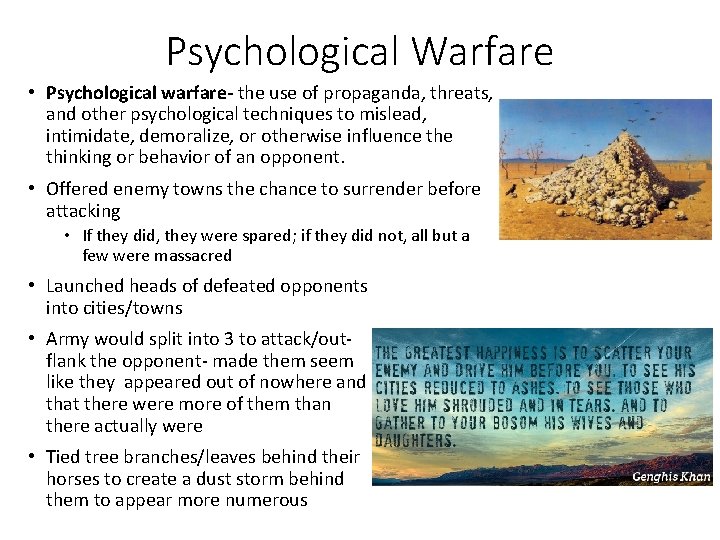
Psychological Warfare • Psychological warfare- the use of propaganda, threats, and other psychological techniques to mislead, intimidate, demoralize, or otherwise influence thinking or behavior of an opponent. • Offered enemy towns the chance to surrender before attacking • If they did, they were spared; if they did not, all but a few were massacred • Launched heads of defeated opponents into cities/towns • Army would split into 3 to attack/outflank the opponent- made them seem like they appeared out of nowhere and that there were more of them than there actually were • Tied tree branches/leaves behind their horses to create a dust storm behind them to appear more numerous
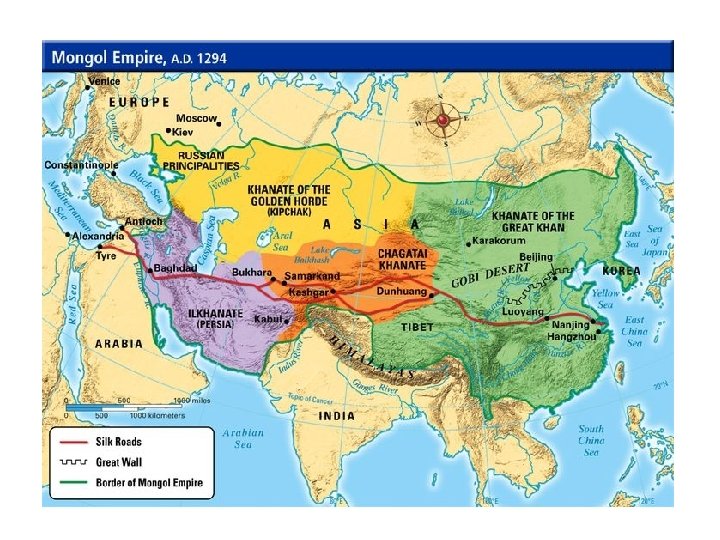
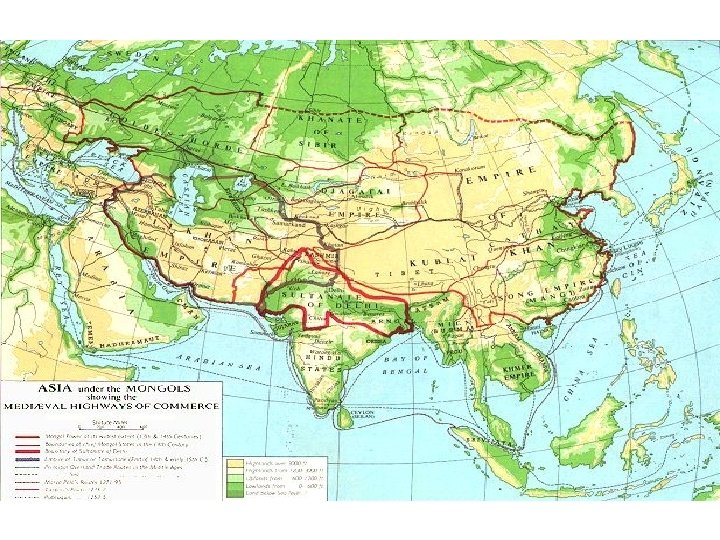
The Khanates • After his death, Genghis Khan’s descendants divided the empire into 4 separate Khanates (kingdoms) • Great Khanate (Mongolia) • Chagatai Khanate (central Asia) • Ilkhanate (Persia) • Golden Horde (Russia)
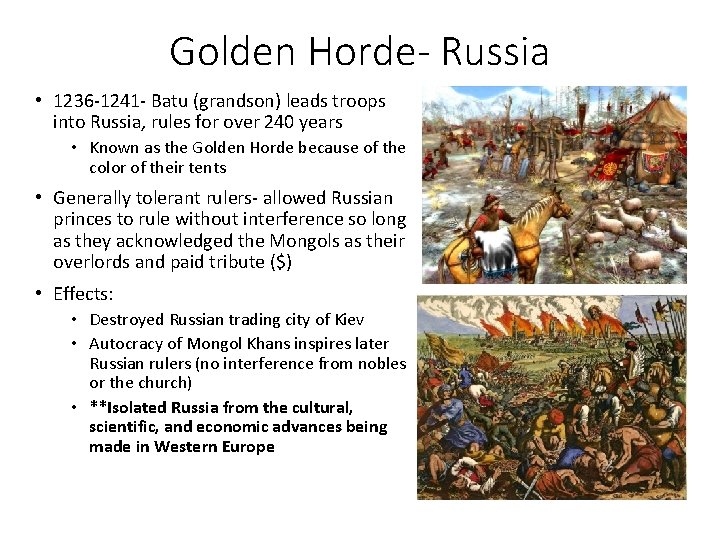
Golden Horde- Russia • 1236 -1241 - Batu (grandson) leads troops into Russia, rules for over 240 years • Known as the Golden Horde because of the color of their tents • Generally tolerant rulers- allowed Russian princes to rule without interference so long as they acknowledged the Mongols as their overlords and paid tribute ($) • Effects: • Destroyed Russian trading city of Kiev • Autocracy of Mongol Khans inspires later Russian rulers (no interference from nobles or the church) • **Isolated Russia from the cultural, scientific, and economic advances being made in Western Europe
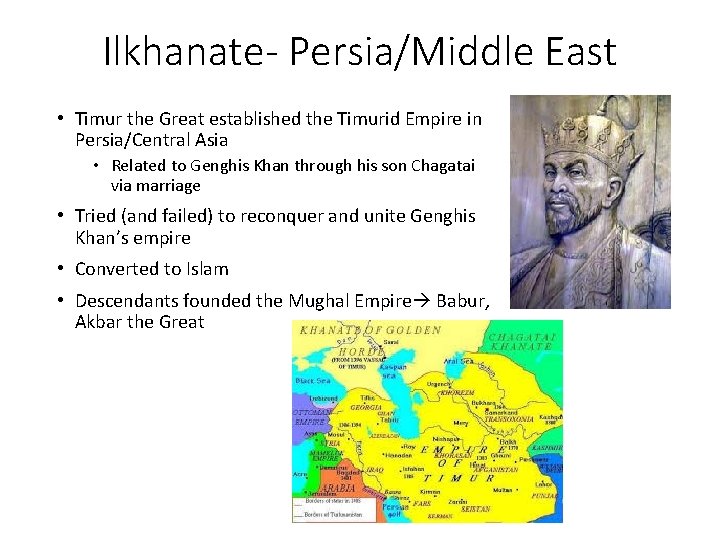
Ilkhanate- Persia/Middle East • Timur the Great established the Timurid Empire in Persia/Central Asia • Related to Genghis Khan through his son Chagatai via marriage • Tried (and failed) to reconquer and unite Genghis Khan’s empire • Converted to Islam • Descendants founded the Mughal Empire Babur, Akbar the Great
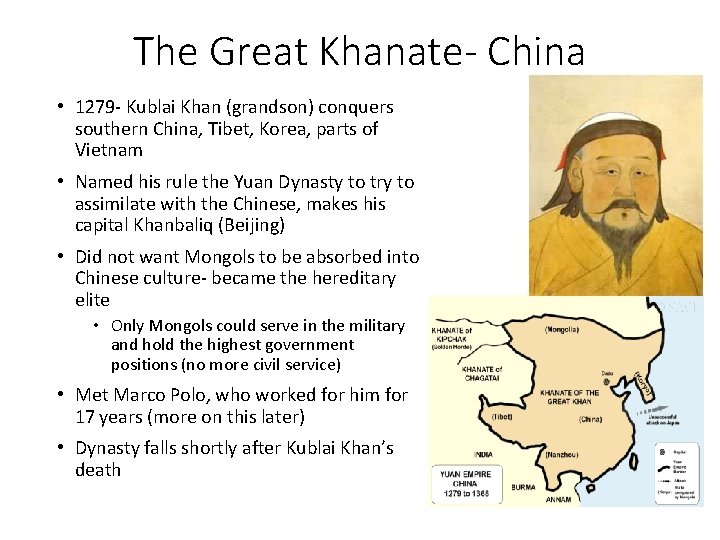
The Great Khanate- China • 1279 - Kublai Khan (grandson) conquers southern China, Tibet, Korea, parts of Vietnam • Named his rule the Yuan Dynasty to try to assimilate with the Chinese, makes his capital Khanbaliq (Beijing) • Did not want Mongols to be absorbed into Chinese culture- became the hereditary elite • Only Mongols could serve in the military and hold the highest government positions (no more civil service) • Met Marco Polo, who worked for him for 17 years (more on this later) • Dynasty falls shortly after Kublai Khan’s death
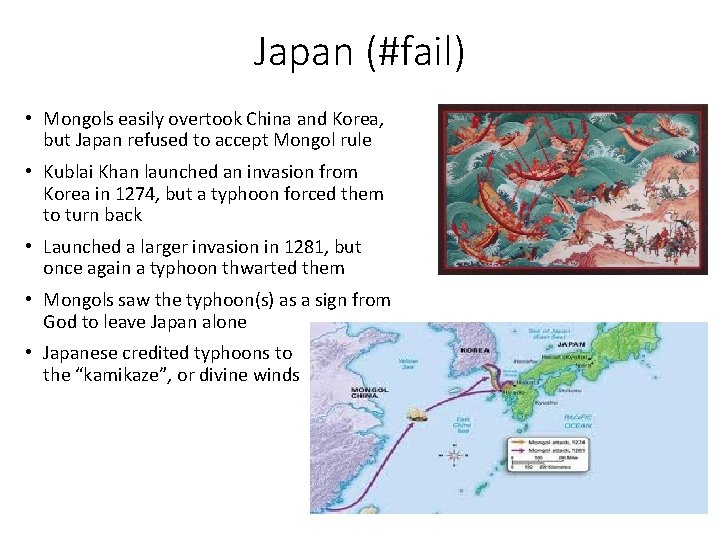
Japan (#fail) • Mongols easily overtook China and Korea, but Japan refused to accept Mongol rule • Kublai Khan launched an invasion from Korea in 1274, but a typhoon forced them to turn back • Launched a larger invasion in 1281, but once again a typhoon thwarted them • Mongols saw the typhoon(s) as a sign from God to leave Japan alone • Japanese credited typhoons to the “kamikaze”, or divine winds
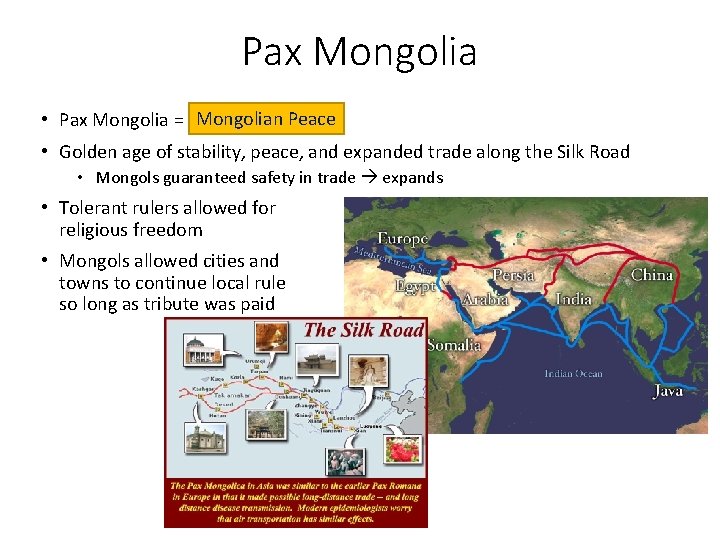
Pax Mongolia • Pax Mongolia = Mongolian Peace • Golden age of stability, peace, and expanded trade along the Silk Road • Mongols guaranteed safety in trade expands • Tolerant rulers allowed for religious freedom • Mongols allowed cities and towns to continue local rule so long as tribute was paid
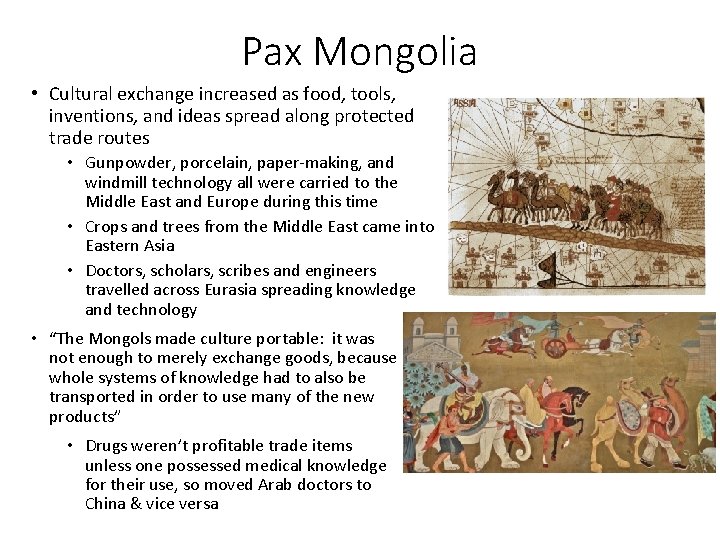
Pax Mongolia • Cultural exchange increased as food, tools, inventions, and ideas spread along protected trade routes • Gunpowder, porcelain, paper-making, and windmill technology all were carried to the Middle East and Europe during this time • Crops and trees from the Middle East came into Eastern Asia • Doctors, scholars, scribes and engineers travelled across Eurasia spreading knowledge and technology • “The Mongols made culture portable: it was not enough to merely exchange goods, because whole systems of knowledge had to also be transported in order to use many of the new products” • Drugs weren’t profitable trade items unless one possessed medical knowledge for their use, so moved Arab doctors to China & vice versa
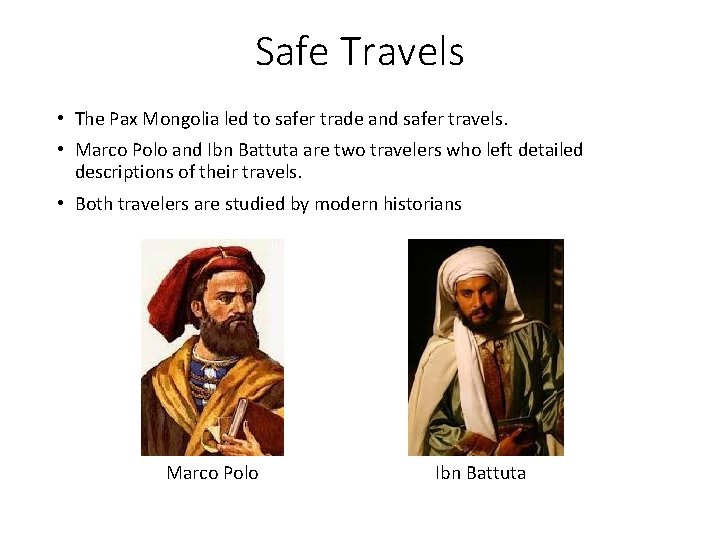
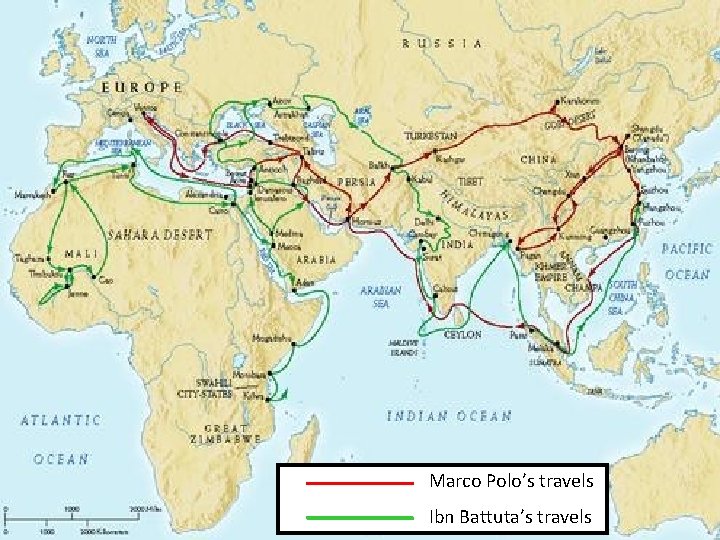
Safe Travels • The Pax Mongolia led to safer trade and safer travels. • Marco Polo and Ibn Battuta are two travelers who left detailed descriptions of their travels. • Both travelers are studied by modern historians Marco Polo Ibn Battuta
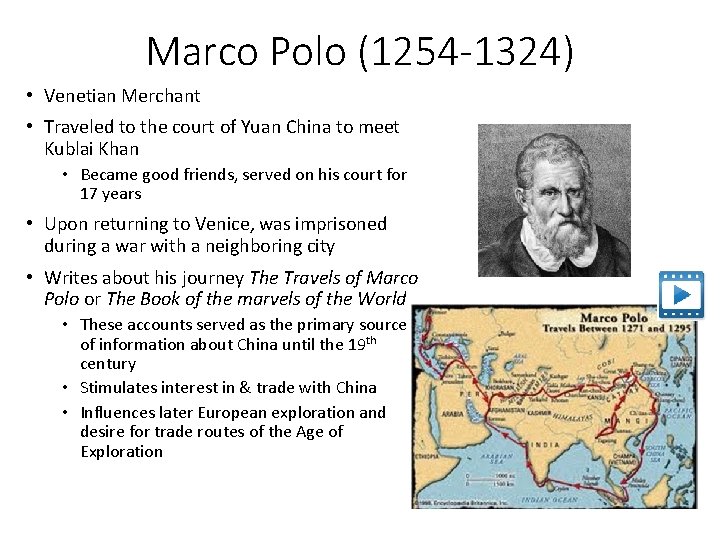
Marco Polo (1254 -1324) • Venetian Merchant • Traveled to the court of Yuan China to meet Kublai Khan • Became good friends, served on his court for 17 years • Upon returning to Venice, was imprisoned during a war with a neighboring city • Writes about his journey The Travels of Marco Polo or The Book of the marvels of the World • These accounts served as the primary source of information about China until the 19 th century • Stimulates interest in & trade with China • Influences later European exploration and desire for trade routes of the Age of Exploration
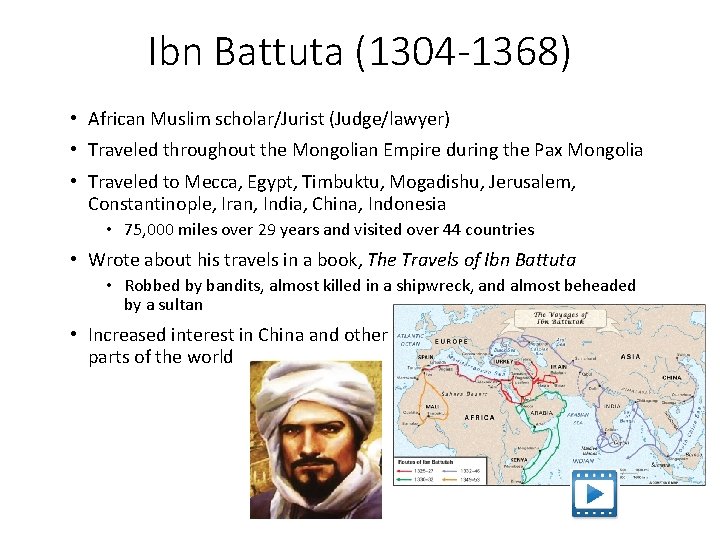
Ibn Battuta (1304 -1368) • African Muslim scholar/Jurist (Judge/lawyer) • Traveled throughout the Mongolian Empire during the Pax Mongolia • Traveled to Mecca, Egypt, Timbuktu, Mogadishu, Jerusalem, Constantinople, Iran, India, China, Indonesia • 75, 000 miles over 29 years and visited over 44 countries • Wrote about his travels in a book, The Travels of Ibn Battuta • Robbed by bandits, almost killed in a shipwreck, and almost beheaded by a sultan • Increased interest in China and other parts of the world
Marco Polo’s travels Ibn Battuta’s travels
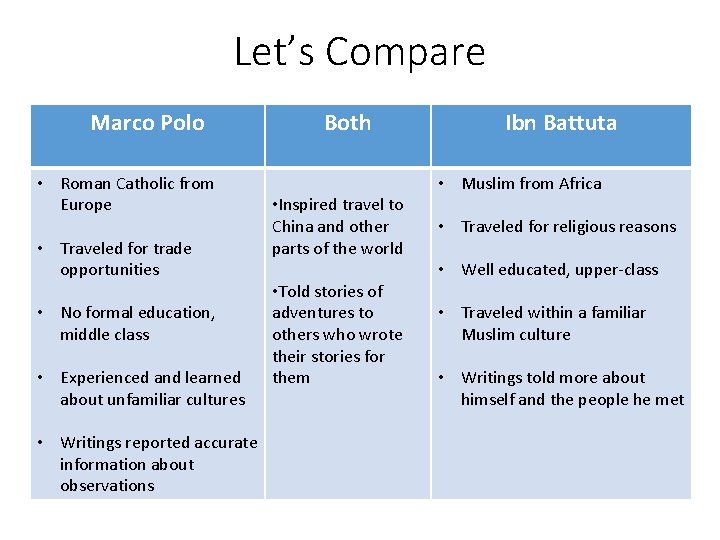
Let’s Compare Marco Polo • Roman Catholic from Europe • Traveled for trade opportunities • No formal education, middle class • Experienced and learned about unfamiliar cultures • Writings reported accurate information about observations Both • Inspired travel to China and other parts of the world • Told stories of adventures to others who wrote their stories for them Ibn Battuta • Muslim from Africa • Traveled for religious reasons • Well educated, upper-class • Traveled within a familiar Muslim culture • Writings told more about himself and the people he met
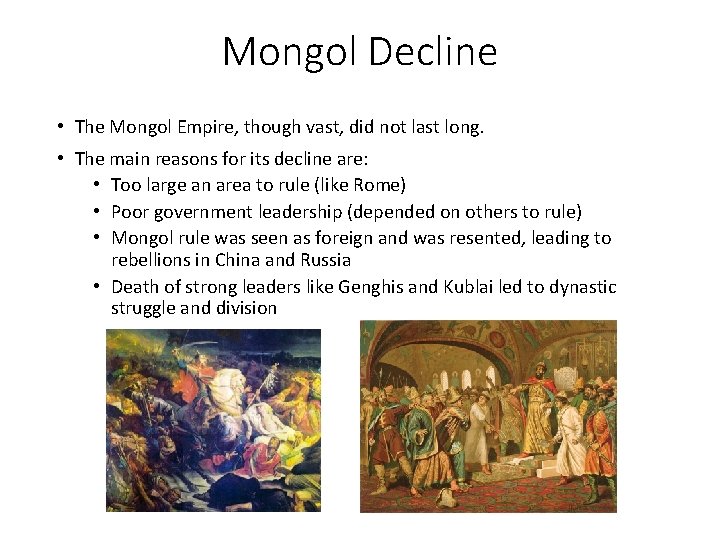
Mongol Decline • The Mongol Empire, though vast, did not last long. • The main reasons for its decline are: • Too large an area to rule (like Rome) • Poor government leadership (depended on others to rule) • Mongol rule was seen as foreign and was resented, leading to rebellions in China and Russia • Death of strong leaders like Genghis and Kublai led to dynastic struggle and division
“The Mongols made no technological breakthroughs, founded no new religions, wrote few books or dramas, and gave the world no new crops or methods of agriculture. Their own craftsmen could not weave cloth, cast pottery, painted no pictures, and built no buildings. ” From Genghis Khan and the Making of the Modern World by Jack Weatherford So why are the Mongols historically significant?