
WAGE POLICY IN INDIA UNIT4 I N T



- Slides: 26
WAGE POLICY IN INDIA UNIT-4
: I N T R O D U C T I O N: In all countries, wage policy is a complex and sensitive area of public policy. This is because the relative status of workers in the society, their commitment to industry and attitude towards management, their morale and motivation towards productivity, their living standards an in fact their way of life are all conditioned by wages, Hence a policy dealing with this crucial problems cannot be simply economic, as it has to reckon with the realities of multi-dimensional social phenomenon, in which besides the workers and the management, the consumer and the society at large, and in consequences the state, are all vitally interested. Wage policy is a determinant of the shares of the rival claimants to the product of industry and national dividend, but there may often be a conflicts between private and social interest, There are, of course, theoretical generalisations or principles that may provide scientific guidelines for framing wage policy. Equally important in this context are the concrete social facts that must be taken into account in its formulation at any given time. NO principles of wage policy can ever be applied in vacuum and in disregard of the realities of a situation. Wage policy has to be pragmatic though it does not follow that it has to be unscientific and remain simply a matter of expediency. Wage policies are principles acting as guidelines for determining a wage structure Wage policy refers to all systematic efforts of the government in relation to national wage and salary system
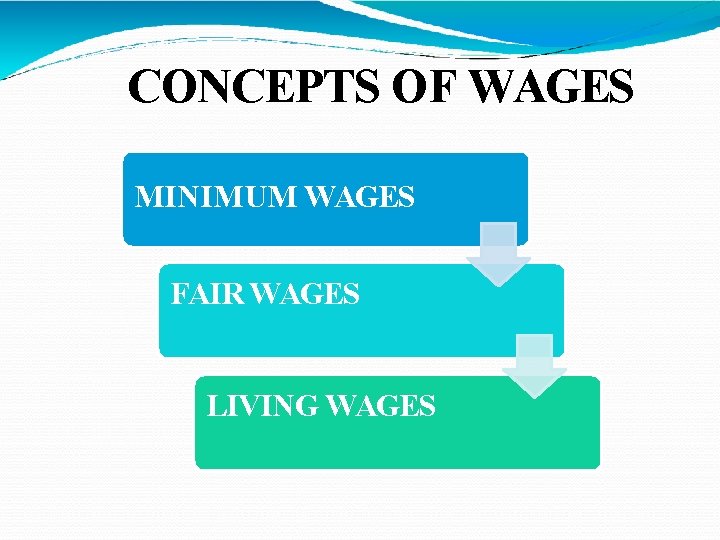
CONCEPTS OF WAGES MINIMUM WAGES FAIR WAGES LIVING WAGES
WAGE : Wage is paid to the assembly line workers or worker at operational level. It is paid hourly/daily/weekly MINIMUM WAGE: It must provide not only for the bare sustenance of life but for the preservation of the efficiency of the workers by providing some measures of education , medical care etc. LIVING WAGE: It is not only for the bare essentials for the worker and his family but also for comfort protection against ill-insurance for old-age. FAIR WAGE: It is in between minimum wages and living wages but below the living wage
MINIMUM WAGE • To provide not merely for bare sustenance of life but also for the preservation of the efficiency of the workers • Minimum wage must provide for some measure of cost of education, medical requirements and amenities • In India, determined mainly under the provision of Minimum Wages Act, 1948
FAIR WAGE • In a narrow sense, wage is fair if it is equal to the rate prevailing in the same trade and in the neighborhood for similar work • In a wider sense, it will be fair if it is equal to the predominant rate for similar work throughout the country
LIVING WAGE • This is higher than fair wage • Enables the wage earner to provide for himself and his family not only the bare necessities like food, clothing and shelter but a frugal comport to meet cost of eduction, medical, social needs, misfortunes and old age • Varies from country to country • Tribunals, awards and wage boards play major role in fair wage fixation
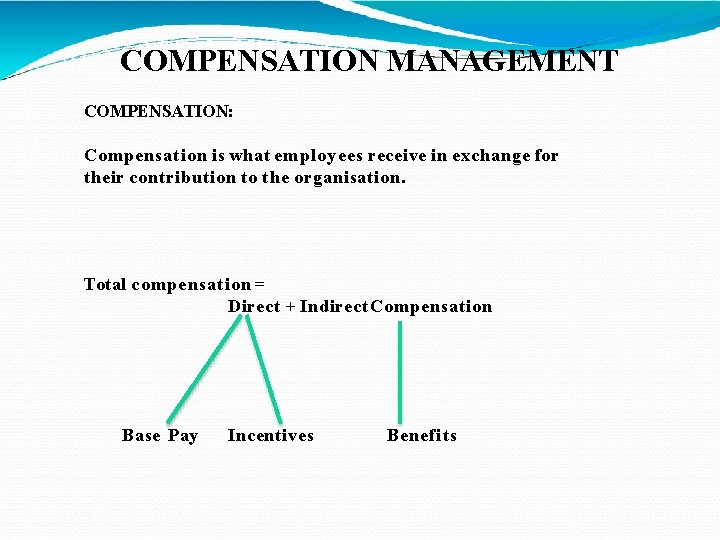
COMPENSATION MANAGEMENT COMPENSATION: Compensation is what employees receive in exchange for their contribution to the organisation. Total compensation = Direct + Indirect Compensation Base Pay Incentives Benefits
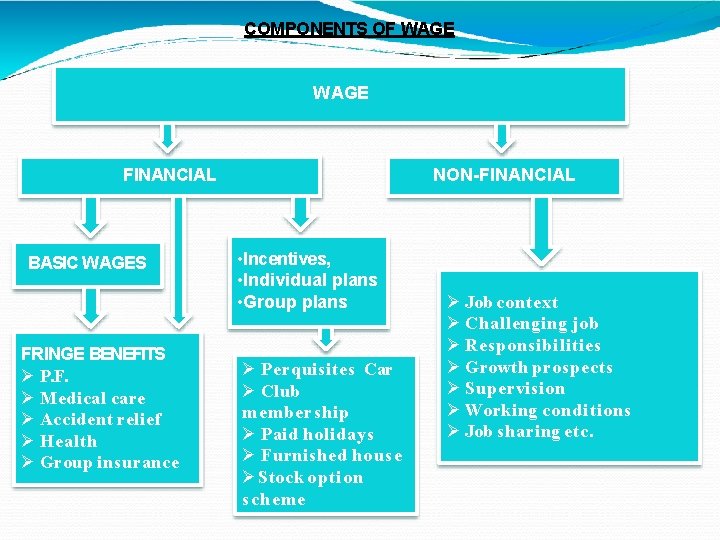
COMPONENTS OF WAGE FINANCIAL BASIC WAGES FRINGE BENEFITS P. F. Medical care Accident relief Health Group insurance NON-FINANCIAL • Incentives, • Individual plans • Group plans Perquisites Car Club membership Paid holidays Furnished house Stock option scheme Job context Challenging job Responsibilities Growth prospects Supervision Working conditions Job sharing etc.
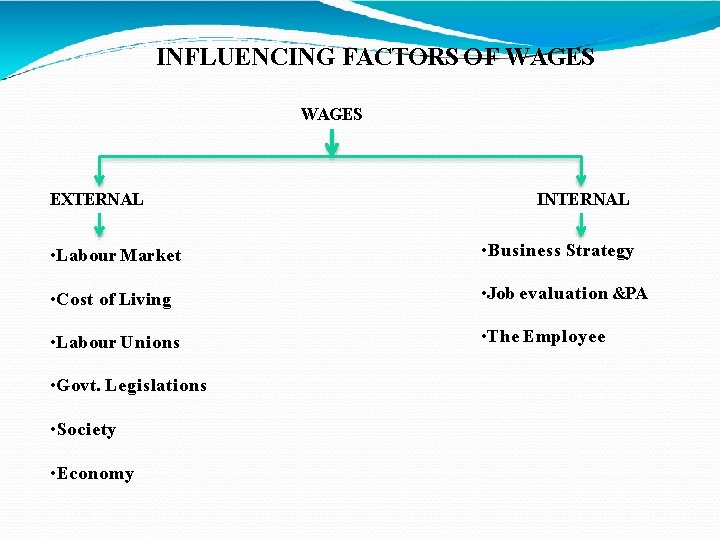
INFLUENCING FACTORS OF WAGES EXTERNAL INTERNAL • Labour Market • Business Strategy • Cost of Living • Job evaluation &PA • Labour Unions • The Employee • Govt. Legislations • Society • Economy
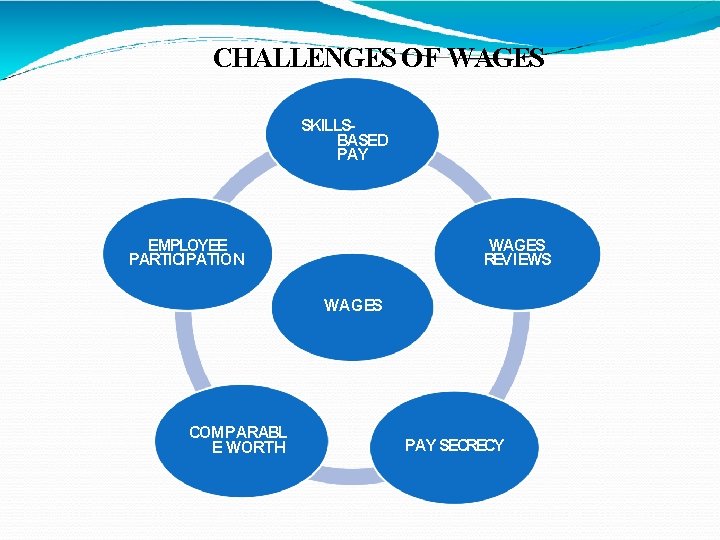
CHALLENGES OF WAGES SKILLSBASED PAY EMPLOYEE PARTICIPATION WAGES REVIEWS WAGES COMPARABL E WORTH PAY SECRECY
WAGE PAYMENT SYSTEM Piece Rate System Time Rate System The piece rate system is that system The time rate system is that system of of wage payment in which the workers are paid on the basis of the paid on the basis of time spent by them units of output produced in the factory Total Wages Earned= Output x Piece Rate Wages Earned = Time spent(Attended) x Wage rate per hour/day/week/month
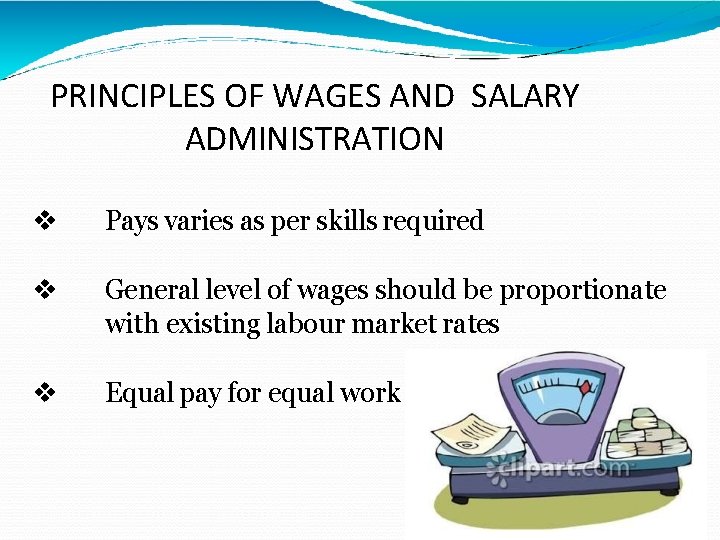
PRINCIPLES OF WAGES AND SALARY ADMINISTRATION Pays varies as per skills required General level of wages should be proportionate with existing labour market rates Equal pay for equal work
OBJECTIVES OF WAGES AND SALARY ADMINISTRATION 1. To recruit persons for a firm 2. To control pay-rolls 3. The elimination of exceptionally low wages 4. To motivate people to perform better 5. To maintain a good public image. 6. Full employment and optimum allocation of all resources 7. The establishment of fair wages standards
Administration of Wages and Salaries Handled by: Personnel department – Or committee who’s major functions are Approval to management on job evaluation methods Review of basic wage and salary structure Help in the formulation of wage policies Co-ordination of relative departmental Review of budget estimates
Wages Policy in India Payment of Wages Act, 1936 Industrial Dispute Act, 1947 Minimum Wages Act, 1948 Equal remuneration Act, 1976 Payment of Bonus Act, 1965 Wage Board
PAYMENT OF WAGES ACT 1936 • The Payment of Wages Act, 1936 regulates payment of wages to employees (direct and indirect). The act is intended to be a remedy against unauthorized deductions made by employer and/or unjustified delay in payment of wages • • Regular Payment should be made before the 7 th day of a month where the number of workers is less than 1000 and 10 th day otherwise. The wage-period shall not exceed 1 month. The Act is applicable only to employees drawing wages not exceeding Rs. 6500 a month. [20] • • Mode of Payment Under the act, payment has to be made in currency notes or coins. Cheque payment or crediting to bank account is allowed with consent in writing by the employee. (Section 6) • • Deduction from Wage Employer is allowed to effect only authorized deductions, as specified in the Act. This include fines (Section 8), absence from duty (Section 9), Damages or loss (Section 10), deduction for services (amenities ) given to employer (Section 11) recovery of advances and loans (Section 12, 13) and payment to cooperative society and insurance (Section 13). Claims for excessive deduction and Non Payment •
Industrial Dispute Act, 1947 • The Industrial Disputes Act, 1947 extends to the whole of India and regulates Indian labour law so far as that concerns trade unions as well as Individual workman employed in any Industry within the territory of Indian mainland. Enacted on 11 th March 1947 and It came into force 1 April 1947
Minimum Wages Act, 1948 • The Minimum Wages Act 1948 is an Act of Parliament concerning Indian labour law that sets the minimum wages that must be paid to skilled and unskilled labours. • The Indian Constitution has defined a 'living wage' that is the level of income for a worker which will ensure a basic standard of living including good health, dignity, comfort, education and provide for any contingency. However, to keep in mind an industry's capacity to pay the constitution has defined a 'fair wage'. Fair wage is that level of wage that not just maintains a level of employment, but seeks to increase it keeping in perspective the industry's capacity to pay.
Equal remuneration Act, 1976 • The Equal Remuneration Act, 1976 aims to provide for the payment of equal remuneration to men and women workers and for the prevention of discrimination, on the ground of sex, against women in the matter of employment and for matters connected therewith or incidental thereto.
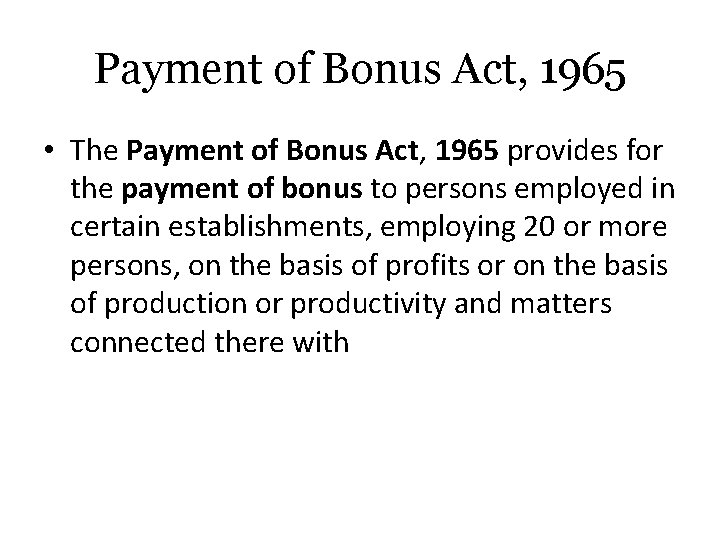
Payment of Bonus Act, 1965 • The Payment of Bonus Act, 1965 provides for the payment of bonus to persons employed in certain establishments, employing 20 or more persons, on the basis of profits or on the basis of production or productivity and matters connected there with
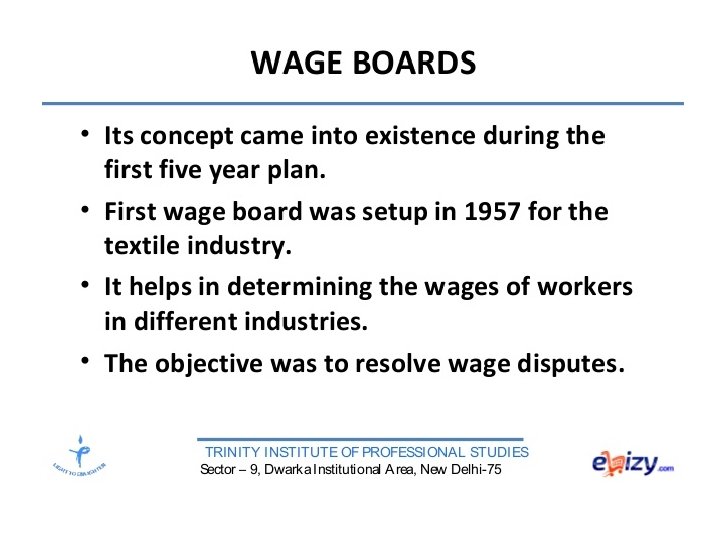
Wage Board
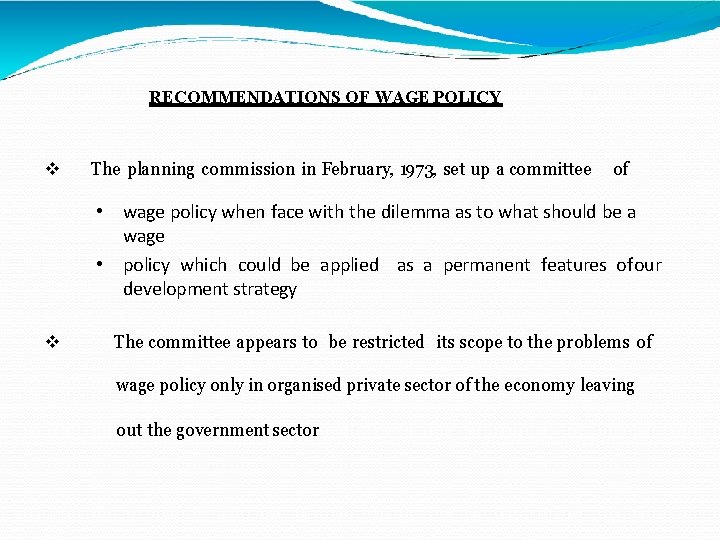
RECOMMENDATIONS OF WAGE POLICY The planning commission in February, 1973, set up a committee of • wage policy when face with the dilemma as to what should be a wage • policy which could be applied as a permanent features ofour development strategy The committee appears to be restricted its scope to the problems of wage policy only in organised private sector of the economy leaving out the government sector
THANK YOU