
WACC What is WACC Companies often run their

- Slides: 20
WACC: What is WACC? Companies often run their business using the capital they raise through various sources. They include raising money through listing their shares on the stock exchange (equity), or by issuing interest-paying bonds or taking commercial loans (debt). All such capital comes at a cost, and the cost associated with each type varies for each source.
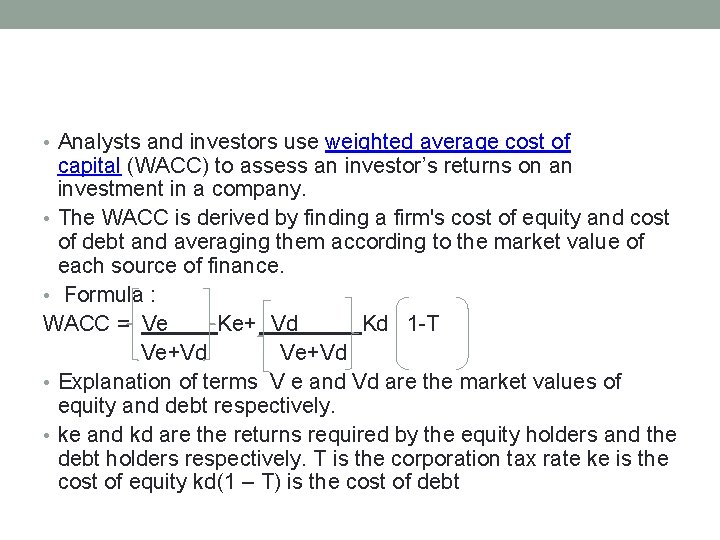
• Analysts and investors use weighted average cost of capital (WACC) to assess an investor’s returns on an investment in a company. • The WACC is derived by finding a firm's cost of equity and cost of debt and averaging them according to the market value of each source of finance. • Formula : WACC = Ve Ke+ Vd Kd 1 -T Ve+Vd • Explanation of terms V e and Vd are the market values of equity and debt respectively. • ke and kd are the returns required by the equity holders and the debt holders respectively. T is the corporation tax rate ke is the cost of equity kd(1 – T) is the cost of debt
Equity and Debt Components of WACC Formula • It's a common misconception that equity capital has no concrete cost that the company must pay after it has listed its shares on the exchange. In reality, there is a cost of equity. • The shareholders' expected rate of return is considered a cost from the company's perspective. That's because if the company fails to deliver this expected return, shareholders will simply sell off their shares, which will lead to a decrease in share price and the company’s overall valuation. The cost of equity is essentially the amount that a company must spend in order to maintain a share price that will keep its investors satisfied and invested.
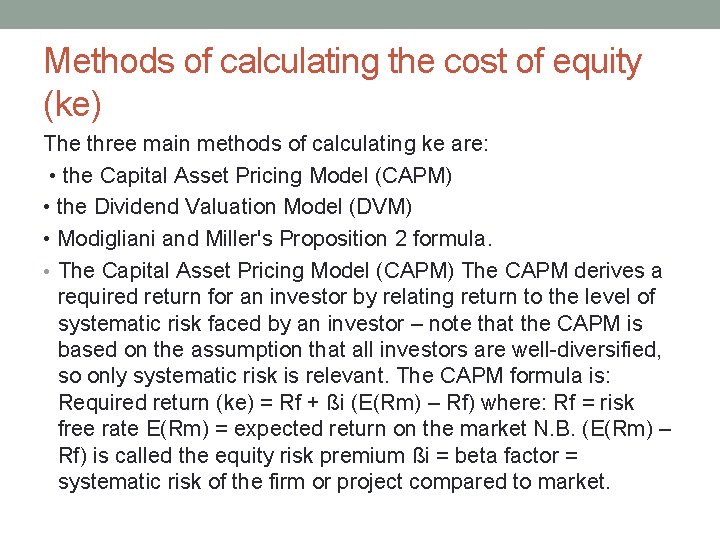
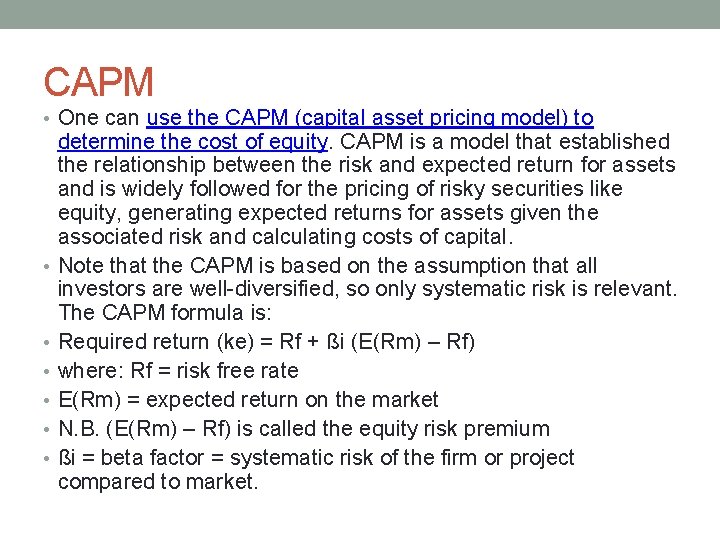
Methods of calculating the cost of equity (ke) The three main methods of calculating ke are: • the Capital Asset Pricing Model (CAPM) • the Dividend Valuation Model (DVM) • Modigliani and Miller's Proposition 2 formula. • The Capital Asset Pricing Model (CAPM) The CAPM derives a required return for an investor by relating return to the level of systematic risk faced by an investor – note that the CAPM is based on the assumption that all investors are well-diversified, so only systematic risk is relevant. The CAPM formula is: Required return (ke) = Rf + ßi (E(Rm) – Rf) where: Rf = risk free rate E(Rm) = expected return on the market N. B. (E(Rm) – Rf) is called the equity risk premium ßi = beta factor = systematic risk of the firm or project compared to market.
CAPM • One can use the CAPM (capital asset pricing model) to • • • determine the cost of equity. CAPM is a model that established the relationship between the risk and expected return for assets and is widely followed for the pricing of risky securities like equity, generating expected returns for assets given the associated risk and calculating costs of capital. Note that the CAPM is based on the assumption that all investors are well-diversified, so only systematic risk is relevant. The CAPM formula is: Required return (ke) = Rf + ßi (E(Rm) – Rf) where: Rf = risk free rate E(Rm) = expected return on the market N. B. (E(Rm) – Rf) is called the equity risk premium ßi = beta factor = systematic risk of the firm or project compared to market.
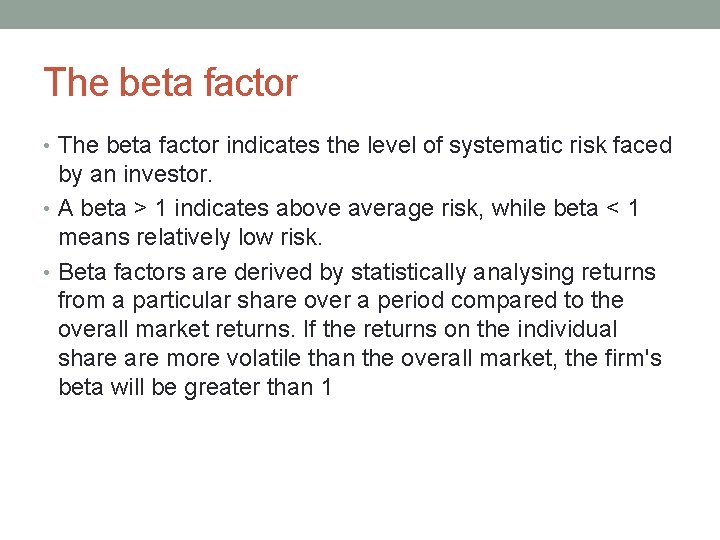
The beta factor • The beta factor indicates the level of systematic risk faced by an investor. • A beta > 1 indicates above average risk, while beta < 1 means relatively low risk. • Beta factors are derived by statistically analysing returns from a particular share over a period compared to the overall market returns. If the returns on the individual share more volatile than the overall market, the firm's beta will be greater than 1
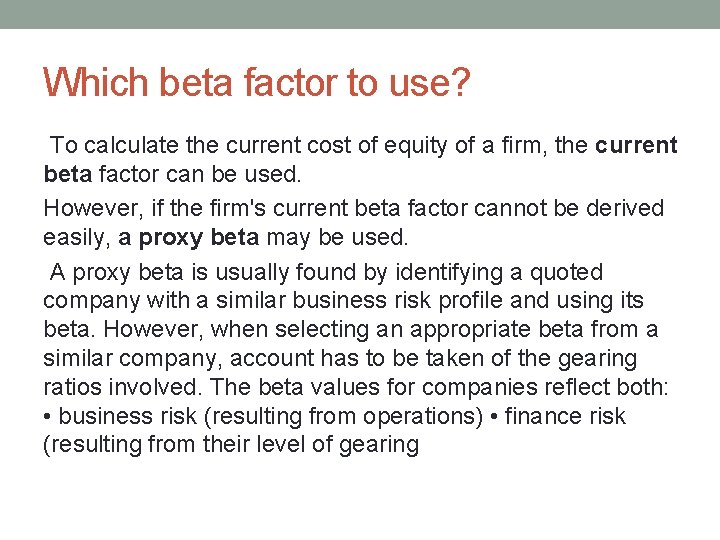
Which beta factor to use? To calculate the current cost of equity of a firm, the current beta factor can be used. However, if the firm's current beta factor cannot be derived easily, a proxy beta may be used. A proxy beta is usually found by identifying a quoted company with a similar business risk profile and using its beta. However, when selecting an appropriate beta from a similar company, account has to be taken of the gearing ratios involved. The beta values for companies reflect both: • business risk (resulting from operations) • finance risk (resulting from their level of gearing
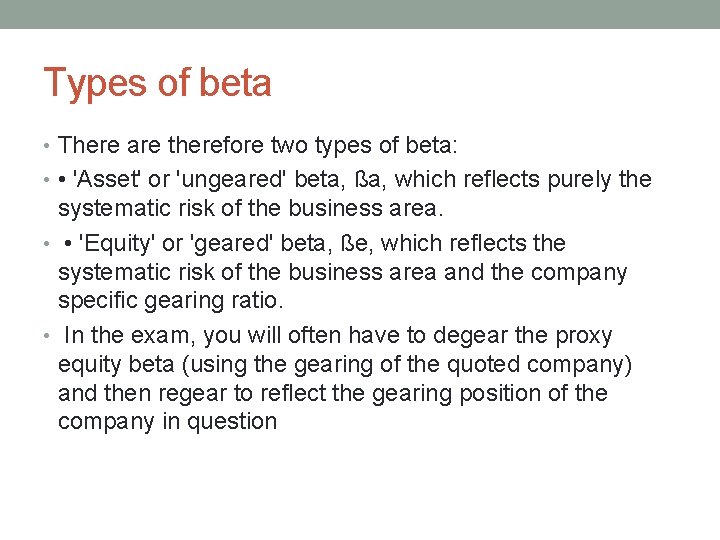
Types of beta • There are therefore two types of beta: • • 'Asset' or 'ungeared' beta, ßa, which reflects purely the systematic risk of the business area. • • 'Equity' or 'geared' beta, ße, which reflects the systematic risk of the business area and the company specific gearing ratio. • In the exam, you will often have to degear the proxy equity beta (using the gearing of the quoted company) and then regear to reflect the gearing position of the company in question
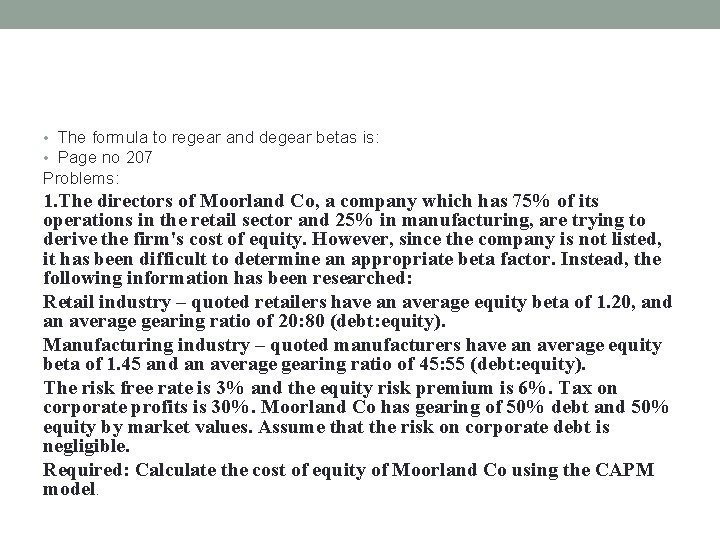
• The formula to regear and degear betas is: • Page no 207 Problems: 1. The directors of Moorland Co, a company which has 75% of its operations in the retail sector and 25% in manufacturing, are trying to derive the firm's cost of equity. However, since the company is not listed, it has been difficult to determine an appropriate beta factor. Instead, the following information has been researched: Retail industry – quoted retailers have an average equity beta of 1. 20, and an average gearing ratio of 20: 80 (debt: equity). Manufacturing industry – quoted manufacturers have an average equity beta of 1. 45 and an average gearing ratio of 45: 55 (debt: equity). The risk free rate is 3% and the equity risk premium is 6%. Tax on corporate profits is 30%. Moorland Co has gearing of 50% debt and 50% equity by market values. Assume that the risk on corporate debt is negligible. Required: Calculate the cost of equity of Moorland Co using the CAPM model.
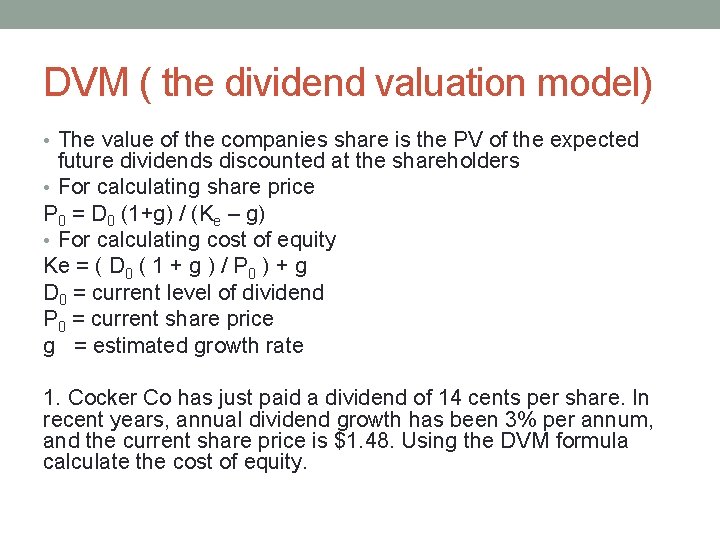
DVM ( the dividend valuation model) • The value of the companies share is the PV of the expected future dividends discounted at the shareholders • For calculating share price P 0 = D 0 (1+g) / (Ke – g) • For calculating cost of equity Ke = ( D 0 ( 1 + g ) / P 0 ) + g D 0 = current level of dividend P 0 = current share price g = estimated growth rate 1. Cocker Co has just paid a dividend of 14 cents per share. In recent years, annual dividend growth has been 3% per annum, and the current share price is $1. 48. Using the DVM formula calculate the cost of equity.
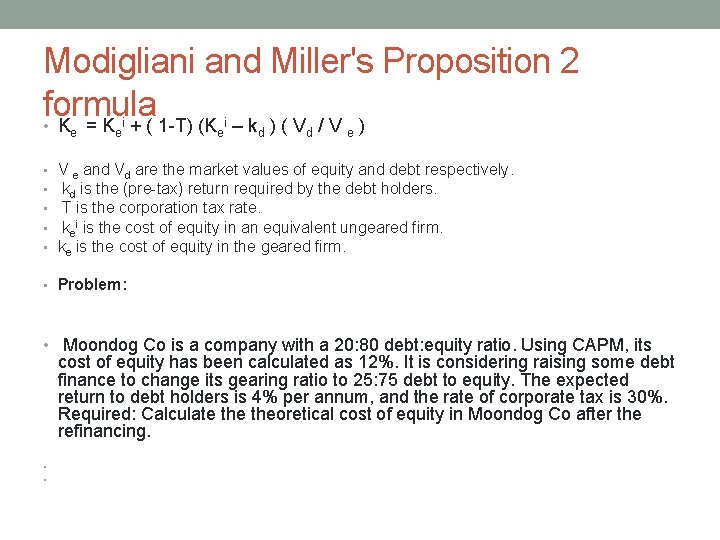
Modigliani and Miller's Proposition 2 formula • K = K + ( 1 -T) (K – k ) ( V / V ) e • • • e i d d e V e and Vd are the market values of equity and debt respectively. kd is the (pre-tax) return required by the debt holders. T is the corporation tax rate. kei is the cost of equity in an equivalent ungeared firm. ke is the cost of equity in the geared firm. • Problem: • Moondog Co is a company with a 20: 80 debt: equity ratio. Using CAPM, its cost of equity has been calculated as 12%. It is considering raising some debt finance to change its gearing ratio to 25: 75 debt to equity. The expected return to debt holders is 4% per annum, and the rate of corporate tax is 30%. Required: Calculate theoretical cost of equity in Moondog Co after the refinancing. • •
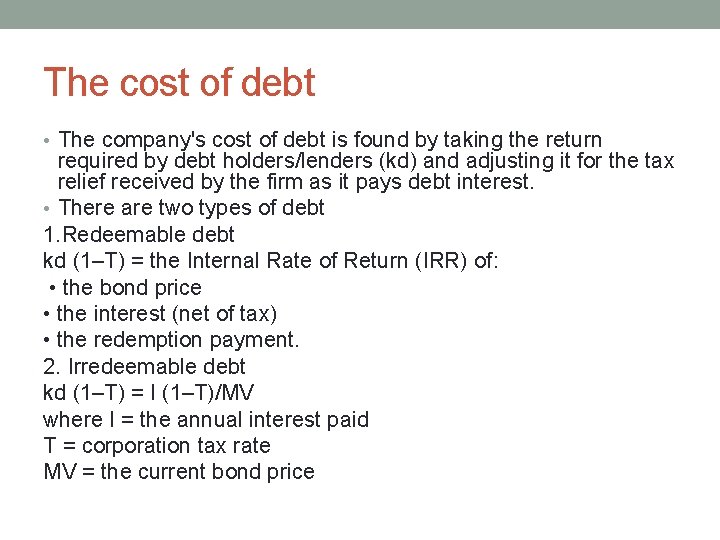
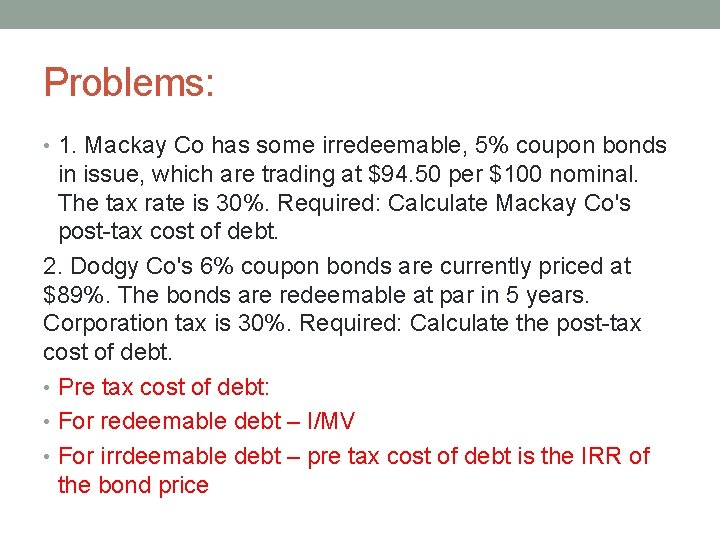
The cost of debt • The company's cost of debt is found by taking the return required by debt holders/lenders (kd) and adjusting it for the tax relief received by the firm as it pays debt interest. • There are two types of debt 1. Redeemable debt kd (1–T) = the Internal Rate of Return (IRR) of: • the bond price • the interest (net of tax) • the redemption payment. 2. Irredeemable debt kd (1–T) = I (1–T)/MV where I = the annual interest paid T = corporation tax rate MV = the current bond price
Problems: • 1. Mackay Co has some irredeemable, 5% coupon bonds in issue, which are trading at $94. 50 per $100 nominal. The tax rate is 30%. Required: Calculate Mackay Co's post-tax cost of debt. 2. Dodgy Co's 6% coupon bonds are currently priced at $89%. The bonds are redeemable at par in 5 years. Corporation tax is 30%. Required: Calculate the post-tax cost of debt. • Pre tax cost of debt: • For redeemable debt – I/MV • For irrdeemable debt – pre tax cost of debt is the IRR of the bond price
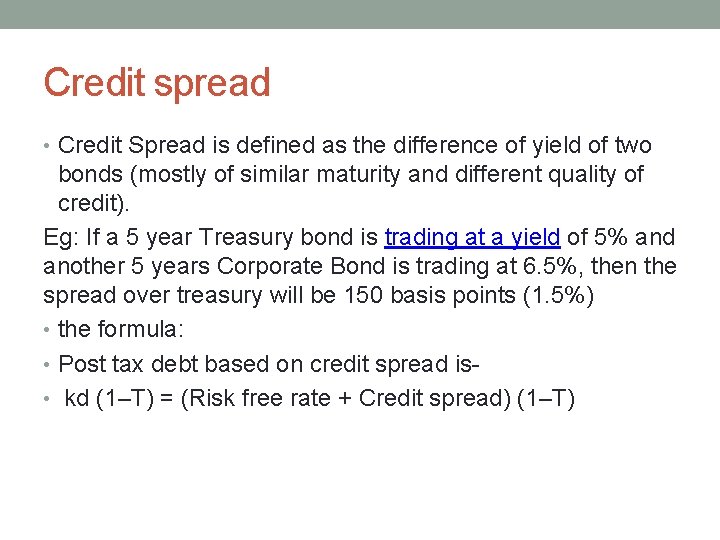
Credit spread • Credit Spread is defined as the difference of yield of two bonds (mostly of similar maturity and different quality of credit). Eg: If a 5 year Treasury bond is trading at a yield of 5% and another 5 years Corporate Bond is trading at 6. 5%, then the spread over treasury will be 150 basis points (1. 5%) • the formula: • Post tax debt based on credit spread is • kd (1–T) = (Risk free rate + Credit spread) (1–T)
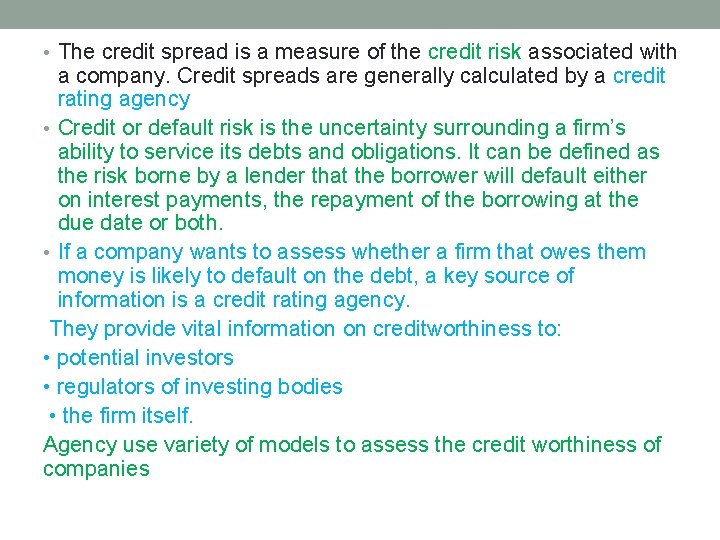
• The credit spread is a measure of the credit risk associated with a company. Credit spreads are generally calculated by a credit rating agency • Credit or default risk is the uncertainty surrounding a firm’s ability to service its debts and obligations. It can be defined as the risk borne by a lender that the borrower will default either on interest payments, the repayment of the borrowing at the due date or both. • If a company wants to assess whether a firm that owes them money is likely to default on the debt, a key source of information is a credit rating agency. They provide vital information on creditworthiness to: • potential investors • regulators of investing bodies • the firm itself. Agency use variety of models to assess the credit worthiness of companies
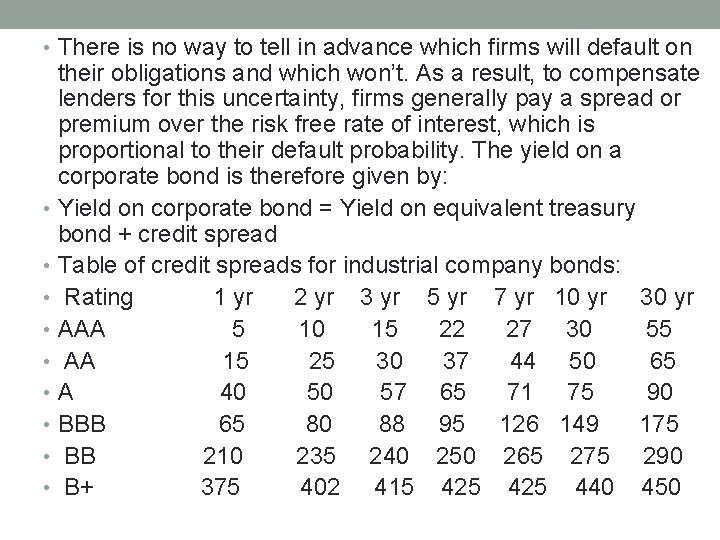
• There is no way to tell in advance which firms will default on their obligations and which won’t. As a result, to compensate lenders for this uncertainty, firms generally pay a spread or premium over the risk free rate of interest, which is proportional to their default probability. The yield on a corporate bond is therefore given by: • Yield on corporate bond = Yield on equivalent treasury bond + credit spread • Table of credit spreads for industrial company bonds: • Rating 1 yr 2 yr 3 yr 5 yr 7 yr 10 yr 30 yr • AAA 5 10 15 22 27 30 55 • AA 15 25 30 37 44 50 65 • A 40 50 57 65 71 75 90 • BBB 65 80 88 95 126 149 175 • BB 210 235 240 250 265 275 290 • B+ 375 402 415 425 440 450
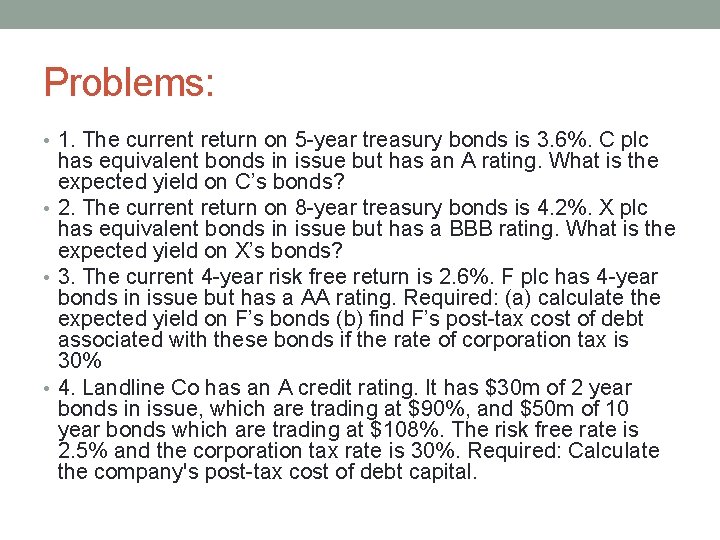
Problems: • 1. The current return on 5 -year treasury bonds is 3. 6%. C plc has equivalent bonds in issue but has an A rating. What is the expected yield on C’s bonds? • 2. The current return on 8 -year treasury bonds is 4. 2%. X plc has equivalent bonds in issue but has a BBB rating. What is the expected yield on X’s bonds? • 3. The current 4 -year risk free return is 2. 6%. F plc has 4 -year bonds in issue but has a AA rating. Required: (a) calculate the expected yield on F’s bonds (b) find F’s post-tax cost of debt associated with these bonds if the rate of corporation tax is 30% • 4. Landline Co has an A credit rating. It has $30 m of 2 year bonds in issue, which are trading at $90%, and $50 m of 10 year bonds which are trading at $108%. The risk free rate is 2. 5% and the corporation tax rate is 30%. Required: Calculate the company's post-tax cost of debt capital.
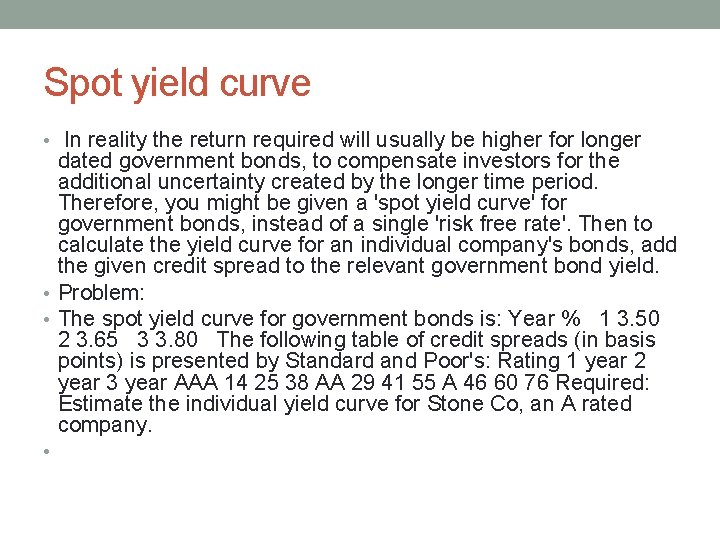
Spot yield curve • In reality the return required will usually be higher for longer dated government bonds, to compensate investors for the additional uncertainty created by the longer time period. Therefore, you might be given a 'spot yield curve' for government bonds, instead of a single 'risk free rate'. Then to calculate the yield curve for an individual company's bonds, add the given credit spread to the relevant government bond yield. • Problem: • The spot yield curve for government bonds is: Year % 1 3. 50 2 3. 65 3 3. 80 The following table of credit spreads (in basis points) is presented by Standard and Poor's: Rating 1 year 2 year 3 year AAA 14 25 38 AA 29 41 55 A 46 60 76 Required: Estimate the individual yield curve for Stone Co, an A rated company. •
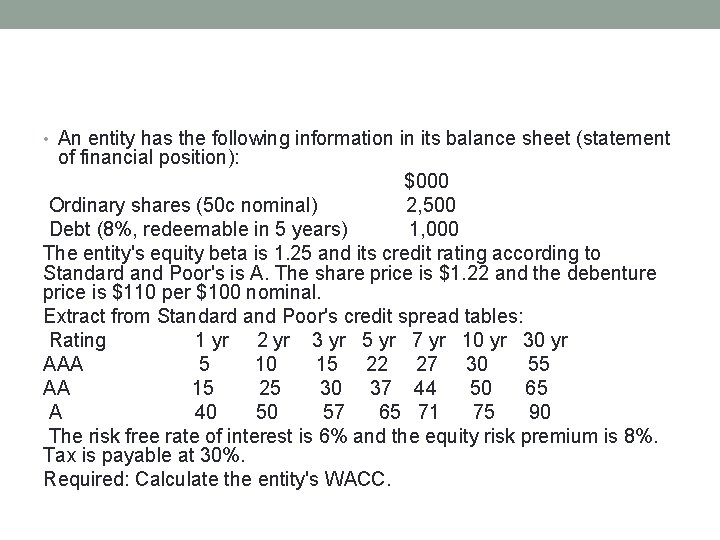
• An entity has the following information in its balance sheet (statement of financial position): $000 Ordinary shares (50 c nominal) 2, 500 Debt (8%, redeemable in 5 years) 1, 000 The entity's equity beta is 1. 25 and its credit rating according to Standard and Poor's is A. The share price is $1. 22 and the debenture price is $110 per $100 nominal. Extract from Standard and Poor's credit spread tables: Rating 1 yr 2 yr 3 yr 5 yr 7 yr 10 yr 30 yr AAA 5 10 15 22 27 30 55 AA 15 25 30 37 44 50 65 A 40 57 65 71 75 90 The risk free rate of interest is 6% and the equity risk premium is 8%. Tax is payable at 30%. Required: Calculate the entity's WACC.