
W production at LHC By Alessandro Tricoli In
W production at LHC By Alessandro Tricoli In collaboration with Monika Wielers Rutherford-Appleton Laboratory ATLAS Rome Workshop 6 th June 2005 Alessandro Tricoli, Oxford ATLAS UK Physics Meeting at. Oxford Durham, University. Alessandro Tricoli, 18 th September University 2006
Overview q Introduction q W production mechanism q Importance of W production as standard candle process q Reconstruction of W->e events and background rejection q Standard ATLAS W Selection as in the TDR q Trigger-aware selection of W->e events against background q MWT and electron rapidity, ET distributions q Alternative approach for W selection: CMS-like q Jet Multiplicity with Cone and KT algorithms in W->e events q effect of jet-finder choice on W selection q Distortion on W-Asymmetry due to W selection cuts q Conclusions and Outlook ATLAS UK Physics Meeting- Durham, 18 th Sept. 2006 Alessandro Tricoli, RAL 2
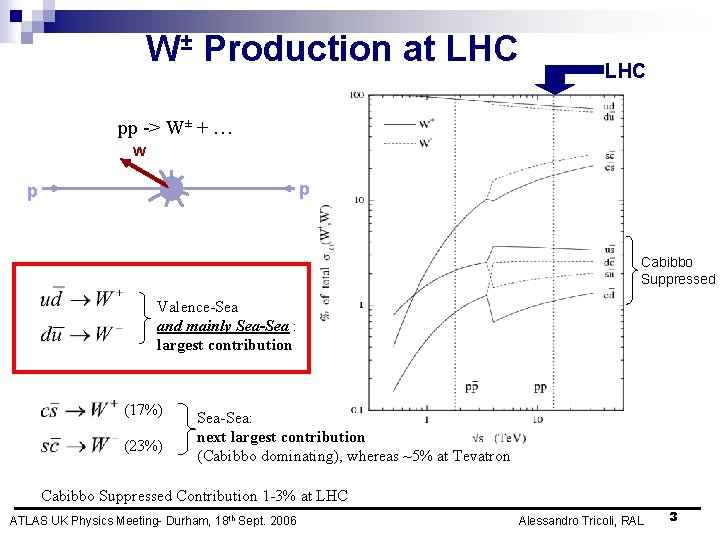
W± Production at LHC pp -> W± + … W p p Cabibbo Suppressed Valence-Sea and mainly Sea-Sea : largest contribution (17%) (23%) Sea-Sea: next largest contribution (Cabibbo dominating), whereas ~5% at Tevatron Cabibbo Suppressed Contribution 1 -3% at LHC ATLAS UK Physics Meeting- Durham, 18 th Sept. 2006 Alessandro Tricoli, RAL 3
Why accurate W reconstruction is important q W production is a standard candle process: q theoretically and experimentally well known q large statistics: q ~21 W->l events per sec. at 1033 cm-2 s-1 lumi. (10 times larger than Z production) q Together with Z it is a control-process for detector calibrations/performances: q trigger selection efficiencies q particle ID efficiency: calorimeter and tracker performances q missing ET calibration (i. e. W->l ) q jet reconstruction (i. e. in situ JES calib. with W->jj in tt events) q luminosity monitor See: ATLAS Calorimeter Calibration Workshop 5 -8 Sept. 2006 q Control-process for physics performances: q Theory cross check: electro-weak corrections, LO-NNLO approximations etc. q PDF constraining (see Mandy’s talk): q low-x gluon using W+ and W- rapidity distributions q low-x valence quarks using W± asymmetry q W+jets process is background to new physics q important to accurately determine its kinematics parameters and quantify uncertainties ATLAS UK Physics Meeting- Durham, 18 th Sept. 2006 Alessandro Tricoli, RAL 4
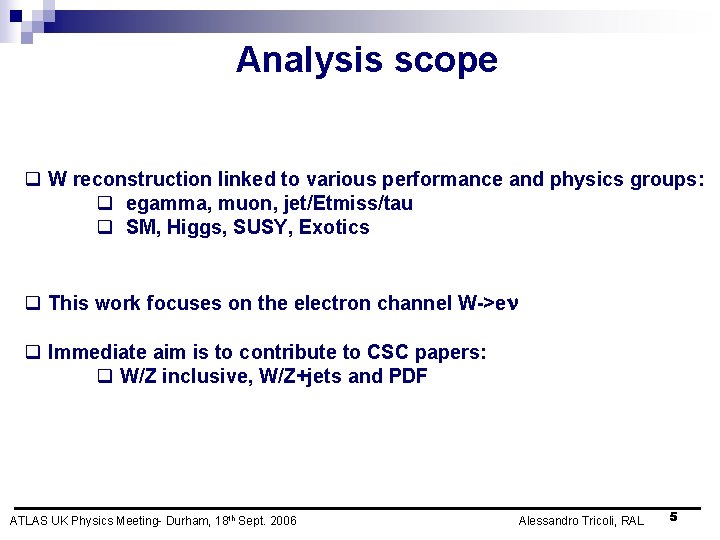
Analysis scope q W reconstruction linked to various performance and physics groups: q egamma, muon, jet/Etmiss/tau q SM, Higgs, SUSY, Exotics q This work focuses on the electron channel W->e q Immediate aim is to contribute to CSC papers: q W/Z inclusive, W/Z+jets and PDF ATLAS UK Physics Meeting- Durham, 18 th Sept. 2006 Alessandro Tricoli, RAL 5
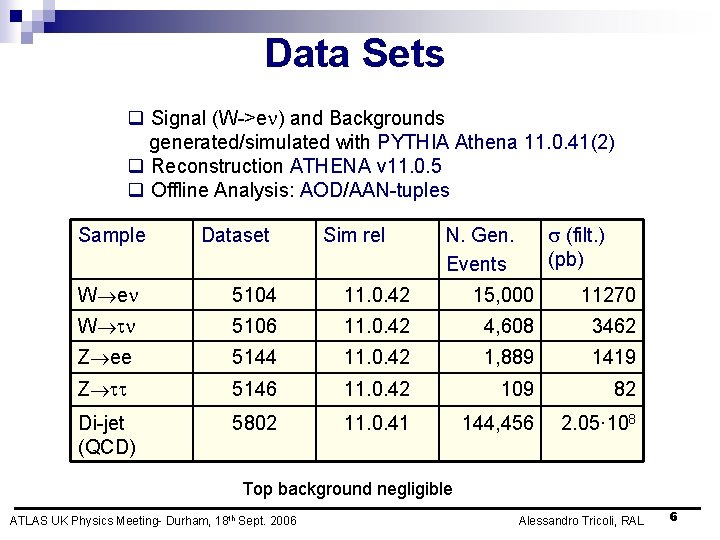
Data Sets q Signal (W->e ) and Backgrounds generated/simulated with PYTHIA Athena 11. 0. 41(2) q Reconstruction ATHENA v 11. 0. 5 q Offline Analysis: AOD/AAN-tuples Sample Dataset Sim rel (filt. ) (pb) N. Gen. Events W e 5104 11. 0. 42 15, 000 11270 W 5106 11. 0. 42 4, 608 3462 Z ee 5144 11. 0. 42 1, 889 1419 Z 5146 11. 0. 42 109 82 Di-jet (QCD) 5802 11. 0. 41 144, 456 2. 05· 108 Top background negligible ATLAS UK Physics Meeting- Durham, 18 th Sept. 2006 Alessandro Tricoli, RAL 6
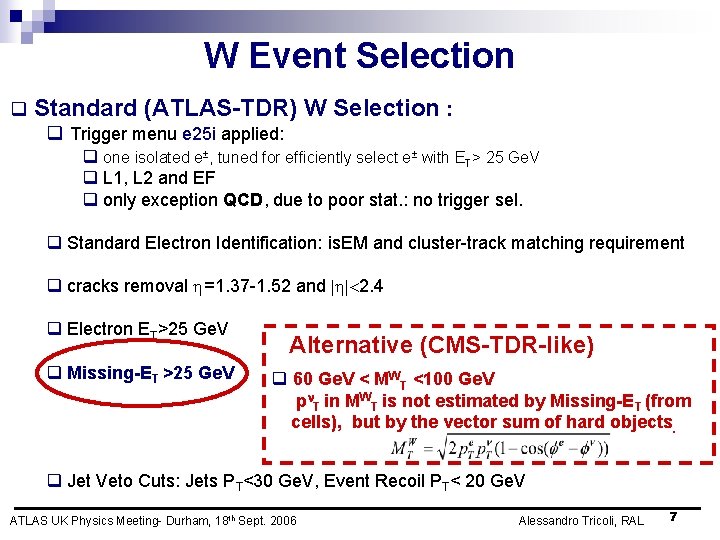
W Event Selection q Standard (ATLAS-TDR) W Selection : q Trigger menu e 25 i applied: q one isolated e±, tuned for efficiently select e± with ET> 25 Ge. V q L 1, L 2 and EF q only exception QCD, due to poor stat. : no trigger sel. q Standard Electron Identification: is. EM and cluster-track matching requirement q cracks removal =1. 37 -1. 52 and | |<2. 4 q Electron ET>25 Ge. V q Missing-ET >25 Ge. V Alternative (CMS-TDR-like) q 60 Ge. V < MWT <100 Ge. V p T in MWT is not estimated by Missing-ET (from cells), but by the vector sum of hard objects. q Jet Veto Cuts: Jets PT<30 Ge. V, Event Recoil PT< 20 Ge. V ATLAS UK Physics Meeting- Durham, 18 th Sept. 2006 Alessandro Tricoli, RAL 7
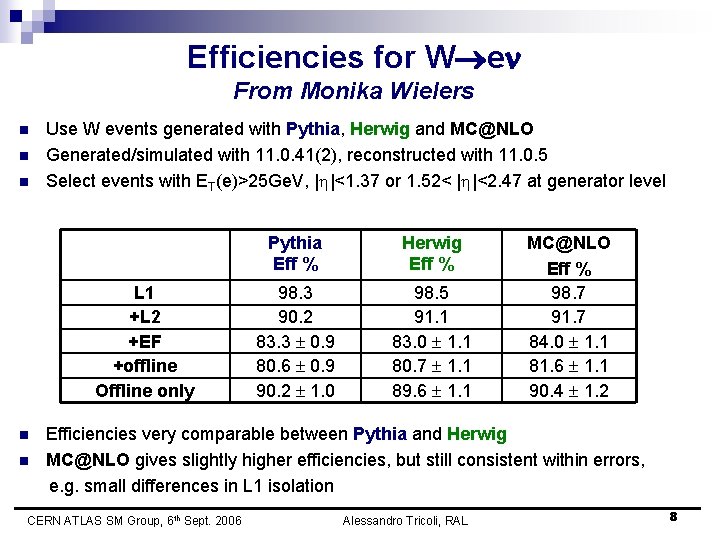
Efficiencies for W e From Monika Wielers n n n Use W events generated with Pythia, Herwig and MC@NLO Generated/simulated with 11. 0. 41(2), reconstructed with 11. 0. 5 Select events with ET(e)>25 Ge. V, | |<1. 37 or 1. 52< | |<2. 47 at generator level L 1 +L 2 +EF +offline Offline only n n Pythia Eff % Herwig Eff % 98. 3 90. 2 83. 3 0. 9 80. 6 0. 9 90. 2 1. 0 98. 5 91. 1 83. 0 1. 1 80. 7 1. 1 89. 6 1. 1 MC@NLO Eff % 98. 7 91. 7 84. 0 1. 1 81. 6 1. 1 90. 4 1. 2 Efficiencies very comparable between Pythia and Herwig MC@NLO gives slightly higher efficiencies, but still consistent within errors, e. g. small differences in L 1 isolation CERN ATLAS SM Group, 6 th Sept. 2006 Alessandro Tricoli, RAL 8
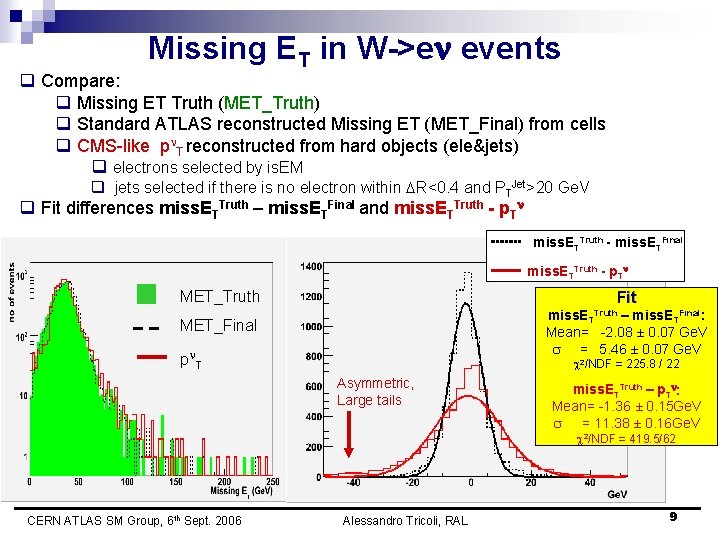
Missing ET in W->e events q Compare: q Missing ET Truth (MET_Truth) q Standard ATLAS reconstructed Missing ET (MET_Final) from cells q CMS-like p T reconstructed from hard objects (ele&jets) q electrons selected by is. EM q jets selected if there is no electron within DR<0. 4 and PTJet>20 Ge. V q Fit differences miss. ETTruth – miss. ETFinal and miss. ETTruth - p. T miss. ETTruth - miss. ETFinal miss. ETTruth - p. T MET_Truth Fit miss. ETTruth – miss. ETFinal: Mean= -2. 08 ± 0. 07 Ge. V = 5. 46 ± 0. 07 Ge. V MET_Final p T 2/NDF = 225. 8 / 22 Asymmetric, Large tails miss. ETTruth – p. T : Mean= -1. 36 ± 0. 15 Ge. V = 11. 38 ± 0. 16 Ge. V 2/NDF = 419. 5/62 CERN ATLAS SM Group, 6 th Sept. 2006 Alessandro Tricoli, RAL 9
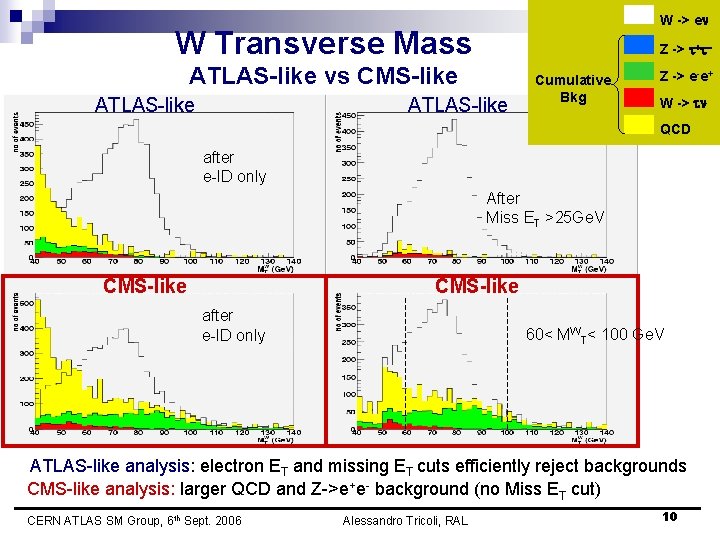
W -> e W Transverse Mass Z -> + - ATLAS-like vs CMS-like ATLAS-like Cumulative Bkg Z -> e-e+ W -> QCD after e-ID only After Miss ET >25 Ge. V CMS-like after e-ID only 60< MWT< 100 Ge. V ATLAS-like analysis: electron ET and missing ET cuts efficiently reject backgrounds CMS-like analysis: larger QCD and Z->e+e- background (no Miss ET cut) CERN ATLAS SM Group, 6 th Sept. 2006 Alessandro Tricoli, RAL 10
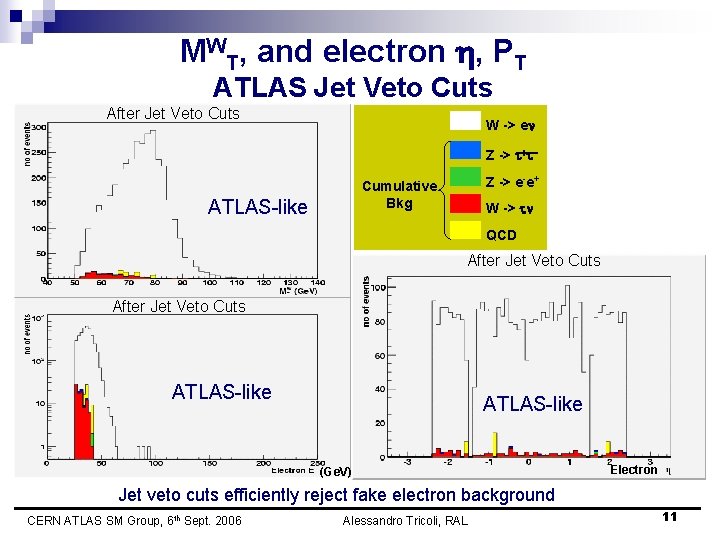
MWT, and electron h, PT ATLAS Jet Veto Cuts After Jet Veto Cuts W -> e Z -> + Z -> e-e+ Cumulative Bkg ATLAS-like W -> QCD After Jet Veto Cuts ATLAS-like (Ge. V) Electron Jet veto cuts efficiently reject fake electron background CERN ATLAS SM Group, 6 th Sept. 2006 Alessandro Tricoli, RAL 11
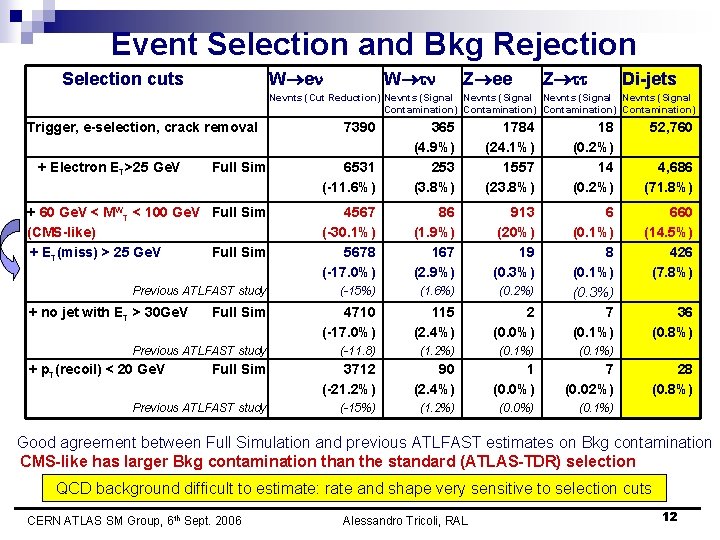
Event Selection and Bkg Rejection Selection cuts W e W Z ee Z Di-jets Nevnts (Cut Reduction) Nevnts (Signal Contamination) Trigger, e-selection, crack removal Full Sim 6531 (-11. 6%) 365 (4. 9%) 253 (3. 8%) + 60 Ge. V < MWT < 100 Ge. V Full Sim (CMS-like) + ET(miss) > 25 Ge. V Full Sim 4567 (-30. 1%) 5678 (-17. 0%) 86 (1. 9%) 167 (2. 9%) 913 (20%) 19 (0. 3%) Previous ATLFAST study (-15%) (1. 6%) (0. 2%) Full Sim 4710 (-17. 0%) 115 (2. 4%) 2 (0. 0%) 6 (0. 1%) 8 (0. 1%) (0. 3%) 7 (0. 1%) Previous ATLFAST study (-11. 8) (1. 2%) (0. 1%) Full Sim 3712 (-21. 2%) 90 (2. 4%) 1 (0. 0%) 7 (0. 02%) Previous ATLFAST study (-15%) (1. 2%) (0. 0%) (0. 1%) + Electron ET>25 Ge. V + no jet with ET > 30 Ge. V + p. T(recoil) < 20 Ge. V 7390 1784 (24. 1%) 1557 (23. 8%) 18 (0. 2%) 14 (0. 2%) 52, 760 4, 686 (71. 8%) 660 (14. 5%) 426 (7. 8%) 36 (0. 8%) 28 (0. 8%) Good agreement between Full Simulation and previous ATLFAST estimates on Bkg contamination CMS-like has larger Bkg contamination than the standard (ATLAS-TDR) selection QCD background difficult to estimate: rate and shape very sensitive to selection cuts CERN ATLAS SM Group, 6 th Sept. 2006 Alessandro Tricoli, RAL 12
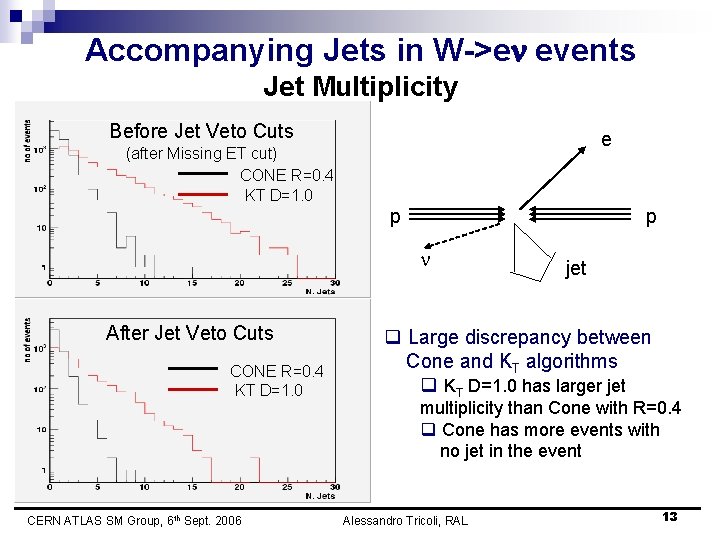
Accompanying Jets in W->e events Jet Multiplicity Before Jet Veto Cuts e (after Missing ET cut) CONE R=0. 4 KT D=1. 0 p p After Jet Veto Cuts CONE R=0. 4 KT D=1. 0 CERN ATLAS SM Group, 6 th Sept. 2006 jet q Large discrepancy between Cone and KT algorithms q KT D=1. 0 has larger jet multiplicity than Cone with R=0. 4 q Cone has more events with no jet in the event Alessandro Tricoli, RAL 13
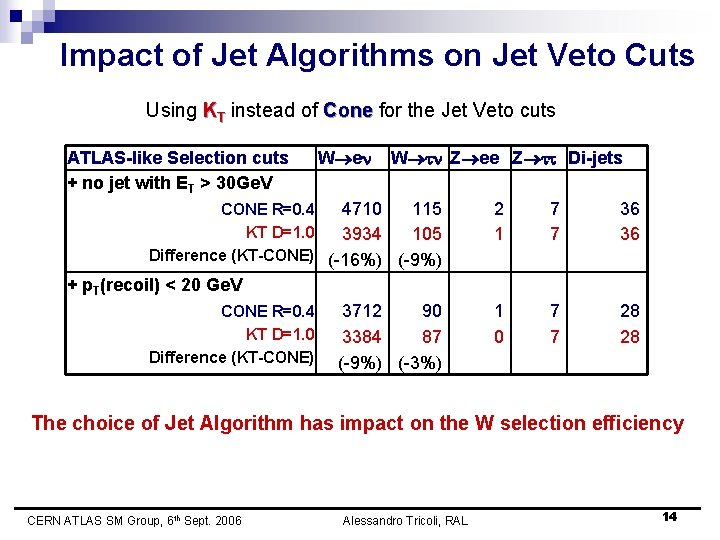
Impact of Jet Algorithms on Jet Veto Cuts Using KT instead of Cone for the Jet Veto cuts ATLAS-like Selection cuts + no jet with ET > 30 Ge. V W e W Z ee Z Di-jets CONE R=0. 4 4710 115 KT D=1. 0 3934 105 Difference (KT-CONE) (-16%) (-9%) 2 1 7 7 36 36 1 0 7 7 28 28 + p. T(recoil) < 20 Ge. V CONE R=0. 4 KT D=1. 0 Difference (KT-CONE) 3712 90 3384 87 (-9%) (-3%) The choice of Jet Algorithm has impact on the W selection efficiency CERN ATLAS SM Group, 6 th Sept. 2006 Alessandro Tricoli, RAL 14
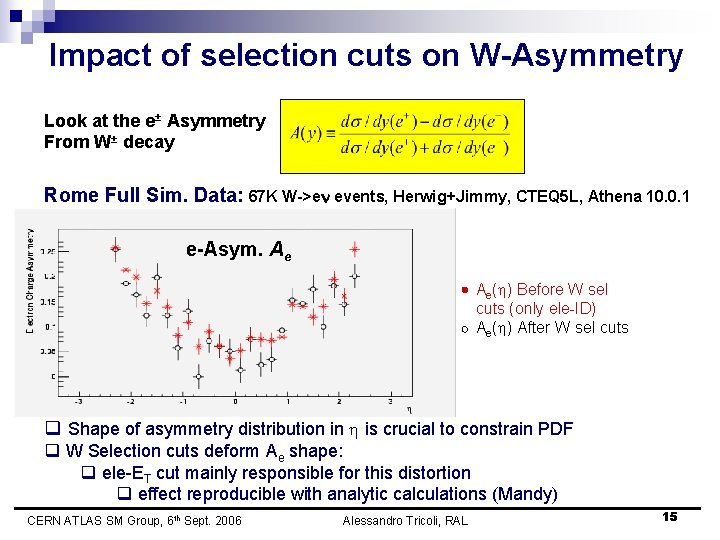
Impact of selection cuts on W-Asymmetry Look at the e± Asymmetry From W± decay Rome Full Sim. Data: 67 K W->e events, Herwig+Jimmy, CTEQ 5 L, Athena 10. 0. 1 e-Asym. Ae Ae( ) Before W sel cuts (only ele-ID) Ae( ) After W sel cuts q Shape of asymmetry distribution in is crucial to constrain PDF q W Selection cuts deform Ae shape: q ele-ET cut mainly responsible for this distortion q effect reproducible with analytic calculations (Mandy) CERN ATLAS SM Group, 6 th Sept. 2006 Alessandro Tricoli, RAL 15
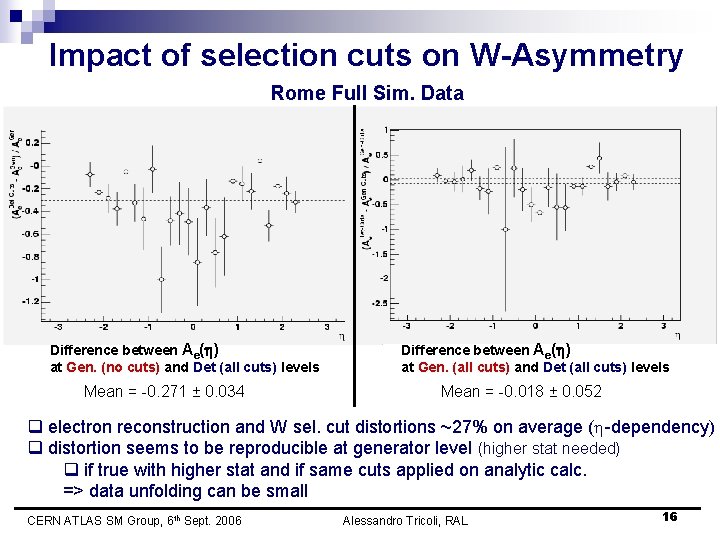
Impact of selection cuts on W-Asymmetry Rome Full Sim. Data Difference between Ae(h) at Gen. (no cuts) and Det (all cuts) levels Mean = -0. 271 ± 0. 034 Difference between Ae(h) at Gen. (all cuts) and Det (all cuts) levels Mean = -0. 018 ± 0. 052 q electron reconstruction and W sel. cut distortions ~27% on average ( -dependency) q distortion seems to be reproducible at generator level (higher stat needed) q if true with higher stat and if same cuts applied on analytic calc. => data unfolding can be small CERN ATLAS SM Group, 6 th Sept. 2006 Alessandro Tricoli, RAL 16
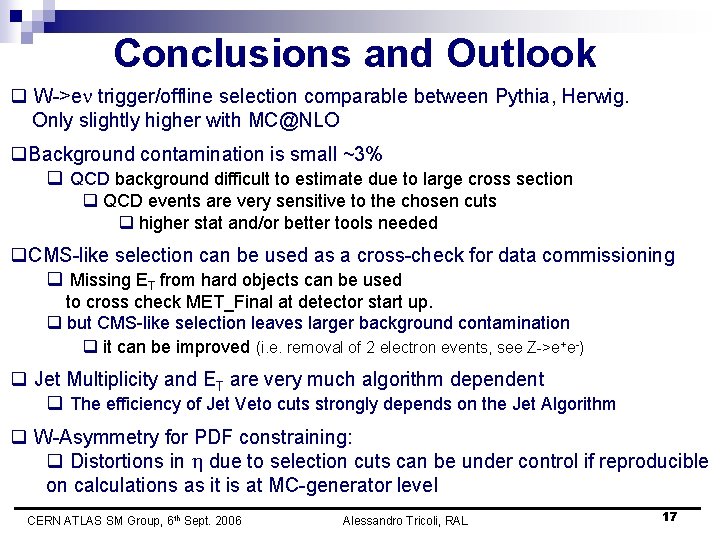
Conclusions and Outlook q W->e trigger/offline selection comparable between Pythia, Herwig. Only slightly higher with MC@NLO q. Background contamination is small ~3% q QCD background difficult to estimate due to large cross section q QCD events are very sensitive to the chosen cuts q higher stat and/or better tools needed q. CMS-like selection can be used as a cross-check for data commissioning q Missing ET from hard objects can be used to cross check MET_Final at detector start up. q but CMS-like selection leaves larger background contamination q it can be improved (i. e. removal of 2 electron events, see Z->e+e-) q Jet Multiplicity and ET are very much algorithm dependent q The efficiency of Jet Veto cuts strongly depends on the Jet Algorithm q W-Asymmetry for PDF constraining: q Distortions in due to selection cuts can be under control if reproducible on calculations as it is at MC-generator level CERN ATLAS SM Group, 6 th Sept. 2006 Alessandro Tricoli, RAL 17
EXTRAS ATLAS UK Physics Meeting- Durham, 18 th Sept. 2006 Alessandro Tricoli, RAL 18
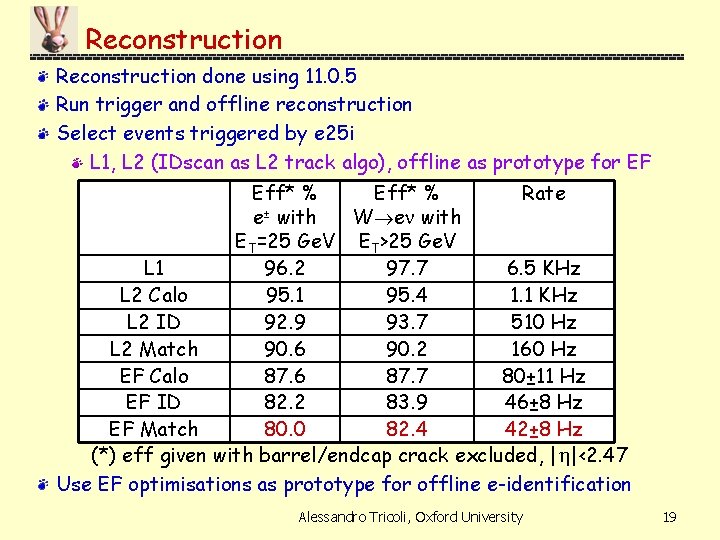
Reconstruction done using 11. 0. 5 Run trigger and offline reconstruction Select events triggered by e 25 i L 1, L 2 (IDscan as L 2 track algo), offline as prototype for EF Eff* % Rate e± with W e with ET=25 Ge. V ET>25 Ge. V L 1 96. 2 97. 7 6. 5 KHz L 2 Calo 95. 1 95. 4 1. 1 KHz L 2 ID 92. 9 93. 7 510 Hz L 2 Match 90. 6 90. 2 160 Hz EF Calo 87. 6 87. 7 80± 11 Hz EF ID 82. 2 83. 9 46± 8 Hz EF Match 80. 0 82. 4 42± 8 Hz (*) eff given with barrel/endcap crack excluded, | |<2. 47 Use EF optimisations as prototype for offline e-identification Alessandro Tricoli, Oxford University 19
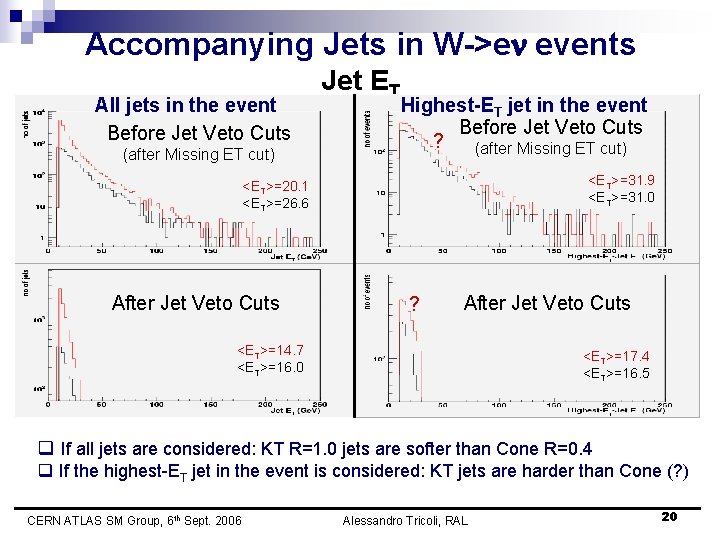
Accompanying Jets in W->e events All jets in the event Before Jet Veto Cuts (after Missing ET cut) Jet ET Highest-ET jet in the event Before Jet Veto Cuts ? (after Missing ET cut) <ET>=31. 9 <ET>=31. 0 <ET>=20. 1 <ET>=26. 6 After Jet Veto Cuts ? After Jet Veto Cuts <ET>=14. 7 <ET>=16. 0 <ET>=17. 4 <ET>=16. 5 q If all jets are considered: KT R=1. 0 jets are softer than Cone R=0. 4 q If the highest-ET jet in the event is considered: KT jets are harder than Cone (? ) CERN ATLAS SM Group, 6 th Sept. 2006 Alessandro Tricoli, RAL 20
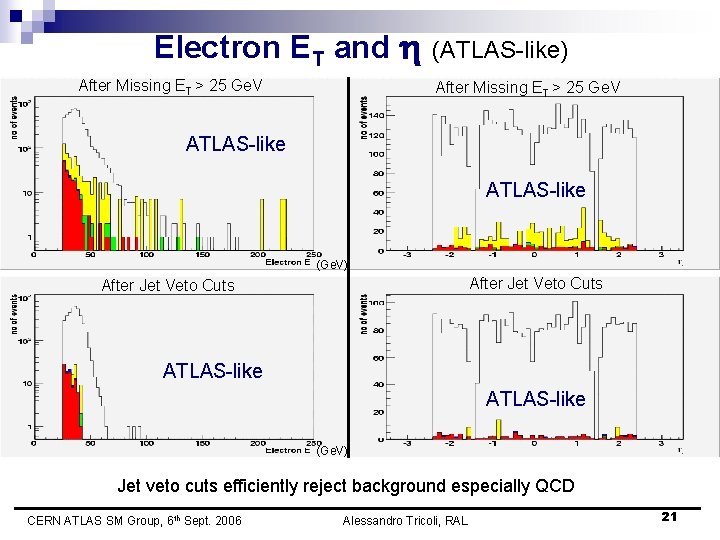
Electron ET and h After Missing ET > 25 Ge. V (ATLAS-like) After Missing ET > 25 Ge. V ATLAS-like (Ge. V) After Jet Veto Cuts ATLAS-like (Ge. V) Jet veto cuts efficiently reject background especially QCD CERN ATLAS SM Group, 6 th Sept. 2006 Alessandro Tricoli, RAL 21
- Slides: 21