
W O W Earthquake Webquest Name Date Go
! W O W Earthquake Webquest
Name: ____________________ Date: _________ Go to http: //www. nationalgeographic. com/features/04/forcesofnature/i nteractive/index. html? section=e Choose a force: Earthquakes On the upper left menu, choose number 1. Read “What is an Earthquake? ”. When do earthquakes happen? ______________________________________________________________ __ How many earthquakes occur every day? Each year? ______________________________________________________________ __ Where and what year was the deadliest quake ever? How many people were killed? ______________________________________________________________ __ On the upper left menu, choose number 2. Read “Where do Earthquakes Occur? ”. Where do most earthquakes occur? ______________________________________________________________ __
What percentage of earthquakes comes from the largest earthquake belt? ______________________________________________________________ __ On the upper left menu, choose number 3. Read “What Causes Earthquakes? ”. What is “plate tectonics”? ______________________________________________________________ __ Click “Next” In which state is the San Andreas Fault? ________________ How long is the San Andreas Fault? _______________ How deep is the fault? _______________ How many earthquakes occur along this fault each year? ___________ On the upper left menu, choose number 4. Read “Types of Faults”. List the four (4) types of faults: 1. 2. 3. 4. _______________________ Click on “Normal Fault” Why do normal faults occur?
Draw a picture of a normal fault: Click on “Next fault type” How does a reverse fault occur? _________________________________________________________________ __ Draw a picture of a reverse fault: Click on “Next fault type” How does a strike-slip fault occur? _________________________________________________________________
Draw a picture of a strike-slip fault: Click on “Next fault type” Why do dip-slip faults occur? _______________________________________________________________ On the upper left menu, choose number 5. Read “Measurement and Recording”. What is the “hypocenter? ” _______________________________________________________________ What is the point directly above the hypocenter? _________________ Click “Next” What is another name for a P wave? ________________ Click “Next” What instrument measures seismic waves?
On the upper left menu, choose number 6. Read “Locate an earthquake? ”. What do you need to pinpoint the epicenter of an earthquake? _________________________________________________________________ __ Click “Trigger an Earthquake” Watch the three (3) seismograph recordings. Click on each triangle. Click on the point where all three (3) circles intersect. Fill in the information about the earthquake you triggered: Location Latitude Longitude Magnitude On the upper left menu, choose number 7 Read “Trigger an earthquake”. 1. Select a ground type. 2. Select a magnitude. Click on “Start the earthquake” Play again until you think you have created the biggest earthquake. What type of ground causes the most destruction? ___________ Would a low magnitude or a high magnitude cause a bigger earthquake? _______________
On top right menu, click on Map. Locate the 1906 San Francisco earthquake and click on it. Fill in the following information: Date Magnitude Deaths Damage Play the video at the bottom. Compare San Francisco before and after the earthquake. Give at least three details to support the comparison. • • • _____________________________________________
Name: ____________________ Date: _________ Go to http: //www. nationalgeographic. com/features/04/forcesofnature/i nteractive/index. html? section=e Choose a force: Earthquakes On the upper left menu, choose number 1. Read “What is an Earthquake? ”. When do earthquakes happen? Earthquakes happen when plates, or rocks, within the Earth suddenly break or shift under stress, sending shock waves rippling. How many earthquakes occur every day? Each year? Thousands of earthquakes occur every day and about 500, 000 quakes occur each year. Where and what year was the deadliest quake ever? How many people were killed? The deadliest quake ever occurred in China in 1557, when an estimated 830, 000 people were killed. On the upper left menu, choose number 2. Read “Where do Earthquakes Occur? ”. Where do most earthquakes occur? Most earthquakes occur along fractures in the Earth’s crust called faults. These are found along the edges of major plates. What are the earthquakes called that are far from plate boundaries and why do they occur? Earthquakes that occur far from plate boundaries are call intraplate quakes. They occur when stress builds up and the
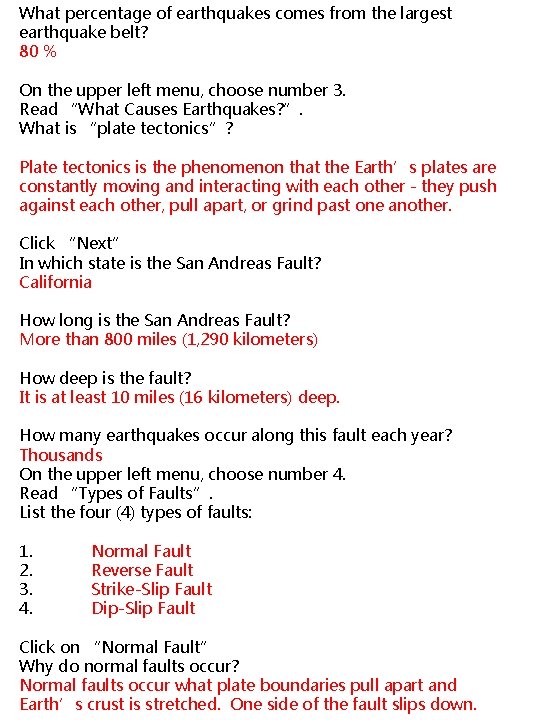
What percentage of earthquakes comes from the largest earthquake belt? 80 % On the upper left menu, choose number 3. Read “What Causes Earthquakes? ”. What is “plate tectonics”? Plate tectonics is the phenomenon that the Earth’s plates are constantly moving and interacting with each other - they push against each other, pull apart, or grind past one another. Click “Next” In which state is the San Andreas Fault? California How long is the San Andreas Fault? More than 800 miles (1, 290 kilometers) How deep is the fault? It is at least 10 miles (16 kilometers) deep. How many earthquakes occur along this fault each year? Thousands On the upper left menu, choose number 4. Read “Types of Faults”. List the four (4) types of faults: 1. 2. 3. 4. Normal Fault Reverse Fault Strike-Slip Fault Dip-Slip Fault Click on “Normal Fault” Why do normal faults occur? Normal faults occur what plate boundaries pull apart and Earth’s crust is stretched. One side of the fault slips down.
Draw a picture of a normal fault: Click on “Next fault type” How does a reverse fault occur? A reverse fault (also known as a thrust fault) occurs where plates are colliding and one side of the fault is pushed up and over the other. Draw a picture of a reverse fault: Click on “Next fault type” How does a strike-slip fault occur? In a strike-slip fault, the plates meet evenly and slide against each other horizontally.
Draw a picture of a strike-slip fault: Click on “Next fault type” Why do dip-slip faults occur? Dip-slip faults are strike-slip faults combined with either a normal fault or a thrust fault. One plate moves sideways, and one moves downward. On the upper left menu, choose number 5. Read “Measurement and Recording”. What is the “hypocenter? ” The hypocenter is the place where the movement first occurred in the fault. It can be hundreds of miles below the Earth’s surface or just beneath it. What is the point directly above the hypocenter? The point directly above the hypocenter is called the epicenter. Click “Next” What is another name for a P wave? Primary wave Click “Next” What instrument measures seismic waves? Seismograph
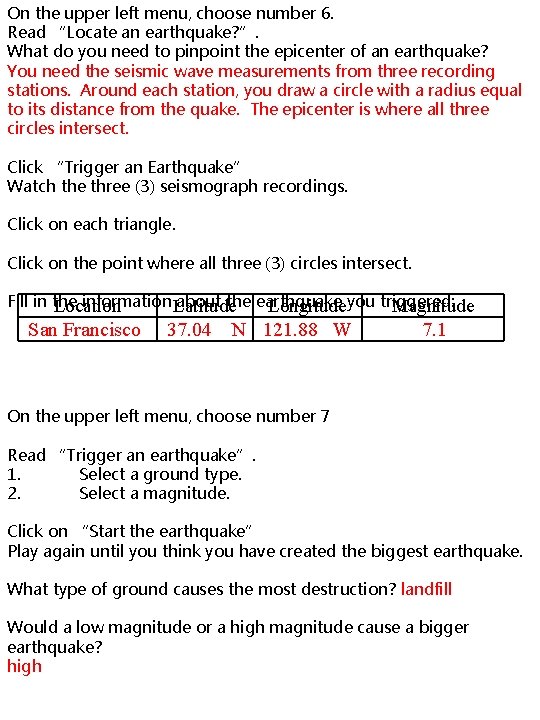
On the upper left menu, choose number 6. Read “Locate an earthquake? ”. What do you need to pinpoint the epicenter of an earthquake? You need the seismic wave measurements from three recording stations. Around each station, you draw a circle with a radius equal to its distance from the quake. The epicenter is where all three circles intersect. Click “Trigger an Earthquake” Watch the three (3) seismograph recordings. Click on each triangle. Click on the point where all three (3) circles intersect. Fill in the information Latitude about the earthquake Location Longitudeyou triggered: Magnitude San Francisco 37. 04 N 121. 88 W 7. 1 On the upper left menu, choose number 7 Read “Trigger an earthquake”. 1. Select a ground type. 2. Select a magnitude. Click on “Start the earthquake” Play again until you think you have created the biggest earthquake. What type of ground causes the most destruction? landfill Would a low magnitude or a high magnitude cause a bigger earthquake? high
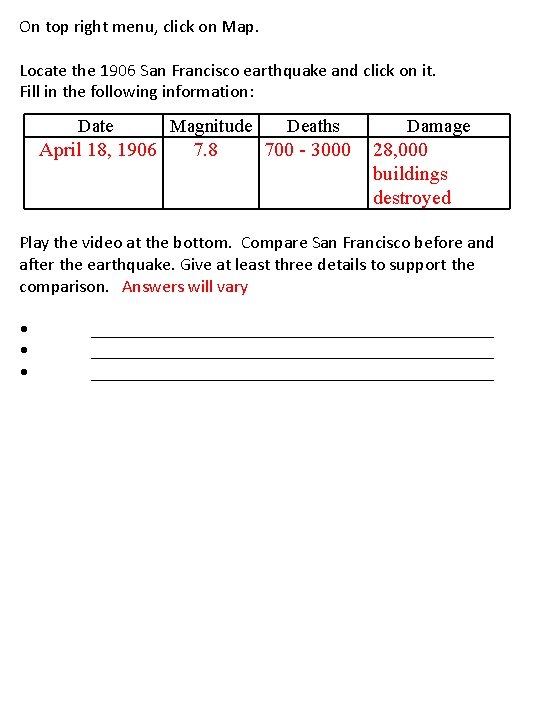
On top right menu, click on Map. Locate the 1906 San Francisco earthquake and click on it. Fill in the following information: Date Magnitude April 18, 1906 7. 8 Deaths 700 - 3000 Damage 28, 000 buildings destroyed Play the video at the bottom. Compare San Francisco before and after the earthquake. Give at least three details to support the comparison. Answers will vary • • • _____________________________________________
- Slides: 13