
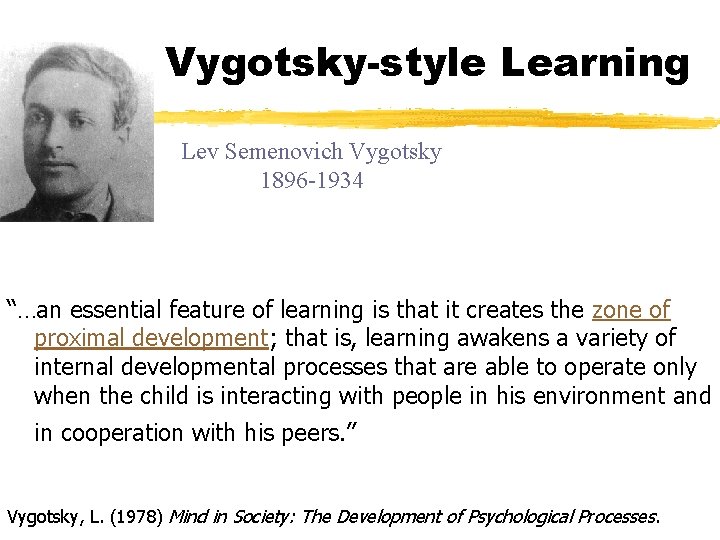
Vygotskystyle Learning Lev Semenovich Vygotsky 1896 1934 an
![Classroom Assessment Techniques [Angelo & Cross] z. Goals inventory z. Selection of technique z.](https://slidetodoc.com/presentation_image_h/8f887b4b145c3b5d1febb3f1e19a0b21/image-27.jpg "Classroom Assessment Techniques [Angelo & Cross] z. Goals inventory z. Selection of technique z.")

- Slides: 29
Vygotsky-style Learning Lev Semenovich Vygotsky 1896 -1934 “…an essential feature of learning is that it creates the zone of proximal development; that is, learning awakens a variety of internal developmental processes that are able to operate only when the child is interacting with people in his environment and in cooperation with his peers. ” Vygotsky, L. (1978) Mind in Society: The Development of Psychological Processes.
Zone of Proximal Development The zone of proximal development is the distance between a child’s “actual developmental level as determined by independent problem solving” and the higher level of “potential development as determined through problem solving under adult guidance or in collaboration with more capable peers. ” Vygotsky, L. (1978) Mind in Society: The Development of Psychological Processes.
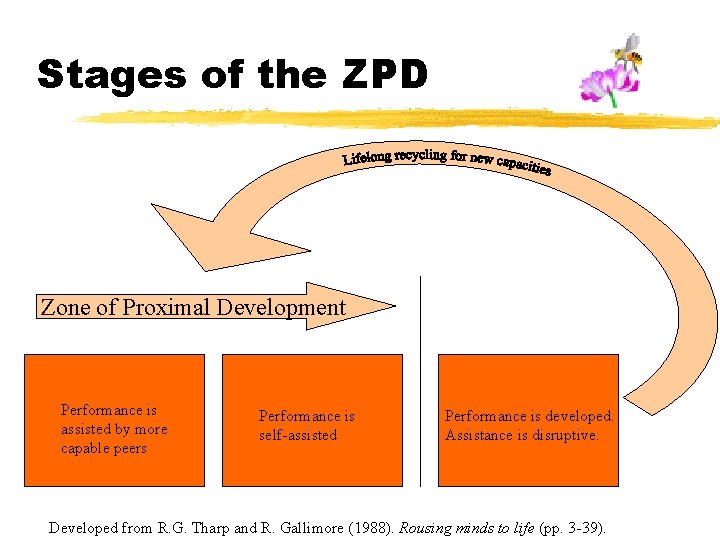
Stages of the ZPD Zone of Proximal Development Performance is assisted by more capable peers Performance is self-assisted Performance is developed. Assistance is disruptive. Developed from R. G. Tharp and R. Gallimore (1988). Rousing minds to life (pp. 3 -39).
Vygotsky-style Classrooms “Activity Settings”
Activity settings z Contexts in which collaborative interaction, intersubjectivity, and assisted performance occur - in which teaching occurs y not random y determined absolutely by restriction to the context of goaldirected action z arise from the pressures and resources of the larger social system of which the participants are a part z can be used as a unit of analysis z the who, what, when, where, and why - the small recurrent dramas of everyday life - played on the stages of home, school, community, and workplace
Who z. People who can achieve the goal of an action are determined by the goal and the setting zmakes for the maximum contribution of each individual desirable to the entire group
What za description of the things that are done za description of how they are done yoperations • Ex. Handling of the host during Communion • Ex. “metacognitive” strategy of questioning that assists the child to retrieve from memory the bits of information needed to locate lost shoes yscripts • Ex. Care and feeding of pets • Ex. Classroom procedures
When z. Activity settings are patterned in time, cannot exist without time zthey are driven by productive activity, occur as often and for as long as the product requires - when the product is produced or the goal achieved, the scheduled activity should end
Where z. Activity settings must have a place to exist zbest placed where the tools, the materials, or the uses of the product dictate - where the production can best occur zmuch truth in the adage that schools teach no thing, but teach only how to talk about things
Why z. Can be described in terms of motivation and meaning ygoal for the activity setting usually provides the motivational impetus xif not, contingency management xnot identical for all members yorganizational structures in the minds of individuals and the cultural meaning of the interaction [schemata]
Vygotsky-style Teaching Therefore the only good kind of instruction is that which marches ahead of development and leads it; it must be aimed not so much at the ripe as at the ripening functions. It remains necessary to determine the lowest threshold at which instruction in, say, arithmetic may begin, since a certain minimal ripeness of junctions is required. But we must consider the upper threshold as well; instruction must be orient toward the future, not the past. ” Vygotsky, L. (1962) Thought and Language.
Good Teaching: a new definition “Teaching consists in assisting performance through the ZPD. Teaching can be said to occur when assistance is offered at points in the ZPD at which performance requires assistance. ” Tharp, R. & Gallimore, R. (1988) Rousing Minds to Life.
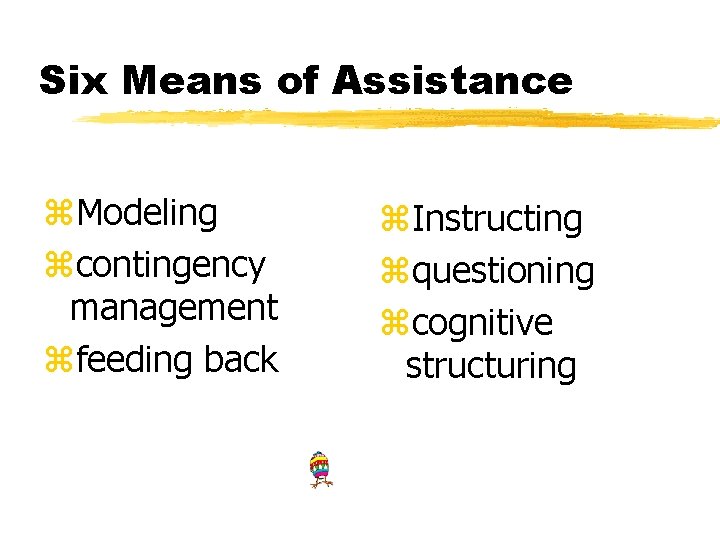
Six Means of Assistance z. Modeling zcontingency management zfeeding back z. Instructing zquestioning zcognitive structuring
Modeling The process of offering behavior for imitation
Contingency Management The process of assisting performance by arranging for rewards or punishments to follow specific behaviors, depending on whether the behaviors are desired.
Feeding-back This is the process of assisting performance providing performance information that compares a given performance to an established standard.
Instructing z. A linguistic process for assisting performance that calls for specific action. z. Effective instructions are embedded in a context: contingency management, feeding-back, and cognitive structuring.
Questioning z. Most characteristic means for assisting performance in formal learning situations. z. Calls for an active linguistic and cognitive response, provoking creations by the student. z. Two types of questions
Questions z those that assess yinquires to discover the level of the pupil’s ability to perform without assistance z those that assist yinquires in order to produce a mental operation that the student cannot or will not produce alone. y. The assistance provided by the question is the prompting of that mental operation
Cognitive Structuring z An organizing structure for thinking and acting z process of organizing the raw stuff of experience z structures that organize content and/or functions and refer to like instances z most frequently practiced
Designing school activity settings z teacher participates at times in at least one activity setting with students z authority of the teacher used to organize activity settings and to make resources of time, place, persons, and tools available z activity setting has a product as a goal, a product that is motivating for the students z focus = ability of the teacher to assist the students [cooperative learning; assisting themselves] z permanent or temporary activity setting as determined by goal z all members should be engaged in the joint productive activity whose purpose is ever-increasing competence to assist performance z teacher designs activity settings, which create products, assist performance, foster intersubjectivities, promote cognitive growth of each individual, refocus accountabilities, and turn schools into a culture of learning.
Vygotsky-Style Assessment z. A continuous process that includes the social context of learning and instruction zdynamic versus static
Static Assessment Refers to measuring the student’s individual performance, what the student has already learned
Dynamic Assessment z. Refers to measuring the student’s assisted performance during collaboration, the student’s potential development, or what the student is in the process of learning zprocess summarized
Dynamic Assessment Procedure (DAP) z Test the learner working alone (static) to provide a baseline measure (highest level without assistance) of skills on a task z provide a controlled protocol of assistance and instruction (dynamic) while child works on comparable task z posttest with an alternate form of original measure while the learner works alone (static) on a the task z compare test and retest measures to establish the learner’s zone of proximal development (ZPD) (the range from the baseline to the highest level obtained with assistance).
DAP cont. z Analyze the learner’s performance both quantitatively and qualitatively on both product and process y a. Identify the upper limit of the ZPD as expressed by mental age, grade equivalent, reading level, or test score (quantitative) y b. Investigate processing strengths and weaknesses and learning style to determine the specific kind of assistance required to obtain optimal performance (qualitative).
Classroom Assessment Techniques [Angelo & Cross] z. Goals inventory z. Selection of technique z. Model technique in an activity setting
Rubrics z. Definition z. Measuring Student Progress