
Vygotskys Zone of Proximal Development By Eileen Baca
Vygotsky’s Zone of Proximal Development By Eileen Baca
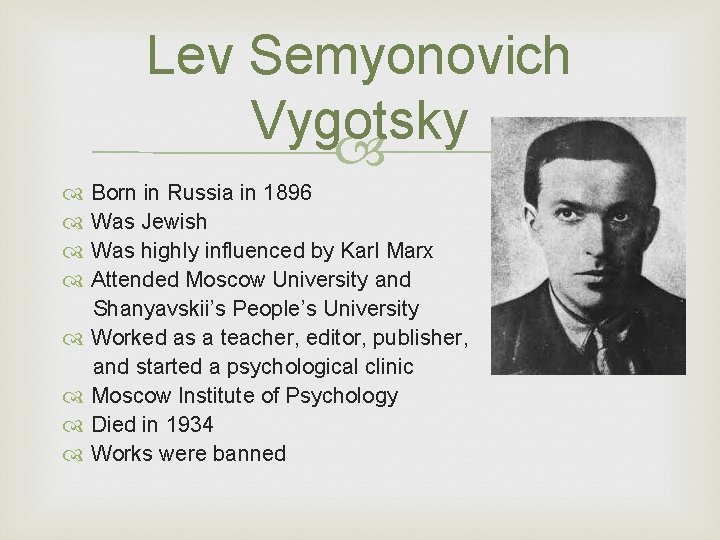
Lev Semyonovich Vygotsky Born in Russia in 1896 Was Jewish Was highly influenced by Karl Marx Attended Moscow University and Shanyavskii’s People’s University Worked as a teacher, editor, publisher, and started a psychological clinic Moscow Institute of Psychology Died in 1934 Works were banned
Zone of Proximal Development The zone of proximal development is the difference between a child’s actual developmental level, and his potential developmental level. In Vygotsky's of proximal development the potential developmental level is achieved with the help of a capable peer or adult.
Capable Peer A peer who possesses a more knowledgeable understanding of the subject matter Helps the other student(s) reach their potential To figure out who was the most capable peer the researcher observed the collaborating group, and sought to ask who, if any, influences the other children’s tower the most? And how?
Vygotsky vs. Montessori Collaborative learning Work is challenging Work chosen by teacher Teacher acts assistant to student Independent Mastery Work is within students developmental level Work chosen by students Teacher role is a passive one
My Hypotheses Is the Vygotsky-styled learning environment the best approach to help a child reach their potential? How will a test preformed in a Vygotsky-styled learning environment compare to a test preformed in a Montessori-styled learning environment? Will boys and girls get similar or different results on this test?
Experiment Who could build the biggest tower? 6 fourth graders Holy Family Grade school 2 groups 1 st group works collaboratively – Vygotsky-style 2 nd group works independently – Montessori-style
Results The results of my hypotheses are inconclusive Limited number of participants Only one boy Not done in true Vygotsky-style Montessori group used the walls and chairs to support their project

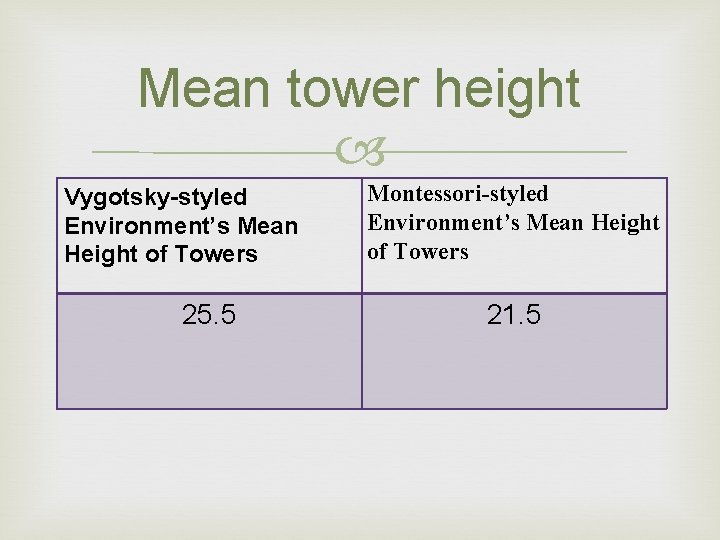
Mean tower height Vygotsky-styled Environment’s Mean Height of Towers 25. 5 Montessori-styled Environment’s Mean Height of Towers 21. 5
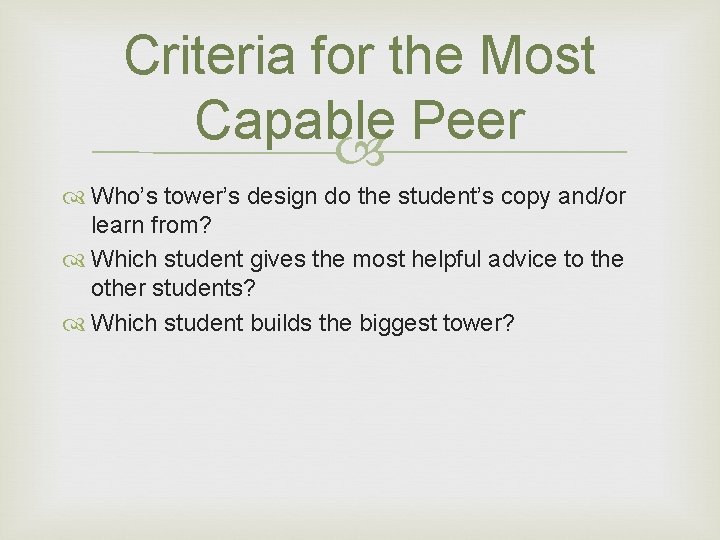
Criteria for the Most Capable Peer Who’s tower’s design do the student’s copy and/or learn from? Which student gives the most helpful advice to the other students? Which student builds the biggest tower?
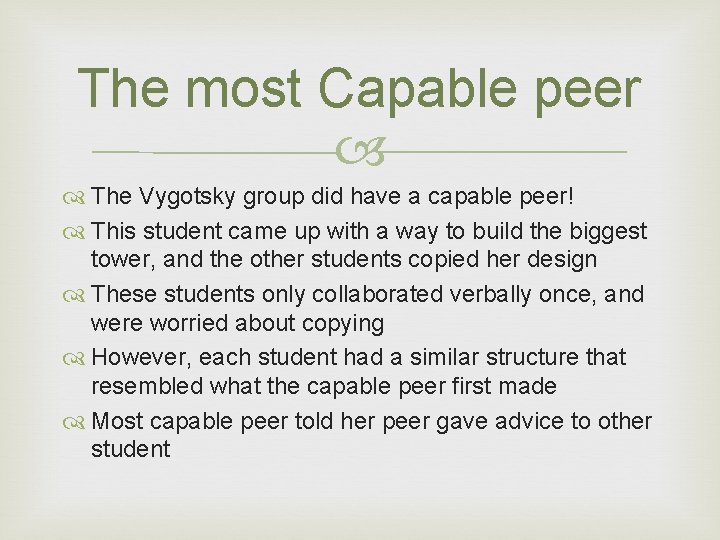
The most Capable peer The Vygotsky group did have a capable peer! This student came up with a way to build the biggest tower, and the other students copied her design These students only collaborated verbally once, and were worried about copying However, each student had a similar structure that resembled what the capable peer first made Most capable peer told her peer gave advice to other student
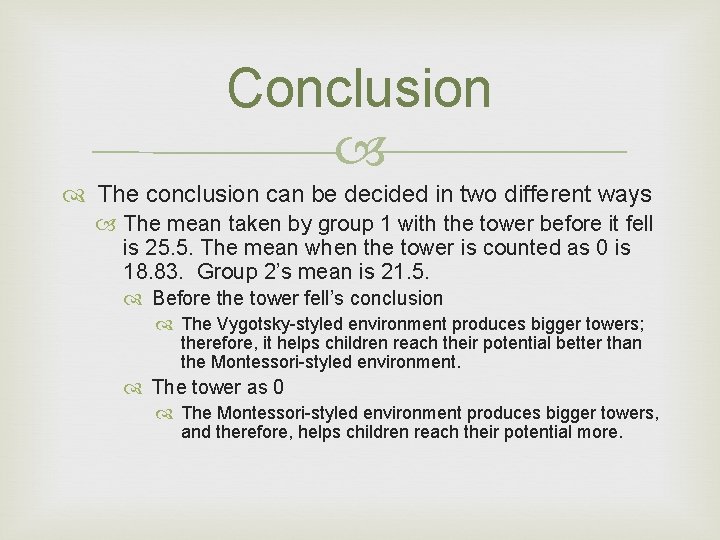
Conclusion The conclusion can be decided in two different ways The mean taken by group 1 with the tower before it fell is 25. 5. The mean when the tower is counted as 0 is 18. 83. Group 2’s mean is 21. 5. Before the tower fell’s conclusion The Vygotsky-styled environment produces bigger towers; therefore, it helps children reach their potential better than the Montessori-styled environment. The tower as 0 The Montessori-styled environment produces bigger towers, and therefore, helps children reach their potential more.
Questions Do students of different ages learn better with the assistance of a capable peer than other ages? Does the capable peer learns anything by helping their less capable peers? Does the zone of proximal development works the same in all subjects areas of school?
Work Cited Crain, W. (2005). Vygotsky's social-historical theory of cognitive development. In Theories of development: Concepts and applications (5 th ed. , pp. 217 -247). Upper Saddle River, New Jersey: Pearson Education Inc. Dixon-Krauss, Lisbeth. Vygotsky in the Classroom: Mediated Literacy Instruction and Assessment. White Plains, NY: Longman, 1996. Print. Moll, Luis C. Vygotsky and Education: Instructional Implications and Applications of Sociohistorical Psychology. Cambridge: Cambridge UP, 1990. Print. Vygotsky, L. S. , and Michael Cole. Mind in Society: The Development of Higher Psychological Processes. Cambridge: Harvard UP, 1978. Print.
- Slides: 15