
Vygotsky Kaitlin Meske and Nicolette Perez n Grew

- Slides: 30
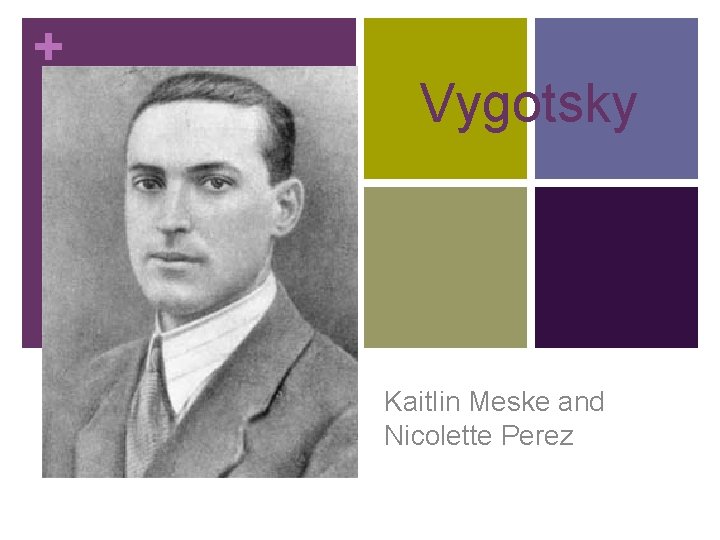
+ Vygotsky Kaitlin Meske and Nicolette Perez
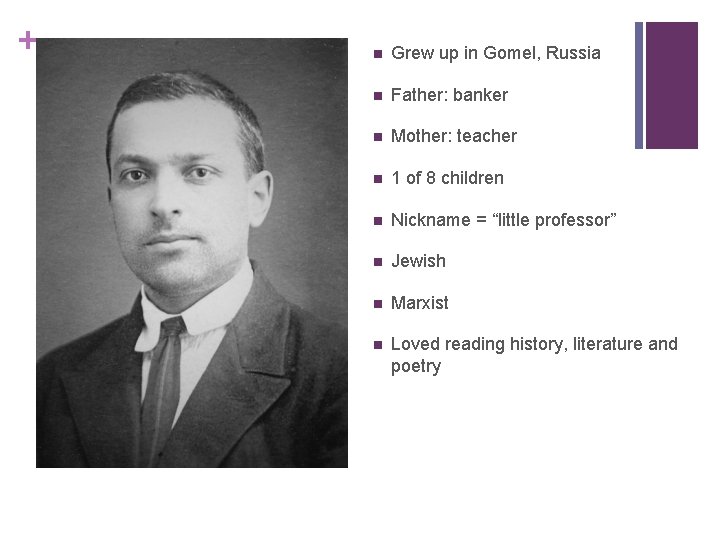
+ n Grew up in Gomel, Russia n Father: banker n Mother: teacher n 1 of 8 children n Nickname = “little professor” n Jewish n Marxist n Loved reading history, literature and poetry
+ A little more n He attended the University of Moscow n n Graduated in 1917 with a law degree 1917 - 1924 n Taught at a secondary school in literature n Wrote his doctoral dissertation on the psychology of art n Held a position at the Moscow institute of Psychology n He was interested in working with children and adults with neurological disorders
+ Vygotsky as a teacher n He was a commanding presence n He inspired enthusiasm, especially in a group of young Marxism n He wanted to create a psychology that would help build a new socialist society n He traveled for research reasons n He wrote at 2 am because of his busy schedule n Wrote poems about his travels
+ Death and after n Sadly, Vygotsky died at the age of 38 years old n From 1936 to 1956, his writings were banned by the Soviet government n Because he conducted some research with intelligence tests, which were condemned by the Communist Party n He criticized the conventional use of intelligence tests n His students and colleagues kept his work alive
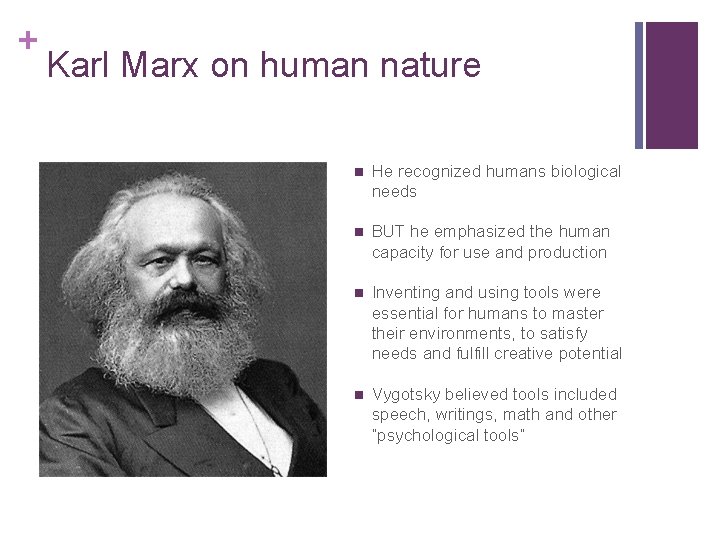
+ Karl Marx on human nature n He recognized humans biological needs n BUT he emphasized the human capacity for use and production n Inventing and using tools were essential for humans to master their environments, to satisfy needs and fulfill creative potential n Vygotsky believed tools included speech, writings, math and other “psychological tools”
+ Key Terms n Zone of proximal development = the distance between the actual developmental level as determined by independent problem solving and the level of potential development as determined through problem solving under adult guidance or in collaboration with more capable peers n Scaffolding = the process of increasing and decreasing support, depending on the child’s skill or competency n Metal Tools = Speech, writing, math and psychological tools, which are the central tools of teaching and learning n Language = universal tools that helps us in a variety of task and transforms a variety of mental functions
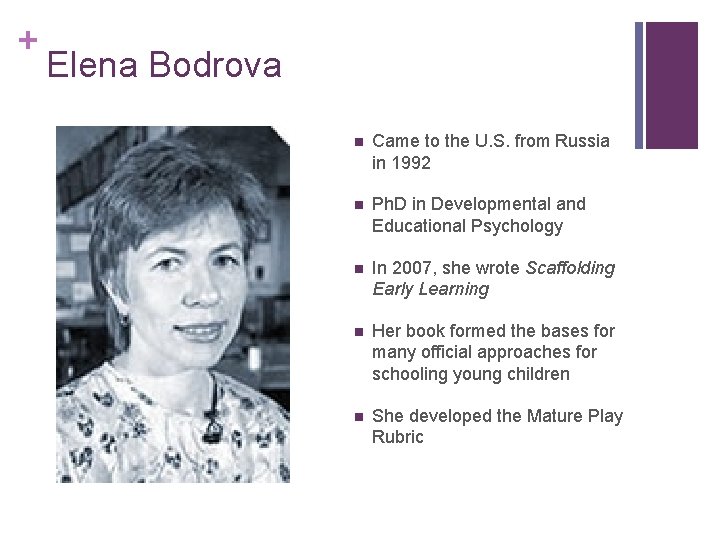
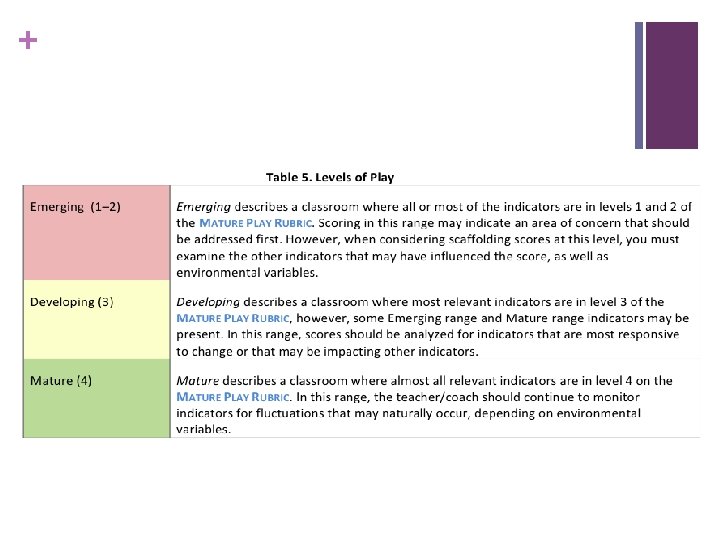
+ Elena Bodrova n Came to the U. S. from Russia in 1992 n Ph. D in Developmental and Educational Psychology n In 2007, she wrote Scaffolding Early Learning n Her book formed the bases for many official approaches for schooling young children n She developed the Mature Play Rubric
+ Our Hypothesis n According to Vygotsky’s theory on play, kindergarten age children should display evidence of mature play. n We hypothesize: n Children will receive scores of 3 or higher according to the Bodrova’s Mature play Rubric n There will be a significant difference between male and female to demonstrate mature play
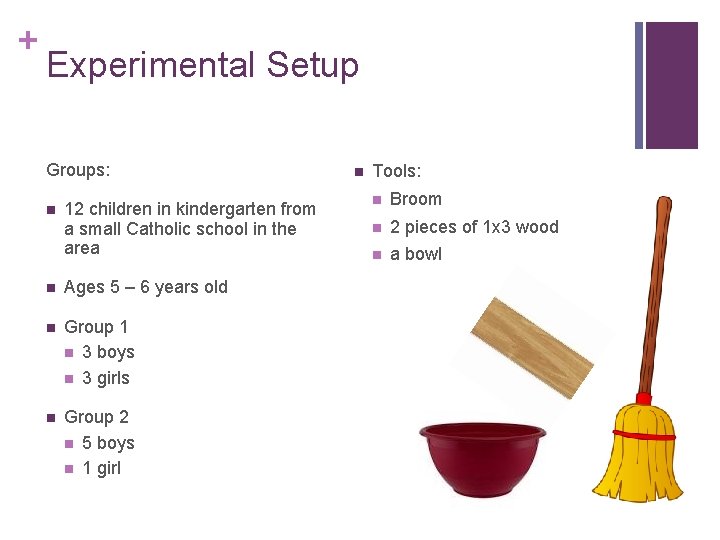
+ Experimental Setup Groups: n 12 children in kindergarten from a small Catholic school in the area n Ages 5 – 6 years old n Group 1 n 3 boys n 3 girls n Group 2 n 5 boys n 1 girl n Tools: n Broom n 2 pieces of 1 x 3 wood n a bowl
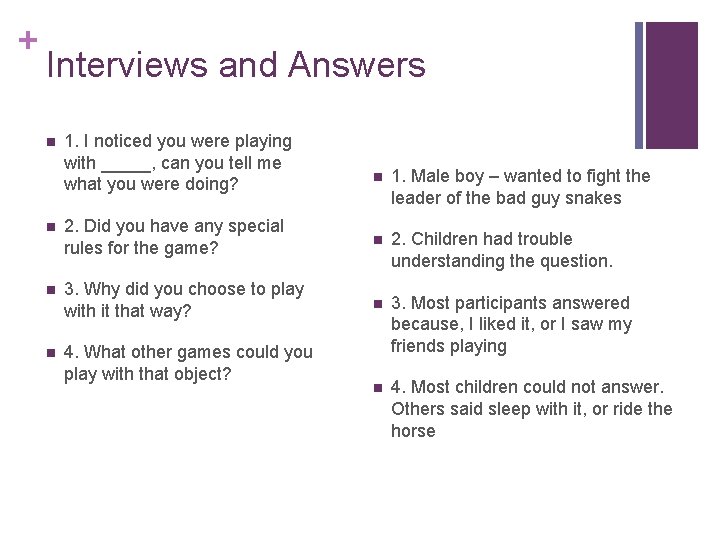
+ Interviews and Answers n 1. I noticed you were playing with _____, can you tell me what you were doing? n 1. Male boy – wanted to fight the leader of the bad guy snakes n 2. Did you have any special rules for the game? n 2. Children had trouble understanding the question. n 3. Why did you choose to play with it that way? n n 4. What other games could you play with that object? 3. Most participants answered because, I liked it, or I saw my friends playing n 4. Most children could not answer. Others said sleep with it, or ride the horse
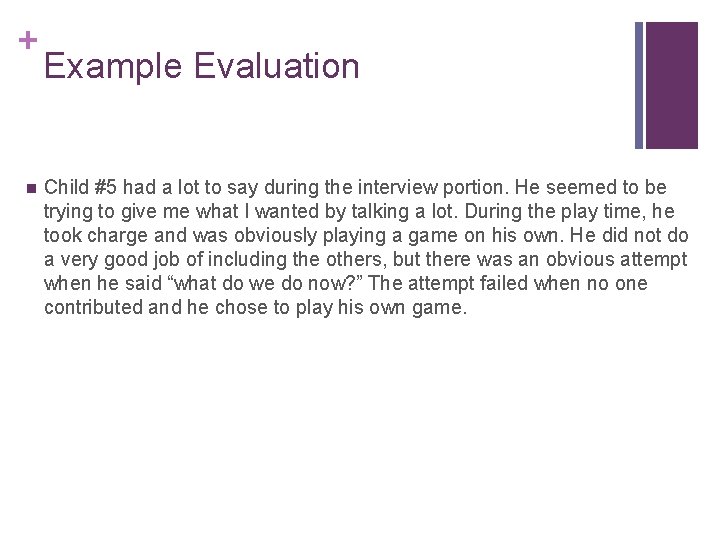
+ n Example Evaluation Child #5 had a lot to say during the interview portion. He seemed to be trying to give me what I wanted by talking a lot. During the play time, he took charge and was obviously playing a game on his own. He did not do a very good job of including the others, but there was an obvious attempt when he said “what do we do now? ” The attempt failed when no one contributed and he chose to play his own game.
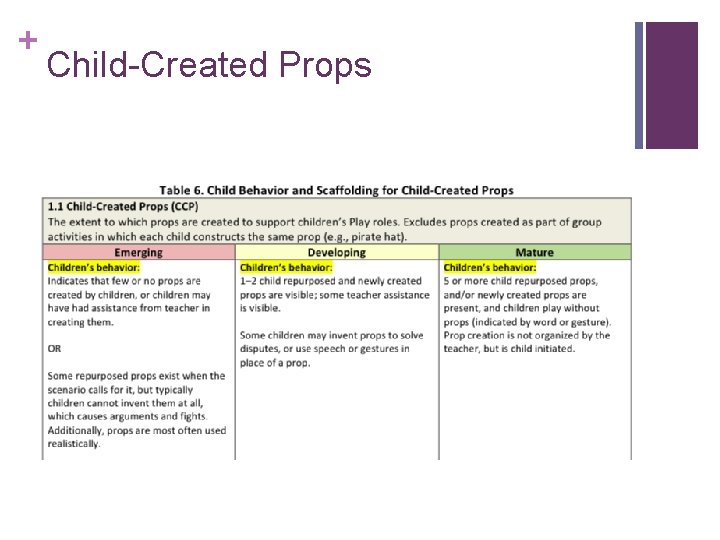
+ Child-Created Props
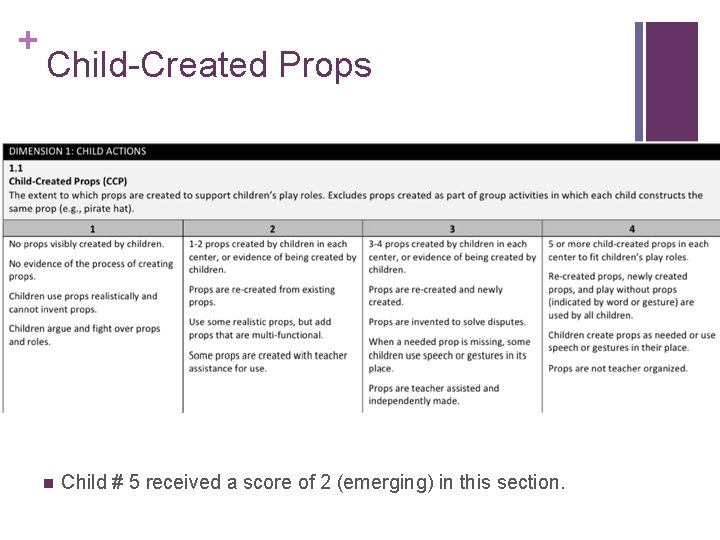
+ Child-Created Props n Child # 5 received a score of 2 (emerging) in this section.
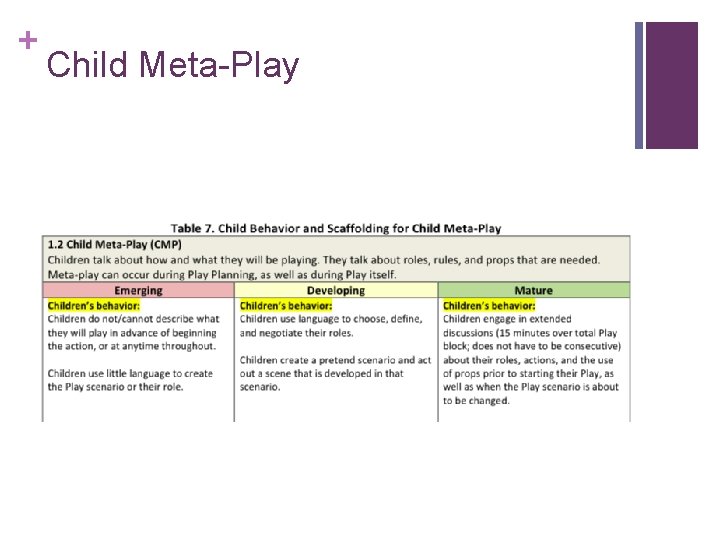
+ Child Meta-Play
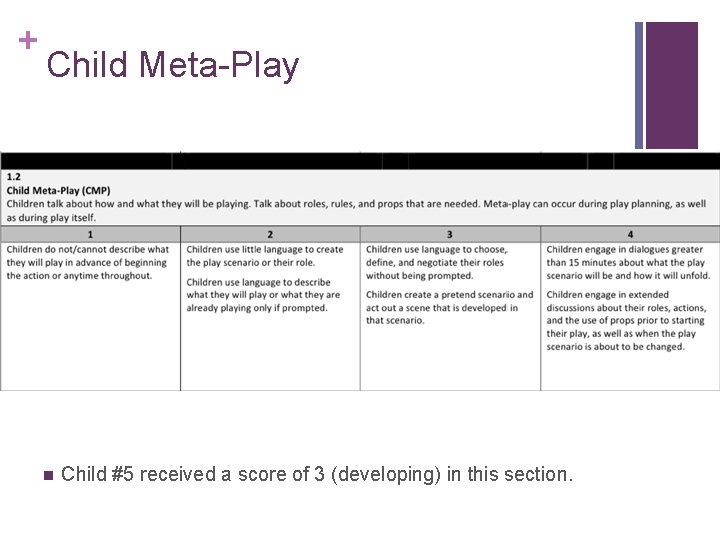
+ Child Meta-Play n Child #5 received a score of 3 (developing) in this section.
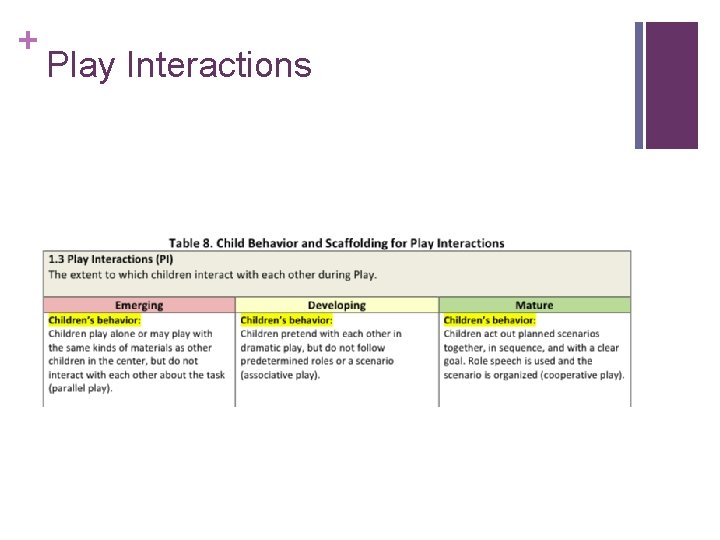
+ Play Interactions
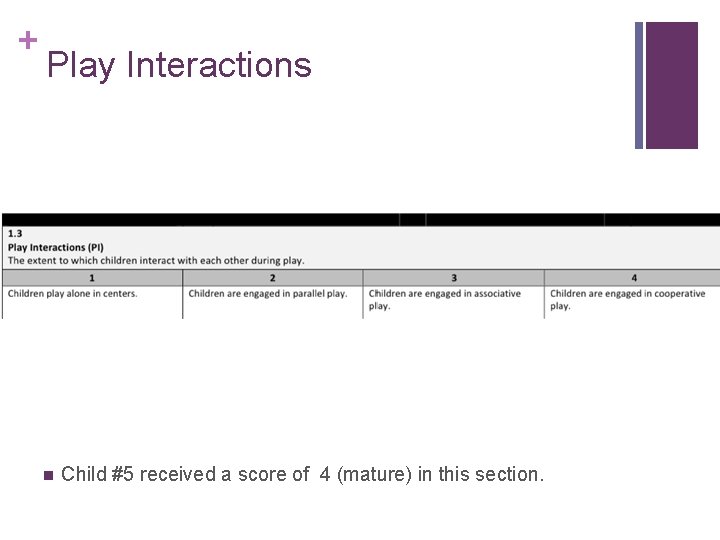
+ Play Interactions n Child #5 received a score of 4 (mature) in this section.
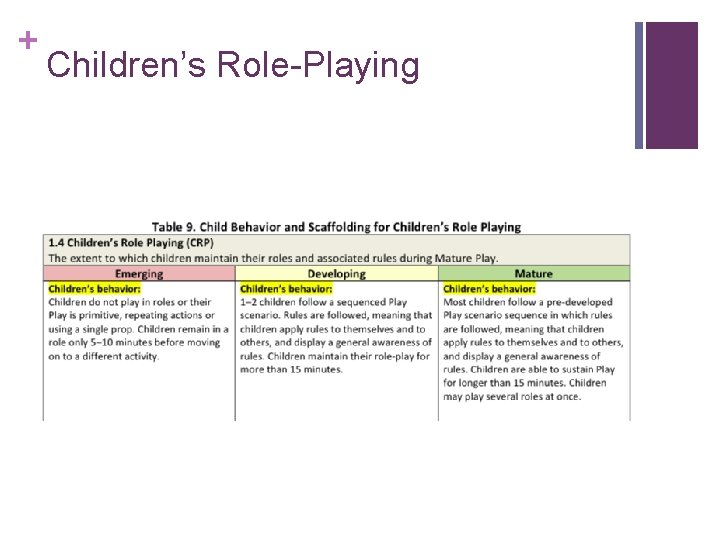
+ Children’s Role-Playing
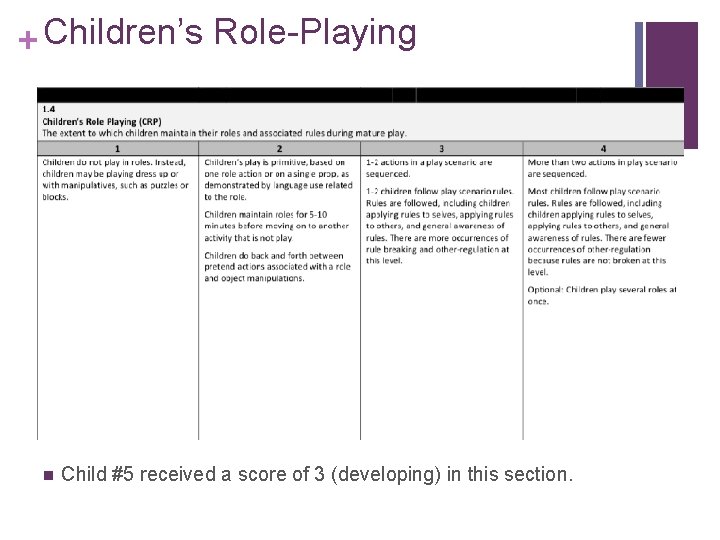
+ Children’s Role-Playing n Child #5 received a score of 3 (developing) in this section.
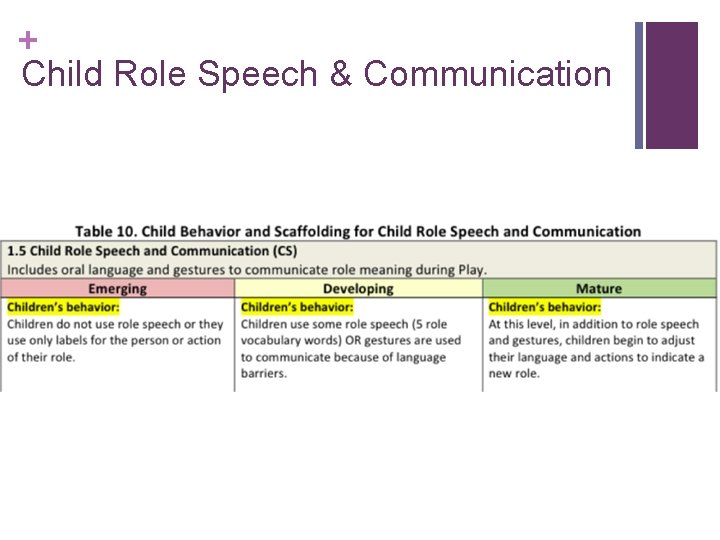
+ Child Role Speech & Communication
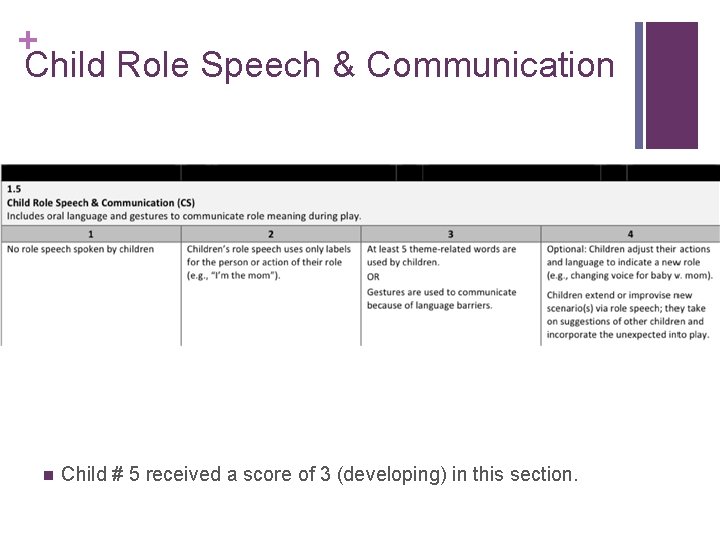
+ Child Role Speech & Communication n Child # 5 received a score of 3 (developing) in this section.
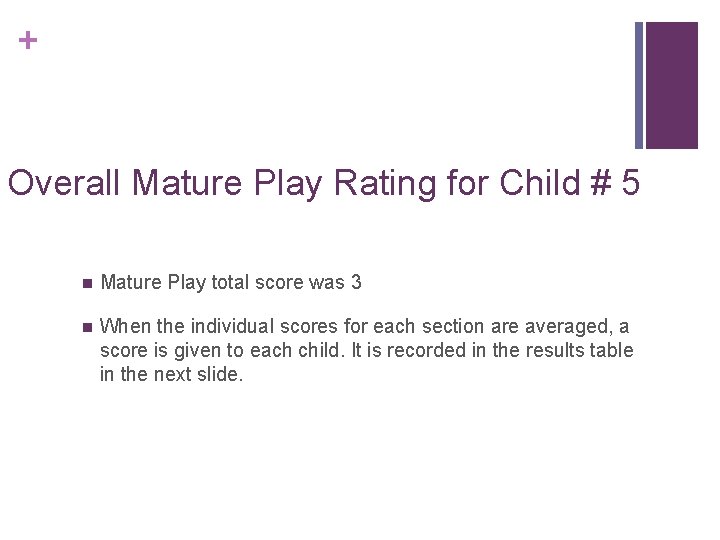
+ Overall Mature Play Rating for Child # 5 n Mature Play total score was 3 n When the individual scores for each section are averaged, a score is given to each child. It is recorded in the results table in the next slide.
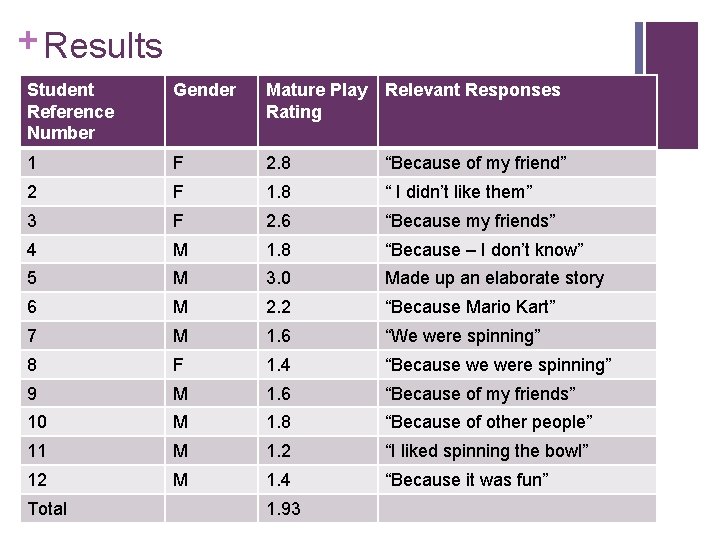
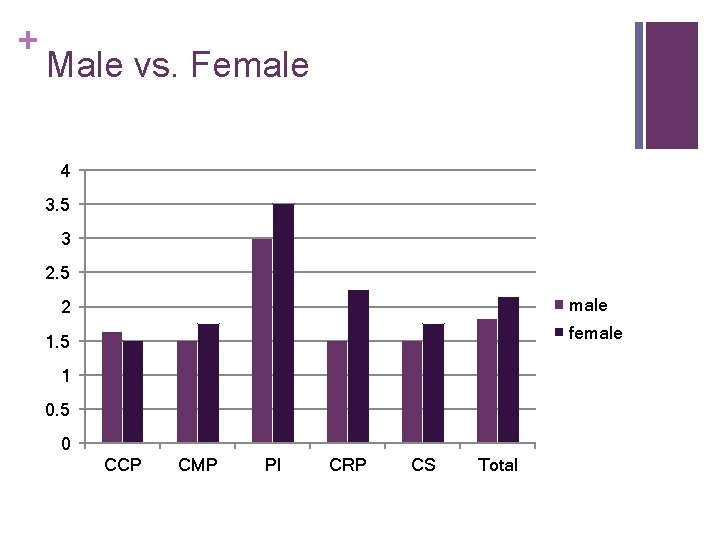
+ Results Student Reference Number Gender Mature Play Rating Relevant Responses 1 F 2. 8 “Because of my friend” 2 F 1. 8 “ I didn’t like them” 3 F 2. 6 “Because my friends” 4 M 1. 8 “Because – I don’t know” 5 M 3. 0 Made up an elaborate story 6 M 2. 2 “Because Mario Kart” 7 M 1. 6 “We were spinning” 8 F 1. 4 “Because we were spinning” 9 M 1. 6 “Because of my friends” 10 M 1. 8 “Because of other people” 11 M 1. 2 “I liked spinning the bowl” 12 M 1. 4 “Because it was fun” Total 1. 93
+ Male vs. Female 4 3. 5 3 2. 5 male 2 female 1. 5 1 0. 5 0 CCP CMP PI CRP CS Total
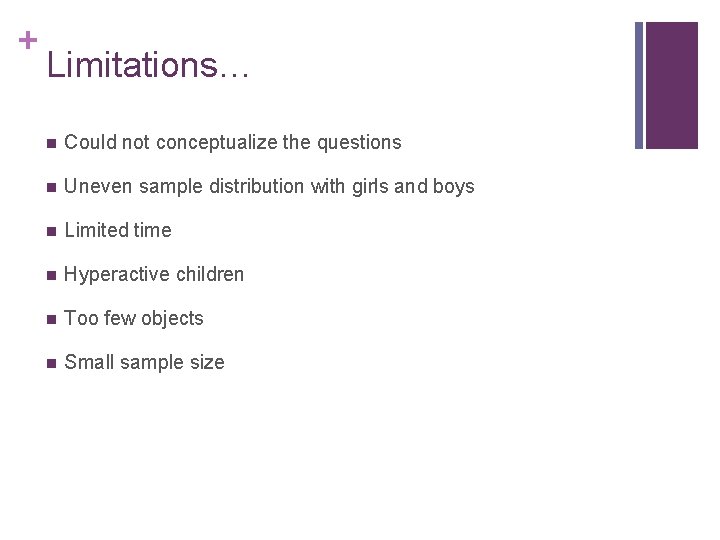
+ Limitations… n Could not conceptualize the questions n Uneven sample distribution with girls and boys n Limited time n Hyperactive children n Too few objects n Small sample size
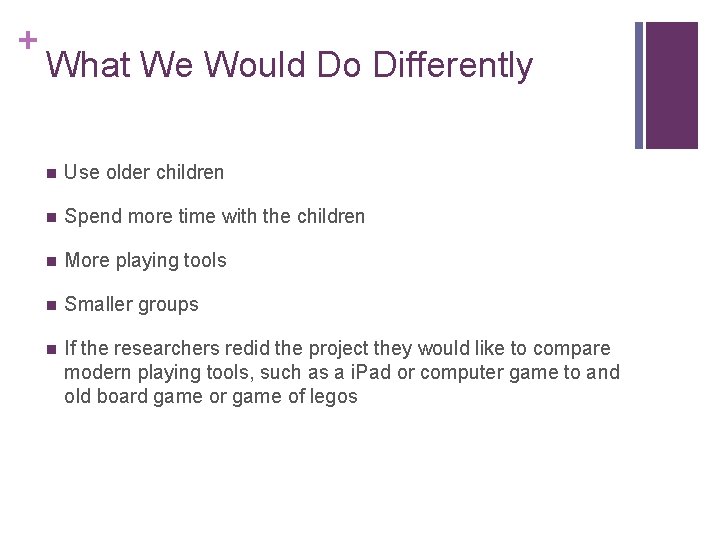
+ What We Would Do Differently n Use older children n Spend more time with the children n More playing tools n Smaller groups n If the researchers redid the project they would like to compare modern playing tools, such as a i. Pad or computer game to and old board game or game of legos
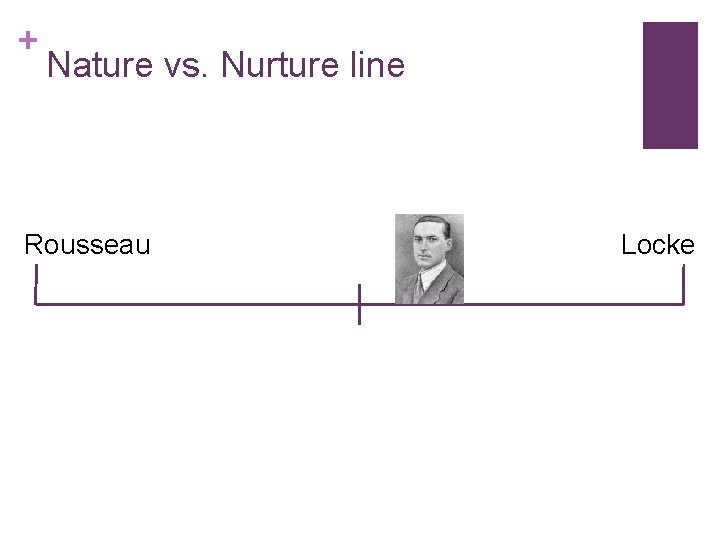
+ Nature vs. Nurture line Rousseau Locke
+ Bibliography n Crain, William C. Theories of Development: Concepts and Applications. Boston, MA: Prentice Hall, 2011. n Berk, Laura E. , and Adam Winsler. Scaffolding Children's Learning: Vygotsky and Early Childhood Education. Washington: National Association for the Education of Young Children, 1995.