
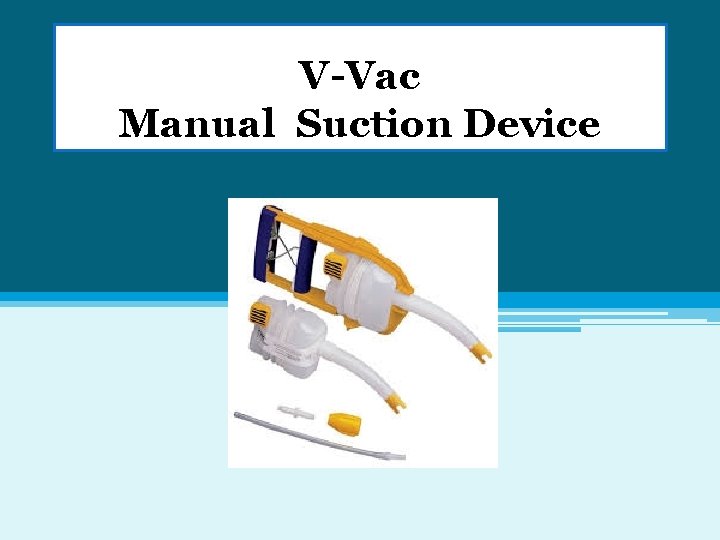
VVac Manual Suction Device What is the VVac



- Slides: 15
V-Vac Manual Suction Device
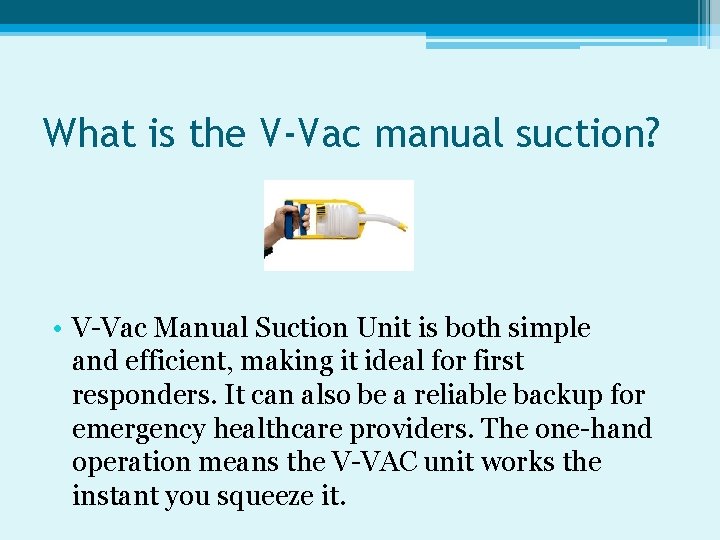
What is the V-Vac manual suction? • V-Vac Manual Suction Unit is both simple and efficient, making it ideal for first responders. It can also be a reliable backup for emergency healthcare providers. The one-hand operation means the V-VAC unit works the instant you squeeze it.
Why we use it? • Patients who have vomited, inhaled fluid or debris, or who are bleeding from the nose or mouth are in danger of an airway obstruction. You cannot maintain an open airway or begin rescue breathing until the airway is clear, so that air exchange can occur. Suction devices can help you remove airway obstructions.
V-Vac information • Due to several different areas having different methods of suction, we will be transitioning to the V-Vac to remain consistent between all inpatient areas. • The V-Vac is does not require batteries or an electrical source and is the most convenient to operate. • V-Vac is always ready to work and require minimal servicing.
Instructions to use: • 1. Place cartridge into the handle by holding the cartridge at a right angle, and then insert the oval-shaped hole firmly into the fitting on the handle. •
Instructions to use: • 2. Keeping the cartridge in the fitting, pivot it toward the handle and then snap it into place with your thumbs. The intake valve is protected by a plastic cap. Be sure to remove this cap before using the unit.
Instructions to use: • 3. To adjust the stroke of the handle squeeze the handle and flip the stroke stop over. The front position provides maximum suction pressure. The rear setting offers the lowest suction pressure.
Instructions to use: • 4. Turn the patient’s head to the side. If you suspect a spinal injury, roll the patient onto his or her side and keep the neck and body from twisting. • 5. Open the patient’s mouth and wipe away any large debris with your gloved fingers.
Instructions to use: • 6. Pull the protective cap off of the tip of the cartridge. • 7. With caution, place the padded tip of the V -Vac into the patient’s mouth. • 8. Generate suction by squeezing the handle firmly and compressing the inner cartridge.
Instructions to use: • 9. The bellow of the cartridge with continue to move with each squeeze and you will see the bellow expand as secretions fill into the cartridge’s reservoir. • Maximum amount of fluid the reservoir can contain is 425 ml.
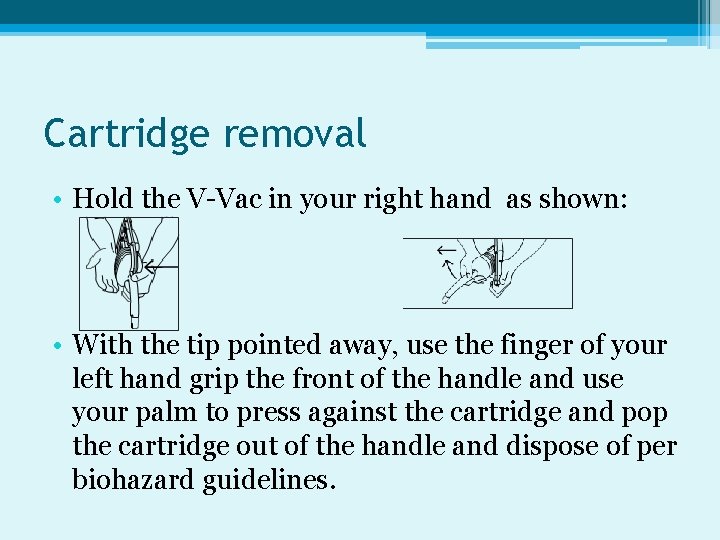
Cartridge removal • Hold the V-Vac in your right hand as shown: • With the tip pointed away, use the finger of your left hand grip the front of the handle and use your palm to press against the cartridge and pop the cartridge out of the handle and dispose of per biohazard guidelines.
What if the tip gets clogged? • If large particle are removed from the patient's mouth, there will be a chance the tip may get clogged while suctioning. If this happens and a firm squeeze does not clear it, then with the handle squeezed , remove V-Vac from the patients mouth. Look at the tip for debris, and remove if visible. If unable to clear cartridge replace with a new one.
Storage • All V-Vac units will be replacing old electrical suction devices on top of crash carts. • V-Vac units will be placed in a clear bag and placed on top of every crash cart. • Daily crash cart checklist should reflect that the V-Vac is present and ready for use.
Cleaning of the V-Vac • After use, please remove the used cartridge. • To clean and disinfect the V-Vac handle, wash with warm soapy water. • Let dry for 5 -10 minutes before placing back into clear bag on top of the crash cart. Remember to restock the cartridge if used.
Educational video from Laderal • https: //youtu. be/junz 9 a. Wwa. OU