
Vus and KS decays from KLOE Gaia Lanfranchi




- Slides: 45
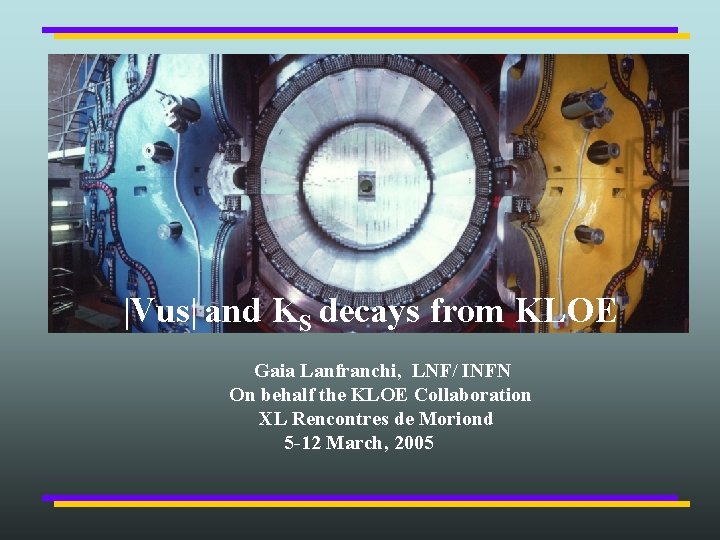
|Vus| and KS decays from KLOE Gaia Lanfranchi, LNF/ INFN On behalf the KLOE Collaboration XL Rencontres de Moriond 5 -12 March, 2005
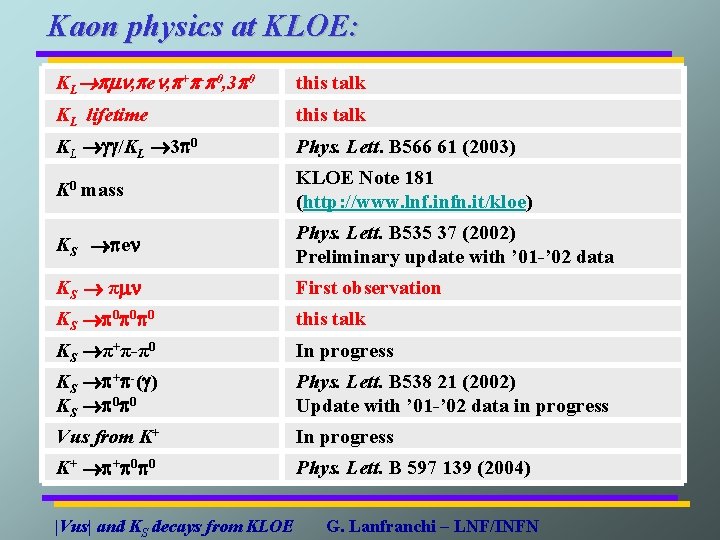
Kaon physics at KLOE: KL , e , + - 0, 3 0 this talk KL lifetime this talk KL /KL 3 0 Phys. Lett. B 566 61 (2003) K 0 mass KLOE Note 181 (http: //www. lnf. infn. it/kloe) KS e Phys. Lett. B 535 37 (2002) Preliminary update with ’ 01 -’ 02 data KS π First observation KS 0 0 0 this talk KS π+π-π0 In progress KS + -( ) KS 0 0 Phys. Lett. B 538 21 (2002) Update with ’ 01 -’ 02 data in progress Vus from K+ In progress K+ + 0 0 Phys. Lett. B 597 139 (2004) |Vus| and KS decays from KLOE G. Lanfranchi – LNF/INFN
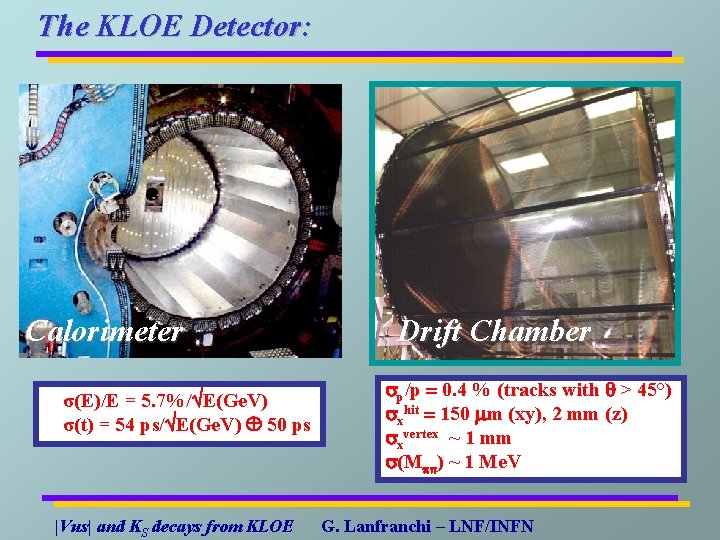
The KLOE Detector: Calorimeter σ(E)/E = 5. 7%/ E(Ge. V) σ(t) = 54 ps/ E(Ge. V) 50 ps |Vus| and KS decays from KLOE Drift Chamber p/p = 0. 4 % (tracks with q > 45°) xhit = 150 m (xy), 2 mm (z) xvertex ~ 1 mm (M ) ~ 1 Me. V G. Lanfranchi – LNF/INFN
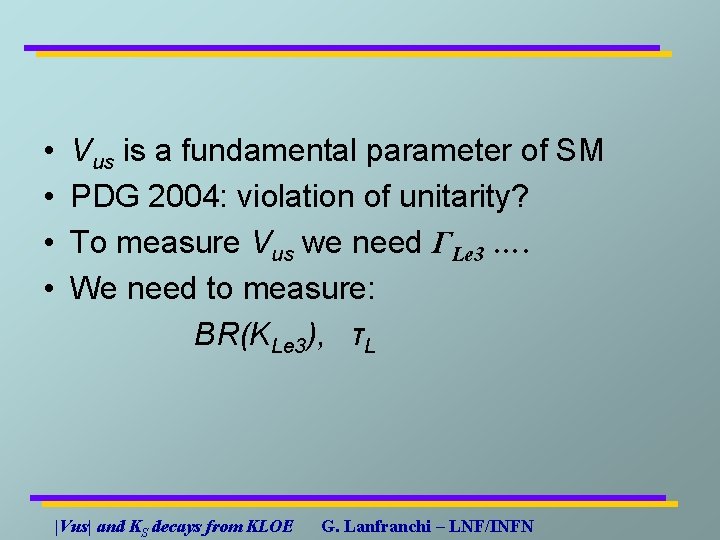
• • Vus is a fundamental parameter of SM PDG 2004: violation of unitarity? To measure Vus we need ΓLe 3 …. We need to measure: BR(KLe 3), τL |Vus| and KS decays from KLOE G. Lanfranchi – LNF/INFN
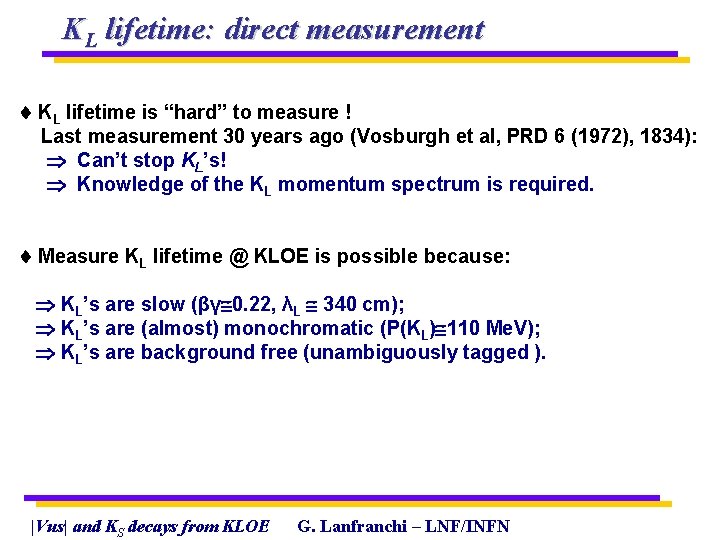
KL lifetime: direct measurement KL lifetime is “hard” to measure ! Last measurement 30 years ago (Vosburgh et al, PRD 6 (1972), 1834): Can’t stop KL’s! Knowledge of the KL momentum spectrum is required. Measure KL lifetime @ KLOE is possible because: KL’s are slow (βγ 0. 22, λL 340 cm); KL’s are (almost) monochromatic (P(KL) 110 Me. V); KL’s are background free (unambiguously tagged ). |Vus| and KS decays from KLOE G. Lanfranchi – LNF/INFN
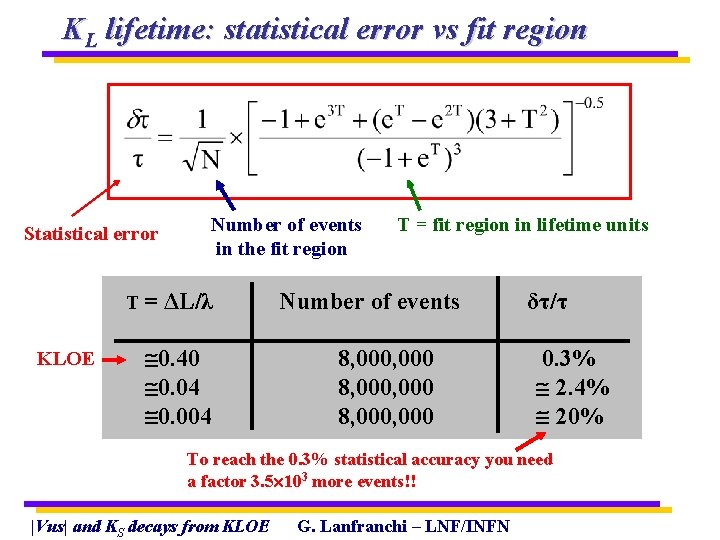
KL lifetime: statistical error vs fit region Statistical error T= KLOE Number of events in the fit region ΔL/λ 0. 40 0. 04 0. 004 T = fit region in lifetime units Number of events 8, 000, 000 8, 000 δτ/τ 0. 3% 2. 4% 20% To reach the 0. 3% statistical accuracy you need a factor 3. 5 103 more events!! |Vus| and KS decays from KLOE G. Lanfranchi – LNF/INFN
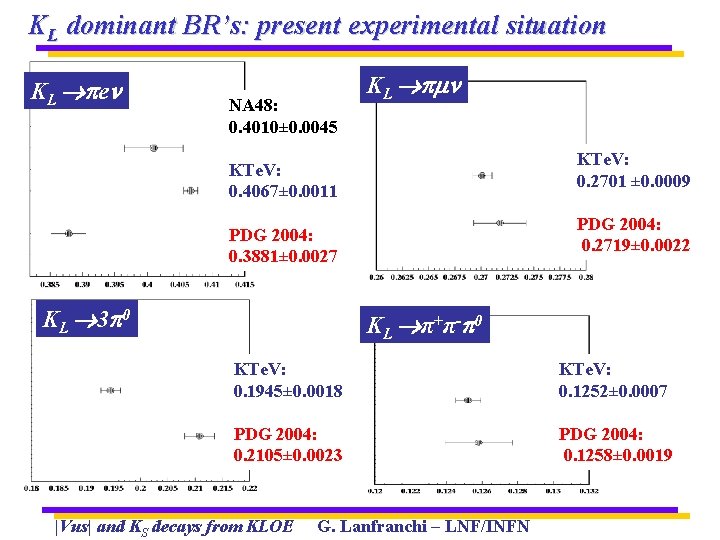
KL dominant BR’s: present experimental situation KL e NA 48: 0. 4010± 0. 0045 KL KTe. V: 0. 2701 ± 0. 0009 KTe. V: 0. 4067± 0. 0011 PDG 2004: 0. 2719± 0. 0022 PDG 2004: 0. 3881± 0. 0027 KL 3 0 K L π + π - 0 KTe. V: 0. 1945± 0. 0018 KTe. V: 0. 1252± 0. 0007 PDG 2004: 0. 2105± 0. 0023 PDG 2004: 0. 1258± 0. 0019 |Vus| and KS decays from KLOE G. Lanfranchi – LNF/INFN
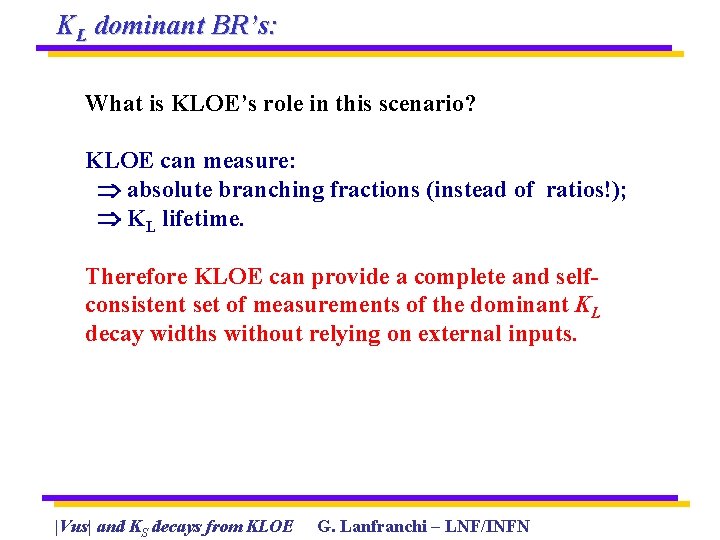
KL dominant BR’s: What is KLOE’s role in this scenario? KLOE can measure: absolute branching fractions (instead of ratios!); KL lifetime. Therefore KLOE can provide a complete and selfconsistent set of measurements of the dominant KL decay widths without relying on external inputs. |Vus| and KS decays from KLOE G. Lanfranchi – LNF/INFN
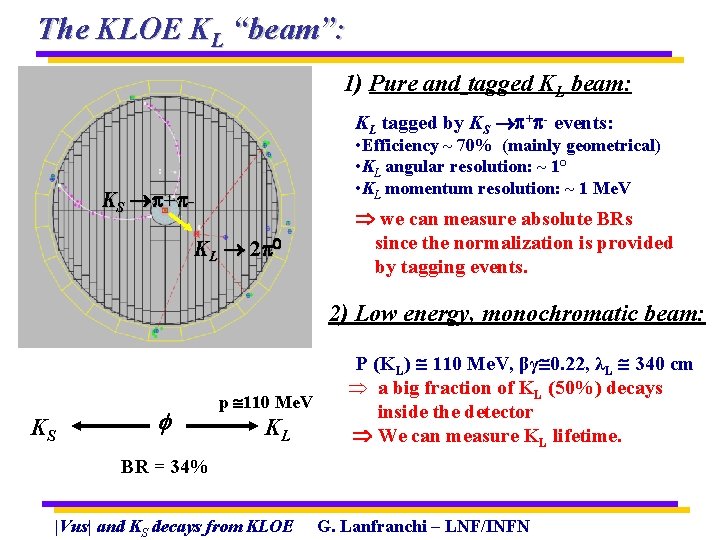
The KLOE KL “beam”: 1) Pure and tagged KL beam: KL tagged by KS + - events: • Efficiency ~ 70% (mainly geometrical) • KL angular resolution: ~ 1° • KL momentum resolution: ~ 1 Me. V KS + KL 2 we can measure absolute BRs since the normalization is provided by tagging events. 2) Low energy, monochromatic beam: KS p 110 Me. V KL P (KL) 110 Me. V, βγ 0. 22, λL 340 cm a big fraction of KL (50%) decays inside the detector We can measure KL lifetime. BR = 34% |Vus| and KS decays from KLOE G. Lanfranchi – LNF/INFN
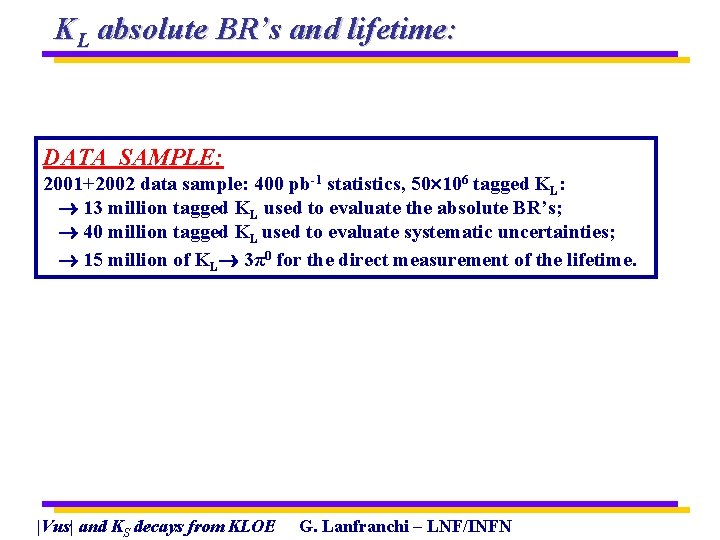
KL absolute BR’s and lifetime: DATA SAMPLE: 2001+2002 data sample: 400 pb-1 statistics, 50 106 tagged KL: 13 million tagged KL used to evaluate the absolute BR’s; 40 million tagged KL used to evaluate systematic uncertainties; 15 million of KL 3π0 for the direct measurement of the lifetime. |Vus| and KS decays from KLOE G. Lanfranchi – LNF/INFN
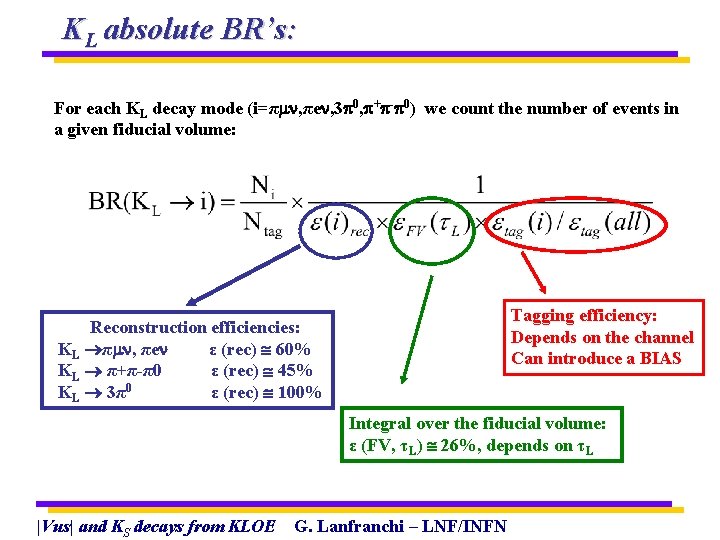
KL absolute BR’s: For each KL decay mode (i=π , πe , 3 0, + - 0) we count the number of events in a given fiducial volume: Tagging efficiency: Depends on the channel Can introduce a BIAS Reconstruction efficiencies: KL π , πe ε (rec) 60% KL π+π-π0 ε (rec) 45% KL 3π0 ε (rec) 100% Integral over the fiducial volume: ε (FV, τL) 26%, depends on τL |Vus| and KS decays from KLOE G. Lanfranchi – LNF/INFN
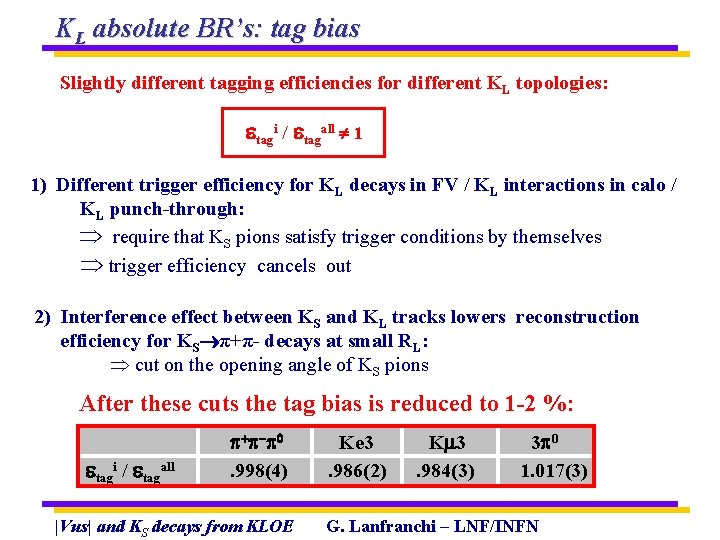
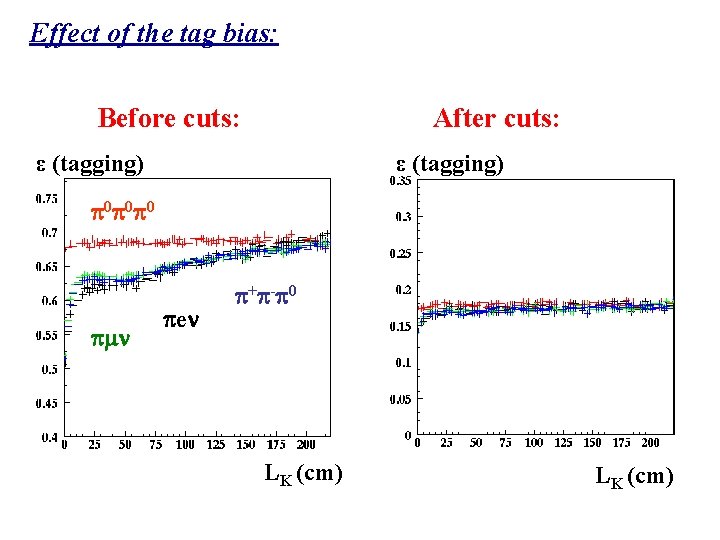
KL absolute BR’s: tag bias Slightly different tagging efficiencies for different KL topologies: tagi / tagall 1 1) Different trigger efficiency for KL decays in FV / KL interactions in calo / KL punch-through: require that KS pions satisfy trigger conditions by themselves trigger efficiency cancels out 2) Interference effect between KS and KL tracks lowers reconstruction efficiency for KS π+π- decays at small RL: cut on the opening angle of KS pions After these cuts the tag bias is reduced to 1 -2 %: tagi / tagall . 998(4) |Vus| and KS decays from KLOE Ke 3. 986(2) K 3. 984(3) 3 0 1. 017(3) G. Lanfranchi – LNF/INFN
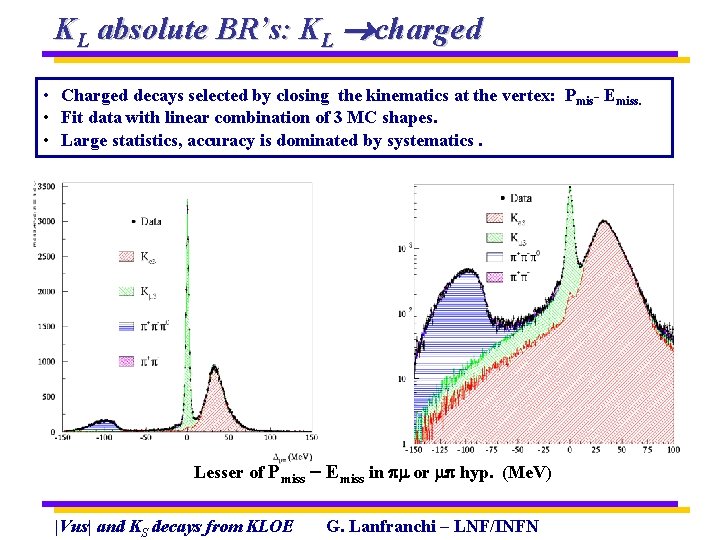
KL absolute BR’s: KL charged • Charged decays selected by closing the kinematics at the vertex: Pmis- Emiss. • Fit data with linear combination of 3 MC shapes. • Large statistics, accuracy is dominated by systematics. Lesser of Pmiss Emiss in or hyp. (Me. V) |Vus| and KS decays from KLOE G. Lanfranchi – LNF/INFN
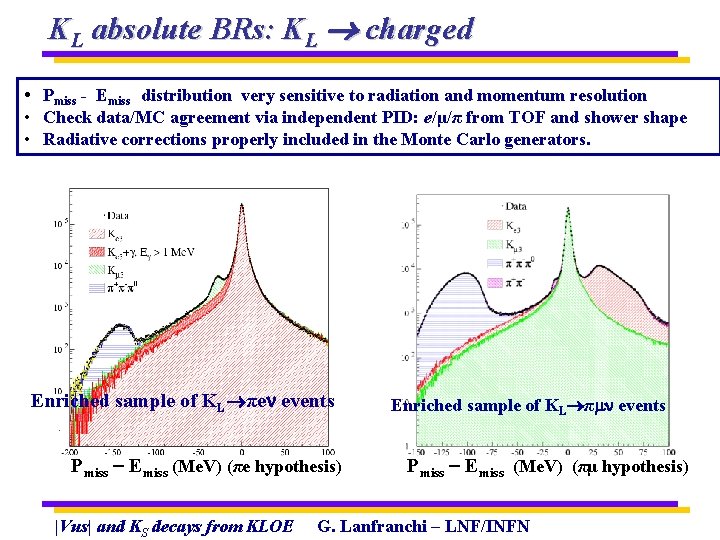
KL absolute BRs: KL charged • Pmiss - Emiss distribution very sensitive to radiation and momentum resolution • Check data/MC agreement via independent PID: e/μ/π from TOF and shower shape • Radiative corrections properly included in the Monte Carlo generators. Enriched sample of KL πe events Pmiss Emiss (Me. V) (πe hypothesis) |Vus| and KS decays from KLOE Enriched sample of KL π events Pmiss Emiss (Me. V) (πμ hypothesis) G. Lanfranchi – LNF/INFN
KL absolute BR’s: KL 0 0 0 The photon vertex of KL 3 0 is reconstructed by TOF, using cluster time/position and KL momentum (from K S ). (Xγ, Yγ, Zγ, Tγ) L π+ Lγ e+ π- solved for the two variables Lγ, LK e- LK Use events with 3 photons “clustering” a vertex 99. 2% selection efficiency Residual background (1. 3%, mainly π+π-π0 events) is subtracted. . |Vus| and KS decays from KLOE, G. Lanfranchi – LNF/INFN
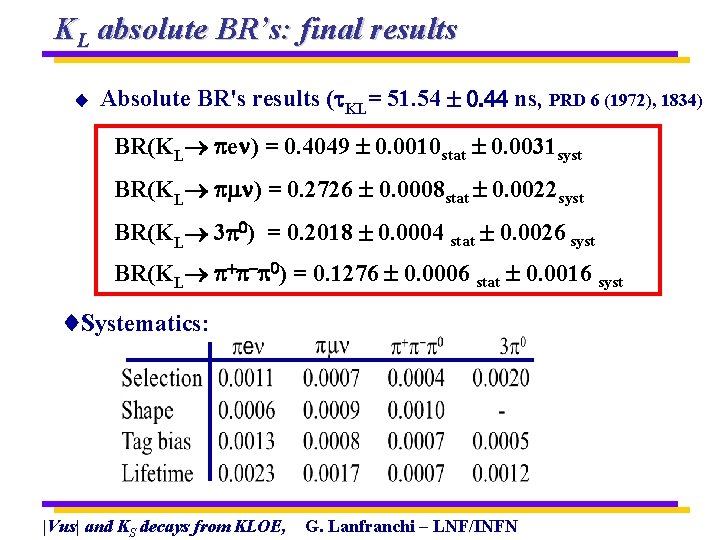
KL absolute BR’s: final results Absolute BR's results (t. KL= 51. 54 . 44 ns, PRD 6 (1972), 1834) BR(KL e ) = 0. 4049 0. 0010 stat 0. 0031 syst BR(KL ) = 0. 2726 0. 0008 stat 0. 0022 syst BR(KL 3 ) = 0. 2018 0. 0004 stat 0. 0026 syst BR(KL ) = 0. 1276 0. 0006 stat 0. 0016 syst Systematics: |Vus| and KS decays from KLOE, G. Lanfranchi – LNF/INFN
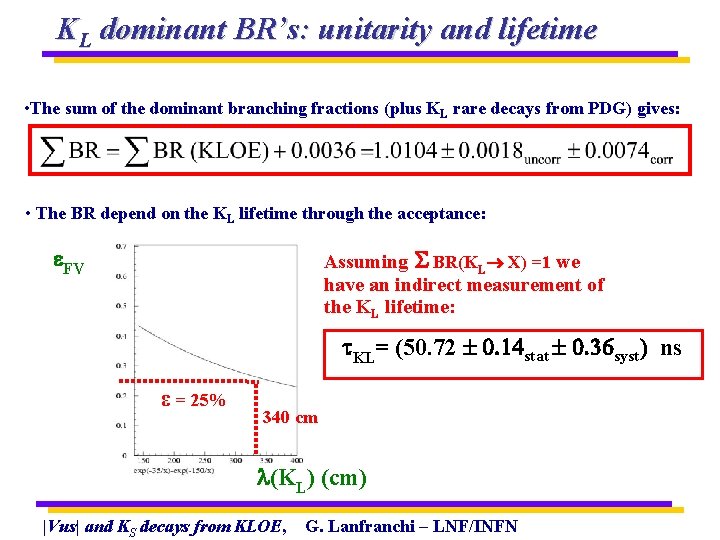
KL dominant BR’s: unitarity and lifetime • The sum of the dominant branching fractions (plus KL rare decays from PDG) gives: • The BR depend on the KL lifetime through the acceptance: FV Assuming S BR(KL X) =1 we have an indirect measurement of the KL lifetime: t. KL= (50. 72 . 14 stat . 36 syst) ns ε = 25% 340 cm l(KL) (cm) |Vus| and KS decays from KLOE, G. Lanfranchi – LNF/INFN
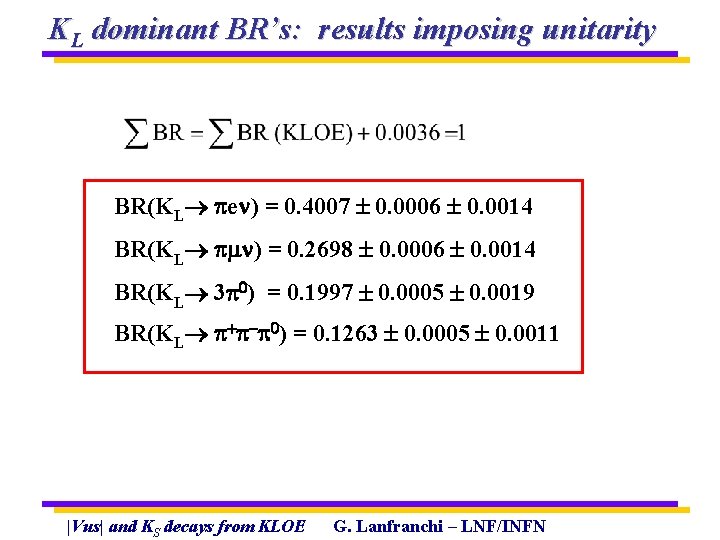
KL dominant BR’s: results imposing unitarity BR(KL e ) = 0. 4007 0. 0006 0. 0014 BR(KL ) = 0. 2698 0. 0006 0. 0014 BR(KL 3 ) = 0. 1997 0. 0005 0. 0019 BR(KL ) = 0. 1263 0. 0005 0. 0011 |Vus| and KS decays from KLOE G. Lanfranchi – LNF/INFN
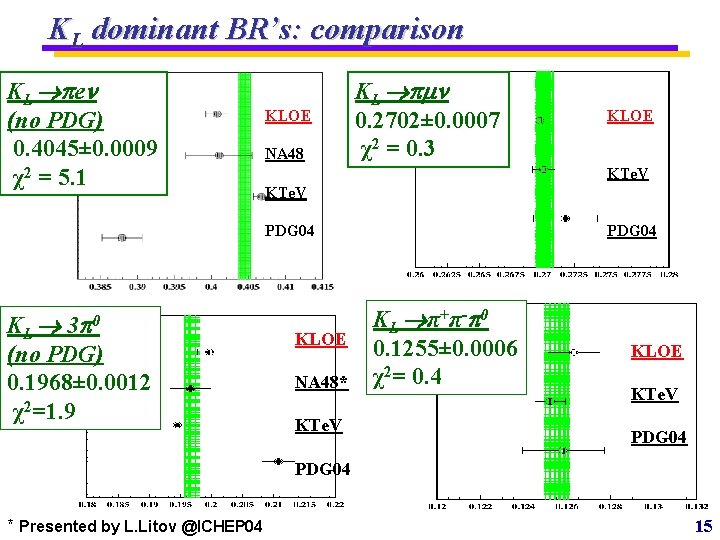
KL dominant BR’s: comparison KL e (no PDG) 0. 4045± 0. 0009 χ2 = 5. 1 KLOE NA 48 KL 0. 2702± 0. 0007 χ2 = 0. 3 KTe. V PDG 04 K L 3 (no PDG) 0. 1968± 0. 0012 χ2=1. 9 0 KLOE NA 48* KTe. V PDG 04 K L π + π - 0 0. 1255± 0. 0006 χ2= 0. 4 KLOE KTe. V PDG 04 * Presented by L. Litov @ICHEP 04 15
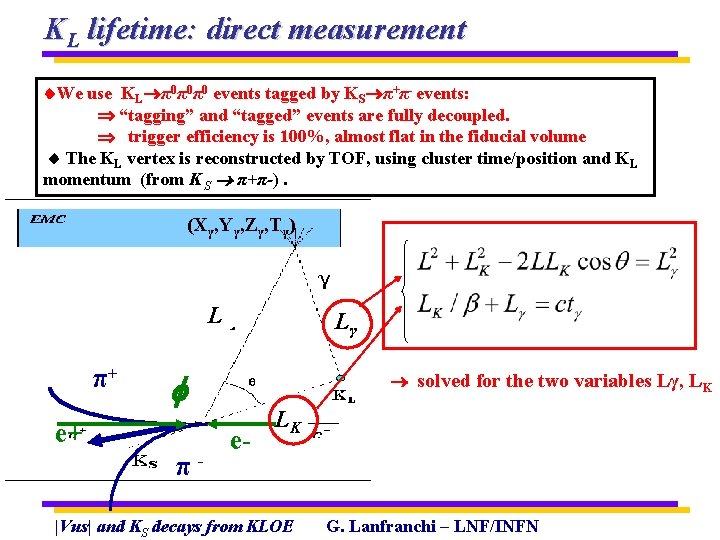
KL lifetime: direct measurement We use KL π0π0π0 events tagged by KS π+π- events: “tagging” and “tagged” events are fully decoupled. trigger efficiency is 100%, almost flat in the fiducial volume The KL vertex is reconstructed by TOF, using cluster time/position and KL momentum (from K S π+π-). (Xγ, Yγ, Zγ, Tγ) L π+ Lγ e+ π- solved for the two variables Lγ, LK e- LK |Vus| and KS decays from KLOE G. Lanfranchi – LNF/INFN
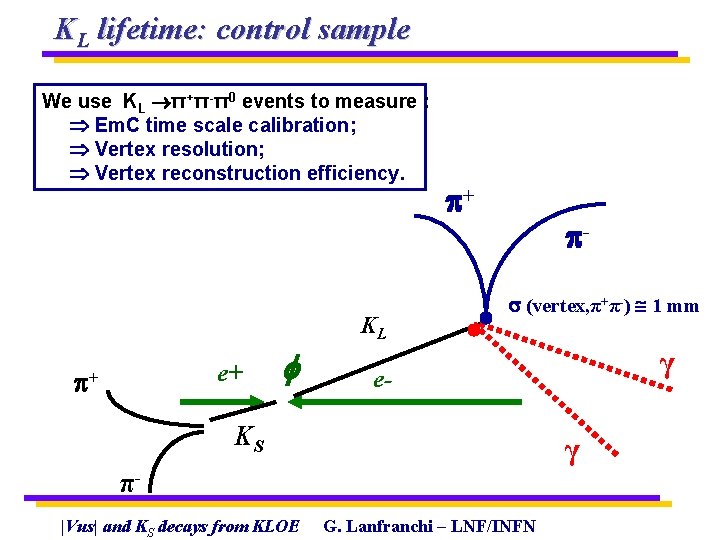
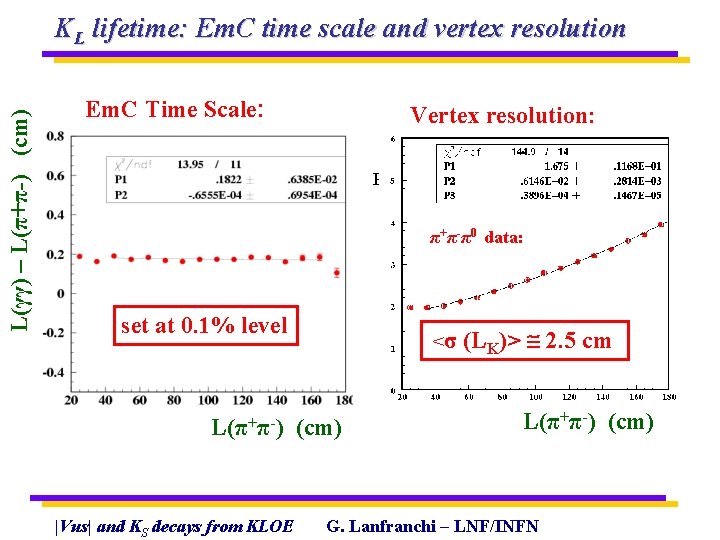
KL lifetime: control sample We use KL π+π-π0 events to measure : Em. C time scale calibration; Vertex resolution; Vertex reconstruction efficiency. KL e+ + + (vertex, π+π-) 1 mm e- KS γ π|Vus| and KS decays from KLOE γ G. Lanfranchi – LNF/INFN
L(γγ) – L(π+π-) (cm) KL lifetime: Em. C time scale and vertex resolution Em. C Time Scale: Vertex resolution: Plot di risoluzione Plot di time scale π+π-π0 data: set at 0. 1% level L(π+π-) |Vus| and KS decays from KLOE <σ (cm) (LK)> 2. 5 cm (cm) L(π+LπK-)(+-)(cm) G. Lanfranchi – LNF/INFN
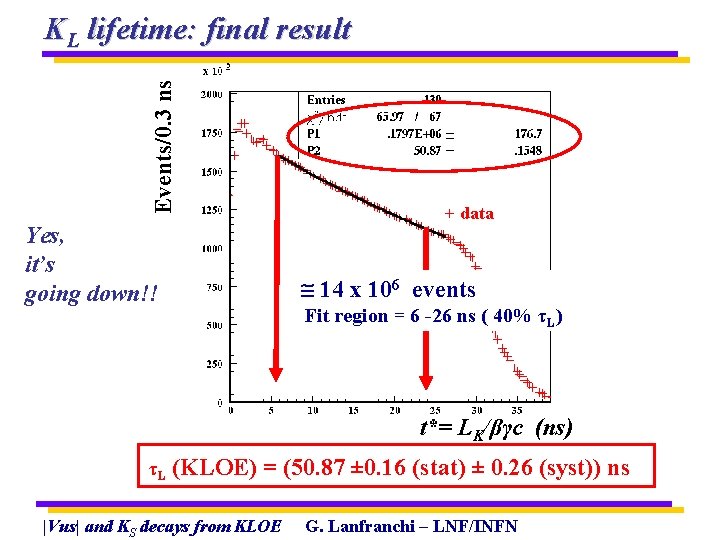
Events/0. 3 ns KL lifetime: final result + data Yes, it’s going down!! 14 x 106 events Fit region = 6 -26 ns ( 40% τL) t*= LK/βγc (ns) τL (KLOE) = (50. 87 ± 0. 16 (stat) ± 0. 26 (syst)) ns |Vus| and KS decays from KLOE G. Lanfranchi – LNF/INFN
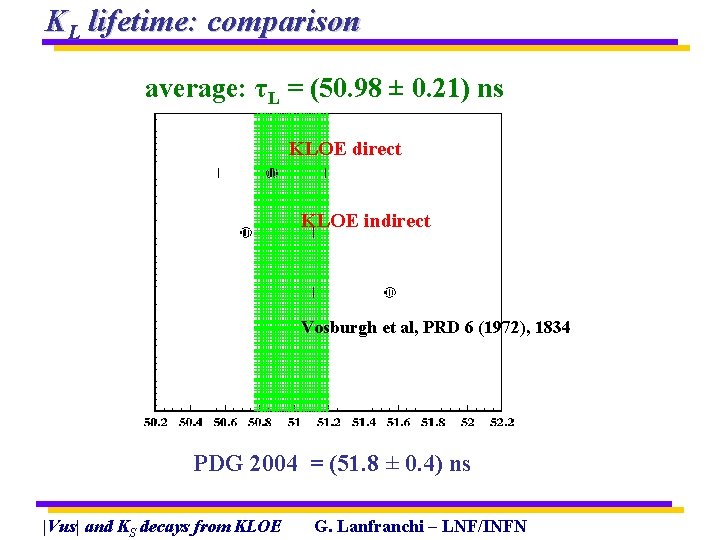
KL lifetime: comparison average: τL = (50. 98 ± 0. 21) ns KLOE direct KLOE indirect Vosburgh et al, PRD 6 (1972), 1834 PDG 2004 = (51. 8 ± 0. 4) ns |Vus| and KS decays from KLOE G. Lanfranchi – LNF/INFN
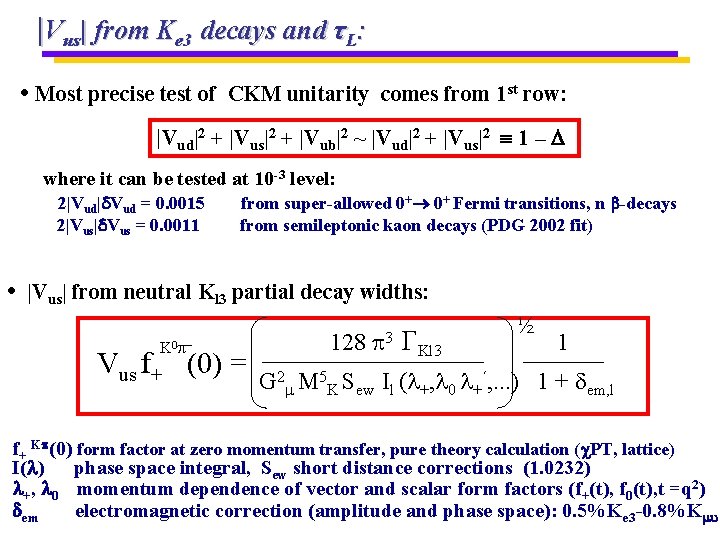
|Vus| from Ke 3 decays and τL: • Most precise test of CKM unitarity comes from 1 st row: |Vud|2 + |Vus|2 + |Vub|2 ~ |Vud|2 + |Vus|2 1 – where it can be tested at 10 -3 level: 2|Vud|d. Vud = 0. 0015 2|Vus|d. Vus = 0. 0011 from super-allowed 0+ 0+ Fermi transitions, n b-decays from semileptonic kaon decays (PDG 2002 fit) • |Vus| from neutral Kl 3 partial decay widths: K 0 - Vus f+ (0) = 128 3 GKl 3 ½ 1 G 2 m M 5 K Sew Il (l+, l 0 l+´, . . . ) 1 + dem, l f+ K (0) form factor at zero momentum transfer, pure theory calculation ( PT, lattice) I(l) phase space integral, Sew short distance corrections (1. 0232) l+, l 0 momentum dependence of vector and scalar form factors (f+(t), f 0(t), t =q 2) dem electromagnetic correction (amplitude and phase space): 0. 5%Ke 3 -0. 8%K u
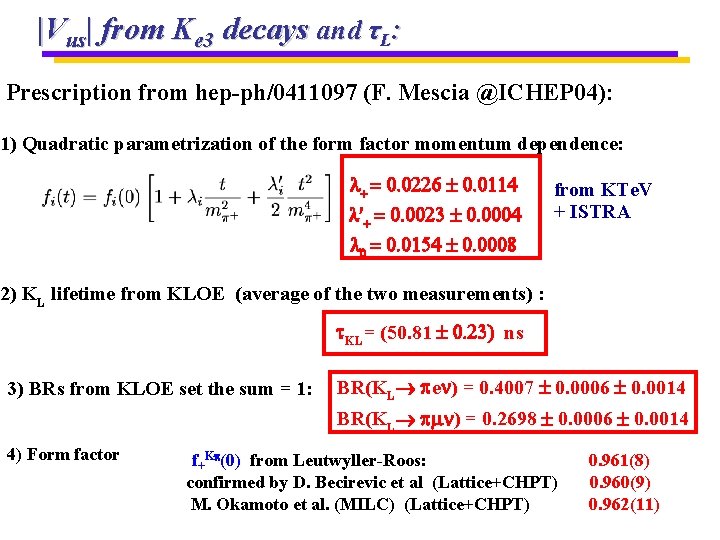
|Vus| from Ke 3 decays and τL: Prescription from hep-ph/0411097 (F. Mescia @ICHEP 04): 1) Quadratic parametrization of the form factor momentum dependence: l = . 226 . 114 l = . 23 . 4 l = . 154 . 8 from KTe. V + ISTRA 2) KL lifetime from KLOE (average of the two measurements) : t. KL= (50. 81 . 23) ns 3) BRs from KLOE set the sum = 1: BR(KL e ) = 0. 4007 0. 0006 0. 0014 BR(KL ) = 0. 2698 0. 0006 0. 0014 4) Form factor f+K (0) from Leutwyller-Roos: confirmed by D. Becirevic et al (Lattice+CHPT) M. Okamoto et al. (MILC) (Lattice+CHPT) 0. 961(8) 0. 960(9) 0. 962(11)
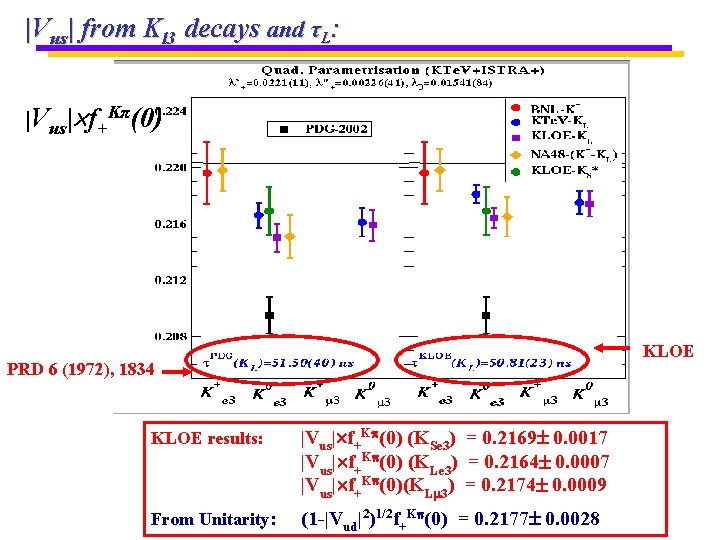
|Vus| from Kl 3 decays and τL: |Vus| f+Kπ(0) KLOE PRD 6 (1972), 1834 KLOE results: |Vus| f+K (0) (KSe 3) = 0. 2169 0. 0017 |Vus| f+K (0) (KLe 3) = 0. 2164 0. 0007 |Vus| f+K (0)(KL 3) = 0. 2174 0. 0009 From Unitarity: (1 -|Vud|2)1/2 f+K (0) = 0. 2177 0. 0028
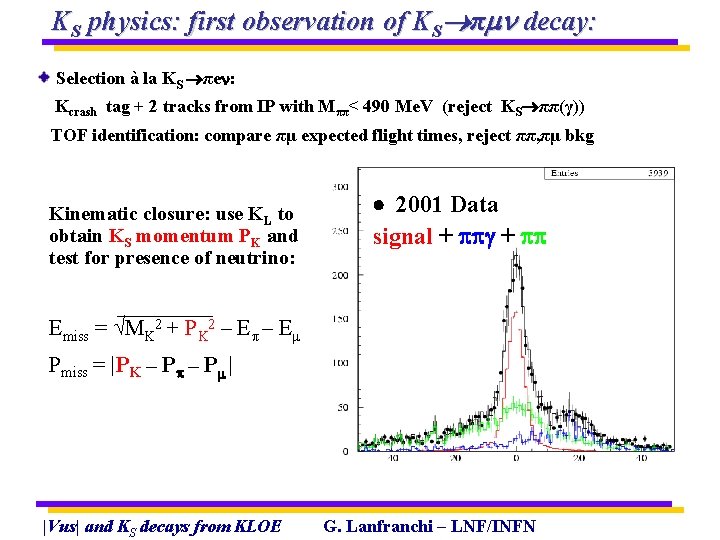
KS physics: first observation of KS π decay: Selection à la KS πe : Kcrash tag + 2 tracks from IP with Mππ< 490 Me. V (reject KS ππ(γ)) TOF identification: compare πμ expected flight times, reject ππ, πμ bkg Kinematic closure: use KL to obtain KS momentum PK and test for presence of neutrino: 2001 Data signal + + Emiss = MK 2 + PK 2 – Em Pmiss = |PK – P | |Vus| and KS decays from KLOE G. Lanfranchi – LNF/INFN
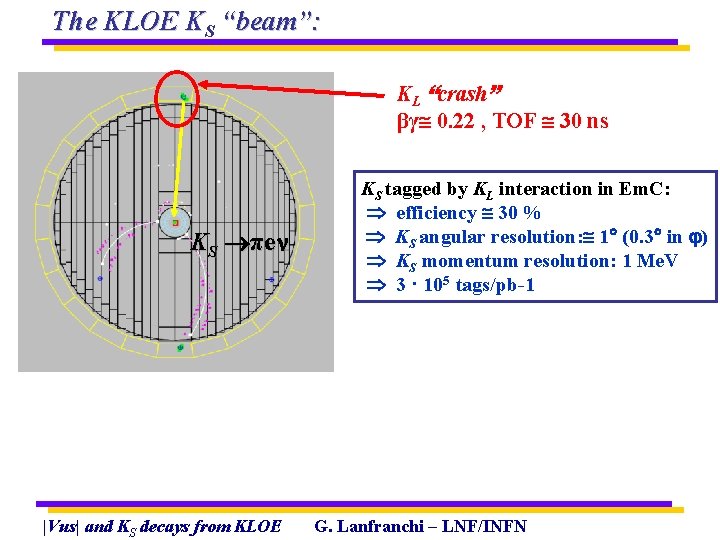
The KLOE KS “beam”: KL “crash” βγ 0. 22 , TOF 30 ns KS πe |Vus| and KS decays from KLOE KS tagged by KL interaction in Em. C: efficiency 30 % KS angular resolution: 1 (0. 3 in ) KS momentum resolution: 1 Me. V 3 · 105 tags/pb-1 G. Lanfranchi – LNF/INFN
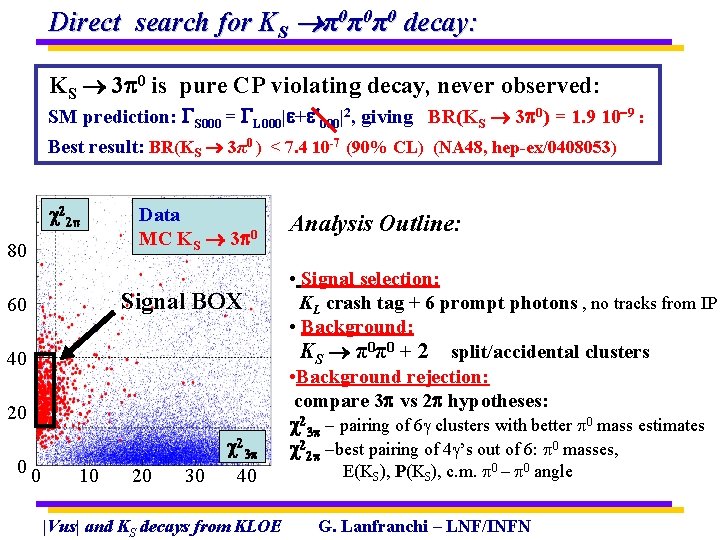
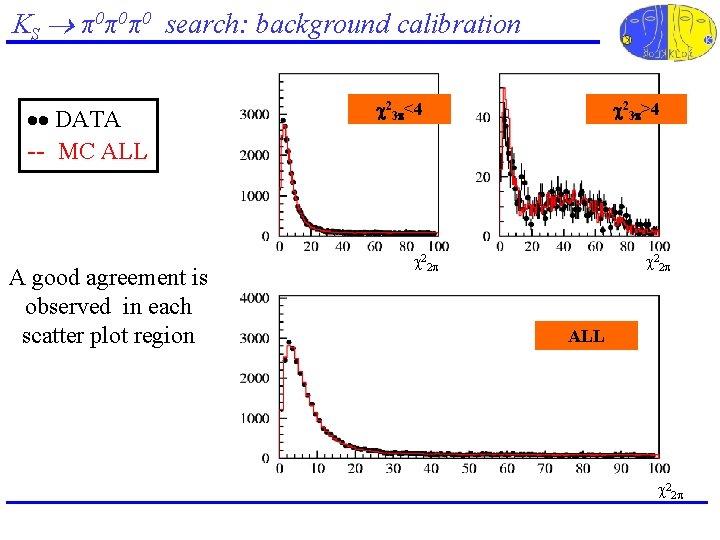
Direct search for KS π0π0π0 decay: KS 3 0 is pure CP violating decay, never observed: SM prediction: GS 000 = GL 000| + 000|2, giving BR(KS 3 0) = 1. 9 10 9 : Best result: BR(KS 3π0 ) < 7. 4 10 -7 (90% CL) (NA 48, hep-ex/0408053) 22 80 Data MC KS 3 0 Signal BOX 60 40 20 00 10 20 30 23 40 |Vus| and KS decays from KLOE Analysis Outline: • Signal selection: KL crash tag + 6 prompt photons , no tracks from IP • Background: KS π0π0 + 2 split/accidental clusters • Background rejection: compare 3 vs 2 hypotheses: 23 - pairing of 6 g clusters with better 0 mass estimates 22 -best pairing of 4 g’s out of 6: 0 masses, E(KS), P(KS), c. m. 0 - 0 angle G. Lanfranchi – LNF/INFN
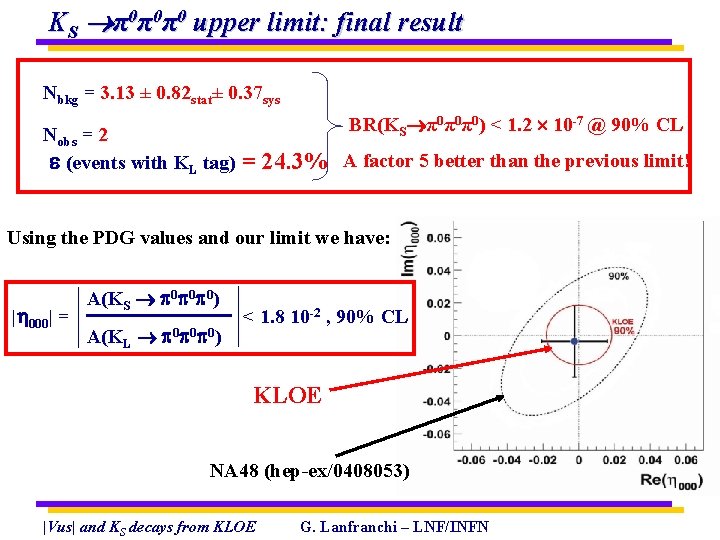
KS π0π0π0 upper limit: final result Nbkg = 3. 13 ± 0. 82 stat± 0. 37 sys Nobs = 2 (events with KL tag) BR(KS π0π0π0) < 1. 2 10 -7 @ 90% CL = 24. 3% A factor 5 better than the previous limit! Using the PDG values and our limit we have: |h 000| = A(KS 0 0 0) A(KL 0 0 0) < 1. 8 10 -2 , 90% CL KLOE NA 48 (hep-ex/0408053) |Vus| and KS decays from KLOE G. Lanfranchi – LNF/INFN 90 % CL
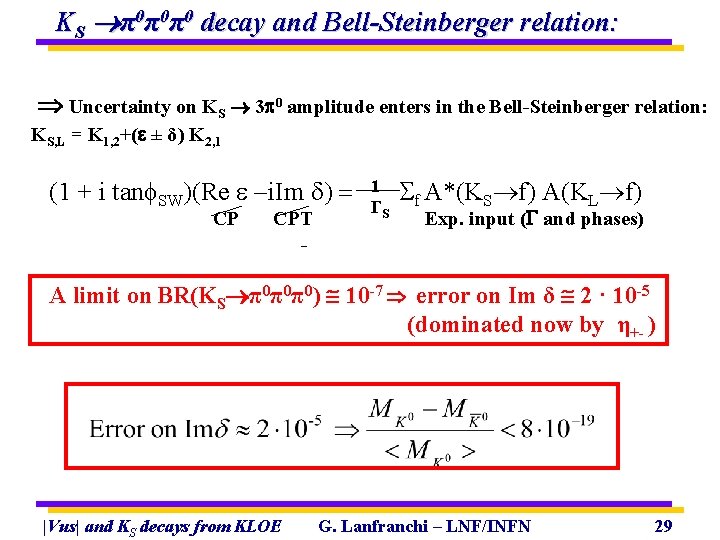
KS π0π0π0 decay and Bell-Steinberger relation: Uncertainty on KS 3 0 amplitude enters in the Bell-Steinberger relation: KS, L = K 1, 2+( ± δ) K 2, 1 1 (1 + i tanf. SW)(Re e -i. Im d) = S f A*(KS f) A(KL f) CP CPT ΓS Exp. input (G and phases) A limit on BR(KS π0π0π0) 10 -7 error on Im δ 2 · 10 -5 (dominated now by η+- ) |Vus| and KS decays from KLOE G. Lanfranchi – LNF/INFN 29
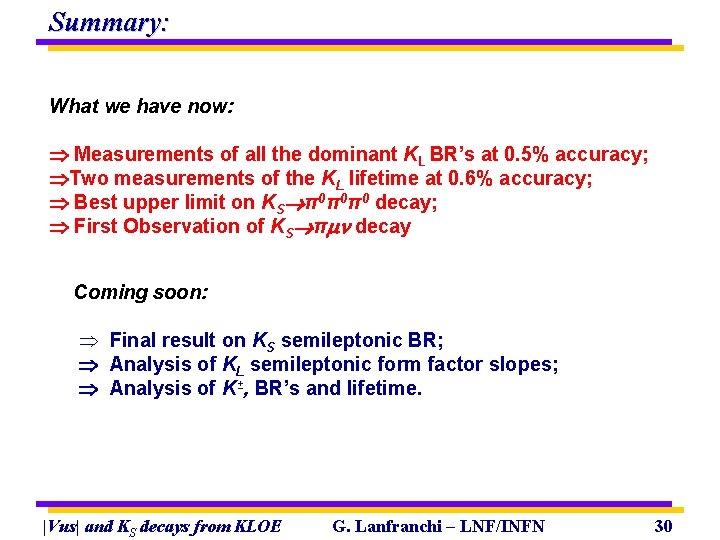
Summary: What we have now: Measurements of all the dominant KL BR’s at 0. 5% accuracy; Two measurements of the KL lifetime at 0. 6% accuracy; Best upper limit on KS π0π0π0 decay; First Observation of KS π decay Coming soon: Final result on KS semileptonic BR; Analysis of KL semileptonic form factor slopes; Analysis of K±, BR’s and lifetime. |Vus| and KS decays from KLOE G. Lanfranchi – LNF/INFN 30
BACKUP SLIDES
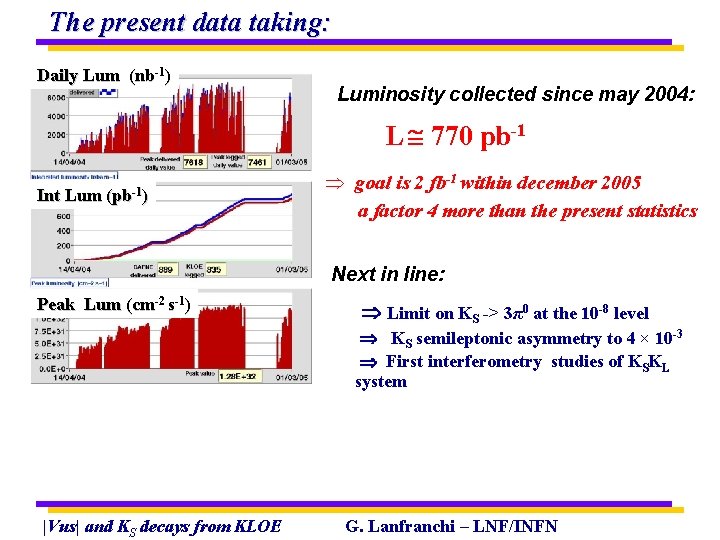
The present data taking: Daily Lum (nb-1) Luminosity collected since may 2004: L 770 pb-1 Int Lum (pb-1) goal is 2 fb-1 within december 2005 a factor 4 more than the present statistics Next in line: Peak Lum (cm-2 s-1) Limit on KS -> 3π0 at the 10 -8 level KS semileptonic asymmetry to 4 × 10 -3 First interferometry studies of KSKL system |Vus| and KS decays from KLOE G. Lanfranchi – LNF/INFN
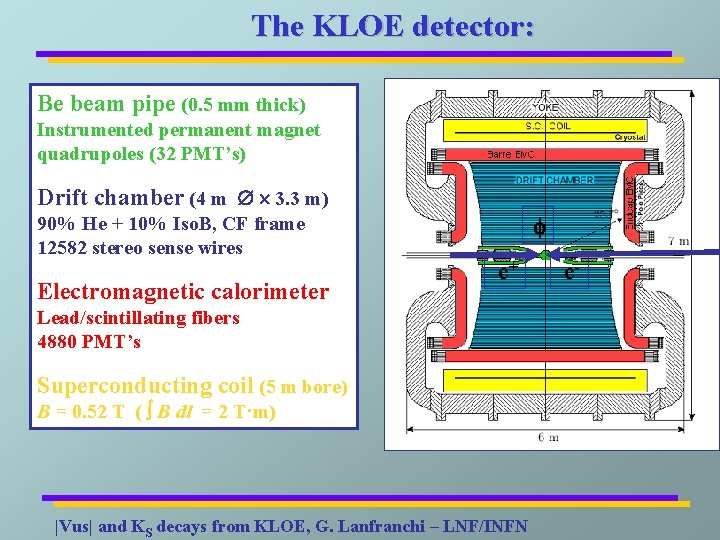
The KLOE detector: Be beam pipe (0. 5 mm thick) Instrumented permanent magnet quadrupoles (32 PMT’s) Drift chamber (4 m 3. 3 m) 90% He + 10% Iso. B, CF frame 12582 stereo sense wires Electromagnetic calorimeter e+ Lead/scintillating fibers 4880 PMT’s Superconducting coil (5 m bore) B = 0. 52 T ( B dl = 2 T·m) |Vus| and KS decays from KLOE, G. Lanfranchi – LNF/INFN e-
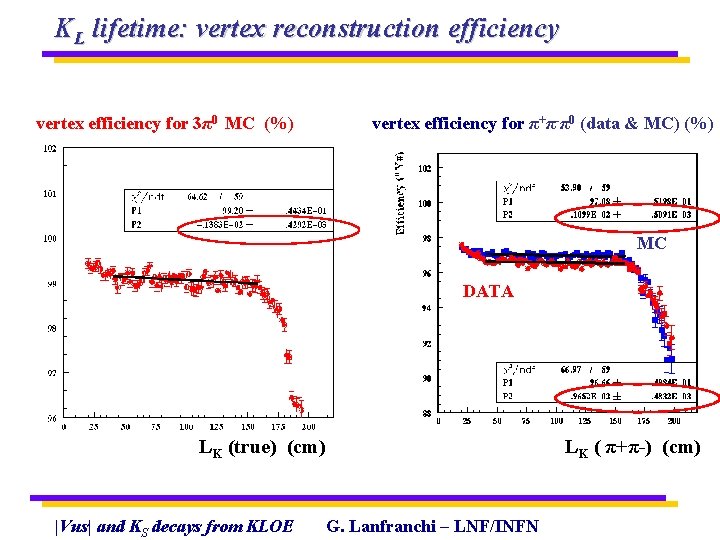
KL lifetime: vertex reconstruction efficiency vertex efficiency for 3π0 MC (%) vertex efficiency for π+π-π0 (data & MC) (%) MC DATA LK (true) (cm) |Vus| and KS decays from KLOE LK ( π+π-) (cm) G. Lanfranchi – LNF/INFN
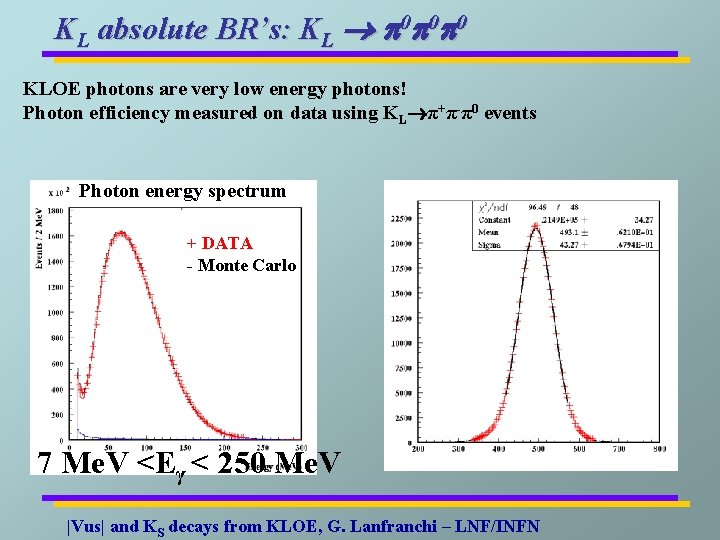
KL absolute BR’s: KL 0 0 0 KLOE photons are very low energy photons! Photon efficiency measured on data using KL π+π-π0 events Photon energy spectrum + DATA - Monte Carlo Plot dell’energia totale per 6 fotoni O della massa totale. 7 Me. V <Eγ < 250 Me. V |Vus| and KS decays from KLOE, G. Lanfranchi – LNF/INFN
Effect of the tag bias: Before cuts: After cuts: ε (tagging) 0 0 0 e + - 0 LK (cm)
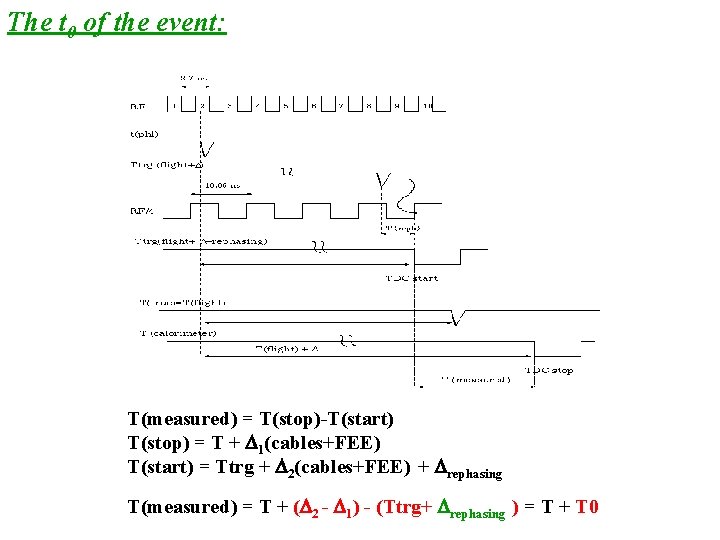
The t 0 of the event: T(measured) = T(stop)-T(start) T(stop) = T + 1(cables+FEE) T(start) = Ttrg + 2(cables+FEE) + rephasing T(measured) = T + ( 2 - 1) - (Ttrg+ rephasing ) = T + T 0
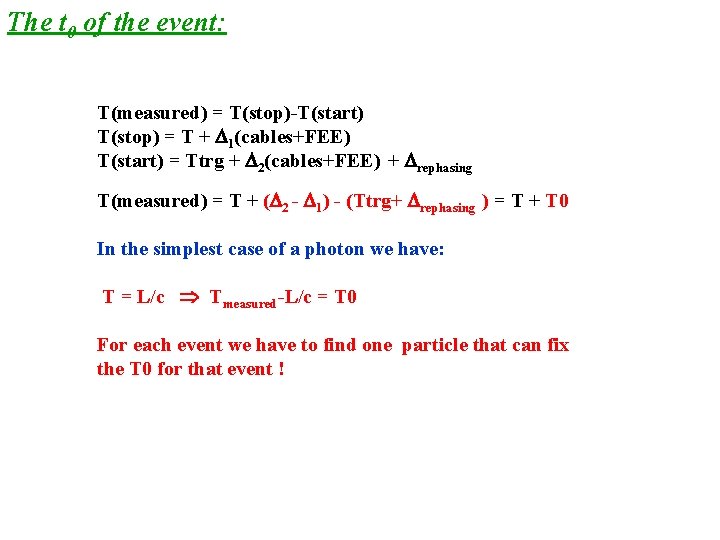
The t 0 of the event: T(measured) = T(stop)-T(start) T(stop) = T + 1(cables+FEE) T(start) = Ttrg + 2(cables+FEE) + rephasing T(measured) = T + ( 2 - 1) - (Ttrg+ rephasing ) = T + T 0 In the simplest case of a photon we have: T = L/c Tmeasured-L/c = T 0 For each event we have to find one particle that can fix the T 0 for that event !
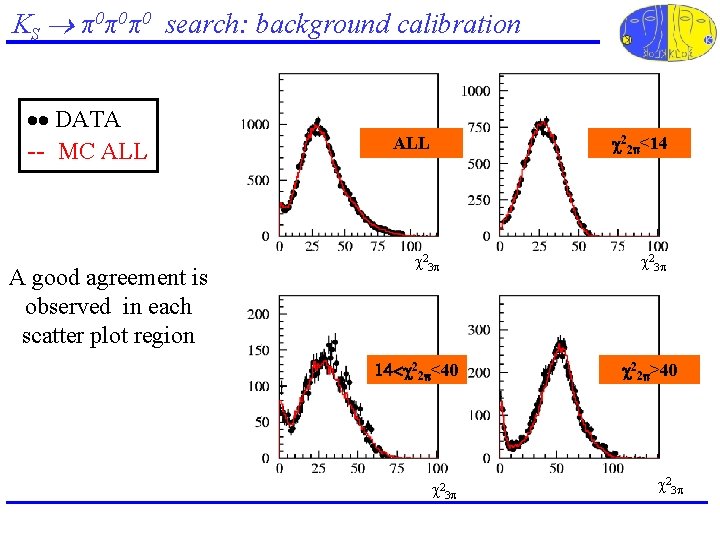
KS π0π0π0 search: background calibration DATA -- MC ALL A good agreement is observed in each scatter plot region 22 <14 ALL c 23 14< 22 <40 22 >40 c 23
KS π0π0π0 search: background calibration DATA -- MC ALL A good agreement is observed in each scatter plot region 23 <4 23 >4 c 22 ALL c 22