
Vulnerabilities 1 Vulnerability Taxonomies This document is licensed
Vulnerabilities 1. Vulnerability Taxonomies This document is licensed with a Creative Commons Attribution 4. 0 International License © 2017
Learning Outcomes Upon completion of this unit, students will be able to: • • Understand what CVE does. Understand what CWE does. Understand what OSVDB does. Understand what CAPEC does. This document is licensed with a Creative Commons Attribution 4. 0 International License © 2017
Topics covered 1. CVE • Common Vulnerabilities and Exposures 2. CWE • Common Weakness Enumeration 3. OSVDB • Open Source Vulnerability Database 4. CAPEC • Common Attack Pattern Enumeration and Classification This document is licensed with a Creative Commons Attribution 4. 0 International License © 2017
CVE – Common Vulnerabilities and Exposures Vulnerability Taxonomies This document is licensed with a Creative Commons Attribution 4. 0 International License © 2017
CVE – Common Vulnerabilities and Exposures • A list of standard terms (CVE identifiers) for publicly known security threats • Basically, a naming standard for security threats • Sponsored by the US Department of Homeland Security • Free to use • Maintained by MITRE, a nonprofit company • Is an international effort • Organizations around the world are actively involved in making their products CVE-compatible • If everyone follows CVE as the naming standard, it’s easier to identify information about a single problem from multiple resources This document is licensed with a Creative Commons Attribution 4. 0 International License © 2017
CVE – History • Most information security tools used their own database that uses their own naming system for security vulnerabilities • Each vendor used different measurement methods to state the number of vulnerabilities or exposures they detected • Consequences: • Possible gaps in security coverage • No effective interoperability among the databases and tools • Launched in 1999 • CVE was the solution to unify information security tools This document is licensed with a Creative Commons Attribution 4. 0 International License © 2017
CVE – How does this work? • When a threat is discovered and disclosed, CVE Numbering Authorities assign the threat a CVE ID then post it on the CVE list • Before it can be posted, the Vulnerability Disclosure Policy must be obeyed • The affected vendor will be contacted about the found threat with Proof of Concept • The vendor should correct the threat within 90 days • After the threat is corrected, it will be disclosed to the public • The vulnerability is then assigned a CVE and put on the CVE list This document is licensed with a Creative Commons Attribution 4. 0 International License © 2017
CVE – Security Threats • The security threats are divided into 2 categories: 1. Vulnerability • Mistake in software that a hacker can use to gain DIRECT access to a system or network 2. Exposure • Mistake in software that a hacker can use to gain INDIRECT access to a system or network This document is licensed with a Creative Commons Attribution 4. 0 International License © 2017
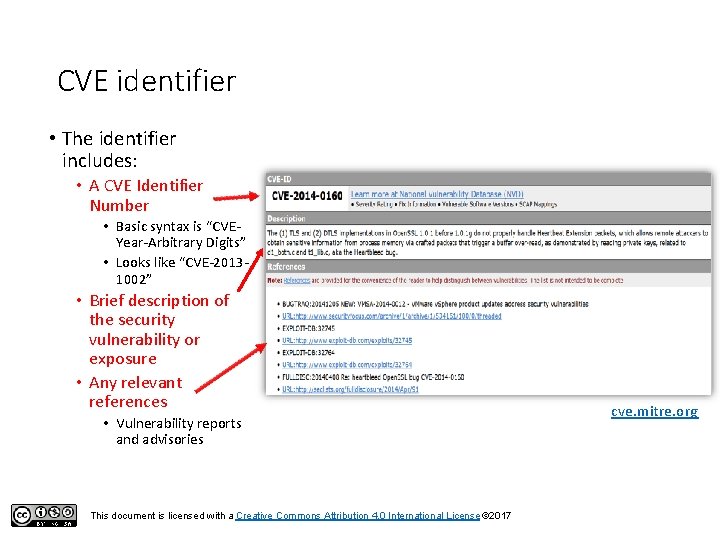
CVE identifier • The identifier includes: • A CVE Identifier Number • Basic syntax is “CVEYear-Arbitrary Digits” • Looks like “CVE-20131002” • Brief description of the security vulnerability or exposure • Any relevant references • Vulnerability reports and advisories This document is licensed with a Creative Commons Attribution 4. 0 International License © 2017 cve. mitre. org
CVE – Who can make CVE Identifiers? • CVE Numbering Authorities (CNAs) • Trusted major OS vendors, security researchers, and research organizations • These people are allowed to assign CVE Identifiers to newly discovered issues • Reasons for having CNAs? • They don’t have to go through MITRE to release an identifier to the public • Puts the burden on the community to keep it updated instead of MITRE having to use man power to keep it updated • Less work on MITRE to manage and maintain the CVE This document is licensed with a Creative Commons Attribution 4. 0 International License © 2017
CVE – Won’t this help hackers? • Any discussion involving vulnerabilities can help hackers • So why do the benefits of having CVE outweigh the risks? • It takes a lot more work for an organization to protect its networks and fix all possible holes than it takes for a hacker to find a single vulnerability to exploit • The organization can use the CVE to identify the problem and easily find the solution • Sharing information within the information security community is much harder than it is for hackers to share information • CVE provides a sharing platform for information security organizations to communicate security threats This document is licensed with a Creative Commons Attribution 4. 0 International License © 2017
To search for CVE Identifiers • This will provide a comprehensive evaluation of the CVE Identifier • http: //www. cvedetails. com/ • Official site • https: //cve. mitre. org/cve. html This document is licensed with a Creative Commons Attribution 4. 0 International License © 2017
CWE – Common Weakness Enumeration Vulnerability Taxonomies This document is licensed with a Creative Commons Attribution 4. 0 International License © 2017
CWE – Common Weakness Enumeration • Online list of software weaknesses • Serves as a common language, a measuring stick for software, and a baseline for weakness identification, mitigation, and prevention efforts • Free • Also maintained by MITRE • Compiled and updated by a group of experts from business academic institutions and government agencies • The software weaknesses will be named in a similar fashion to the CVE identifiers • Example: CWE-493 • Note: CWEs do not include the year This document is licensed with a Creative Commons Attribution 4. 0 International License © 2017
CWE – Tiers • The CWE is assembled into 3 tiers • Top tier • Divides known weaknesses into a few large, general classes • Used by enterprise management people, academics, researchers, and vendors • Middle tier • Divides into several dozen categorized groups of definitions • Used by security experts, system administrators, and software developers • Lower tier • Full list of weaknesses • Used by people at all levels including PC users This document is licensed with a Creative Commons Attribution 4. 0 International License © 2017
CWE – What’s the purpose? • Allows service providers to inform users of weaknesses and possible solutions • Allows software buyers to have a good comparison of similar products offered by different vendors • Allows legal personnel to formalize contracts, terms, and conditions of a certain software’s usage • Organizations want assurance that the software products they buy or develop are free of known security flaws This document is licensed with a Creative Commons Attribution 4. 0 International License © 2017
To search the CWE • http: //cwe. mitre. org/data/index. h tml This document is licensed with a Creative Commons Attribution 4. 0 International License © 2017
OSVDB – Open Source Vulnerability Database Vulnerability Taxonomies This document is licensed with a Creative Commons Attribution 4. 0 International License © 2017
OSVDB – Open Source Vulnerability Database • Independent, open-sourced database of vulnerabilities • Started in 2002 at the Blackhat and DEFCON conferences • The database was officially open to the public in 2004 • Why did they create this? • To provide accurate, non-biased technical information on security vulnerabilities • The open source nature of the database promoted greater collaboration between companies and individuals • The idea was to eliminate redundant work and reduce expenses from the development and maintenance of running a vulnerability database This document is licensed with a Creative Commons Attribution 4. 0 International License © 2017
OSVDB – Open Source Vulnerability Database • The database was shutdown on April 5 th, 2016 • The creators couldn’t get the security community to support the database and contribute to it • Thus, the creators were straining themselves keeping this database updated and maintained This document is licensed with a Creative Commons Attribution 4. 0 International License © 2017
OSVDB • While the database can no longer be accessed, the blog they created is still active • https: //blog. osvdb. org/ • This blog provides commentary on things related to vulnerabilities This document is licensed with a Creative Commons Attribution 4. 0 International License © 2017
CAPEC – Common Attack Pattern Enumeration and Classification Vulnerability Taxonomies This document is licensed with a Creative Commons Attribution 4. 0 International License © 2017
CAPEC – Common Attack Pattern Enumeration and Classification • Comprehensive dictionary and classification taxonomy of known attacks • Complex taxonomy of hundreds of attack classes showing textual, categorical, and referential data • These are common methods for exploiting software systems • Free • Maintained by MITRE • Released in 2007 • Naming is same as CWE but uses CAPEC • Example: CAPEC-66 This document is licensed with a Creative Commons Attribution 4. 0 International License © 2017
CAPEC – Common Attack Pattern Enumeration and Classification • Why is this useful? • Advance community understanding of these attacks and enhance defenses • Able to communicate with others about a specific attack and have them understand exactly what you’re referring to • Used mainly by analysts, developers, testers, and educators • Public participation and contributions continue to develop the list • CAPEC provides the means for identifying, collecting, and sharing attack patterns among the information security community This document is licensed with a Creative Commons Attribution 4. 0 International License © 2017
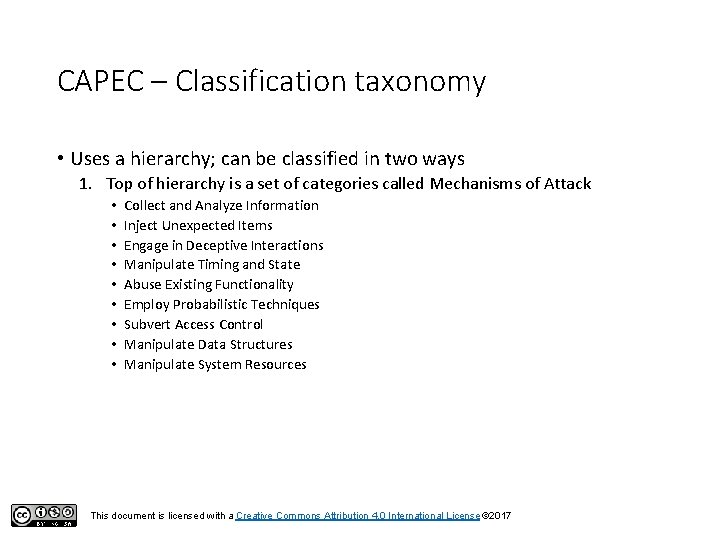
CAPEC – Classification taxonomy • Uses a hierarchy; can be classified in two ways 1. Top of hierarchy is a set of categories called Mechanisms of Attack • • • Collect and Analyze Information Inject Unexpected Items Engage in Deceptive Interactions Manipulate Timing and State Abuse Existing Functionality Employ Probabilistic Techniques Subvert Access Control Manipulate Data Structures Manipulate System Resources This document is licensed with a Creative Commons Attribution 4. 0 International License © 2017
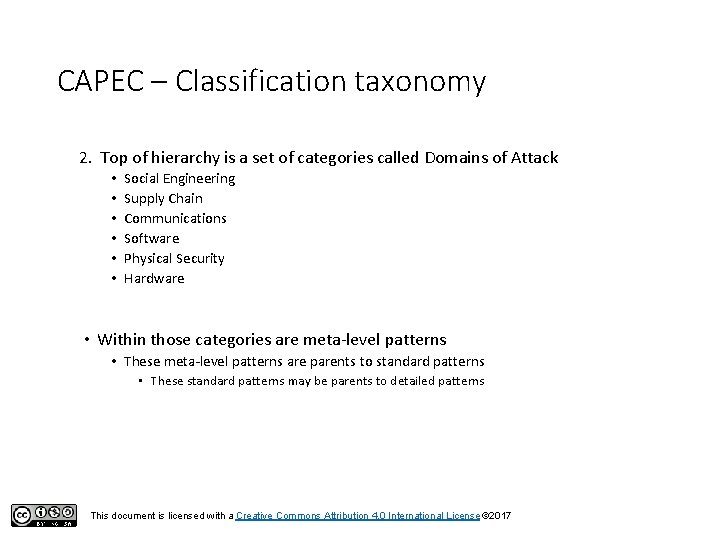
CAPEC – Classification taxonomy 2. Top of hierarchy is a set of categories called Domains of Attack • • • Social Engineering Supply Chain Communications Software Physical Security Hardware • Within those categories are meta-level patterns • These meta-level patterns are parents to standard patterns • These standard patterns may be parents to detailed patterns This document is licensed with a Creative Commons Attribution 4. 0 International License © 2017
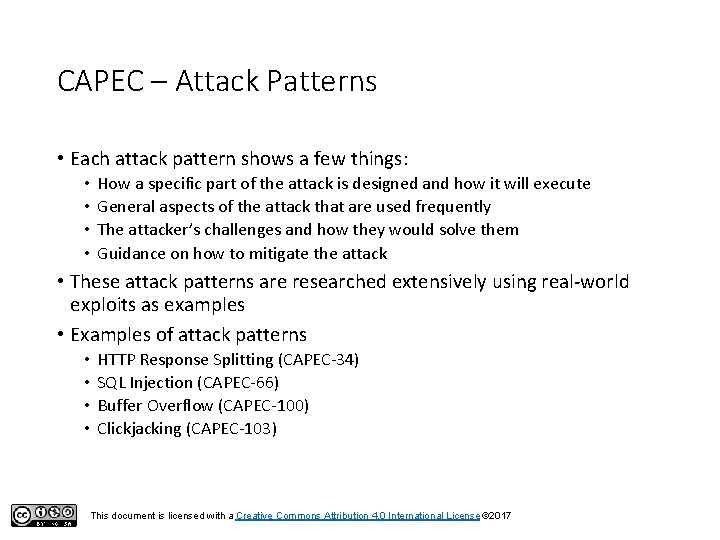
CAPEC – Attack Patterns • Each attack pattern shows a few things: • • How a specific part of the attack is designed and how it will execute General aspects of the attack that are used frequently The attacker’s challenges and how they would solve them Guidance on how to mitigate the attack • These attack patterns are researched extensively using real-world exploits as examples • Examples of attack patterns • • HTTP Response Splitting (CAPEC-34) SQL Injection (CAPEC-66) Buffer Overflow (CAPEC-100) Clickjacking (CAPEC-103) This document is licensed with a Creative Commons Attribution 4. 0 International License © 2017
Search CAPEC • https: //capec. mitre. org/data/defi nitions/1000. html This document is licensed with a Creative Commons Attribution 4. 0 International License © 2017
Conclusion • These vulnerability taxonomies have forever impacted the way we communicate security threats • CVE, CWE, OSVDB, and CAPEC were all created to provide a standard for security threats that would unify the information security community • • better communication about security threats produced a world-wide collaboration Platform to share information Helps developers debug their software This document is licensed with a Creative Commons Attribution 4. 0 International License © 2017
- Slides: 29