
Vulkan Subgroups Nuno Subtil nsubtilnvidia com Copyright Khronos
Vulkan Subgroups Nuno Subtil nsubtil@nvidia. com © Copyright Khronos™ Group 2018 - Page 1
Agenda • What are subgroups and why they’re useful • Subgroup overview • Vulkan 1. 1 Subgroup Operations • Partitioned Subgroup Operations • NV Implementation Details • Tips • Mapping to HLSL © Copyright Khronos™ Group 2018 - Page 2
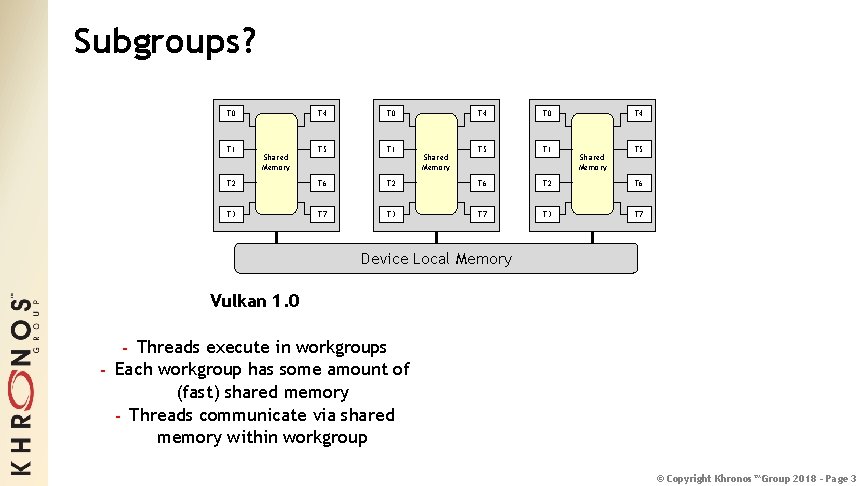
Subgroups? T 4 T 0 T 5 T 1 T 2 T 6 T 3 T 7 T 0 T 1 Shared Memory T 4 T 0 T 5 T 1 T 2 T 6 T 3 T 7 Shared Memory T 4 Shared Memory T 5 Device Local Memory Vulkan 1. 0 - Threads execute in workgroups - Each workgroup has some amount of (fast) shared memory - Threads communicate via shared memory within workgroup © Copyright Khronos™ Group 2018 - Page 3
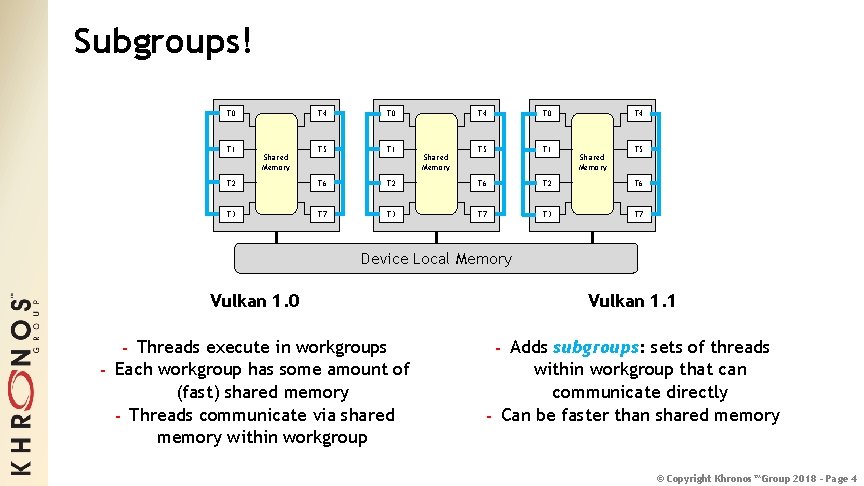
Subgroups! T 4 T 0 T 5 T 1 T 2 T 6 T 3 T 7 T 0 T 1 Shared Memory T 4 T 0 T 5 T 1 T 2 T 6 T 3 T 7 Shared Memory T 4 Shared Memory T 5 Device Local Memory Vulkan 1. 0 Vulkan 1. 1 - Threads execute in workgroups - Each workgroup has some amount of (fast) shared memory - Threads communicate via shared memory within workgroup - Adds subgroups: sets of threads within workgroup that can communicate directly - Can be faster than shared memory © Copyright Khronos™ Group 2018 - Page 4

Subgroups! • All-to-all communication across sets of threads within a workgroup - Equivalent to HLSL SM 6 wave ops • Can be more efficient than shared memory - If the data you want to move is in registers, subgroups are typically faster - Implicit, finer-grained synchronization • May have lower latency - Shared memory implies workgroup-wide synchronization - Subgroup operations only require synchronization within participating threads • Exposed in all shader stages - Compute support is required - Other stages are allowed depending on the implementation © Copyright Khronos™ Group 2018 - Page 5
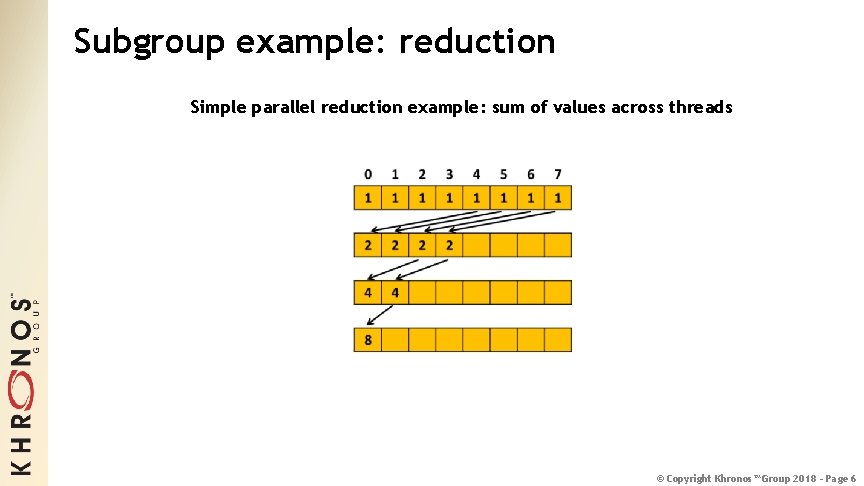
Subgroup example: reduction Simple parallel reduction example: sum of values across threads © Copyright Khronos™ Group 2018 - Page 6
![Subgroup example: reduction Parallel reduction loop using shared memory shared int s[WORKGROUP_SIZE]; … int](http://slidetodoc.com/presentation_image_h/a066c619b9af8be326246496da6cac7f/image-7.jpg "Subgroup example: reduction Parallel reduction loop using shared memory shared int s[WORKGROUP_SIZE]; … int")
Subgroup example: reduction Parallel reduction loop using shared memory shared int s[WORKGROUP_SIZE]; … int a = compute_local_value(); s[gl_Work. Group. ID. x] = a; // memory write memory. Barrier. Shared(); // synchronize workgroup if (current_thread_should_reduce()) { int b = s[gl_Work. Group. ID. x + iter. Delta]; // memory read perform_reduction_step(a, b); iter. Delta /= 2; } © Copyright Khronos™ Group 2018 - Page 7
![Subgroup example: reduction Parallel reduction loop using shared memory shared int s[WORKGROUP_SIZE]; … int](http://slidetodoc.com/presentation_image_h/a066c619b9af8be326246496da6cac7f/image-8.jpg "Subgroup example: reduction Parallel reduction loop using shared memory shared int s[WORKGROUP_SIZE]; … int")
Subgroup example: reduction Parallel reduction loop using shared memory shared int s[WORKGROUP_SIZE]; … int a = compute_local_value(); s[gl_Work. Group. ID. x] = a; // memory write memory. Barrier. Shared(); // synchronize workgroup if (current_thread_should_reduce()) { int b = s[gl_Work. Group. ID. x + iter. Delta]; // memory read perform_reduction_step(a, b); iter. Delta /= 2; } Shuffle. Down (x, 1) Parallel reduction loop using subgroups int a = compute_local_value(); int b = subgroup. Shuffle. Down(a, iter. Delta); // synchronize subgroup if (current_thread_should_reduce()) { perform_reduction_step(a, b); iter. Delta /= 2; } 7 9 3 4 ? © Copyright Khronos™ Group 2018 - Page 8
![Subgroup example: reduction Parallel reduction loop using shared memory shared int s[WORKGROUP_SIZE]; … int](http://slidetodoc.com/presentation_image_h/a066c619b9af8be326246496da6cac7f/image-9.jpg "Subgroup example: reduction Parallel reduction loop using shared memory shared int s[WORKGROUP_SIZE]; … int")
Subgroup example: reduction Parallel reduction loop using shared memory shared int s[WORKGROUP_SIZE]; … int a = compute_local_value(); s[gl_Work. Group. ID. x] = a; // memory write memory. Barrier. Shared(); // synchronize workgroup if (current_thread_should_reduce()) { int b = s[gl_Work. Group. ID. x + iter. Delta]; // memory read perform_reduction_step(a, b); iter. Delta /= 2; } Workgroup-wide synchronization + two memory operations Parallel reduction loop using subgroups int a = compute_local_value(); int b = subgroup. Shuffle. Down(a, iter. Delta); // synchronize subgroup if (current_thread_should_reduce()) { perform_reduction_step(a, b); iter. Delta /= 2; } Fewer threads synchronize; no memory operations © Copyright Khronos™ Group 2018 - Page 9
When to use subgroups? • Quite a few algorithms may benefit - Reductions: post-processing effects - Min/max/sum across range of data - Bloom, depth-of-field, motion blur are good candidates - List building: light culling - Reduce shared memory atomics, skip work across subgroup (e. g. , entire subgroup decides no elements need to be added to the list) - Sorting - Bitonic sort can be accelerated via subgroups © Copyright Khronos™ Group 2018 - Page 10

When not to use subgroups? • Tradeoff between different kinds of latency - Shared memory: - Workgroup-wide synchronization latency - Read/write latency (e. g. , if backed by cache) - Subgroups: - Subgroup-wide synchronization latency - Potentially increased ALU/issue latency (may expand to multiple instructions) • Tradeoffs can be implementation dependent © Copyright Khronos™ Group 2018 - Page 11
More details • Set of shader invocations (threads) - Efficiently synchronize and share data with each other - Exposed “as if” running concurrently - Maps to warp (NV), wavefront (AMD) - Implementation can advertise smaller subgroup size than HW implements • Invocations in a subgroup may be active or inactive - Active: execution is being performed - Inactive: not being executed - Non-uniform flow control - Local workgroup size not a multiple of subgroup size - Can change throughout shader execution as control flow diverges and re-converges © Copyright Khronos™ Group 2018 - Page 12

Vulkan 1. 1 API: Subgroup Properties • A new structure to query subgroup support on a physical device - subgroup. Size – number of invocations in each subgroup - must be at least 1 (and <= 128) - supported. Stages – which shader stages support subgroup operations - VK_SHADER_STAGE_COMPUTE_BIT is required - supported. Operations – which subgroup operations are supported - VK_SUBGROUP_FEATURE_BASIC_BIT is required - quad. Operations. In. All. Stages – do quads ops work in all stages or only fragment and compute © Copyright Khronos™ Group 2018 - Page 13
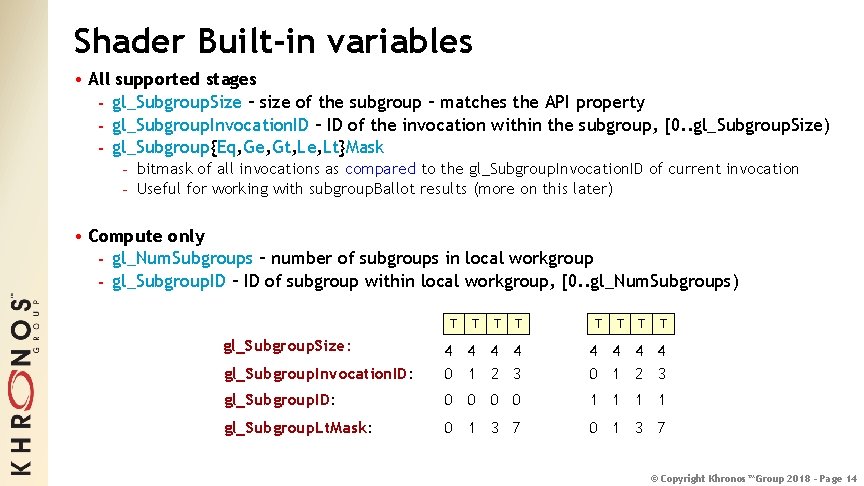
Shader Built-in variables • All supported stages - gl_Subgroup. Size – size of the subgroup – matches the API property - gl_Subgroup. Invocation. ID – ID of the invocation within the subgroup, [0. . gl_Subgroup. Size) - gl_Subgroup{Eq, Ge, Gt, Le, Lt}Mask - bitmask of all invocations as compared to the gl_Subgroup. Invocation. ID of current invocation - Useful for working with subgroup. Ballot results (more on this later) • Compute only - gl_Num. Subgroups – number of subgroups in local workgroup - gl_Subgroup. ID – ID of subgroup within local workgroup, [0. . gl_Num. Subgroups) T gl_Subgroup. Size: T T T T gl_Subgroup. Invocation. ID: 4 4 4 4 0 1 2 3 gl_Subgroup. ID: 0 0 1 1 gl_Subgroup. Lt. Mask: 0 1 3 7 © Copyright Khronos™ Group 2018 - Page 14
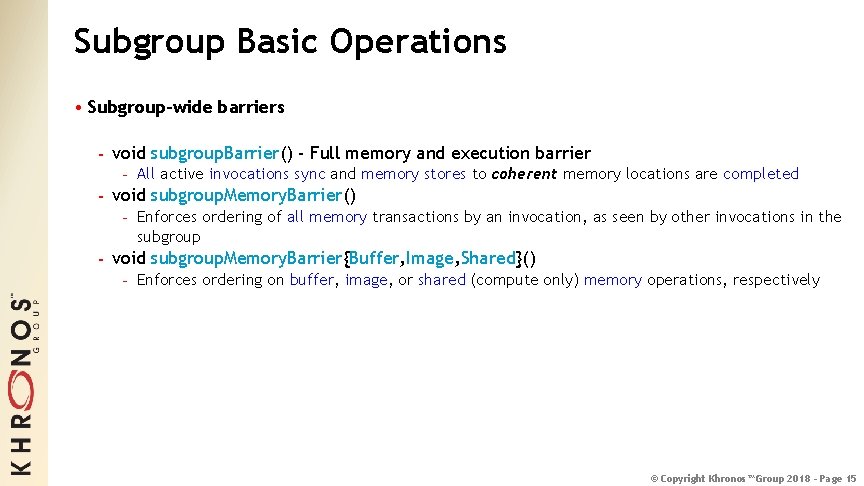
Subgroup Basic Operations • Subgroup-wide barriers - void subgroup. Barrier() - Full memory and execution barrier - All active invocations sync and memory stores to coherent memory locations are completed - void subgroup. Memory. Barrier() - Enforces ordering of all memory transactions by an invocation, as seen by other invocations in the subgroup - void subgroup. Memory. Barrier{Buffer, Image, Shared}() - Enforces ordering on buffer, image, or shared (compute only) memory operations, respectively © Copyright Khronos™ Group 2018 - Page 15
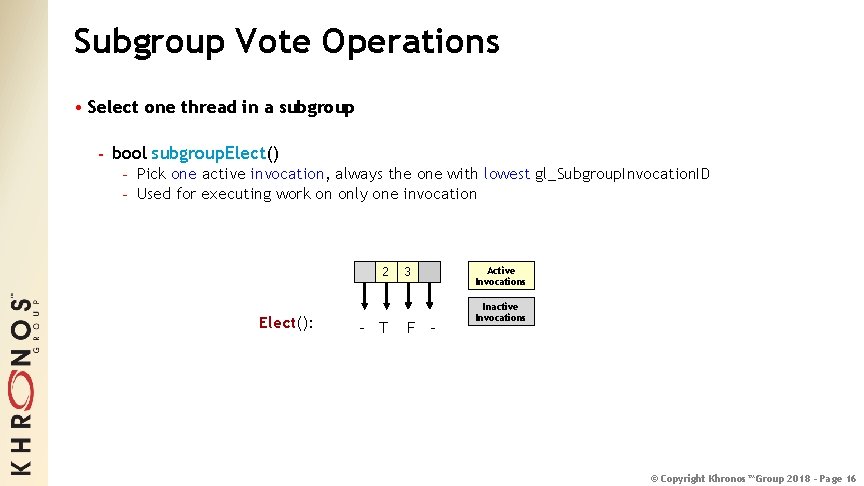
Subgroup Vote Operations • Select one thread in a subgroup - bool subgroup. Elect() - Pick one active invocation, always the one with lowest gl_Subgroup. Invocation. ID - Used for executing work on only one invocation 2 Elect(): - T 3 F - Active Invocations Inactive Invocations © Copyright Khronos™ Group 2018 - Page 16
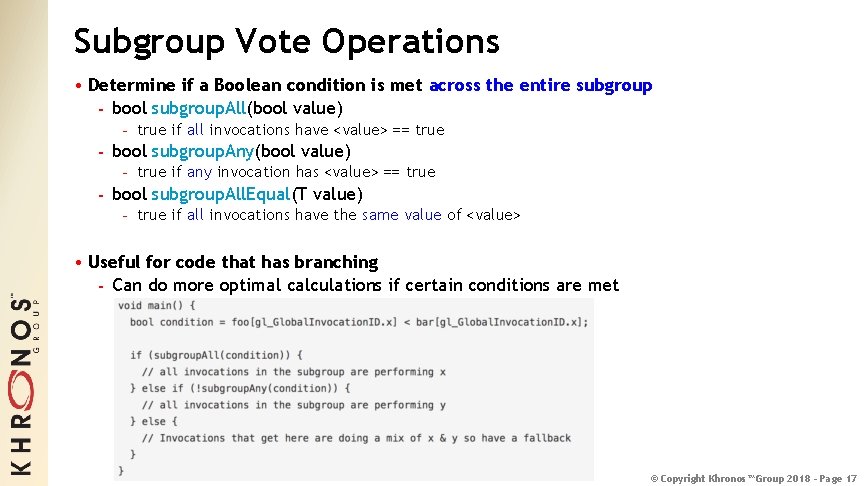
Subgroup Vote Operations • Determine if a Boolean condition is met across the entire subgroup - bool subgroup. All(bool value) - true if all invocations have <value> == true - bool subgroup. Any(bool value) - true if any invocation has <value> == true - bool subgroup. All. Equal(T value) - true if all invocations have the same value of <value> • Useful for code that has branching - Can do more optimal calculations if certain conditions are met © Copyright Khronos™ Group 2018 - Page 17
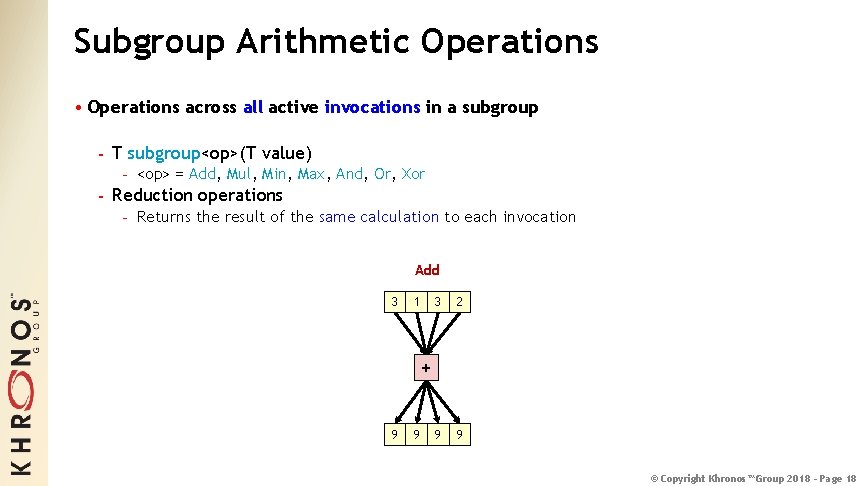
Subgroup Arithmetic Operations • Operations across all active invocations in a subgroup - T subgroup<op>(T value) - <op> = Add, Mul, Min, Max, And, Or, Xor - Reduction operations - Returns the result of the same calculation to each invocation Add 3 1 3 2 9 9 + 9 9 © Copyright Khronos™ Group 2018 - Page 18
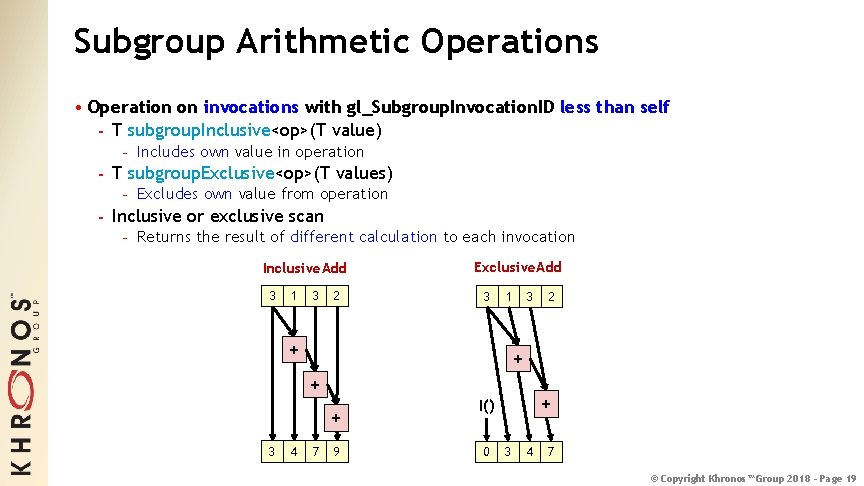
Subgroup Arithmetic Operations • Operation on invocations with gl_Subgroup. Invocation. ID less than self - T subgroup. Inclusive<op>(T value) - Includes own value in operation - T subgroup. Exclusive<op>(T values) - Excludes own value from operation - Inclusive or exclusive scan - Returns the result of different calculation to each invocation Inclusive. Add 3 1 3 2 Exclusive. Add 3 1 + 3 2 + + + 3 4 7 9 + I() 0 3 4 7 © Copyright Khronos™ Group 2018 - Page 19
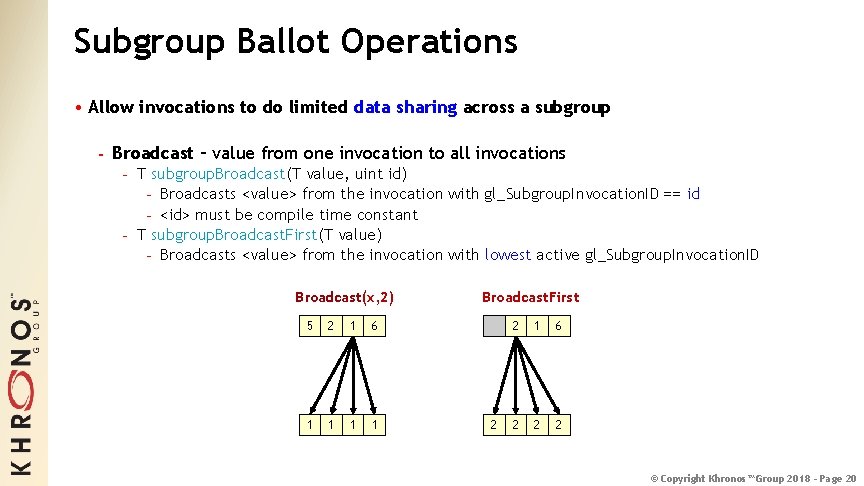
Subgroup Ballot Operations • Allow invocations to do limited data sharing across a subgroup - Broadcast – value from one invocation to all invocations - T subgroup. Broadcast(T value, uint id) - Broadcasts <value> from the invocation with gl_Subgroup. Invocation. ID == id - <id> must be compile time constant - T subgroup. Broadcast. First(T value) - Broadcasts <value> from the invocation with lowest active gl_Subgroup. Invocation. ID Broadcast(x, 2) 5 2 1 6 1 1 Broadcast. First 2 2 1 6 2 2 2 © Copyright Khronos™ Group 2018 - Page 20
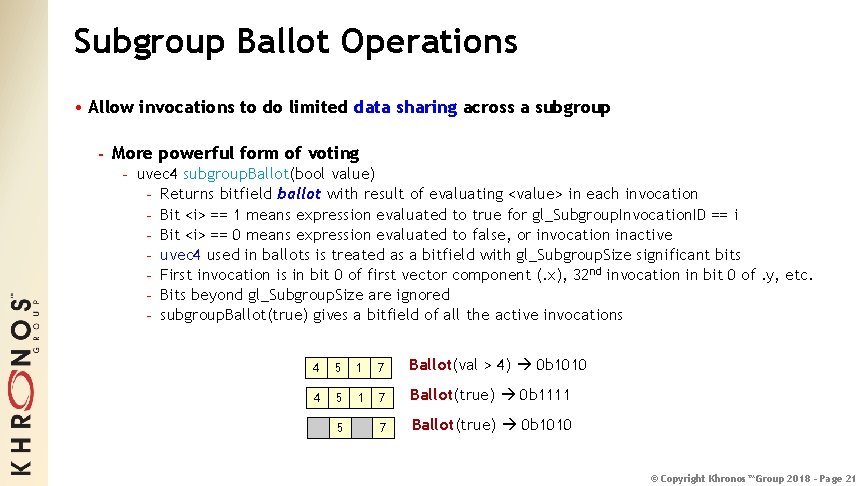
Subgroup Ballot Operations • Allow invocations to do limited data sharing across a subgroup - More powerful form of voting - uvec 4 subgroup. Ballot(bool value) - Returns bitfield ballot with result of evaluating <value> in each invocation - Bit <i> == 1 means expression evaluated to true for gl_Subgroup. Invocation. ID == i - Bit <i> == 0 means expression evaluated to false, or invocation inactive - uvec 4 used in ballots is treated as a bitfield with gl_Subgroup. Size significant bits - First invocation is in bit 0 of first vector component (. x), 32 nd invocation in bit 0 of. y, etc. - Bits beyond gl_Subgroup. Size are ignored - subgroup. Ballot(true) gives a bitfield of all the active invocations 4 5 1 7 Ballot(val > 4) 0 b 1010 4 5 1 7 Ballot(true) 0 b 1111 7 Ballot(true) 0 b 1010 5 © Copyright Khronos™ Group 2018 - Page 21
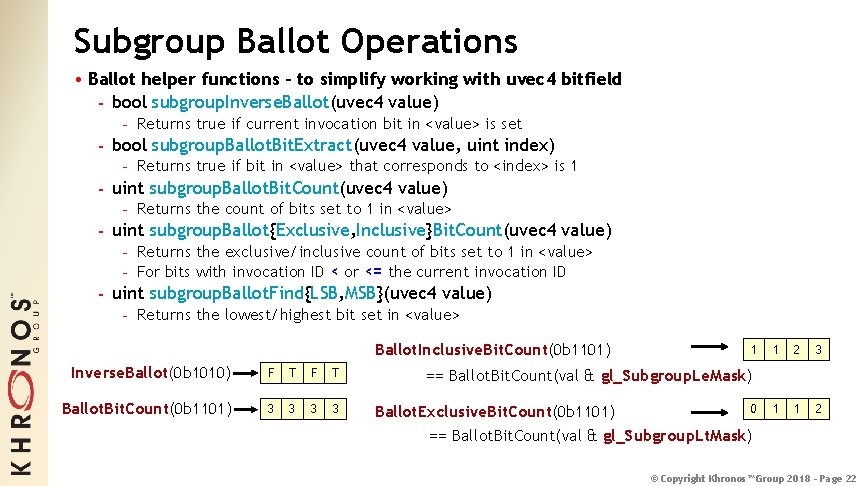
Subgroup Ballot Operations • Ballot helper functions – to simplify working with uvec 4 bitfield - bool subgroup. Inverse. Ballot(uvec 4 value) - Returns true if current invocation bit in <value> is set - bool subgroup. Ballot. Bit. Extract(uvec 4 value, uint index) - Returns true if bit in <value> that corresponds to <index> is 1 - uint subgroup. Ballot. Bit. Count(uvec 4 value) - Returns the count of bits set to 1 in <value> - uint subgroup. Ballot{Exclusive, Inclusive}Bit. Count(uvec 4 value) - Returns the exclusive/inclusive count of bits set to 1 in <value> - For bits with invocation ID < or <= the current invocation ID - uint subgroup. Ballot. Find{LSB, MSB}(uvec 4 value) - Returns the lowest/highest bit set in <value> Ballot. Inclusive. Bit. Count(0 b 1101) Inverse. Ballot(0 b 1010) F T Ballot. Bit. Count(0 b 1101) 3 3 1 1 2 == Ballot. Bit. Count(val & gl_Subgroup. Le. Mask) 0 Ballot. Exclusive. Bit. Count(0 b 1101) == Ballot. Bit. Count(val & gl_Subgroup. Lt. Mask) © Copyright Khronos™ Group 2018 - Page 22
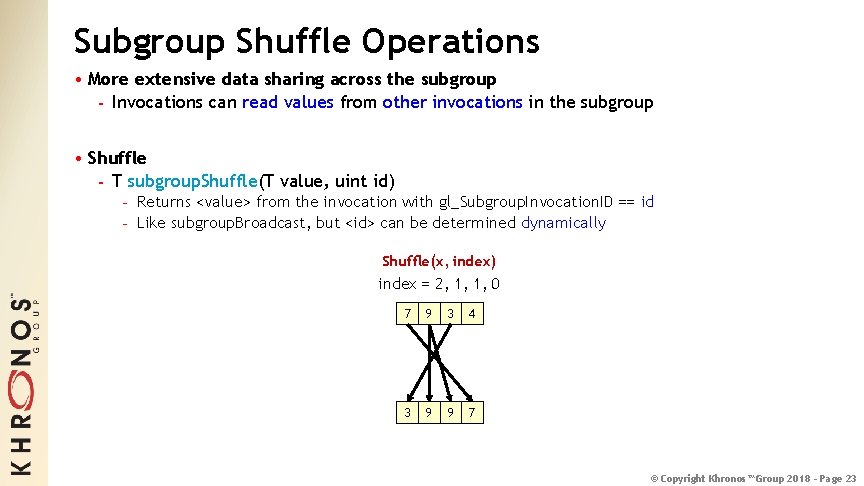
Subgroup Shuffle Operations • More extensive data sharing across the subgroup - Invocations can read values from other invocations in the subgroup • Shuffle - T subgroup. Shuffle(T value, uint id) - Returns <value> from the invocation with gl_Subgroup. Invocation. ID == id - Like subgroup. Broadcast, but <id> can be determined dynamically Shuffle(x, index) index = 2, 1, 1, 0 7 9 3 4 3 9 9 7 © Copyright Khronos™ Group 2018 - Page 23
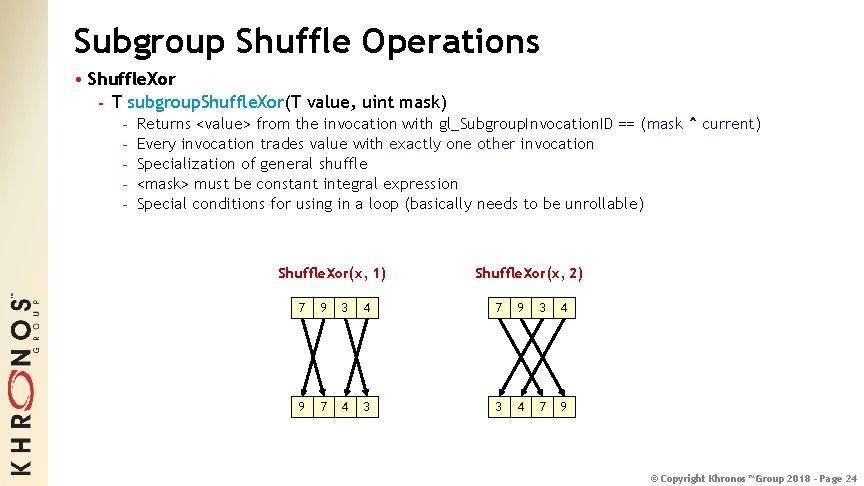
Subgroup Shuffle Operations • Shuffle. Xor - T subgroup. Shuffle. Xor(T value, uint mask) - Returns <value> from the invocation with gl_Subgroup. Invocation. ID == (mask ^ current) Every invocation trades value with exactly one other invocation Specialization of general shuffle <mask> must be constant integral expression Special conditions for using in a loop (basically needs to be unrollable) Shuffle. Xor(x, 1) Shuffle. Xor(x, 2) 7 9 3 4 9 7 4 3 3 4 7 9 © Copyright Khronos™ Group 2018 - Page 24
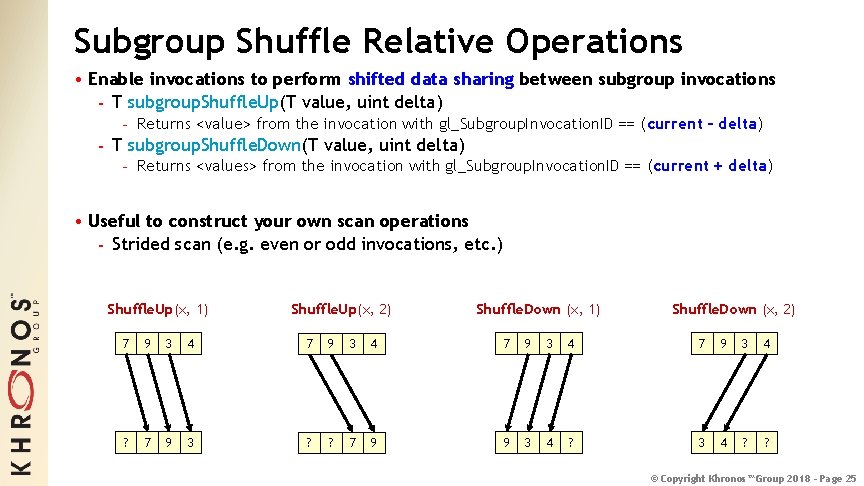
Subgroup Shuffle Relative Operations • Enable invocations to perform shifted data sharing between subgroup invocations - T subgroup. Shuffle. Up(T value, uint delta) - Returns <value> from the invocation with gl_Subgroup. Invocation. ID == (current – delta) - T subgroup. Shuffle. Down(T value, uint delta) - Returns <values> from the invocation with gl_Subgroup. Invocation. ID == (current + delta) • Useful to construct your own scan operations - Strided scan (e. g. even or odd invocations, etc. ) Shuffle. Up(x, 1) Shuffle. Up(x, 2) Shuffle. Down (x, 1) Shuffle. Down (x, 2) 7 9 3 4 ? 7 9 3 ? ? 7 9 9 3 4 ? ? © Copyright Khronos™ Group 2018 - Page 25
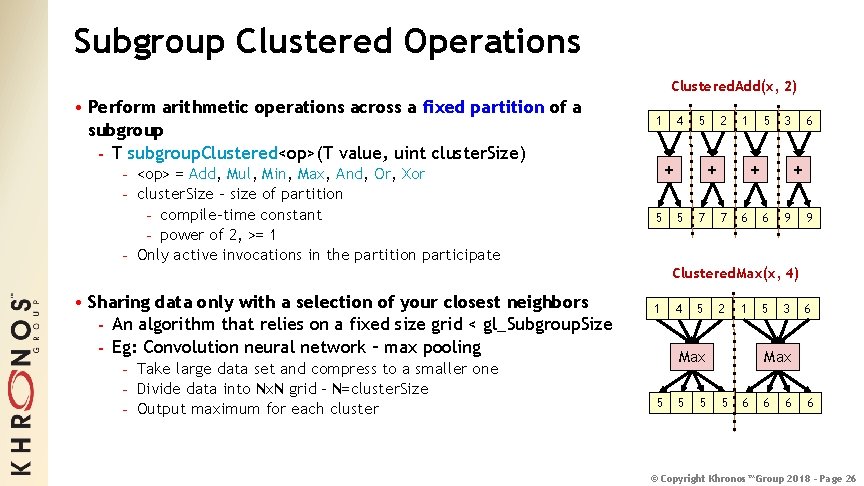
Subgroup Clustered Operations Clustered. Add(x, 2) • Perform arithmetic operations across a fixed partition of a subgroup - T subgroup. Clustered<op>(T value, uint cluster. Size) - <op> = Add, Mul, Min, Max, And, Or, Xor - cluster. Size – size of partition - compile-time constant - power of 2, >= 1 - Only active invocations in the partition participate 4 1 5 + 5 2 + 5 7 5 1 3 + 7 6 6 + 6 9 9 Clustered. Max(x, 4) • Sharing data only with a selection of your closest neighbors - An algorithm that relies on a fixed size grid < gl_Subgroup. Size - Eg: Convolution neural network – max pooling - Take large data set and compress to a smaller one - Divide data into Nx. N grid – N=cluster. Size - Output maximum for each cluster 1 4 5 2 1 Max 5 5 3 6 Max 5 6 6 © Copyright Khronos™ Group 2018 - Page 26
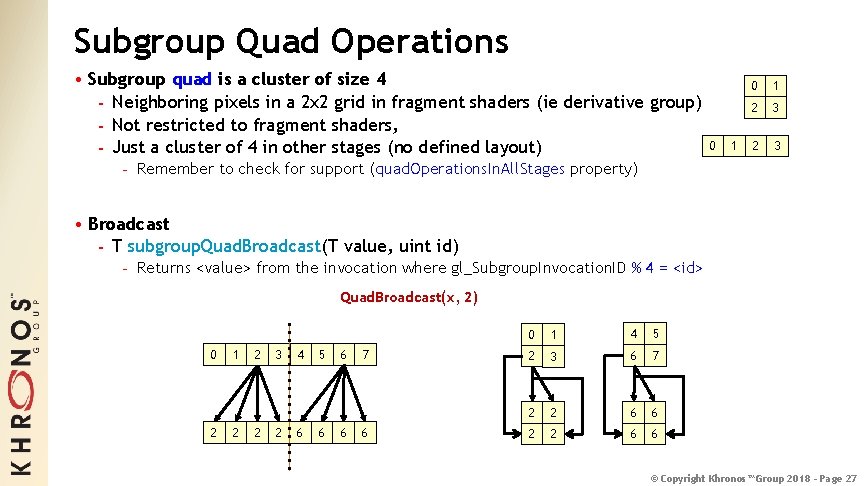
Subgroup Quad Operations • Subgroup quad is a cluster of size 4 - Neighboring pixels in a 2 x 2 grid in fragment shaders (ie derivative group) - Not restricted to fragment shaders, - Just a cluster of 4 in other stages (no defined layout) 0 1 2 3 - Remember to check for support (quad. Operations. In. All. Stages property) • Broadcast - T subgroup. Quad. Broadcast(T value, uint id) - Returns <value> from the invocation where gl_Subgroup. Invocation. ID % 4 = <id> Quad. Broadcast(x, 2) 0 2 1 2 2 2 3 2 4 6 5 6 6 6 7 6 0 1 4 5 2 3 6 7 2 2 6 6 © Copyright Khronos™ Group 2018 - Page 27
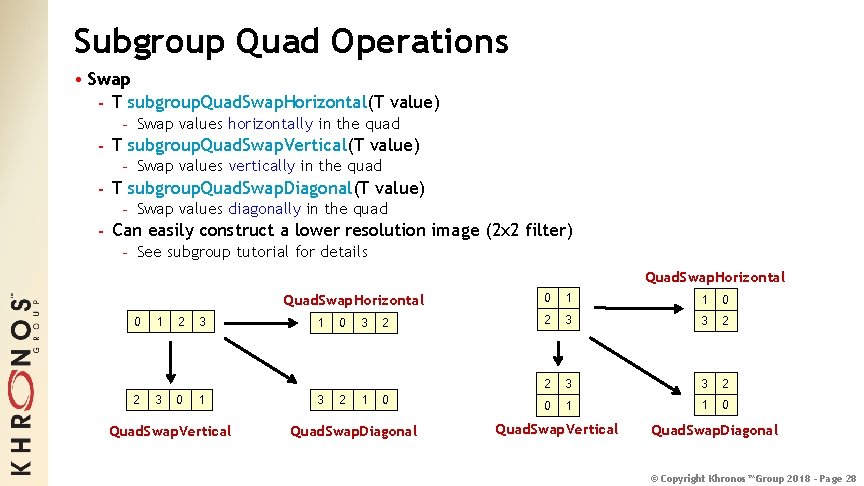
Subgroup Quad Operations • Swap - T subgroup. Quad. Swap. Horizontal(T value) - Swap values horizontally in the quad - T subgroup. Quad. Swap. Vertical(T value) - Swap values vertically in the quad - T subgroup. Quad. Swap. Diagonal(T value) - Swap values diagonally in the quad - Can easily construct a lower resolution image (2 x 2 filter) - See subgroup tutorial for details Quad. Swap. Horizontal 0 2 1 3 2 0 3 1 Quad. Swap. Vertical 1 3 0 2 3 1 2 0 Quad. Swap. Diagonal 0 1 1 0 2 3 3 2 0 1 1 0 Quad. Swap. Vertical Quad. Swap. Diagonal © Copyright Khronos™ Group 2018 - Page 28
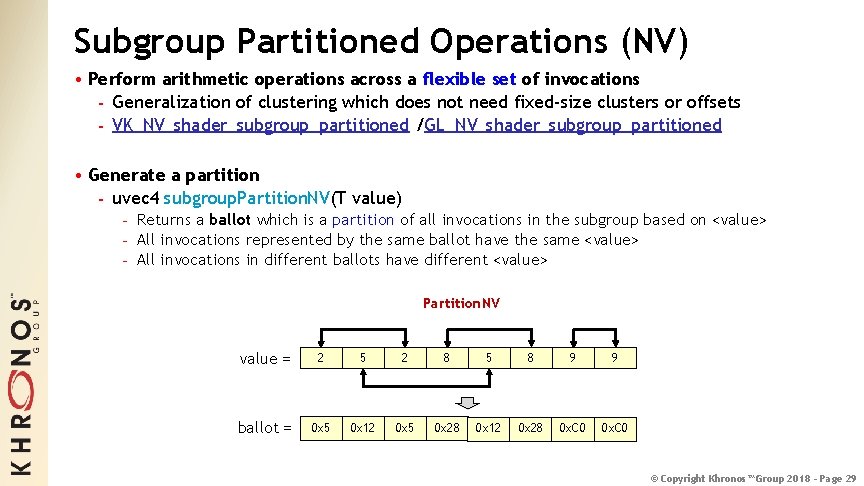
Subgroup Partitioned Operations (NV) • Perform arithmetic operations across a flexible set of invocations - Generalization of clustering which does not need fixed-size clusters or offsets - VK_NV_shader_subgroup_partitioned /GL_NV_shader_subgroup_partitioned • Generate a partition - uvec 4 subgroup. Partition. NV(T value) - Returns a ballot which is a partition of all invocations in the subgroup based on <value> - All invocations represented by the same ballot have the same <value> - All invocations in different ballots have different <value> Partition. NV value = 2 5 2 8 5 8 9 9 ballot = 0 x 5 0 x 12 0 x 5 0 x 28 0 x 12 0 x 28 0 x. C 0 © Copyright Khronos™ Group 2018 - Page 29
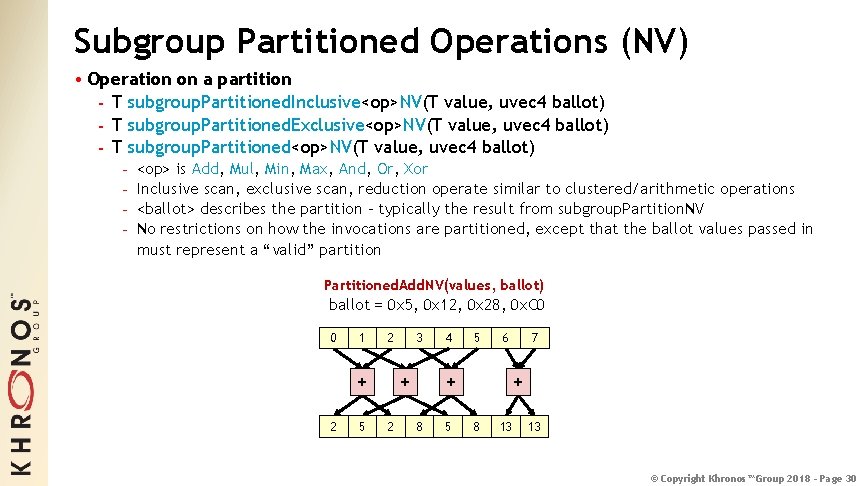
Subgroup Partitioned Operations (NV) • Operation on a partition - T subgroup. Partitioned. Inclusive<op>NV(T value, uvec 4 ballot) - T subgroup. Partitioned. Exclusive<op>NV(T value, uvec 4 ballot) - T subgroup. Partitioned<op>NV(T value, uvec 4 ballot) - <op> is Add, Mul, Min, Max, And, Or, Xor Inclusive scan, exclusive scan, reduction operate similar to clustered/arithmetic operations <ballot> describes the partition – typically the result from subgroup. Partition. NV No restrictions on how the invocations are partitioned, except that the ballot values passed in must represent a “valid” partition Partitioned. Add. NV(values, ballot) ballot = 0 x 5, 0 x 12, 0 x 28, 0 x. C 0 0 1 2 + 2 5 3 + 2 4 5 6 + 8 5 7 + 8 13 13 © Copyright Khronos™ Group 2018 - Page 30
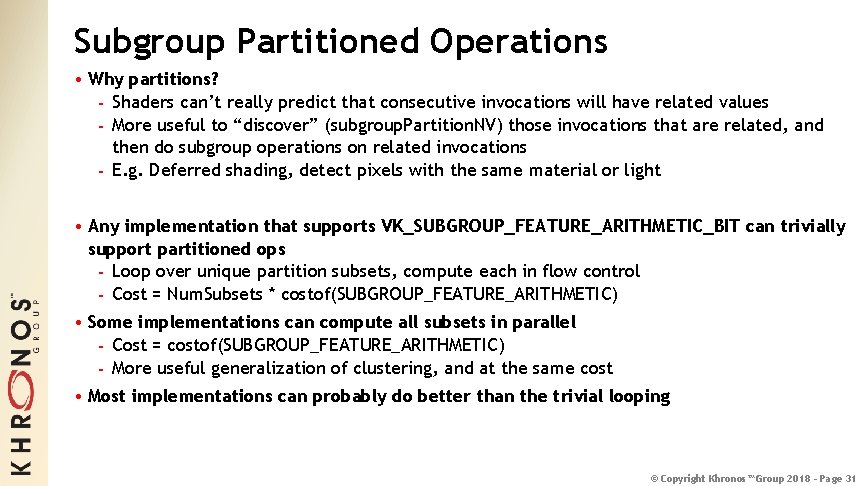
Subgroup Partitioned Operations • Why partitions? - Shaders can’t really predict that consecutive invocations will have related values - More useful to “discover” (subgroup. Partition. NV) those invocations that are related, and then do subgroup operations on related invocations - E. g. Deferred shading, detect pixels with the same material or light • Any implementation that supports VK_SUBGROUP_FEATURE_ARITHMETIC_BIT can trivially support partitioned ops - Loop over unique partition subsets, compute each in flow control - Cost = Num. Subsets * costof(SUBGROUP_FEATURE_ARITHMETIC) • Some implementations can compute all subsets in parallel - Cost = costof(SUBGROUP_FEATURE_ARITHMETIC) - More useful generalization of clustering, and at the same cost • Most implementations can probably do better than the trivial looping © Copyright Khronos™ Group 2018 - Page 31
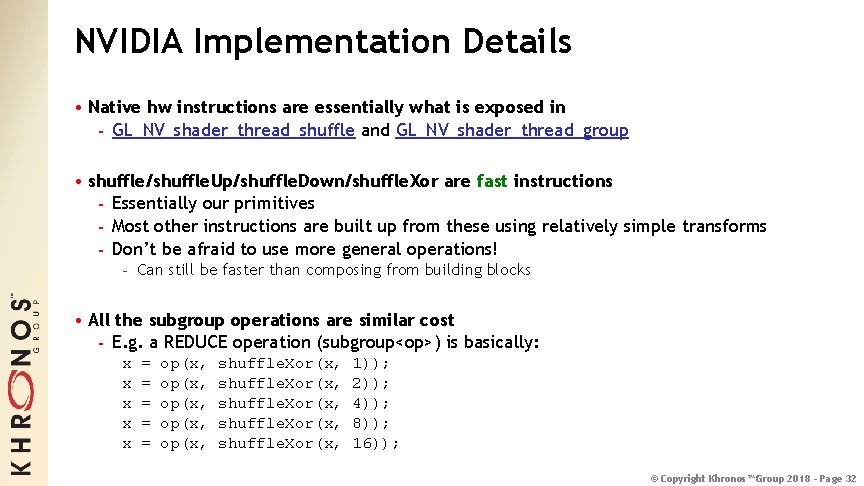
NVIDIA Implementation Details • Native hw instructions are essentially what is exposed in - GL_NV_shader_thread_shuffle and GL_NV_shader_thread_group • shuffle/shuffle. Up/shuffle. Down/shuffle. Xor are fast instructions - Essentially our primitives - Most other instructions are built up from these using relatively simple transforms - Don’t be afraid to use more general operations! - Can still be faster than composing from building blocks • All the subgroup operations are similar cost - E. g. a REDUCE operation (subgroup<op>) is basically: x x x = = = op(x, op(x, shuffle. Xor(x, 1)); 2)); 4)); 8)); 16)); © Copyright Khronos™ Group 2018 - Page 32
Tips • Make local workgroup be at least the size of the subgroup (compute), - Ideally integer multiples - Common subgroup sizes: 32 (NVIDIA, Intel), 64 (AMD) • Subgroup size of 1 isn’t very useful, but makes a single code path possible • Subgroup operations provide implicit subgroup execution barriers • Operations only act on active invocations • Be aware of inactive lanes or out of range invocation IDs - Reading gives undefined values in most cases! • Helper invocations participate in subgroup operations © Copyright Khronos™ Group 2018 - Page 33
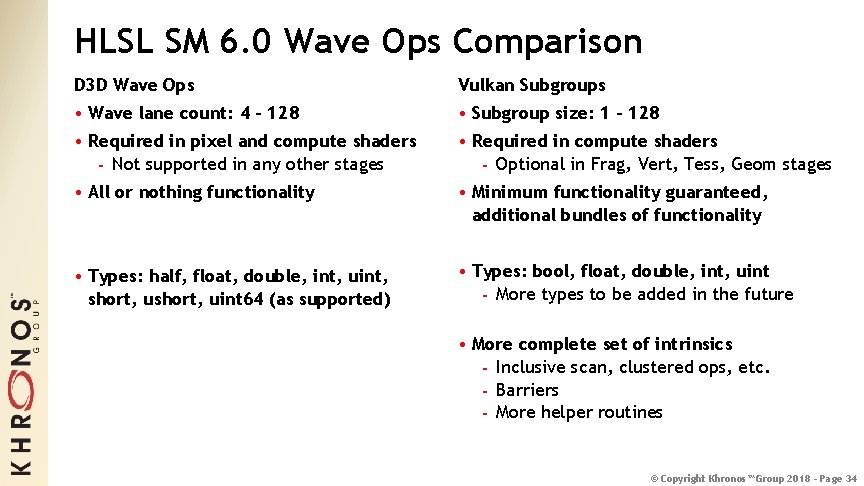
HLSL SM 6. 0 Wave Ops Comparison D 3 D Wave Ops Vulkan Subgroups • Wave lane count: 4 - 128 • Subgroup size: 1 – 128 • Required in pixel and compute shaders - Not supported in any other stages • Required in compute shaders - Optional in Frag, Vert, Tess, Geom stages • All or nothing functionality • Minimum functionality guaranteed, additional bundles of functionality • Types: half, float, double, int, uint, short, uint 64 (as supported) • Types: bool, float, double, int, uint - More types to be added in the future • More complete set of intrinsics - Inclusive scan, clustered ops, etc. - Barriers - More helper routines © Copyright Khronos™ Group 2018 - Page 34
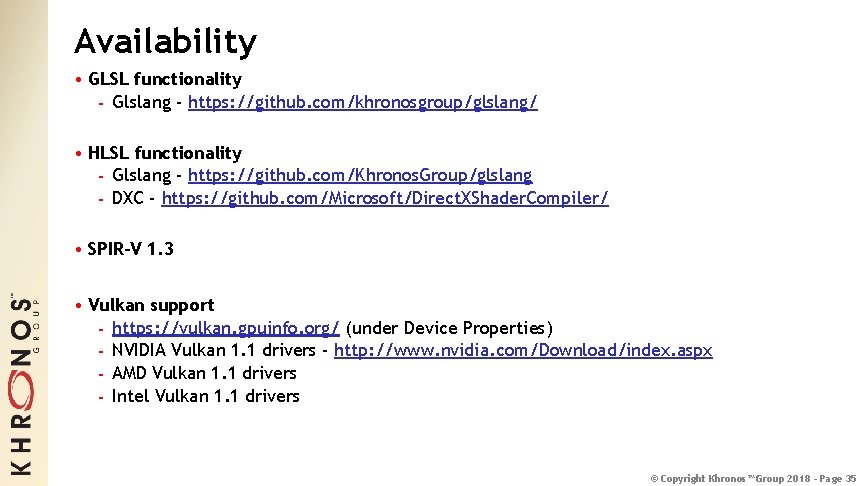
Availability • GLSL functionality - Glslang - https: //github. com/khronosgroup/glslang/ • HLSL functionality - Glslang - https: //github. com/Khronos. Group/glslang - DXC - https: //github. com/Microsoft/Direct. XShader. Compiler/ • SPIR-V 1. 3 • Vulkan support - https: //vulkan. gpuinfo. org/ (under Device Properties) - NVIDIA Vulkan 1. 1 drivers - http: //www. nvidia. com/Download/index. aspx - AMD Vulkan 1. 1 drivers - Intel Vulkan 1. 1 drivers © Copyright Khronos™ Group 2018 - Page 35
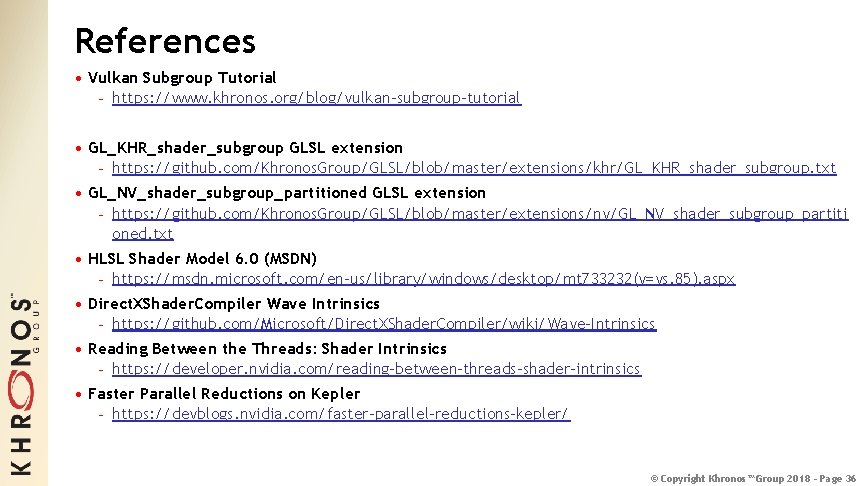
References • Vulkan Subgroup Tutorial - https: //www. khronos. org/blog/vulkan-subgroup-tutorial • GL_KHR_shader_subgroup GLSL extension - https: //github. com/Khronos. Group/GLSL/blob/master/extensions/khr/GL_KHR_shader_subgroup. txt • GL_NV_shader_subgroup_partitioned GLSL extension - https: //github. com/Khronos. Group/GLSL/blob/master/extensions/nv/GL_NV_shader_subgroup_partiti oned. txt • HLSL Shader Model 6. 0 (MSDN) - https: //msdn. microsoft. com/en-us/library/windows/desktop/mt 733232(v=vs. 85). aspx • Direct. XShader. Compiler Wave Intrinsics - https: //github. com/Microsoft/Direct. XShader. Compiler/wiki/Wave-Intrinsics • Reading Between the Threads: Shader Intrinsics - https: //developer. nvidia. com/reading-between-threads-shader-intrinsics • Faster Parallel Reductions on Kepler - https: //devblogs. nvidia. com/faster-parallel-reductions-kepler/ © Copyright Khronos™ Group 2018 - Page 36
Thank You • Daniel Koch (NVIDIA) • Neil Henning (AMD) @sheredom • Lei Zhang (Google) • Jeff Bolz (NVIDIA) • Piers Daniell (NVIDIA) © Copyright Khronos™ Group 2018 - Page 37
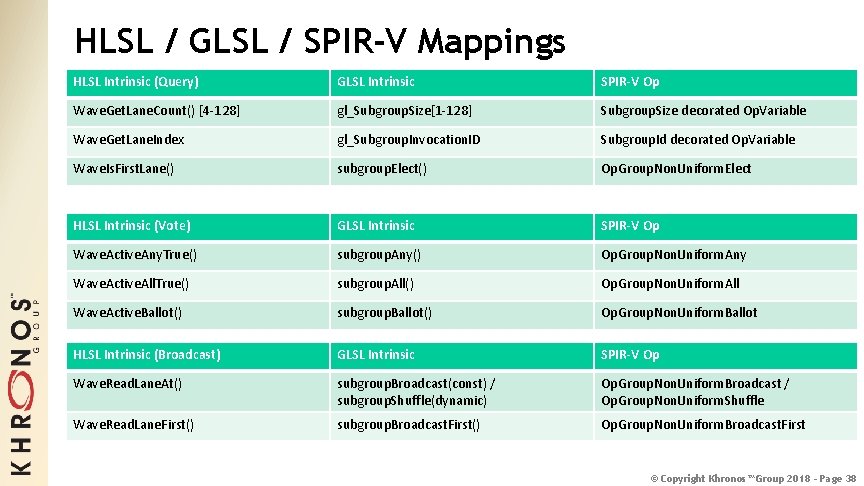
HLSL / GLSL / SPIR-V Mappings HLSL Intrinsic (Query) GLSL Intrinsic SPIR-V Op Wave. Get. Lane. Count() [4 -128] gl_Subgroup. Size[1 -128] Subgroup. Size decorated Op. Variable Wave. Get. Lane. Index gl_Subgroup. Invocation. ID Subgroup. Id decorated Op. Variable Wave. Is. First. Lane() subgroup. Elect() Op. Group. Non. Uniform. Elect HLSL Intrinsic (Vote) GLSL Intrinsic SPIR-V Op Wave. Active. Any. True() subgroup. Any() Op. Group. Non. Uniform. Any Wave. Active. All. True() subgroup. All() Op. Group. Non. Uniform. All Wave. Active. Ballot() subgroup. Ballot() Op. Group. Non. Uniform. Ballot HLSL Intrinsic (Broadcast) GLSL Intrinsic SPIR-V Op Wave. Read. Lane. At() subgroup. Broadcast(const) / subgroup. Shuffle(dynamic) Op. Group. Non. Uniform. Broadcast / Op. Group. Non. Uniform. Shuffle Wave. Read. Lane. First() subgroup. Broadcast. First() Op. Group. Non. Uniform. Broadcast. First © Copyright Khronos™ Group 2018 - Page 38
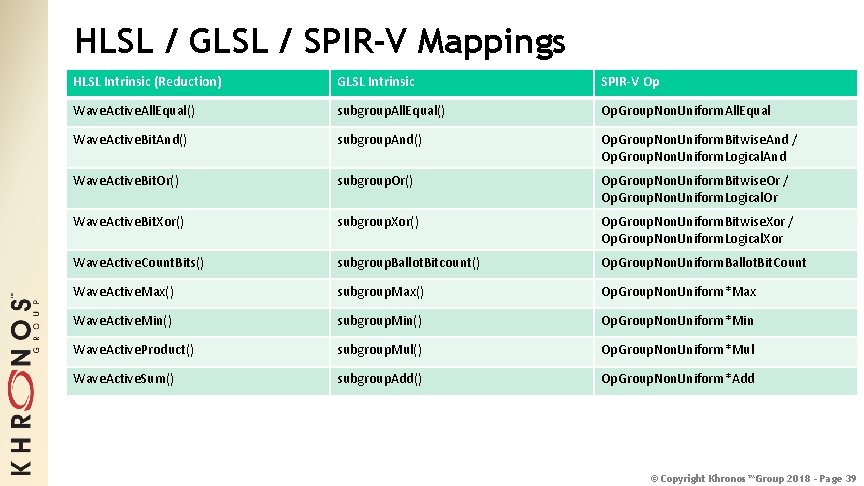
HLSL / GLSL / SPIR-V Mappings HLSL Intrinsic (Reduction) GLSL Intrinsic SPIR-V Op Wave. Active. All. Equal() subgroup. All. Equal() Op. Group. Non. Uniform. All. Equal Wave. Active. Bit. And() subgroup. And() Op. Group. Non. Uniform. Bitwise. And / Op. Group. Non. Uniform. Logical. And Wave. Active. Bit. Or() subgroup. Or() Op. Group. Non. Uniform. Bitwise. Or / Op. Group. Non. Uniform. Logical. Or Wave. Active. Bit. Xor() subgroup. Xor() Op. Group. Non. Uniform. Bitwise. Xor / Op. Group. Non. Uniform. Logical. Xor Wave. Active. Count. Bits() subgroup. Ballot. Bitcount() Op. Group. Non. Uniform. Ballot. Bit. Count Wave. Active. Max() subgroup. Max() Op. Group. Non. Uniform*Max Wave. Active. Min() subgroup. Min() Op. Group. Non. Uniform*Min Wave. Active. Product() subgroup. Mul() Op. Group. Non. Uniform*Mul Wave. Active. Sum() subgroup. Add() Op. Group. Non. Uniform*Add © Copyright Khronos™ Group 2018 - Page 39
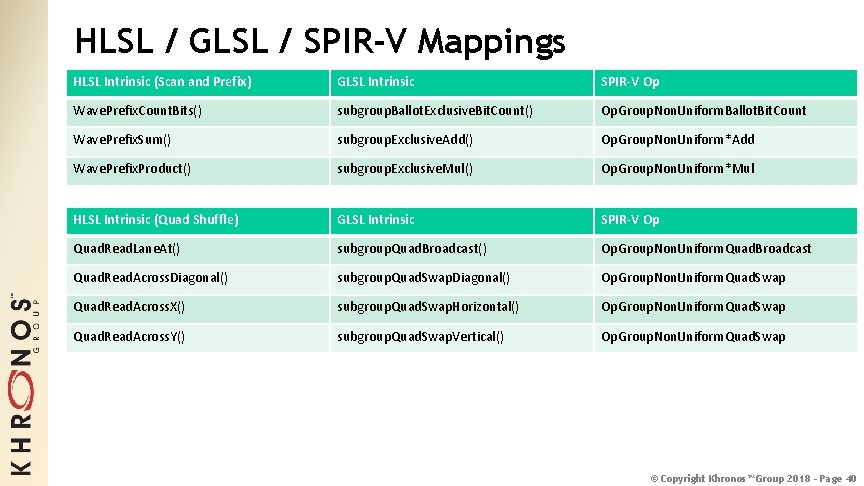
HLSL / GLSL / SPIR-V Mappings HLSL Intrinsic (Scan and Prefix) GLSL Intrinsic SPIR-V Op Wave. Prefix. Count. Bits() subgroup. Ballot. Exclusive. Bit. Count() Op. Group. Non. Uniform. Ballot. Bit. Count Wave. Prefix. Sum() subgroup. Exclusive. Add() Op. Group. Non. Uniform*Add Wave. Prefix. Product() subgroup. Exclusive. Mul() Op. Group. Non. Uniform*Mul HLSL Intrinsic (Quad Shuffle) GLSL Intrinsic SPIR-V Op Quad. Read. Lane. At() subgroup. Quad. Broadcast() Op. Group. Non. Uniform. Quad. Broadcast Quad. Read. Across. Diagonal() subgroup. Quad. Swap. Diagonal() Op. Group. Non. Uniform. Quad. Swap Quad. Read. Across. X() subgroup. Quad. Swap. Horizontal() Op. Group. Non. Uniform. Quad. Swap Quad. Read. Across. Y() subgroup. Quad. Swap. Vertical() Op. Group. Non. Uniform. Quad. Swap © Copyright Khronos™ Group 2018 - Page 40
- Slides: 40