
VT PBIS Conference October 2017 The Interconnected Systems
VT PBIS Conference October 2017 The Interconnected Systems Framework (ISF) for Integrating Mental Health in Schools Lucille Eber, Midwest PBIS Network National PBIS TA Center With: Michaela Martin and Jamie Kinnarney of ONSU And Tiffiny Hubbard of WCMHS www. midwestpbis. org www. pbis. org
Key Questions 1. Can we expand the effectiveness of the school-based continuum if we include a broader group of stakeholders within one integrated behavioral health system (school/community mental health providers, family)? 2. Can we, using local data, enhance the continuum with a greater array of EBPs to meet the needs of more students with greater effectiveness? 3. Can we increase the # of students with data-based improvements in social/emotional functioning (beyond "clinician judgment”)?
Big Ideas 1. Rationale/need for interconnected systems 2. How PBIS can serve as a framework for an expanded continuum of school mental health interventions 3. How changing roles of clinicians, crosstraining, and shared decision making can lead to an expanded system of behavioral health support 4. How tools can guide the development and implementation of an ISF

Advancing Education Effectiveness: Interconnecting School Mental Health and School-Wide Positive Behavior Support Editors: Susan Barrett, Lucille Eber, and Mark Weist pbis. org csmh. umaryland IDEA Partnership NASDSE
ISF National Leadership Team • Susan Barrett, Director, Mid-Atlantic PBIS sbarrett@midatlanticpbis. org • Lucille Eber, Director, Midwest PBIS lucille. eber@midwestpbis. org • • Bob Putnam, Executive Vice President of PBIS and Consultation, May Institute bputnam@mayinstitute. org Kelly Perales, Director of Training and Technical Assistance PBIS/MH Integration, Midwest PBIS Network kelly. perales@midwestpbis. org • Mark Weist, Professor, Clinical. Community and School Psychology, U South Carolina weist@mailbox. sc. edu • Sharon Stephan, Co-Director, CSMH sstephan@psych. umaryland. edu • Nancy Lever, Co-Director, CSMH nlever@psych. umaryland. edu • Joni Splett, Assistant Professor, University of Florida splett@coe. ufl. edu • Ashley Quell, University of South Carolina quell@mailbox. sc. edu
ISF Defined – Structure and process for education and mental health systems to interact in most effective and efficient way – Guided by key stakeholders in education and mental health/community systems – Who have the authority to reallocate resources, change role and function of staff, and change policy
MTSS/ISF Core Features – Effective teams that include community mental health providers – Data-based decision making – Formal processes for the selection & implementation of evidence-based practices (EBP) – Early access through use of comprehensive screening – Rigorous progress-monitoring for both fidelity & effectiveness – Ongoing coaching at both the systems & practices level
What Does it Mean to Integrate? Change in routines and procedures? (e. g. who needs to be available to participate in team meetings? ) Change in how interventions are selected and monitored? (e. g. team review of data/research vs. individual clinician choice? ) Change in language we use? (e. g. identifying specific interventions vs. generic terms such as “counseling” or “supports”? ) Changes in roles/functions of staff? (e. g. clinicians coordinating/overseeing some interventions that non-clinicians deliver? )
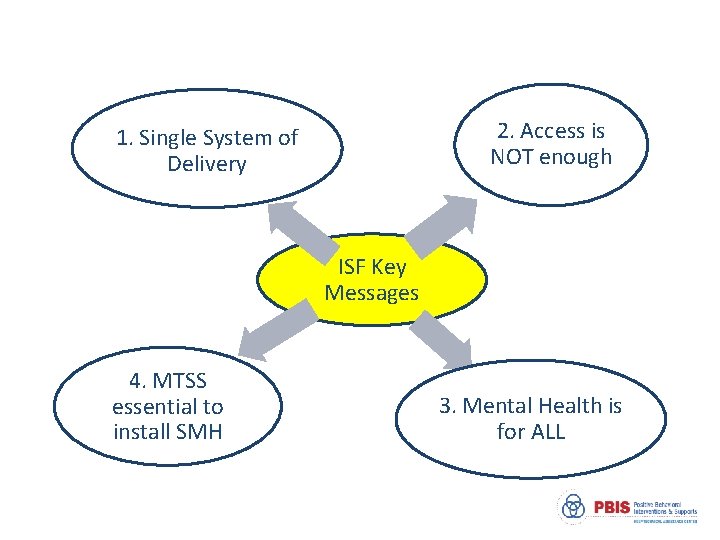
2. Access is NOT enough 1. Single System of Delivery ISF Key Messages 4. MTSS essential to install SMH 3. Mental Health is for ALL
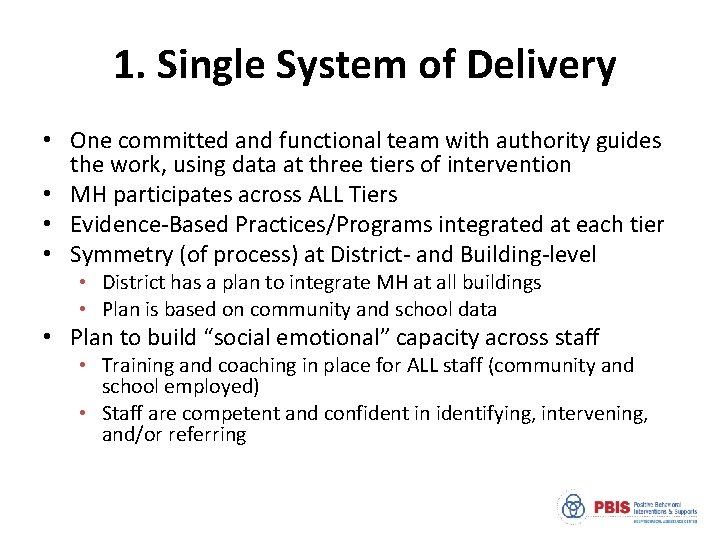
1. Single System of Delivery • One committed and functional team with authority guides the work, using data at three tiers of intervention • MH participates across ALL Tiers • Evidence-Based Practices/Programs integrated at each tier • Symmetry (of process) at District- and Building-level • District has a plan to integrate MH at all buildings • Plan is based on community and school data • Plan to build “social emotional” capacity across staff • Training and coaching in place for ALL staff (community and school employed) • Staff are competent and confident in identifying, intervening, and/or referring
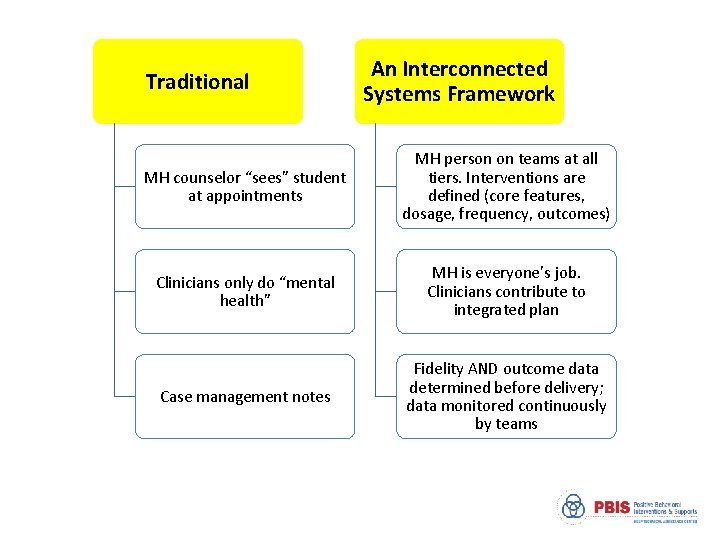
Traditional An Interconnected Systems Framework MH counselor “sees” student at appointments MH person on teams at all tiers. Interventions are defined (core features, dosage, frequency, outcomes) Clinicians only do “mental health” MH is everyone’s job. Clinicians contribute to integrated plan Case management notes Fidelity AND outcome data determined before delivery; data monitored continuously by teams
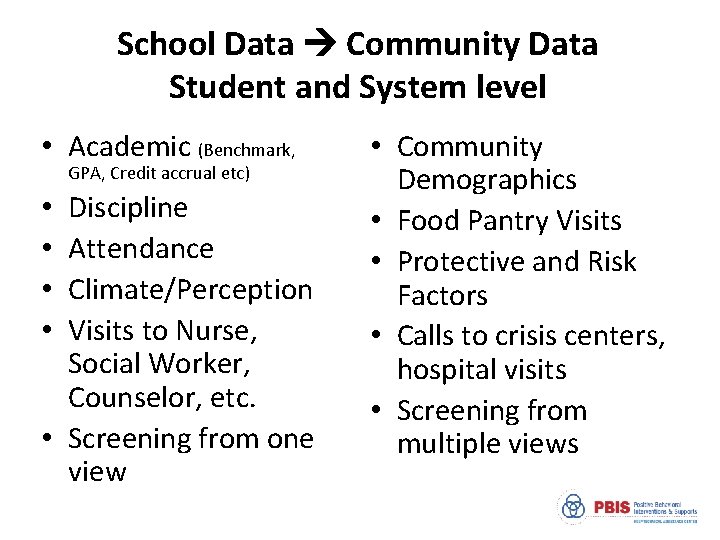
School Data Community Data Student and System level • Academic (Benchmark, GPA, Credit accrual etc) Discipline Attendance Climate/Perception Visits to Nurse, Social Worker, Counselor, etc. • Screening from one view • • • Community Demographics • Food Pantry Visits • Protective and Risk Factors • Calls to crisis centers, hospital visits • Screening from multiple views
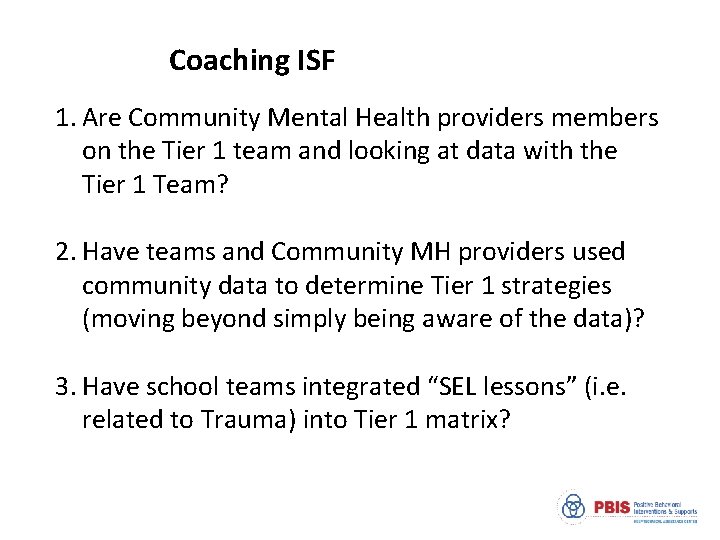
Coaching ISF 1. Are Community Mental Health providers members on the Tier 1 team and looking at data with the Tier 1 Team? 2. Have teams and Community MH providers used community data to determine Tier 1 strategies (moving beyond simply being aware of the data)? 3. Have school teams integrated “SEL lessons” (i. e. related to Trauma) into Tier 1 matrix?
2. Access is NOT enough All work is focused on ensuring positive outcomes for ALL children and youth and their families. • Interventions are matched to presenting problem using data, monitored for fidelity and outcome • Teams and staff are explicit about types of interventions students and youth receive (e. g. from “student receives counseling” to “student receives 4 coping skills group sessions) • Skills acquired during sessions are supported by ALL staff (e. g. staff are aware that student is working on developing coping skills and provides prompts, precorrects, acknowledges across school day)
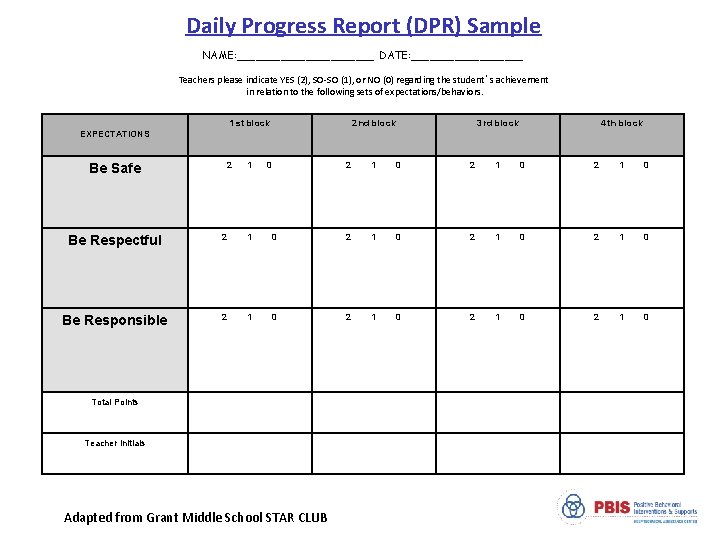
Daily Progress Report (DPR) Sample NAME: ___________ DATE: _________ Teachers please indicate YES (2), SO-SO (1), or NO (0) regarding the student’s achievement in relation to the following sets of expectations/behaviors. 1 st block 2 nd block 3 rd block 4 th block Be Safe 2 1 0 2 1 0 Be Respectful 2 1 0 Be Responsible 2 1 0 EXPECTATIONS Total Points Teacher Initials Adapted from Grant Middle School STAR CLUB
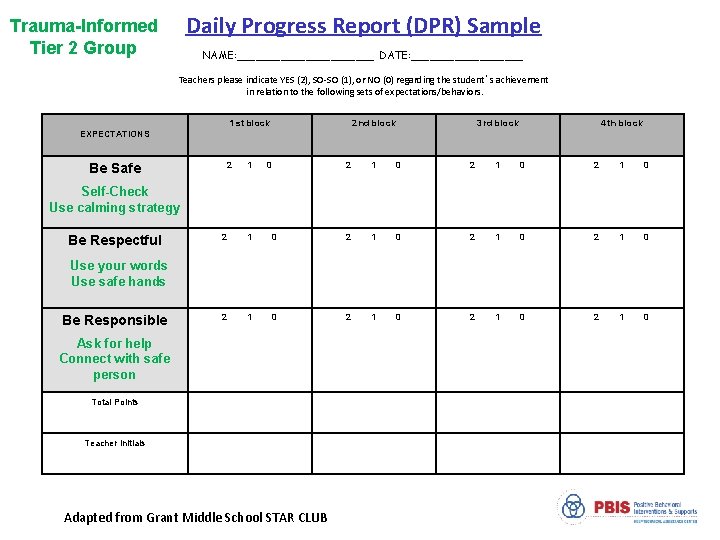
Daily Progress Report (DPR) Sample Trauma-Informed Tier 2 Group NAME: ___________ DATE: _________ Teachers please indicate YES (2), SO-SO (1), or NO (0) regarding the student’s achievement in relation to the following sets of expectations/behaviors. 1 st block 2 nd block 3 rd block 4 th block 2 1 0 2 1 0 2 1 0 2 1 0 EXPECTATIONS Be Safe Self-Check Use calming strategy Be Respectful Use your words Use safe hands Be Responsible Ask for help Connect with safe person Total Points Teacher Initials Adapted from Grant Middle School STAR CLUB
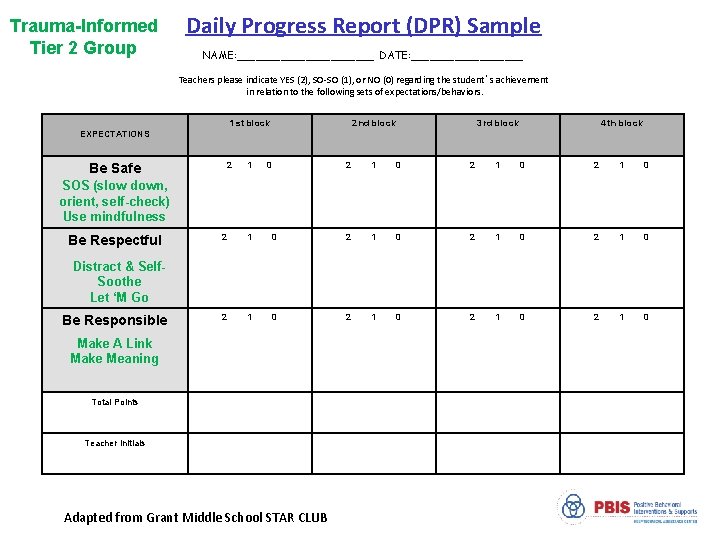
Trauma-Informed Tier 2 Group Daily Progress Report (DPR) Sample NAME: ___________ DATE: _________ Teachers please indicate YES (2), SO-SO (1), or NO (0) regarding the student’s achievement in relation to the following sets of expectations/behaviors. 1 st block 2 nd block 3 rd block 4 th block 2 1 0 2 1 0 2 1 0 2 1 0 EXPECTATIONS Be Safe SOS (slow down, orient, self-check) Use mindfulness Be Respectful Distract & Self. Soothe Let ‘M Go Be Responsible Make A Link Make Meaning Total Points Teacher Initials Adapted from Grant Middle School STAR CLUB
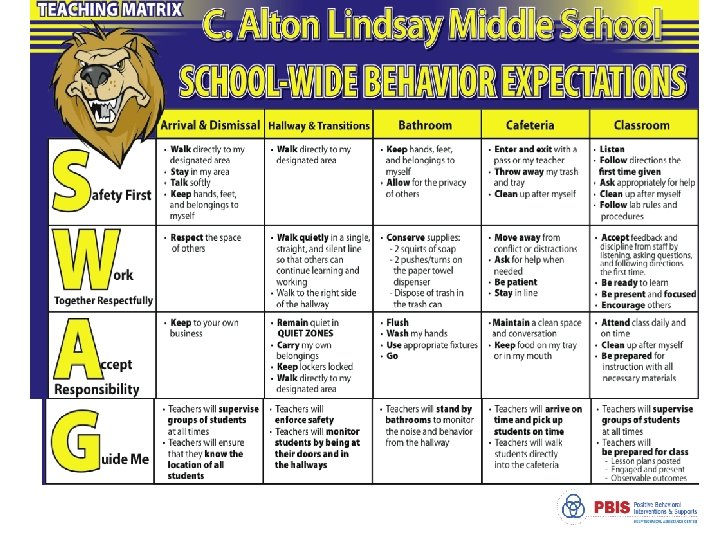
3. Mental Health is for ALL • Positive school climate and culture serves as protective factor • Social/emotional/behavioral health addressed with same level of attention and concern as is our children’s academic and cognitive achievement • Social behavior skills taught and reinforced by ALL staff across ALL settings and embedded in ALL curriculum • Behavior examples used to explicitly teach what behaviors look like and sound like across school settings
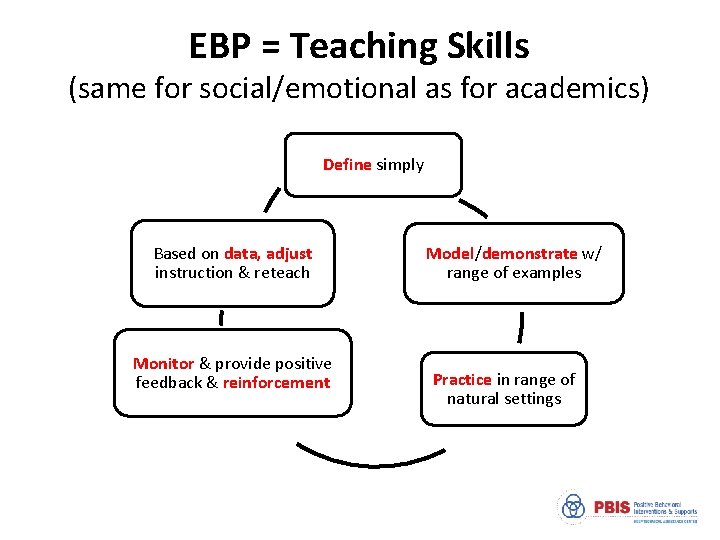
EBP = Teaching Skills (same for social/emotional as for academics) Define simply Based on data, adjust instruction & reteach Monitor & provide positive feedback & reinforcement Model/demonstrate w/ range of examples Practice in range of natural settings
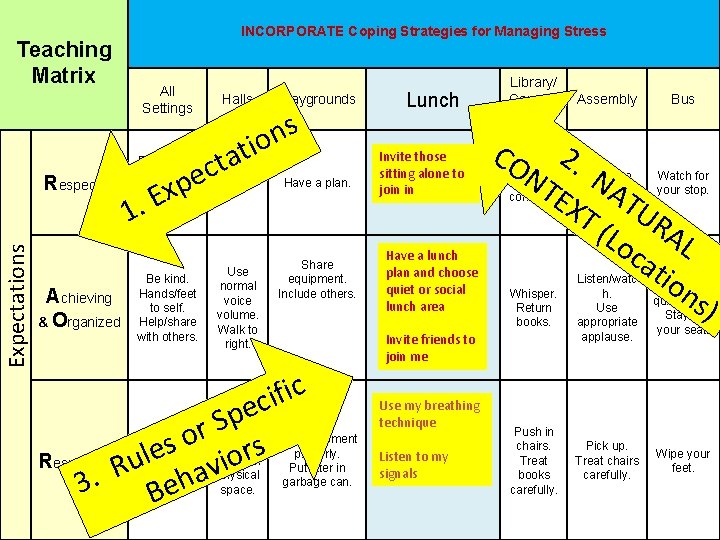
Teaching Matrix Expectations Respectful Achieving & Organized INCORPORATE Coping Strategies for Managing Stress All Settings Be kind. Hands/feet to self. Help/share with others. Playgrounds s n io t a t c e p x E Be on task. Give your best effort. Be prepared. 1. Halls Walk. Use normal voice volume. Walk to right. Have a plan. Share equipment. Include others. c i f i c e p S r o s s r Responsible ule o i v R a. h 3 Be Recycle. Clean up after self. Pick up litter. Maintain physical space. Use equipment properly. Put litter in garbage can. Lunch Invite those sitting alone to join in Have a lunch plan and choose quiet or social lunch area Library/ Comput er Lab CO Listen to my signals Bus 2. NT NA EX TU T( R Lo AL ca tio ns Study, read, compute. Sit in one spot. Watch for your stop. Whisper. Return books. Listen/watc h. Use appropriate applause. Use a quiet voice. Stay in your seat. Push in chairs. Treat books carefully. Pick up. Treat chairs carefully. Wipe your feet. Invite friends to join me Use my breathing technique Assembly )
4. Installed and aligned with core features of MTSS framework • • • Teams Data-based decision-making Continuum of linked EBPs Screening Progress monitoring Ongoing PD/coaching Are these features in place (or partially/in progress) in your district?
Multiple Evidence-Based Interventions of Varying Intensity • Install foundational interventions school-wide • Ensure identification, monitoring, and selection process are in place • Identify additional interventions that might be needed such as: • Trauma-informed interventions • Coping Cat • Check and Connect
MTSS: A Continuum of Evidence. Based Practices (EBPs) Linked Across Tiers • A formal process for selecting and implementing evidence-based practices • Team process (not individual clinicians) • Interventions linked across tiers with dosage and specificity of interventions increasing from lower to higher tiers • Consumer Guide to Selecting Evidence-based Practices
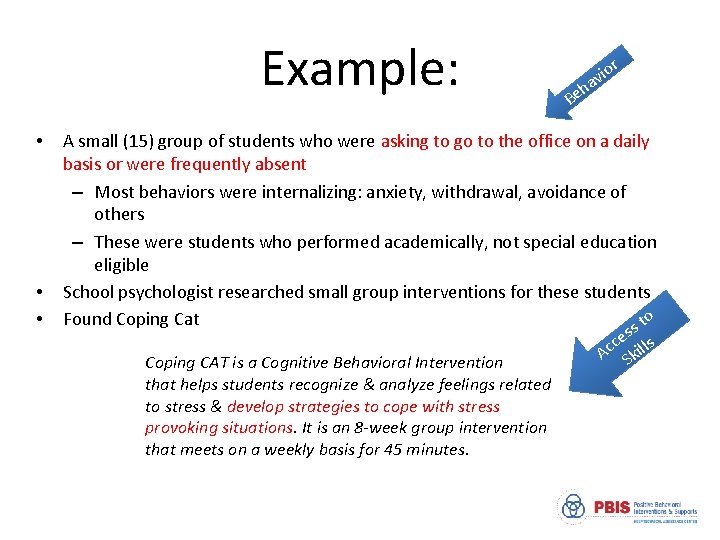
Example: • • • ior v a h Be A small (15) group of students who were asking to go to the office on a daily basis or were frequently absent – Most behaviors were internalizing: anxiety, withdrawal, avoidance of others – These were students who performed academically, not special education eligible School psychologist researched small group interventions for these students o Found Coping Cat st Coping CAT is a Cognitive Behavioral Intervention that helps students recognize & analyze feelings related to stress & develop strategies to cope with stress provoking situations. It is an 8 -week group intervention that meets on a weekly basis for 45 minutes. es ls c Ac Skil
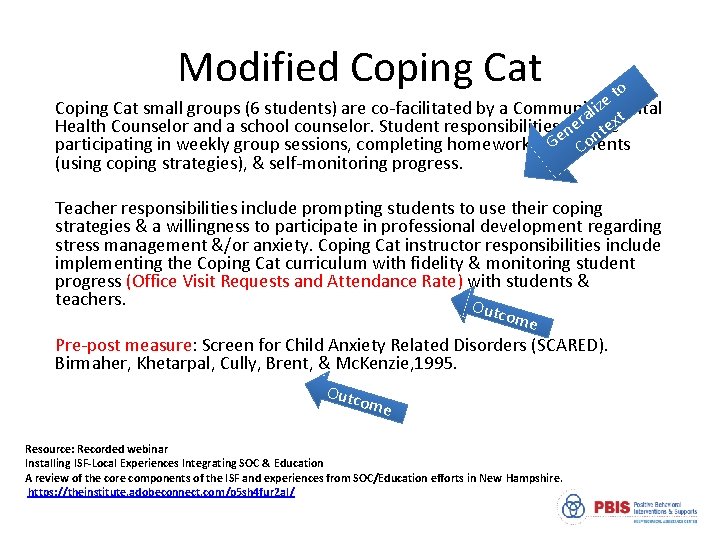
Modified Coping Cat to e Coping Cat small groups (6 students) are co-facilitated by a Community liz Mental a r ext e Health Counselor and a school counselor. Student responsibilities include t n Ge Con participating in weekly group sessions, completing homework assignments (using coping strategies), & self-monitoring progress. Teacher responsibilities include prompting students to use their coping strategies & a willingness to participate in professional development regarding stress management &/or anxiety. Coping Cat instructor responsibilities include implementing the Coping Cat curriculum with fidelity & monitoring student progress (Office Visit Requests and Attendance Rate) with students & teachers. Ou tcom e Pre-post measure: Screen for Child Anxiety Related Disorders (SCARED). Birmaher, Khetarpal, Cully, Brent, & Mc. Kenzie, 1995. Outc ome Resource: Recorded webinar Installing ISF-Local Experiences Integrating SOC & Education A review of the core components of the ISF and experiences from SOC/Education efforts in New Hampshire. https: //theinstitute. adobeconnect. com/p 5 sh 4 fur 2 al/
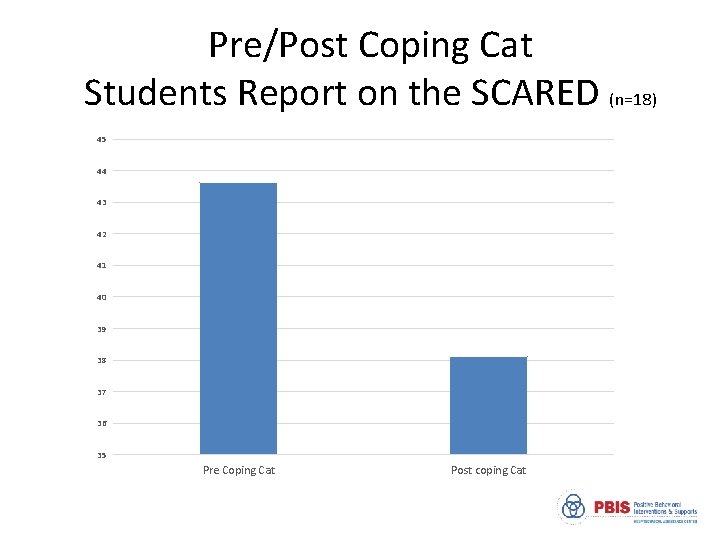
Pre/Post Coping Cat Students Report on the SCARED (n=18) 45 44 43 42 41 40 39 38 37 36 35 Pre Coping Cat Post coping Cat
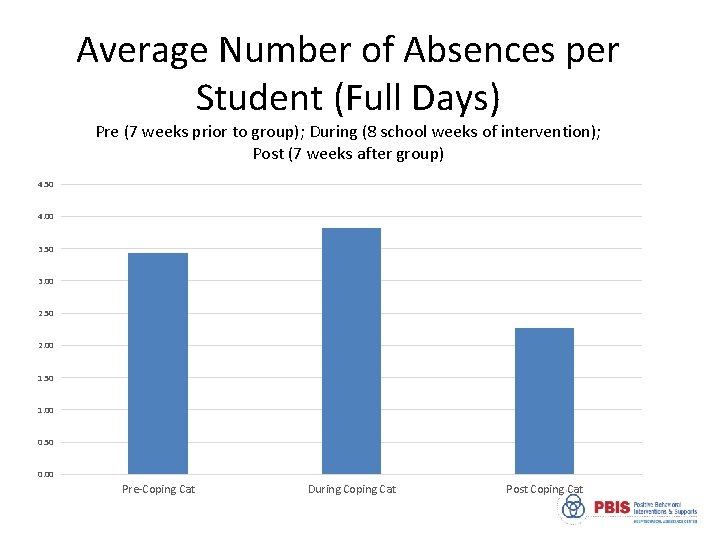
Average Number of Absences per Student (Full Days) Pre (7 weeks prior to group); During (8 school weeks of intervention); Post (7 weeks after group) 4. 50 4. 00 3. 50 3. 00 2. 50 2. 00 1. 50 1. 00 0. 50 0. 00 Pre-Coping Cat During Coping Cat Post Coping Cat
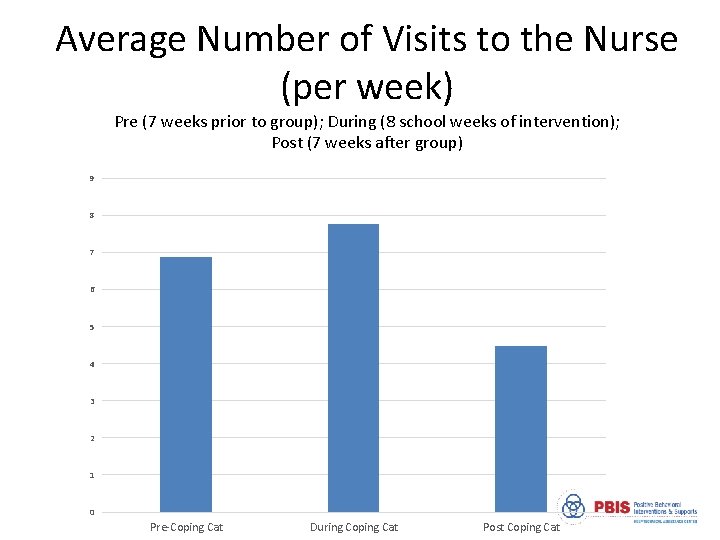
Average Number of Visits to the Nurse (per week) Pre (7 weeks prior to group); During (8 school weeks of intervention); Post (7 weeks after group) 9 8 7 6 5 4 3 2 1 0 Pre-Coping Cat During Coping Cat Post Coping Cat
Integrated Action Plan • School-employed and community-employed staff share responsibilities and resources • Uses framework of PBIS and blends in SMH across tiers to provide full continuum of prevention and intervention based on data and use of EBPs
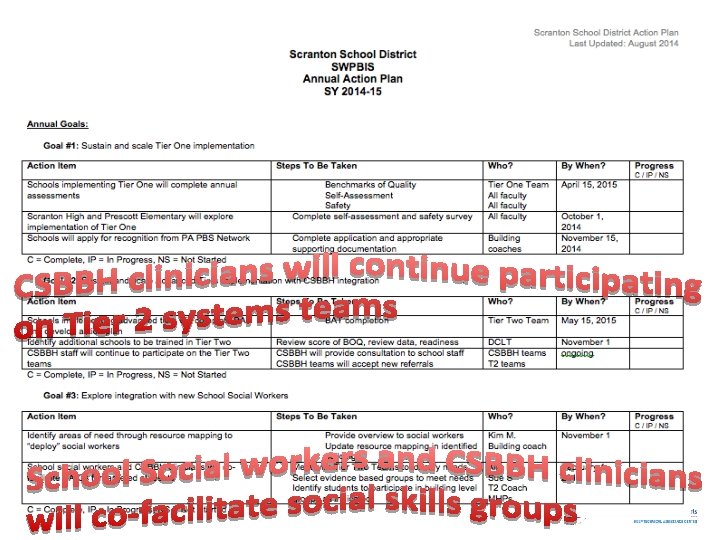
Examples of Coaching ISF 1. Are Community MH providers members on the Tier 2 team? 2. Are interventions provided by community providers determined as part of the overall system (All Tiers)? 3. Are interventions provided by Community MH providers progress monitored through Tier 2 team?
Interconnected Systems Framework Action Planning Companion Guide SW-PBIS Tiered Fidelity Inventory
ISF Action Planning Companion Guide to SWPBIS TFI • The purpose is to guide action planning for integration of Mental Health into PBIS • Not for use in scoring the TFI • At this point, the ISF enhancements do not impact PBIS fidelity measures • To measure ISF fidelity, consider piloting the ISF II
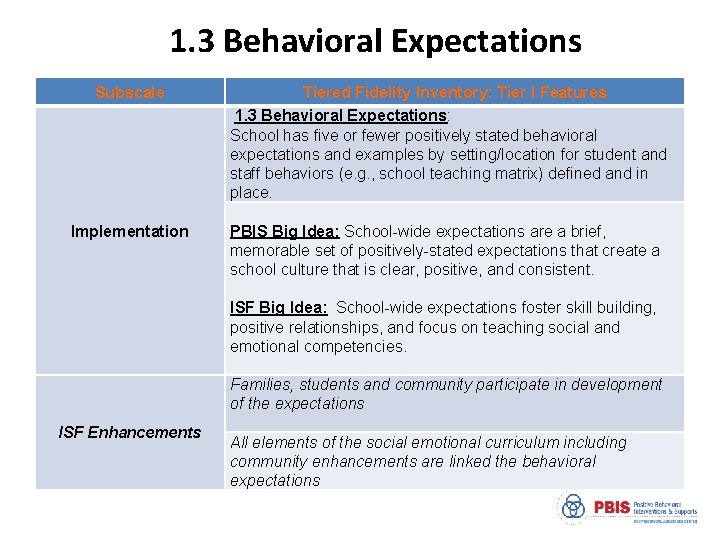
1. 3 Behavioral Expectations Subscale Tiered Fidelity Inventory: Tier I Features 1. 3 Behavioral Expectations: School has five or fewer positively stated behavioral expectations and examples by setting/location for student and staff behaviors (e. g. , school teaching matrix) defined and in place. Implementation PBIS Big Idea: School-wide expectations are a brief, memorable set of positively-stated expectations that create a school culture that is clear, positive, and consistent. ISF Big Idea: School-wide expectations foster skill building, positive relationships, and focus on teaching social and emotional competencies. Families, students and community participate in development of the expectations ISF Enhancements All elements of the social emotional curriculum including community enhancements are linked the behavioral expectations
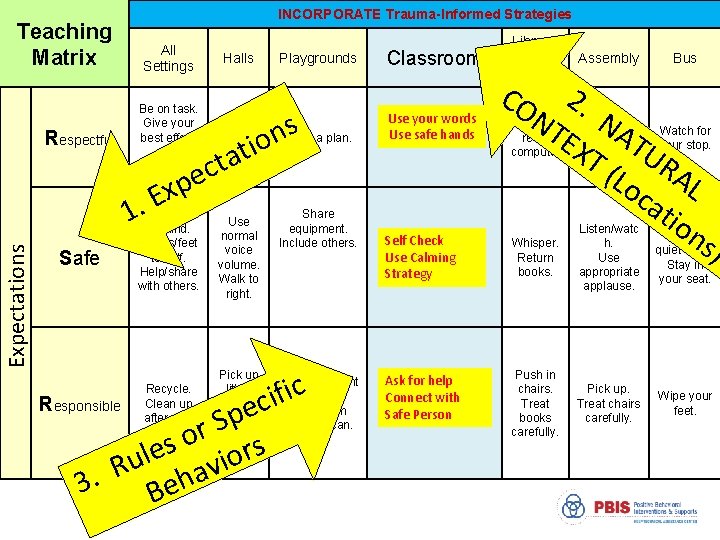
Teaching Matrix Respectful INCORPORATE Trauma-Informed Strategies All Settings Be on task. Give your best effort. Be prepared. Expectations 1. Safe Halls s n o i t a ct e p Ex Be kind. Hands/feet to self. Help/share with others. Playgrounds Walk. Use normal voice volume. Walk to right. Have a plan. Share equipment. Include others. c i f i Responsible c e p S r o s s e r l o u i v R a. h 3 Be Recycle. Clean up after self. Pick up litter. Maintain physical space. Use equipment properly. Put litter in garbage can. Library/ Comput er Lab Assembly Study, read, compute. Sit in one spot. Watch for your stop. Self Check Use Calming Strategy Whisper. Return books. Listen/watc h. Use appropriate applause. Use a quiet voice. Stay in your seat. Ask for help Connect with Safe Person Push in chairs. Treat books carefully. Pick up. Treat chairs carefully. Wipe your feet. Classroom Use your words Use safe hands Bus CO 2. NT NA EX TU T( R Lo AL ca tio ns )
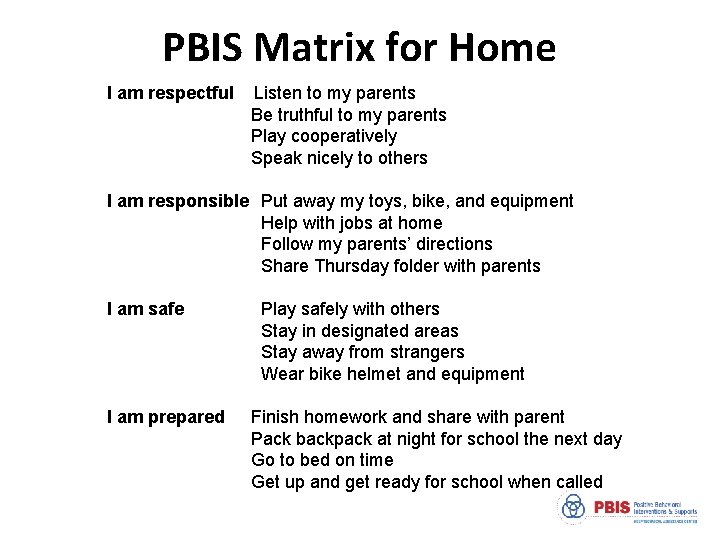
PBIS Matrix for Home I am respectful Listen to my parents Be truthful to my parents Play cooperatively Speak nicely to others I am responsible Put away my toys, bike, and equipment Help with jobs at home Follow my parents’ directions Share Thursday folder with parents I am safe Play safely with others Stay in designated areas Stay away from strangers Wear bike helmet and equipment I am prepared Finish homework and share with parent Pack backpack at night for school the next day Go to bed on time Get up and get ready for school when called
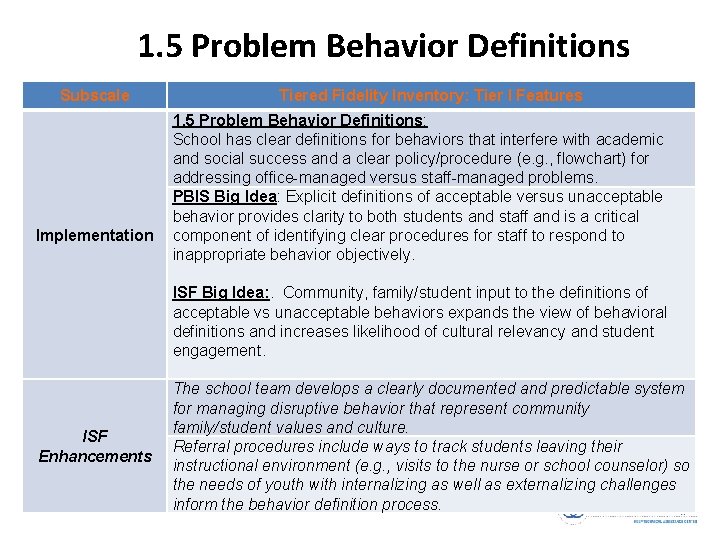
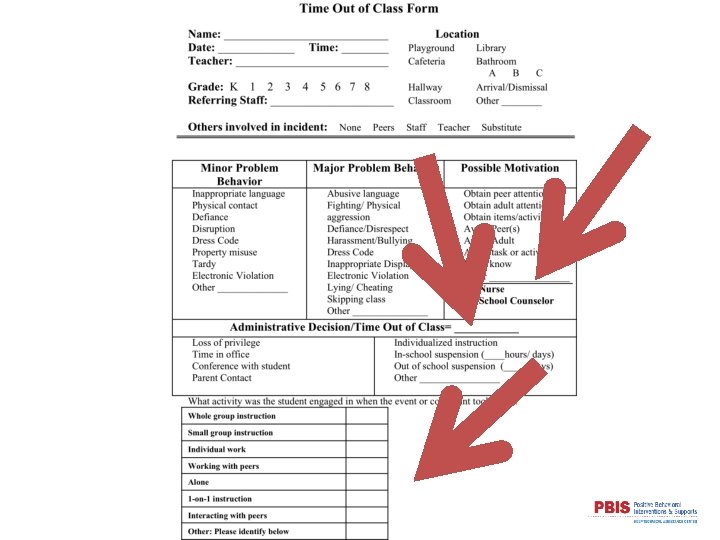
1. 5 Problem Behavior Definitions Subscale Implementation ISF Enhancements Tiered Fidelity Inventory: Tier I Features 1. 5 Problem Behavior Definitions: School has clear definitions for behaviors that interfere with academic and social success and a clear policy/procedure (e. g. , flowchart) for addressing office-managed versus staff-managed problems. PBIS Big Idea: Explicit definitions of acceptable versus unacceptable behavior provides clarity to both students and staff and is a critical component of identifying clear procedures for staff to respond to inappropriate behavior objectively. ISF Big Idea: . Community, family/student input to the definitions of acceptable vs unacceptable behaviors expands the view of behavioral definitions and increases likelihood of cultural relevancy and student engagement. The school team develops a clearly documented and predictable system for managing disruptive behavior that represent community family/student values and culture. Referral procedures include ways to track students leaving their instructional environment (e. g. , visits to the nurse or school counselor) so the needs of youth with internalizing as well as externalizing challenges inform the behavior definition process.
Broaden Use of Data: Focus on Internalizing Issues
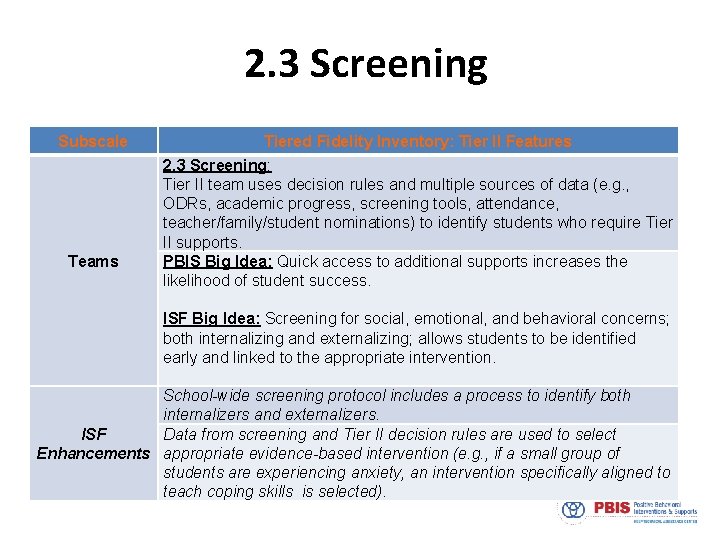
2. 3 Screening Subscale Tiered Fidelity Inventory: Tier II Features 2. 3 Screening: Tier II team uses decision rules and multiple sources of data (e. g. , ODRs, academic progress, screening tools, attendance, teacher/family/student nominations) to identify students who require Tier II supports. PBIS Big Idea: Quick access to additional supports increases the Teams likelihood of student success. ISF Big Idea: Screening for social, emotional, and behavioral concerns; both internalizing and externalizing; allows students to be identified early and linked to the appropriate intervention. School-wide screening protocol includes a process to identify both internalizers and externalizers. Data from screening and Tier II decision rules are used to select ISF Enhancements appropriate evidence-based intervention (e. g. , if a small group of students are experiencing anxiety, an intervention specifically aligned to teach coping skills is selected).
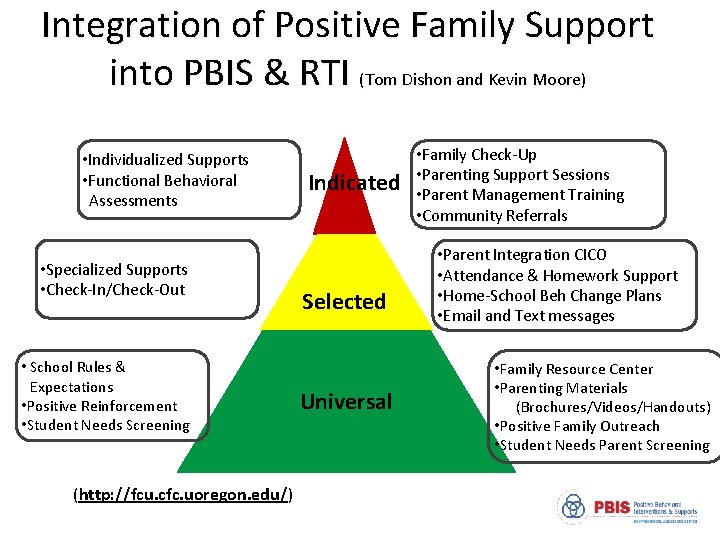
Integration of Positive Family Support into PBIS & RTI (Tom Dishon and Kevin Moore) • Individualized Supports • Functional Behavioral Assessments • Specialized Supports • Check-In/Check-Out • School Rules & Expectations • Positive Reinforcement • Student Needs Screening (http: //fcu. cfc. uoregon. edu/) Indicated Selected Universal • Family Check-Up • Parenting Support Sessions • Parent Management Training • Community Referrals • Parent Integration CICO • Attendance & Homework Support • Home-School Beh Change Plans • Email and Text messages • Family Resource Center • Parenting Materials (Brochures/Videos/Handouts) • Positive Family Outreach • Student Needs Parent Screening
Methuen Public Schools Methuen, MA John Crocker Session E 8 John Crocker National PBIS Leadership Forum October 28, 2016 Comprehensive School Mental Health System National Quality Initiative Summit April 26, 2016
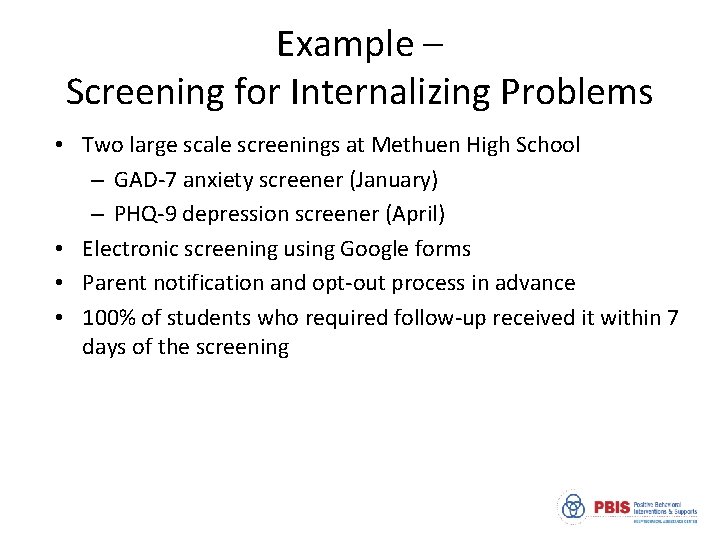
Example – Screening for Internalizing Problems • Two large scale screenings at Methuen High School – GAD-7 anxiety screener (January) – PHQ-9 depression screener (April) • Electronic screening using Google forms • Parent notification and opt-out process in advance • 100% of students who required follow-up received it within 7 days of the screening
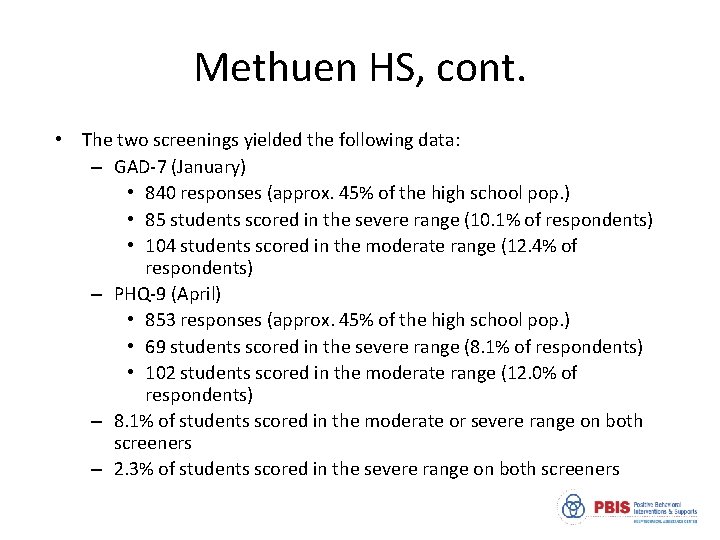
Methuen HS, cont. • The two screenings yielded the following data: – GAD-7 (January) • 840 responses (approx. 45% of the high school pop. ) • 85 students scored in the severe range (10. 1% of respondents) • 104 students scored in the moderate range (12. 4% of respondents) – PHQ-9 (April) • 853 responses (approx. 45% of the high school pop. ) • 69 students scored in the severe range (8. 1% of respondents) • 102 students scored in the moderate range (12. 0% of respondents) – 8. 1% of students scored in the moderate or severe range on both screeners – 2. 3% of students scored in the severe range on both screeners
Mental Health Partnership in Vermont Orange North SU and WCMH’s Partnership VT PBIS Leadership Forum
ONSU/WSSU- Central Vermont SU Orange/Washington School District Orange Center School Washington Village Central Vermont Unified Union School District Williamstown Northfield
Setting the Context ● K-8 school with 100 students ● No school-wide approach to behavior ● Six 1: 1 Behavior Interventionists (contracted from local mental health agency) ● Chronic office referrals with no attention to data ● Ineffective leadership
Vision for a Partnership with Mental Health Reactive to Proactive Implement PBIS within MTSS To Partner with local mental health agency in creating SU-wide approach that is proactive, that benefits all students, and that enriches the school’s climate
ONSU MTSS
How did we do this? ● In 2011, all schools began the professional learning in implementation of the principles of PBIS. ● Orange Center School drastically reduced its need for one on one behavior support with the implementation of PBIS at the Targeted & Intensive levels. ● They quickly realized that students coming off intensive supports still needed the support of a resource that had expertise in behavior and could help provide wrap around supports for the child and family. ● The PBIS Analyst was created in spring of 2012 after financial resources were reallocated.
ONSU PBIS Analyst Model Is… ● Proactive ● Expertise ● Support ● Professional Learning ● For all students’ benefit ● Part of a team approach ● Part of a MTSS system
ONSU PBIS Analyst Model Is NOT … ● Responsive ● Behavior Intervention ● Discipline ● Outside consultant ● For only a few students ● Silo ● Dumping Ground
Roles & Responsibilities ● Case-manages 8 to 10 students with targeted plans ● Provided social/emotional intervention to students on targeted plans ● Conducted Functional Behavior Assessments ● Created/monitored/exited behavior support plans ● Collaborated with Sp. Ed on behavior plans for students with intensive needs ● Coordinated interagency support ● Coached Check in Check Out ● Supported staff in universal social/emotional strategies ● Member of PBIS Universal & Targeted Intensive Teams
So what now what? 2012 -2013 ● Expanded to Washington Village School & Williamstown Middle/High School. 2013 -2014 ● Expanded to Williamstown Elementary which eliminated the planning room model. 2017 -2018 ● Expanded to Northfield Elementary & Northfield Middle School which maintains a planning room model. ● PBIS Analyst Model is in 18 schools in Vermont!
Lessons WE learned along the way! ● There must be a solid universal system as a foundation BEFORE developing this type of partnership. ● There must be strong leadership with strong commitment to being proactive and persevering for student success. ● There must be structures developed that support clear and continual communication between the principal, analyst and other team members. ● SU-systemic approach for sustainability.
Summarizing Questions Dialogue Possible Next Steps
ISF Resources available at: www. midwestpbis. org
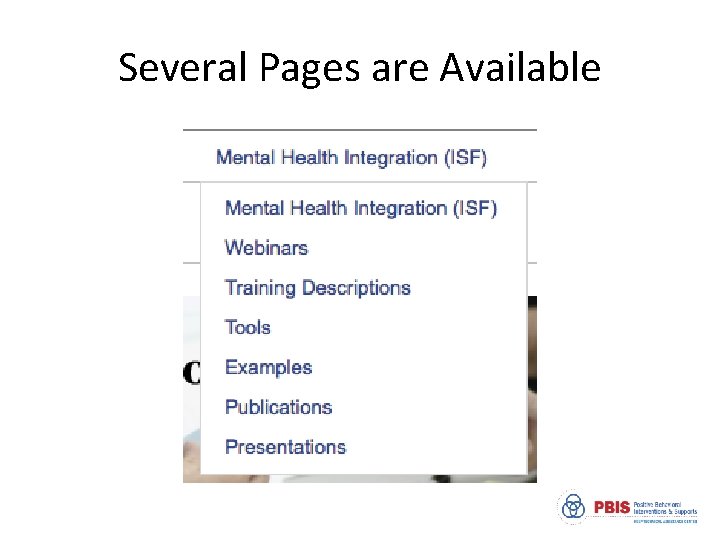
Several Pages are Available
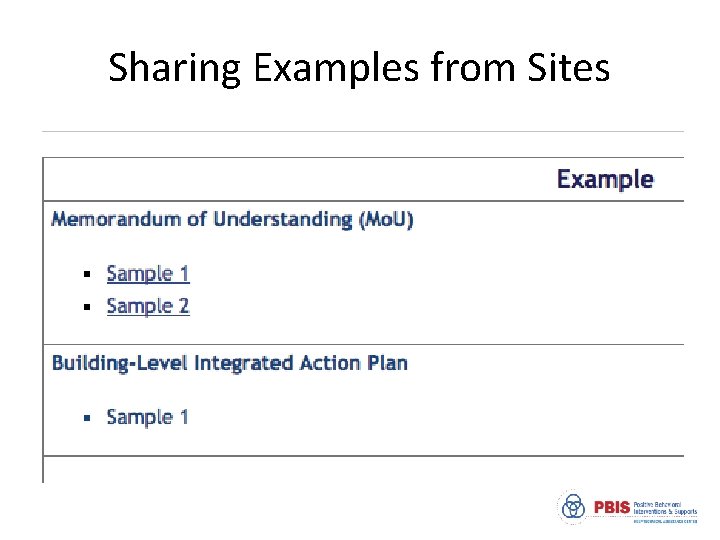
Sharing Examples from Sites
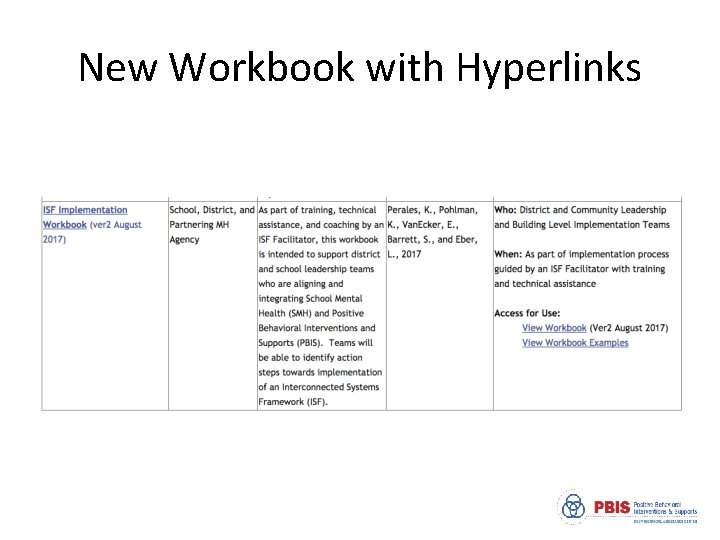
New Workbook with Hyperlinks
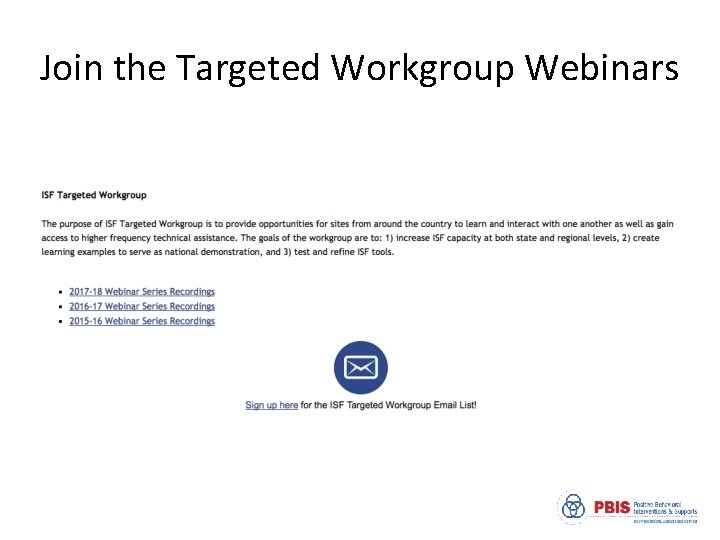
Join the Targeted Workgroup Webinars
- Slides: 63