
Vsevolod Kapatsinski Indiana University Linguistics and Cognitive Science

- Slides: 32
Vsevolod Kapatsinski Indiana University Linguistics and Cognitive Science Speech Research Lab vkapatsi@indiana. edu Syntactic variation in Russian adversative conjunctions Implications for sentence production
The problem • No contexts that categorically determine conjunction choice • The aims: – First corpus-based multivariate study of the problem – Implications for sentence production in general
Factors • Register • Discourse • Semantic • Syntax
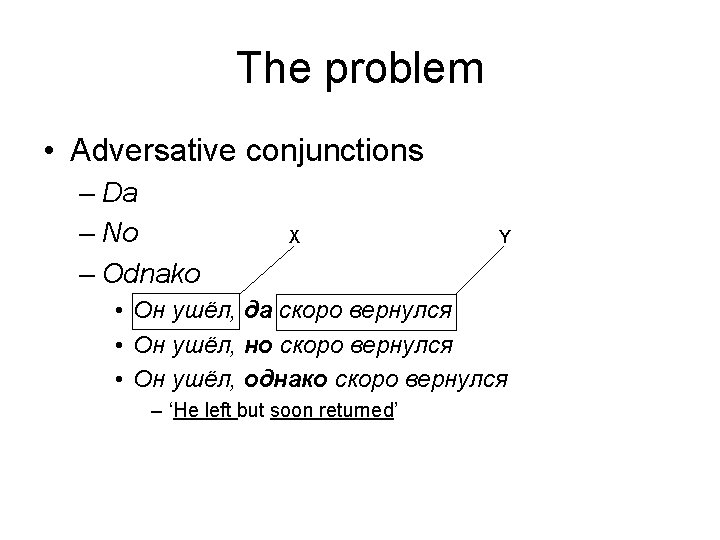
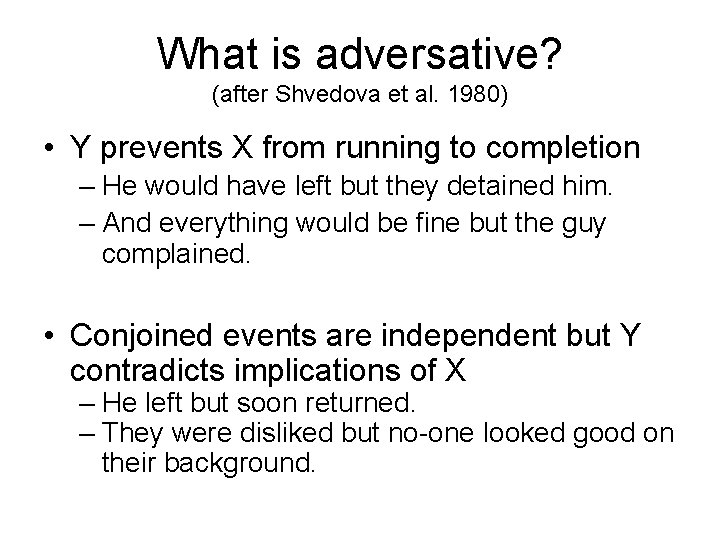
What is adversative? (after Shvedova et al. 1980) • Y prevents X from running to completion – He would have left but they detained him. – And everything would be fine but the guy complained. • Conjoined events are independent but Y contradicts implications of X – He left but soon returned. – They were disliked but no-one looked good on their background.
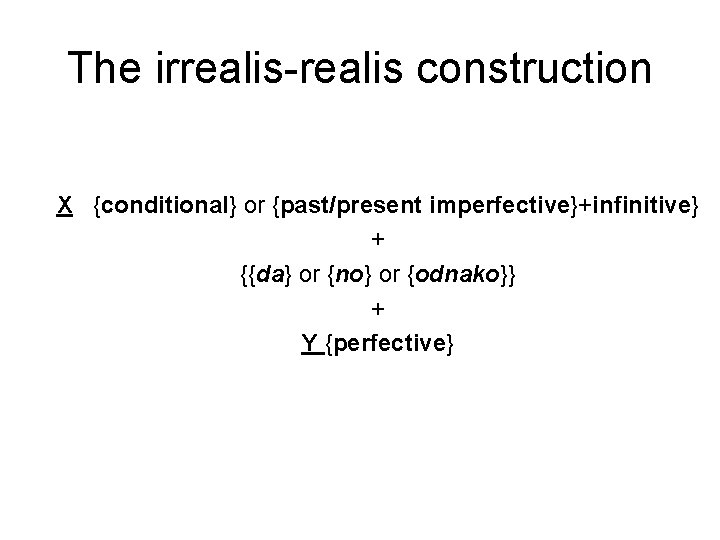
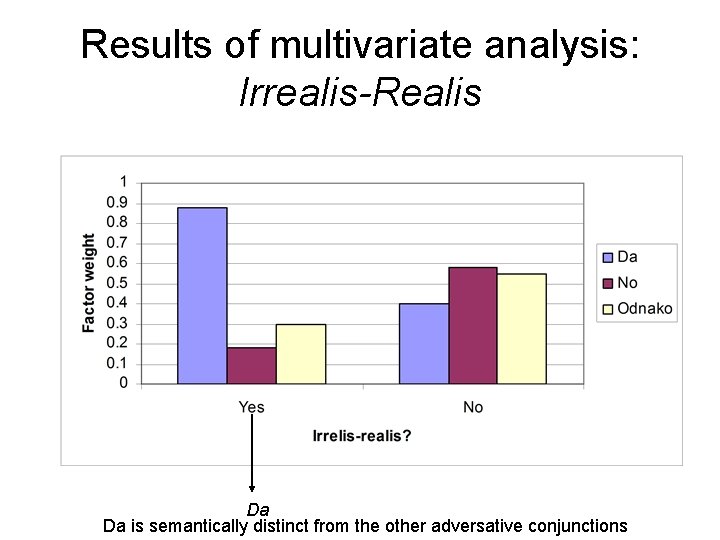
The irrealis-realis construction X {conditional} or {past/present imperfective}+infinitive} + {{da} or {no} or {odnako}} + Y {perfective}
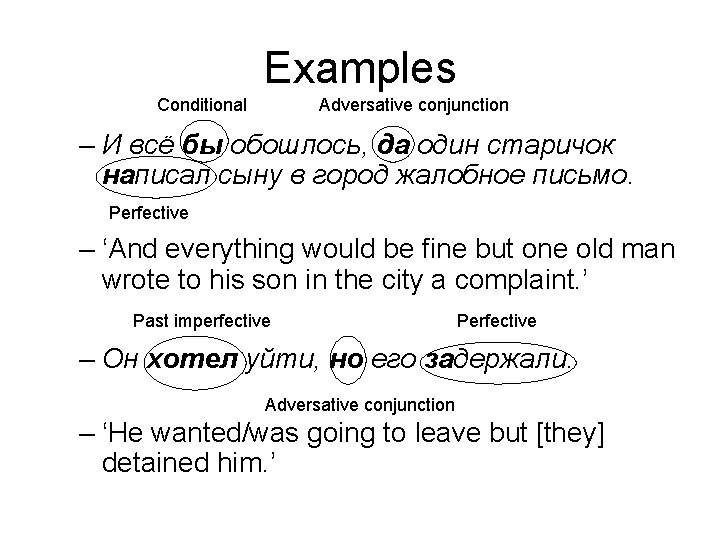
Examples Conditional Adversative conjunction – И всё бы обошлось, да один старичок написал сыну в город жалобное письмо. Perfective – ‘And everything would be fine but one old man wrote to his son in the city a complaint. ’ Past imperfective Perfective – Он хотел уйти, но его задержали. Adversative conjunction – ‘He wanted/was going to leave but [they] detained him. ’
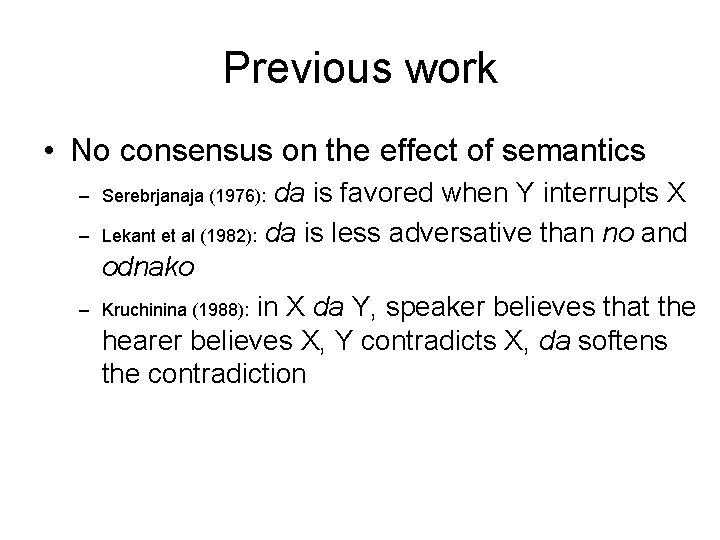
Previous work • No consensus on the effect of semantics da is favored when Y interrupts X Lekant et al (1982): da is less adversative than no and odnako Kruchinina (1988): in X da Y, speaker believes that the hearer believes X, Y contradicts X, da softens the contradiction – Serebrjanaja (1976): – –
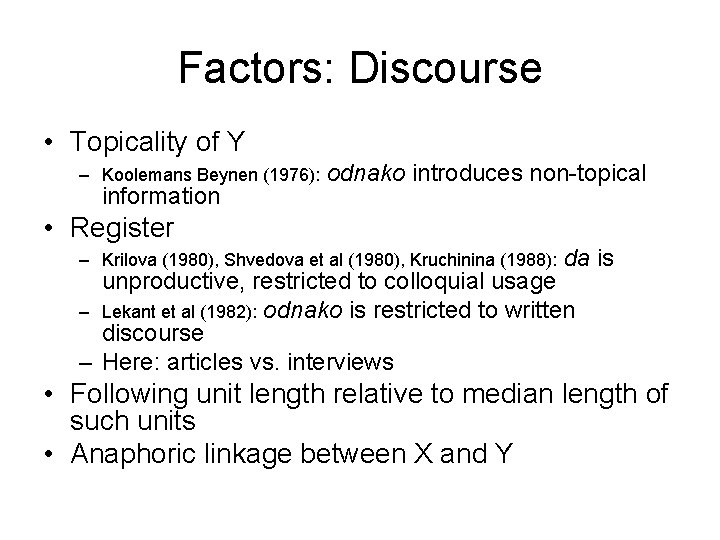
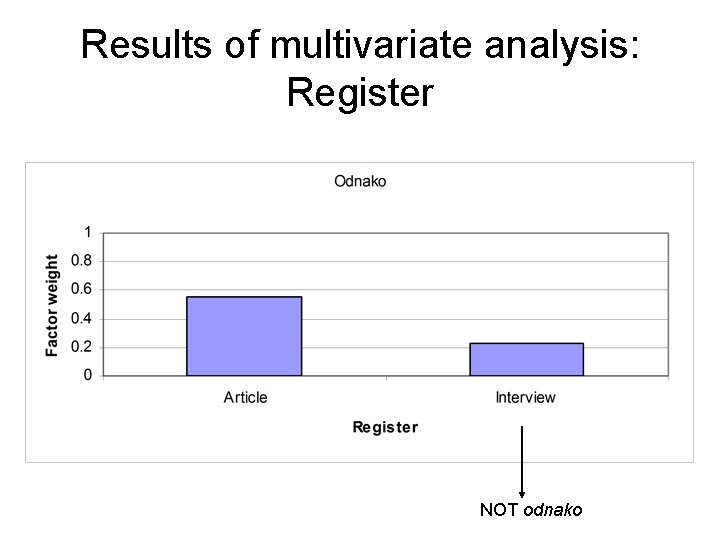
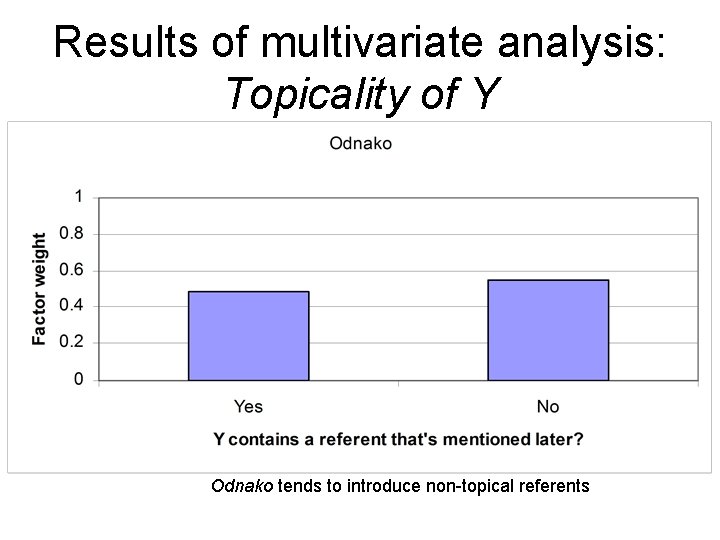
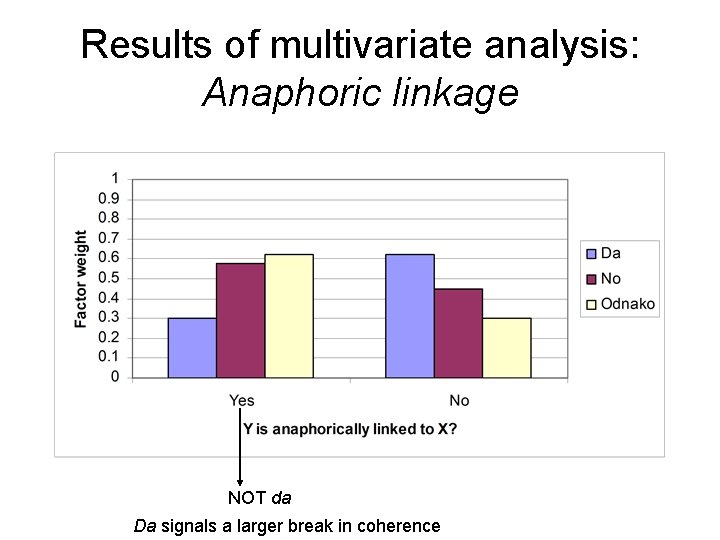
Factors: Discourse • Topicality of Y – Koolemans Beynen (1976): information odnako introduces non-topical • Register – Krilova (1980), Shvedova et al (1980), Kruchinina (1988): da is unproductive, restricted to colloquial usage – Lekant et al (1982): odnako is restricted to written discourse – Here: articles vs. interviews • Following unit length relative to median length of such units • Anaphoric linkage between X and Y
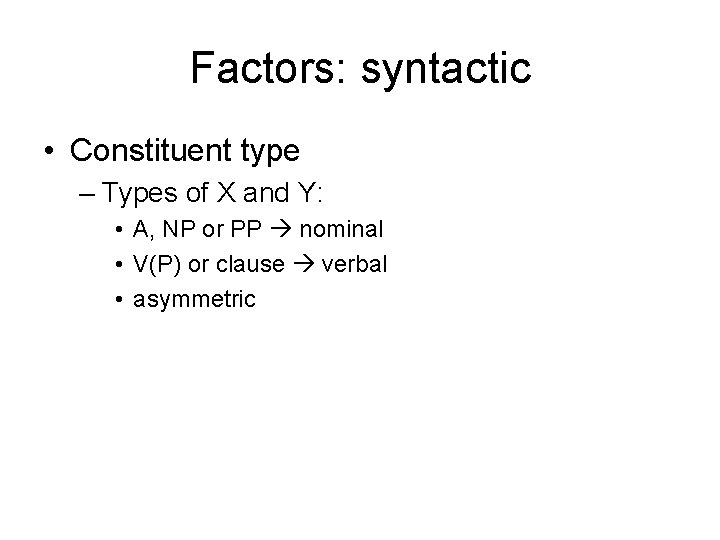
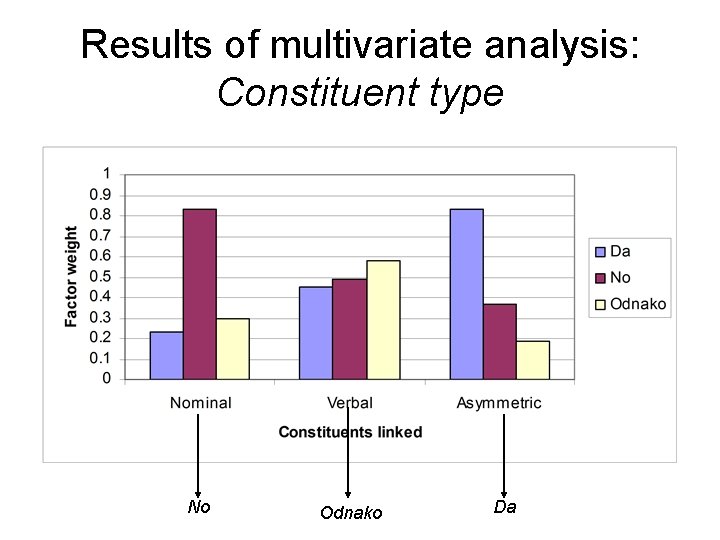
Factors: syntactic • Constituent type – Types of X and Y: • A, NP or PP nominal • V(P) or clause verbal • asymmetric
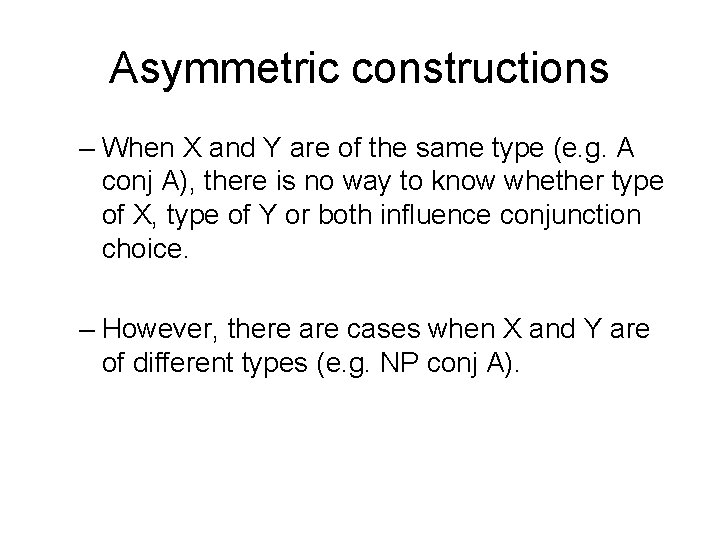
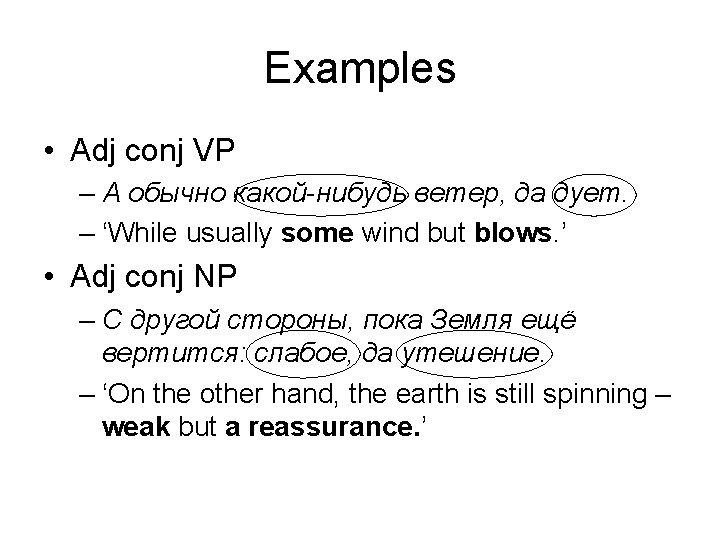
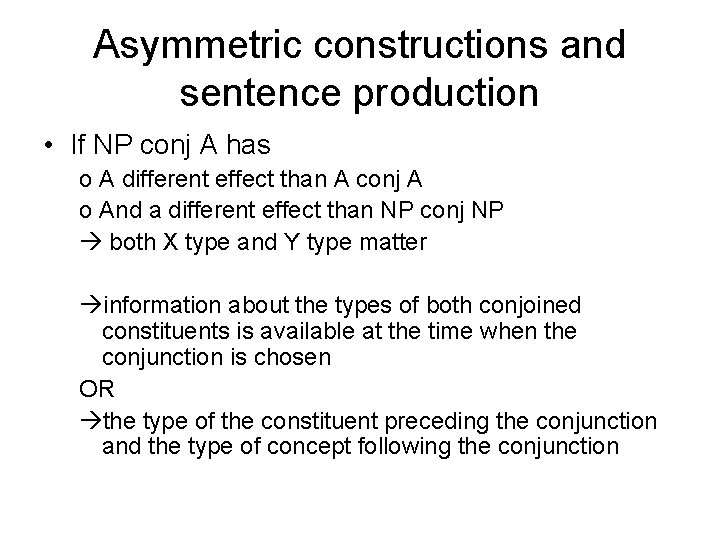
Asymmetric constructions – When X and Y are of the same type (e. g. A conj A), there is no way to know whether type of X, type of Y or both influence conjunction choice. – However, there are cases when X and Y are of different types (e. g. NP conj A).
Asymmetric constructions and sentence production • If NP conj A has o A different effect than A conj A o And a different effect than NP conj NP both X type and Y type matter information about the types of both conjoined constituents is available at the time when the conjunction is chosen OR the type of the constituent preceding the conjunction and the type of concept following the conjunction
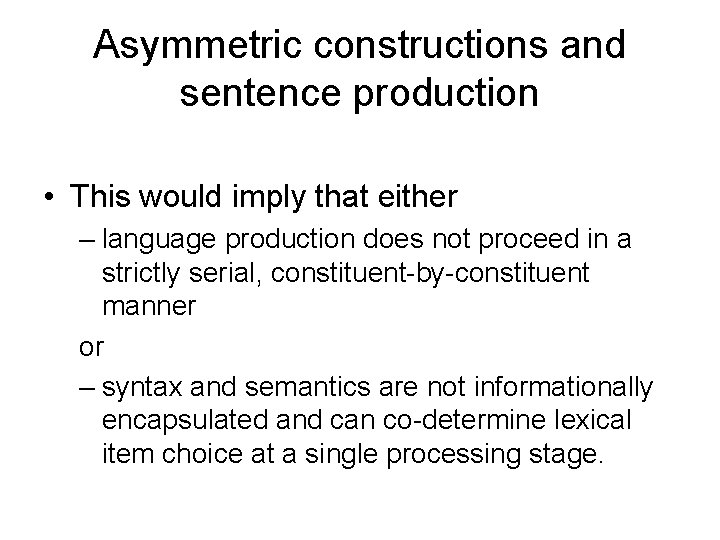
Asymmetric constructions and sentence production • This would imply that either – language production does not proceed in a strictly serial, constituent-by-constituent manner or – syntax and semantics are not informationally encapsulated and can co-determine lexical item choice at a single processing stage.
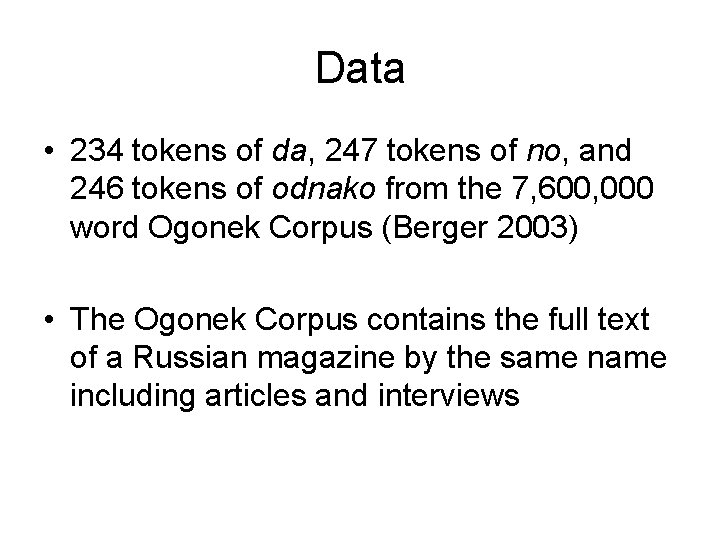
Data • 234 tokens of da, 247 tokens of no, and 246 tokens of odnako from the 7, 600, 000 word Ogonek Corpus (Berger 2003) • The Ogonek Corpus contains the full text of a Russian magazine by the same name including articles and interviews
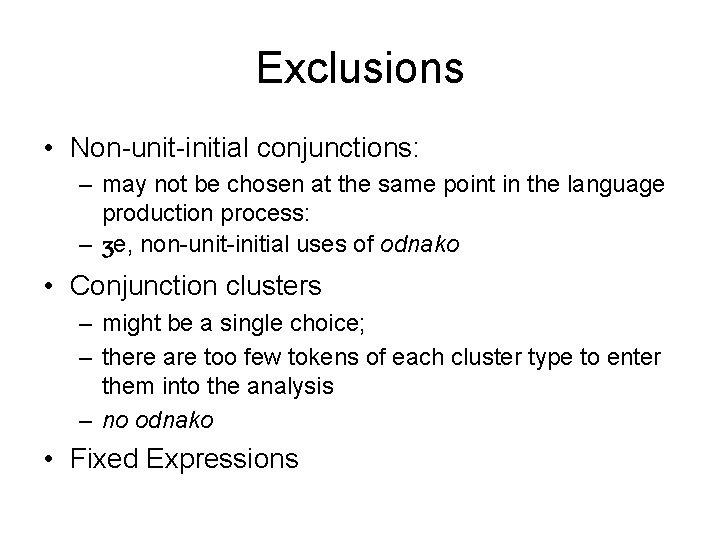
Exclusions • Non-unit-initial conjunctions: – may not be chosen at the same point in the language production process: – e, non-unit-initial uses of odnako • Conjunction clusters – might be a single choice; – there are too few tokens of each cluster type to enter them into the analysis – no odnako • Fixed Expressions
Analysis • Varbrule – Add factors one by one, see if the larger model explains more variation than the smaller model, keep factors whose addition increases predictiveness and whose deletion decreases it – Output: factor weights
Register
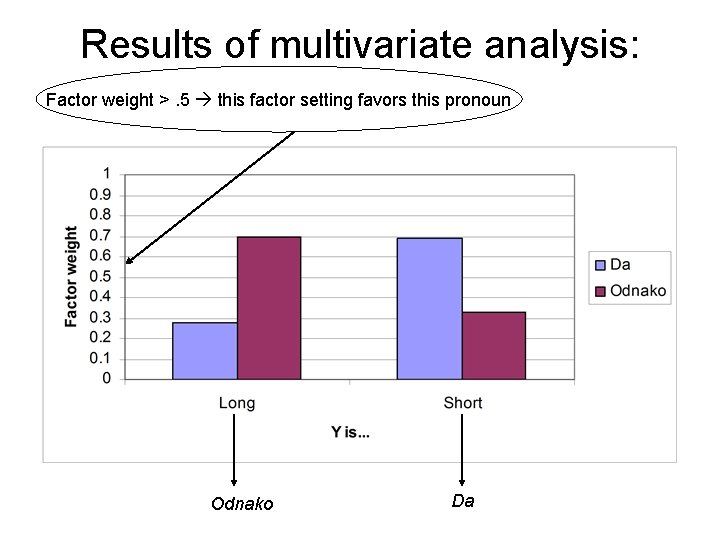
Results of multivariate analysis: Length ofthis. Ypronoun Factor weight >. 5 this factor setting favors Odnako Da
Results of multivariate analysis: Register NOT odnako
Discourse
Results of multivariate analysis: Topicality of Y Odnako tends to introduce non-topical referents
Results of multivariate analysis: Anaphoric linkage NOT da Da signals a larger break in coherence
Semantics
Results of multivariate analysis: Irrealis-Realis Da Da is semantically distinct from the other adversative conjunctions
Syntax
Results of multivariate analysis: Constituent type No Odnako Da
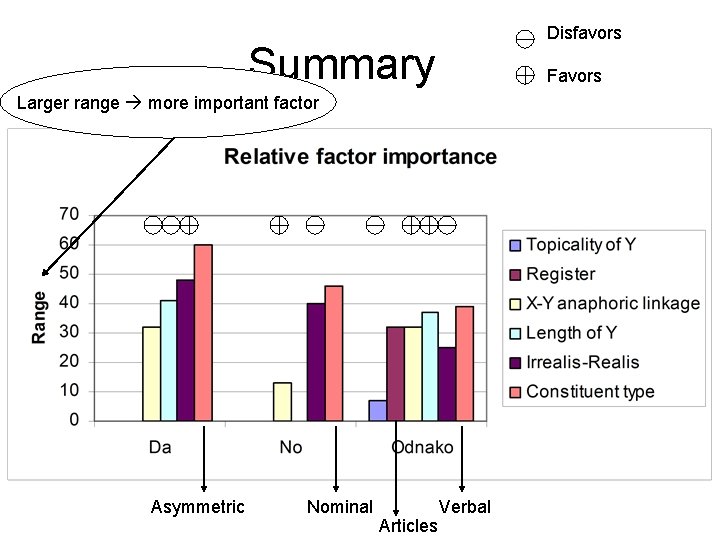
Disfavors Summary Favors Larger range more important factor Asymmetric Nominal Articles Verbal
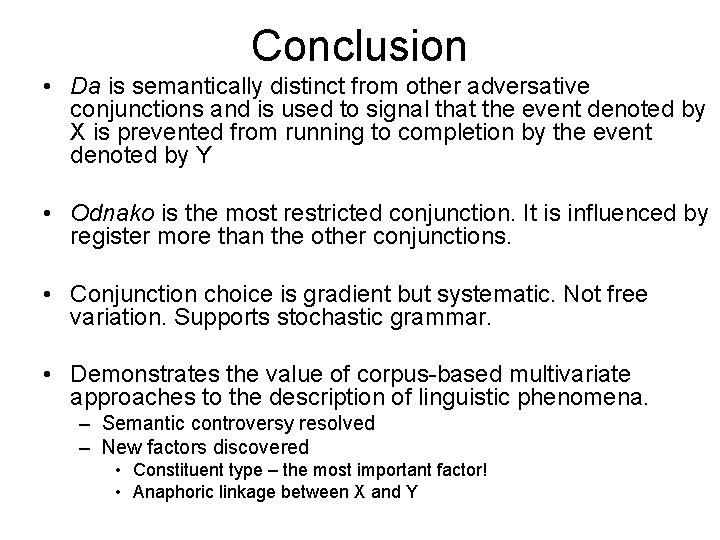
Conclusion • Da is semantically distinct from other adversative conjunctions and is used to signal that the event denoted by X is prevented from running to completion by the event denoted by Y • Odnako is the most restricted conjunction. It is influenced by register more than the other conjunctions. • Conjunction choice is gradient but systematic. Not free variation. Supports stochastic grammar. • Demonstrates the value of corpus-based multivariate approaches to the description of linguistic phenomena. – Semantic controversy resolved – New factors discovered • Constituent type – the most important factor! • Anaphoric linkage between X and Y
Processing implications • Asymmetric constructions behave differently than symmetric constructions Types of both of the conjoined constituents must be available when the conjunction is chosen Sentence production does not proceed in strictly serial, constituent-by-constituent manner Or, syntax and semantics jointly determine conjunction choice at a single processing stage.
References Koolemans Beynen, G. (1976). Semantic differences between no and odnako. Slavic and East European Journal, 20 (2), 167 -73. Krilova, G. (1980). Ruskijat sojuz da I negovite funkcionalni ekvivalenti v xudozhestveni prevodi na bolgarski ezik. Sopostavitelno Ezikoznanie, 5 (3), 18 -25. Kruchinina, I. N. (1988). Struktura i Funkcii Sochinitel’noj Svjazi v Russkom Jazyke. Moscow: Nauka. Lekant, P. A. et al. (1982). Sovremennyj Russkij Literaturnyj Jazyk. Moscow: Vysshaja Shkola. Rand, D. , and D. Sankoff. (1990). Gold. Varb Version 2: A Variable Rule Application for Macintosh. On-line Manual. http: //www. crm. umontreal. ca/~sankoff/Gold. Varb. Manual. Dir Serebrjanaja, F. I. (1976). Nekotorye nabljudenija nad upotrebleniem sojuza da. Russkij Jazyk v Shkole, 4. SFB 441, Project B 1. Ogonek 1996 -2002. http: //heckel. sfb. uni-tuebingen. de/cgibin/cqp. pl? sprache=en&trans=lat Shvedova, N. Ju, N. D. Arutjunova, A. V. Bondarko, V. V. Ivanov, V. V. Lopatin, I. S. Uluxanov, F. Filin, and the Institute for the Russian Language, The Academy of Sciences of the USSR. (1980). Russkaja Grammatika. Vol. 2: Sintaksis. Moscow: Nauka.
Acknowledgements • N. I. H. for funding • Rena Torres-Cacoullos for teaching me VARBRULE • Tessa Bent, Adam Buchwald, Susannah Levi, Rebecca Ronquest, and Rena Torres -Cacoullos for useful feedback