
VSEPR Valence Shell Electron Pair Repulsion Theory es
- Slides: 10
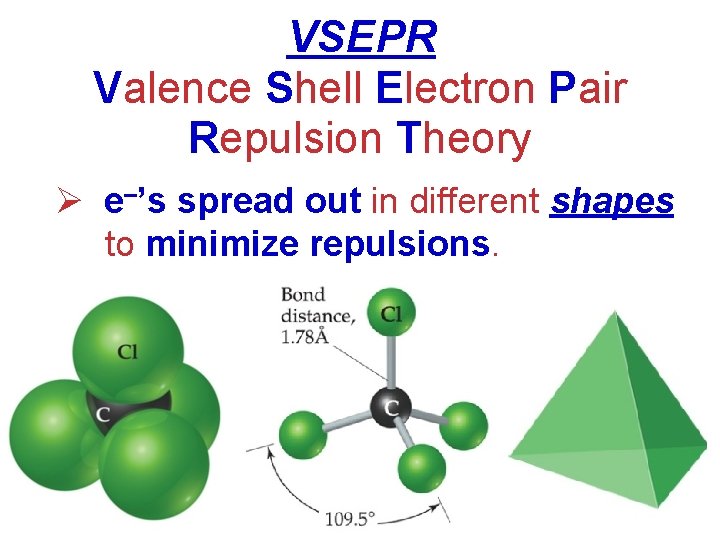
VSEPR Valence Shell Electron Pair Repulsion Theory Ø e–’s spread out in different shapes to minimize repulsions.
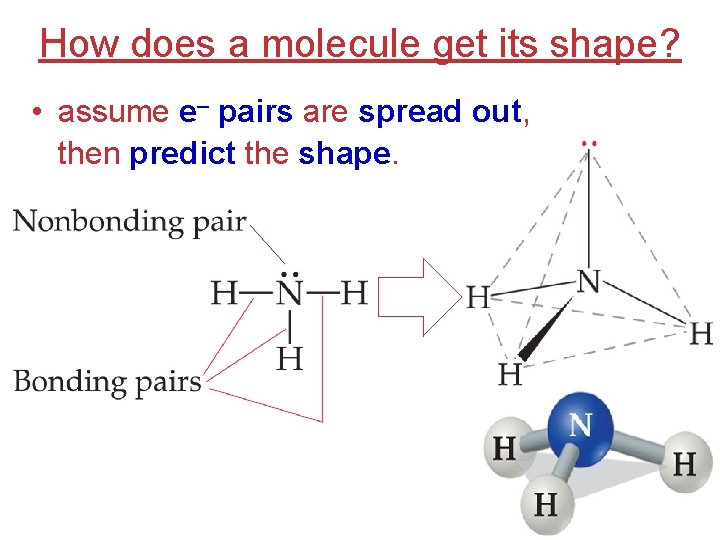
How does a molecule get its shape? • assume e– pairs are spread out, then predict the shape.
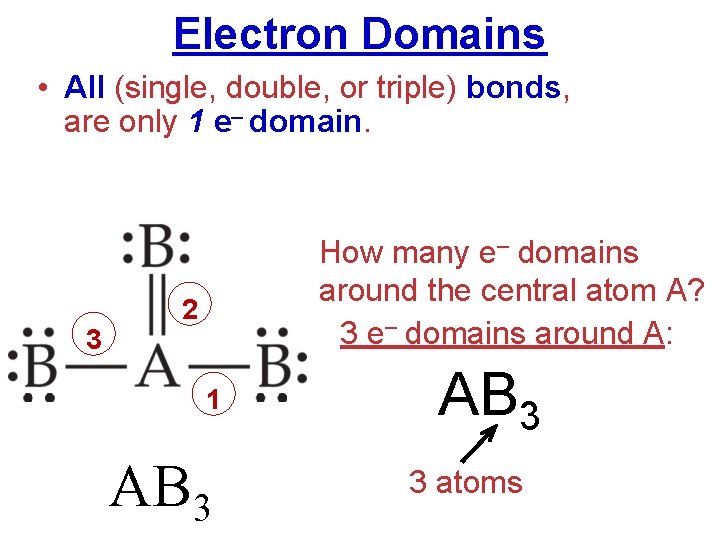
Electron Domains • All (single, double, or triple) bonds, are only 1 e– domain. 3 How many e– domains around the central atom A? 3 e– domains around A: 2 1 AB 3 3 atoms
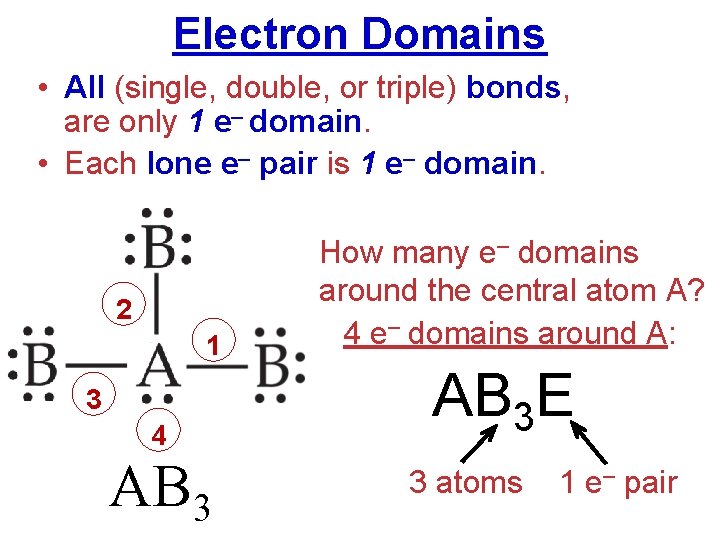
Electron Domains • All (single, double, or triple) bonds, are only 1 e– domain. • Each lone e– pair is 1 e– domain. 2 B 3 1 4 AB 3 How many e– domains around the central atom A? 4 e– domains around A: AB 3 E 3 atoms 1 e– pair
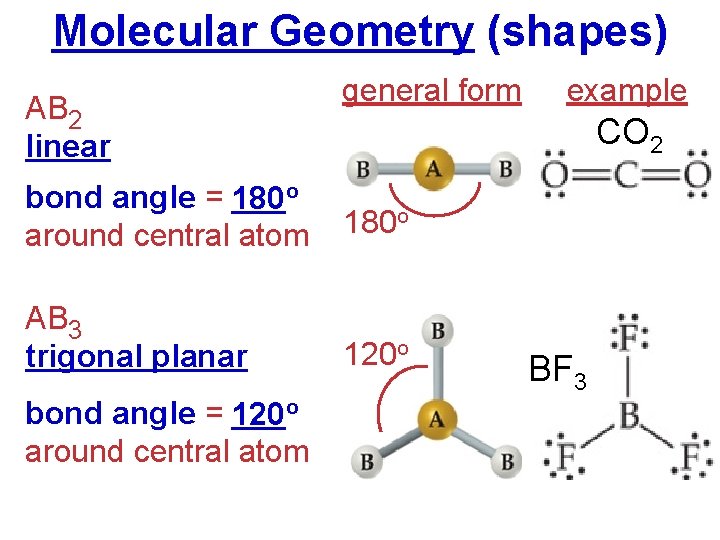
Molecular Geometry (shapes) AB 2 linear general form CO 2 bond angle = 180 ___o around central atom 180 o AB 3 trigonal planar 120 o bond angle = 120 ___o around central atom example BF 3
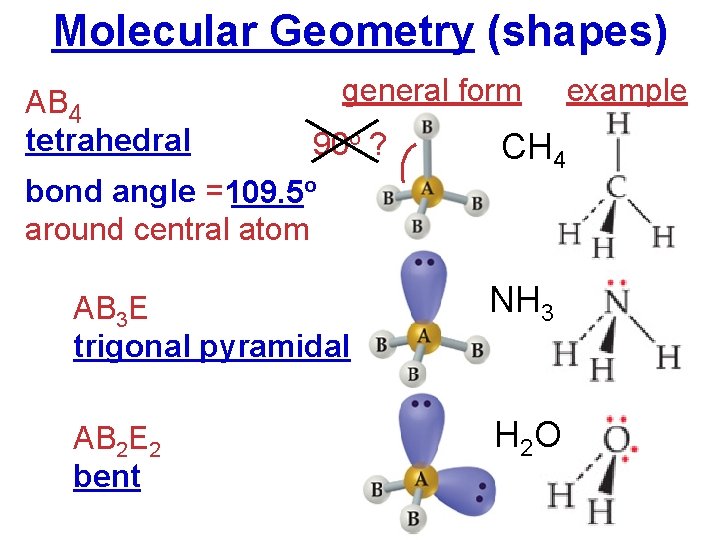
Molecular Geometry (shapes) AB 4 tetrahedral general form 90 o ? example CH 4 bond angle =109. 5 ____o around central atom AB 3 E trigonal pyramidal NH 3 AB 2 E 2 bent H 2 O
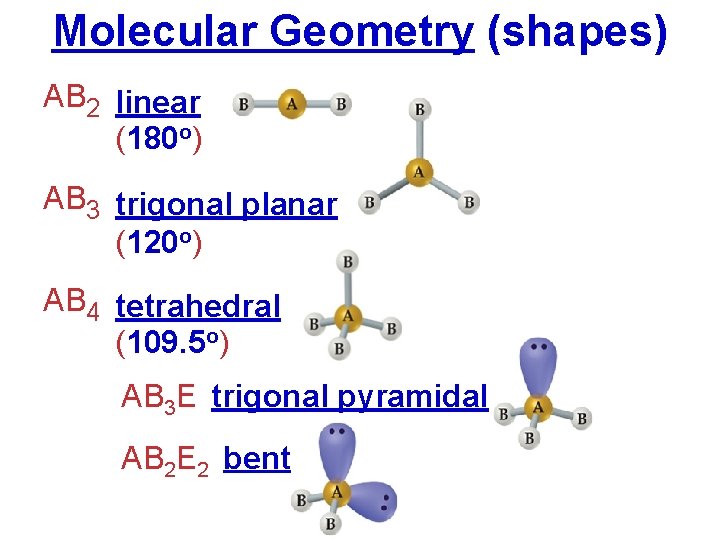
Molecular Geometry (shapes) AB 2 linear (180 o) AB 3 trigonal planar (120 o) AB 4 tetrahedral (109. 5 o) AB 3 E trigonal pyramidal AB 2 E 2 bent
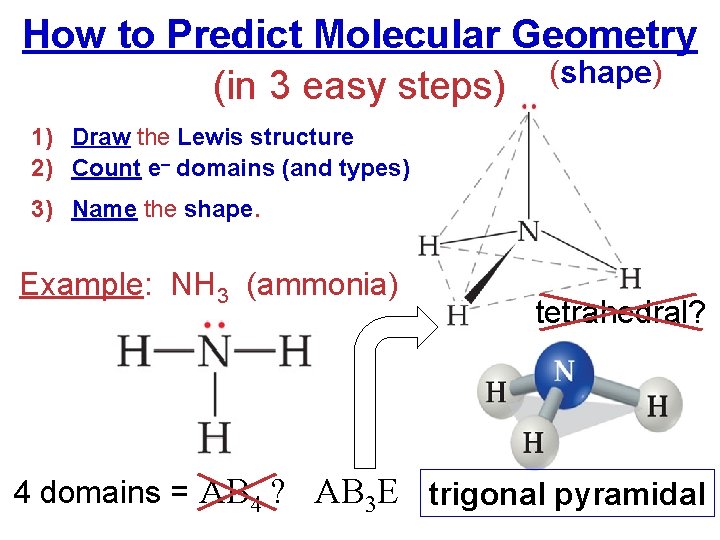
How to Predict Molecular Geometry (shape) (in 3 easy steps) 1) Draw the Lewis structure 2) Count e– domains (and types) 3) Name the shape. Example: NH 3 (ammonia) tetrahedral? 4 domains = AB 4 ? AB 3 E trigonal pyramidal
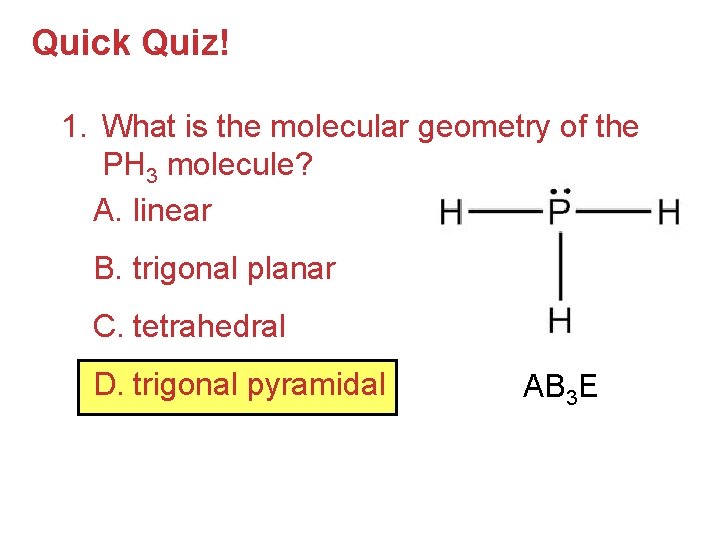
Quick Quiz! 1. What is the molecular geometry of the PH 3 molecule? A. linear B. trigonal planar C. tetrahedral D. trigonal pyramidal AB 3 E
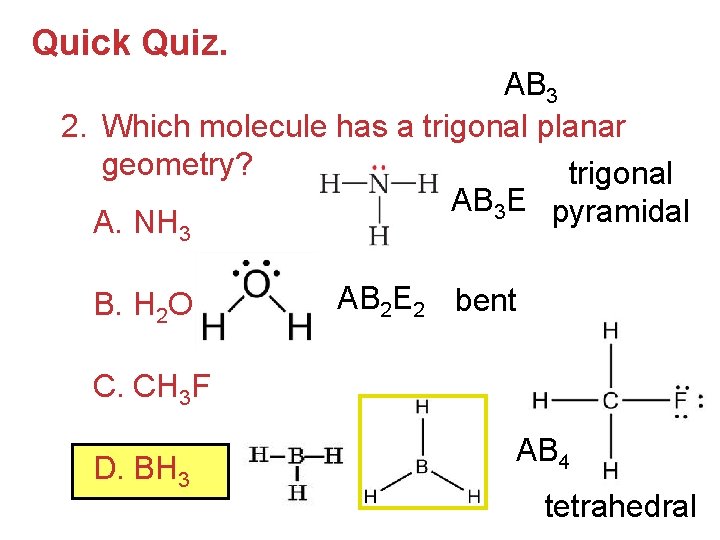
Quick Quiz. AB 3 2. Which molecule has a trigonal planar geometry? trigonal AB 3 E pyramidal A. NH 3 B. H 2 O AB 2 E 2 bent C. CH 3 F D. BH 3 AB 4 tetrahedral