
VOXES a new high resolution Xray spectrometer for
- Slides: 26
VOXES, a new high resolution X-ray spectrometer for low yield measurements in high background environments X E O S Alessandro Scordo Laboratori Nazionali di Frascati, INFN Workoshop “Developement of novel detectors at LNF”, Frascati, 14 -06 -2016
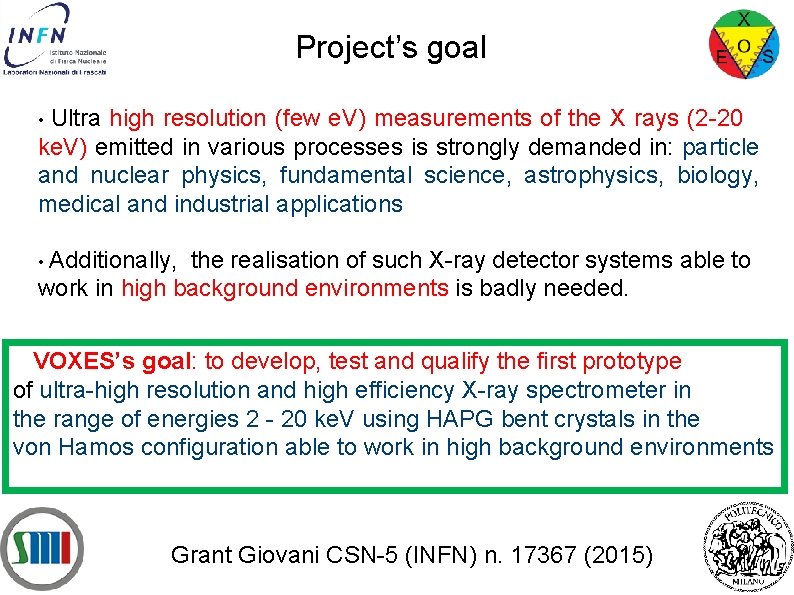
Project’s goal • Ultra high resolution (few e. V) measurements of the X rays (2 -20 ke. V) emitted in various processes is strongly demanded in: particle and nuclear physics, fundamental science, astrophysics, biology, medical and industrial applications • Additionally, the realisation of such X-ray detector systems able to work in high background environments is badly needed. VOXES’s goal: to develop, test and qualify the first prototype of ultra-high resolution and high efficiency X-ray spectrometer in the range of energies 2 - 20 ke. V using HAPG bent crystals in the von Hamos configuration able to work in high background environments Grant Giovani CSN-5 (INFN) n. 17367 (2015)
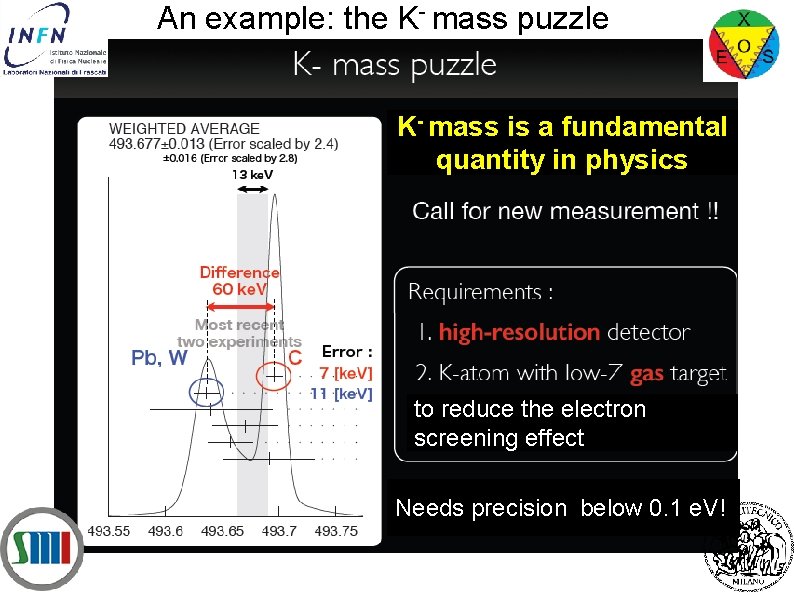
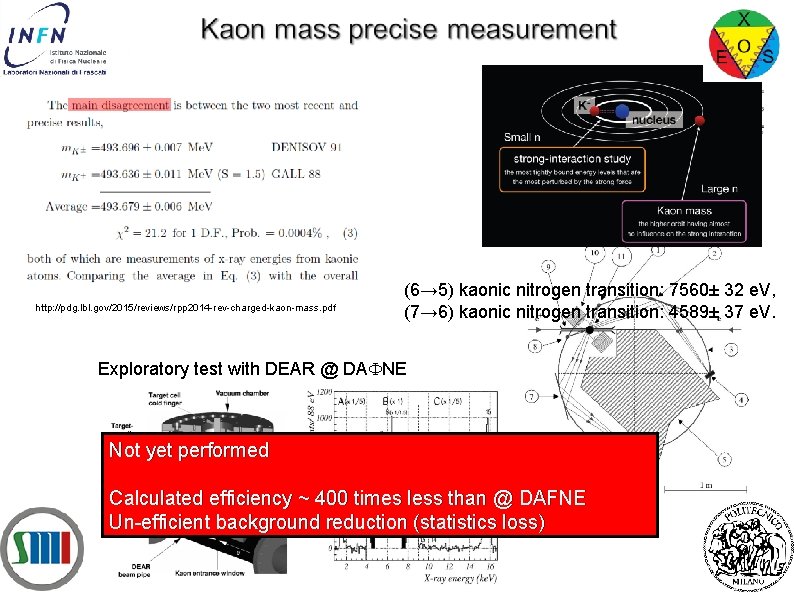
An example: the K- mass puzzle K- mass is a fundamental quantity in physics to reduce the electron screening effect Needs precision below 0. 1 e. V!
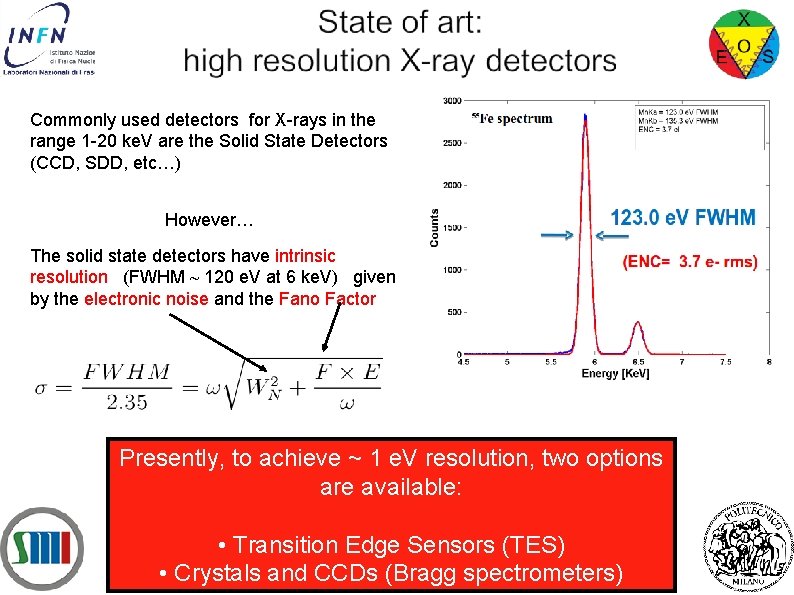
Commonly used detectors for X-rays in the range 1 -20 ke. V are the Solid State Detectors (CCD, SDD, etc…) However… The solid state detectors have intrinsic resolution (FWHM ~ 120 e. V at 6 ke. V) given by the electronic noise and the Fano Factor Presently, to achieve ~ 1 e. V resolution, two options are available: • Transition Edge Sensors (TES) • Crystals and CCDs (Bragg spectrometers)
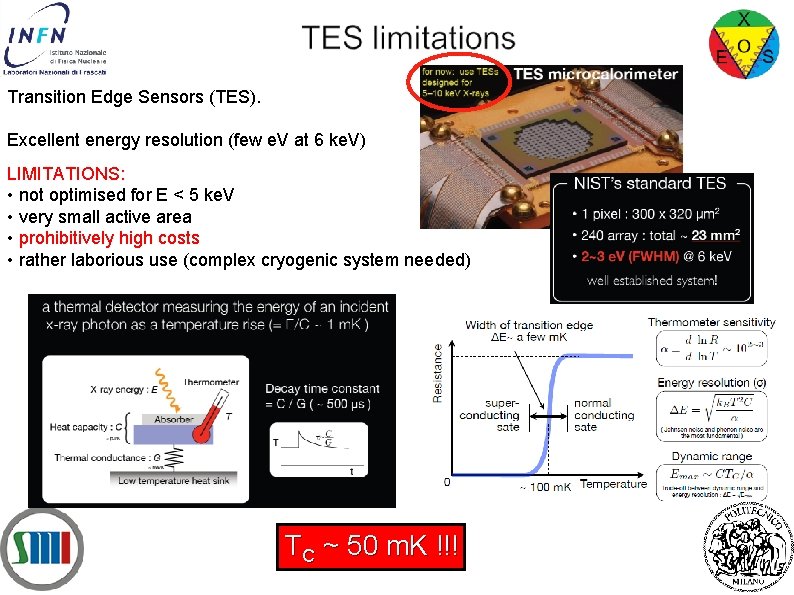
Transition Edge Sensors (TES). Excellent energy resolution (few e. V at 6 ke. V) LIMITATIONS: • not optimised for E < 5 ke. V • very small active area • prohibitively high costs • rather laborious use (complex cryogenic system needed) TC ~ 50 m. K !!!
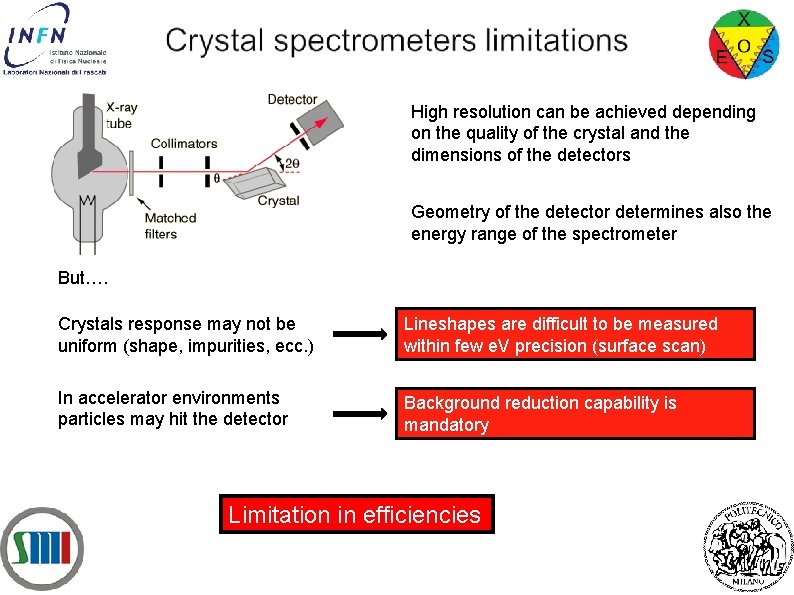
High resolution can be achieved depending on the quality of the crystal and the dimensions of the detectors Geometry of the detector determines also the energy range of the spectrometer But…. Crystals response may not be uniform (shape, impurities, ecc. ) Lineshapes are difficult to be measured within few e. V precision (surface scan) In accelerator environments particles may hit the detector Background reduction capability is mandatory Limitation in efficiencies
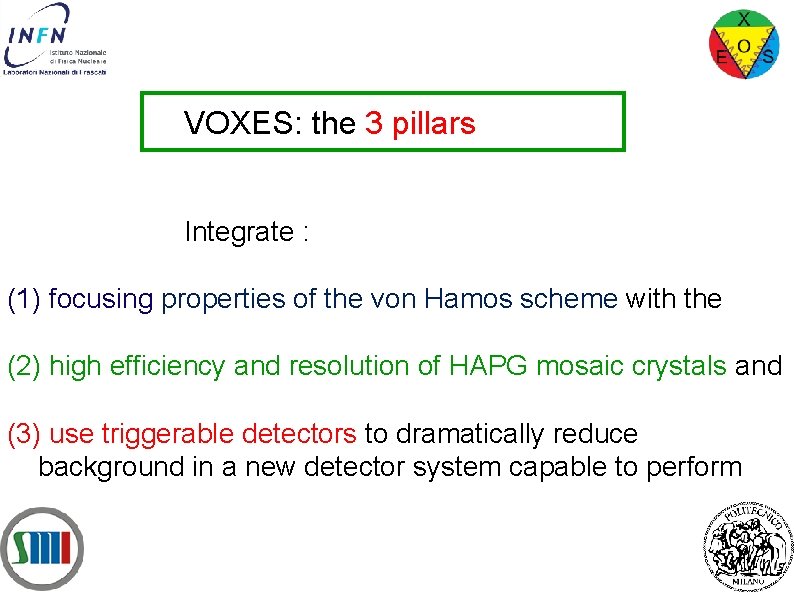
VOXES: the 3 pillars Integrate : (1) focusing properties of the von Hamos scheme with the (2) high efficiency and resolution of HAPG mosaic crystals and (3) use triggerable detectors to dramatically reduce background in a new detector system capable to perform
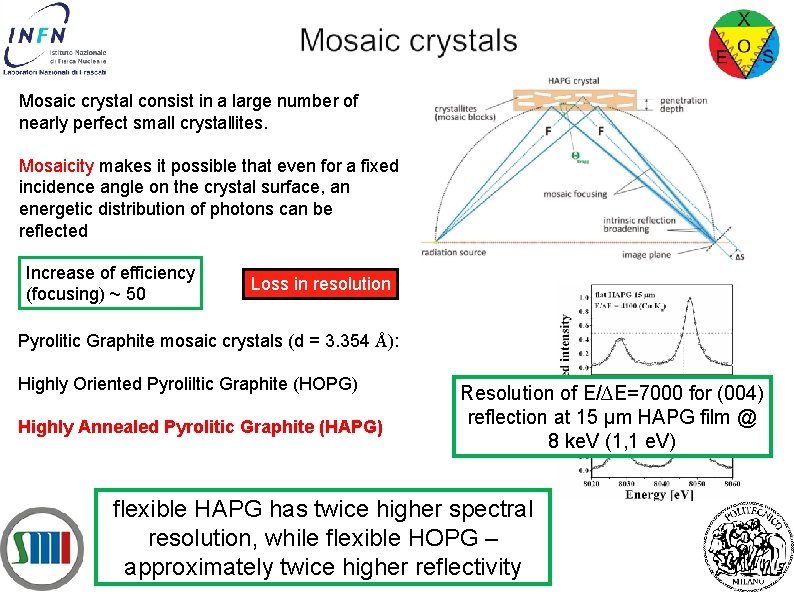
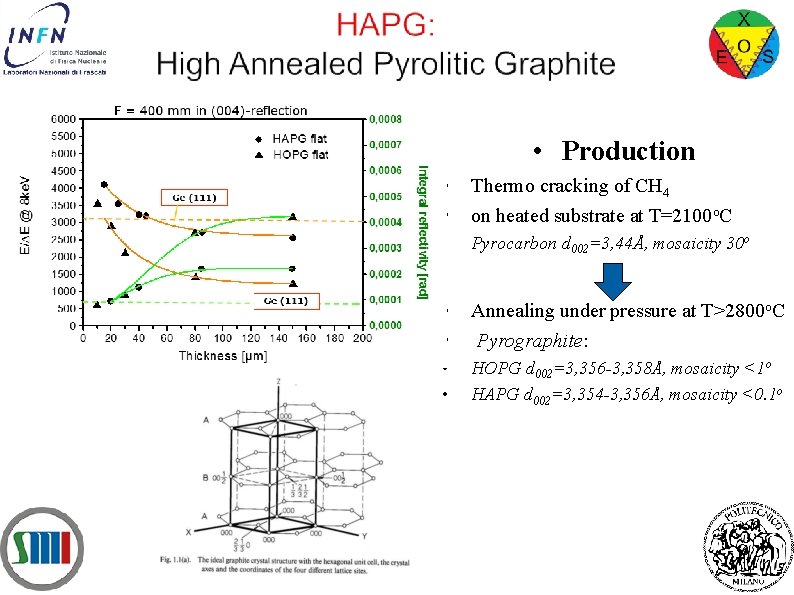
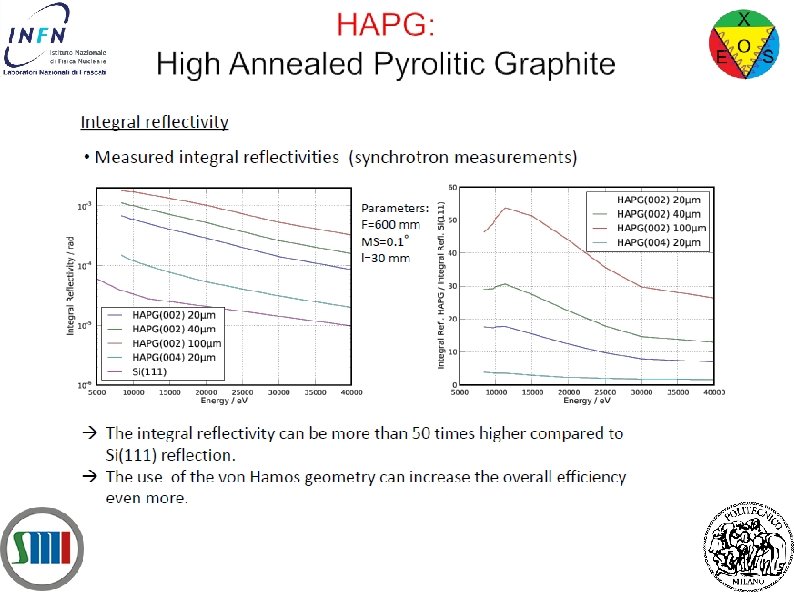
Mosaic crystal consist in a large number of nearly perfect small crystallites. Mosaicity makes it possible that even for a fixed incidence angle on the crystal surface, an energetic distribution of photons can be reflected Increase of efficiency (focusing) ~ 50 Loss in resolution Pyrolitic Graphite mosaic crystals (d = 3. 354 Å): Highly Oriented Pyroliltic Graphite (HOPG) Highly Annealed Pyrolitic Graphite (HAPG) Resolution of E/∆E=7000 for (004) reflection at 15 µm HAPG film @ 8 ke. V (1, 1 e. V) flexible HAPG has twice higher spectral resolution, while flexible HOPG – approximately twice higher reflectivity
• Production • • Thermo cracking of CH 4 on heated substrate at T=2100 o. C • Pyrocarbon d 002=3, 44Å, mosaicity 30 o • • Annealing under pressure at T>2800 o. C Pyrographite: • • HOPG d 002=3, 356 -3, 358Å, mosaicity <1 o HAPG d 002=3, 354 -3, 356Å, mosaicity <0. 1 o
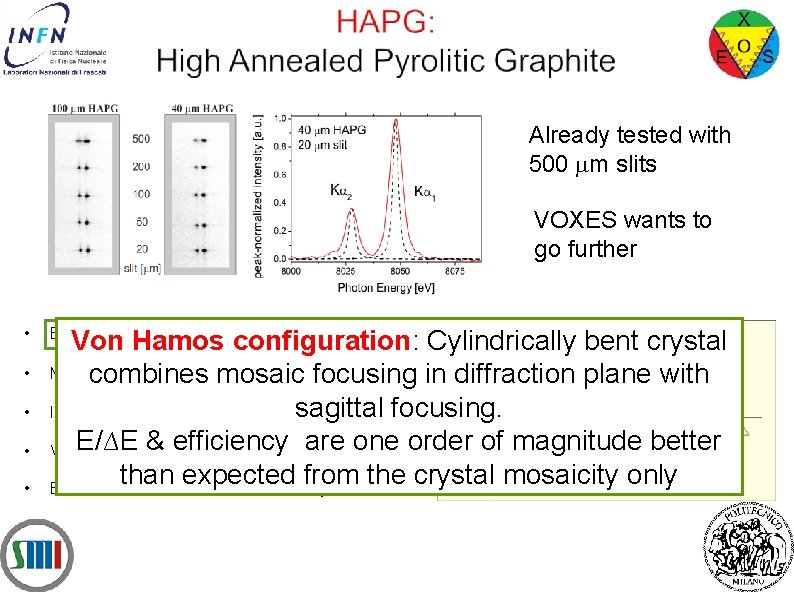
Already tested with 500 m slits VOXES wants to go further • • • Von Hamos configuration: Cylindrically bent crystal Mosaic spread down to 0. 05 degree combines mosaic focusing in diffraction plane with sagittal focusing. Integral reflectivity ~ 10 higher than for other crystals E/∆E & efficiency are one order of magnitude better Variable thickness (efficiency) than expected from the crystal mosaicity only Excellent thermal and radiation stability Bending does not influence resolution and intensity 2
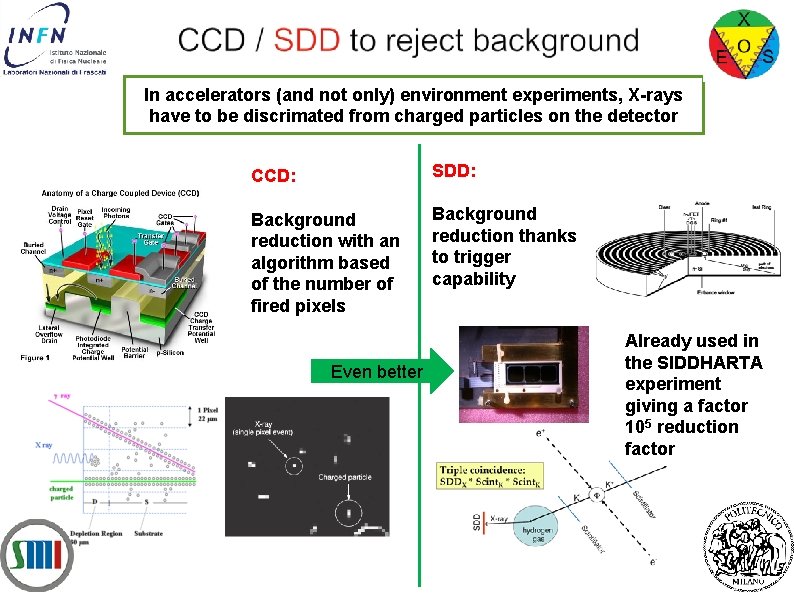
In accelerators (and not only) environment experiments, X-rays have to be discrimated from charged particles on the detector CCD: SDD: Background reduction with an algorithm based of the number of fired pixels Background reduction thanks to trigger capability Even better Already used in the SIDDHARTA experiment giving a factor 105 reduction factor
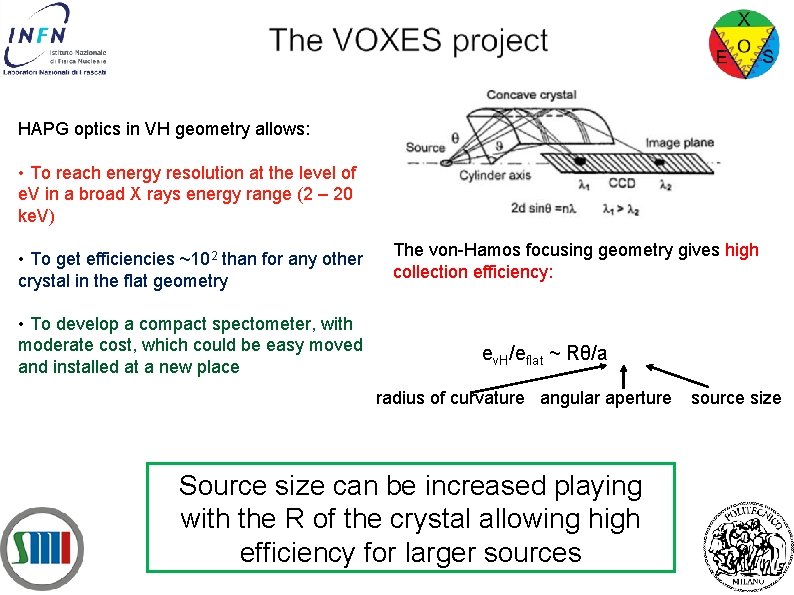
HAPG optics in VH geometry allows: • To reach energy resolution at the level of e. V in a broad X rays energy range (2 – 20 ke. V) • To get efficiencies ~102 than for any other crystal in the flat geometry • To develop a compact spectometer, with moderate cost, which could be easy moved and installed at a new place The von-Hamos focusing geometry gives high collection efficiency: ev. H/eflat ~ Rθ/a radius of curvature angular aperture source size Source size can be increased playing with the R of the crystal allowing high efficiency for larger sources
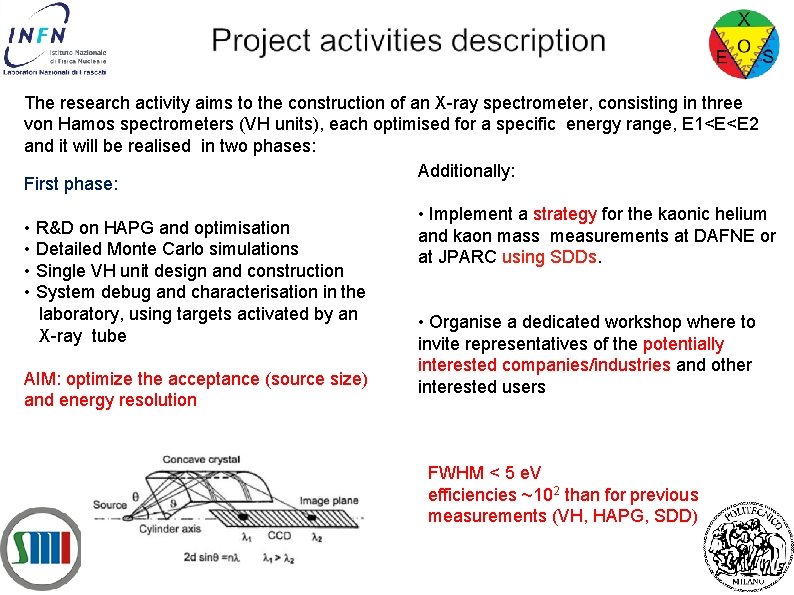
The research activity aims to the construction of an X-ray spectrometer, consisting in three von Hamos spectrometers (VH units), each optimised for a specific energy range, E 1<E<E 2 and it will be realised in two phases: Additionally: Second phase: First phase: • R&D on HAPG and optimisation • Detailed Monte Carlo simulations • Single VH unit design and construction • System debug and characterisation in the laboratory, using targets activated by an X-ray tube AIM: optimize the acceptance (source size) and energy resolution • • Implement a strategy for the kaonic helium Mcarlo simul. design, and construction of and kaon mass measurements at DAFNE or the final VOXES system prototype: 3 VH at JPARC using SDDs. units • Use of SDDs • Final Slow Control & DAQ software • • Organise a dedicated workshop where to Debug, test and calibration @ LNF invite representatives of the potentially • Pionic helium measurement at PSI interested companies/industries and other interested users AIM: VOXES qualification by the measurement of the pionic helium X-ray lines @ PSI with: FWHM < 5 e. V efficiencies ~102 than for previous measurements (VH, HAPG, SDD)
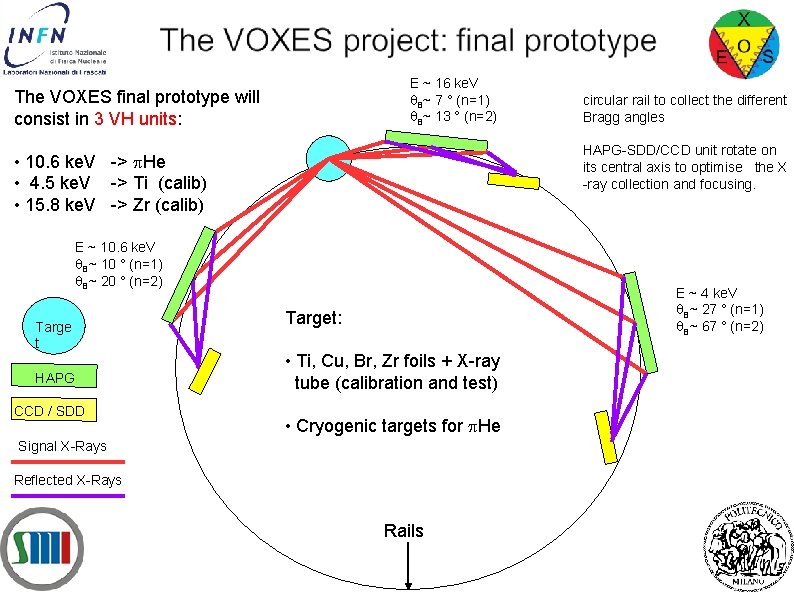
E ~ 16 ke. V B~ 7 ° (n=1) B~ 13 ° (n=2) The VOXES final prototype will consist in 3 VH units: HAPG-SDD/CCD unit rotate on its central axis to optimise the X -ray collection and focusing. • 10. 6 ke. V -> He • 4. 5 ke. V -> Ti (calib) • 15. 8 ke. V -> Zr (calib) E ~ 10. 6 ke. V B~ 10 ° (n=1) B~ 20 ° (n=2) Targe t HAPG CCD / SDD circular rail to collect the different Bragg angles E ~ 4 ke. V B~ 27 ° (n=1) B~ 67 ° (n=2) Target: • Ti, Cu, Br, Zr foils + X-ray tube (calibration and test) • Cryogenic targets for He Signal X-Rays Reflected X-Rays Rails
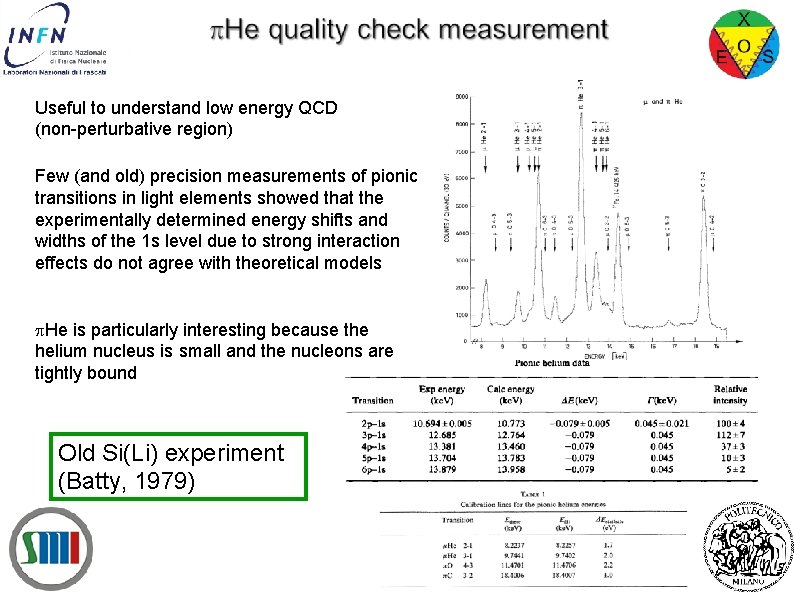
Useful to understand low energy QCD (non-perturbative region) Few (and old) precision measurements of pionic transitions in light elements showed that the experimentally determined energy shifts and widths of the 1 s level due to strong interaction effects do not agree with theoretical models He is particularly interesting because the helium nucleus is small and the nucleons are tightly bound Old Si(Li) experiment (Batty, 1979)
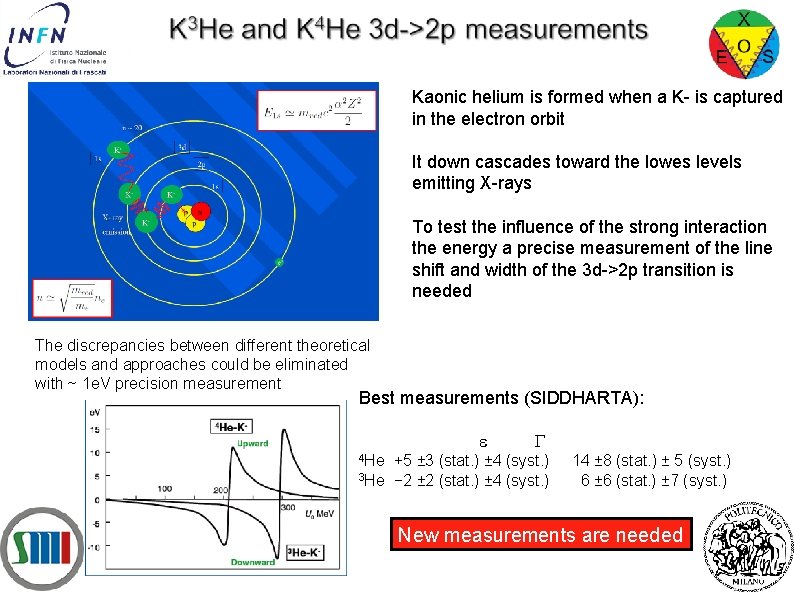
Kaonic helium is formed when a K- is captured in the electron orbit It down cascades toward the lowes levels emitting X-rays To test the influence of the strong interaction the energy a precise measurement of the line shift and width of the 3 d->2 p transition is needed The discrepancies between different theoretical models and approaches could be eliminated with ~ 1 e. V precision measurement Best measurements (SIDDHARTA): 4 He +5 ± 3 (stat. ) ± 4 (syst. ) 14 ± 8 (stat. ) ± 5 (syst. ) 3 He − 2 ± 2 (stat. ) ± 4 (syst. ) 6 ± 6 (stat. ) ± 7 (syst. ) New measurements are needed
http: //pdg. lbl. gov/2015/reviews/rpp 2014 -rev-charged-kaon-mass. pdf (6→ 5) kaonic nitrogen transition: 7560± 32 e. V, (7→ 6) kaonic nitrogen transition: 4589± 37 e. V. Exploratory test with DEAR @ DA NE Not yet performed Calculated efficiency ~ 400 times less than @ DAFNE Un-efficient background reduction (statistics loss)
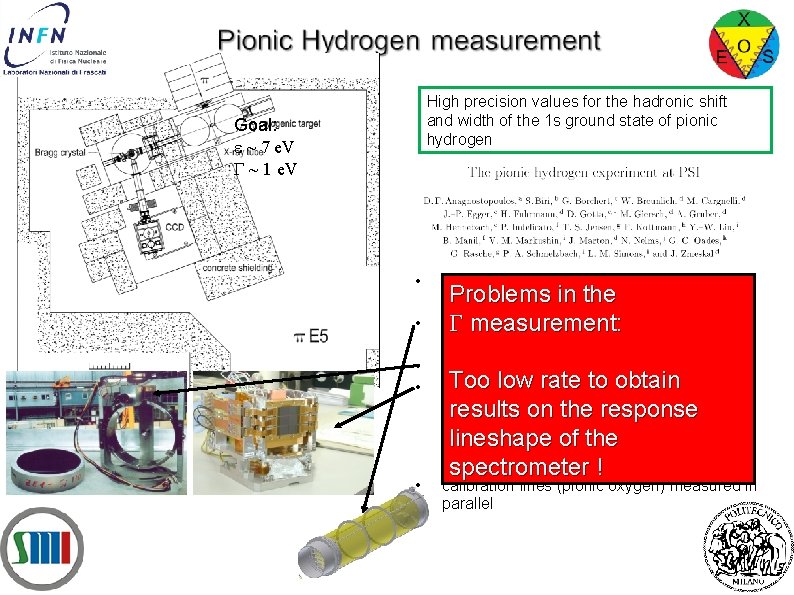
High precision values for the hadronic shift and width of the 1 s ground state of pionic hydrogen Goal: ~ 7 e. V ~ 1 e. V • high pion flux in E 5 at PSI 9 p. Problems in the =112 Me. V/c, ~ 10 /s • Light weight cryogenic target measurement: for wide density range • spherically bent Bragg crystals (Silicon) Too low rate to obtain • position sensitive X-ray detection with CCD array: results on the response CCD-22 (600 x 600 pixel) in 2 x 3 matrix, lineshape of the background reduction by shielding and pixel analysis spectrometer ! • calibration lines (pionic oxygen) measured in parallel
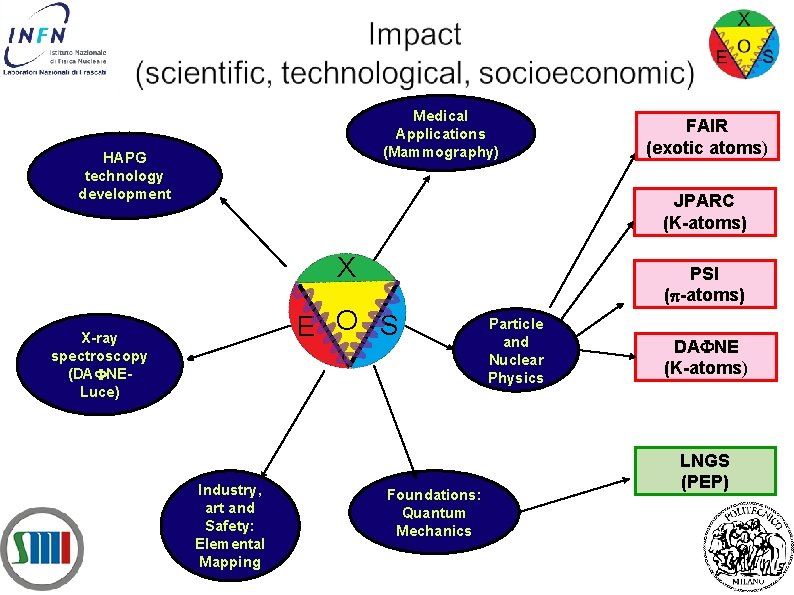
Medical Applications (Mammography) HAPG technology development FAIR (exotic atoms) JPARC (K-atoms) X E O S X-ray spectroscopy (DA NELuce) Industry, art and Safety: Elemental Mapping Foundations: Quantum Mechanics PSI ( -atoms) Particle and Nuclear Physics DA NE (K-atoms) LNGS (PEP)
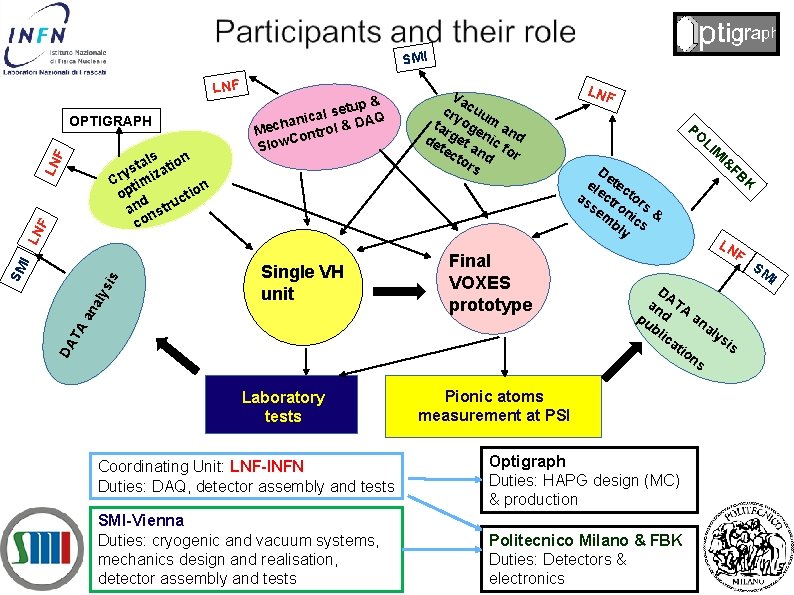
SMI LNF OPTIGRAPH Single VH unit Va cr cuu y tar oge m an de get nic d tec an for tor d s Final VOXES prototype DA T A an aly sis SM I LN F s tal ation s y Cr timiz n tio op d c an nstru co tup & e s l anica l & DAQ h c e M ontro C w Slo Laboratory tests Coordinating Unit: LNF-INFN Duties: DAQ, detector assembly and tests SMI-Vienna Duties: cryogenic and vacuum systems, mechanics design and realisation, detector assembly and tests LNF PO LI M De el tec as ectr tor se on s & m ic bl s y I& FB K LN F DA an TA an pu d al bl ys ic at is io ns Pionic atoms measurement at PSI Optigraph Duties: HAPG design (MC) & production Politecnico Milano & FBK Duties: Detectors & electronics SM I
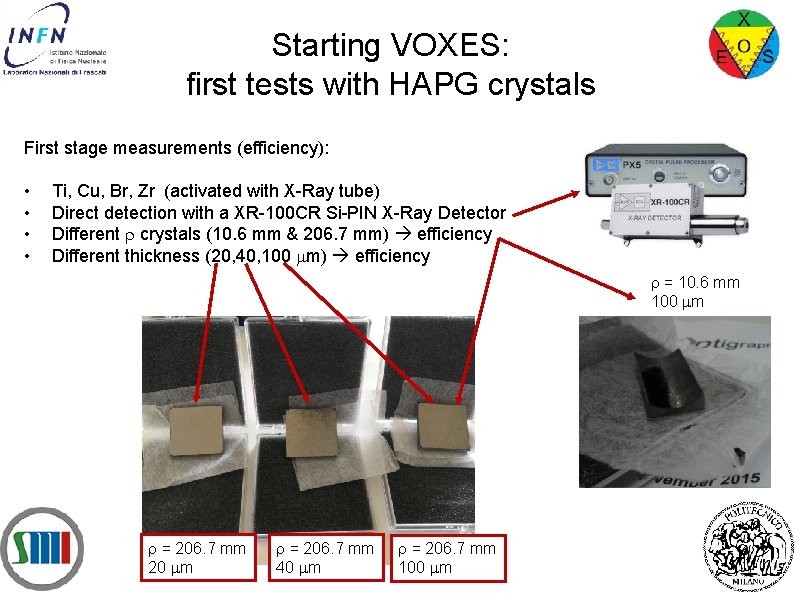
Starting VOXES: first tests with HAPG crystals First stage measurements (efficiency): • • Ti, Cu, Br, Zr (activated with X-Ray tube) Direct detection with a XR-100 CR Si-PIN X-Ray Detector Different r crystals (10. 6 mm & 206. 7 mm) efficiency Different thickness (20, 40, 100 m) efficiency r = 10. 6 mm 100 m r = 206. 7 mm 20 m r = 206. 7 mm 40 m r = 206. 7 mm 100 m
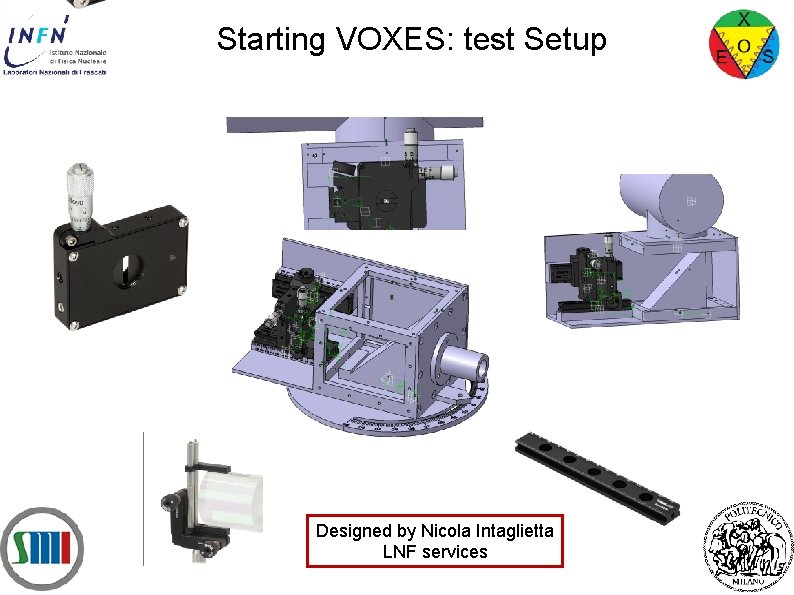
Starting VOXES: test Setup Designed by Nicola Intaglietta LNF services
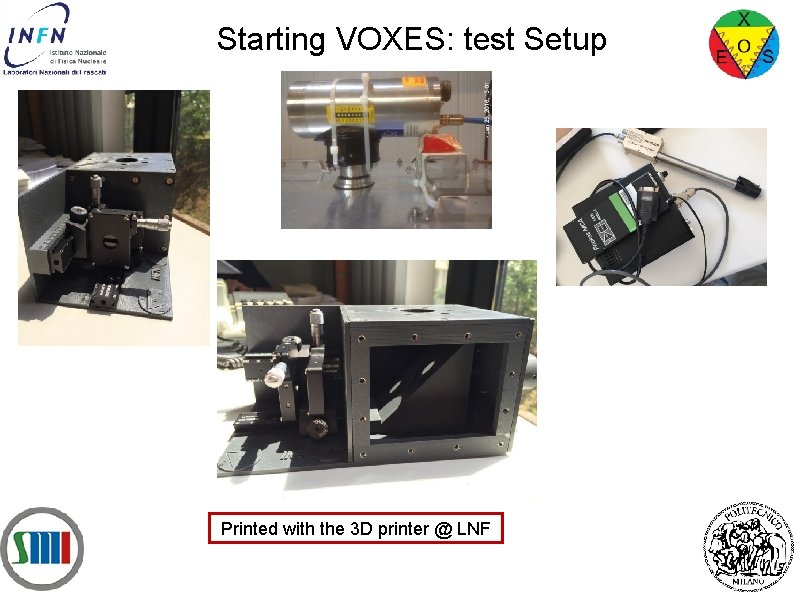
Starting VOXES: test Setup Printed with the 3 D printer @ LNF
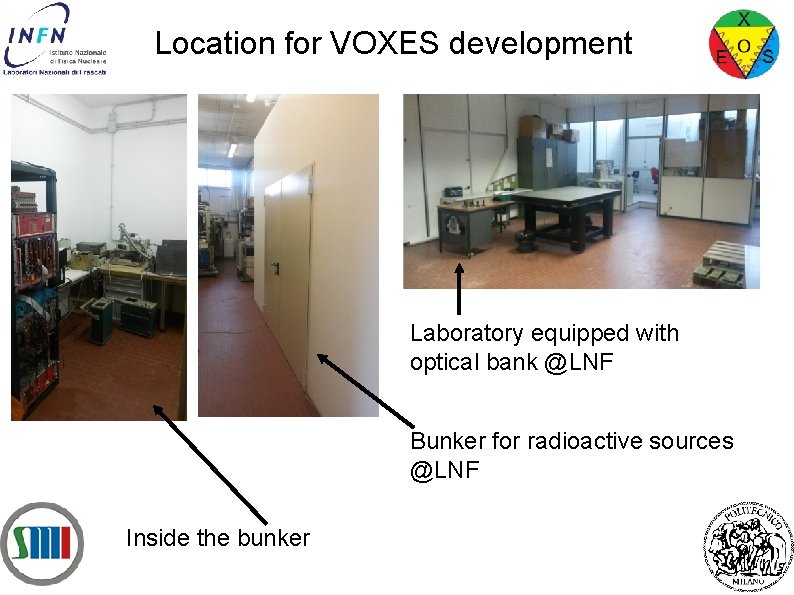
Location for VOXES development Laboratory equipped with optical bank @LNF Bunker for radioactive sources @LNF Inside the bunker
• VOXES develops an innovative ultra-high resolution X-ray spectrometer prototype, badly needed in various fields of research and technological applications • To achieve its goal VOXES sets up a highly qualified multi-disciplinary international network, with contacts with the world-leader producer of HAPG (Optigraph) • VOXES introduces a new technology in INFN, having high potential for applications inside INFN (DA NE-Luce, SIDDHARTA, VIP@LNGS) and in external facilities (JPARC, PSI, FAIR), in strong contact with world-leader institutes (Poli. Mi, SMI, FBK) and crystals producer (Optigraph) • VOXES will realise a feasibility demonstration through a preliminary measurement with high scientific impact (pionic helium at PSI) Thank you for the attention