
Vowels 2 LIN 3201 Some reminders about 1
Vowels 2 LIN 3201

Some reminders about
1. Vowels are described in three basic parameters: ¡ Tongue height: [i] vs. [a] (high vs. low /close vs. open) ¡ Tongue backness: [i] vs. [u] (front vs. back) ¡ Lip rounding: [i] vs. [y] (rounded vs. unrounded)
2. Vowels, as syllable nuclei, may occur alone in the nucleus or with other sounds ¡ Pure vowels – a single vowel that maintains tongue positioning and lip rounding state during entire production of the vowel; [i] or [o] ¡ Glided vowels – a combination of a vowel and another vowel or an approximant in the same syllable; tongue and lip position “glides” from production of sound a to sound b; [iy] or [ow] l Also known as diphthongs l Perceived as being a single unit
3. Vowels are organized into a reference system known as Cardinal Vowels (CVs) l Cardinal vowels are a system of universal reference vowels l They don’t necessarily coincide with vowels of any one language (Especially not English!) l Considered to be auditorily equidistant steps, so your tongue doesn’t necessarily move in equidistant steps l They are all peripheral (occurring at the outermost boundaries of the vowel system) and pure
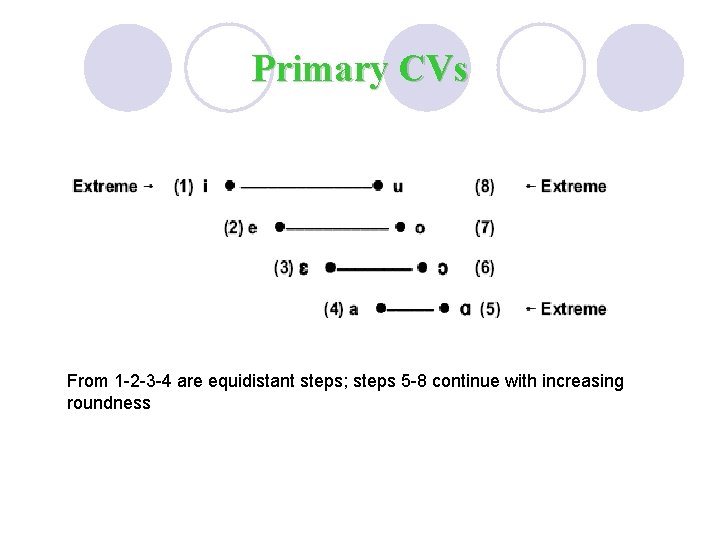
Primary CVs From 1 -2 -3 -4 are equidistant steps; steps 5 -8 continue with increasing roundness
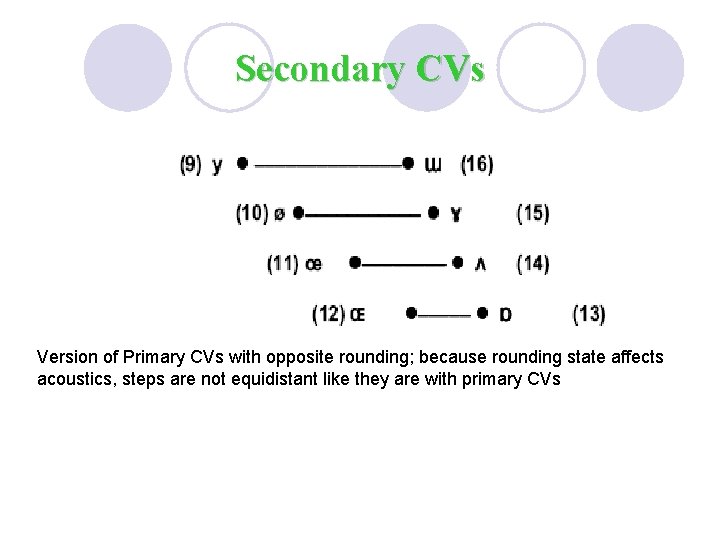
Secondary CVs Version of Primary CVs with opposite rounding; because rounding state affects acoustics, steps are not equidistant like they are with primary CVs
4. Some languages use an additional features to describe vowel qualities l Sometimes called “tense” vs. “lax” vowels, where tense = tightened tongue musculature l Used to distinguish vowels in English [i] vs. [I] l Be cautious, this terminology is controversial l Some languages, like Akan or Twi, do have a vowel distinction in pharynx width l ATR – Advanced Tongue Root – is a better description than tense or lax (+ATR or –ATR) ¡ Involves lowering the larynx or advancing the root of the tongue so that the pharyngeal cavity is enlarged
5. There additional modifications affecting vowels Nasalization – send air through nasal cavity during production of vowel l Voicelessness – devoice vowel l Length – vowel increase in length l Diphthongs – combine with another vowel (or approximant) in same syllable l ¡ ¡ Rhotacization – adding “r-coloring” to vowel, as in American English pronunciation of bird Gliding in general – adding vowel or approximant in the same syllable before producing the primary vowel (on-glide) or after (off-glide)
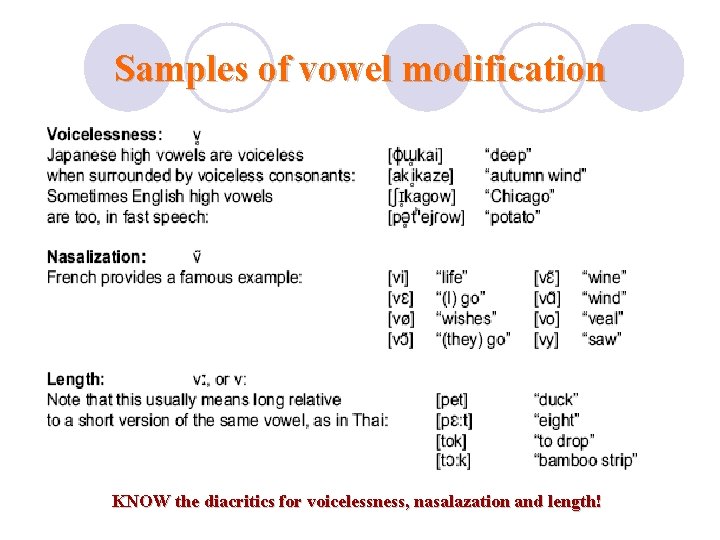
Samples of vowel modification KNOW the diacritics for voicelessness, nasalazation and length!
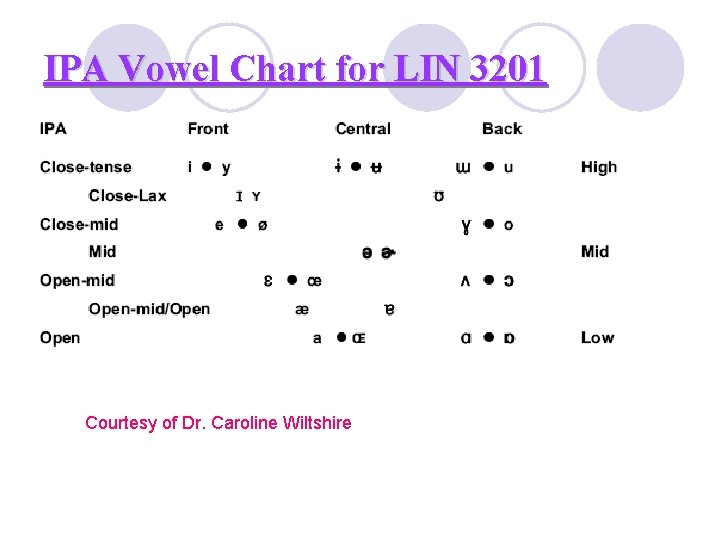
IPA Vowel Chart for LIN 3201 Courtesy of Dr. Caroline Wiltshire
- Slides: 11