
Voting Theory Problems and Solutions An introduction to
Voting Theory: Problems and Solutions An introduction to Voting Theory, based on: William Poundstone's Gaming the Vote: why elections aren't fair (and what we can do about it) (2008) From Robert Cavalier's Approaching Deliberative Democracy: theory and practice (2011): Gerry Mackey's Deliberation, but Voting Too Christian List and Anne Sliwka's Learning Democratic Communication through ”Deliberative Polling”
Voting Theory: Problems and Solutions The problem (today): Troubles with our system, and even. . . Troubles with any system! Change is also hard to implement, and Stepping back, voting as the central activity of a democracy may be the wrong way to go about it The solution (next week): Stay tuned!
Problems with our system The United States often uses Plurality Voting: Each individual can vote for one candidate The candidate with the most votes wins The electoral college is an additional complication, but plurality voting is usually used to determine who gets a state’s votes
Problems with our system A well-known example of Plurality Voting: Bush, Gore and Nader would all like to become President Common voter preferences: B>G>N N>G>B G>N>B Individuals decide whom to vote for, cast their votes Just to simplify, imagine that Bush gets 48%, Gore 47%, Nader 5% Bush wins, although he's the majority's least favorite
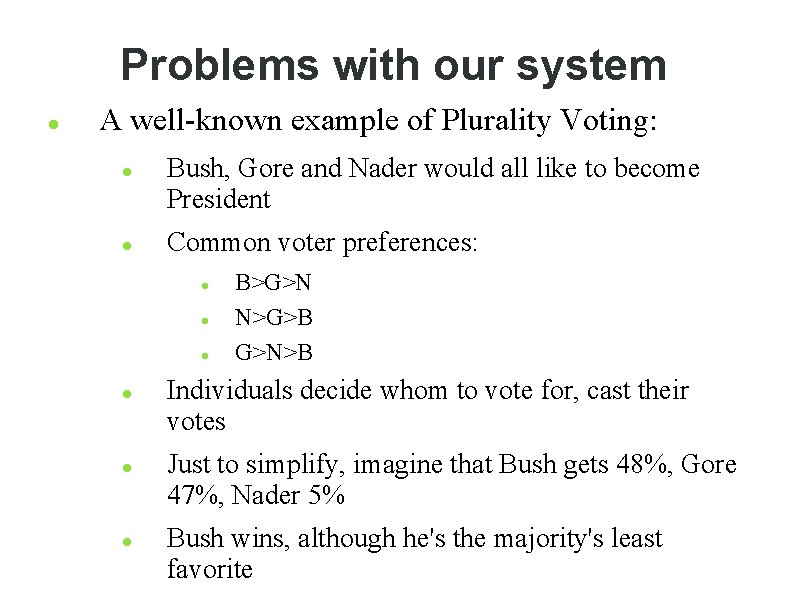
Problems with our system This simple example shows one big problem for Plurality Voting: Vote Splitting occurs when multiple candidates appeal to a group of voters with similar preferences If the voters do not coordinate on a single candidate, the group’s vote is split This is particularly troublesome when, as often happens, it causes the majority's least preferred candidate to win
Problems with our system Vote Splitting has an enormous impact on our system and our politics The major parties hold primaries to avoid vote splitting within a party Third party candidates have no way of getting power, and are even discouraged from being spoilers It is common for politicians and parties to spend money trying to split the rival party's vote (Poundstone) Generally this strikes us as unfair – shouldn't the winner be a simple and intuitive function of voter preferences?
Problems with our system Other problems with American Plurality Voting: Getting elected requires having a broad base of support, pushing candidates towards the political center (compare to proportional representation) Voices from the rest of the spectrum are ignored, leaving those perspectives out of the debate Since many Americans are cynical and not aware of other ways of voting, there is little pressure to change
The problem is not just ours. . . Plurality Voting has serious problems, but there is no simple solution Arrow's Theorem says, essentially, that there is no perfect voting system; there is no way to take individual preferences and turn them into an outcome such that a set of intuitive desiderata are all guaranteed to be satisfied
Arrow's Theorem Assume a group of individuals, each having a preference ordering x>y>z. . . over a set of (more than 2) candidates We want an aggregation rule – a way of transforming these individual preferences into a group preference – that is sensible and fair. The ideal voting system is one that never makes an intuitively terrible decision, given the preferences of the voters.
Arrow's Theorem Kenneth Arrow proved that this is impossible: there does not exist a voting system universally transforming individual preference orderings into a good decision Specifically, no such system can satisfy the following criteria, thought to capture the most basic requirements of a good voting system: Unrestricted domain, Transitivity, Weak Pareto, Non-dictatorship, Independence of irrelevant alternatives
Conditions of Arrows Theorem Unrestricted domain: Individuals can have any preference ordering over the candidates Motivation: people's preferences are their own business. Voting rule should work regardless.
Conditions of Arrows Theorem Transitivity: A preference relation > is transitive if when a>b and b>c, then a>c. A voting rule violating transitivity would make no sense – it would be incoherent.
Conditions of Arrows Theorem Weak Pareto: if all individuals prefer candidate A to candidate B, then the voting rule should prefer A to B as well This seems obvious! When voters agree about who is best, the voting rule should simply agree with the voters
Conditions of Arrows Theorem Non-dictatorship: No individual is a dictator, i. e. an individual whose preference solely determines the aggregate preference. A dictator could change the group preference just by changing their individual preference. Motivation: fairness and the ideals of democracy. All votes are supposed to have equal importance. That's why we vote to begin with!
Conditions of Arrows Theorem Independence of irrelevant alternatives (IIA): The aggregate preference between any two candidates is a function only of individual preferences between those two candidates. Motivation: when ranking A and B, relative preference for C is irrelevant.
Arrow's Theorem In summary, Arrow proved that there is no system of preference aggregation that satisfies all of the preceding intuitive criteria. We have two choices: Give up some of those criteria, and accept a system that can fail some of them Use a system that does something other than aggregate preference orderings (e. g. Approval Voting)
Arrow's Theorem: Example 1 Condorcet Voting: A candidate wins on this criterion if they would win in a head to head contest with each other candidate This ensures that if a majority favor a candidate, that candidate wins, at minimum
Arrow's Theorem: Example 2 But Condorcet Voting has problems: It fails IIA There is not always a Condorcet Winner given a set of preferences, and so in some cases another procedure would be needed to determine the election winner
Arrow's Theorem: Example 2 Borda Count: Each individual ranks each candidate (giving a '1' for the most preferred, '2' for the second favorite, etc. For each candidate, the numbers they received are added up The candidate with the lowest score wins, since low numbers indicate higher preference The benefit of this system is that individuals' relative rankings of their non-first-choice candidates is taken into account
Arrow's Theorem: Example 2 The Borda count seems like a reasonable rule, but: It fails IIA A candidate can be preferred by a majority and still lose (this is at least strange) A candidate could win against each other candidate head to head, but lose the election (violating the Condorcet criterion) Dishonesty pays – ranking close competitors last gives one's own preferred candidate an advantage
No voting system is perfect Practical problems: A voting system must be easy to implement, so that results can be calculated quickly It should be reliable, and not easy to hack The system should be easy for people to use, understand, trust Prefer to have honest voting, not strategic voting
Obstacles to change Even once we recognize the problems with our system, change is hard to implement: Arrow's Theorem causes many to lose hope Advocates of different solutions (to be discussed next week) argue instead of working together Changing the voting system requires having politicians who benefitted from the old system (by getting elected) agree to get rid of it – there is a conflict of interest People are suspicious of new voting schemes
A step back from the voting problem We've looked at a series of problems with particular voting systems, and with moving from one to another Perhaps our narrow focus on voting systems is itself problematic
A step back from the voting problem The assumption that voting is the central act of democracy has been challenged (e. g. by Mackie) Perhaps a healthy democracy requires public discussion, or even deliberation, a process by which individuals discuss the issues and possible solutions in an attempt to reach conclusions that will be good for the whole community
A step back from the problem of voting When voting is viewed from an economics or rational choice perspective, it is seen as a process where: Individuals vote based on their own narrow selfinterest When votes are tallied, the winner is the candidate whose positions are in the best interest of the most people What about public-spiritedness and the public good?
A step back from the problem of voting This tension between individual self-interest and public-spiritedness is highlighted by two paradoxes The paradox of voting The paradox of informedness
A step back from the problem of voting The paradox of voting (or non-voting): The odds that an individual's vote determines the outcome of an election are miniscule – the individual would have to be the tie-breaker of an even election Voting takes time and energy So even though the benefits from having the election go to the preferred candidate might be highly desirable, The expected value of voting is negative, so ”rational” people would not vote
A step back from the voting problem The paradox of informedness: Keeping up to date on politics and current events takes time and energy The probability that learning this information will enable an individual to positively impact future events is miniscule Again, the expected value of staying informed is negative, and rational people shouldn't bother
A step back from the problem of voting Despite these paradoxes, many people do vote and try to stay informed This empirical fact shows that there is a problem with viewing voting as the central act of democracy People do not vote out of self-interest (demonstrated by List and Swilka), but because participation is important to them This indicates that devising an ideal voting system won't even solve our problems – we need a good system for participation
Summary: Problem of Voting Plurality Voting has serious problems, most notably Vote Splitting Arrow's Theorem: no perfect system we can substitute for it Voting systems must also be practical, and they must be instituted by politicians Finally, by focusing narrowly on voting schemes, we miss the bigger picture, where deliberation and participation play important roles in healthy democracies
- Slides: 30