
Vortex pinning by a columnar defect in planar
Vortex pinning by a columnar defect in planar superconductors with point disorder Anatoli Polkovnikov Yariv Kafri, David Nelson Department of Physics, Harvard University.
Plan of the talk 1. Vortex physics in 1+1 dimension. Mapping to a Luttinger liquid. 2. Effects of point disorder. Vortex glass phase. Response to a columnar pin. 3. Unzipping of a single vortex from a columnar pin and a twin plane with point disorder. 4. Unzipping a single vortex from a twodimensional Luttinger liquid. Revealing the Luttinger liquid parameter.
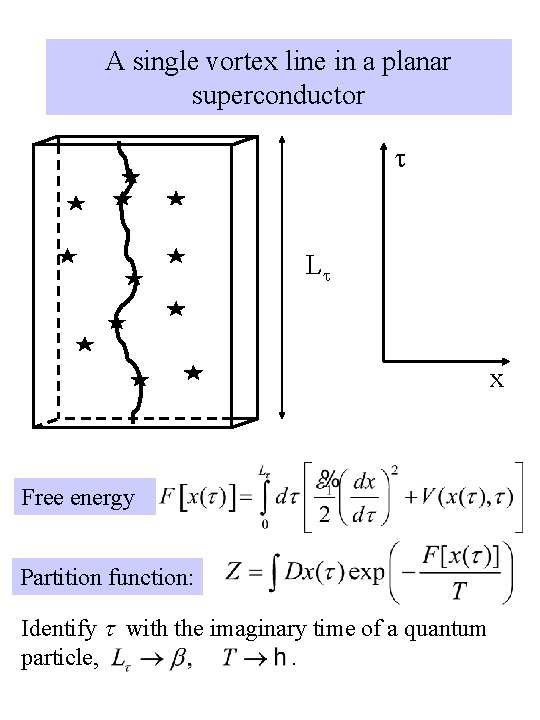
A single vortex line in a planar superconductor L x Free energy Partition function: Identify with the imaginary time of a quantum particle, .
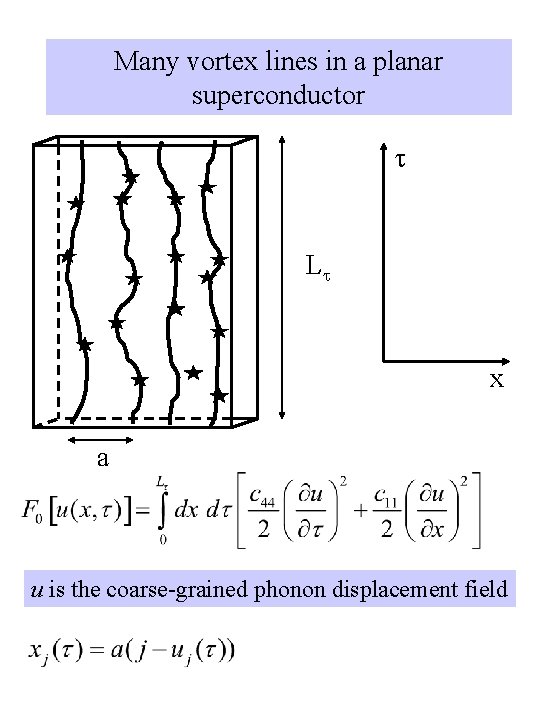
Many vortex lines in a planar superconductor L x a u is the coarse-grained phonon displacement field
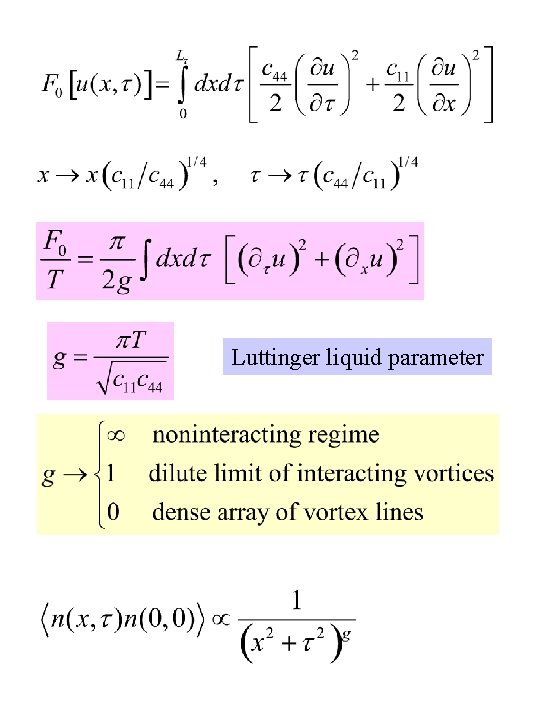
Luttinger liquid parameter
![Random phase, [0, 2 ] Point disorder: Flow equations near g=1 1 J. Cardy](http://slidetodoc.com/presentation_image/dd9f9f7bcd4ff5555160c8031aab3c2d/image-6.jpg "Random phase, [0, 2 ] Point disorder: Flow equations near g=1 1 J. Cardy")
Random phase, [0, 2 ] Point disorder: Flow equations near g=1 1 J. Cardy and S. Ostlund, 1982 g

Correlation functions Vortex liquid phase J. Cardy and S. Ostlund, 1982, M. P. A. Fisher 1989. vortex glass phase 1 g

Add a columnar pin Contribution to free energy Kane-Fisher problem with no disorder:
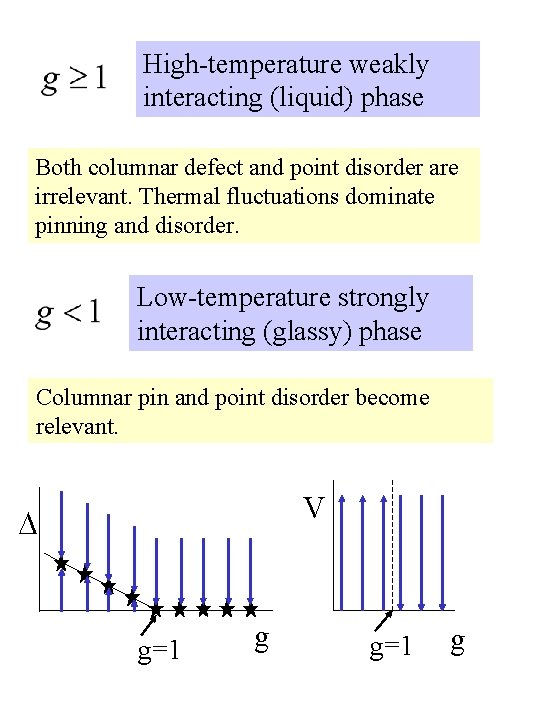
High-temperature weakly interacting (liquid) phase Both columnar defect and point disorder are irrelevant. Thermal fluctuations dominate pinning and disorder. Low-temperature strongly interacting (glassy) phase Columnar pin and point disorder become relevant. V g=1 g
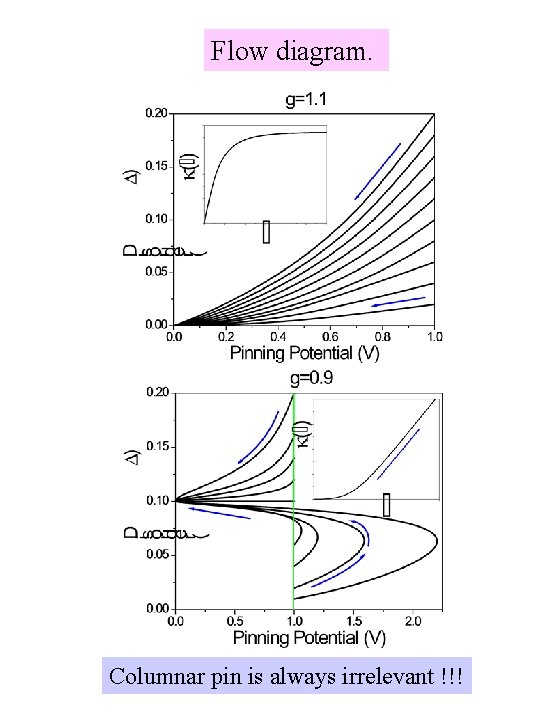
Flow diagram. Columnar pin is always irrelevant !!!
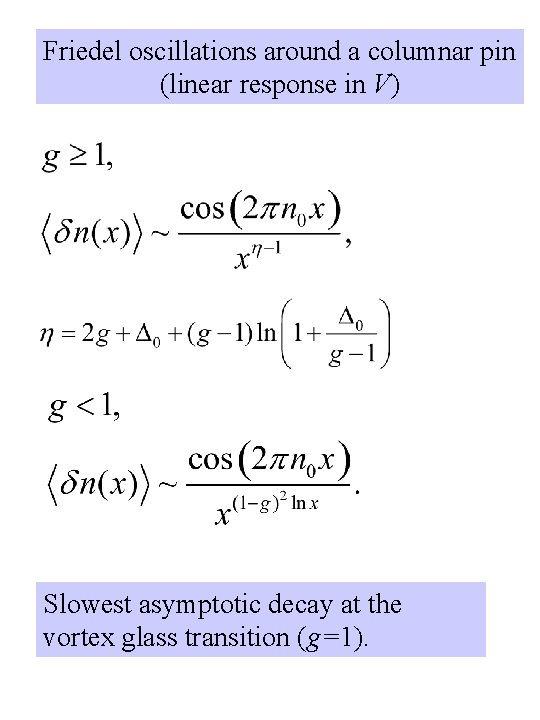
Friedel oscillations around a columnar pin (linear response in V) Slowest asymptotic decay at the vortex glass transition (g=1).
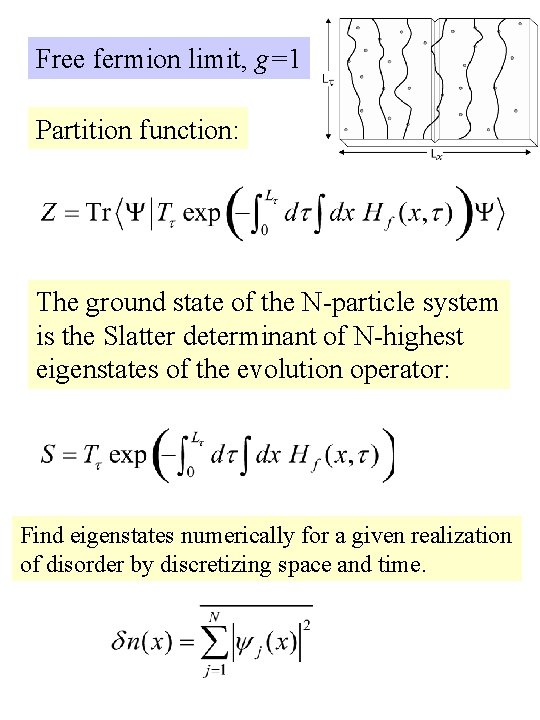
Free fermion limit, g=1 Partition function: The ground state of the N-particle system is the Slatter determinant of N-highest eigenstates of the evolution operator: Find eigenstates numerically for a given realization of disorder by discretizing space and time.
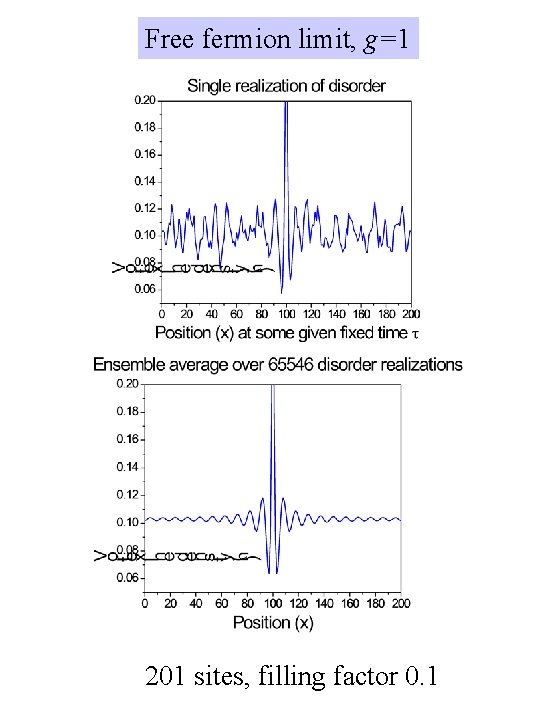
Free fermion limit, g=1 201 sites, filling factor 0. 1
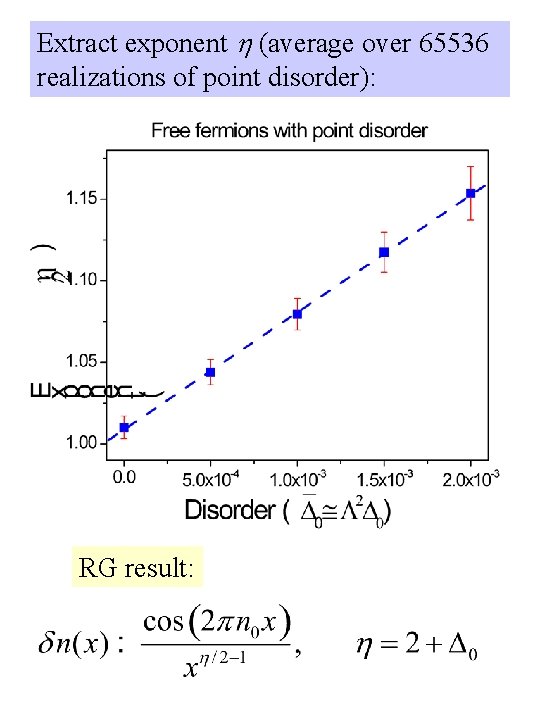
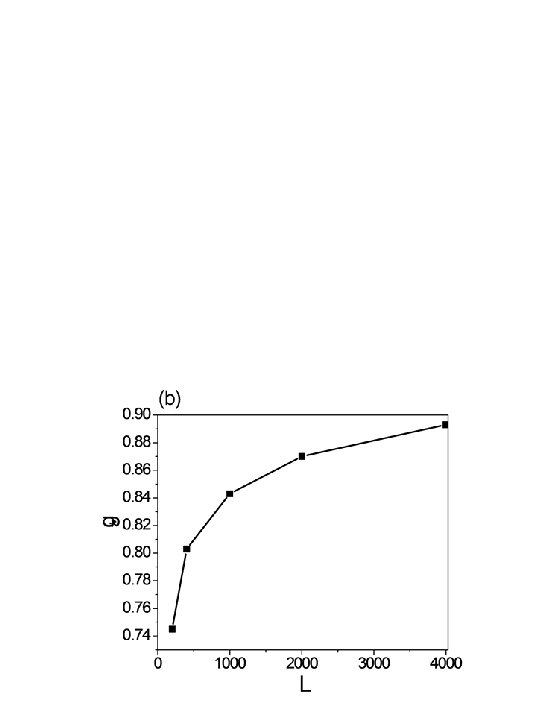
Extract exponent (average over 65536 realizations of point disorder): RG result:
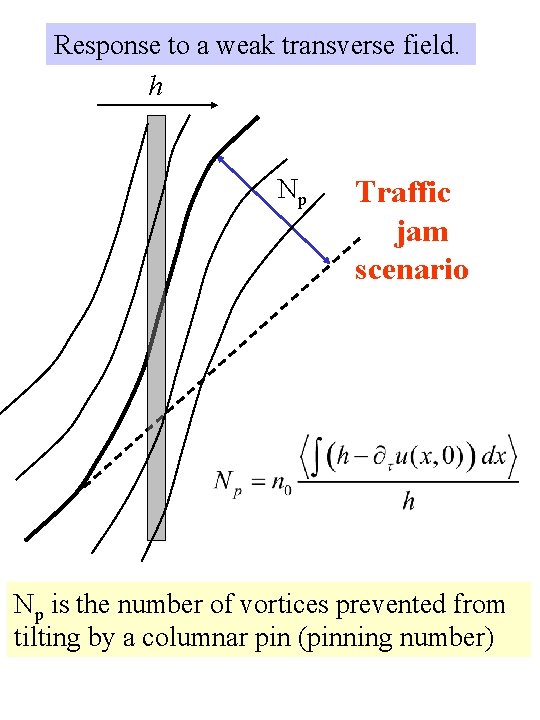
Response to a weak transverse field. h Np Traffic jam scenario Np is the number of vortices prevented from tilting by a columnar pin (pinning number)
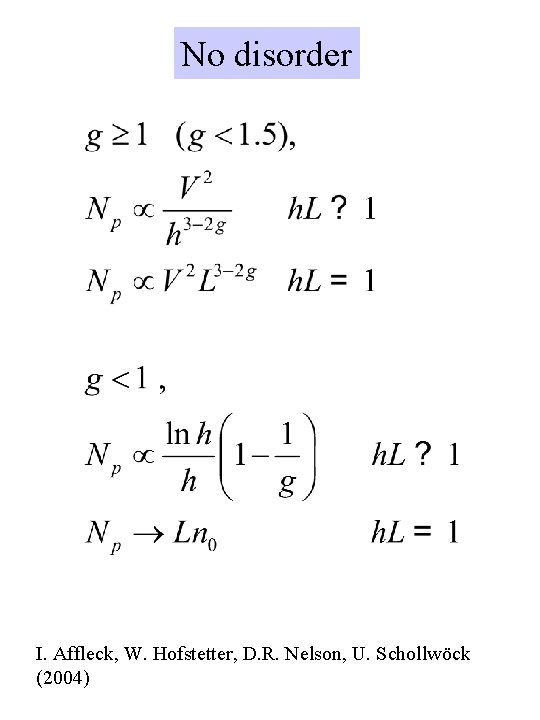
No disorder I. Affleck, W. Hofstetter, D. R. Nelson, U. Schollwöck (2004)
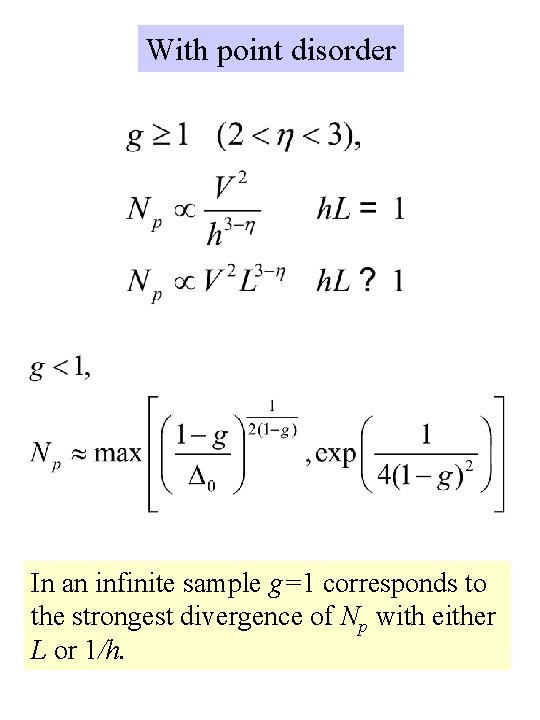
With point disorder In an infinite sample g=1 corresponds to the strongest divergence of Np with either L or 1/h.
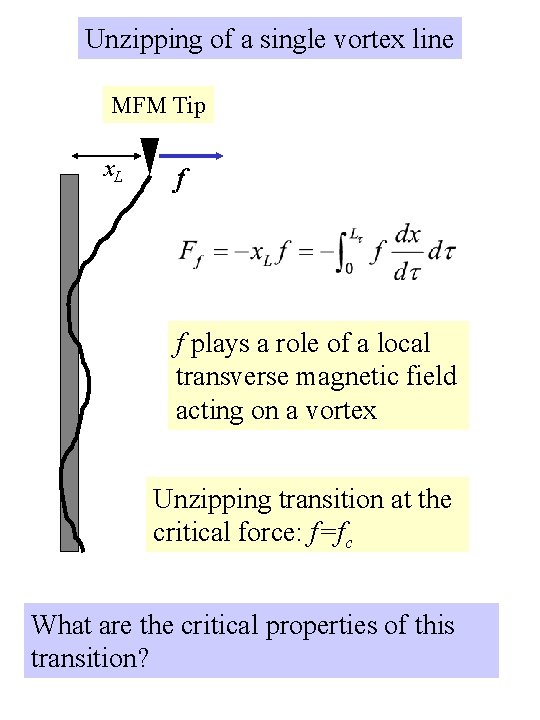
Unzipping of a single vortex line MFM Tip x. L f f plays a role of a local transverse magnetic field acting on a vortex Unzipping transition at the critical force: f=fc What are the critical properties of this transition?
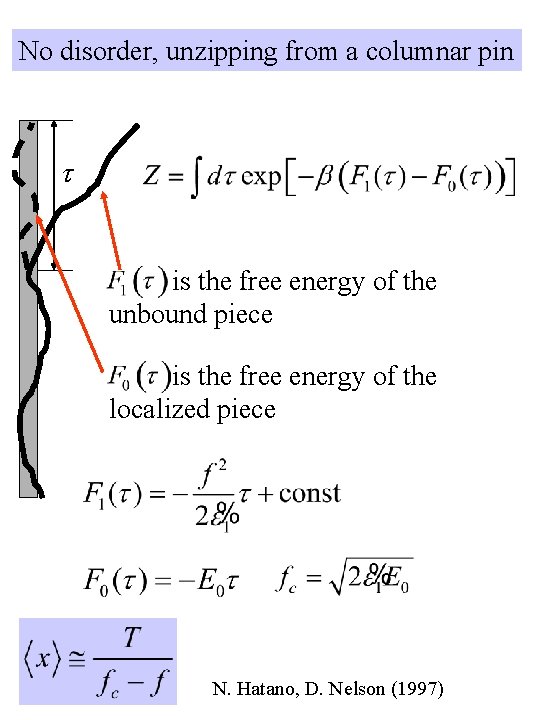
No disorder, unzipping from a columnar pin is the free energy of the unbound piece is the free energy of the localized piece N. Hatano, D. Nelson (1997)
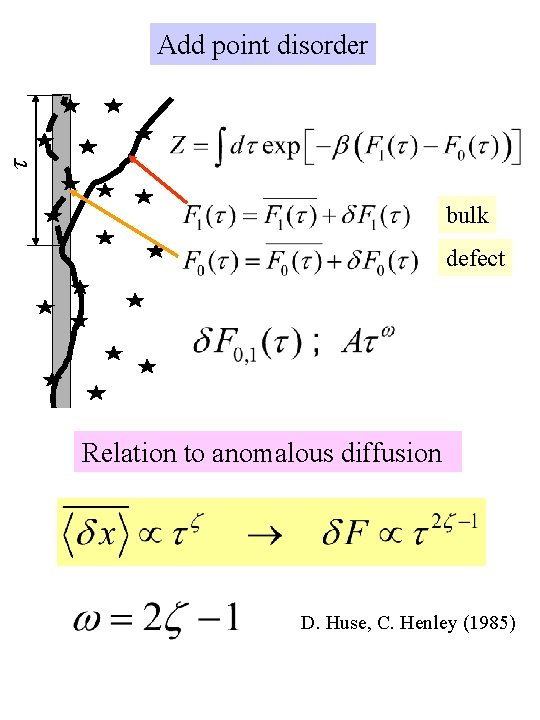
Add point disorder bulk defect Relation to anomalous diffusion D. Huse, C. Henley (1985)

Dominant disorder on the defect Fragmented Columnar pin: =1/2 Disordered twin plane =1/3, =2/3 x Dominant disorder in the bulk 2 D: =1/3 3 D: 0. 22

Disordered columnar pin ( =1/2): D. Lubensky and D. Nelson (2000). x Replica calculation:
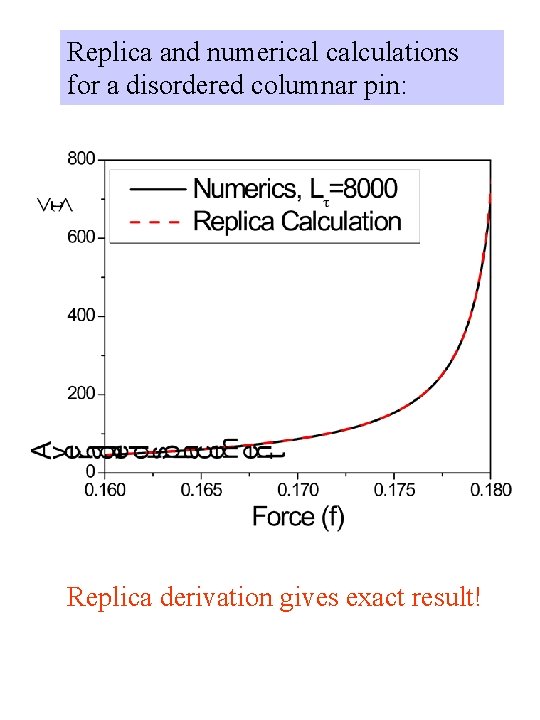
Replica and numerical calculations for a disordered columnar pin: Replica derivation gives exact result!
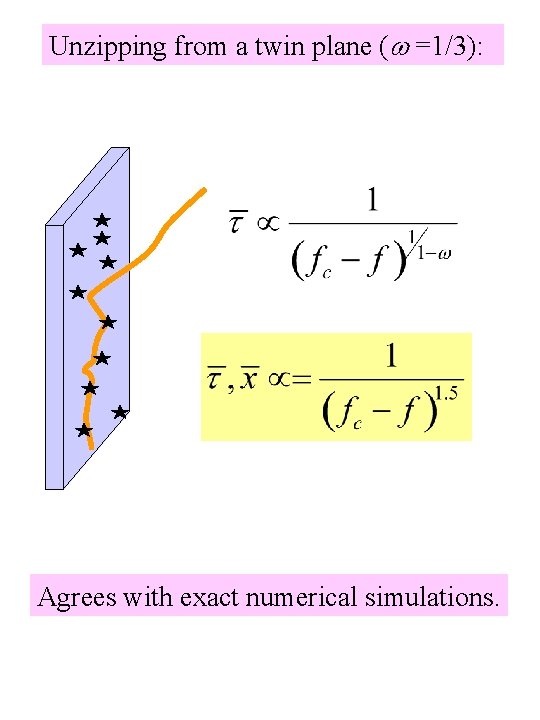
Unzipping from a twin plane ( =1/3): Agrees with exact numerical simulations.
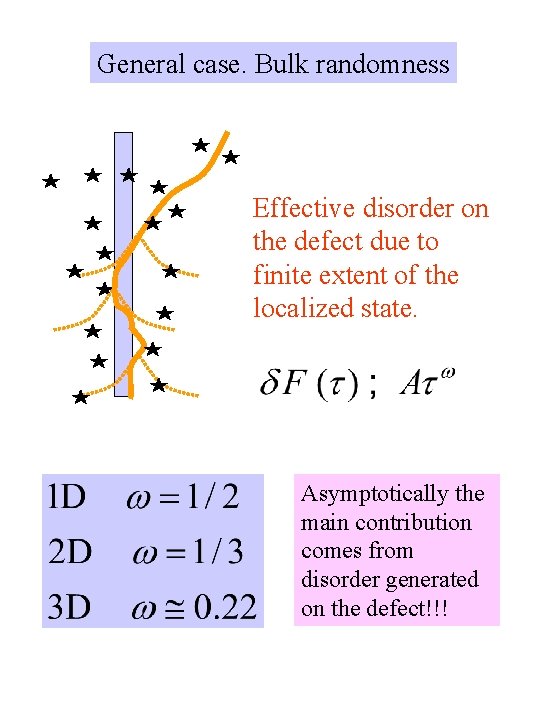
General case. Bulk randomness Effective disorder on the defect due to finite extent of the localized state. Asymptotically the main contribution comes from disorder generated on the defect!!!
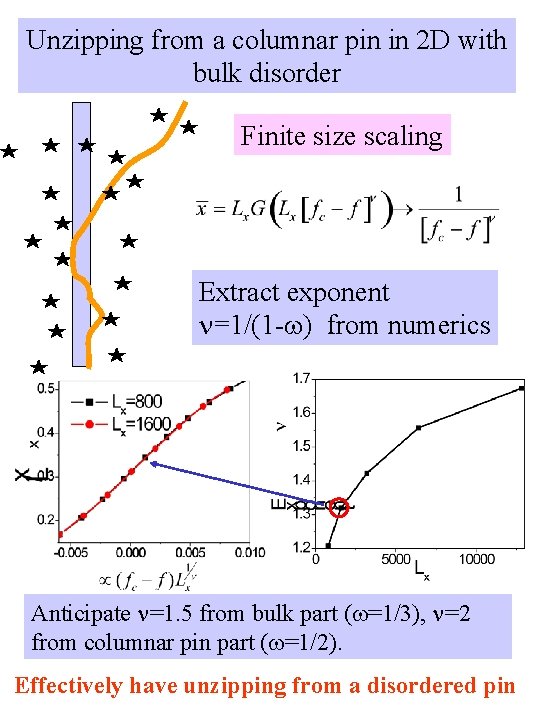
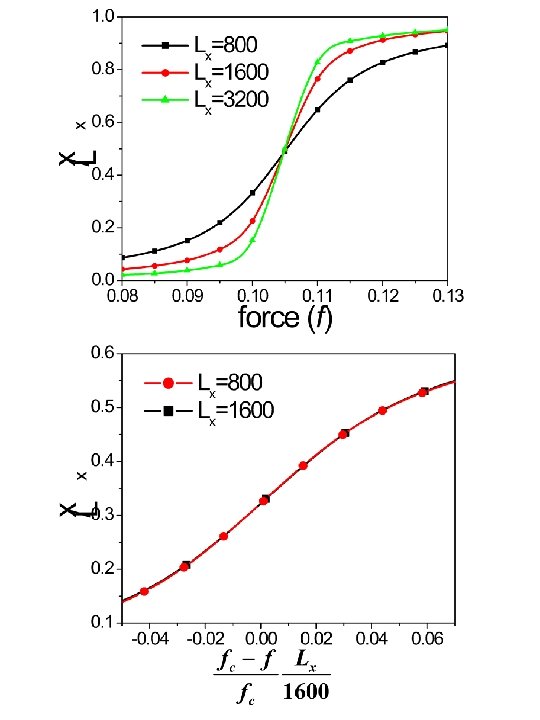
Unzipping from a columnar pin in 2 D with bulk disorder Finite size scaling Extract exponent =1/(1 - ) from numerics Anticipate =1. 5 from bulk part ( =1/3), =2 from columnar pin part ( =1/2). Effectively have unzipping from a disordered pin
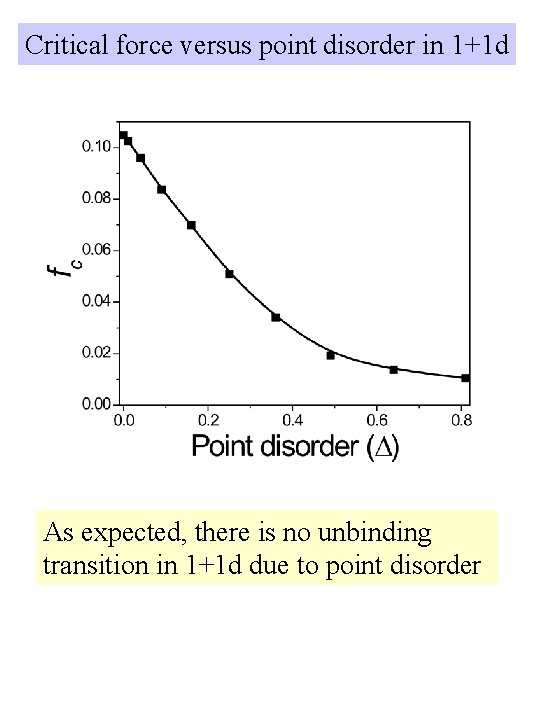
Critical force versus point disorder in 1+1 d As expected, there is no unbinding transition in 1+1 d due to point disorder
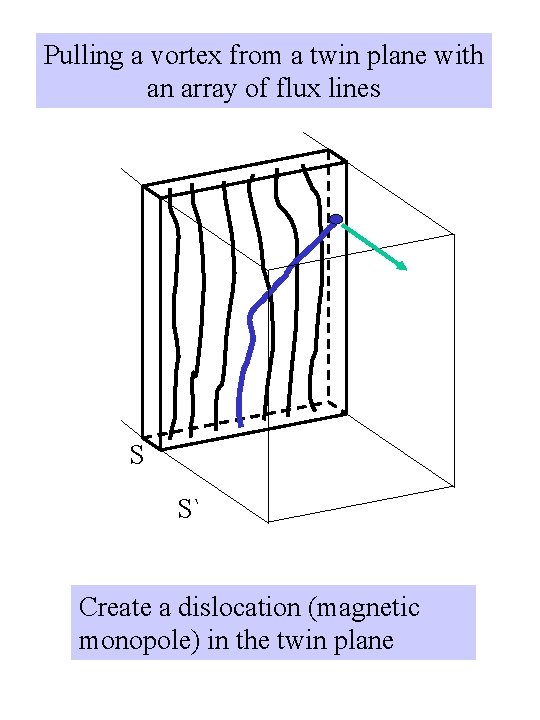
Pulling a vortex from a twin plane with an array of flux lines S S` Create a dislocation (magnetic monopole) in the twin plane
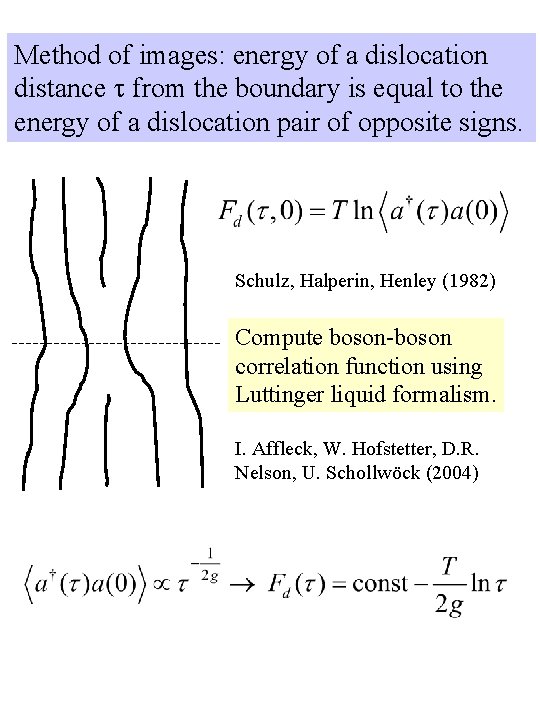
Method of images: energy of a dislocation distance from the boundary is equal to the energy of a dislocation pair of opposite signs. Schulz, Halperin, Henley (1982) Compute boson-boson correlation function using Luttinger liquid formalism. I. Affleck, W. Hofstetter, D. R. Nelson, U. Schollwöck (2004)
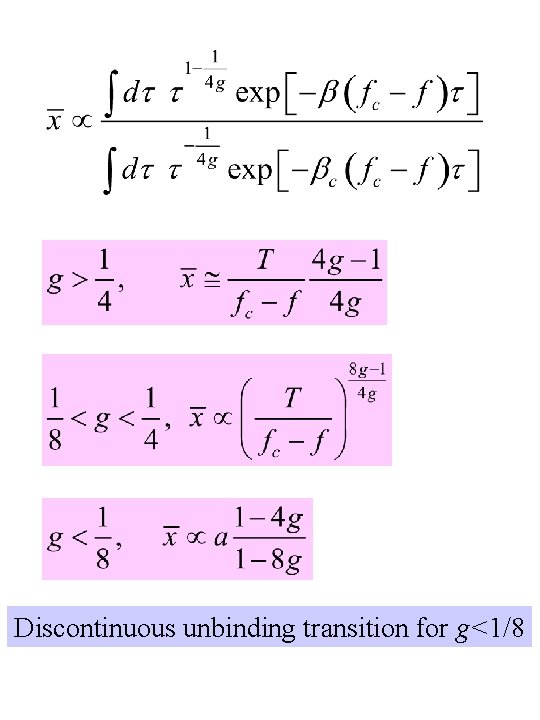
Discontinuous unbinding transition for g<1/8
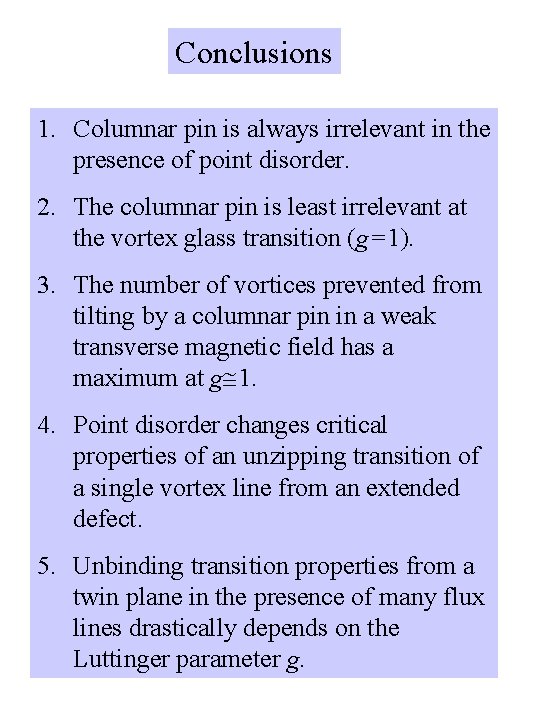
Conclusions 1. Columnar pin is always irrelevant in the presence of point disorder. 2. The columnar pin is least irrelevant at the vortex glass transition (g=1). 3. The number of vortices prevented from tilting by a columnar pin in a weak transverse magnetic field has a maximum at g 1. 4. Point disorder changes critical properties of an unzipping transition of a single vortex line from an extended defect. 5. Unbinding transition properties from a twin plane in the presence of many flux lines drastically depends on the Luttinger parameter g.
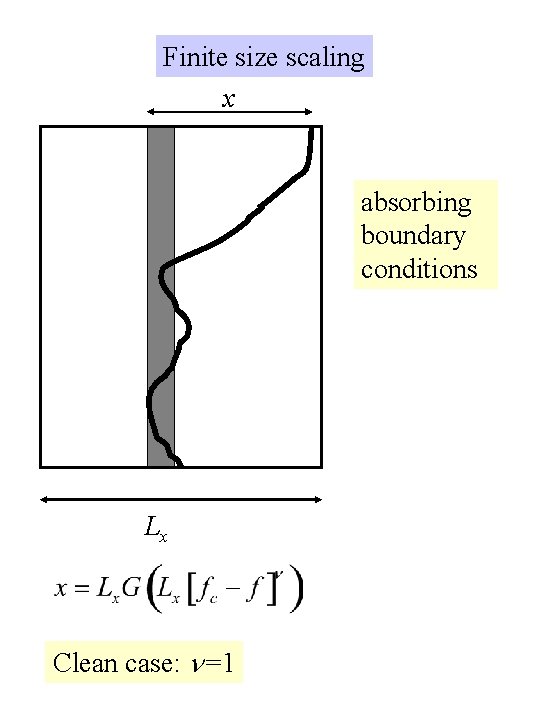
Finite size scaling x absorbing boundary conditions Lx Clean case: =1
- Slides: 34