
Voronoi Diagrams and Problem Transformations Steven Love supervised
Voronoi Diagrams and Problem Transformations Steven Love, supervised by: Jack Snoeyink and Dave Millman

What is a Voronoi Diagram? � A spatial decomposition A set of polygons A set of polyhedra Vanhoutte 2009
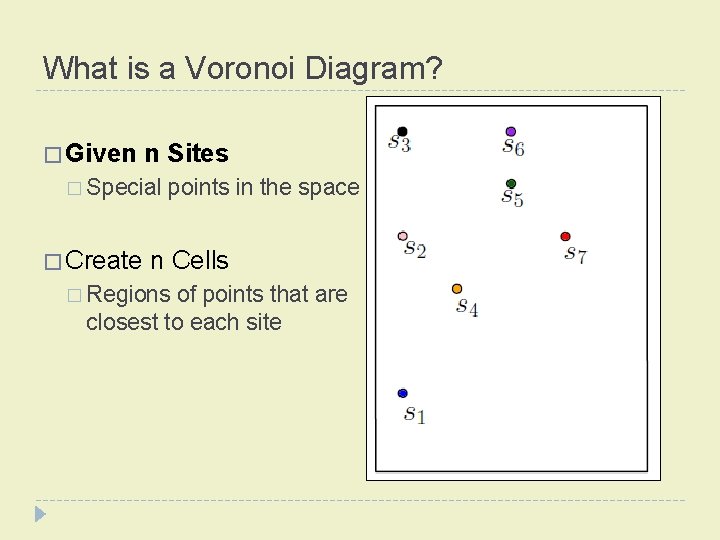
What is a Voronoi Diagram? � Given n Sites � Special points in the space � Create n Cells � Regions of points that are closest to each site
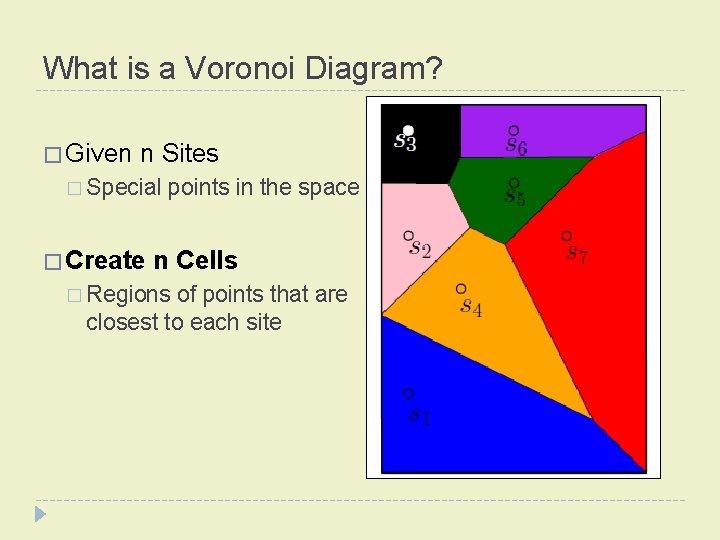
What is a Voronoi Diagram? � Given n Sites � Special points in the space � Create n Cells � Regions of points that are closest to each site
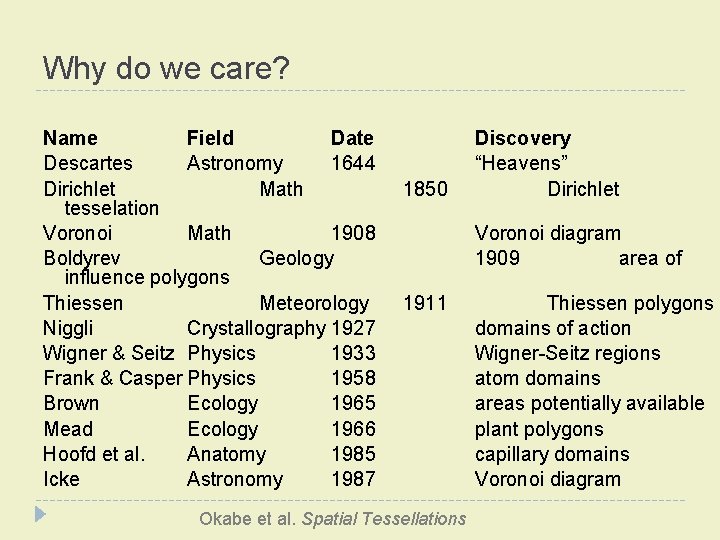
Why do we care? Name Field Date Descartes Astronomy 1644 Dirichlet Math tesselation Voronoi Math 1908 Boldyrev Geology influence polygons Thiessen Meteorology Niggli Crystallography 1927 Wigner & Seitz Physics 1933 Frank & Casper Physics 1958 Brown Ecology 1965 Mead Ecology 1966 Hoofd et al. Anatomy 1985 Icke Astronomy 1987 1850 Discovery “Heavens” Dirichlet Voronoi diagram 1909 area of 1911 Okabe et al. Spatial Tessellations Thiessen polygons domains of action Wigner-Seitz regions atom domains areas potentially available plant polygons capillary domains Voronoi diagram
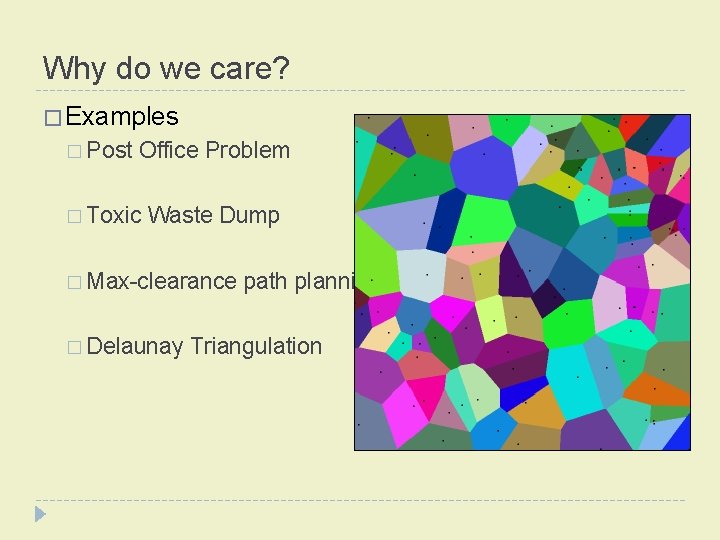
Why do we care? � Examples � Post Office Problem � Toxic Waste Dump � Max-clearance path planning � Delaunay Triangulation
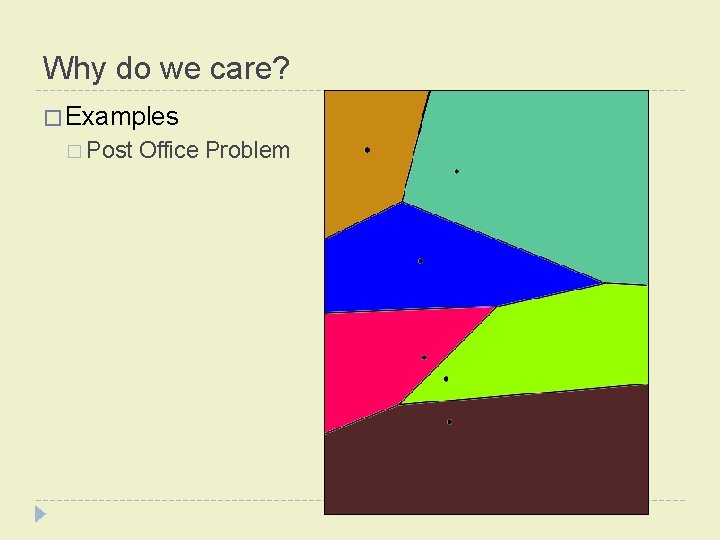
Why do we care? � Examples � Post Office Problem
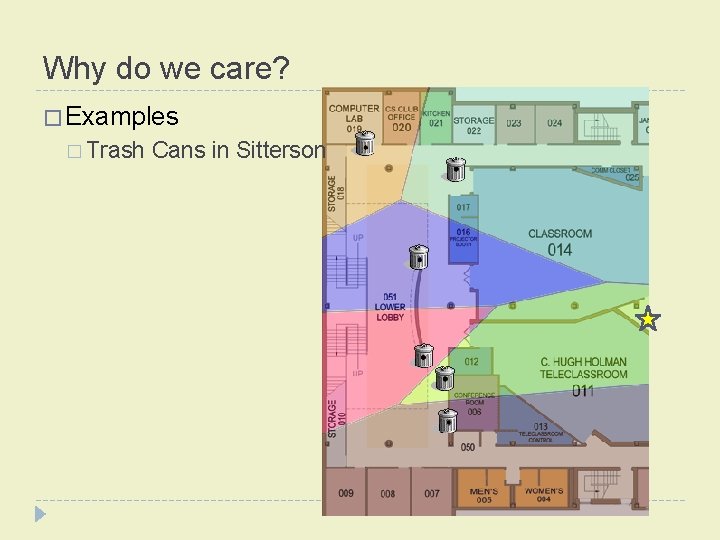
Why do we care? � Examples � Trash Cans in Sitterson

Discretized Voronoi Diagram � n Sites � n Cells � U x U Grid � U^2 Pixels
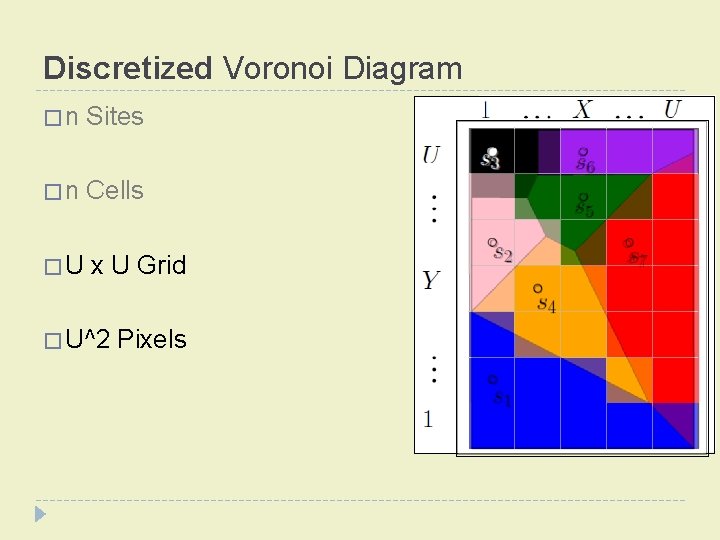
Discretized Voronoi Diagram � n Sites � n Cells � U x U Grid � U^2 Pixels s
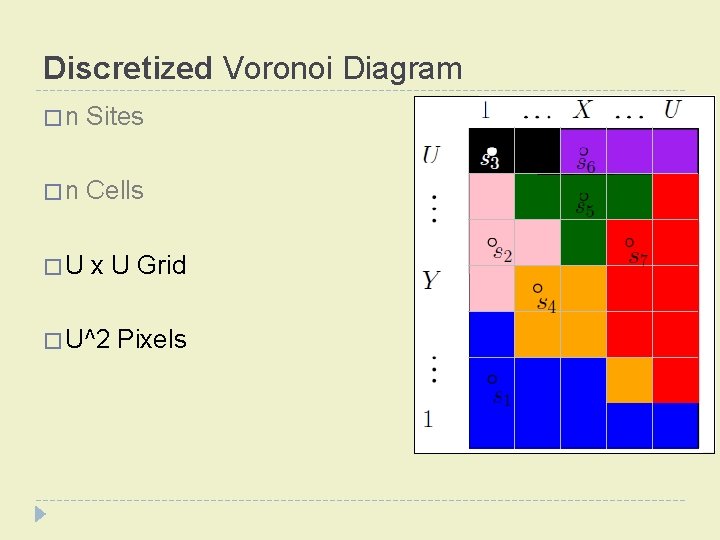
Discretized Voronoi Diagram � n Sites � n Cells � U x U Grid � U^2 Pixels s

Discretized Voronoi Diagram � 2 sites � 2 cells � 5 x 5 grid � 25 pixels D is ‘distance’ transform, IDX is discrete Voronoi Math. Works MATLAB R 2012 a Documentation for bwdis
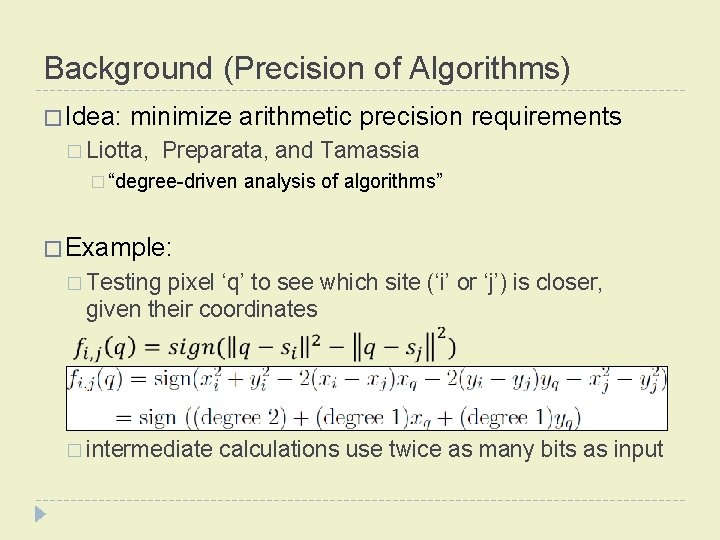
Background (Precision of Algorithms) � Idea: minimize arithmetic precision requirements � Liotta, Preparata, and Tamassia � “degree-driven analysis of algorithms” � Example: � Testing pixel ‘q’ to see which site (‘i’ or ‘j’) is closer, given their coordinates � intermediate calculations use twice as many bits as input

Background (Precision of Algorithms) Name Time Fortune O(n lg n) 5 5 Breu et al. O(U^2) 4 O(1) 0 Hoff et al. O(n*U^2) Z-buffer O(1) 0 Maurer, Chan Maurer, Chan Our Usq. Lg. U Us 1 Our Usq. Lg. U O(U^2) 3 O(1) 0 O(U^2 lg U) 2 O(1) 0 Us 2 O(U^2) 2 O(1) 0 Our Usq Time Degree Time O(lg n) Degree 6 6
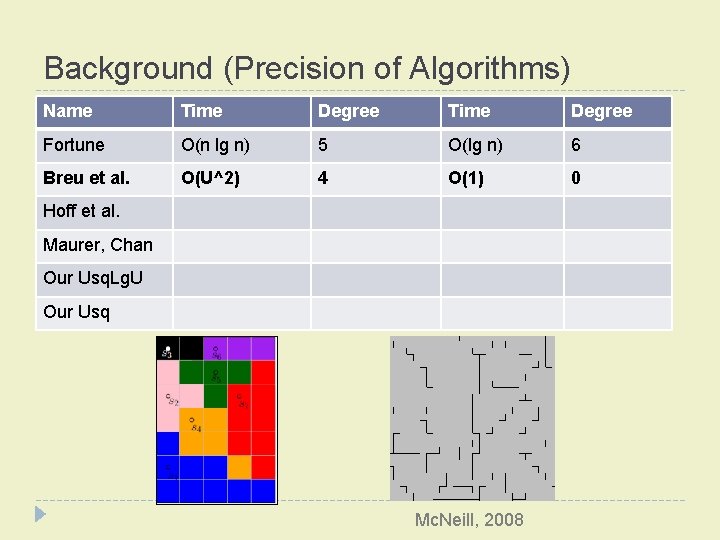
Background (Precision of Algorithms) Name Time Degree Fortune O(n lg n) 5 O(lg n) 6 Breu et al. O(U^2) 4 O(1) 0 Hoff et al. Maurer, Chan Our Usq. Lg. U Our Usq Mc. Neill, 2008
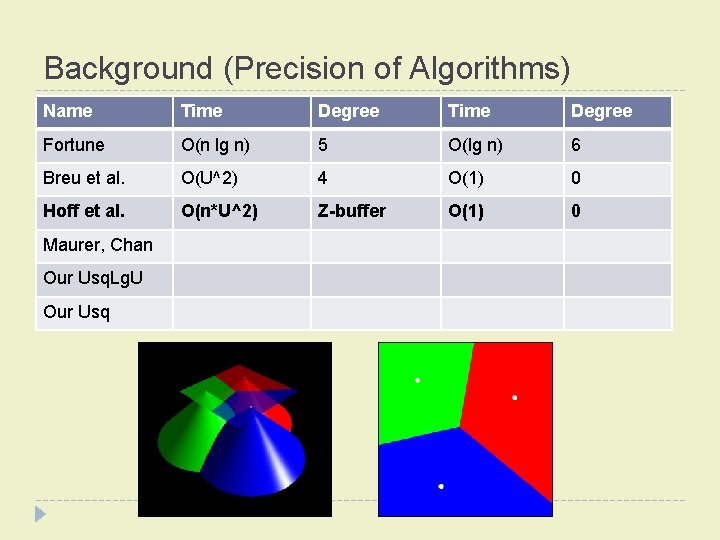
Background (Precision of Algorithms) Name Time Degree Fortune O(n lg n) 5 O(lg n) 6 Breu et al. O(U^2) 4 O(1) 0 Hoff et al. O(n*U^2) Z-buffer O(1) 0 Maurer, Chan Our Usq. Lg. U Our Usq
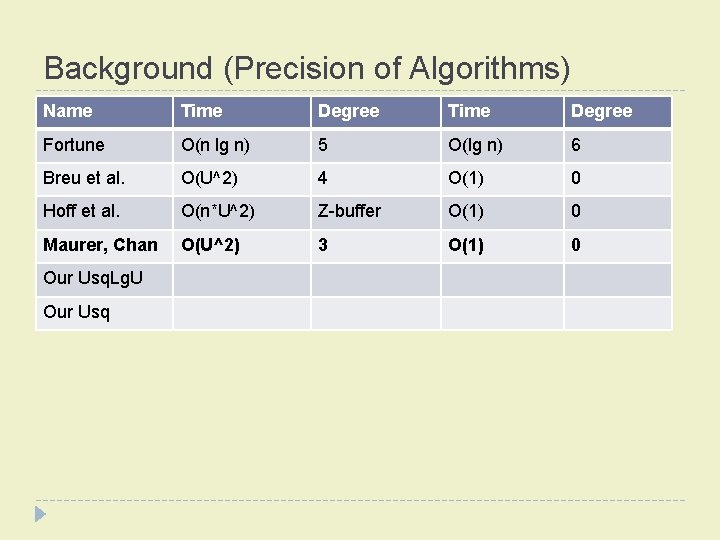
Background (Precision of Algorithms) Name Time Degree Fortune O(n lg n) 5 O(lg n) 6 Breu et al. O(U^2) 4 O(1) 0 Hoff et al. O(n*U^2) Z-buffer O(1) 0 Maurer, Chan O(U^2) 3 O(1) 0 Our Usq. Lg. U Our Usq
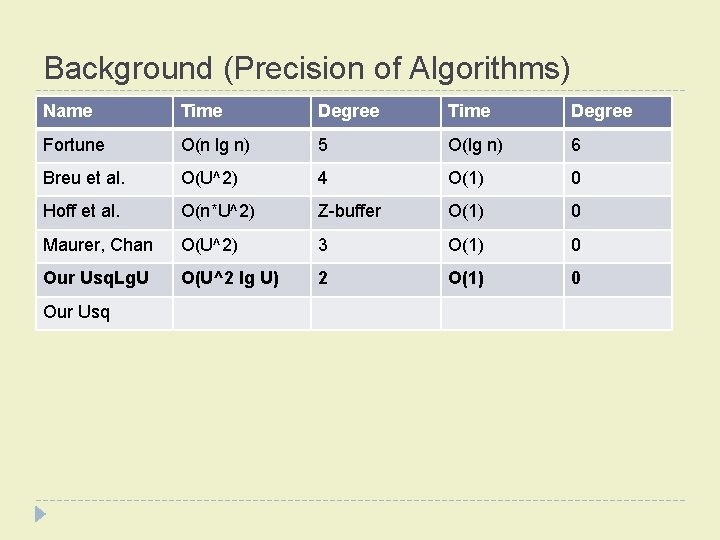
Background (Precision of Algorithms) Name Time Degree Fortune O(n lg n) 5 O(lg n) 6 Breu et al. O(U^2) 4 O(1) 0 Hoff et al. O(n*U^2) Z-buffer O(1) 0 Maurer, Chan O(U^2) 3 O(1) 0 Our Usq. Lg. U O(U^2 lg U) 2 O(1) 0 Our Usq
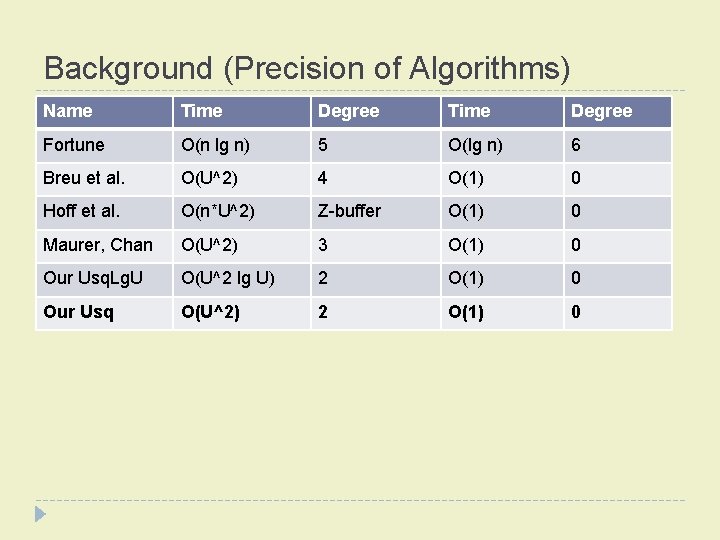
Background (Precision of Algorithms) Name asdfasd. Time Degree Fortune O(n lg n) 5 O(lg n) 6 Breu et al. O(U^2) 4 O(1) 0 Hoff et al. O(n*U^2) Z-buffer O(1) 0 Maurer, Chan O(U^2) 3 O(1) 0 Our Usq. Lg. U O(U^2 lg U) 2 O(1) 0 Our Usq O(U^2) 2 O(1) 0
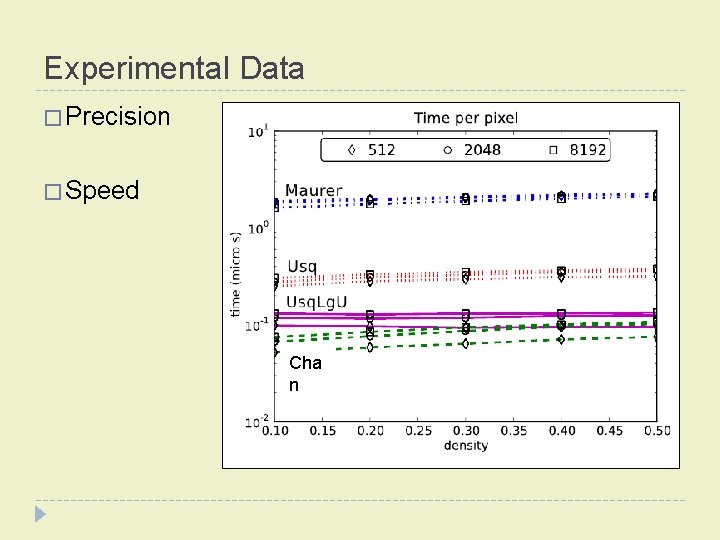
Experimental Data � Precision � Speed Cha n
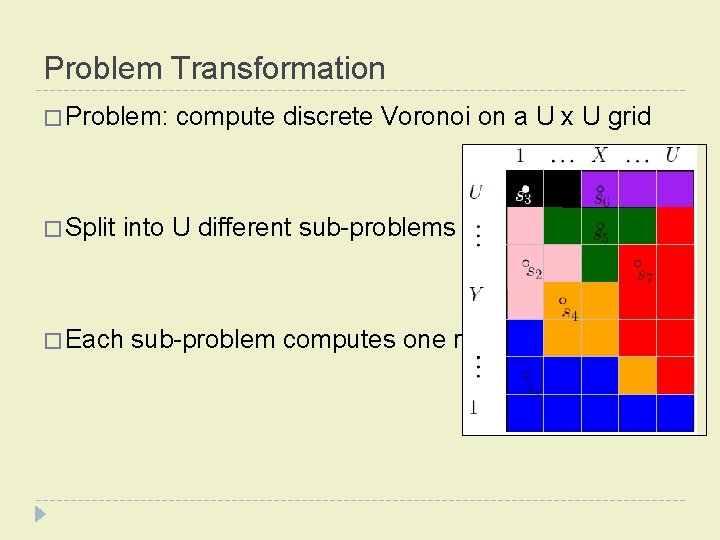
Problem Transformation � Problem: compute discrete Voronoi on a U x U grid � Split into U different sub-problems � Each sub-problem computes one row
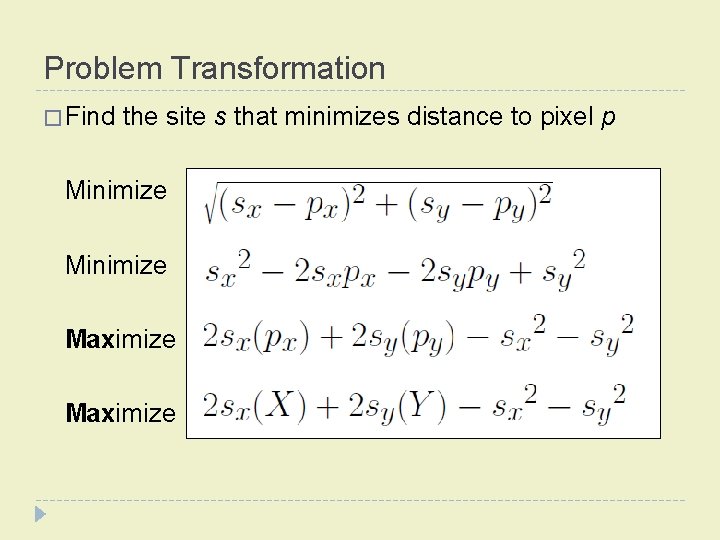
Problem Transformation � Find the site s that minimizes distance to pixel p Minimize Maximize
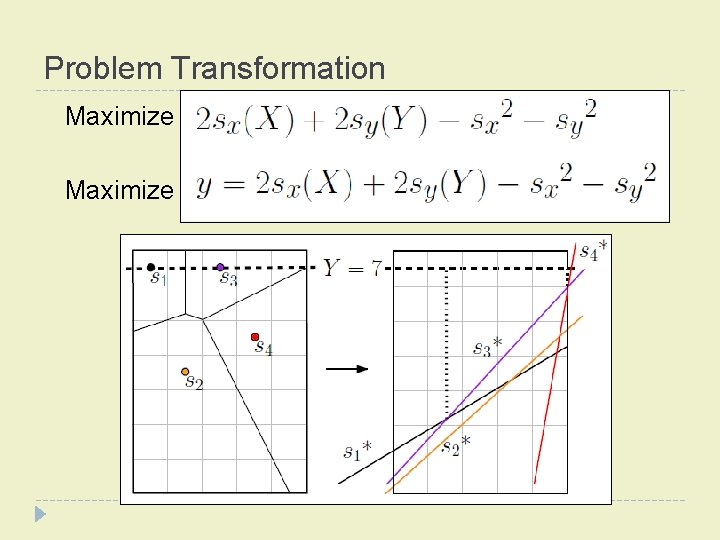
Problem Transformation Maximize
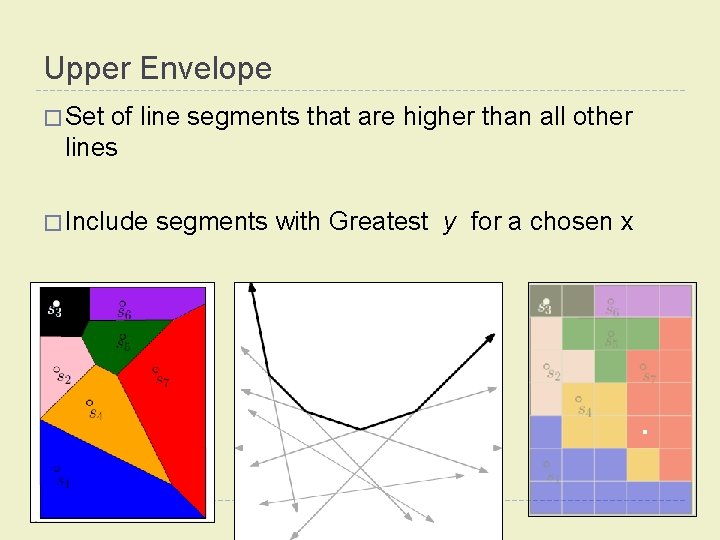
Upper Envelope � Set of line segments that are higher than all other lines � Include segments with Greatest y for a chosen x
![Discrete Upper Envelope � For each x in [1, U] we assign the index](http://slidetodoc.com/presentation_image_h/2e396967a83eb15b3f8ced15bf9f5695/image-25.jpg "Discrete Upper Envelope � For each x in [1, U] we assign the index")
Discrete Upper Envelope � For each x in [1, U] we assign the index of the highest line � A naïve algorithm is O(n*U) for n lines
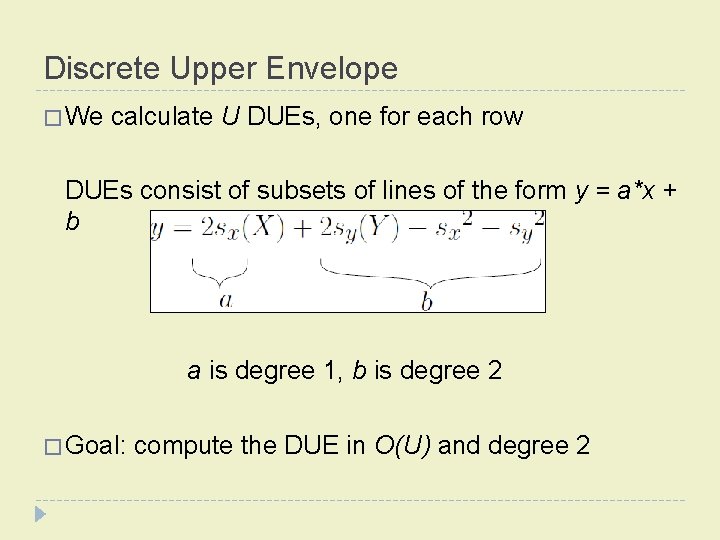
Discrete Upper Envelope � We calculate U DUEs, one for each row DUEs consist of subsets of lines of the form y = a*x + b a is degree 1, b is degree 2 � Goal: compute the DUE in O(U) and degree 2
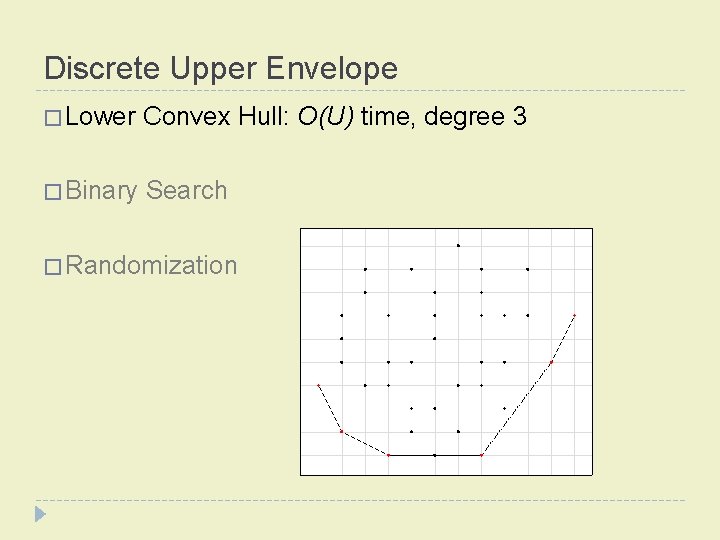
Discrete Upper Envelope � Lower Convex Hull: O(U) time, degree 3 � Binary Search � Randomization
Discrete Upper Envelope � Lower Convex Hull: O(U) time, degree 3 � Binary Search: O(U � Randomization lg U) time, degree 2
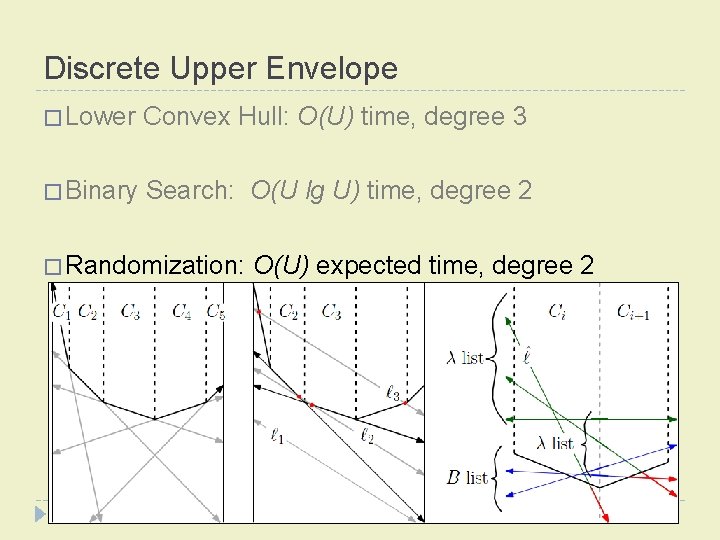
Discrete Upper Envelope � Lower Convex Hull: O(U) time, degree 3 � Binary Search: O(U lg U) time, degree 2 � Randomization: O(U) expected time, degree 2
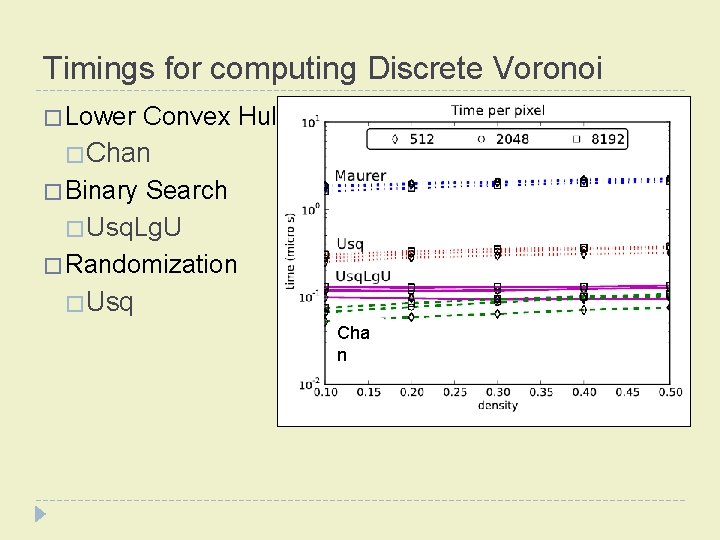
Timings for computing Discrete Voronoi � Lower Convex Hull �Chan � Binary Search � Usq. Lg. U � Randomization �Usq Cha n
Future Work � Minimizing degrees of other geometric algorithms � Visualizations for these complex algorithms
- Slides: 31