
VOLUNTEERS DRIVE THE NORTH AMERICAN BREEDING BIRD SURVEY
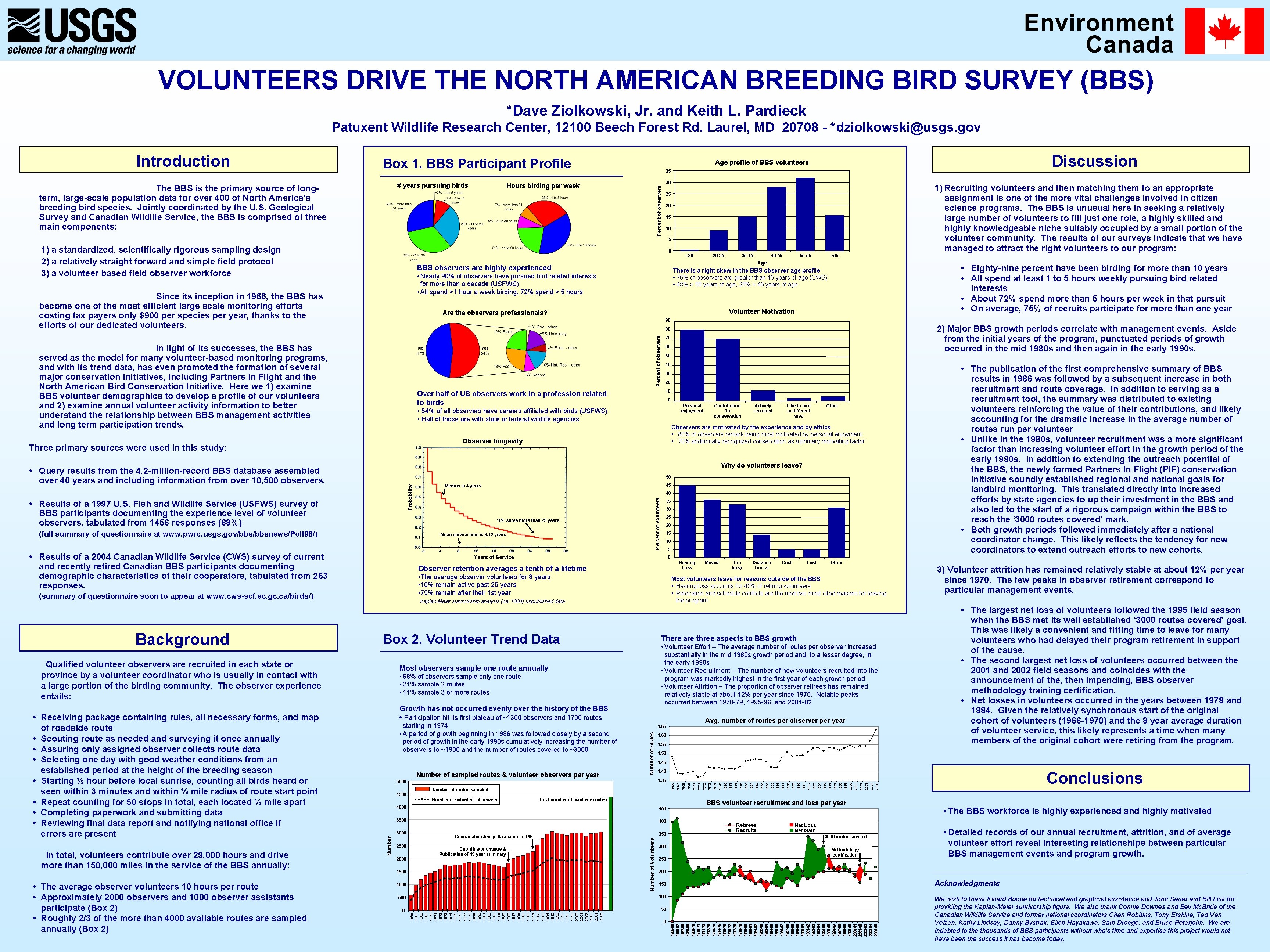
VOLUNTEERS DRIVE THE NORTH AMERICAN BREEDING BIRD SURVEY (BBS) *Dave Ziolkowski, Jr. and Keith L. Pardieck Patuxent Wildlife Research Center, 12100 Beech Forest Rd. Laurel, MD 20708 - *dziolkowski@usgs. gov Box 1. BBS Participant Profile # years pursuing birds The BBS is the primary source of longterm, large-scale population data for over 400 of North America’s breeding bird species. Jointly coordinated by the U. S. Geological Survey and Canadian Wildlife Service, the BBS is comprised of three main components: Discussion Age profile of BBS volunteers 35 30 Hours birding per week Percent of observers Introduction 1) Recruiting volunteers and then matching them to an appropriate assignment is one of the more vital challenges involved in citizen science programs. The BBS is unusual here in seeking a relatively large number of volunteers to fill just one role, a highly skilled and highly knowledgeable niche suitably occupied by a small portion of the volunteer community. The results of our surveys indicate that we have managed to attract the right volunteers to our program: 25 20 15 10 5 1) a standardized, scientifically rigorous sampling design 2) a relatively straight forward and simple field protocol 3) a volunteer based field observer workforce 0 >65 • Eighty-nine percent have been birding for more than 10 years • All spend at least 1 to 5 hours weekly pursuing bird related interests • About 72% spend more than 5 hours per week in that pursuit • On average, 75% of recruits participate for more than one year 2) Major BBS growth periods correlate with management events. Aside from the initial years of the program, punctuated periods of growth occurred in the mid 1980 s and then again in the early 1990 s. Percent of observers 80 70 60 50 40 • The publication of the first comprehensive summary of BBS results in 1986 was followed by a subsequent increase in both recruitment and route coverage. In addition to serving as a recruitment tool, the summary was distributed to existing volunteers reinforcing the value of their contributions, and likely accounting for the dramatic increase in the average number of routes run per volunteer • Unlike in the 1980 s, volunteer recruitment was a more significant factor than increasing volunteer effort in the growth period of the early 1990 s. In addition to extending the outreach potential of the BBS, the newly formed Partners In Flight (PIF) conservation initiative soundly established regional and national goals for landbird monitoring. This translated directly into increased efforts by state agencies to up their investment in the BBS and also led to the start of a rigorous campaign within the BBS to reach the ‘ 3000 routes covered’ mark. • Both growth periods followed immediately after a national coordinator change. This likely reflects the tendency for new coordinators to extend outreach efforts to new cohorts. 30 20 10 Over half of US observers work in a profession related to birds 0 Contribution To conservation Personal enjoyment • 54% of all observers have careers affiliated with birds (USFWS) • Half of those are with state or federal wildlife agencies Like to bird in different area Actively recruited Other Observers are motivated by the experience and by ethics • 80% of observers remark being most motivated by personal enjoyment • 70% additionally recognized conservation as a primary motivating factor Observer longevity Why do volunteers leave? 45 Median is 4 years 40 Percent of volunteers 10% serve more than 25 years Mean service time is 8. 42 years 25 20 15 10 5 Years of Service 0 Hearing Loss Observer retention averages a tenth of a lifetime • The average observer volunteers for 8 years • 10% remain active past 25 years • 75% remain after their 1 st year Kaplan-Meier survivorship analysis (ca. 1994) unpublished data Box 2. Volunteer Trend Data 3500 400 2000 Coordinator change & Publication of 15 -year summary 1500 1000 Number of Volunteers 2500 350 300 250 Retirees Recruits Net Loss Net Gain 3000 routes covered Methodology certification Conclusions 2005 2003 BBS volunteer recruitment and loss per year 2004 2001 2002 2000 1998 1999 1997 1996 1994 1995 1993 1992 1991 1990 1989 1988 1987 1985 1986 1984 1983 1982 1981 1980 1978 1974 1973 1972 1966 450 • The BBS workforce is highly experienced and highly motivated • Detailed records of our annual recruitment, attrition, and of average volunteer effort reveal interesting relationships between particular BBS management events and program growth. 200 150 500 100 0 50 1966 1967 1968 1969 1970 1971 1972 1973 1974 1975 1976 1977 1978 1979 1980 1981 1982 1983 1984 1985 1986 1987 1988 1989 1990 1991 1992 1993 1994 1995 1996 1997 1998 1999 2000 2001 2002 2003 2004 2005 Number 1. 40 Total number of available routes Coordinator change & creation of PIF • The largest net loss of volunteers followed the 1995 field season when the BBS met its well established ‘ 3000 routes covered’ goal. This was likely a convenient and fitting time to leave for many volunteers who had delayed their program retirement in support of the cause. • The second largest net loss of volunteers occurred between the 2001 and 2002 field seasons and coincides with the announcement of the, then impending, BBS observer methodology training certification. • Net losses in volunteers occurred in the years between 1978 and 1984. Given the relatively synchronous start of the original cohort of volunteers (1966 -1970) and the 8 year average duration of volunteer service, this likely represents a time when many members of the original cohort were retiring from the program. 1. 45 4000 3) Volunteer attrition has remained relatively stable at about 12% per year since 1970. The few peaks in observer retirement correspond to particular management events. 1. 50 Number of routes sampled Number of volunteer observers Other 1. 55 1. 35 5000 4500 Lost 1. 60 1979 Number of routes Number of sampled routes & volunteer observers per year Cost Avg. number of routes per observer per year 1. 65 1977 Growth has not occurred evenly over the history of the BBS • Participation hit its first plateau of ~1300 observers and 1700 routes 1976 • 68% of observers sample only one route • 21% sample 2 routes • 11% sample 3 or more routes 1975 Most observers sample one route annually starting in 1974 • A period of growth beginning in 1986 was followed closely by a second period of growth in the early 1990 s cumulatively increasing the number of observers to ~1900 and the number of routes covered to ~3000 Distance Too far • Volunteer Effort – The average number of routes per observer increased substantially in the mid 1980 s growth period and, to a lesser degree, in the early 1990 s • Volunteer Recruitment – The number of new volunteers recruited into the program was markedly highest in the first year of each growth period • Volunteer Attrition – The proportion of observer retirees has remained relatively stable at about 12% per year since 1970. Notable peaks occurred between 1978 -79, 1995 -96, and 2001 -02 1971 Qualified volunteer observers are recruited in each state or province by a volunteer coordinator who is usually in contact with a large portion of the birding community. The observer experience entails: Too busy There are three aspects to BBS growth 1970 (summary of questionnaire soon to appear at www. cws-scf. ec. gc. ca/birds/) Moved Most volunteers leave for reasons outside of the BBS • Hearing loss accounts for 45% of retiring volunteers • Relocation and schedule conflicts are the next two most cited reasons for leaving the program 1969 • Results of a 2004 Canadian Wildlife Service (CWS) survey of current and recently retired Canadian BBS participants documenting demographic characteristics of their cooperators, tabulated from 263 responses. 30 1967 (full summary of questionnaire at www. pwrc. usgs. gov/bbsnews/Poll 98/) 35 1968 Probability 50 • Results of a 1997 U. S. Fish and Wildlife Service (USFWS) survey of BBS participants documenting the experience level of volunteer observers, tabulated from 1456 responses (88%) • The average observer volunteers 10 hours per route • Approximately 2000 observers and 1000 observer assistants participate (Box 2) • Roughly 2/3 of the more than 4000 available routes are sampled annually (Box 2) 56 -65 90 • Query results from the 4. 2 -million-record BBS database assembled over 40 years and including information from over 10, 500 observers. In total, volunteers contribute over 29, 000 hours and drive more than 150, 000 miles in the service of the BBS annually: 46 -55 Volunteer Motivation Are the observers professionals? Three primary sources were used in this study: • Receiving package containing rules, all necessary forms, and map of roadside route • Scouting route as needed and surveying it once annually • Assuring only assigned observer collects route data • Selecting one day with good weather conditions from an established period at the height of the breeding season • Starting ½ hour before local sunrise, counting all birds heard or seen within 3 minutes and within ¼ mile radius of route start point • Repeat counting for 50 stops in total, each located ½ mile apart • Completing paperwork and submitting data • Reviewing final data report and notifying national office if errors are present 36 -45 There is a right skew in the BBS observer age profile • 76% of observers are greater than 45 years of age (CWS) • 48% > 55 years of age, 25% < 46 years of age • Nearly 90% of observers have pursued bird related interests for more than a decade (USFWS) • All spend >1 hour a week birding, 72% spend > 5 hours In light of its successes, the BBS has served as the model for many volunteer-based monitoring programs, and with its trend data, has even promoted the formation of several major conservation initiatives, including Partners in Flight and the North American Bird Conservation Initiative. Here we 1) examine BBS volunteer demographics to develop a profile of our volunteers and 2) examine annual volunteer activity information to better understand the relationship between BBS management activities and long term participation trends. Background 20 -35 Age BBS observers are highly experienced Since its inception in 1966, the BBS has become one of the most efficient large scale monitoring efforts costing tax payers only $900 per species per year, thanks to the efforts of our dedicated volunteers. <20 0 Acknowledgments We wish to thank Kinard Boone for technical and graphical assistance and John Sauer and Bill Link for providing the Kaplan-Meier survivorship figure. We also thank Connie Downes and Bev Mc. Bride of the Canadian Wildlife Service and former national coordinators Chan Robbins, Tony Erskine, Ted Van Velzen, Kathy Lindsay, Danny Bystrak, Ellen Hayakawa, Sam Droege, and Bruce Peterjohn. We are indebted to the thousands of BBS participants without who’s time and expertise this project would not have been the success it has become today.
- Slides: 1