
VOLUME Volume Length x Breadth x Height Volume
VOLUME

Volume = Length x Breadth x Height Volume = Base Area x Height 1) Look out for the given components. 2) Is there a need to convert? 3) How can we make use of the information to solve the problem?
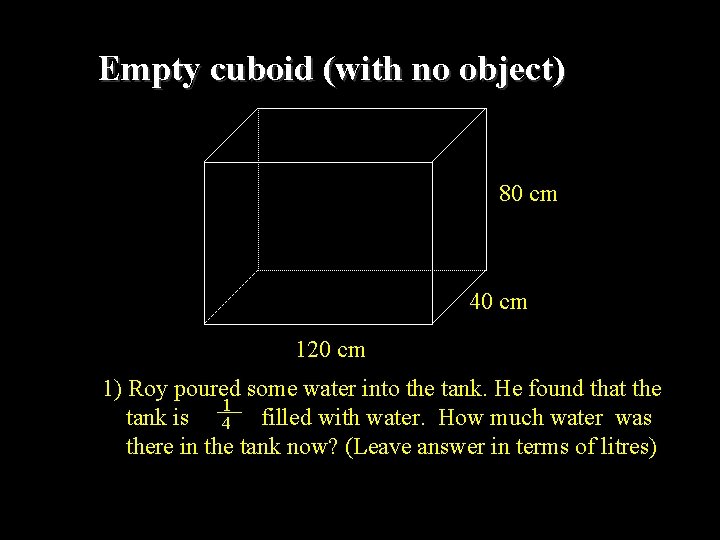
Empty cuboid (with no object) 80 cm 40 cm 120 cm 1) Roy poured some water into the tank. He found that the 1 tank is 4 filled with water. How much water was there in the tank now? (Leave answer in terms of litres)
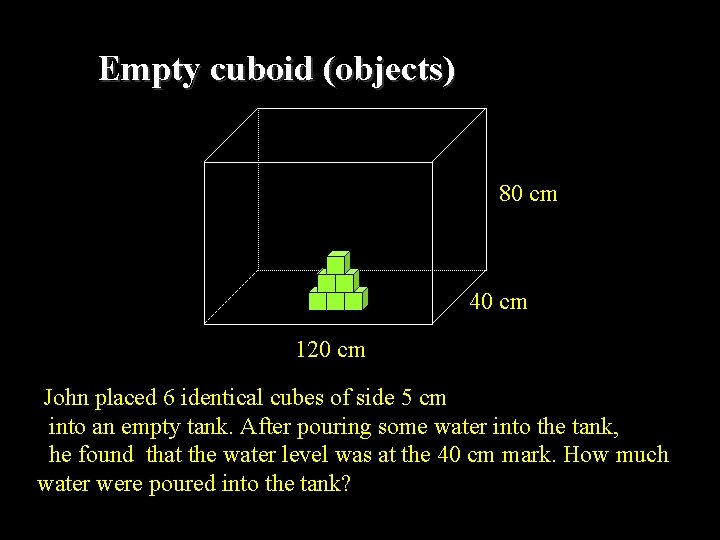
Empty cuboid (objects) 80 cm 40 cm 120 cm John placed 6 identical cubes of side 5 cm into an empty tank. After pouring some water into the tank, he found that the water level was at the 40 cm mark. How much water were poured into the tank?
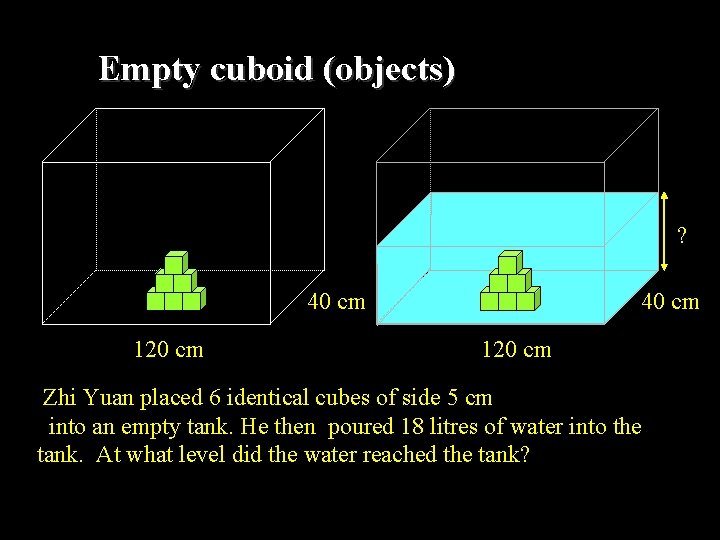
Empty cuboid (objects) ? 40 cm 120 cm Zhi Yuan placed 6 identical cubes of side 5 cm into an empty tank. He then poured 18 litres of water into the tank. At what level did the water reached the tank?

Cuboid with water (with object) 64 cm 40 cm 60 cm Justin placed a stone in an empty tank that has a height of 80 cm He then filled the tank with water to its brim. After he took out the stone from the tank, the water level dropped to 64 cm mark. Find the ratio of the volume of stone to the volume of water in the tank.
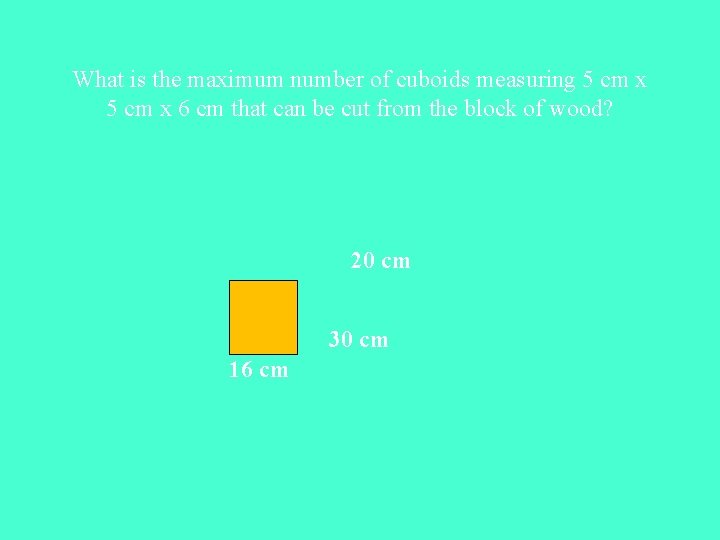
What is the maximum number of cuboids measuring 5 cm x 6 cm that can be cut from the block of wood? 20 cm 30 cm 16 cm
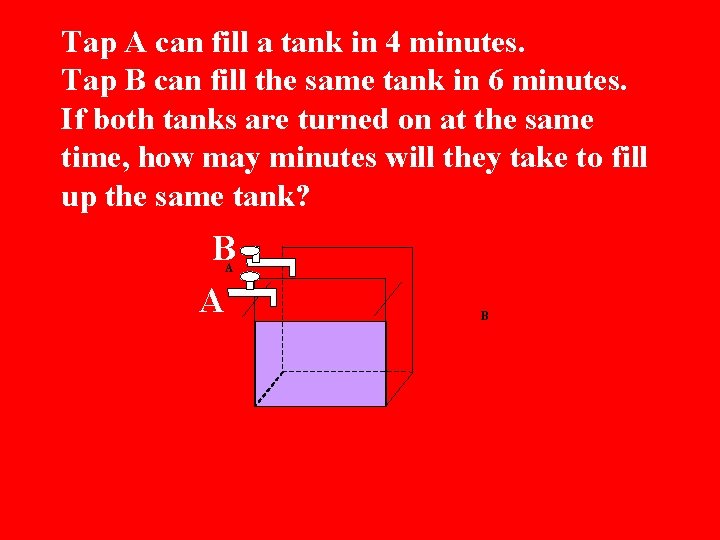
Tap A can fill a tank in 4 minutes. Tap B can fill the same tank in 6 minutes. If both tanks are turned on at the same time, how may minutes will they take to fill up the same tank? B A A B
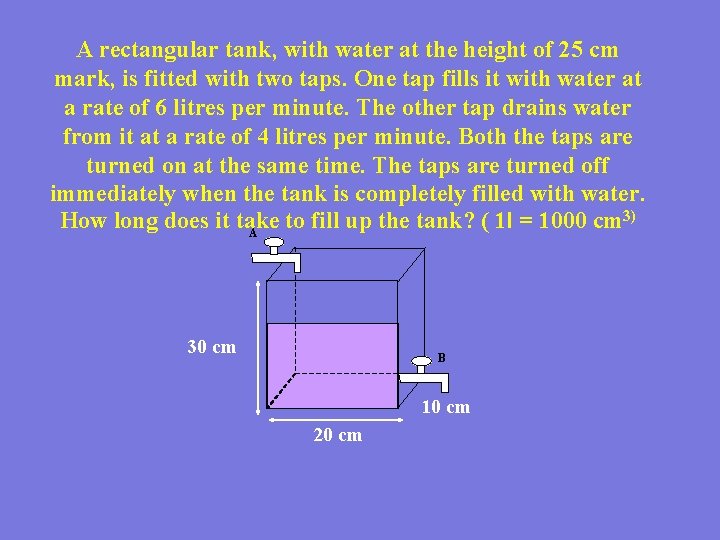
A rectangular tank, with water at the height of 25 cm mark, is fitted with two taps. One tap fills it with water at a rate of 6 litres per minute. The other tap drains water from it at a rate of 4 litres per minute. Both the taps are turned on at the same time. The taps are turned off immediately when the tank is completely filled with water. 3) How long does it take to fill up the tank? ( 1 l = 1000 cm A 30 cm B 10 cm 20 cm
- Slides: 9