
Volume Prisms and Cylinders Lesson 12 4 Volume
- Slides: 9
Volume Prisms and Cylinders Lesson 12. 4
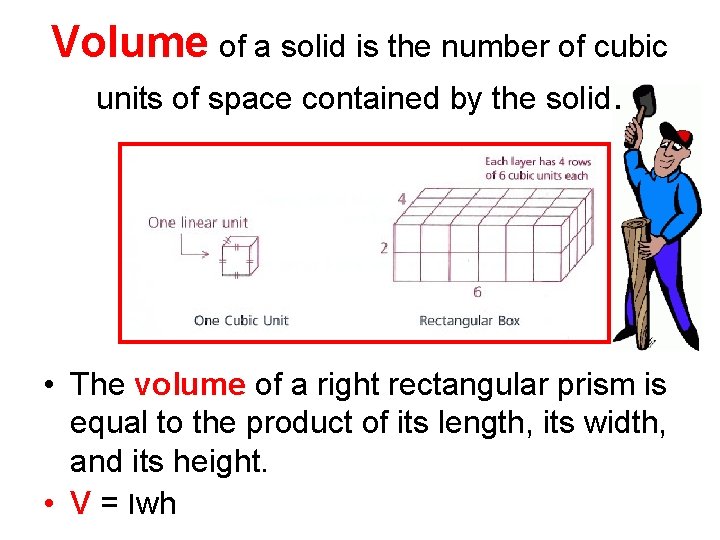
Volume of a solid is the number of cubic units of space contained by the solid. • The volume of a right rectangular prism is equal to the product of its length, its width, and its height. • V = lwh
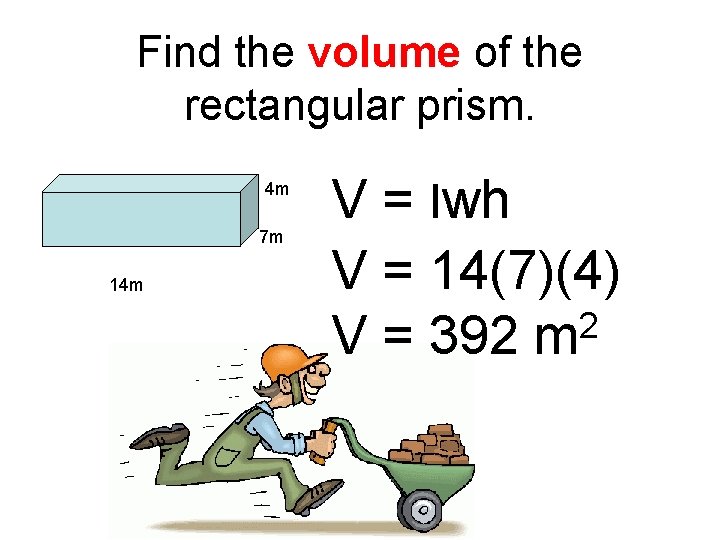
Find the volume of the rectangular prism. 4 m 7 m 14 m V = lwh V = 14(7)(4) 2 V = 392 m
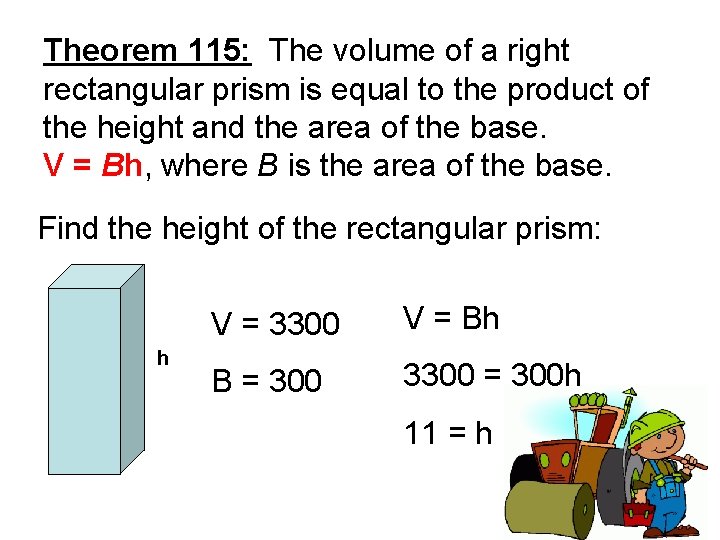
Theorem 115: The volume of a right rectangular prism is equal to the product of the height and the area of the base. V = Bh, where B is the area of the base. Find the height of the rectangular prism: h V = 3300 V = Bh B = 300 3300 = 300 h 11 = h
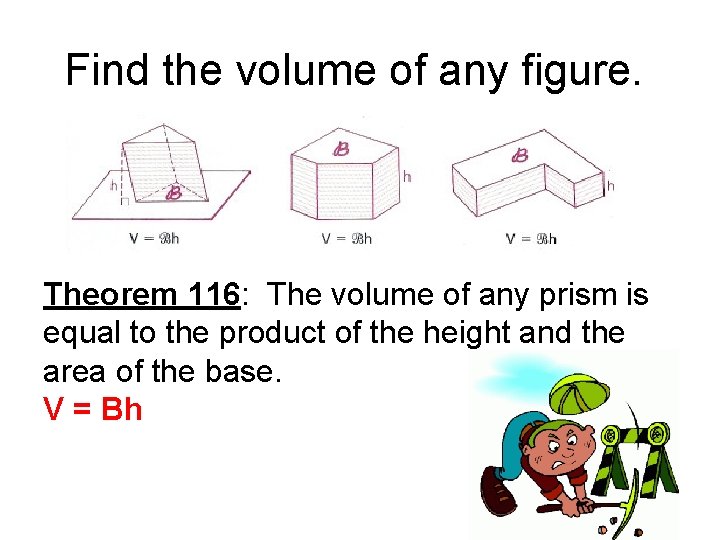
Find the volume of any figure. Theorem 116: The volume of any prism is equal to the product of the height and the area of the base. V = Bh
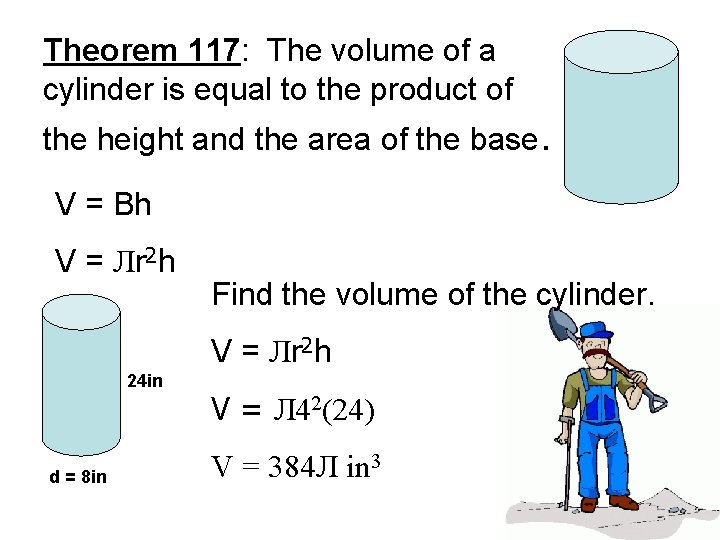
Theorem 117: The volume of a cylinder is equal to the product of the height and the area of the base. V = Bh V = Лr 2 h Find the volume of the cylinder. V = Лr 2 h 24 in d = 8 in V = Л 42(24) V = 384 Л in 3
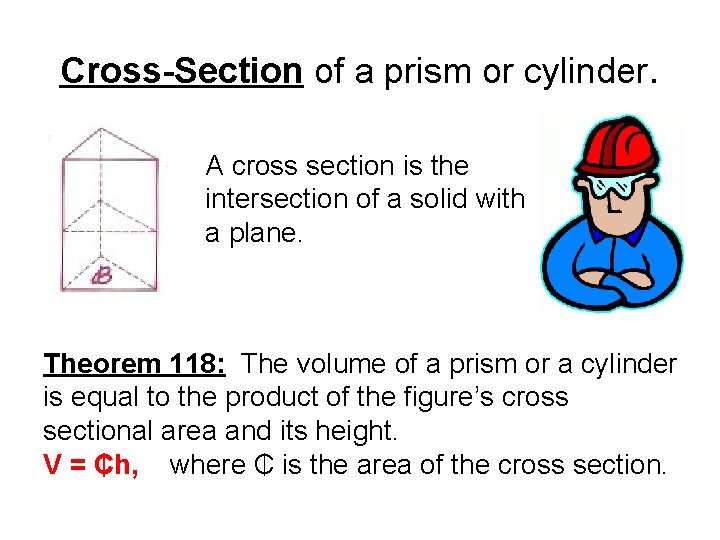
Cross-Section of a prism or cylinder. A cross section is the intersection of a solid with a plane. Theorem 118: The volume of a prism or a cylinder is equal to the product of the figure’s cross sectional area and its height. V = ₵h, where ₵ is the area of the cross section.
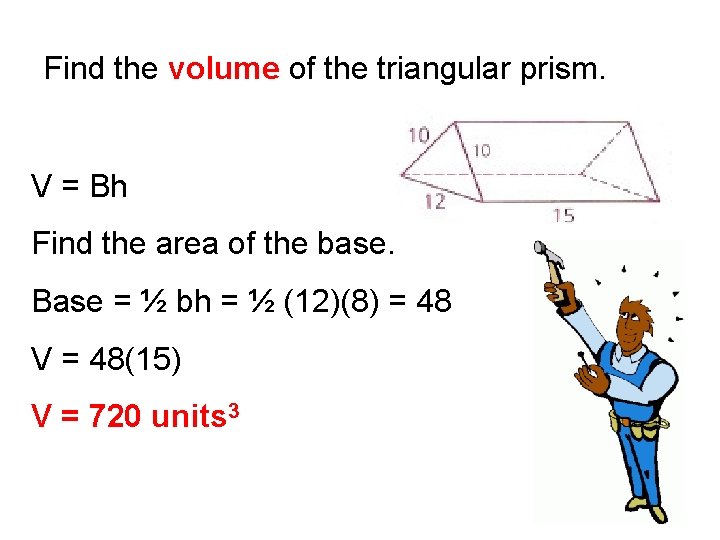
Find the volume of the triangular prism. V = Bh Find the area of the base. Base = ½ bh = ½ (12)(8) = 48 V = 48(15) V = 720 units 3
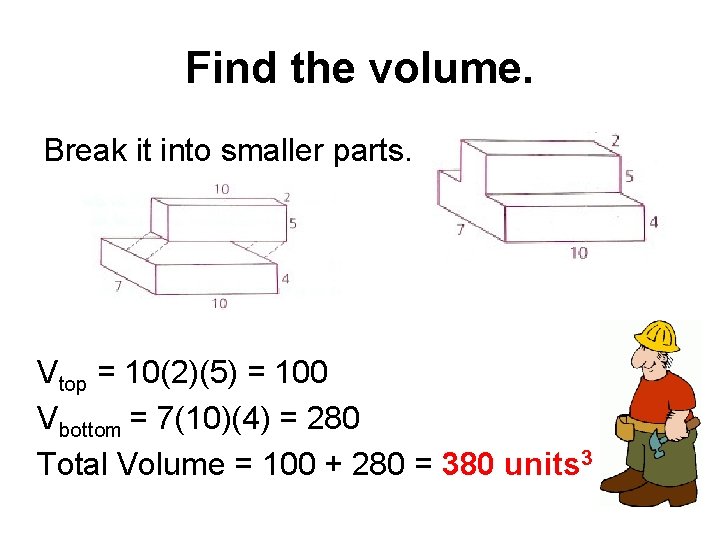
Find the volume. Break it into smaller parts. Vtop = 10(2)(5) = 100 Vbottom = 7(10)(4) = 280 Total Volume = 100 + 280 = 380 units 3