
Volume One Disability Access Insert Corporate logo here
Volume One: Disability Access Insert Corporate logo here © Commonwealth of Australia and the States and Territories of Australia 2020, published by the Australian Building Codes Board.
Table of contents Introduction • How it works • What you’ll learn. Contents • Applying the NCC • Overview of relevant NCC Volume One disability access requirements including: • Section D • Verification Methods for Section D: Access and Egress • Accessible adult change facilities. Summary
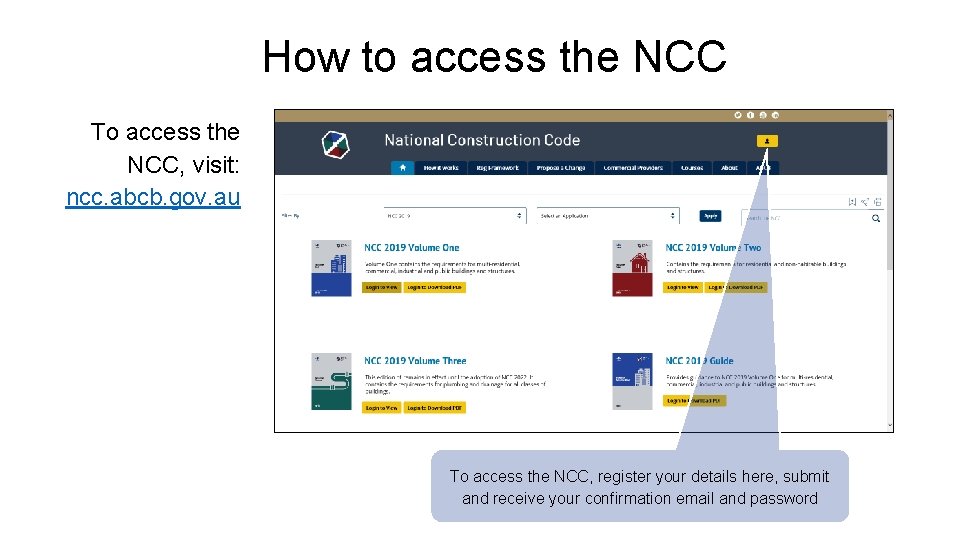
How to access the NCC To access the NCC, visit: ncc. abcb. gov. au To access the NCC, register your details here, submit and receive your confirmation email and password
What you will learn Aims & Objectives • To provide you with a basic understanding of the NCC Volume One disability access requirements. Who this material is for • All building professionals.
Overview of the NCC The role of the NCC is to provide: • nationally consistent minimum necessary regulations; and • a technical basis for the design and construction of buildings and certain structures. There are three performance-based volumes in the NCC, namely: • the Building Code of Australia (BCA) (NCC Volumes One and Two); and • the Plumbing Code of Australia (PCA) (NCC Volume Three).
NCC Volume One • Contains the design and construction requirements for Class 2 to 9 buildings, and certain requirements for Class 1 b, 10 a and 10 b buildings and structures. • Class 2 to 9 buildings are generally commercial, industrial, multi-residential, and institutional buildings. • Volume One contains 9 distinct Sections (A to J). • Volume Three contains some specific requirements for accessible plumbing fittings and fixtures.

NCC Compliance Structure
Performance Solutions • The performance-based NCC allows for flexibility in how compliance is achieved. • Performance Solutions give designers the flexibility to do things differently, potentially providing a more cost effective design and improving constructability. • Performance Solutions would need to provide a level of access and amenity that meet the relevant Performance Requirements.
NCC Volume One: Relevant Sections For disability access in NCC Volume One, they are: • Section A: how to use the NCC, including building classifications; • Section D: access and egress requirements for buildings; and • Parts E 3, F 2 and H 2: some specific requirements (e. g. lifts and accessible sanitary facilities).

Background of the Access Provisions In this section we will look at: • Background and objectives of the NCC disability access requirements; and • The relationship with: • the Disability Discrimination Act 1992; and • the Disability (Access to Premises - buildings) Standards 2010.
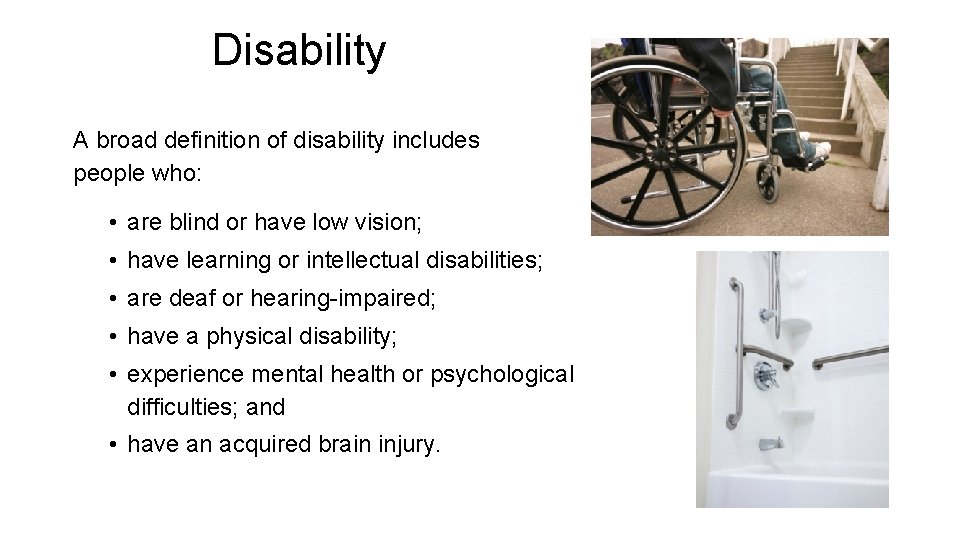
Disability A broad definition of disability includes people who: • are blind or have low vision; • have learning or intellectual disabilities; • are deaf or hearing-impaired; • have a physical disability; • experience mental health or psychological difficulties; and • have an acquired brain injury.
Background • Disability access requirements have been in the BCA since 1990. • Focus has primarily been on access to commercial and public buildings i. e. Class 3 and 5 -9 buildings.

Objectives and Application of the NCC Access Provisions Overall access objectives To provide, as far as is reasonable, people with safe, equitable and dignified access to: • a building, and • the services and facilities within a building. The NCC only addresses the physical fabric and layout of a building. It does not address: • fixtures and fittings; • wayfinding information; or • management policies.

Relationship with the DDA and Premises Standards • The NCC access provisions reflect the requirements of the Premises Standards made under the Commonwealth Disability Discrimination Act 1992 (DDA). • The Premises Standards were developed to provide certainty in relation to what levels of access to public buildings would satisfy the general nondiscrimination requirements of the DDA. • Results in a uniform set of requirements.
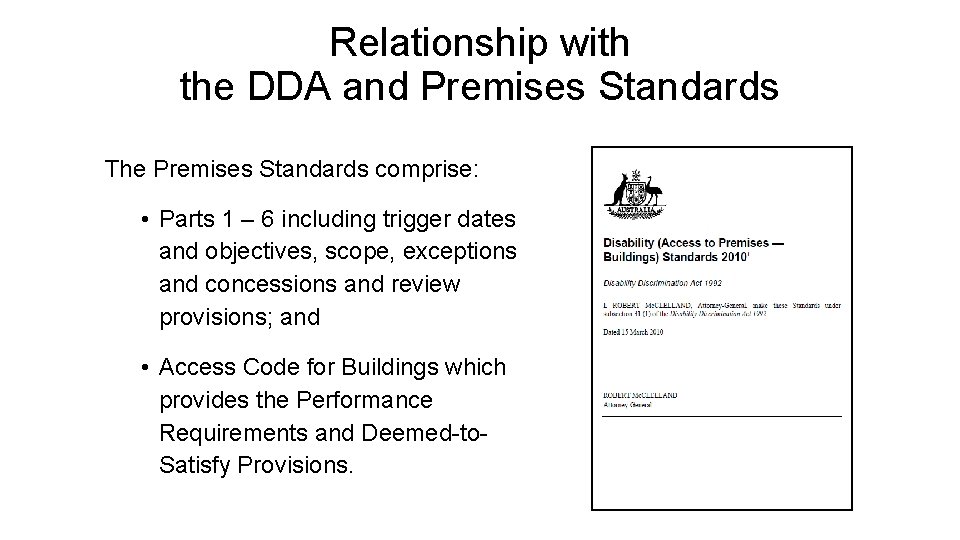
Relationship with the DDA and Premises Standards The Premises Standards comprise: • Parts 1 – 6 including trigger dates and objectives, scope, exceptions and concessions and review provisions; and • Access Code for Buildings which provides the Performance Requirements and Deemed-to. Satisfy Provisions.
NCC Disability Access requirements In this section we will look at relevant: • defined terms; • referenced documents; • Performance Requirements; • Verification Methods; and • Deemed-to-Satisfy Provisions.
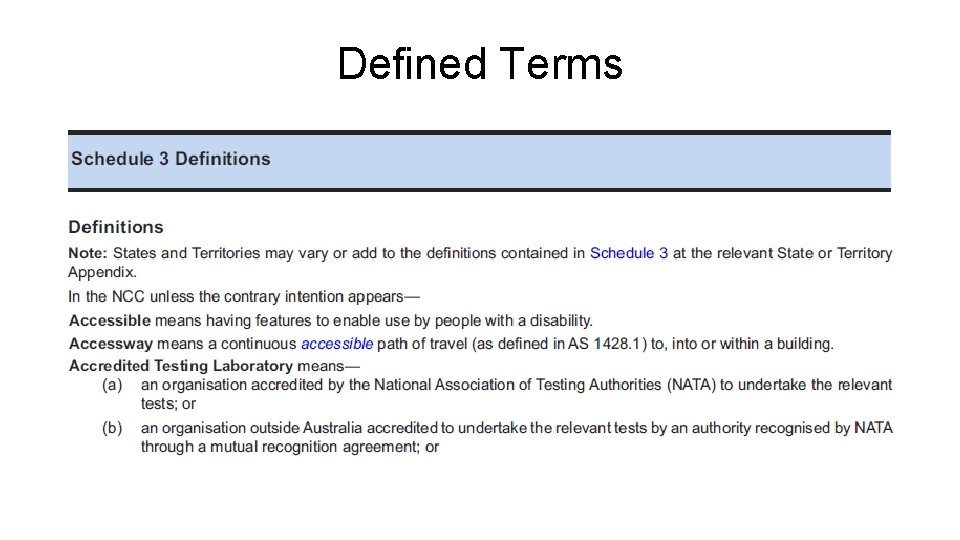
Defined Terms
Referenced Documents • The NCC itself does not contain details of every design and construction requirement for a building or plumbing or drainage system. • It calls upon or ‘references’ other documents called NCC referenced documents. • They are adopted as Deemed-to-Satisfy means of complying with Performance Requirements. • They are listed in Schedule 4 of the NCC. Examples include Australian Standards, ABCB protocols, ABCB standards and other publications. • The NCC also takes precedence over any referenced document.
Referenced Documents • AS 1428. 1: Design for access and mobility, Part 1 – General requirements for access – New building work • Contains technical information on the construction of accessways, for example: • dimensions and clearances at doorways; • design of handrails; and • layout of accessible toilets. • Other relevant Australian Standards include: • AS/NZS 2890. 6: Parking facilities - Off-street parking for people with disabilities; and • AS 1428. 4. 1: Design for access and mobility - Means to assist the orientation of people with vision impairment Tactile ground surface indicators.
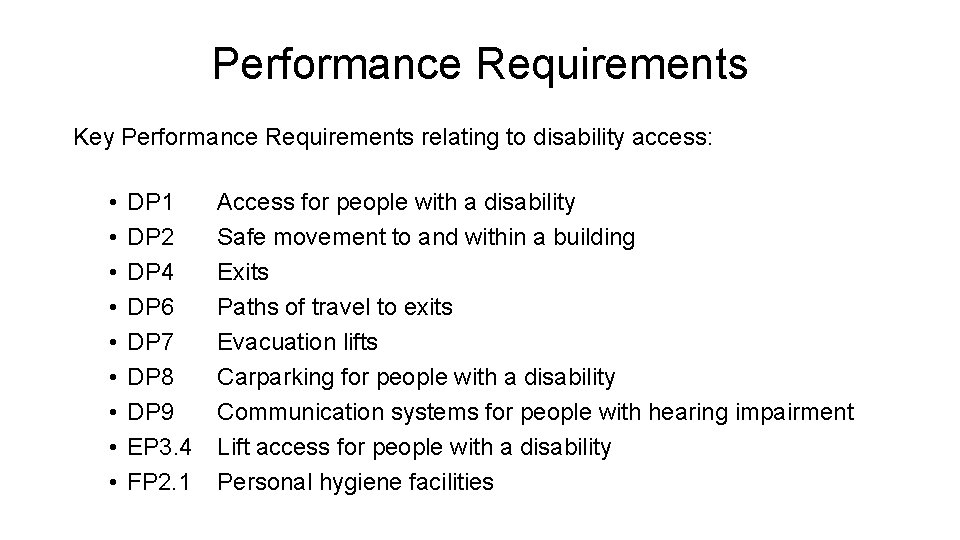
Performance Requirements Key Performance Requirements relating to disability access: • • • DP 1 DP 2 DP 4 DP 6 DP 7 DP 8 DP 9 EP 3. 4 FP 2. 1 Access for people with a disability Safe movement to and within a building Exits Paths of travel to exits Evacuation lifts Carparking for people with a disability Communication systems for people with hearing impairment Lift access for people with a disability Personal hygiene facilities
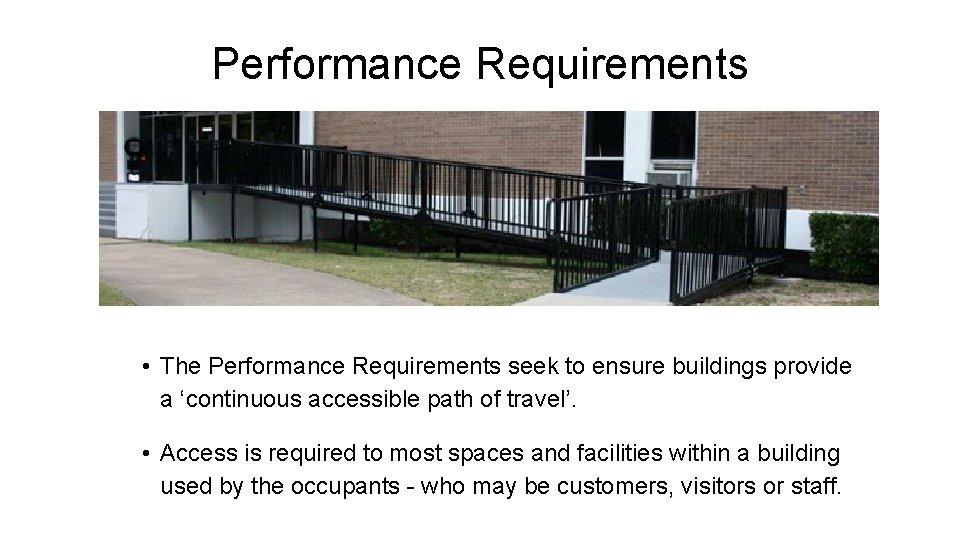
Performance Requirements • The Performance Requirements seek to ensure buildings provide a ‘continuous accessible path of travel’. • Access is required to most spaces and facilities within a building used by the occupants - who may be customers, visitors or staff.
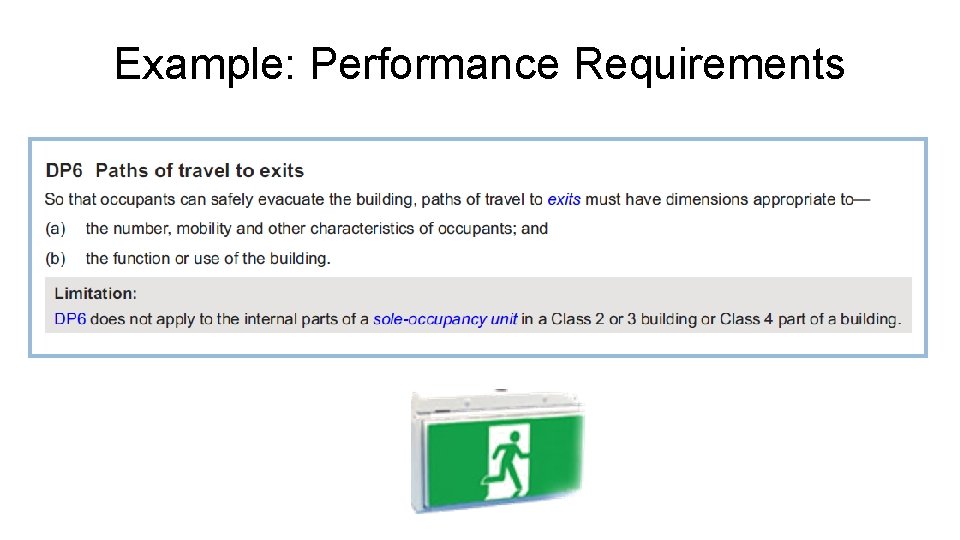
Example: Performance Requirements
Assessing Performance Solutions • A 2. 2 states that Performance Solutions will only comply with the NCC when the Assessment Method/s used demonstrate compliance with Performance Requirements. • A 2. 2(2) describes the four Assessment Methods that can be used to demonstrate compliance. • Designers should discuss which Assessment Method should be used with the Approval Authority prior to proceeding with developing a detailed Performance Solution. • A Deemed-to-Satisfy Solution can also be used to comply with the Performance Requirements. Refer to A 2. 3 for further details.
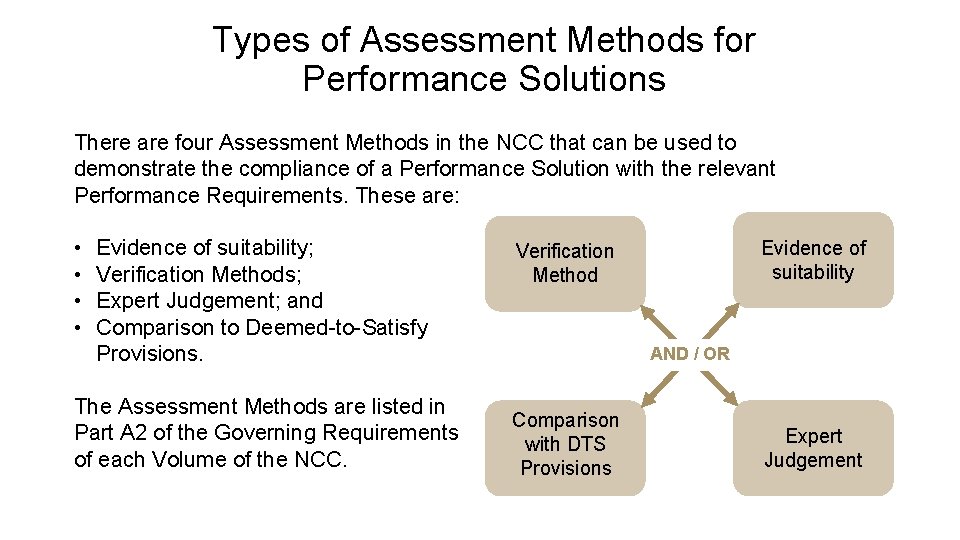
Types of Assessment Methods for Performance Solutions There are four Assessment Methods in the NCC that can be used to demonstrate the compliance of a Performance Solution with the relevant Performance Requirements. These are: • • Evidence of suitability; Verification Methods; Expert Judgement; and Comparison to Deemed-to-Satisfy Provisions. The Assessment Methods are listed in Part A 2 of the Governing Requirements of each Volume of the NCC. Evidence of suitability Verification Method AND / OR Comparison with DTS Provisions Expert Judgement
Verification Methods • Verification Method (VM) is a NCC defined term. It is defined as: • a test, inspection, calculation, or other method that determines whether a Performance Solution complies with the relevant Performance Requirements. • A practitioner can use a VM within the NCC, or a VM which is not in the NCC. • There a number of NCC Verification Methods for disability access. In Section D, there are two: • DV 2: Access to and within a building; and • DV 3: Ramp gradient, crossfall, surface profile and slip resistance for ramps used by wheelchairs.
Deemed-to-Satisfy Provisions • A Deemed-to-Satisfy Solution, which complies with the Deemed-to-Satisfy Provisions is deemed to comply with the Performance Requirements. • Compliance with the Deemed-to-Satisfy Provisions ensures compliance with the Access Code of the Premises Standards. • The Deemed-to-Satisfy Provisions related to disability access are contained in four Parts: • Part D 3: covers general building access requirements • Part E 3: covers lifts • Part F 2: covers accessible sanitary facilities including adult change facilities • Part H 2: covers requirements for public transport buildings.
Deemed-to-Satisfy Provisions Part D 3: Access for people with a disability • D 3. 1 – General building access requirements • D 3. 2 – Access to buildings • D 3. 3 – Parts of buildings to be accessible • D 3. 4 – Exemptions • D 3. 5 – Accessible carparking • D 3. 6 – Signage • D 3. 7 – Hearing augmentation • D 3. 8 – Tactile indicators • D 3. 9 – Wheelchair seating spaces in Class 9 b assembly buildings • D 3. 10 – Swimming pools • D 3. 11 – Ramps • D 3. 12 – Glazing on an accessway • Specification D 3. 6 – Braille and tactile signs • Specification D 3. 10 – Accessible water entry/exit for swimming pools
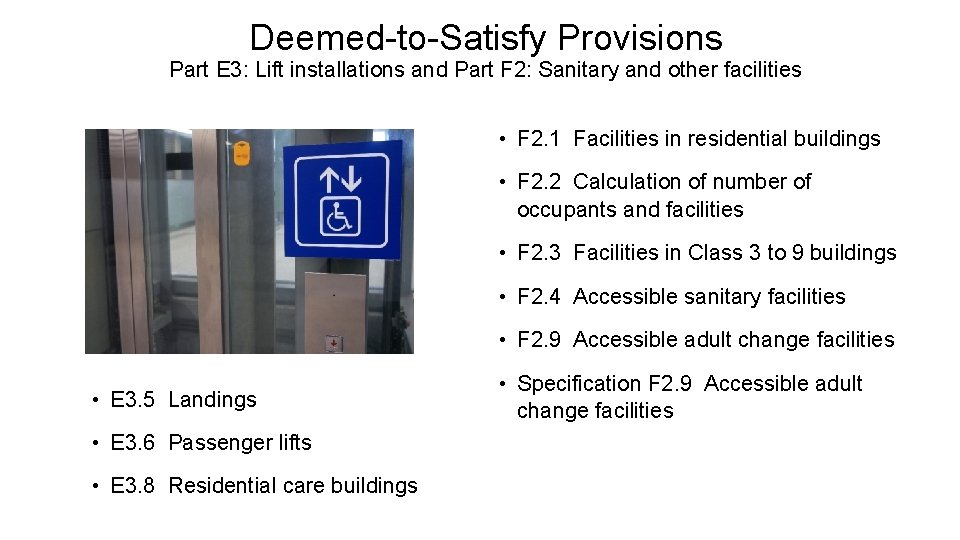
Deemed-to-Satisfy Provisions Part E 3: Lift installations and Part F 2: Sanitary and other facilities • F 2. 1 Facilities in residential buildings • F 2. 2 Calculation of number of occupants and facilities • F 2. 3 Facilities in Class 3 to 9 buildings • F 2. 4 Accessible sanitary facilities • F 2. 9 Accessible adult change facilities • E 3. 5 Landings • E 3. 6 Passenger lifts • E 3. 8 Residential care buildings • Specification F 2. 9 Accessible adult change facilities
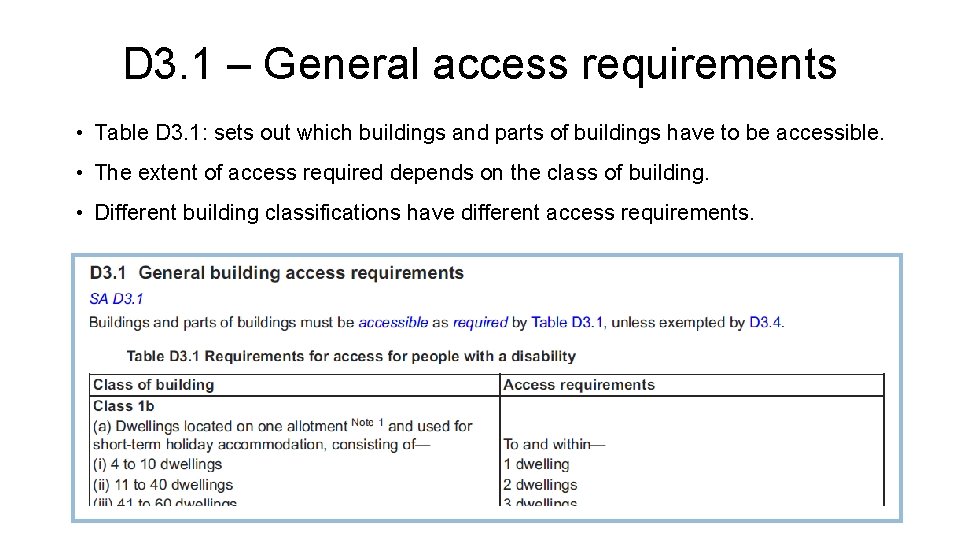
D 3. 1 – General access requirements • Table D 3. 1: sets out which buildings and parts of buildings have to be accessible. • The extent of access required depends on the class of building. • Different building classifications have different access requirements.
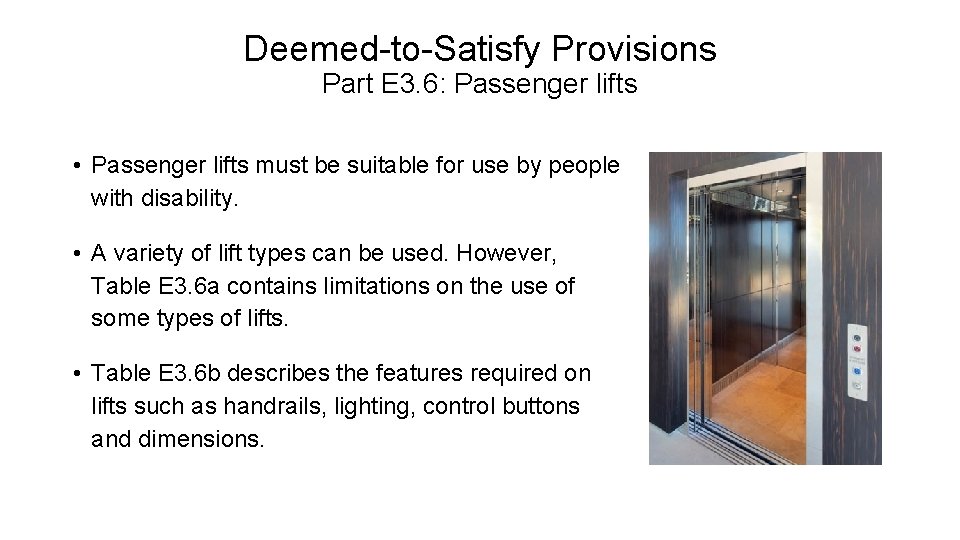
Deemed-to-Satisfy Provisions Part E 3. 6: Passenger lifts • Passenger lifts must be suitable for use by people with disability. • A variety of lift types can be used. However, Table E 3. 6 a contains limitations on the use of some types of lifts. • Table E 3. 6 b describes the features required on lifts such as handrails, lighting, control buttons and dimensions.
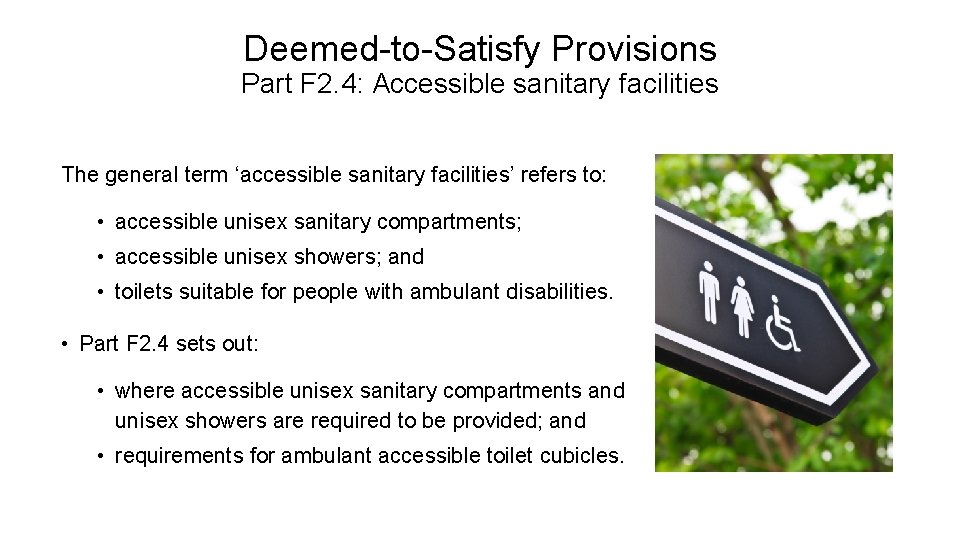
Deemed-to-Satisfy Provisions Part F 2. 4: Accessible sanitary facilities The general term ‘accessible sanitary facilities’ refers to: • accessible unisex sanitary compartments; • accessible unisex showers; and • toilets suitable for people with ambulant disabilities. • Part F 2. 4 sets out: • where accessible unisex sanitary compartments and unisex showers are required to be provided; and • requirements for ambulant accessible toilet cubicles.
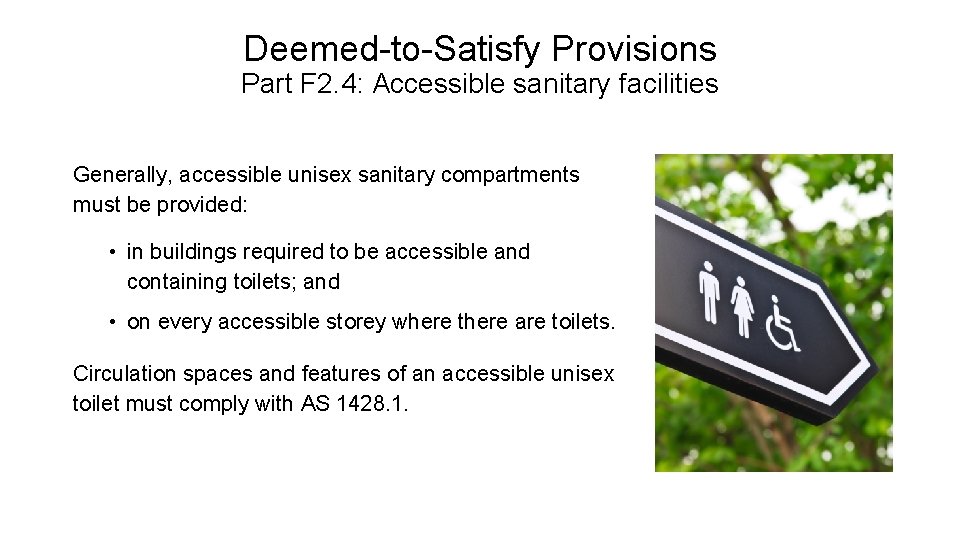
Deemed-to-Satisfy Provisions Part F 2. 4: Accessible sanitary facilities Generally, accessible unisex sanitary compartments must be provided: • in buildings required to be accessible and containing toilets; and • on every accessible storey where there are toilets. Circulation spaces and features of an accessible unisex toilet must comply with AS 1428. 1.
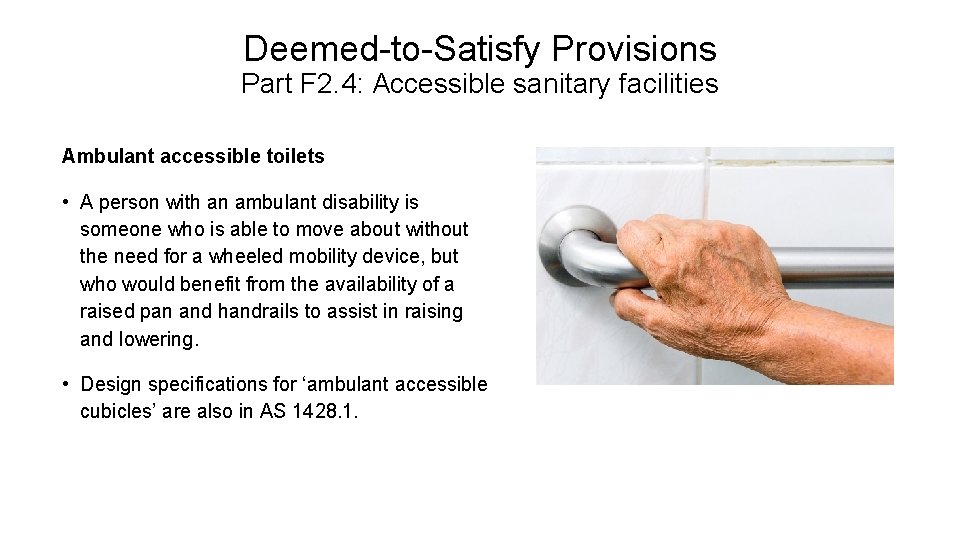
Deemed-to-Satisfy Provisions Part F 2. 4: Accessible sanitary facilities Ambulant accessible toilets • A person with an ambulant disability is someone who is able to move about without the need for a wheeled mobility device, but who would benefit from the availability of a raised pan and handrails to assist in raising and lowering. • Design specifications for ‘ambulant accessible cubicles’ are also in AS 1428. 1.
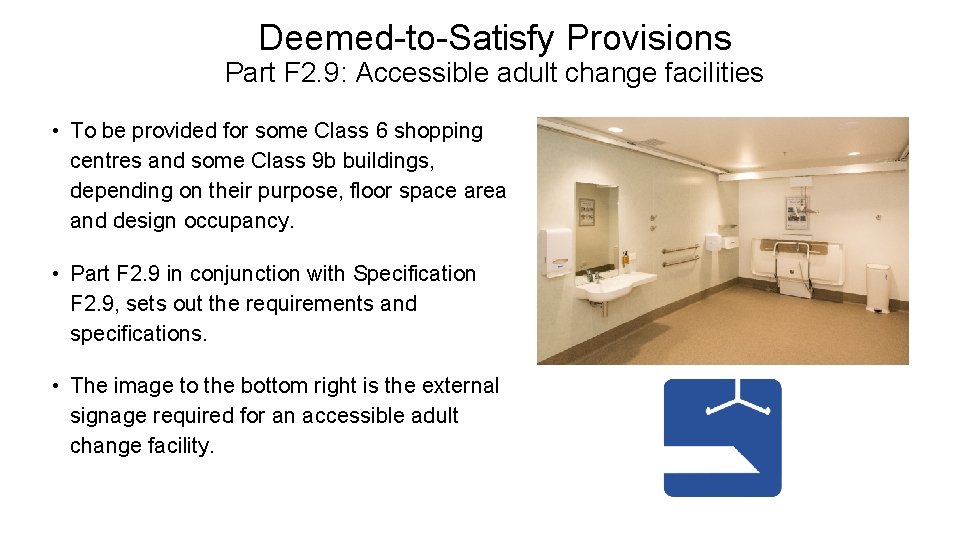
Deemed-to-Satisfy Provisions Part F 2. 9: Accessible adult change facilities • To be provided for some Class 6 shopping centres and some Class 9 b buildings, depending on their purpose, floor space area and design occupancy. • Part F 2. 9 in conjunction with Specification F 2. 9, sets out the requirements and specifications. • The image to the bottom right is the external signage required for an accessible adult change facility.
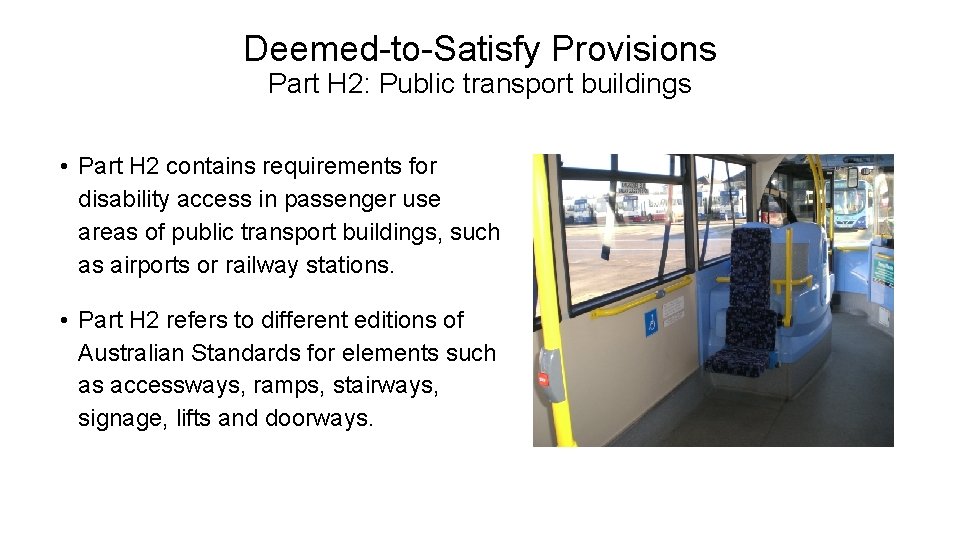
Deemed-to-Satisfy Provisions Part H 2: Public transport buildings • Part H 2 contains requirements for disability access in passenger use areas of public transport buildings, such as airports or railway stations. • Part H 2 refers to different editions of Australian Standards for elements such as accessways, ramps, stairways, signage, lifts and doorways.
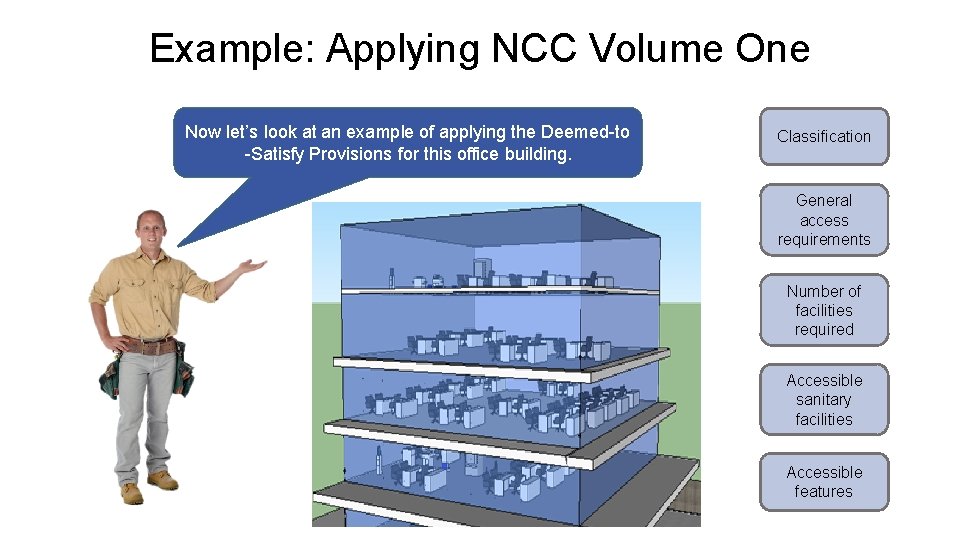
Example: Applying NCC Volume One Now let’s look at an example of applying the Deemed-to -Satisfy Provisions for this office building. Classification General access requirements Number of facilities required Accessible sanitary facilities Accessible features
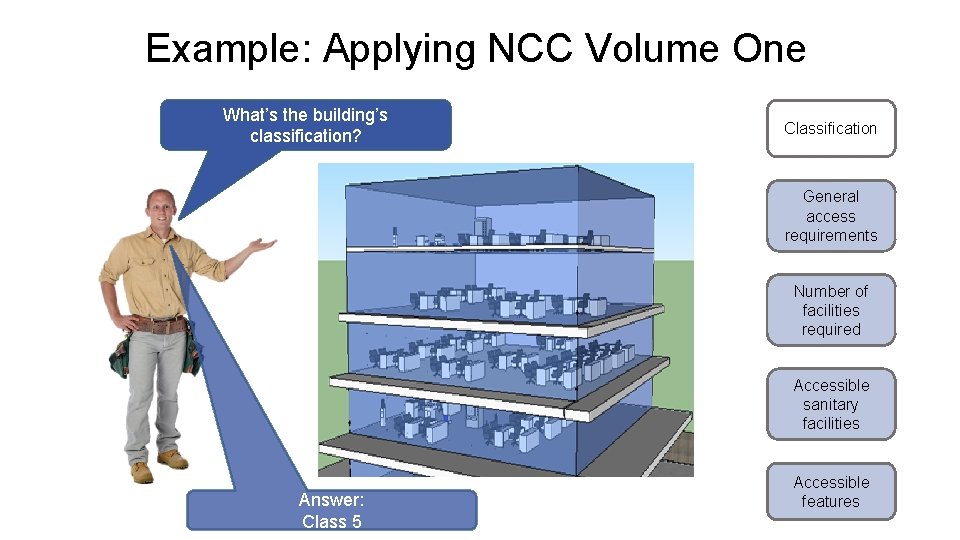
Example: Applying NCC Volume One What’s the building’s classification? Classification General access requirements Number of facilities required Accessible sanitary facilities Answer: Class 5 Accessible features
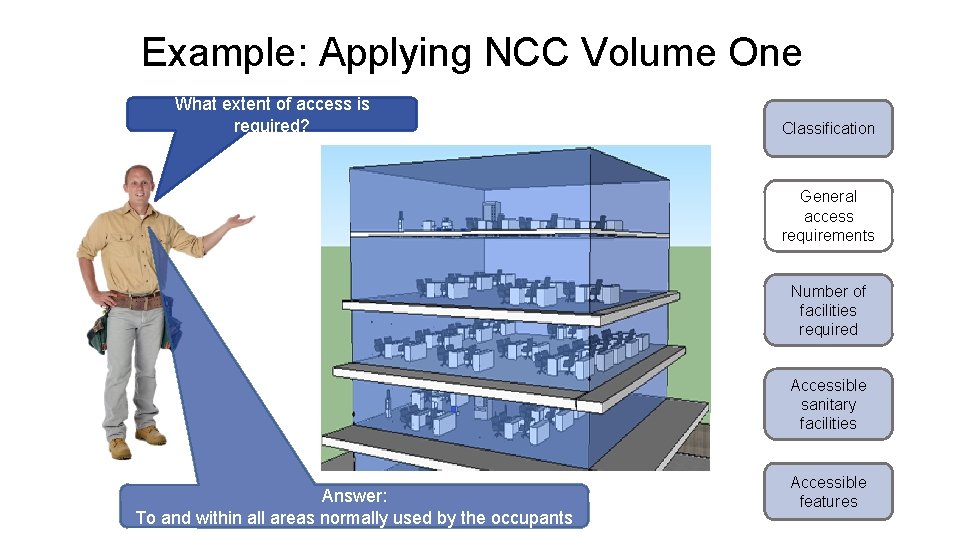
Example: Applying NCC Volume One What extent of access is required? Classification General access requirements Number of facilities required Accessible sanitary facilities Answer: To and within all areas normally used by the occupants Accessible features
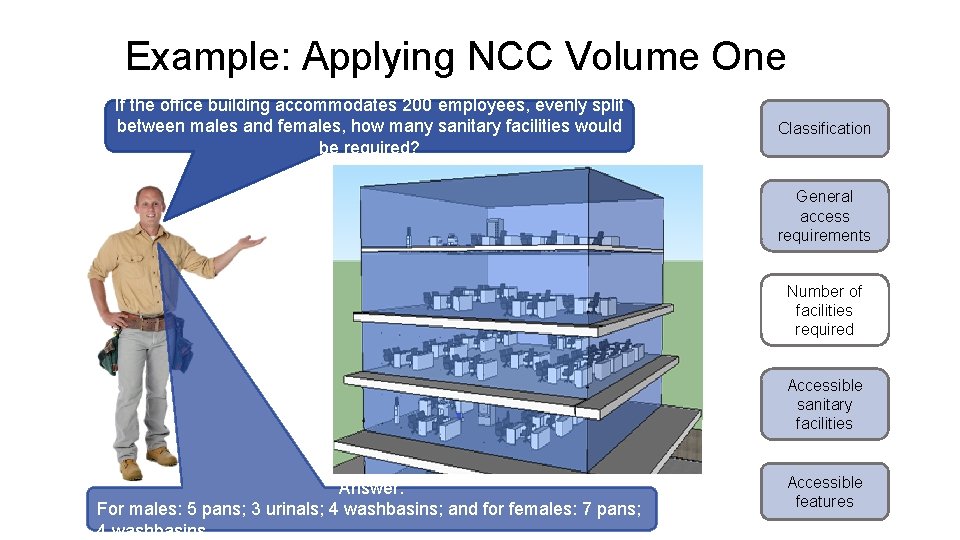
Example: Applying NCC Volume One If the office building accommodates 200 employees, evenly split between males and females, how many sanitary facilities would be required? Classification General access requirements Number of facilities required Accessible sanitary facilities Answer: For males: 5 pans; 3 urinals; 4 washbasins; and for females: 7 pans; 4 washbasins Accessible features
Example: Applying NCC Volume One Remember accessible sanitary facilities! Classification General access requirements Number of facilities required Accessible sanitary facilities Accessible features
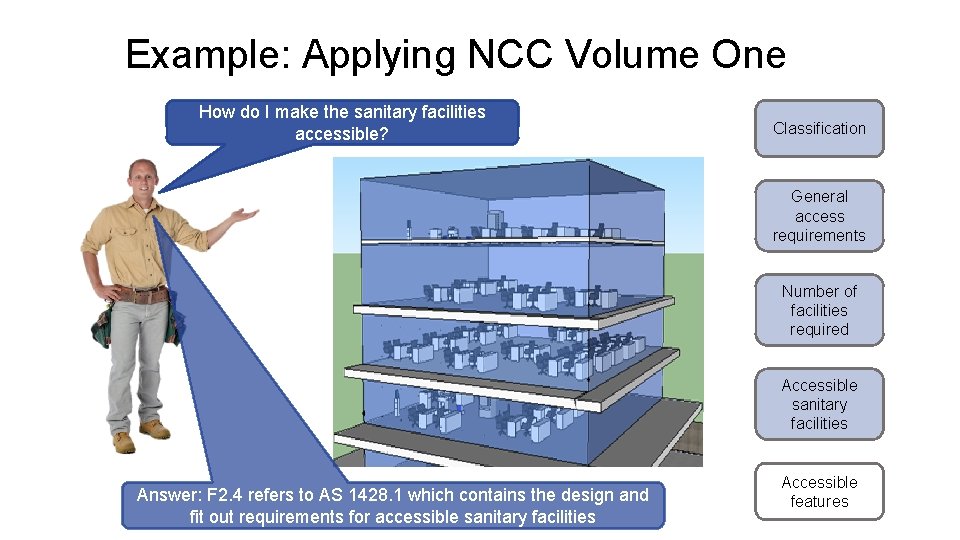
Example: Applying NCC Volume One How do I make the sanitary facilities accessible? Classification General access requirements Number of facilities required Accessible sanitary facilities Answer: F 2. 4 refers to AS 1428. 1 which contains the design and fit out requirements for accessible sanitary facilities Accessible features
Other Matters In this section we will look at: • existing buildings; • unjustifiable hardship; • the Guide to Volume One; and • the Guideline on the application of the Premises Standards.
Existing Buildings • Under building law, any differentiation of requirements for existing buildings is a function of State and Territory building regulations rather than the NCC. • Three areas for particular consideration are: • exemptions for existing Class 1 b and Class 2 buildings; • application of ‘affected part’; and • requirements for upgrades to existing lifts and accessible unisex toilets.
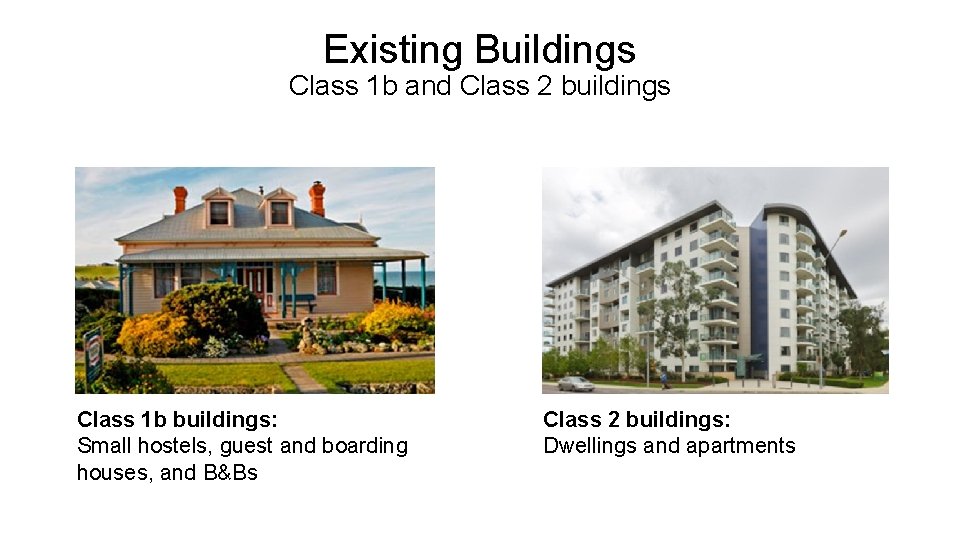
Existing Buildings Class 1 b and Class 2 buildings Class 1 b buildings: Small hostels, guest and boarding houses, and B&Bs Class 2 buildings: Dwellings and apartments
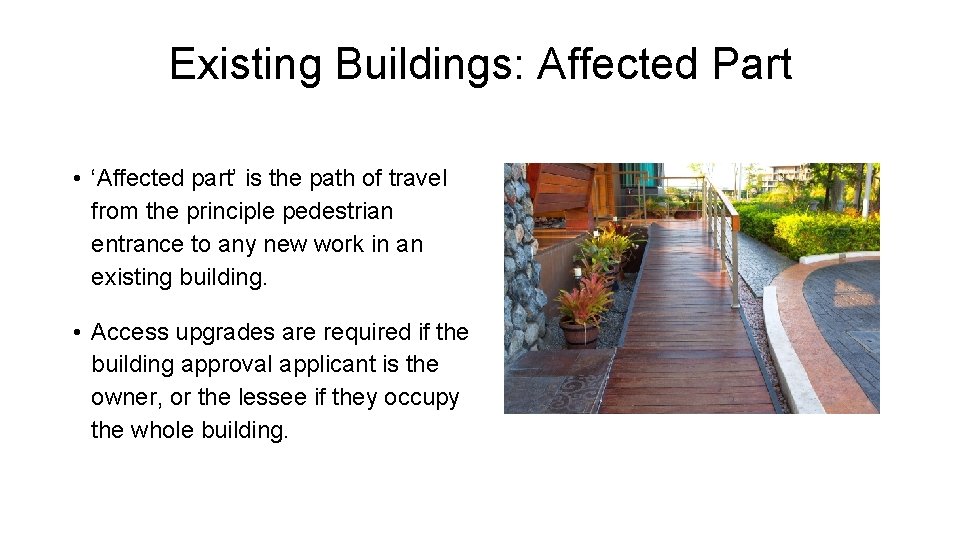
Existing Buildings: Affected Part • ‘Affected part’ is the path of travel from the principle pedestrian entrance to any new work in an existing building. • Access upgrades are required if the building approval applicant is the owner, or the lessee if they occupy the whole building.
Unjustifiable Hardship • The Premises Standards allows for a defence of unjustifiable hardship in some situations. • Compliance with the Premises Standards is still required to the maximum extent not involving unjustifiable hardship: • Example: enlarging a lift may impose unjustifiable hardship but upgrading the lift control panel to provide braille and tactile buttons may not. • Access panels or similar.
Guide to Volume One and Guideline on the application of the Premises Standards • To accompany NCC Volume One, the ABCB produces the Guide to Volume One, which: • provides background and explanatory information; and • provides valuable assistance in understanding the relationships between Parts of the BCA and is a valuable aid when interpreting provisions. • To assist in the understanding and application of the Premises Standards the Australian Human Rights Commission has produced a publication titled, ”Guideline on the application of the Premises Standards”. ncc. abcb. gov. au humanrights. gov. au
Conclusion Upon completion, you’ll have gained a basic understanding of the NCC disability access requirements with a focus on: • the application of the NCC; and • background and objective of the NCC disability access requirements within NCC Volume One. You will have also gained a basic understanding of: • defined terms; • referenced documents; • Performance Requirements; • Verification Methods and • Deemed-to-Satisfy Provisions.
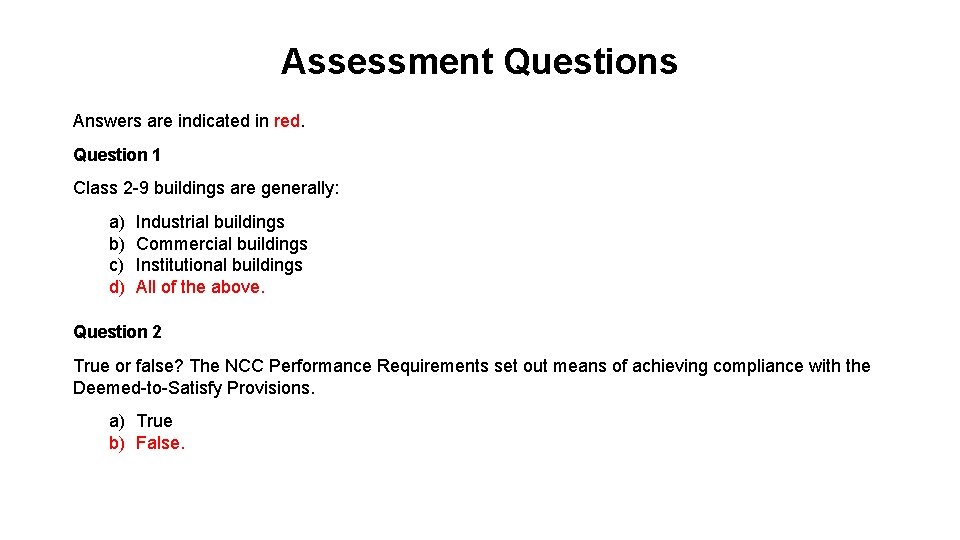
Assessment Questions Answers are indicated in red. Question 1 Class 2 -9 buildings are generally: a) b) c) d) Industrial buildings Commercial buildings Institutional buildings All of the above. Question 2 True or false? The NCC Performance Requirements set out means of achieving compliance with the Deemed-to-Satisfy Provisions. a) True b) False.
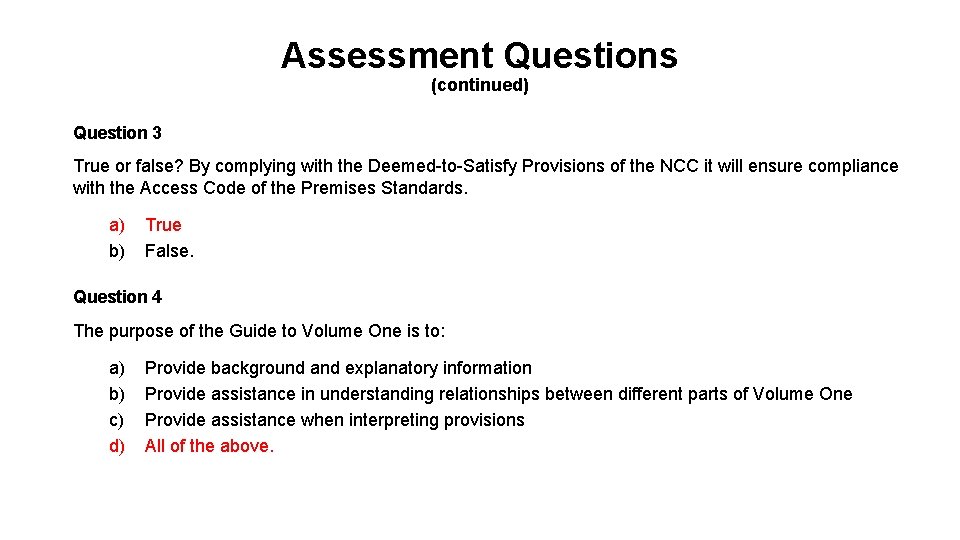
Assessment Questions (continued) Question 3 True or false? By complying with the Deemed-to-Satisfy Provisions of the NCC it will ensure compliance with the Access Code of the Premises Standards. a) b) True False. Question 4 The purpose of the Guide to Volume One is to: a) b) c) d) Provide background and explanatory information Provide assistance in understanding relationships between different parts of Volume One Provide assistance when interpreting provisions All of the above.
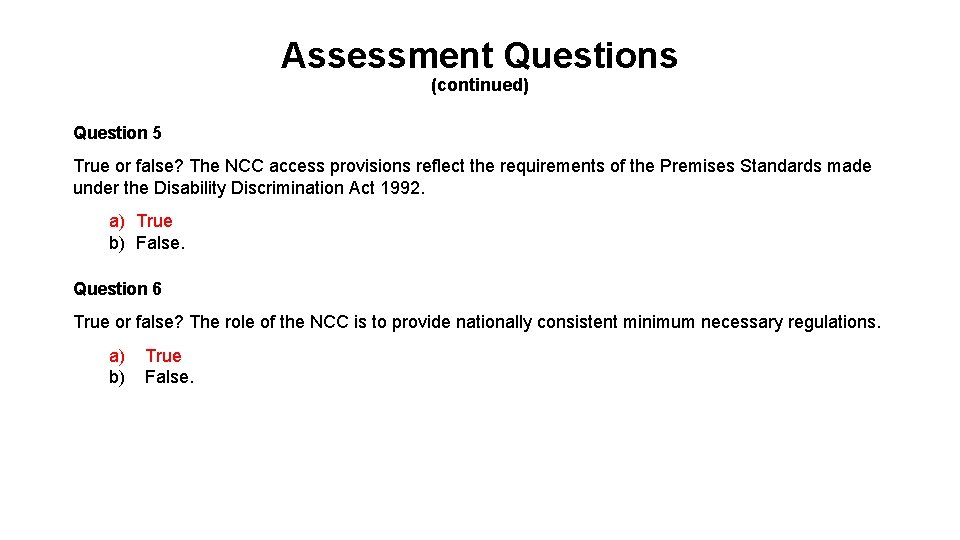
Assessment Questions (continued) Question 5 True or false? The NCC access provisions reflect the requirements of the Premises Standards made under the Disability Discrimination Act 1992. a) True b) False. Question 6 True or false? The role of the NCC is to provide nationally consistent minimum necessary regulations. a) b) True False.
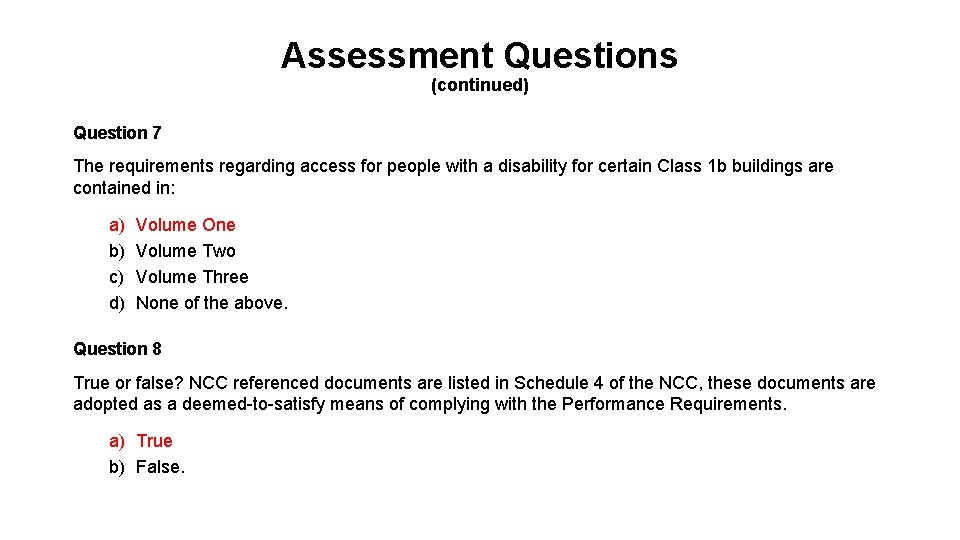
Assessment Questions (continued) Question 7 The requirements regarding access for people with a disability for certain Class 1 b buildings are contained in: a) b) c) d) Volume One Volume Two Volume Three None of the above. Question 8 True or false? NCC referenced documents are listed in Schedule 4 of the NCC, these documents are adopted as a deemed-to-satisfy means of complying with the Performance Requirements. a) True b) False.
Assessment Questions (continued) Question 9 True or false? Disability access requirements have been in the BCA since 1998. (a) True (b) False. Question 10 Do the NCC access provisions address building management policies? a) Yes b) No.
Assessment Questions (continued) Question 11 The definition of “accessible” in the NCC is: Accessible … a) means a continuous accessible path of travel to, into or within a building b) means having features such as a path of travel to enable use by people with a disability into or within a building c) means having features to enable use by people with a disability d) means general access requirements to new buildings. Question 12 For a Class 5 office building, access would be required: a) Only to certain areas within buildings b) To and within all areas normally used by the occupants c) To only a certain number of the offices within the building.
Copyright, Attribution & Disclaimer Copyright © Commonwealth of Australia and the States and Territories of Australia 2020, published by the Australian Building Codes Board. The material in this publication is licensed under a Creative Commons Attribution— 4. 0 International licence, with the exception of: any third party material, any trademarks, and any images or photographs. More information on this CC BY licence is set out at the Creative Commons Website. Enquiries about this publication can be sent to: Australian Building Codes Board , GPO Box 2013, CANBERRA ACT 2601. Phone: 1300 134 631, Email: ncc@abcb. gov. au www. abcb. gov. au. Attribution Use of all or part of this publication must include the following attribution: © Commonwealth of Australia and the States and Territories 2020, published by the Australian Building Codes Board. Disclaimer By accessing or using this publication, you agree to the following: While care has been taken in the preparation of this publication, it may not be complete or up-to-date. You can ensure that you are using a complete and upto-date version by checking the Australian Building Codes Board website (www. abcb. gov. au). The Australian Building Codes Board, the Commonwealth of Australia and States and Territories of Australia do not accept any liability, including liability for negligence, for any loss (howsoever caused), damage, injury, expense or cost incurred by any person as a result of accessing, using or relying upon this publication, to the maximum extent permitted by law. No representation or warranty is made or given as to the currency, accuracy, reliability, merchantability, fitness for any purpose or completeness of this publication or any information which may appear on any linked websites, or in other linked information sources, and all such representations and warranties are excluded to the extent permitted by law. This publication is not legal or professional advice. Persons rely upon this publication entirely at their own risk and must take responsibility for assessing the relevance and accuracy of the information in relation to their particular circumstances.
- Slides: 55