
VOLUME MASS AND CAPACITY LG TO USE TOOLS

- Slides: 12
VOLUME, MASS AND CAPACITY LG: TO USE TOOLS TO COMPARE, ORDER AND MEASURE VOLUME, MASS AND CAPACITY
WHAT DO WE KNOW ABOUT VOLUME AND CAPACITY? Watch this clip on volume and capacity and talk about what you know about volume and capacity? https: //www. youtube. com/watch? v=GKCE 8 oh. IBq. E
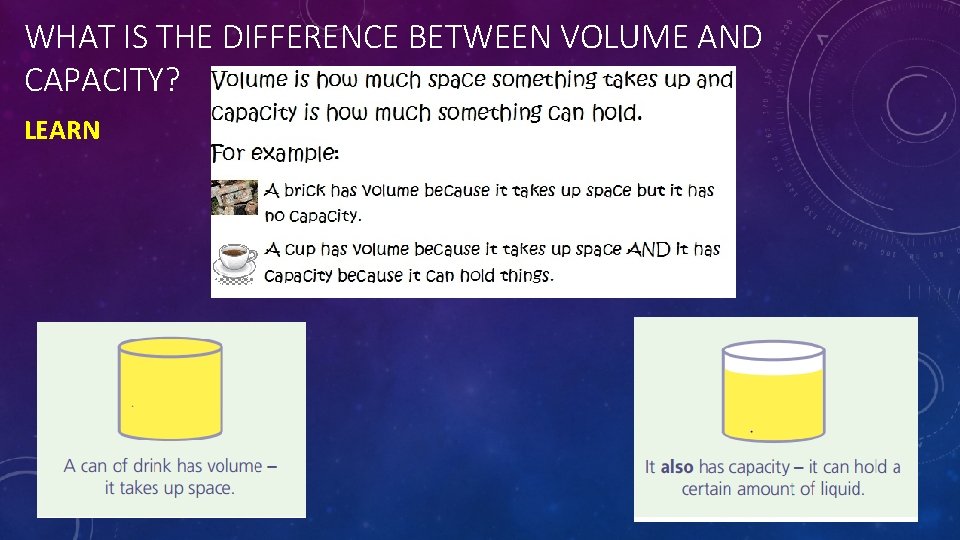
WHAT IS THE DIFFERENCE BETWEEN VOLUME AND CAPACITY? LEARN
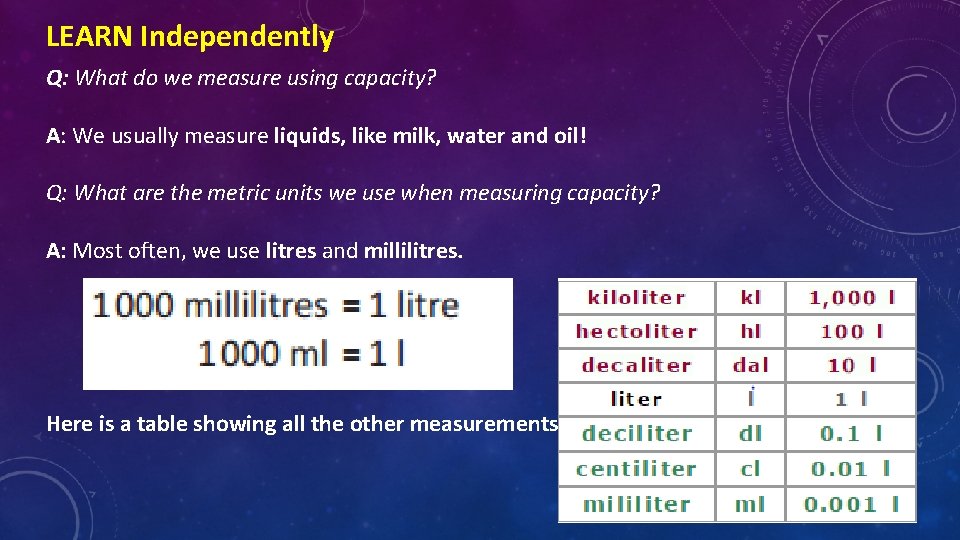
LEARN Independently Q: What do we measure using capacity? A: We usually measure liquids, like milk, water and oil! Q: What are the metric units we use when measuring capacity? A: Most often, we use litres and millilitres. Here is a table showing all the other measurements!
LET’S EXPLORE CAPACITY! APPLY 1 a) Find, draw and name 2 things that have a capacity greater than your water bottle. 1 b) Find, draw and name 2 things that have a smaller capacity than your water bottle. 1 c) Name 4 things that you might measure in litres and millitres. 1 d) Name 2 situations where you might need to measure capacity.
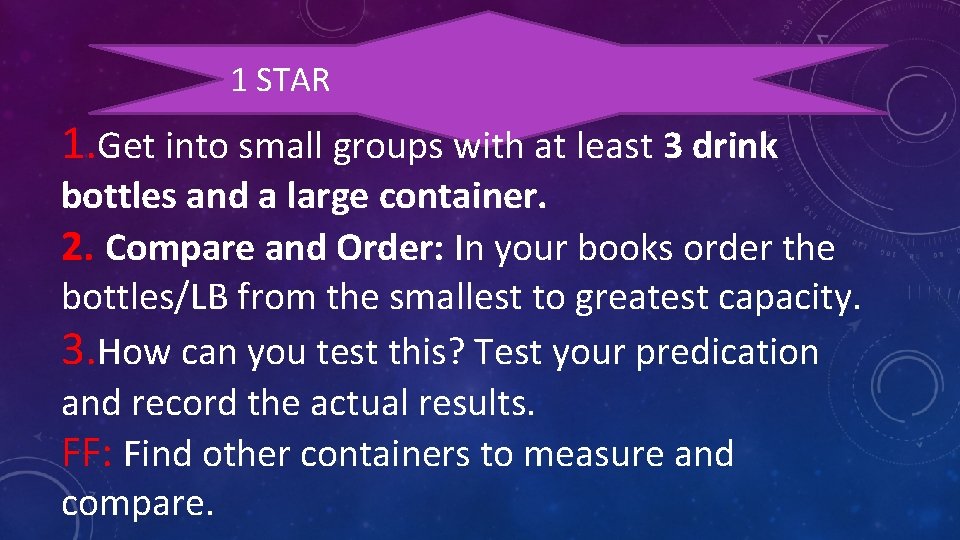
1 STAR 1. Get into small groups with at least 3 drink bottles and a large container. 2. Compare and Order: In your books order the bottles/LB from the smallest to greatest capacity. 3. How can you test this? Test your predication and record the actual results. FF: Find other containers to measure and compare.
LOOK AND EXPLORE: MASS 1. Have a look at the items on the table and. Have a lift, compare 2 together. 2. Be sure to read their weight in grams and kilograms or litres and millilitres.
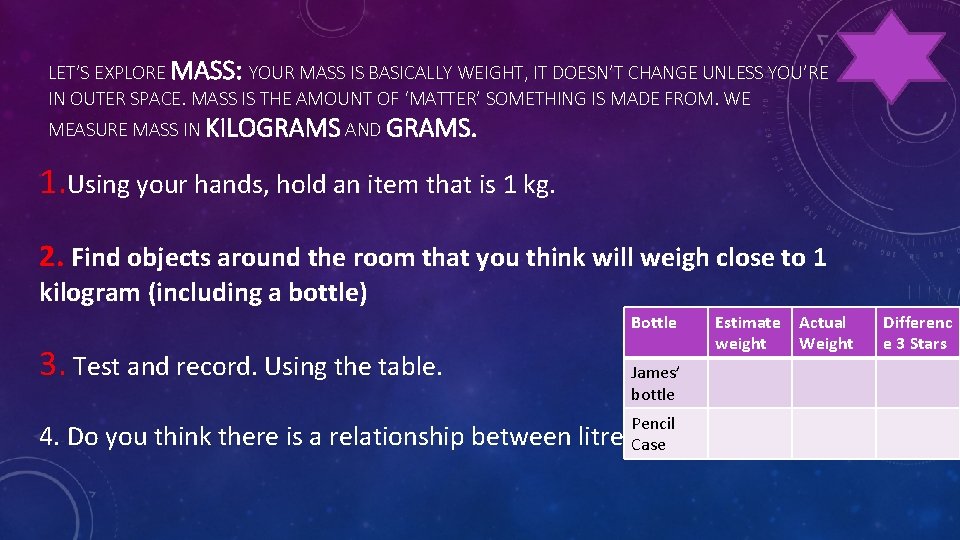
LET’S EXPLORE MASS: YOUR MASS IS BASICALLY WEIGHT, IT DOESN’T CHANGE UNLESS YOU’RE IN OUTER SPACE. MASS IS THE AMOUNT OF ‘MATTER’ SOMETHING IS MADE FROM. WE MEASURE MASS IN KILOGRAMS AND GRAMS. 1. Using your hands, hold an item that is 1 kg. 2. Find objects around the room that you think will weigh close to 1 kilogram (including a bottle) Bottle 3. Test and record. Using the table. 4. Do you think there is a relationship between Estimate weight Actual Weight James’ bottle Pencil litres. Case and kilograms? Differenc e 3 Stars
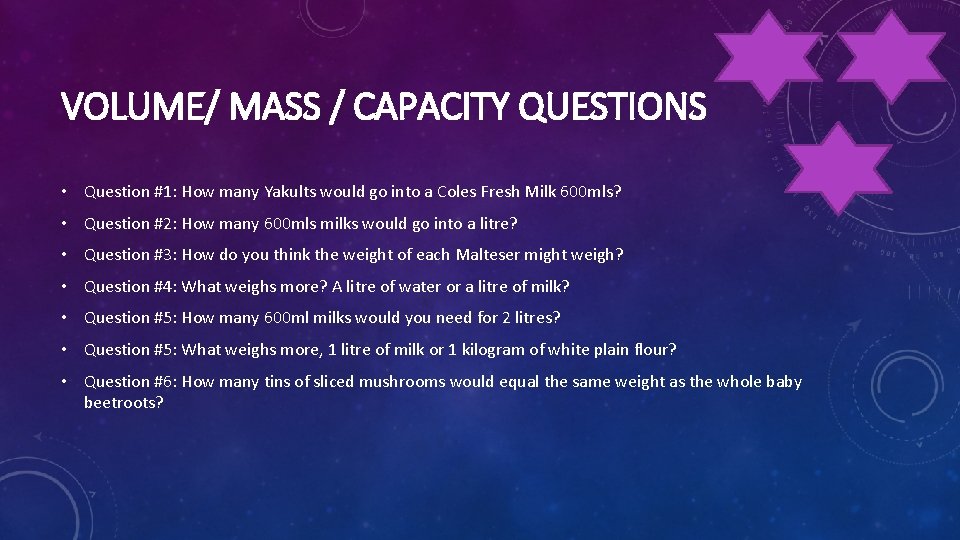
VOLUME/ MASS / CAPACITY QUESTIONS • Question #1: How many Yakults would go into a Coles Fresh Milk 600 mls? • Question #2: How many 600 mls milks would go into a litre? • Question #3: How do you think the weight of each Malteser might weigh? • Question #4: What weighs more? A litre of water or a litre of milk? • Question #5: How many 600 ml milks would you need for 2 litres? • Question #5: What weighs more, 1 litre of milk or 1 kilogram of white plain flour? • Question #6: How many tins of sliced mushrooms would equal the same weight as the whole baby beetroots?
Volume and Water Displacement LET’S EXPLORE VOLUME WITH WATER DISPLACEMENT: REMEMBER: VOLUME IS HOW MUCH SPACE SOMETHING TAKES UP… We can find the volume of an object, by using water displacement. This means measuring how much the water rises, when you submerge an object to find its volume. 1. Get a clear container and fill it half way with water. 2. Find 3 -5 objects of similar size and order them from what you think will have the smallest to greatest volume. 3. Test and check by seeing how far the water rises for each object.
3 Star Wonderful Wonderings…. The same or not? Is one kilo of a solid, the same weight as a litre of water? And Is a litre of water, the same weight as a litre of milk? How can you test this? Flame Test: Can you work out the capacity of a container by the using the Burning Experiment? Have a think about this and write a procedure on how you would do this. Be ready to present and test this in front of the class.
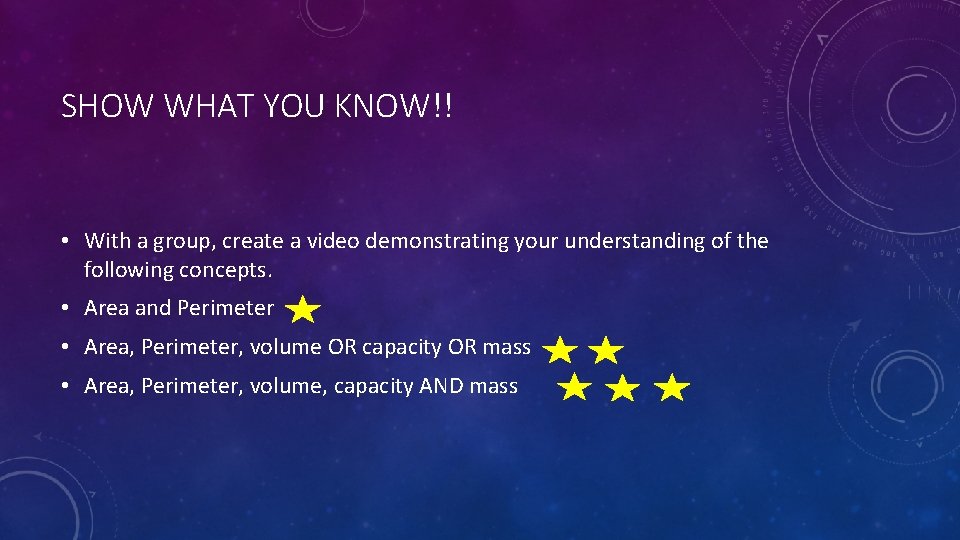
SHOW WHAT YOU KNOW!! • With a group, create a video demonstrating your understanding of the following concepts. • Area and Perimeter • Area, Perimeter, volume OR capacity OR mass • Area, Perimeter, volume, capacity AND mass