
Volume and Density What is volume Volume is

- Slides: 22
Volume and Density
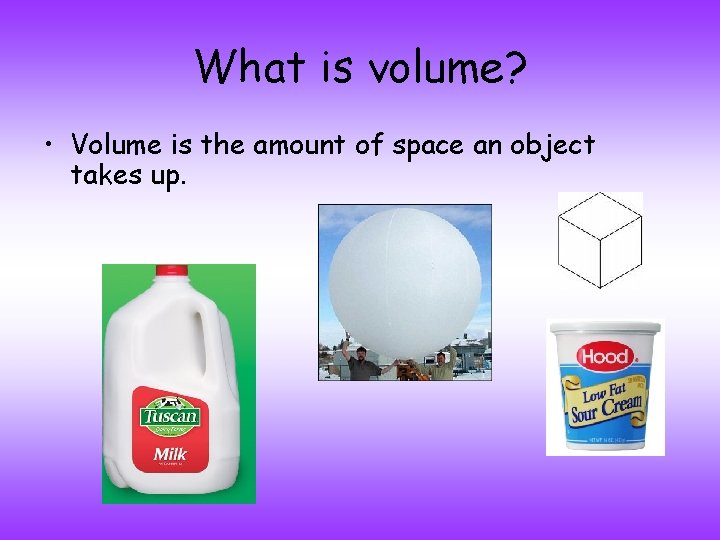
What is volume? • Volume is the amount of space an object takes up.
How is volume measured? • Volume is measured in units called: – Liters (L) - liquid – Milliliters (m. L) - liquid – Cubic centimeters (cm 3) - solid
What does volume have to do with mass? • Volume is a general property of matter. • This means that all matter has volume and mass. – All objects have an amount of matter. (Mass) – All matter takes up space. (Volume) • Now we can define matter in a more scientific way (Matter is not just “stuff” anymore. ) – “Matter is anything that has mass and volume. ”
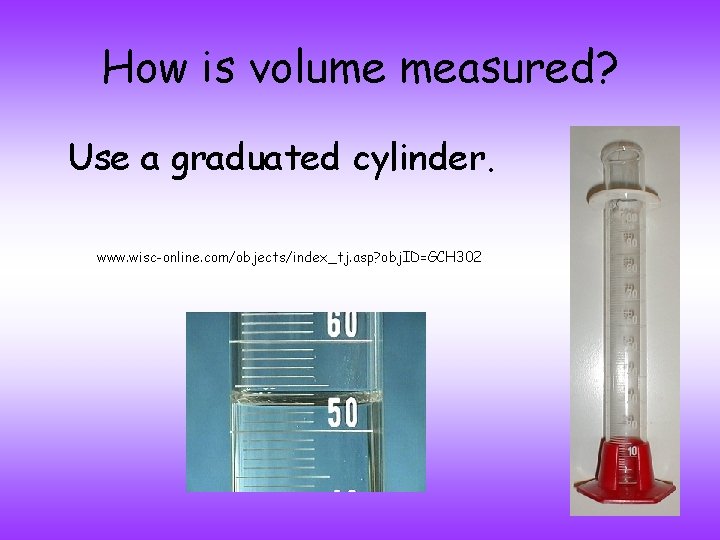
How is volume measured? Use a graduated cylinder. www. wisc-online. com/objects/index_tj. asp? obj. ID=GCH 302
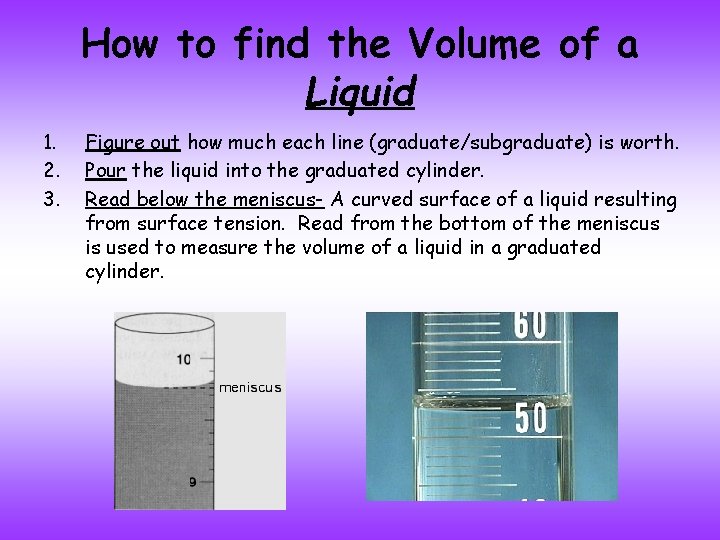
How to find the Volume of a Liquid 1. 2. 3. Figure out how much each line (graduate/subgraduate) is worth. Pour the liquid into the graduated cylinder. Read below the meniscus- A curved surface of a liquid resulting from surface tension. Read from the bottom of the meniscus is used to measure the volume of a liquid in a graduated cylinder.
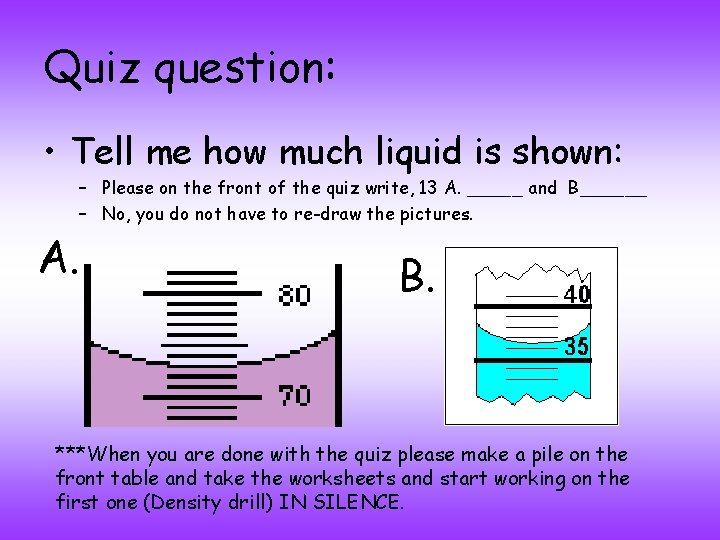
Quiz question: • Tell me how much liquid is shown: – Please on the front of the quiz write, 13 A. _____ and B______ – No, you do not have to re-draw the pictures. A. B. ***When you are done with the quiz please make a pile on the front table and take the worksheets and start working on the first one (Density drill) IN SILENCE.
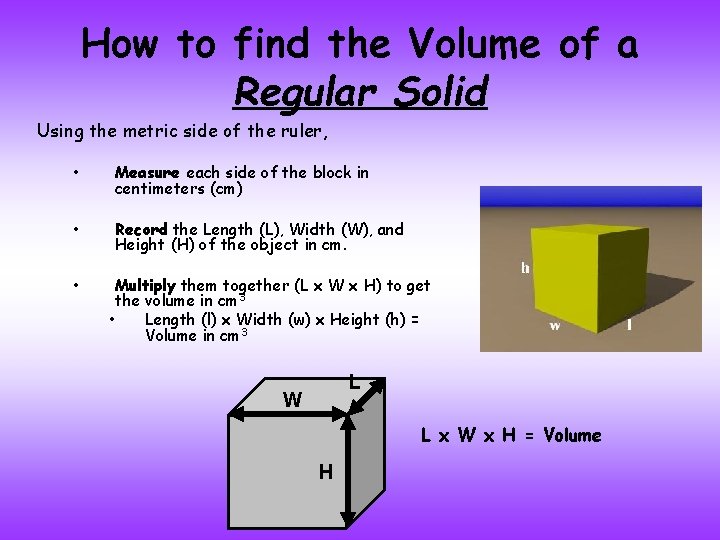
How to find the Volume of a Regular Solid Using the metric side of the ruler, • Measure each side of the block in centimeters (cm) • Record the Length (L), Width (W), and Height (H) of the object in cm. • Multiply them together (L x W x H) to get the volume in cm 3 • Length (l) x Width (w) x Height (h) = Volume in cm 3 L W L x W x H = Volume H
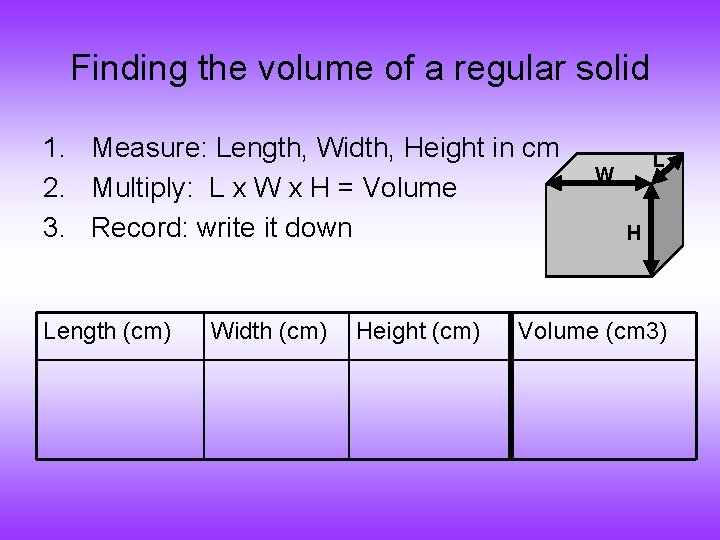
Finding the volume of a regular solid 1. Measure: Length, Width, Height in cm 2. Multiply: L x W x H = Volume 3. Record: write it down Length (cm) Width (cm) Height (cm) L W H Volume (cm 3)
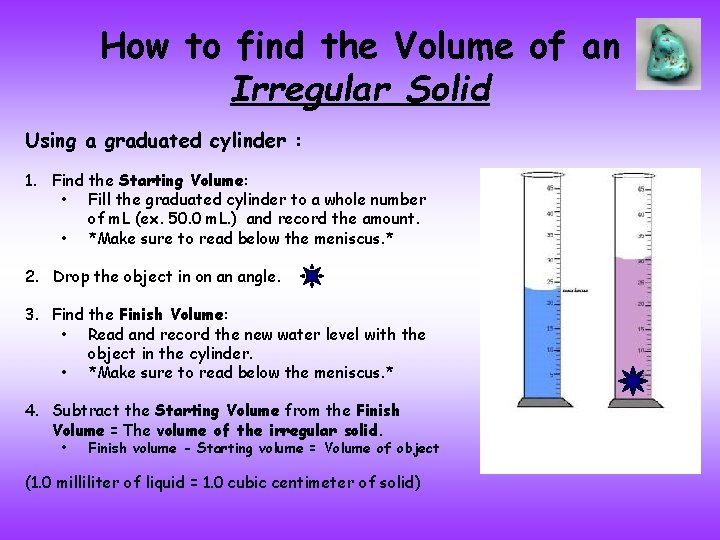
How to find the Volume of an Irregular Solid Using a graduated cylinder : 1. Find the Starting Volume: • Fill the graduated cylinder to a whole number of m. L (ex. 50. 0 m. L. ) and record the amount. • *Make sure to read below the meniscus. * 2. Drop the object in on an angle. 3. Find the Finish Volume: • Read and record the new water level with the object in the cylinder. • *Make sure to read below the meniscus. * 4. Subtract the Starting Volume from the Finish Volume = The volume of the irregular solid. • Finish volume - Starting volume = Volume of object (1. 0 milliliter of liquid = 1. 0 cubic centimeter of solid)
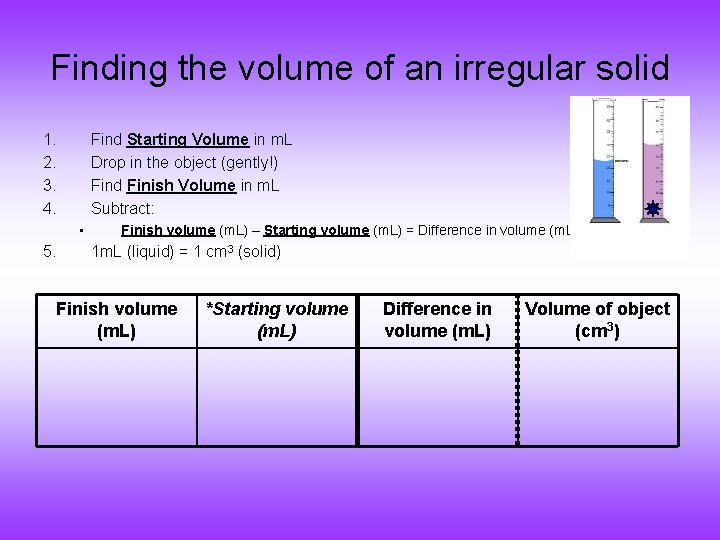
Finding the volume of an irregular solid 1. 2. 3. 4. Find Starting Volume in m. L Drop in the object (gently!) Find Finish Volume in m. L Subtract: • 5. Finish volume (m. L) – Starting volume (m. L) = Difference in volume (m. L) 1 m. L (liquid) = 1 cm 3 (solid) Finish volume (m. L) *Starting volume (m. L) Difference in volume (m. L) Volume of object (cm 3)
DENSITY is a general property of matter.
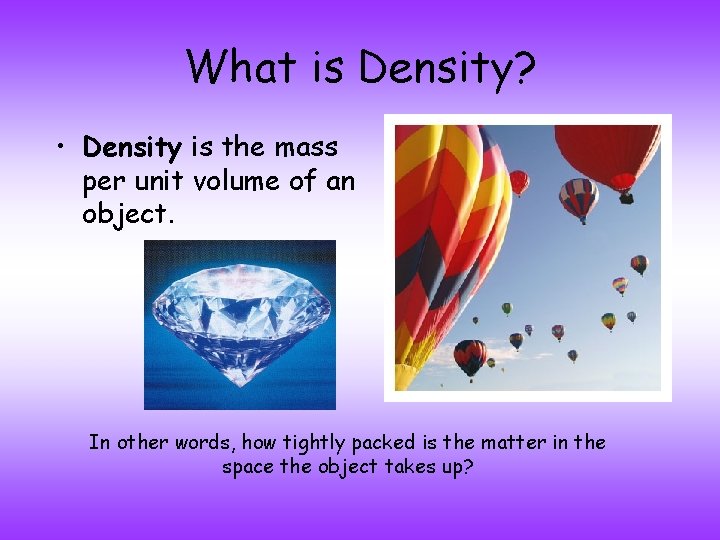
What is Density? • Density is the mass per unit volume of an object. In other words, how tightly packed is the matter in the space the object takes up?
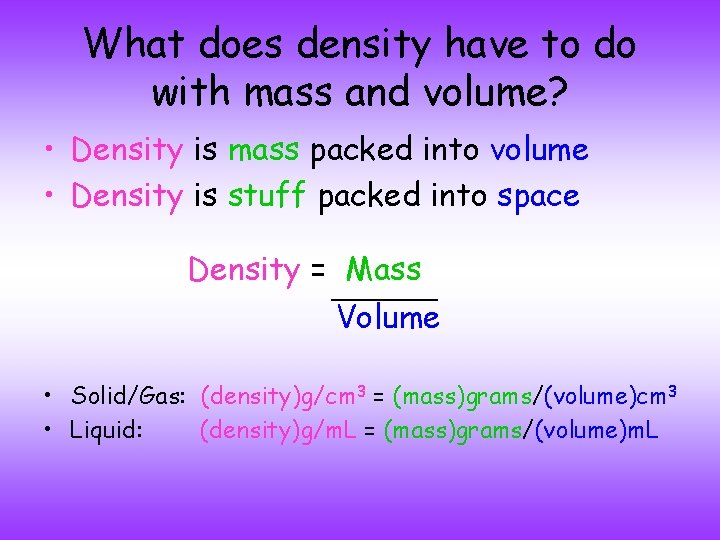
What does density have to do with mass and volume? • Density is mass packed into volume • Density is stuff packed into space Density = ______ Mass Volume • Solid/Gas: (density)g/cm 3 = (mass)grams/(volume)cm 3 • Liquid: (density)g/m. L = (mass)grams/(volume)m. L
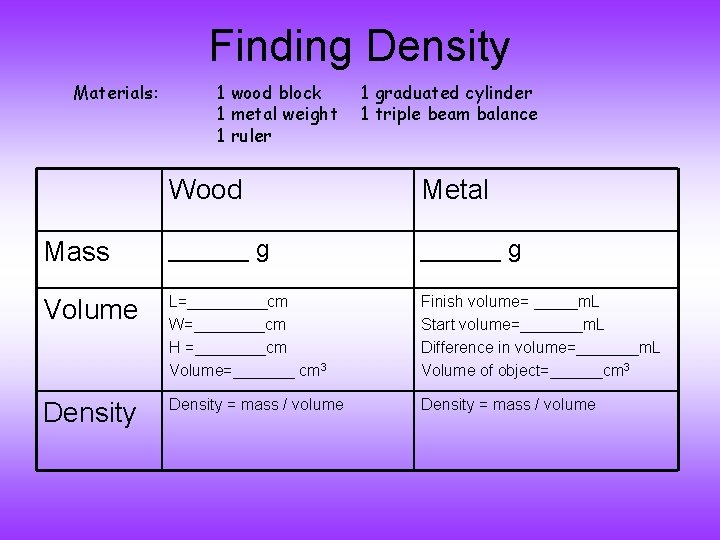
Finding Density Materials: 1 wood block 1 metal weight 1 ruler 1 graduated cylinder 1 triple beam balance Wood Metal Mass ______ g Volume L=_____cm W=____cm H =____cm Volume=_______ cm 3 Finish volume= _____m. L Start volume=_______m. L Difference in volume=_______m. L Volume of object=______cm 3 Density = mass / volume
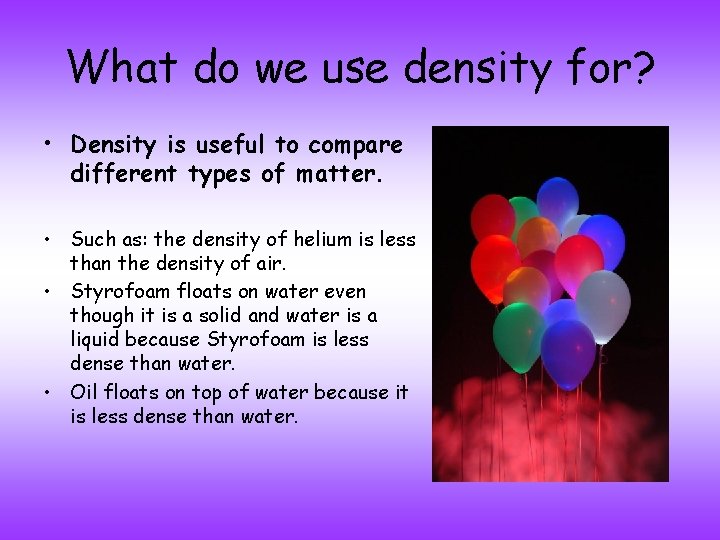
What do we use density for? • Density is useful to compare different types of matter. • Such as: the density of helium is less than the density of air. • Styrofoam floats on water even though it is a solid and water is a liquid because Styrofoam is less dense than water. • Oil floats on top of water because it is less dense than water.
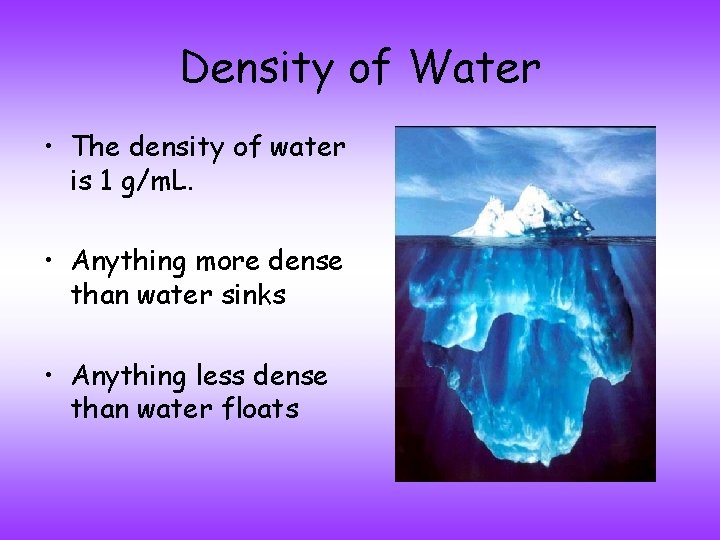
Density of Water • The density of water is 1 g/m. L. • Anything more dense than water sinks • Anything less dense than water floats
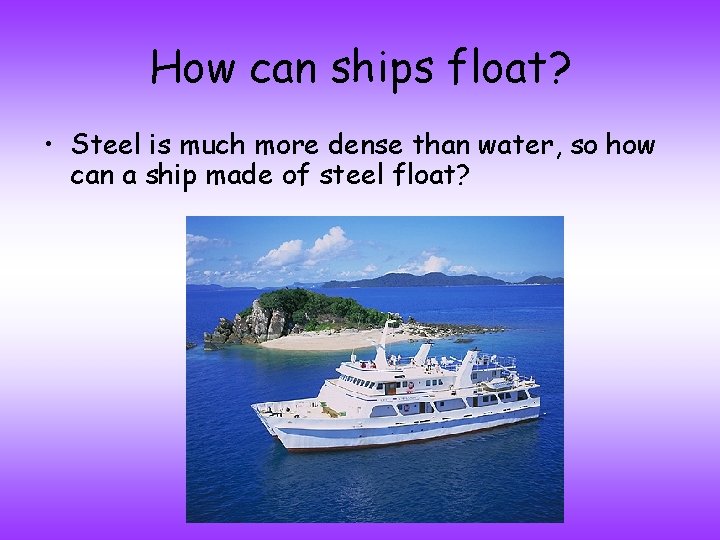
How can ships float? • Steel is much more dense than water, so how can a ship made of steel float?
Why ships float… • Although steel is used in ship building, the hull of the ship contains many “air-locked” compartments. • Air has a density of 0. 001 g/cm 3 and water has a density of 1 g/cm 3. • The air in the ship makes the ship less dense than water.
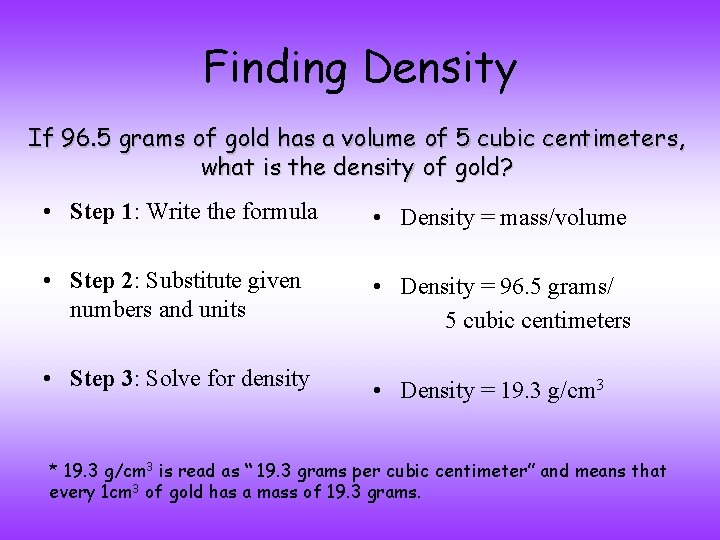
Finding Density If 96. 5 grams of gold has a volume of 5 cubic centimeters, what is the density of gold? • Step 1: Write the formula • Density = mass/volume • Step 2: Substitute given numbers and units • Density = 96. 5 grams/ 5 cubic centimeters • Step 3: Solve for density • Density = 19. 3 g/cm 3 * 19. 3 g/cm 3 is read as “ 19. 3 grams per cubic centimeter” and means that every 1 cm 3 of gold has a mass of 19. 3 grams.
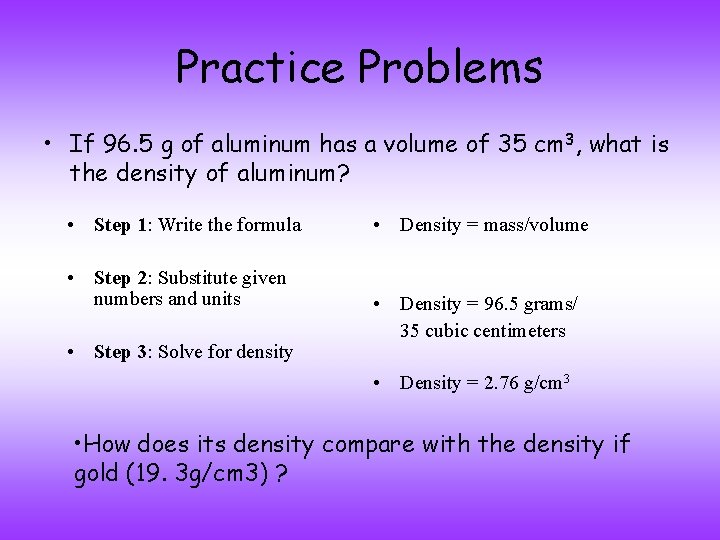
Practice Problems • If 96. 5 g of aluminum has a volume of 35 cm 3, what is the density of aluminum? • Step 1: Write the formula • Step 2: Substitute given numbers and units • Step 3: Solve for density • Density = mass/volume • Density = 96. 5 grams/ 35 cubic centimeters • Density = 2. 76 g/cm 3 • How does its density compare with the density if gold (19. 3 g/cm 3) ?
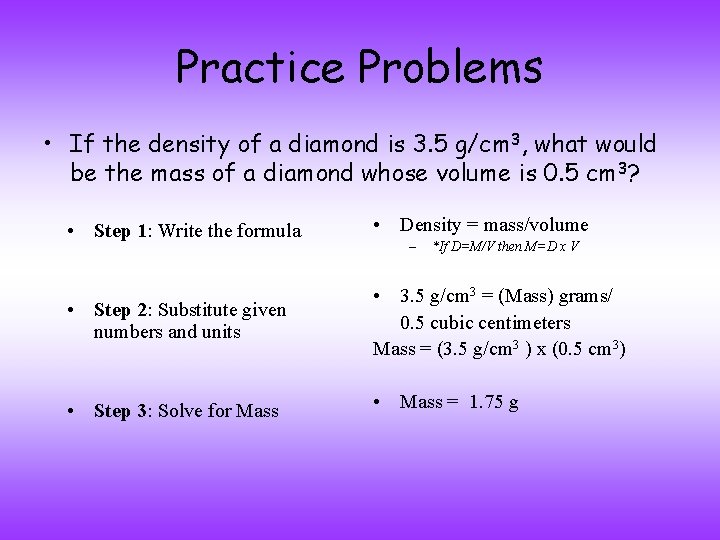
Practice Problems • If the density of a diamond is 3. 5 g/cm 3, what would be the mass of a diamond whose volume is 0. 5 cm 3? • Step 1: Write the formula • Density = mass/volume • Step 2: Substitute given numbers and units • 3. 5 g/cm 3 = (Mass) grams/ 0. 5 cubic centimeters Mass = (3. 5 g/cm 3 ) x (0. 5 cm 3) • Step 3: Solve for Mass • Mass = 1. 75 g – *If D=M/V then M=D x V