
Voltages and Currents in Y connection Fig 1
- Slides: 10
Voltages and Currents in Y connection
Fig: 1
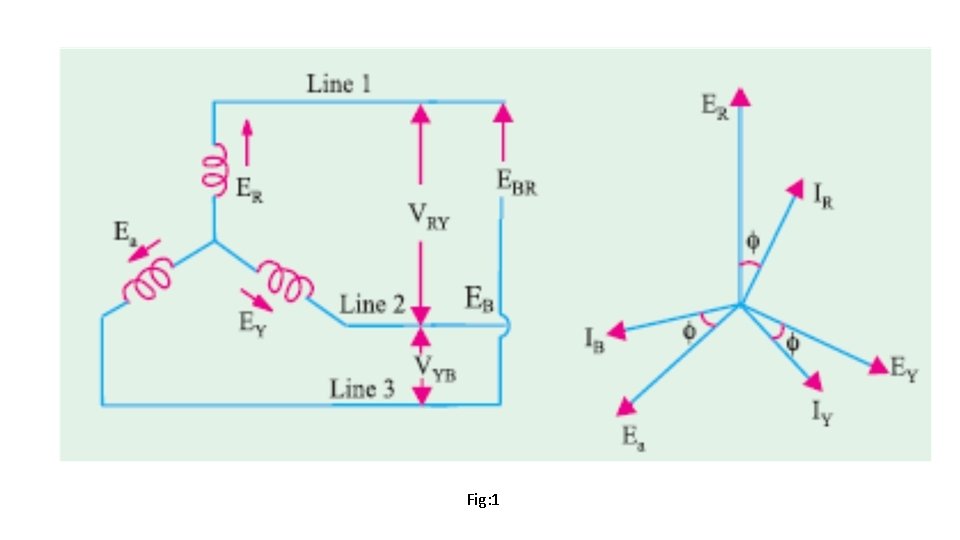
• Consider the circuit of a typical star connection shown above. • The voltage induced in each winding is the phase voltage. This is denoted by ER, EY and EB. • The current which flows through each winding is called the phase current. • The voltage available between any pair of terminals is called the line voltage. This is indicated by VRY, VYB, VBR. • The current which flows through the line is called the line current.
• In Fig: 1 shown , there are two phase windings between each pair of terminals. • The instantaneous value of potential difference between any two terminals is the arithmetic difference of the appropriate two phase emf’s. • The vector diagram of the emf’s and currents is also shown in Fig: 1. The load is considered to be of lagging nature. Hence the current in each phase lags the voltages by an angle Ø. • The system considered above is a balanced system. There fore all the phase voltages are equal by magnitude and will be denoted by Eph.
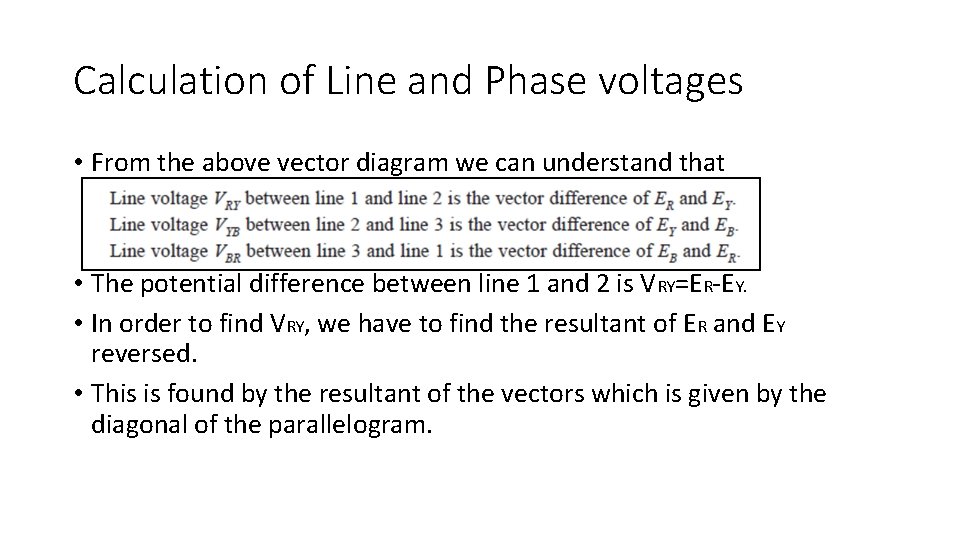
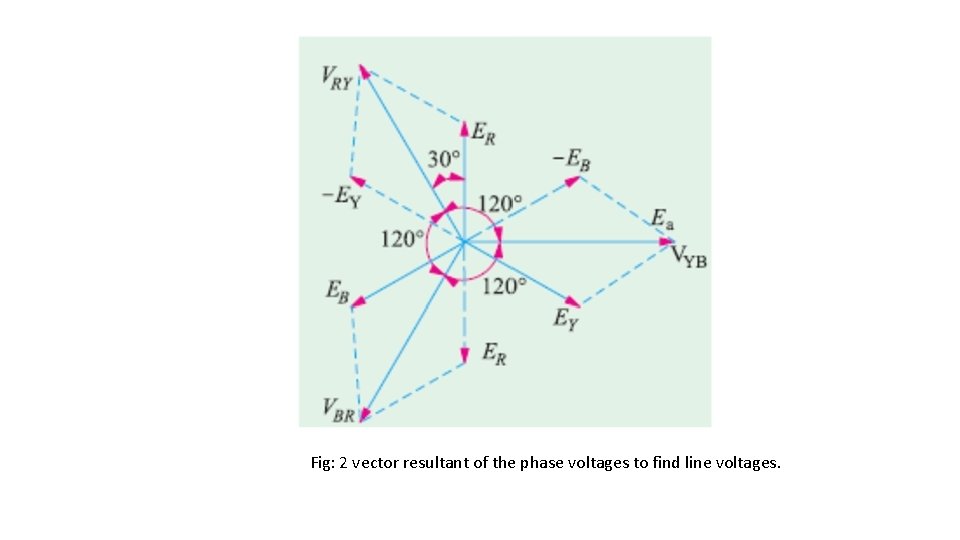
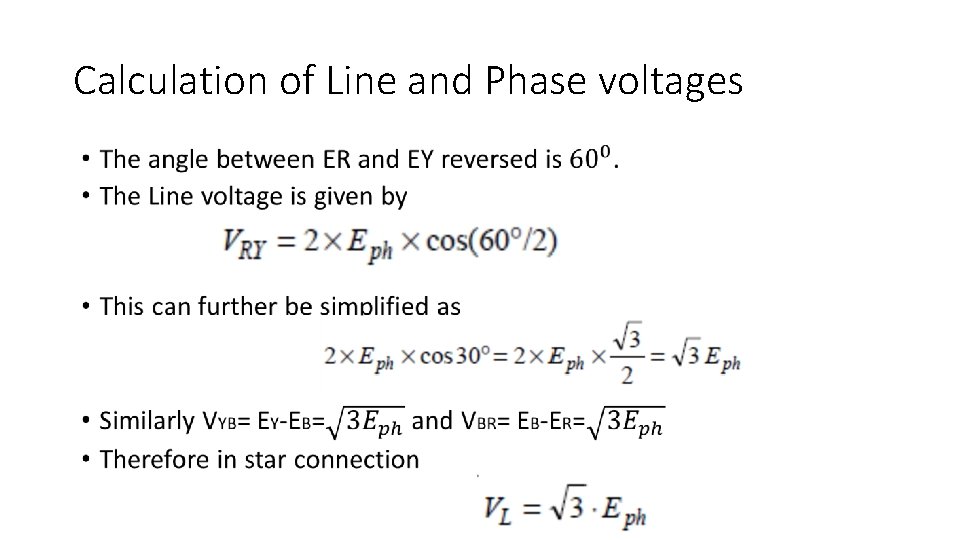
Calculation of Line and Phase voltages • From the above vector diagram we can understand that • The potential difference between line 1 and 2 is VRY=ER-EY. • In order to find VRY, we have to find the resultant of ER and EY reversed. • This is found by the resultant of the vectors which is given by the diagonal of the parallelogram.
Fig: 2 vector resultant of the phase voltages to find line voltages.
Calculation of Line and Phase voltages •
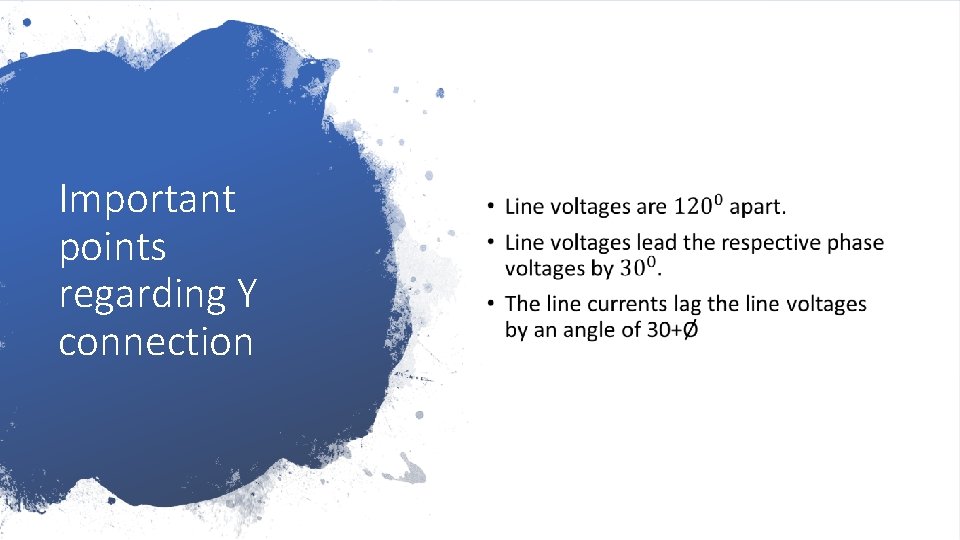
• Important points regarding Y connection
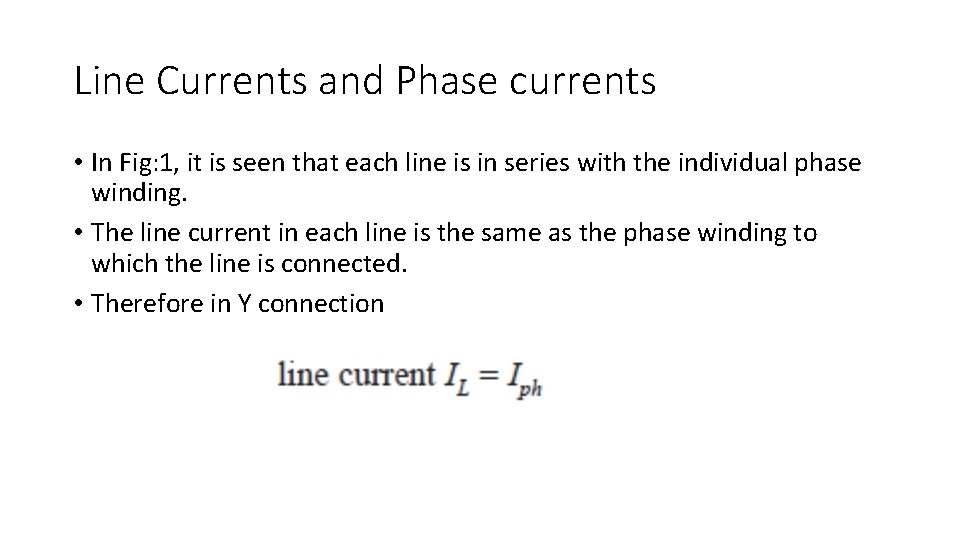
Line Currents and Phase currents • In Fig: 1, it is seen that each line is in series with the individual phase winding. • The line current in each line is the same as the phase winding to which the line is connected. • Therefore in Y connection
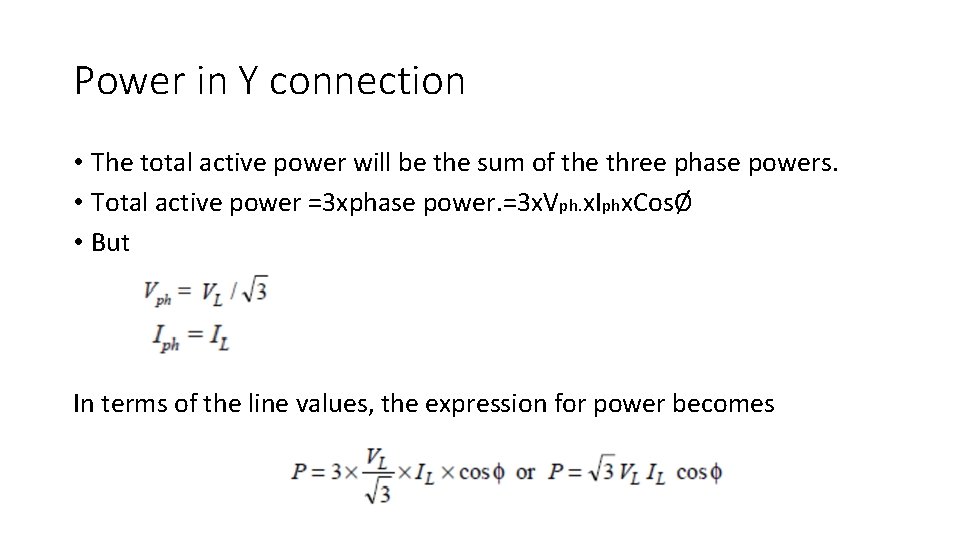
Power in Y connection • The total active power will be the sum of the three phase powers. • Total active power =3 xphase power. =3 x. Vph. x. Iphx. CosØ • But In terms of the line values, the expression for power becomes