
VOLTAGE Remember One coulomb is the charge equal
VOLTAGE
Remember. . • One coulomb is the charge equal to the charge of 6. 25 X 1018 electrons – Unit of charge (C) • 1 ampere =1 coulomb per sec – Unit of electric current (I) • Voltage= the push/force behind electrons
Voltage • Voltage is the force that moves electric charges in a circuit. • Voltage drop/potential difference: The difference in the amount of voltage between two points in a circuit – Things that make voltage drop include anything that uses energy like LOADS or other RESISTORS
Electric potential (also referred to as voltage) • is the energy given to each electron by the energy source. It is the potential energy that the electron leaving the energy source contains. • This energy is then transferred to one or more electric loads that convert the energy to another form. The electric potential is measured in the SI unit called volts.
Voltage/potential difference • Measure in volts (v) • Measured using a voltmeter • A voltmeter is always connected in PARALLEL around a LOAD, to measure the change in voltage. – Positive side of the voltmeter is connected to the positive end of the circuit and the negative side is connected to the negative terminal
Circuit diagrams • A voltmeter is the device that measures the amount of potential energy used by an object in a circuit V • The voltmeter has two outlets. The red outlet is the positive end and the black outlet is the negative end. To use a voltmeter, two wires are connected from each of its plugs and the wires are connected around the object that is being tested.
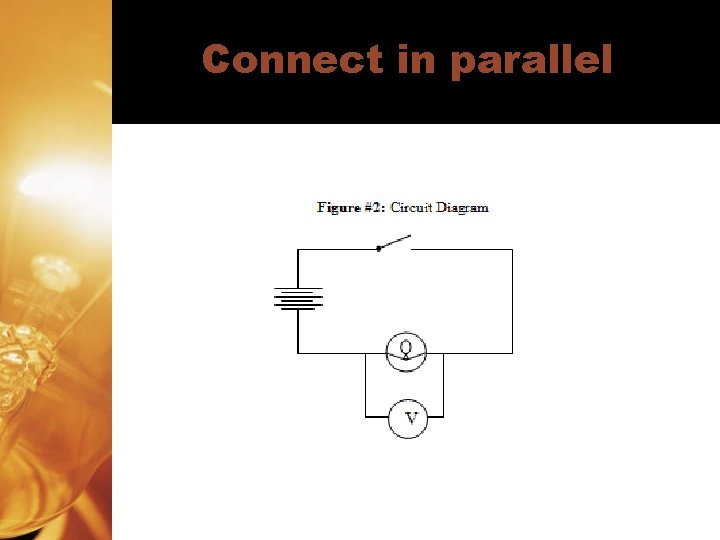
Connect in parallel
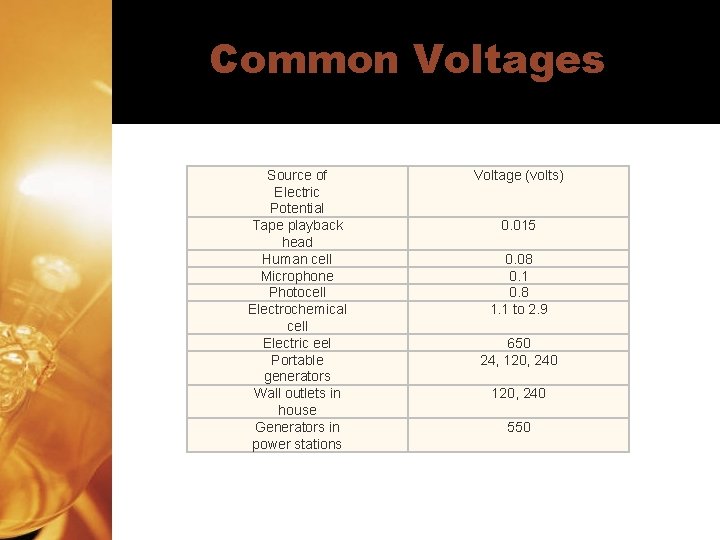
Common Voltages Source of Electric Potential Tape playback head Human cell Microphone Photocell Electrochemical cell Electric eel Portable generators Wall outlets in house Generators in power stations Voltage (volts) 0. 015 0. 08 0. 1 0. 8 1. 1 to 2. 9 650 24, 120, 240 550
Potential Energy • Electric potential energy is the electrical energy stored in a battery • All forms of energy are measured in joules (J). • When describing energy of electrons in a circuit, we talk about the potential energy per coulomb of charge.
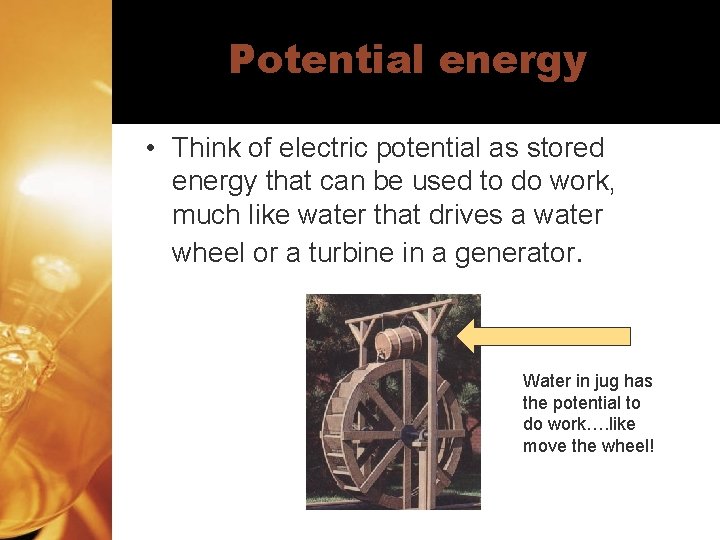
Potential energy • Think of electric potential as stored energy that can be used to do work, much like water that drives a water wheel or a turbine in a generator. Water in jug has the potential to do work…. like move the wheel!
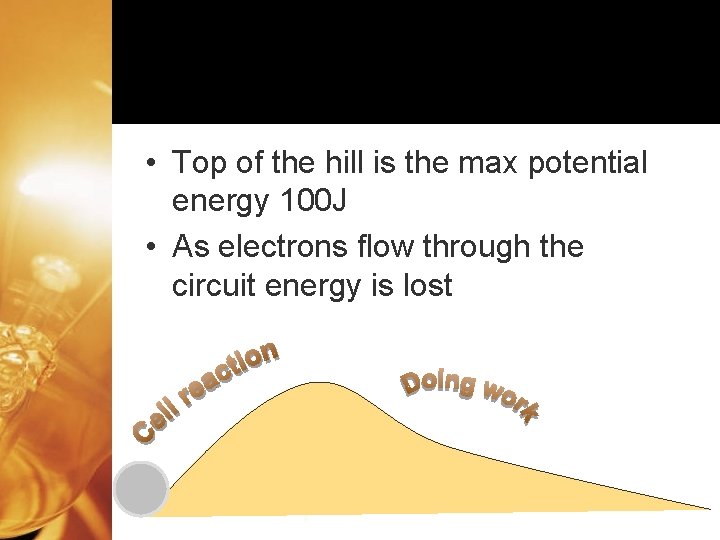
• Top of the hill is the max potential energy 100 J • As electrons flow through the circuit energy is lost
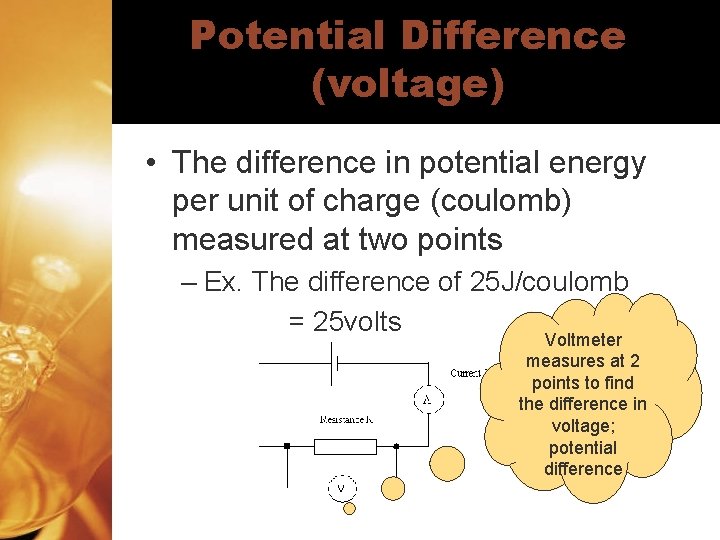
Potential Difference (voltage) • The difference in potential energy per unit of charge (coulomb) measured at two points – Ex. The difference of 25 J/coulomb = 25 volts Voltmeter measures at 2 points to find the difference in voltage; potential difference
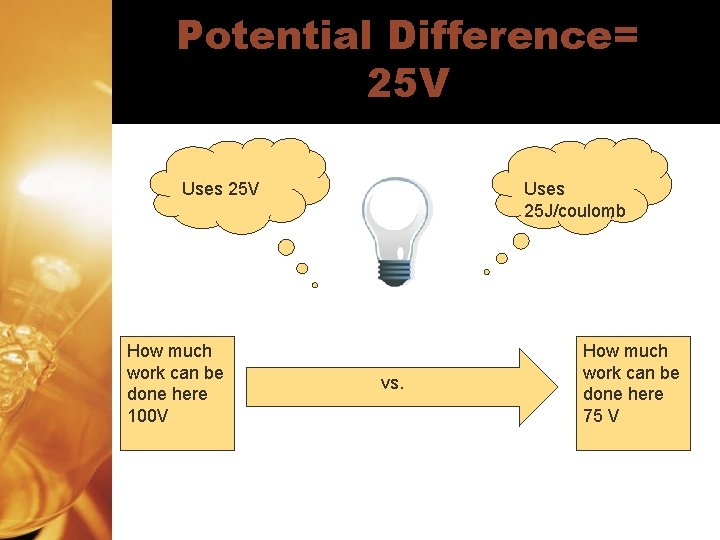
Potential Difference= 25 V Uses 25 V How much work can be done here 100 V Uses 25 J/coulomb vs. How much work can be done here 75 V
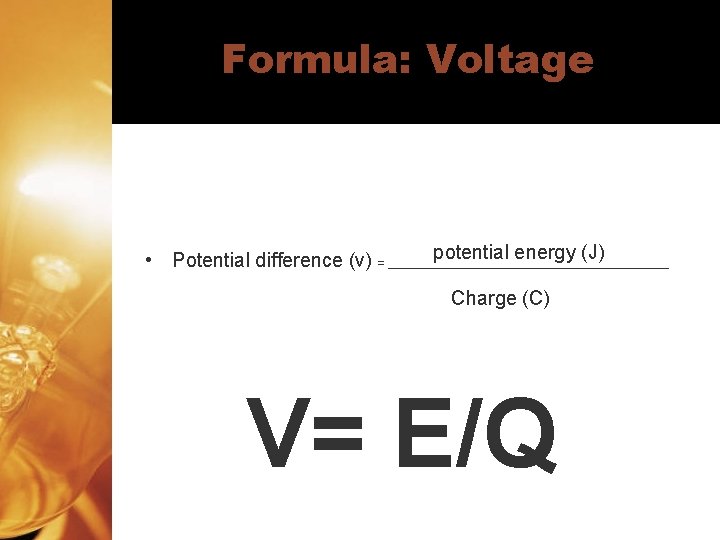
Formula: Voltage potential energy (J) • Potential difference (v) = _____________________ Charge (C) V= E/Q

Example 1 1. If a wall outlet provide 300 J of electric energy and there is 28 C of charge, what is the potential difference between the negative and positive end of the socket? G: E= 300 J; Q=28 C R: V= ? A: V=E/Q =300 J/28 C S: =10. 7 V S: Therefore, the wall socket provide 10. 7 V.
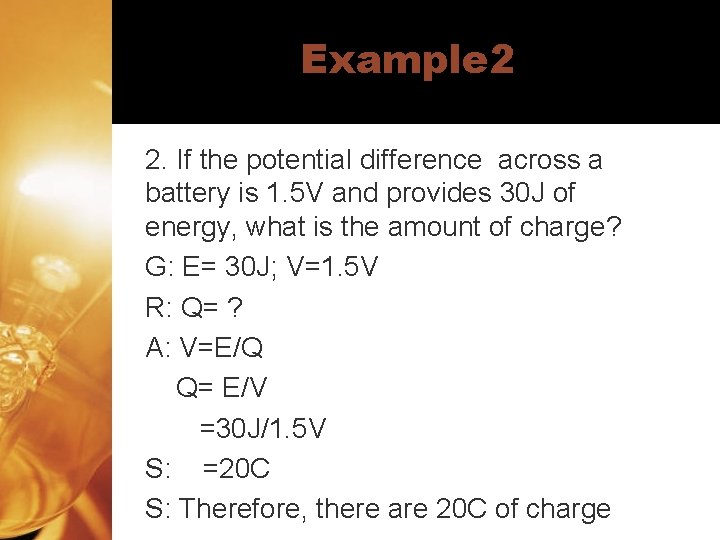
Example 2 2. If the potential difference across a battery is 1. 5 V and provides 30 J of energy, what is the amount of charge? G: E= 30 J; V=1. 5 V R: Q= ? A: V=E/Q Q= E/V =30 J/1. 5 V S: =20 C S: Therefore, there are 20 C of charge

Example 3 3. How many joules of energy are produced when there is a potential difference of 106 V and 46 C of charge? G: V= 106 V; Q=46 C R: E= ? A: V=E/Q E=QV = (46 C)(106 V) S: = 4876 J S: Therefore, 4876 J are produced.
Overall…. • A current is the movement of electrons • In order to move our electrons we need to build up energy (through chemical reactions that cause charge separation and the electric field. ) • That build up is called potential energy and voltage is the difference in energy/coulomb • Voltage is measured in volts • In order for a circuit to continue, electrons that left the negative terminal must return to the positive terminal of the power source to complete the circuit
- Slides: 18