
Voltage and distance and E Field Definition derive
- Slides: 7
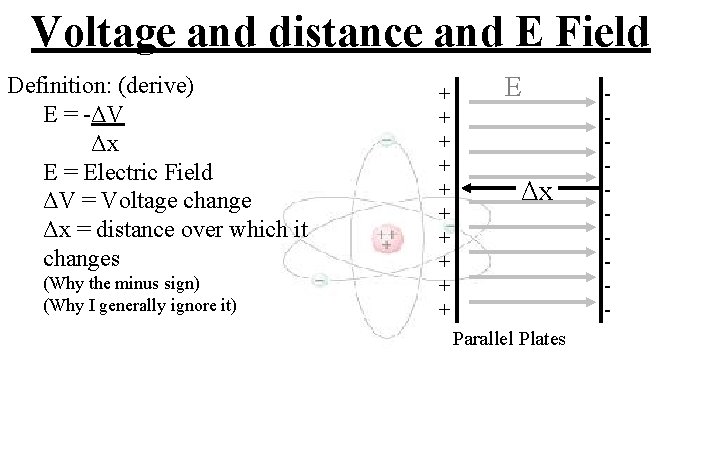
Voltage and distance and E Field Definition: (derive) E = -ΔV Δx E = Electric Field ΔV = Voltage change Δx = distance over which it changes (Why the minus sign) (Why I generally ignore it) + + + + + E Δx Parallel Plates -
Example 1: What is the electric field when you have 12. 0 V across two || plates that are separated by. 0150 m? 800. V/m. (show units)
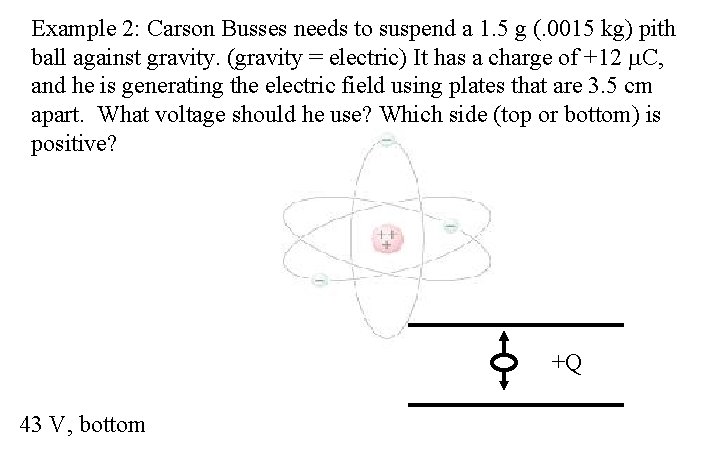
Example 2: Carson Busses needs to suspend a 1. 5 g (. 0015 kg) pith ball against gravity. (gravity = electric) It has a charge of +12 C, and he is generating the electric field using plates that are 3. 5 cm apart. What voltage should he use? Which side (top or bottom) is positive? +Q 43 V, bottom
Whiteboards: Voltage, Electric Field, and distance 1|2|3|4 TOC
Lei Der. Hosen places a voltage of 25 V across two || plates separated by 5. 0 cm of distance. What is the electric field generated? E = -ΔV/Δx, ΔV = 25, Δx =. 050 m, E = 500 V/m 5. 0 x 102 V/m
Art Zenkraftz measures a 125 V/m electric field between some || plates separated by 3. 1 mm. What must be the voltage across them? E = -ΔV/Δx, Δx = 3. 1 x 10 -3 m, E = 125 V/m ΔV = 0. 3875 V = 0. 39 V
Oliver Goodguy needs to generate a 13 V/m electric field using a 1. 50 V source. What distance should he separate || plates to generate this electric field? E = -ΔV/Δx, ΔV = 1. 50 V, , E = 13 V/m Δx = 0. 1154 m = 0. 12 m = 12 cm