
VOLCANOLOGY What is a Volcano Is an opening
- Slides: 29
VOLCANOLOGY
What is a Volcano? • Is an opening in the Earth’s surface through which molten lava, red-hot rocks, steam and fumes pour out.
What is Volcanology? • Volcanology is a branch of science that deals with volcanic eruptions.
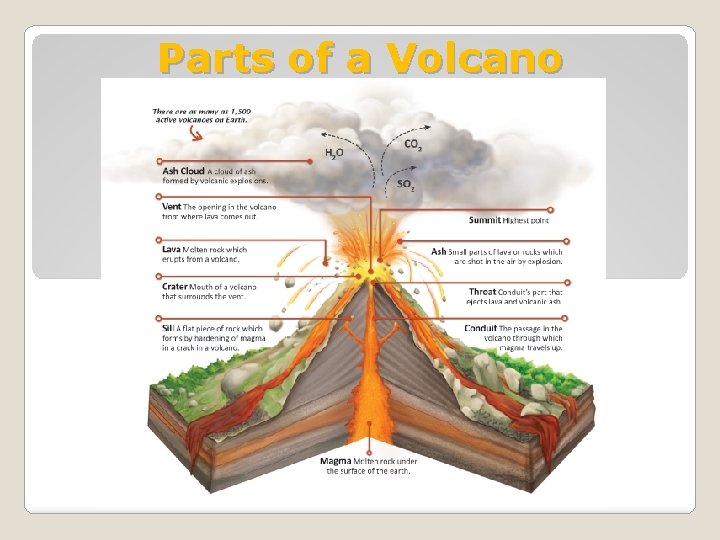
Parts of a Volcano • • • Ash Lava flows Lava domes Magma Lava Vents • • • Tephra Caldera Lahar Fissure Dikes
Parts of a Volcano • Ash – consists of rock, mineral, and volcanic glass fragments smaller than a tenth of an inch diameter or slightly larger than a pinhead. • Lava flows – masses of magma that pour onto the Earth’s surface during an effusive eruption; they include both moving lava and the resulting solidified deposits.
Parts of a Volcano • Lava domes – rounded, steep-sidedmounds built by magma that is highly resistant to flows. • Magma – molten or partially molten rock beneath the earth surface. • Lava – the word for magma when it erupts onto the Earth’s surface.
Parts of a Volcano • Vents – opening in the Earth’s crust from which magma and volcanic gases escape onto the ground or into the atmosphere. • Tephra – a general term for fragments of volcanic rock and lava that are blasted into the air by explosions or carried upward by hot gases in eruption columns or lava fountains.
Parts of a Volcano • Caldera – a large, usually circular depression at the summit of a volcano formed when magma is withdrawn or erupted from a shallow underground magma reservoir. • Lahar – an Indonesian word for rapidly flowing mixture of rock debris and water that originates on slopes of a volcano.
Parts of a Volcano • Fissure – an elongated fracture or crack at the surface from which lava erupts. • Dikes – tabular or sheet-like bodies of magma that cut through and across the layering of adjacent rocks then solidify.
Parts of a Volcano
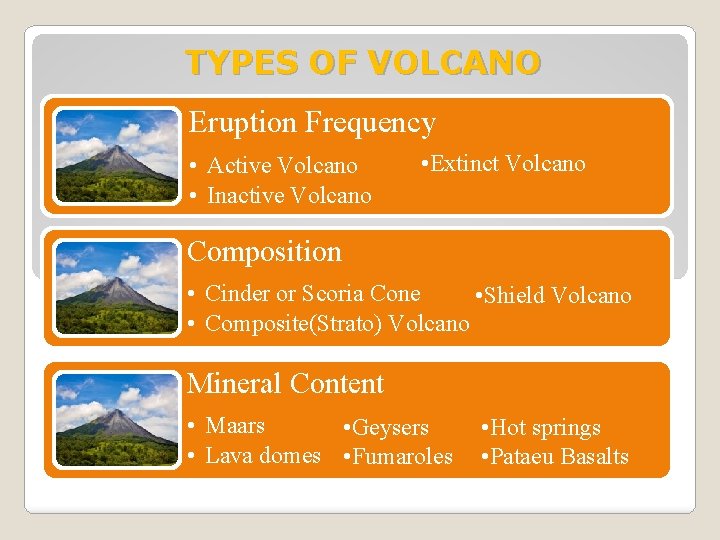
TYPES OF VOLCANO Eruption Frequency • Active Volcano • Inactive Volcano • Extinct Volcano Composition • Cinder or Scoria Cone • Shield Volcano • Composite(Strato) Volcano Mineral Content • Maars • Geysers • Lava domes • Fumaroles • Hot springs • Pataeu Basalts
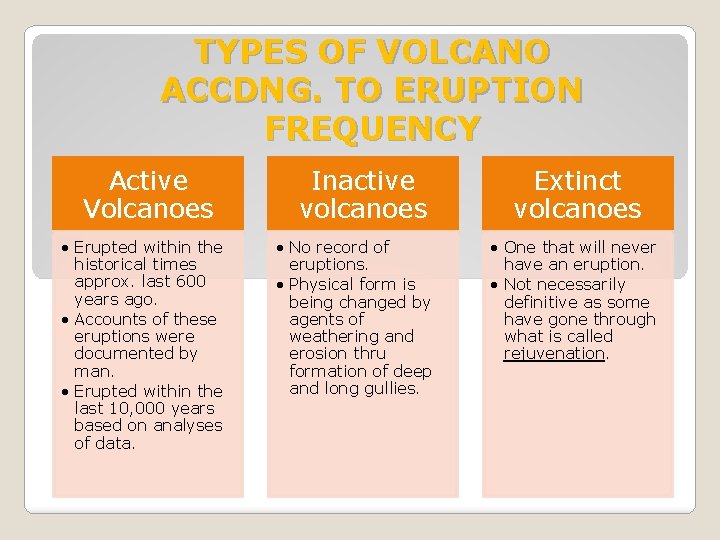
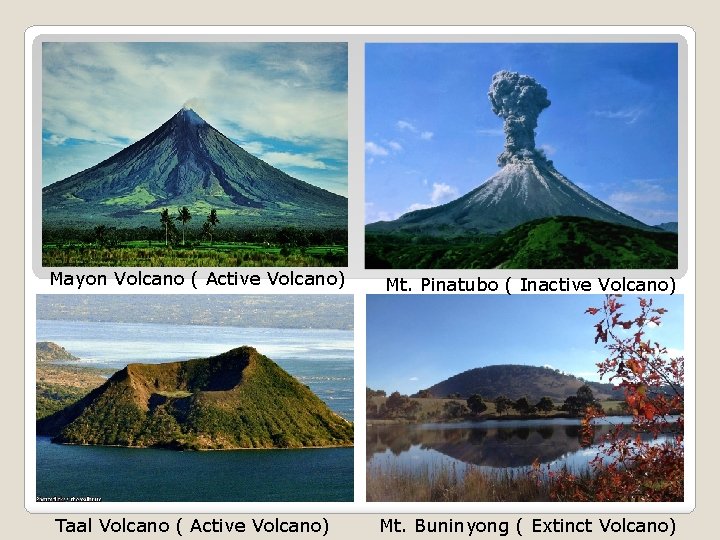
TYPES OF VOLCANO ACCDNG. TO ERUPTION FREQUENCY Active Volcanoes • Erupted within the historical times approx. last 600 years ago. • Accounts of these eruptions were documented by man. • Erupted within the last 10, 000 years based on analyses of data. Inactive volcanoes • No record of eruptions. • Physical form is being changed by agents of weathering and erosion thru formation of deep and long gullies. Extinct volcanoes • One that will never have an eruption. • Not necessarily definitive as some have gone through what is called rejuvenation.
Mayon Volcano ( Active Volcano) Mt. Pinatubo ( Inactive Volcano) Taal Volcano ( Active Volcano) Mt. Buninyong ( Extinct Volcano)
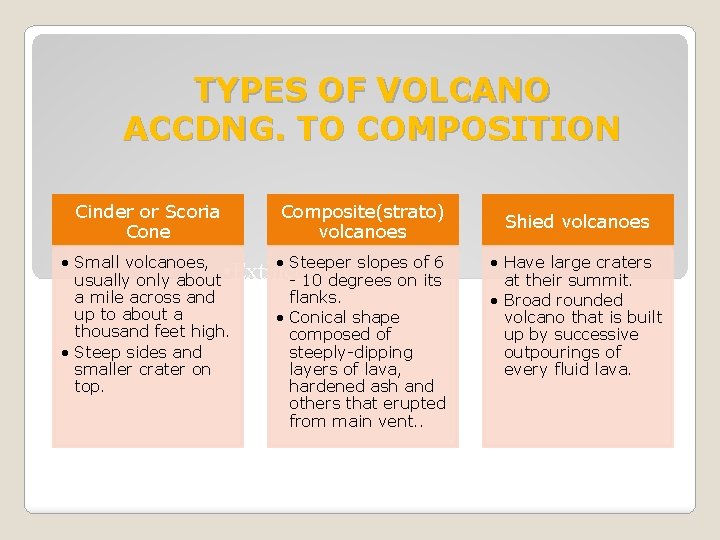
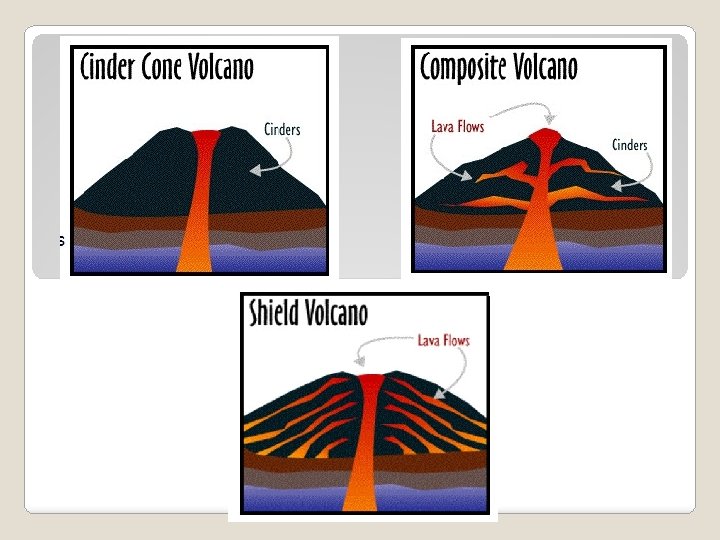
TYPES OF VOLCANO ACCDNG. TO COMPOSITION Cinder or Scoria Cone Composite(strato) volcanoes • Small volcanoes, • Steeper slopes of 6 • Extinct Volcano usually only about - 10 degrees on its a mile across and flanks. up to about a • Conical shape thousand feet high. composed of • Steep sides and steeply-dipping smaller crater on layers of lava, top. hardened ash and others that erupted from main vent. . Shied volcanoes • Have large craters at their summit. • Broad rounded volcano that is built up by successive outpourings of every fluid lava.
TYPES OF VOLCANO ACCDNG. TO MINERAL CONTENT • Maars • Lava domes • Geysers • Fumaroles • Hot springs • Pataeu Basalts
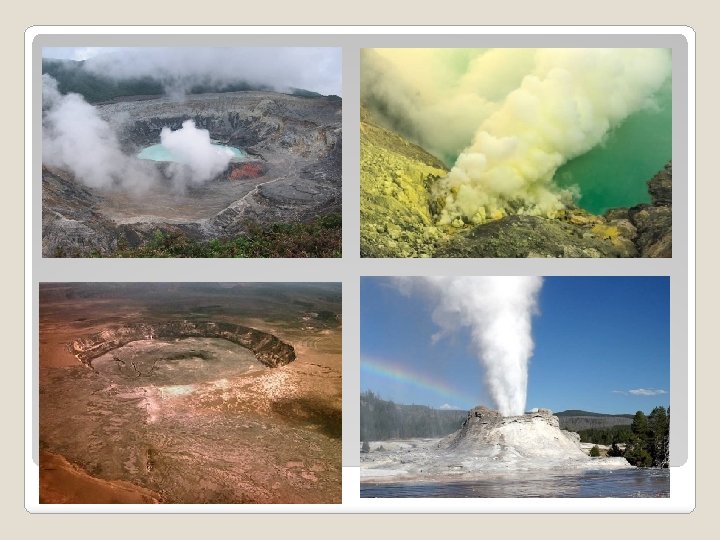
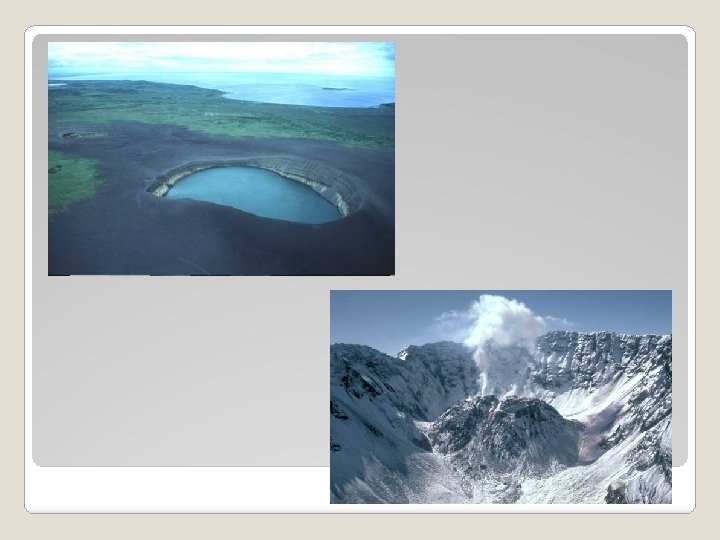
TYPES OF VOLCANO ACCDNG. TO MINERAL CONTENT • Maars – a broad, low-relief volcanic crater cause by phreatomagmatic eruption(occurs when groundwater contact with hot lava or magma) comes into • Lava domes – roughly circular mound-shaped protrusion. • Geysers – spring characterized by intermittent discharge of water turbulently and accompanied by steam. ejected • Fumaroles – opening in a planet’s crust, emits carbon dioxide, sulfur dioxide and hydrogen chloride. • Hot springs – spring produced by the emergence of geothermally groundwater that rises from earth’s crust. • Pataeu Basalts- volcanic plateau produced by volcanic activity. heated
VOLCANIC ERUPTION The most common type of volcanic eruption occurs when magma (the term for lava when it is below the Earth's surface) is released from a volcanic vent. Eruptions can be effusive, where lava flows like a thick, sticky liquid, or explosive, where fragmented lava explodes out of a vent. In explosive eruptions, the fragmented rock may be accompanied by ash and gases; in effusive eruptions, degassing is common but ash is usually not. Volcanologists classify eruptions into several different types. Some are named for particular volcanoes where the type of eruption is common; others concern the resulting shape of the eruptive products or the place where the eruptions occur.
VOLCANIC ERUPTION • Hawaiian Eruption - In a Hawaiian eruption, fluid basaltic lava is thrown into the air in jets from a vent or line of vents (a fissure) at the summit or on the flank of a volcano. The jets can last for hours or even days, a phenomenon known as fire fountaining. The spatter created by bits of hot lava falling out of the fountain can melt together and form lava flows, or build hills called spatter cones. Lava flows may also come from vents at the same time as fountaining occurs, or during periods where fountaining has paused. Because these flows are very fluid, they can travel miles from their source before they cool and harden.
VOLCANIC ERUPTION • Strombolian Eruption - Strombolian eruptions are distinct bursts of fluid lava (usually basalt or basaltic andesite) from the mouth of a magma-filled summit conduit. The explosions usually occur every few minutes at regular or irregular intervals. The explosions of lava, which can reach heights of hundreds of meters, are caused by the bursting of large bubbles of gas, which travel upward in the magma-filled conduit until they reach the open air.
VOLCANIC ERUPTION • Vulcanian Eruption A Vulcanian eruption is a short, violent, relatively small explosion of viscous magma (usually andesite, dacite, or rhyolite). This type of eruption results from the fragmentation and explosion of a plug of lava in a volcanic conduit, or from the rupture of a lava dome (viscous lava that piles up over a vent). Vulcanian eruptions create powerful explosions in which material can travel faster than 350 meters per second (800 mph) and rise several kilometers into the air. They produce tephra, ash clouds, and pyroclastic density currents (clouds of hot ash, gas and rock that flow almost like fluids).
VOLCANIC ERUPTION • Plinian Eruption The largest and most violent of all the types of volcanic eruptions are Plinian eruptions. They are caused by the fragmentation of gassy magma, and are usually associated with very viscous magmas (dacite and rhyolite). They release enormous amounts of energy and create eruption columns of gas and ash that can rise up to 50 km (35 miles) high at speeds of hundreds of meters per second. Ash from an eruption column can drift or be blown hundreds or thousands of miles away from the volcano. The eruption columns are usually shaped like a mushroom (similar to a nuclear explosion) or an Italian pine tree; Pliny the Younger, a Roman historian, made the comparison while viewing the 79 AD eruption of Mount Vesuvius, and Plinian eruptions are named for him.
VOLCANIC ERUPTION • Surtseyan Eruption Surtseyan eruptions are a kind of hydromagmatic eruption, where magma or lava interacts explosively with water. In most cases, Surtseyan eruptions occur when an undersea volcano has finally grown large enough to break the water's surface; because water expands when it turns to steam, water that comes into contact with hot lava explodes and creates plumes of ash, steam and scoria. Lavas created by a Surtseyan eruption tend to be basalt, since most oceanic volcanoes are basaltic. The classic example of a Surtseyan eruption was the volcanic island of Surtsey, which erupted off the south coast of Iceland between 1963 and 1965.
PHILVOLCS • The Philippine Institute of Volcanology and Seismology or PHILVOCS is a national institution dedicated to provide information on the activities of volcanoes, earthquakes and tsunamis as well as other specialized information and services primarily for protection of life and property and in support of economic, productivity and sustainable development. • One of the service agencies of the Department of Science and Technology(DOST). • Dr. Renato U. Solidum Jr. (2003 -present) is the head of PHILVOLCS. A recognized expert in Volcano and Earthquake Geology and many more.
PHILVOLCS MANDATES : 1. Predict the occurrence of volcanic eruptions and earthquakes and their related geotectonic phenomena. 2. Determine how eruptions and earthquakes shall occur and also areas likely to be affected. 3. Generate sufficient data forecasting volcanic eruptions and earthquakes MANDATES : 4. Mitigate hazards of volcanic activities through appropriate detection, forecast and warning system. 5. Formulate appropriate disaster preparedness plan. Source: • www. philvolcs. dost. gov. ph
END OF REPORT VOLCANOLOGY REPORTERS: Tuliao, Warren Daniel S. Fernandez, Dakilah B. Sta. Isabel, Rodel E. References/Sources: www. philvolcs. dost. gov. ph http: //geology. com/volcanoes/types-of-volcanic-eruptions/ Google images