
Volatile impurities Gas chromatography 2 2 28 Ethanol






- Slides: 26
Volatile impurities, Gas chromatography (2. 2. 28). Ethanol Reference solution (b) Dilute 50 µl of anhydrous methanol R and 50 µl of acetaldehyde R to 50. 0 ml with the substance to be examined. Dilute 100 µl of the solution to 10. 0 ml with the substance to be examined. Reference solution (c) Dilute 150 µl of acetal R to 50. 0 ml with the substance to be examined. Dilute 100 µl of the solution to 10. 0 ml with the substance to be examined. Reference solution (d) Dilute 100 µl of benzene R to 100. 0 ml with the substance to be examined. Dilute 100 µl of the solution to 50. 0 ml with the substance to be examined. Column: —material: fused silica, —size: l = 30 m, Ø = 0. 32 mm, —stationary phase: poly[(cyanopropyl)(phenyl)][dimethyl]siloxane R (film thickness 1. 8 µm). Carrier gas helium for chromatography R. Linear velocity 35 cm/s. Detection: Flame ionisation.
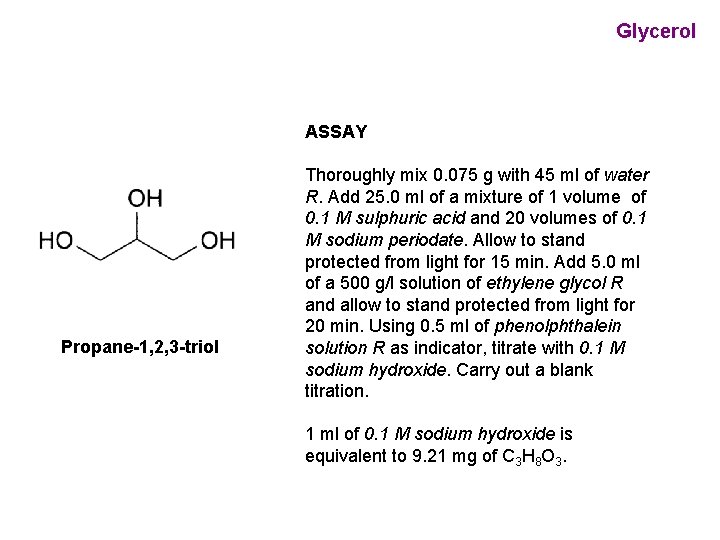
Glycerol ASSAY Propane-1, 2, 3 -triol Thoroughly mix 0. 075 g with 45 ml of water R. Add 25. 0 ml of a mixture of 1 volume of 0. 1 M sulphuric acid and 20 volumes of 0. 1 M sodium periodate. Allow to stand protected from light for 15 min. Add 5. 0 ml of a 500 g/l solution of ethylene glycol R and allow to stand protected from light for 20 min. Using 0. 5 ml of phenolphthalein solution R as indicator, titrate with 0. 1 M sodium hydroxide. Carry out a blank titration. 1 ml of 0. 1 M sodium hydroxide is equivalent to 9. 21 mg of C 3 H 8 O 3.
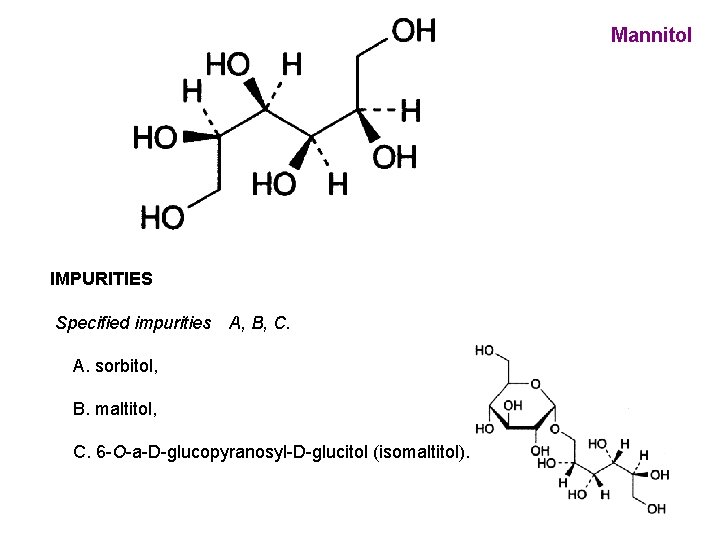
Mannitol IMPURITIES Specified impurities A, B, C. A. sorbitol, B. maltitol, C. 6 -O-a-D-glucopyranosyl-D-glucitol (isomaltitol).
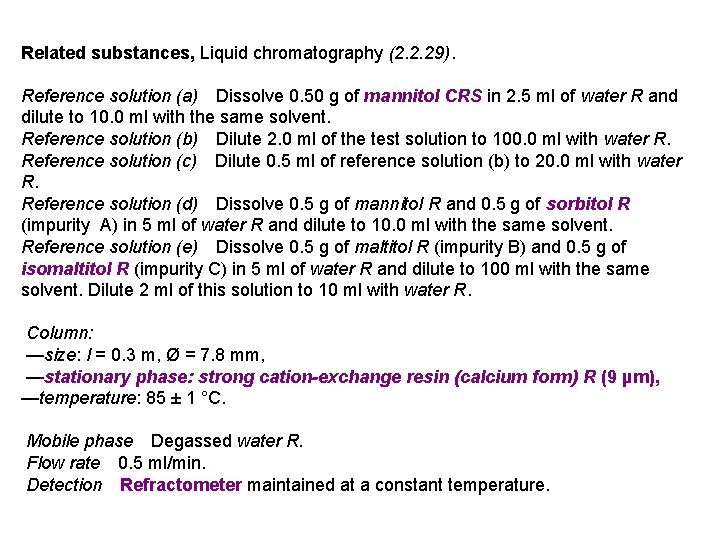
Related substances, Liquid chromatography (2. 2. 29). Reference solution (a) Dissolve 0. 50 g of mannitol CRS in 2. 5 ml of water R and dilute to 10. 0 ml with the same solvent. Reference solution (b) Dilute 2. 0 ml of the test solution to 100. 0 ml with water R. Reference solution (c) Dilute 0. 5 ml of reference solution (b) to 20. 0 ml with water R. Reference solution (d) Dissolve 0. 5 g of mannitol R and 0. 5 g of sorbitol R (impurity A) in 5 ml of water R and dilute to 10. 0 ml with the same solvent. Reference solution (e) Dissolve 0. 5 g of maltitol R (impurity B) and 0. 5 g of isomaltitol R (impurity C) in 5 ml of water R and dilute to 100 ml with the same solvent. Dilute 2 ml of this solution to 10 ml with water R. Column: —size: l = 0. 3 m, Ø = 7. 8 mm, —stationary phase: strong cation-exchange resin (calcium form) R (9 µm), —temperature: 85 ± 1 °C. Mobile phase Degassed water R. Flow rate 0. 5 ml/min. Detection Refractometer maintained at a constant temperature.
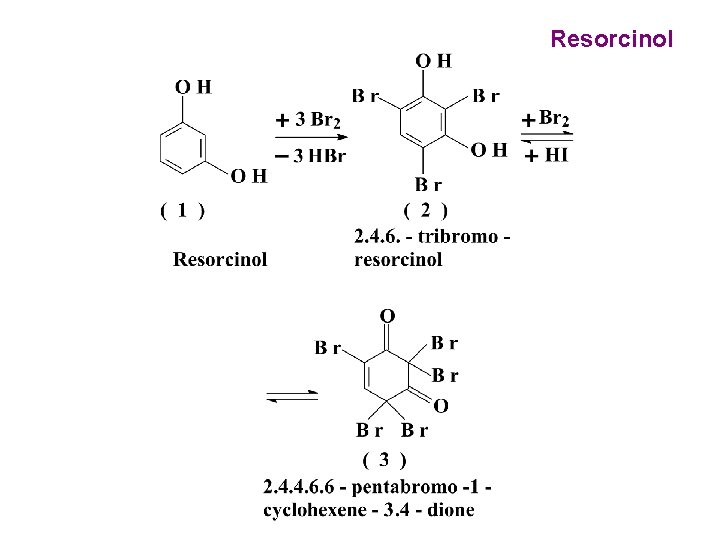
Resorcinol
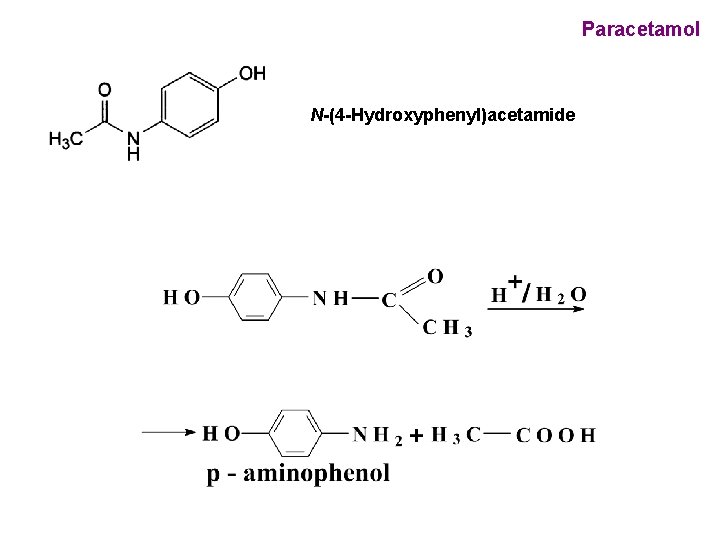
Paracetamol N-(4 -Hydroxyphenyl)acetamide
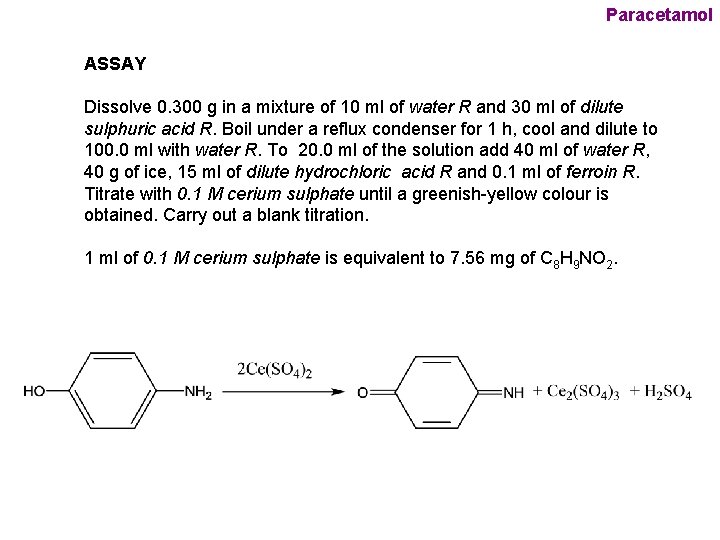
Paracetamol ASSAY Dissolve 0. 300 g in a mixture of 10 ml of water R and 30 ml of dilute sulphuric acid R. Boil under a reflux condenser for 1 h, cool and dilute to 100. 0 ml with water R. To 20. 0 ml of the solution add 40 ml of water R, 40 g of ice, 15 ml of dilute hydrochloric acid R and 0. 1 ml of ferroin R. Titrate with 0. 1 M cerium sulphate until a greenish-yellow colour is obtained. Carry out a blank titration. 1 ml of 0. 1 M cerium sulphate is equivalent to 7. 56 mg of C 8 H 9 NO 2.