
Volatile Elements Test Models for the Origin of
- Slides: 2
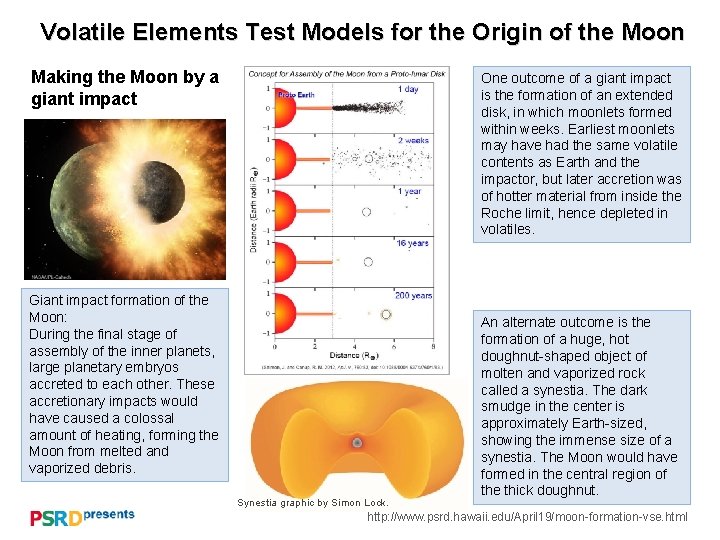
Volatile Elements Test Models for the Origin of the Moon Making the Moon by a giant impact One outcome of a giant impact is the formation of an extended disk, in which moonlets formed within weeks. Earliest moonlets may have had the same volatile contents as Earth and the impactor, but later accretion was of hotter material from inside the Roche limit, hence depleted in volatiles. Giant impact formation of the Moon: During the final stage of assembly of the inner planets, large planetary embryos accreted to each other. These accretionary impacts would have caused a colossal amount of heating, forming the Moon from melted and vaporized debris. Synestia graphic by Simon Lock. An alternate outcome is the formation of a huge, hot doughnut-shaped object of molten and vaporized rock called a synestia. The dark smudge in the center is approximately Earth-sized, showing the immense size of a synestia. The Moon would have formed in the central region of the thick doughnut. http: //www. psrd. hawaii. edu/April 19/moon-formation-vse. html
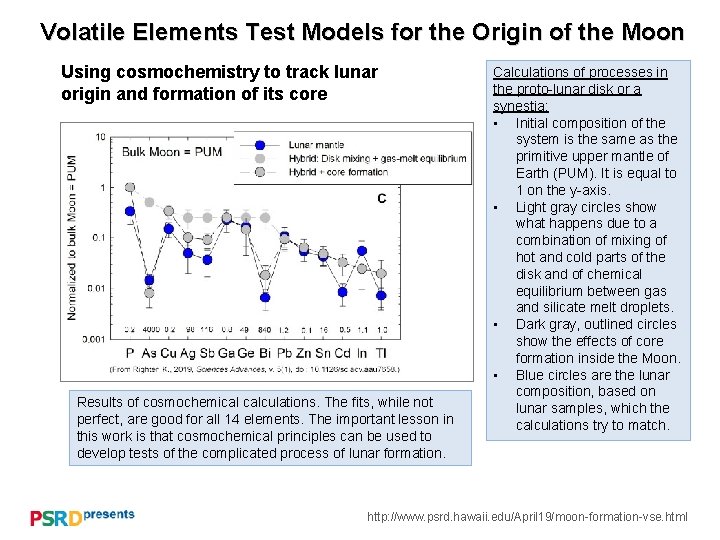
Volatile Elements Test Models for the Origin of the Moon Using cosmochemistry to track lunar origin and formation of its core Results of cosmochemical calculations. The fits, while not perfect, are good for all 14 elements. The important lesson in this work is that cosmochemical principles can be used to develop tests of the complicated process of lunar formation. Calculations of processes in the proto-lunar disk or a synestia: • Initial composition of the system is the same as the primitive upper mantle of Earth (PUM). It is equal to 1 on the y-axis. • Light gray circles show what happens due to a combination of mixing of hot and cold parts of the disk and of chemical equilibrium between gas and silicate melt droplets. • Dark gray, outlined circles show the effects of core formation inside the Moon. • Blue circles are the lunar composition, based on lunar samples, which the calculations try to match. http: //www. psrd. hawaii. edu/April 19/moon-formation-vse. html