
Voids size distribution in the 2 d FGRS

Voids size distribution in the 2 d. FGRS Volker Müller, Benda-Beckmann Sander von • Voids finder and void sizes • Analysis of 2 d. F: self-similar distribution • Faint galaxies in 2 d. F voids • Comparison with SAM of Millenium simulation Amsterdam Workshop AIP

Void definition • smoothed density field or galaxies • underdensity or empty volumes: spheres, ellipsoids, convex on grid • void size distribution provides void probability F(>r) -> P 0(r) • void sizes depend on sample -> void hierarchy 2 d. F voids • count-in-cell study: Croton et al. -> P 0(r) as function of N 2 • void finder of Hoyle, Vogeley -> wall and void galaxies - large voids • Patiri et al. -> abundance of large voids • here: void finder of Kauffmann & Fairall on grid -> fast & ‚complete‘ Void galaxies • much interest, but difficult (low number, wide fields) Amsterdam Workshop

Void search M. , Arbabi, Einasto, Tucker, 00 & 02 LCRS & CDM-mock samples M. & Maulbetsch 04 SDSS 100 Mpc/h yellow: void search including extensions, red: base voids M << M* Void filling factor (VFF) or void size distribution, as function of diameter: f(<D) is fraction of survey volume not contained in voids M* D / Mpc/h Amsterdam Workshop

Void statistics percentile sizes form samples with mean separation , e. g. diffent random dilution or different magnitude cuts: Amsterdam Workshop

SDSS equatorial slices Poisson SDSS void hierarchy: broad differential size distribution Amsterdam Workshop

2 d. F volume limited samples sample area z Blim V / 106 Mpc 3/h 3 Mpc/h 1 . 05 -. 1 -18. 5 . 8 1. 3 4. 4 5. 4 7 18 2 . 1 -. 14 -19 1. 1 2. 4 5. 8 6. 3 55 51 3 . 14 -. 2 -20 4. 7 7 9. 4 10 196 246 Nvoid D>20 Mpc/h galaxies 2 x 3 volume limited samples: k+e-correction 6000 to 10000 galaxies each uniform completeness threshold: c > 0. 6 75% of galaxies 5% of sky surface undersampled 5. 5 rsp. 7. 5 deg thickness Amsterdam Workshop (15 - 70 Mpc/h)
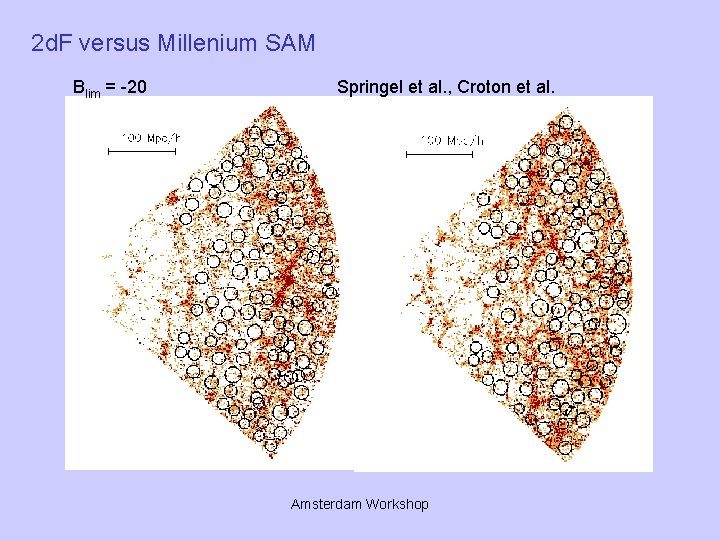
2 d. F versus Millenium SAM Blim = -20 Springel et al. , Croton et al. Amsterdam Workshop

Abundance of 2 d. F voids by number yellow: void search including extensions, red: base voids up to radius of 26 Mpc/h Amsterdam Workshop

2 d. F size distribution void size distribution without extensions strong dependence on samples compare Hoyle & Vogele 04 Amsterdam Workshop

Scaling of 2 d. F size distribution = 18 Mpc/h = 4 Mpc/h Void size quartiles lie on tight linear relations: = 0. 4, 0. 8, 1. 3 for 25 -, med, & 75 percentile Amsterdam Workshop

N/SGP vs. model Voids in SAMs of Millenium simulation (Croton et al. ) with survey masks: excellent fit of cumulative void size distribution and scaling relation Amsterdam Workshop

N/SGP 2 versus 500 Mpc/h box Sampples with B < -18, 19, -20, -21 60% dilutions redshift survey mask real Selection effects: sample size, real vs. redshift space, inhomogeous sampling: voids in redshift space are 10% larger than in real space voids in masked fields are 15% smaller than in complete box Amsterdam Workshop

Mock size distribution (Millenium simulation) void sizes depend on galaxy brightness, voids with max. size 40 Mpc/h good statistics: For B>-20: 400 (20000) voids larger than 20 (10) Mpc/h Amsterdam Workshop

Void scaling Voids among fainter galaxies have larger relative size Amsterdam Workshop

Void size distribution for different objects Self-similarity of voids among different objects: galaxies, groups and clusters 2 d. F/SDSS LCRS groups Amsterdam Workshop
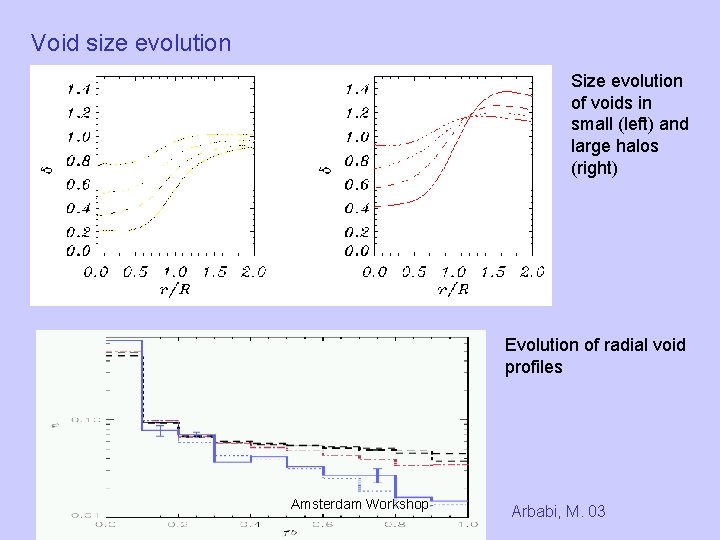
Void size evolution Size evolution of voids in small (left) and large halos (right) Evolution of radial void profiles Amsterdam Workshop Arbabi, M. 03
Void statistics depends on galaxy sample • bright galaxies define large voids • large voids among faint galaxies have large D / • faint galaxies define same structures as bright ones • void size distribution mainly parametized by galaxy separation • parameter b describes cut off: f(r) flat from to b , b = 3 - 4 • selection effects due to finite volume • voids about 20% larger among red than blue galaxies Void galaxies • special conditions for galaxy formation? Amsterdam Workshop

Void galaxies (voids D > 8 Mpc/h by B < -20 galaxies) Color distribution fit by sum of two Gaussian (cp. Baldry et al. 04) similar results for void galaxies in SDSS by Royas et al. (04) and Patiri et al. (06) here: shift of the blue maximum Amsterdam Workshop
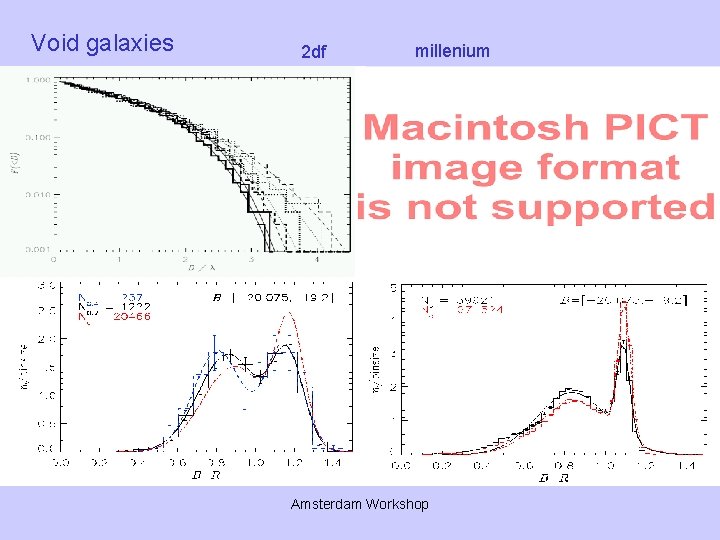
Void galaxies 2 df millenium Amsterdam Workshop

Void galaxies Weak influence of void environment on spectral parameter Similar results for 2 d. F by Croton et al. (05) for underdense regions on 8 Mpc/h abundance of passive galaxies reduced especially among brighter magnitude bin Amsterdam Workshop
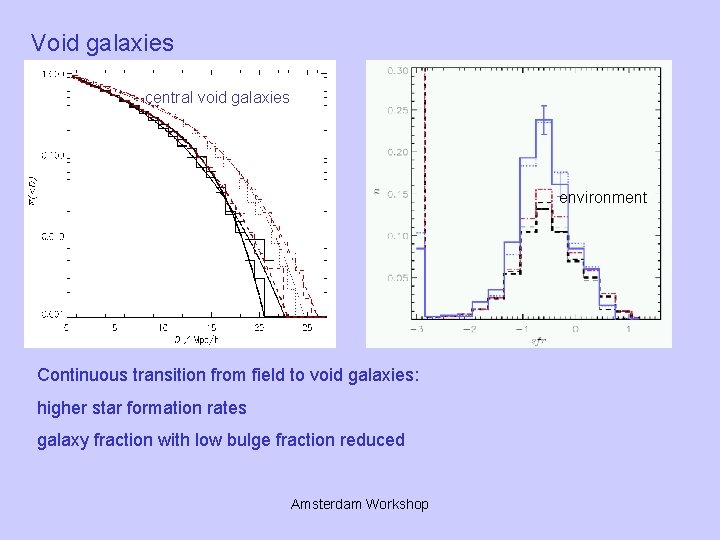
Void galaxies central void galaxies environment Continuous transition from field to void galaxies: higher star formation rates galaxy fraction with low bulge fraction reduced Amsterdam Workshop

void filling factor • self-similar distribution • median void size covering 50% of volume quite small: 5 Mpc/h + • maximum voids depend on survey volume: exponential cut-off at 3 -5 • void size distribution provides void probability: F(>r) <-> P 0(r) 2 d. F vs. simulation • size distribution in excellent agreement with mock samples Void galaxies • similar bimodality of blue and red galaxies as in the field • fraction of red galaxies reduced, blue increased • effect stronger for voids among bright galaxies • weak effect: blue shift of the colors of blue galaxies Amsterdam Workshop
- Slides: 22