
Voice Thread https voicethread com What is Voice
- Slides: 5
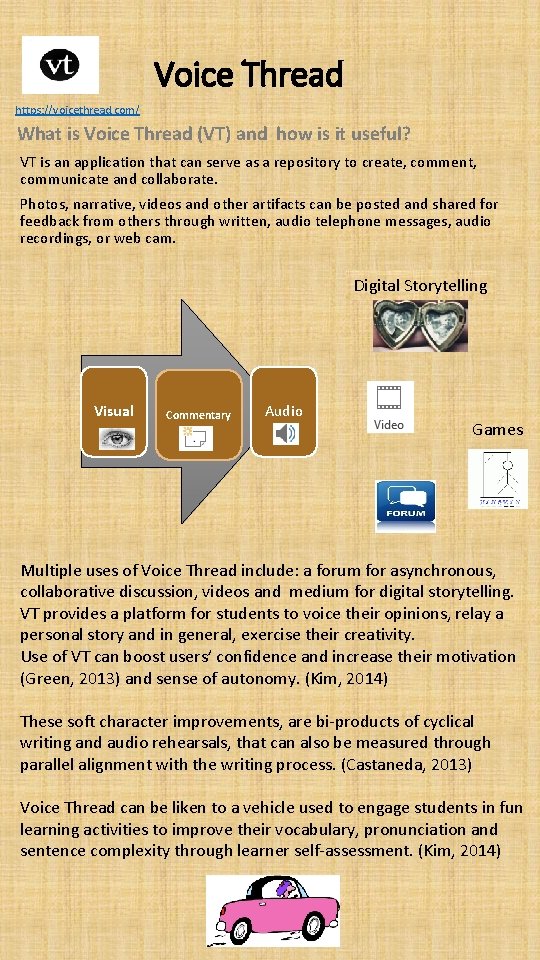
Voice Thread https: //voicethread. com/ What is Voice Thread (VT) and how is it useful? VT is an application that can serve as a repository to create, comment, communicate and collaborate. Photos, narrative, videos and other artifacts can be posted and shared for feedback from others through written, audio telephone messages, audio recordings, or web cam. Digital Storytelling Visual Commentary Audio Games Multiple uses of Voice Thread include: a forum for asynchronous, collaborative discussion, videos and medium for digital storytelling. VT provides a platform for students to voice their opinions, relay a personal story and in general, exercise their creativity. Use of VT can boost users’ confidence and increase their motivation (Green, 2013) and sense of autonomy. (Kim, 2014) These soft character improvements, are bi-products of cyclical writing and audio rehearsals, that can also be measured through parallel alignment with the writing process. (Castaneda, 2013) Voice Thread can be liken to a vehicle used to engage students in fun learning activities to improve their vocabulary, pronunciation and sentence complexity through learner self-assessment. (Kim, 2014)
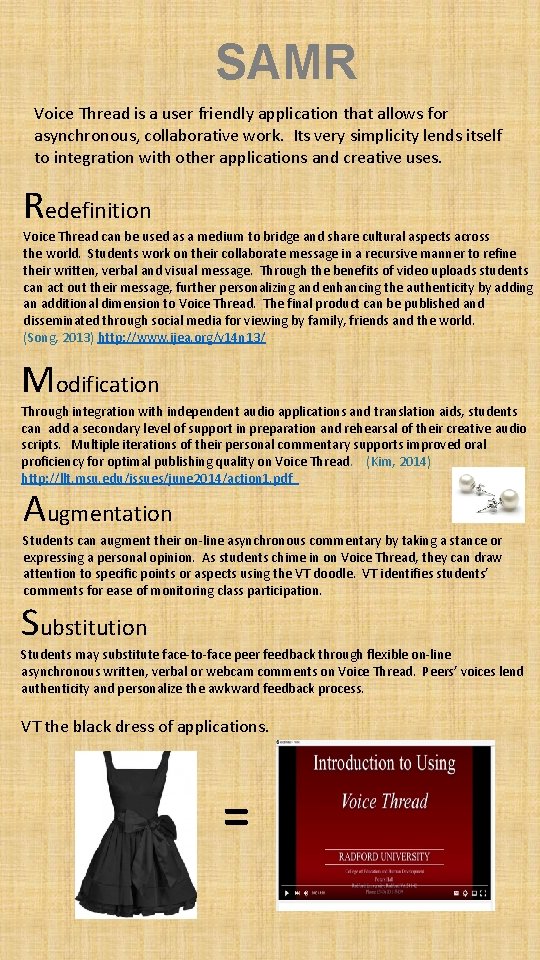
SAMR Voice Thread is a user friendly application that allows for asynchronous, collaborative work. Its very simplicity lends itself to integration with other applications and creative uses. Redefinition Voice Thread can be used as a medium to bridge and share cultural aspects across the world. Students work on their collaborate message in a recursive manner to refine their written, verbal and visual message. Through the benefits of video uploads students can act out their message, further personalizing and enhancing the authenticity by adding an additional dimension to Voice Thread. The final product can be published and disseminated through social media for viewing by family, friends and the world. (Song, 2013) http: //www. ijea. org/v 14 n 13/ Modification Through integration with independent audio applications and translation aids, students can add a secondary level of support in preparation and rehearsal of their creative audio scripts. Multiple iterations of their personal commentary supports improved oral proficiency for optimal publishing quality on Voice Thread. (Kim, 2014) http: //llt. msu. edu/issues/june 2014/action 1. pdf Augmentation Students can augment their on-line asynchronous commentary by taking a stance or expressing a personal opinion. As students chime in on Voice Thread, they can draw attention to specific points or aspects using the VT doodle. VT identifies students’ comments for ease of monitoring class participation. Substitution Students may substitute face-to-face peer feedback through flexible on-line asynchronous written, verbal or webcam comments on Voice Thread. Peers’ voices lend authenticity and personalize the awkward feedback process. VT the black dress of applications. =
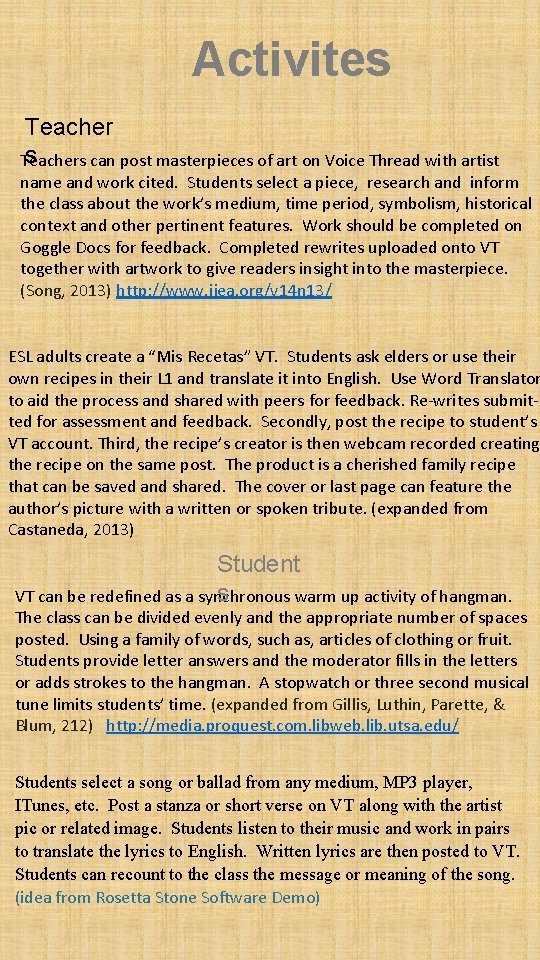
Activites Teachers can post masterpieces of art on Voice Thread with artist name and work cited. Students select a piece, research and inform the class about the work’s medium, time period, symbolism, historical context and other pertinent features. Work should be completed on Goggle Docs for feedback. Completed rewrites uploaded onto VT together with artwork to give readers insight into the masterpiece. (Song, 2013) http: //www. ijea. org/v 14 n 13/ ESL adults create a “Mis Recetas” VT. Students ask elders or use their own recipes in their L 1 and translate it into English. Use Word Translator to aid the process and shared with peers for feedback. Re-writes submitted for assessment and feedback. Secondly, post the recipe to student’s VT account. Third, the recipe’s creator is then webcam recorded creating the recipe on the same post. The product is a cherished family recipe that can be saved and shared. The cover or last page can feature the author’s picture with a written or spoken tribute. (expanded from Castaneda, 2013) Student s VT can be redefined as a synchronous warm up activity of hangman. The class can be divided evenly and the appropriate number of spaces posted. Using a family of words, such as, articles of clothing or fruit. Students provide letter answers and the moderator fills in the letters or adds strokes to the hangman. A stopwatch or three second musical tune limits students’ time. (expanded from Gillis, Luthin, Parette, & Blum, 212) http: //media. proquest. com. libweb. lib. utsa. edu/ Students select a song or ballad from any medium, MP 3 player, ITunes, etc. Post a stanza or short verse on VT along with the artist pic or related image. Students listen to their music and work in pairs to translate the lyrics to English. Written lyrics are then posted to VT. Students can recount to the class the message or meaning of the song. (idea from Rosetta Stone Software Demo)
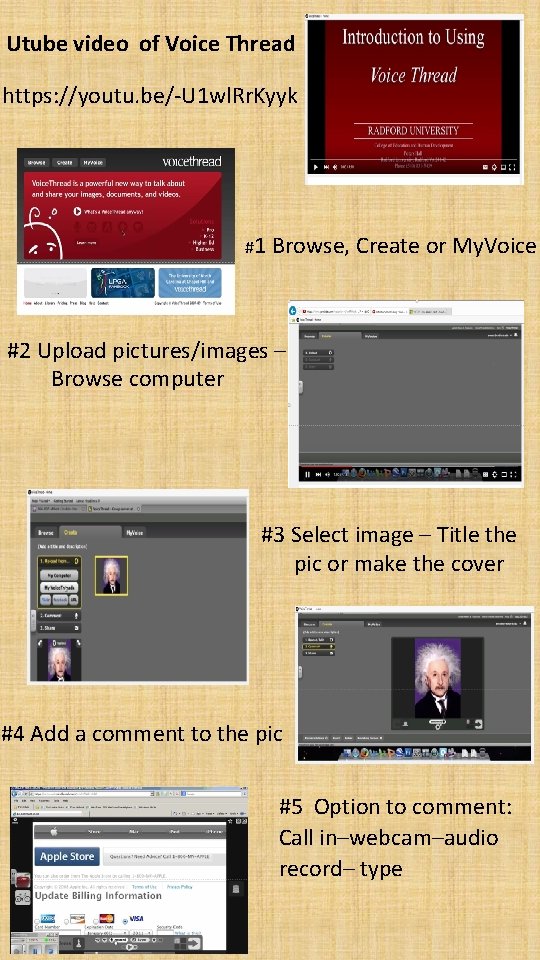
Utube video of Voice Thread https: //youtu. be/-U 1 wl. Rr. Kyyk #1 Browse, Create or My. Voice #2 Upload pictures/images – Browse computer #3 Select image – Title the pic or make the cover #4 Add a comment to the pic #5 Option to comment: Call in–webcam–audio record– type
References Castaneda, M. E. (2013). “I am proud that I did it and it’s a piece of me”: Digital storytelling in the foreign language classroom. CALICO Journal, 30(1), 44 -62. doi: 10. 11139/cj. 30. 1. 44 -62 Gillis, A. , Luthin, K. , Parette, H. P. , & Blum, C. (2012). Using Voice Thread to create meaningful receptive and expressive learning activities for young children. Early Childhood Education Journal, 40(4), 203 -211. doi: http: //dx. doi. org. libweb. lib. utsa. edu/10. 1007/ s 10643 -012 -0521 -1 http: //media. proquest. com. libweb. lib. utsa. edu/ media/pq/classic/doc/2696099361/fmt/pi/rep/NONE? hl=&cit%3 Aauth=Gillis%2 C+Afton%3 BLuthin%2 C +Katie%3 BParette%2 C+Howard+P%3 BBlum%2 C+Craig&cit%3 Atitle=Using+Voice. Thread+to+Create+ Meaningful+Receptive+and+Expressive+Learning+Activities+for+Young+Children&cit%3 Apub=Early+ Childhood+Education+Journal&cit%3 Avol=40&cit%3 Aiss=4&cit%3 Apg=203&cit%3 Adate=Aug+2012&ic =true&cit%3 Aprod=Pro. Quest&_a=Chgy. MDE 2 MDQx. OTAw. MDcy. OTE 3 Mzo 5 Nj. Ux. Mj. ESBj. Ex. NDcz. NBo. KT 05 FX 1 NFQVJDSCIOMTI 5 Lj. Ex. NS 4 x. MDMu. OTkq. BTU 0 MDIw. Mgox. MDIy. MTA 4 NTYw. Og 1 Eb 2 N 1 b. WVud. Elt. YWdl Qg. Ew. Ug. ZPbmxpbm. Va. Ak. ZUYg. NQRl. Rq. Cj. Iw. MTIv. MDgv. MDFy. Cj. Iw. MTIv. MDgv. Mz. F 6 AIIBKFAt. MTAw. Nz. Ew. Ni 03 MTIy. LUNVU 1 RPTUVSLTEw. MDAw. MTYw. LTEw. NDYy. ODCSAQZPbmxpbm. XKAVFNb 3 ppb. Gxh. Lz. Uu. MCAo. V 2 lu ZG 93 cy. BOVCA 2 Lj. M 7 IFd. PVz. Y 0 Oy. BUcmlk. ZW 50 Lzcu. MDsg. VG 91 Y 2 g 7 IEx. DSk. I 7 IHJ 2 Oj. Ex. Lj. Ap. IGxpa 2 Ug. R 2 Vja 2%2 FSARJTY 2 hvb. GFyb. Hkg. Sm 91 cm 5 hb. HOa. Agd. Qcm. VQYWlkqg. Io. T 1 M 6 RU 1 TLVBk. Zk. Rv. Y 1 Zp. ZXd. CYXNl. LW dld. E 1 l. ZGlh. VXJs. Rm 9 y. SXRlbco. CD 0 Fyd. Gljb. GV 8 Rm. Vhd. HVy. Zd. ICAVni. Ag. FO 6 g. IGc 3 Vtb. W 9 u 8 g. IA&_s=BDf 0 k 3 lvs NV 5 YPBryz. VSs. D 7 Eck. U%3 D Green, L. S. (2013). Language learning through a lens: The case for digital storytelling in the second language classroom. School Libraries Worldwide, 19(2), 23. http: //www. lucysantosgreen. com/uploads/6/8/3/3/6833178/ final_article_file_slw-libre. pdf Kim, S. (2014). Developing autonomous learning for oral proficiency using digital storytelling. Language Learning & Technology: A Refereed Journal for Second and Foreign Language Educators, 18(2), 20. http: //llt. msu. edu/issues 2014/action 1. pdf