
Voice Print how the way we talk shapes



- Slides: 56
Voice. Print how the way we talk shapes how we think and act Alan Robertson The Psychometrics Forum September 2017
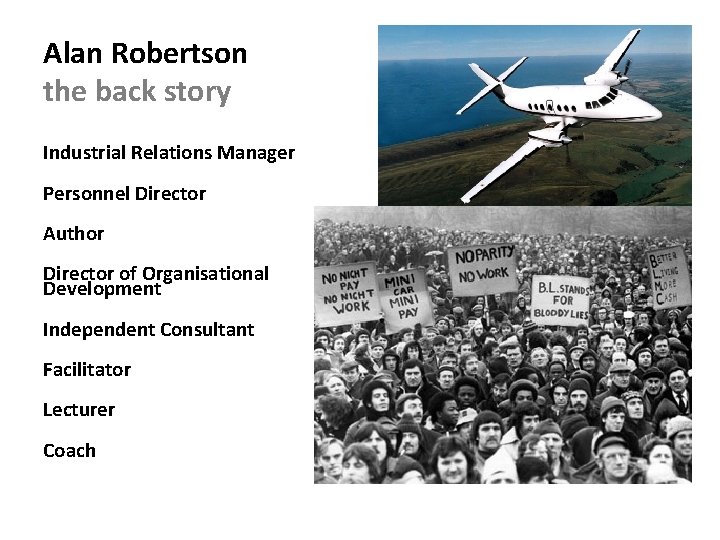
Alan Robertson the back story Industrial Relations Manager Personnel Director Author Director of Organisational Development Independent Consultant Facilitator Lecturer Coach
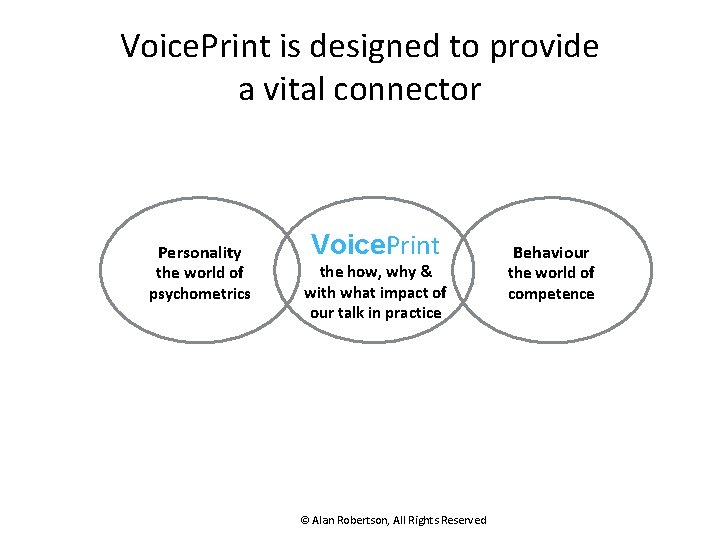
Voice. Print is designed to provide a vital connector Personality the world of psychometrics Voice. Print the how, why & with what impact of our talk in practice © Alan Robertson, All Rights Reserved Behaviour the world of competence
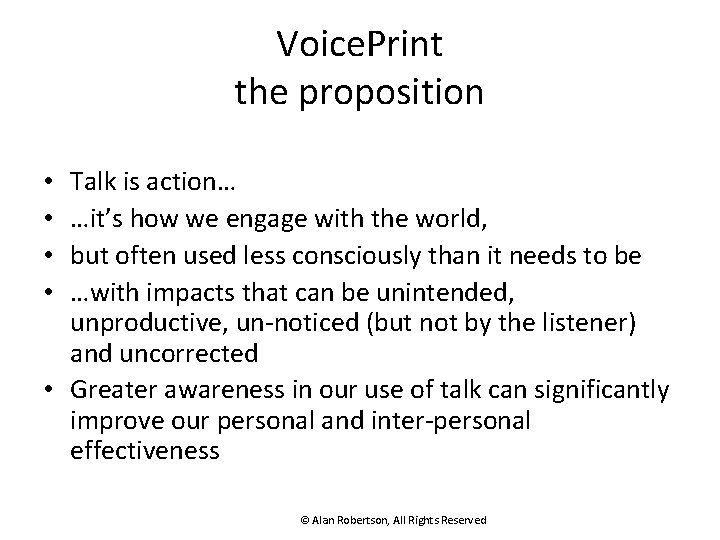
Voice. Print the proposition Talk is action… …it’s how we engage with the world, but often used less consciously than it needs to be …with impacts that can be unintended, unproductive, un-noticed (but not by the listener) and uncorrected • Greater awareness in our use of talk can significantly improve our personal and inter-personal effectiveness • • © Alan Robertson, All Rights Reserved
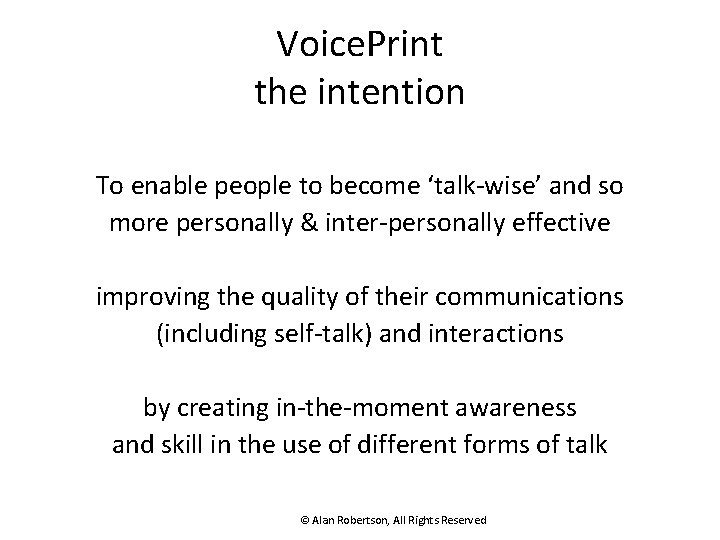
Voice. Print the intention To enable people to become ‘talk-wise’ and so more personally & inter-personally effective improving the quality of their communications (including self-talk) and interactions by creating in-the-moment awareness and skill in the use of different forms of talk © Alan Robertson, All Rights Reserved
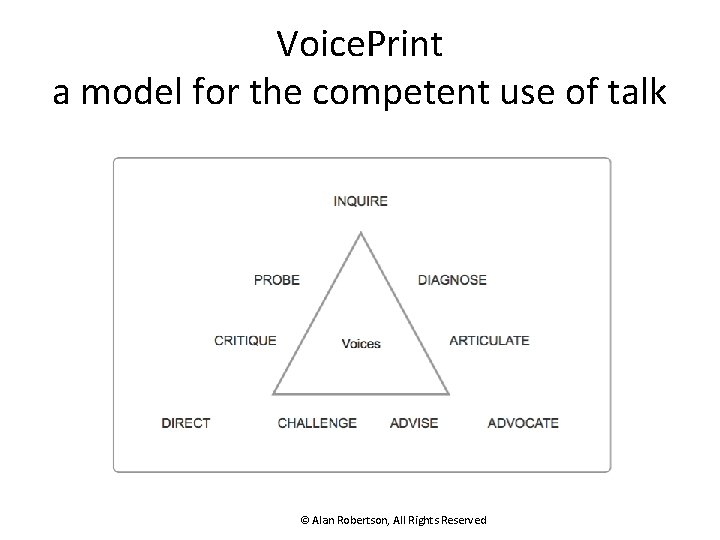
Voice. Print a model for the competent use of talk © Alan Robertson, All Rights Reserved
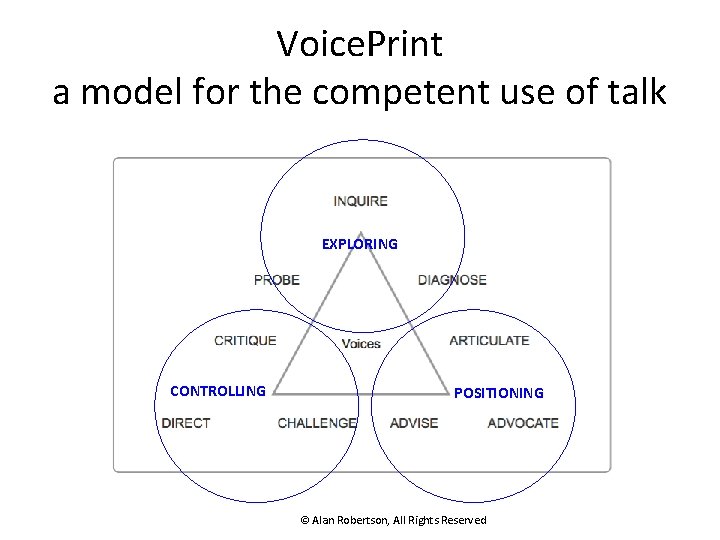
Voice. Print a model for the competent use of talk EXPLORING CONTROLLING POSITIONING © Alan Robertson, All Rights Reserved
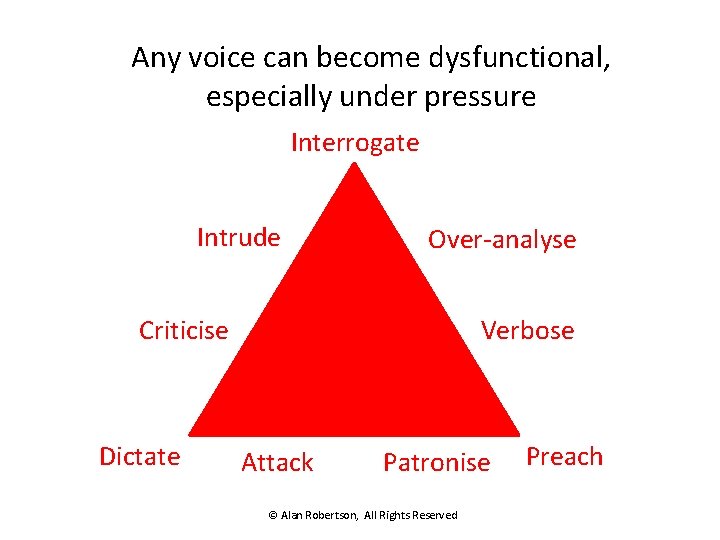
Any voice can become dysfunctional, especially under pressure Interrogate Intrude Over-analyse Criticise Dictate Verbose Attack Patronise © Alan Robertson, All Rights Reserved Preach
Psychometric/ Statistical analysis Voice structures – Validity: each voice is demonstrated to be independent of the others (PCA or Factor Analysis) – Validity – clear differentiation can be seen between the ‘normal’ and ‘pressure’ voice types for all Voices (standardised scores show strong differences in behaviour and usage between the ‘normal’ and ‘pressure’ voices) (ANOVA) SOLUTIONS Jane Pollock
Psychometric/ Statistical analysis Voice structures: for example – Reliability Cronbach Alpha scores for each voice Articulate Advocate Advise Challenge Direct Critique Probe Inquire Diagnose 707 707 705 707 704 Alpha 0. 494 0. 739 0. 498 0. 675 0. 618 0. 436 0. 475 0. 746 0. 618 N items 9 9 9 9 9 Voice N – Test, re-test work is yet to be done SOLUTIONS Jane Pollock
Psychometric/ Statistical analysis • Independent assessment of the Voice. Print product(s) show preliminary results as follows: – Voice structures which identify use and over-use (over extension) of many of the voices – Differentiation between different responder groups in terms of gender, occupational sector, in some voices, ethnicity SOLUTIONS Jane Pollock
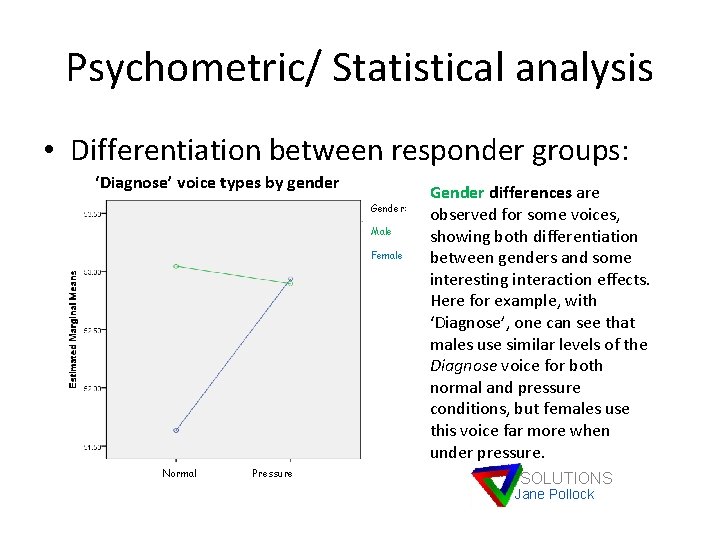
Psychometric/ Statistical analysis • Differentiation between responder groups: ‘Diagnose’ voice types by gender Gender: Male Female Normal Gender differences are observed for some voices, showing both differentiation between genders and some interesting interaction effects. Here for example, with ‘Diagnose’, one can see that males use similar levels of the Diagnose voice for both normal and pressure conditions, but females use this voice far more when under pressure. Pressure SOLUTIONS Jane Pollock
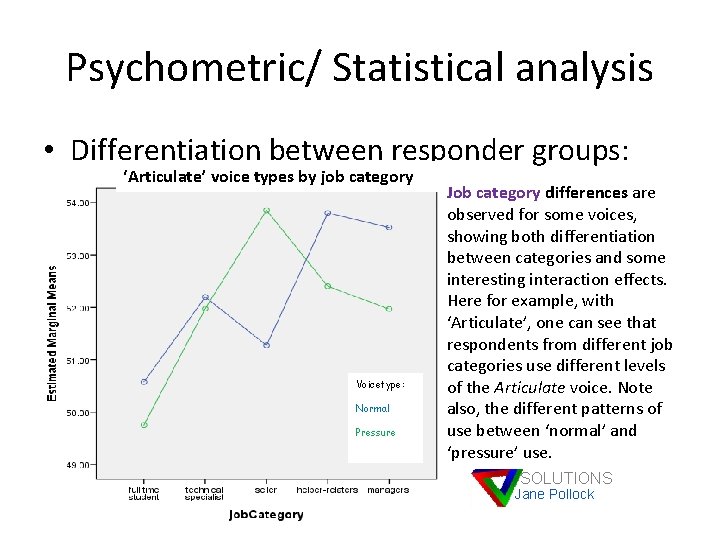
Psychometric/ Statistical analysis • Differentiation between responder groups: ‘Articulate’ voice types by job category Voicetype: Normal Pressure Job category differences are observed for some voices, showing both differentiation between categories and some interesting interaction effects. Here for example, with ‘Articulate’, one can see that respondents from different job categories use different levels of the Articulate voice. Note also, the different patterns of use between ‘normal’ and ‘pressure’ use. SOLUTIONS Jane Pollock
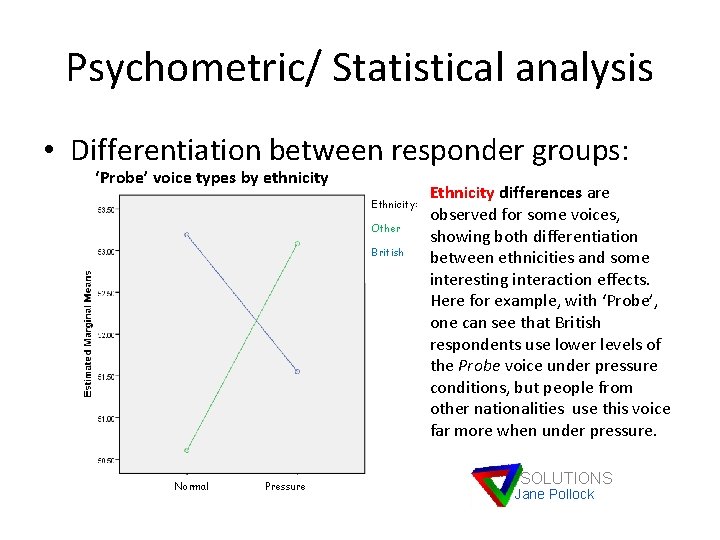
Psychometric/ Statistical analysis • Differentiation between responder groups: ‘Probe’ voice types by ethnicity Ethnicity: Other British Normal Pressure Ethnicity differences are observed for some voices, showing both differentiation between ethnicities and some interesting interaction effects. Here for example, with ‘Probe’, one can see that British respondents use lower levels of the Probe voice under pressure conditions, but people from other nationalities use this voice far more when under pressure. SOLUTIONS Jane Pollock
Voice. Print is a developmental product • • • Available both as a self-perception & a 360 instrument Producing both individual and team profiles Committed to combining utility and rigour Psychometric/statistical analyses are ongoing Further refinements are being pursued © Alan Robertson, All Rights Reserved
Voice. Print in practice: some key findings to date • • • Like personalities, Voice. Prints are highly diverse Different people use the available range differently We often talk ‘at crossed purposes’ …and may use some voices primarily inwardly Adept use of the full available range is rare We each tend to use certain preferred voices regularly …and others only occasionally or rarely ‘Sensitivities’ incline us away from some voice/s ‘Gaps’ in our repertoire may be problematic …and so may our ‘strong’ voices © Alan Robertson, All Rights Reserved
Voice. Print in practice: using the profiles • • • The self report profile brings tendency into awareness …and helps reflection on intention & potential impact The 360 clarifies actual impact on others …impact which may not correspond with intention Used together, they facilitate the development of skill …and crucially the development of sensitivity © Alan Robertson, All Rights Reserved
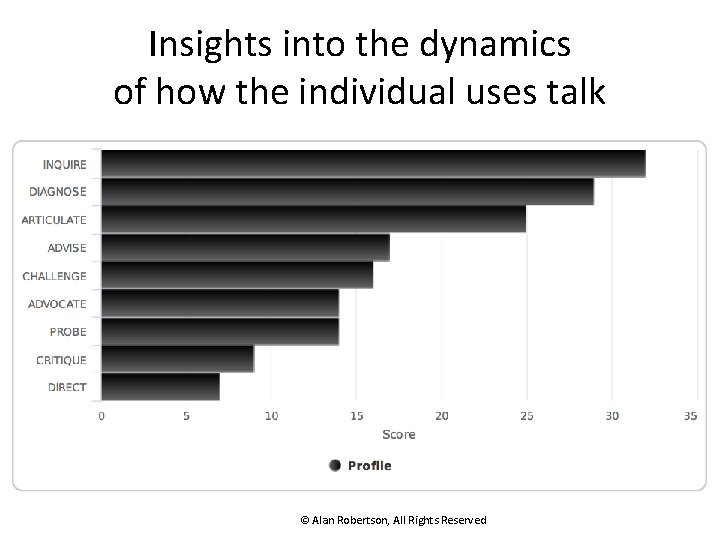
Insights into the dynamics of how the individual uses talk © Alan Robertson, All Rights Reserved
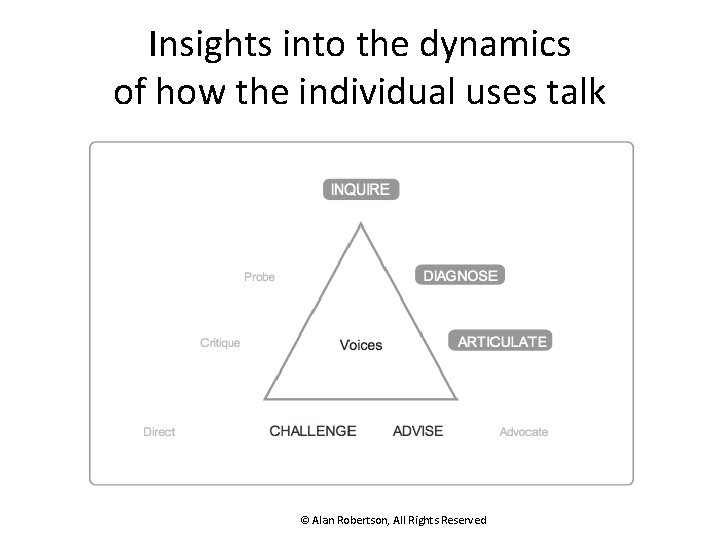
Insights into the dynamics of how the individual uses talk © Alan Robertson, All Rights Reserved
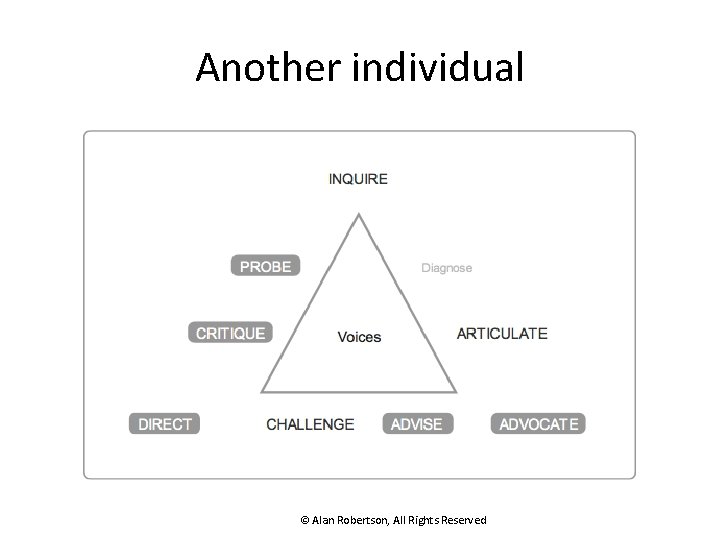
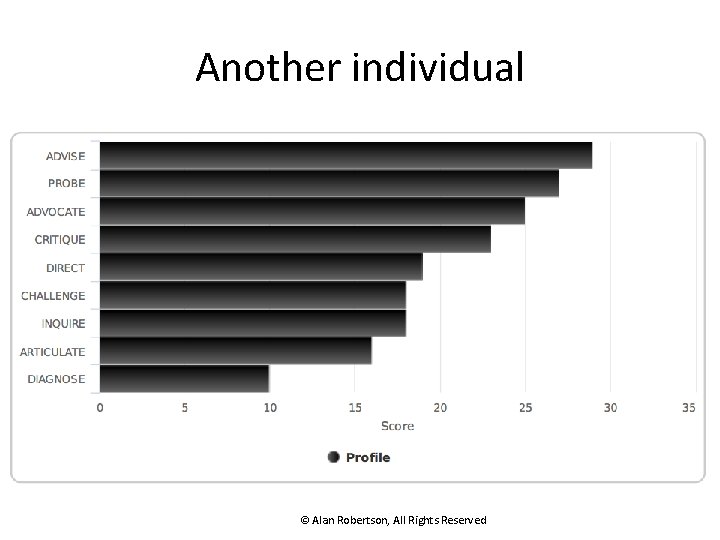
Another individual © Alan Robertson, All Rights Reserved
Another individual © Alan Robertson, All Rights Reserved
Voice. Prints leave strong marks on the distinctive way that an individual thinks… • …and talks • …and interacts • …and impacts on situations and other people And if that is true for the individual… • …the scope for misunderstanding and confusion just gets bigger • …when people come together in ‘teams’ © Alan Robertson, All Rights Reserved
The perennial challenge of teamworking The social system is NOT a friendship system, but rather the co-ordinating and integrating buffer between the technical transformation process and the demands & constraints of a turbulent environment. © Alan Robertson, All Rights Reserved
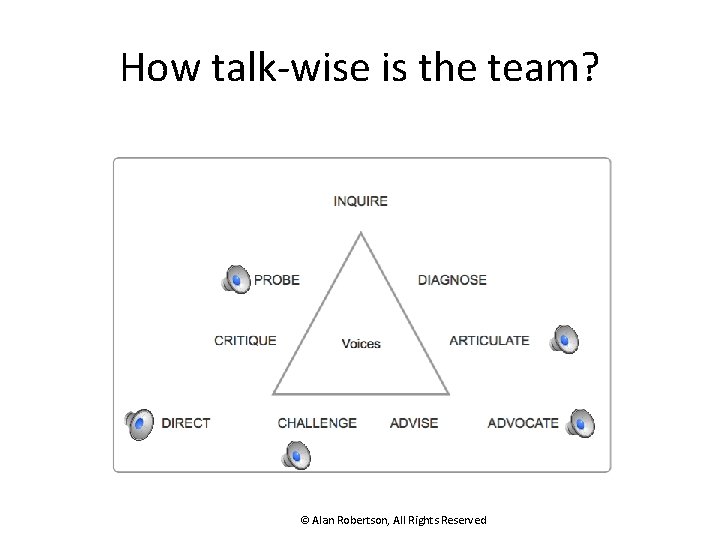
How talk-wise is the team? © Alan Robertson, All Rights Reserved
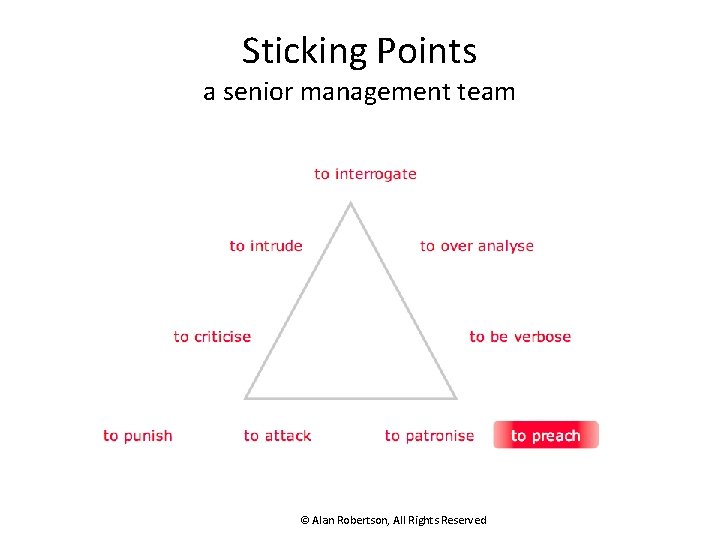
Sticking Points a senior management team © Alan Robertson, All Rights Reserved
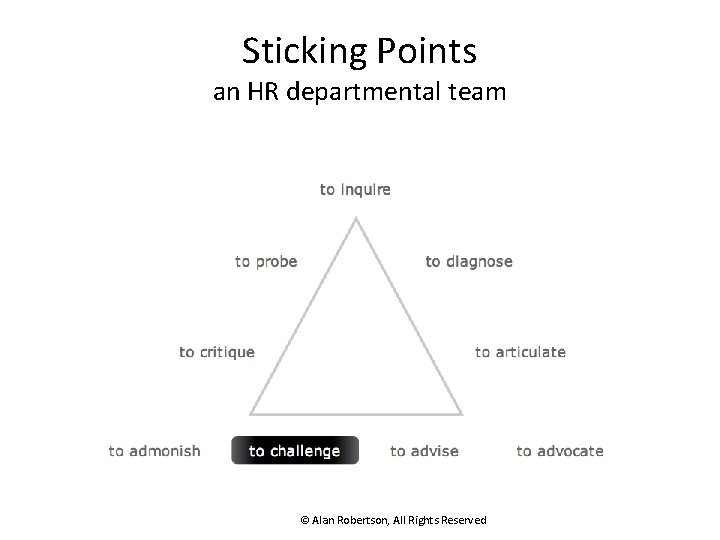
Sticking Points an HR departmental team © Alan Robertson, All Rights Reserved
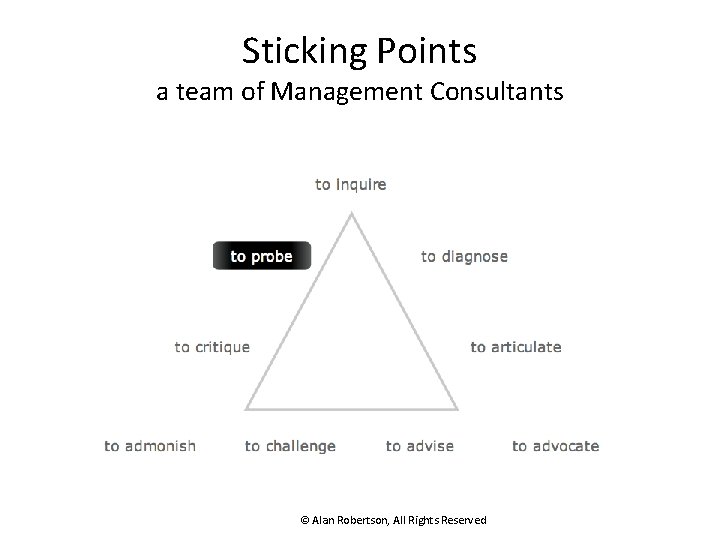
Sticking Points a team of Management Consultants © Alan Robertson, All Rights Reserved
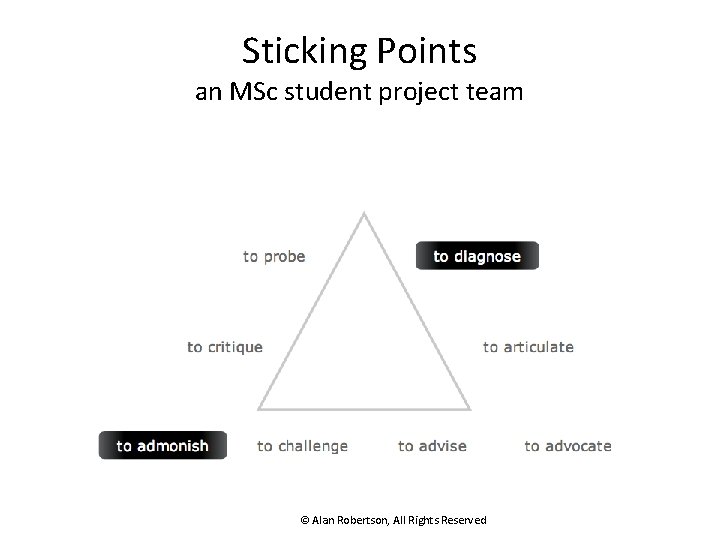
Sticking Points an MSc student project team © Alan Robertson, All Rights Reserved
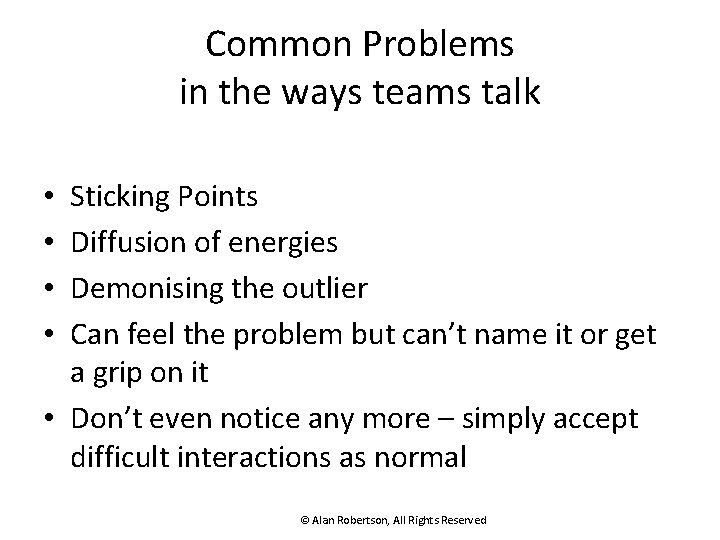
Common Problems in the ways teams talk Sticking Points Diffusion of energies Demonising the outlier Can feel the problem but can’t name it or get a grip on it • Don’t even notice any more – simply accept difficult interactions as normal • • © Alan Robertson, All Rights Reserved
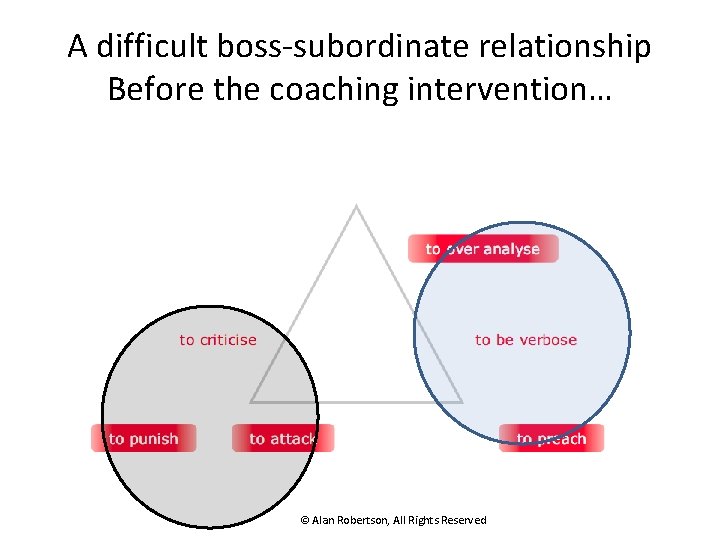
A difficult boss-subordinate relationship Before the coaching intervention… © Alan Robertson, All Rights Reserved
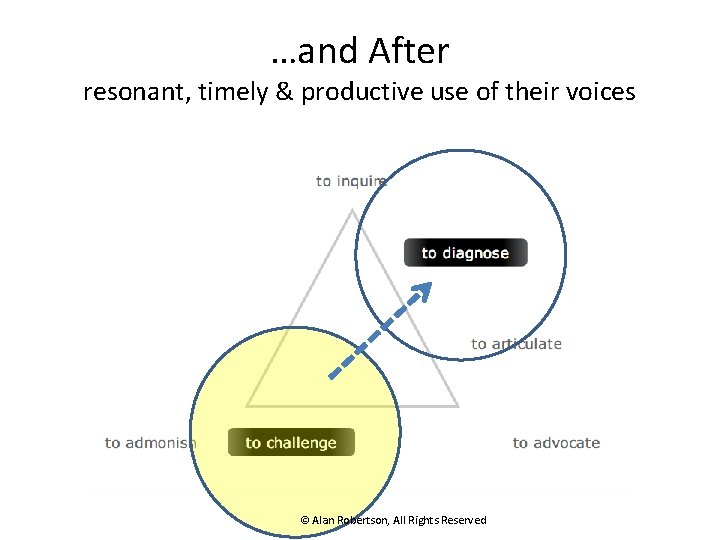
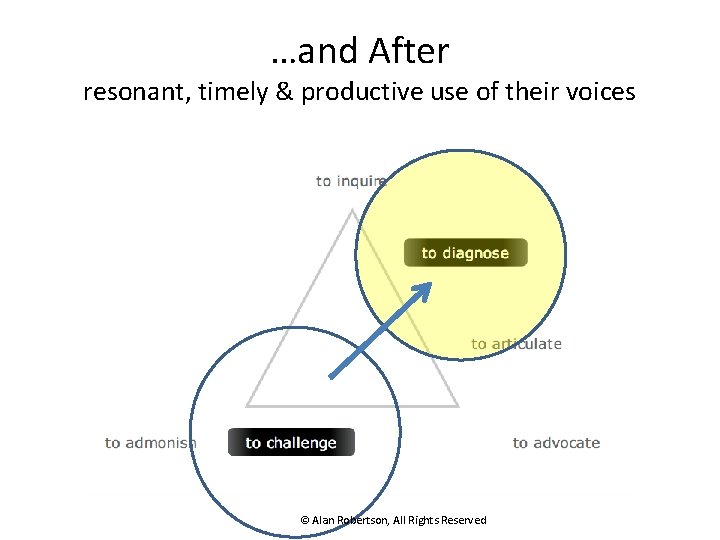
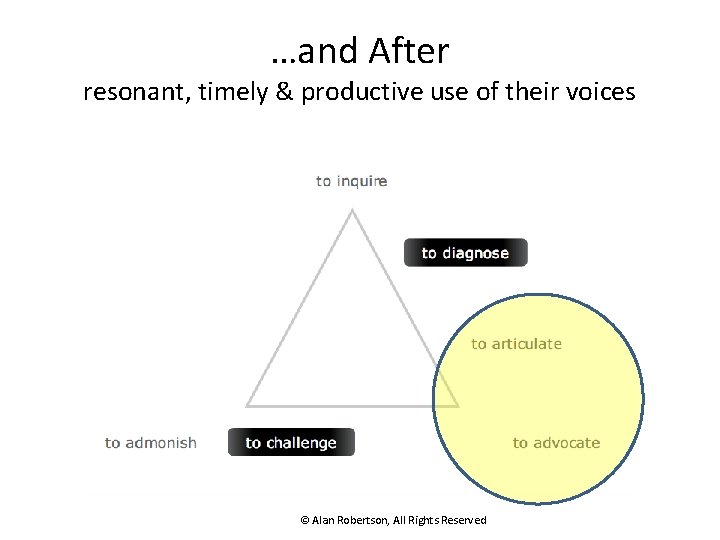
…and After resonant, timely & productive use of their voices © Alan Robertson, All Rights Reserved
…and After resonant, timely & productive use of their voices © Alan Robertson, All Rights Reserved
…and After resonant, timely & productive use of their voices © Alan Robertson, All Rights Reserved
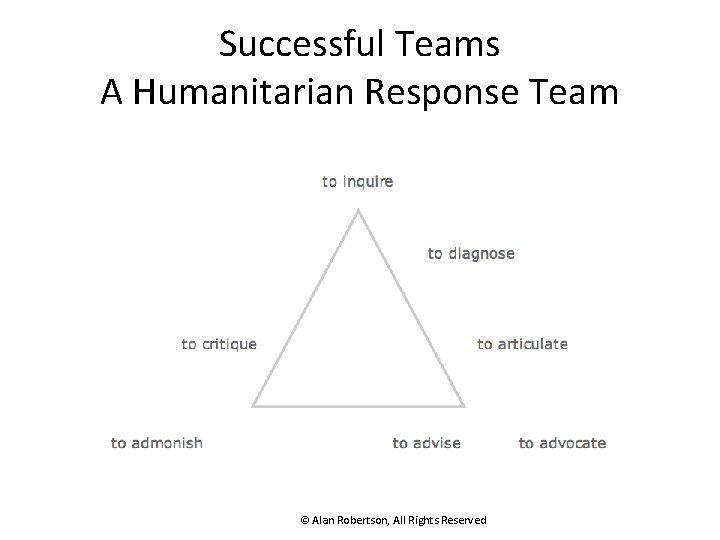
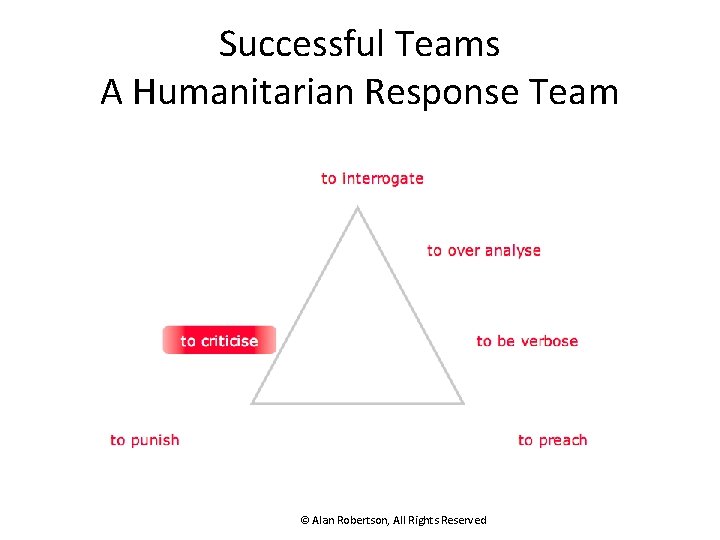
Successful Teams A Humanitarian Response Team © Alan Robertson, All Rights Reserved
Successful Teams A Humanitarian Response Team © Alan Robertson, All Rights Reserved
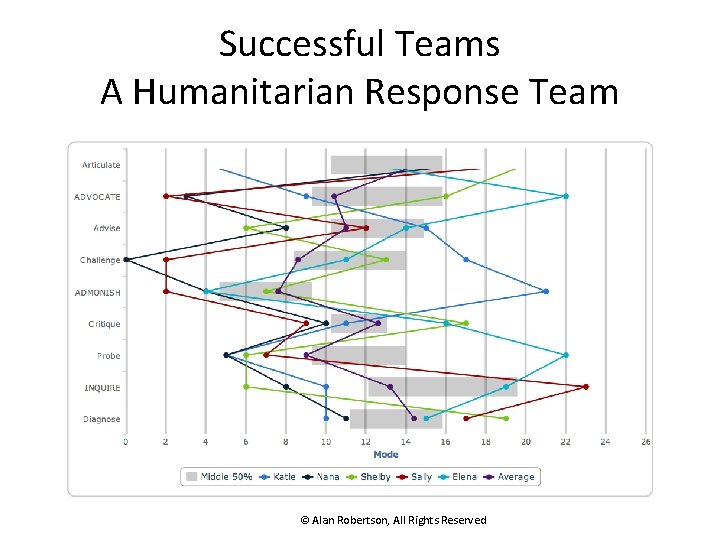
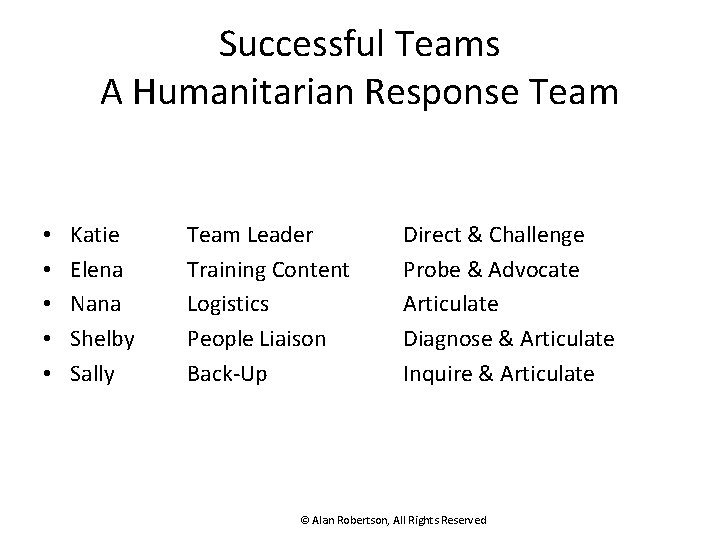
Successful Teams A Humanitarian Response Team • • • Katie Elena Nana Shelby Sally Team Leader Training Content Logistics People Liaison Back-Up Direct & Challenge Probe & Advocate Articulate Diagnose & Articulate Inquire & Articulate © Alan Robertson, All Rights Reserved
Successful Teams A Humanitarian Response Team © Alan Robertson, All Rights Reserved
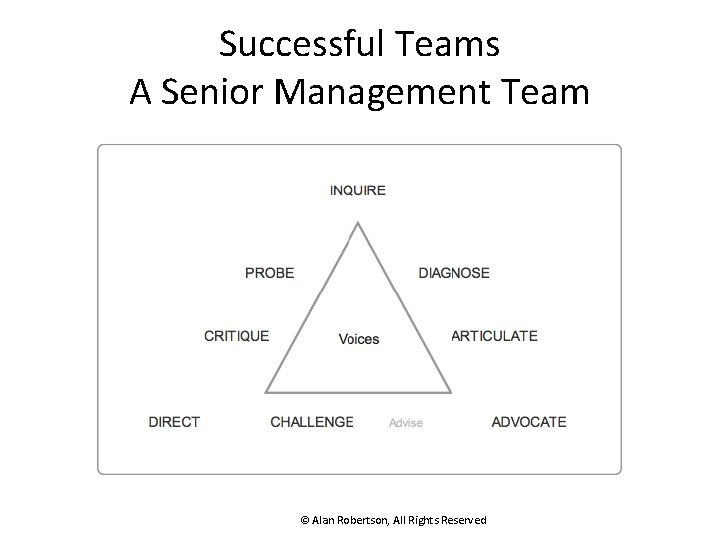
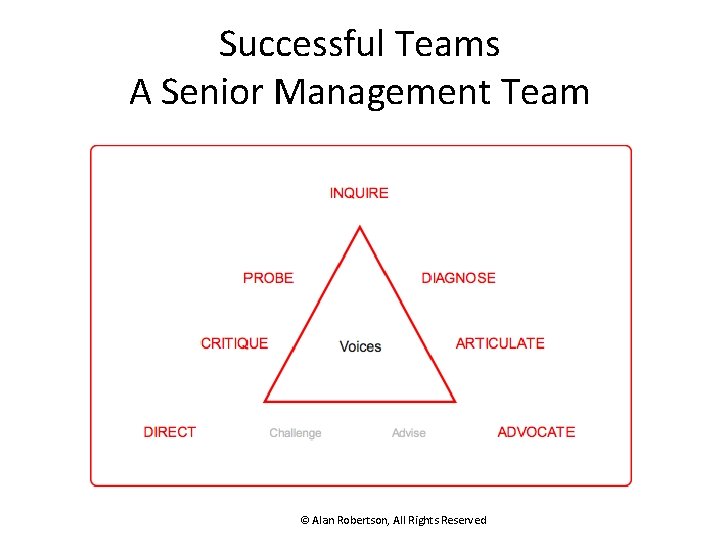
Successful Teams A Senior Management Team © Alan Robertson, All Rights Reserved
Successful Teams A Senior Management Team © Alan Robertson, All Rights Reserved
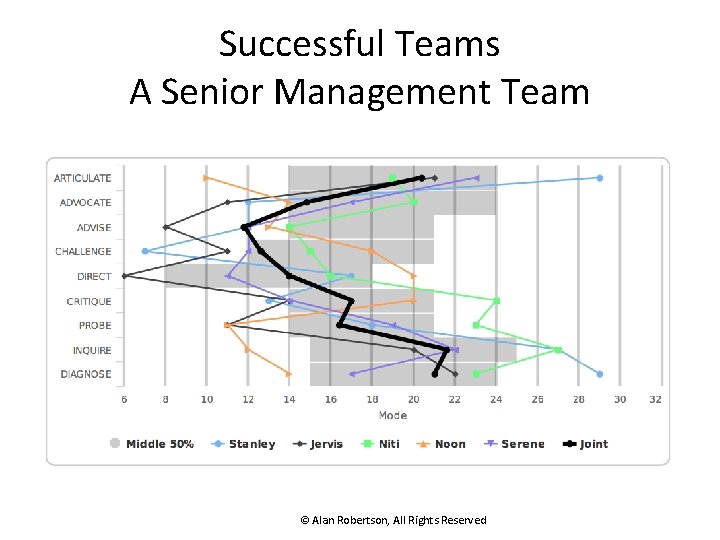
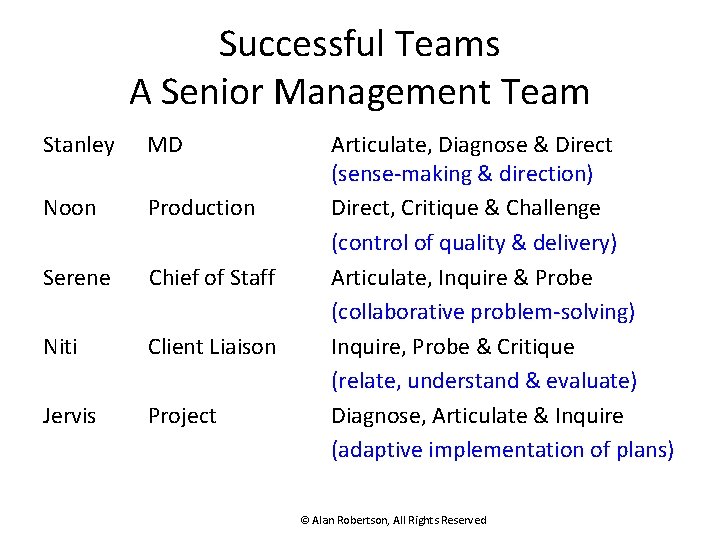
Successful Teams A Senior Management Team Stanley MD Noon Production Serene Chief of Staff Niti Client Liaison Jervis Project Articulate, Diagnose & Direct (sense-making & direction) Direct, Critique & Challenge (control of quality & delivery) Articulate, Inquire & Probe (collaborative problem-solving) Inquire, Probe & Critique (relate, understand & evaluate) Diagnose, Articulate & Inquire (adaptive implementation of plans) © Alan Robertson, All Rights Reserved
Successful Teams A Senior Management Team © Alan Robertson, All Rights Reserved
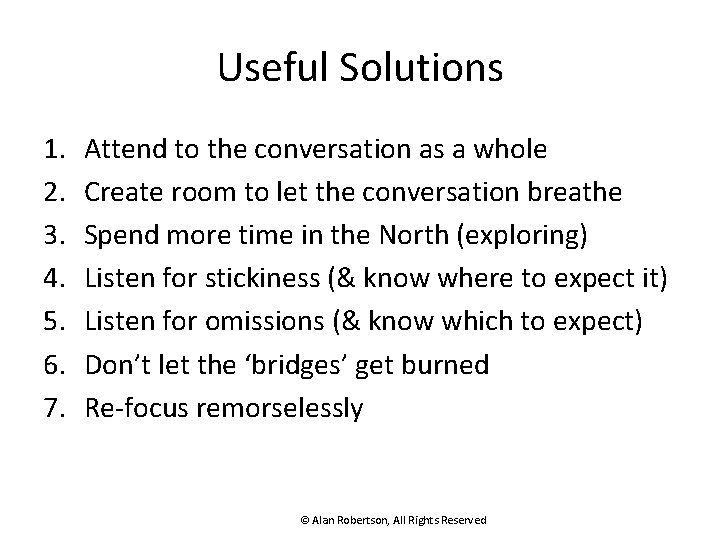
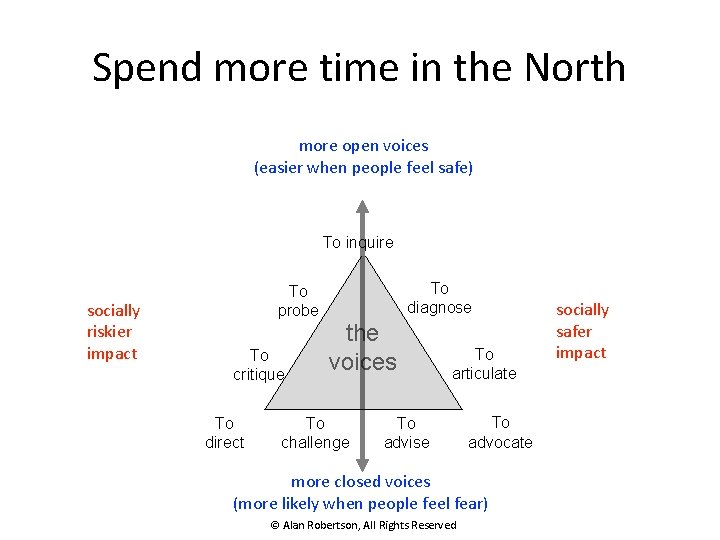
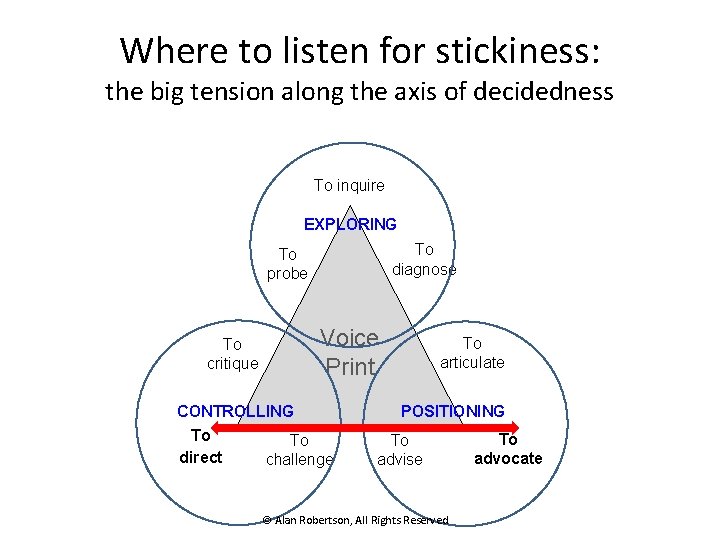
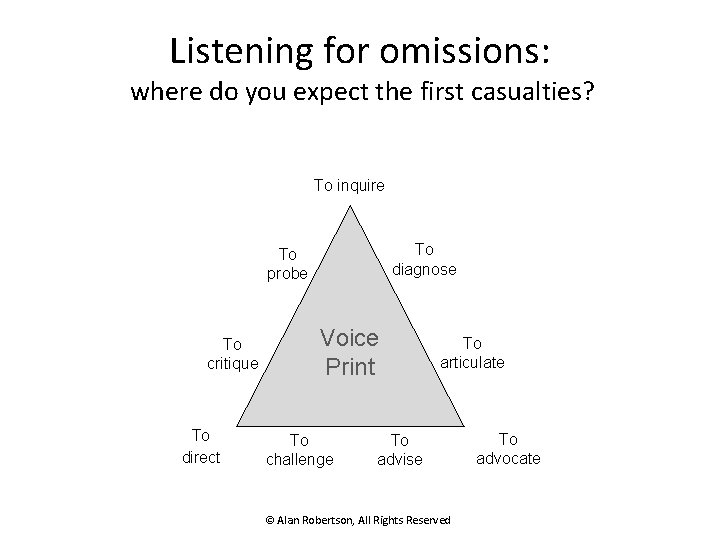
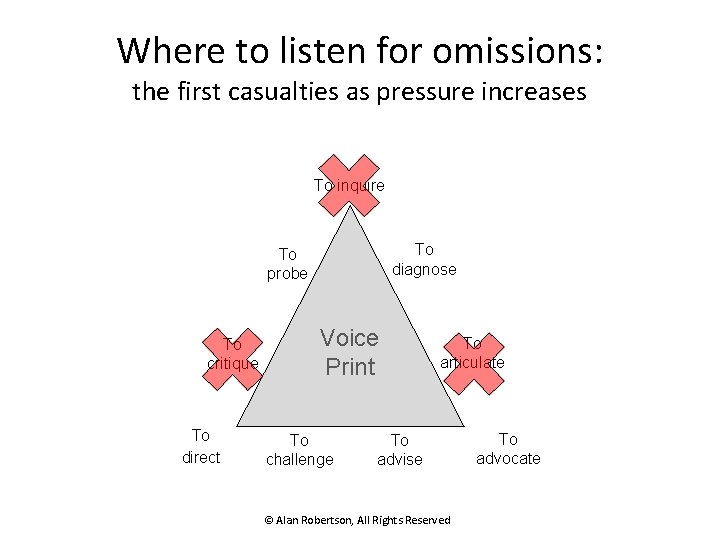
Useful Solutions 1. 2. 3. 4. 5. 6. 7. Attend to the conversation as a whole Create room to let the conversation breathe Spend more time in the North (exploring) Listen for stickiness (& know where to expect it) Listen for omissions (& know which to expect) Don’t let the ‘bridges’ get burned Re-focus remorselessly © Alan Robertson, All Rights Reserved
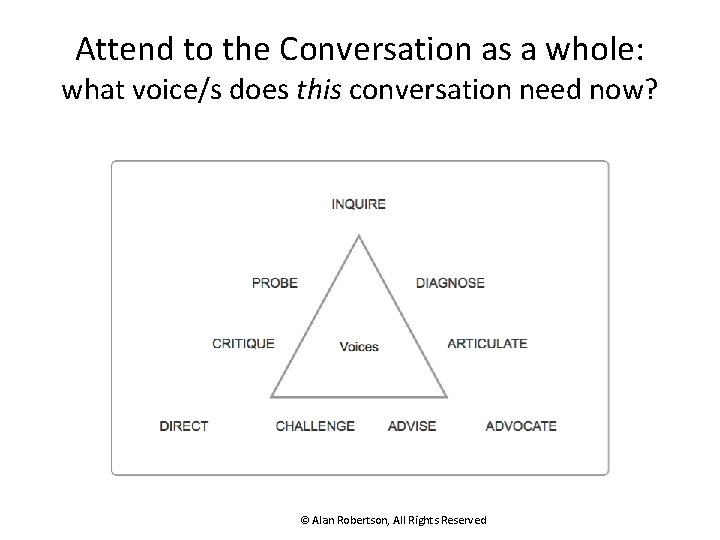
Attend to the Conversation as a whole: what voice/s does this conversation need now? © Alan Robertson, All Rights Reserved
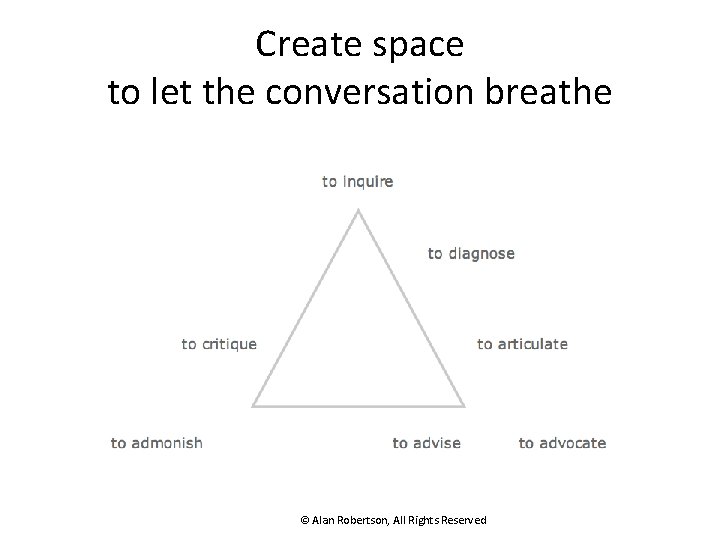
Create space to let the conversation breathe © Alan Robertson, All Rights Reserved
Spend more time in the North more open voices (easier when people feel safe) To inquire socially riskier impact To probe To critique To direct To diagnose the voices To challenge To articulate To advise To advocate more closed voices (more likely when people feel fear) © Alan Robertson, All Rights Reserved socially safer impact
Where to listen for stickiness: the big tension along the axis of decidedness To inquire EXPLORING To diagnose To probe To critique Voice Print CONTROLLING To To direct challenge To articulate POSITIONING To advise © Alan Robertson, All Rights Reserved To advocate
Listening for omissions: where do you expect the first casualties? To inquire To diagnose To probe To critique To direct Voice Print To challenge To articulate To advise © Alan Robertson, All Rights Reserved To advocate
Where to listen for omissions: the first casualties as pressure increases To inquire To diagnose To probe To critique To direct Voice Print To challenge To articulate To advise © Alan Robertson, All Rights Reserved To advocate
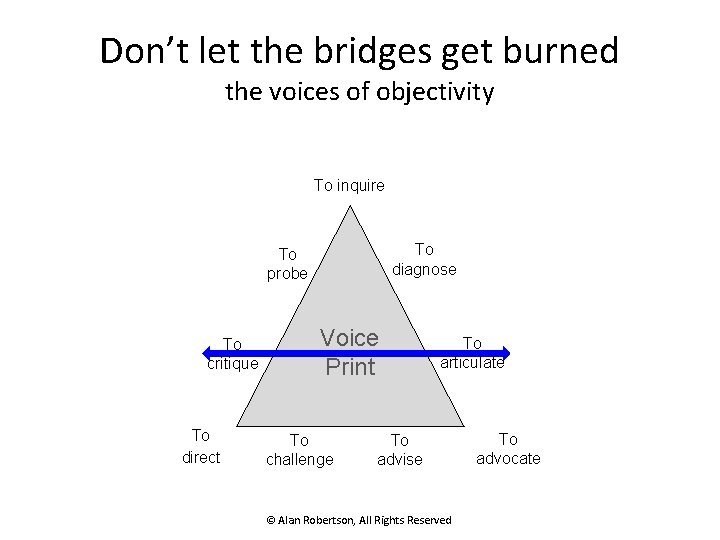
Don’t let the bridges get burned the voices of objectivity To inquire To diagnose To probe To critique To direct Voice Print To challenge To articulate To advise © Alan Robertson, All Rights Reserved To advocate
Re-focus remorselessly: possibly the most important voice in teamworking To inquire EXPLORING To diagnose To probe To critique Voice Print CONTROLLING To To direct challenge To articulate POSITIONING To advise © Alan Robertson, All Rights Reserved To advocate
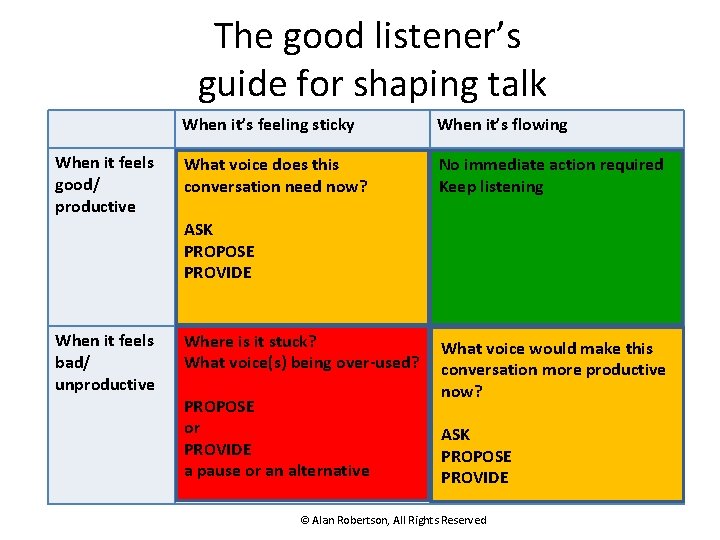
The good listener’s guide for shaping talk When it feels good/ productive When it’s feeling sticky When it’s flowing What voice does this conversation need now? No immediate action required Keep listening ASK PROPOSE PROVIDE When it feels bad/ unproductive Where is it stuck? What voice(s) being over-used? PROPOSE or PROVIDE a pause or an alternative What voice would make this conversation more productive now? ASK PROPOSE PROVIDE © Alan Robertson, All Rights Reserved
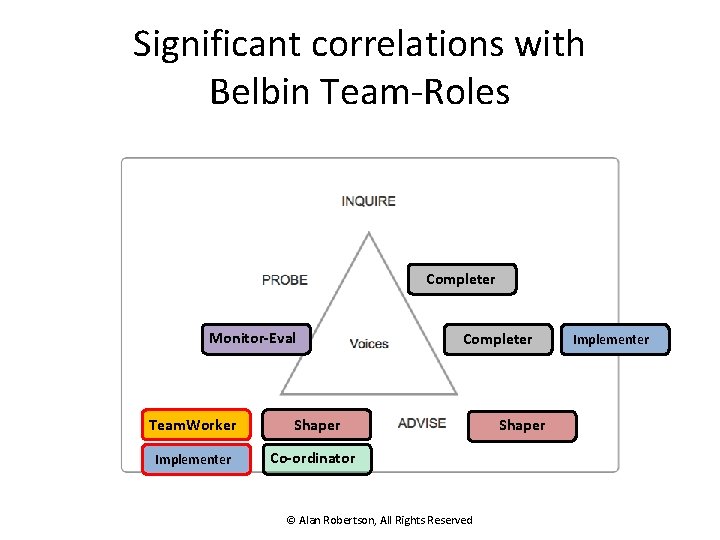
Significant correlations with Belbin Team-Roles Completer Monitor-Eval Team. Worker Implementer Completer Shaper Co-ordinator © Alan Robertson, All Rights Reserved Shaper Implementer
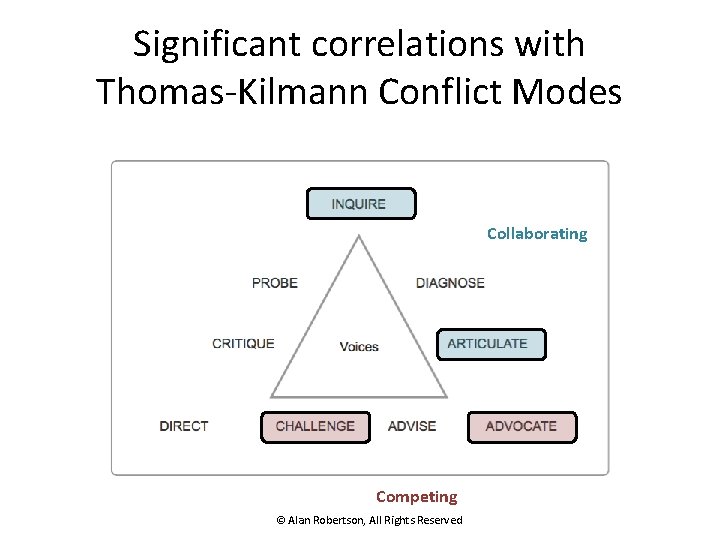
Significant correlations with Thomas-Kilmann Conflict Modes Collaborating Competing © Alan Robertson, All Rights Reserved
Some Suggestions • Understanding how different models ‘speak to each other’ helps us to speak to each other • Belbin’s model tells us more about what pulls teams apart than what enables them to harness difference and work effectively • Nouns & adjectives might help understanding, but we need verbs to develop practice • The lived experience of teamworking (and any interacting) is dynamic & in-the-moment; that’s where energy goes… • …so that’s where our attention needs to go too • …giving more attention to Moments (products of voice, context, impact & reaction), Momentum and Movements © Alan Robertson, All Rights Reserved
alan@businesscognition. co. uk HTTPS: //LETSTALK. VOICEPRINT. GLOBAL