
Voice over IP Vo IP background and regulatory
Voice over IP (Vo. IP) – background and regulatory aspects Background for discussions at ERG meeting 17. 6. 04 Olli Mattila Finnish Communications Regulatory Authority ( Chairman of the IRG FN WG / Vo. IP Subgroup)
Content • Technical concept of Vo. IP vs PSTN phone • Comments on market development / impact on PSTN • Comments on regulatory issuers • Ficora`s decision on Vo. IP service • IRG FN WG / Vo. IP subgroup 16. 12. 2021 2
Technical concept of Vo. IP vs PSTN 16. 12. 2021 3
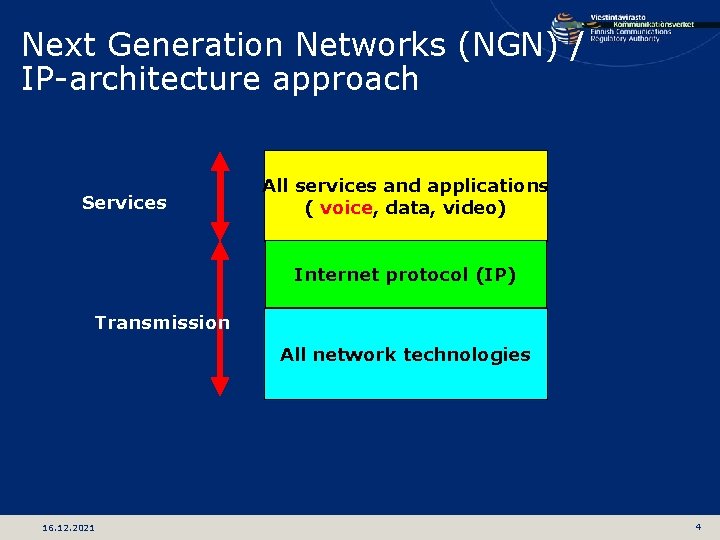
Next Generation Networks (NGN) / IP-architecture approach Services All services and applications ( voice, data, video) Internet protocol (IP) Transmission All network technologies 16. 12. 2021 4
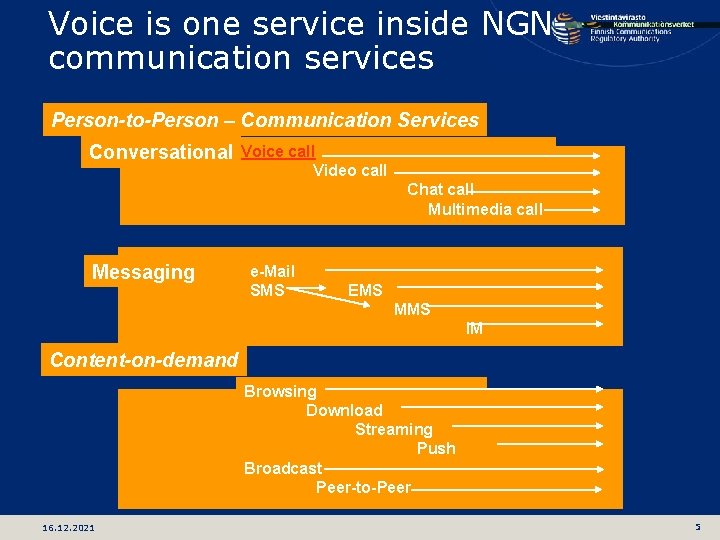
Voice is one service inside NGNcommunication services Person-to-Person – Communication Services Conversational Voice call Video call Chat call Multimedia call Messaging e-Mail SMS EMS MMS IM Content-on-demand Browsing Download Streaming Push Broadcast Peer-to-Peer 16. 12. 2021 5
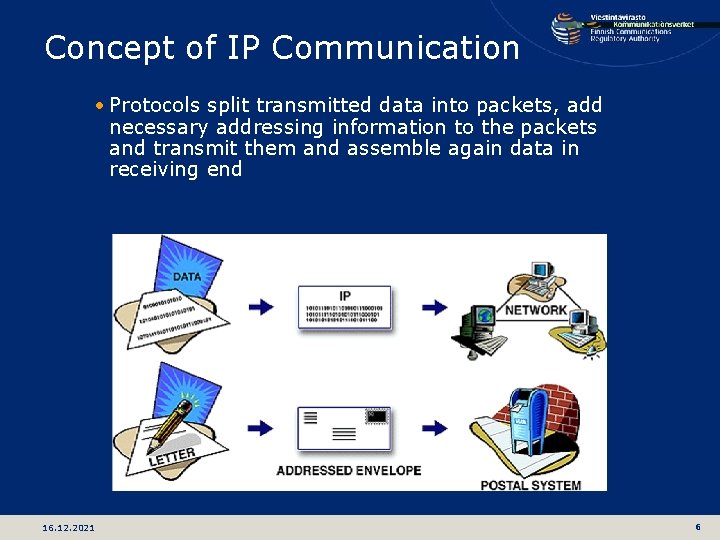
Concept of IP Communication • Protocols split transmitted data into packets, add necessary addressing information to the packets and transmit them and assemble again data in receiving end 16. 12. 2021 6
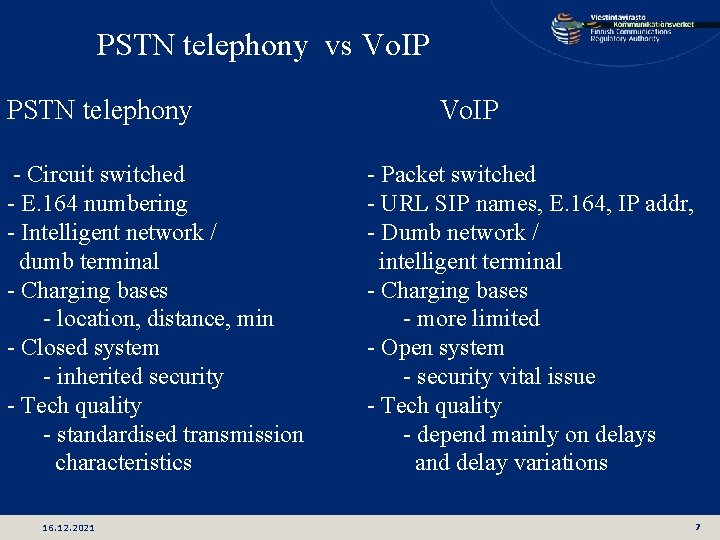
PSTN telephony vs Vo. IP PSTN telephony - Circuit switched - E. 164 numbering - Intelligent network / dumb terminal - Charging bases - location, distance, min - Closed system - inherited security - Tech quality - standardised transmission characteristics 16. 12. 2021 Vo. IP - Packet switched - URL SIP names, E. 164, IP addr, - Dumb network / intelligent terminal - Charging bases - more limited - Open system - security vital issue - Tech quality - depend mainly on delays and delay variations 7
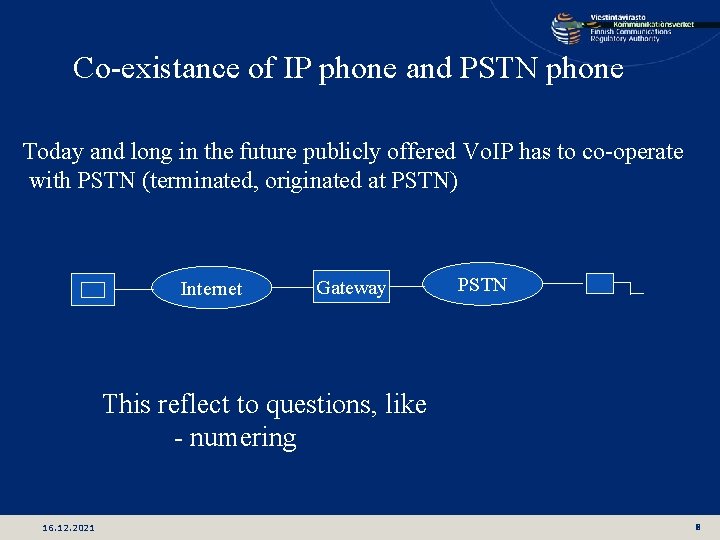
Co-existance of IP phone and PSTN phone Today and long in the future publicly offered Vo. IP has to co-operate with PSTN (terminated, originated at PSTN) Internet Gateway PSTN This reflect to questions, like - numering 16. 12. 2021 8
Nature of Vo. IP service creates problems with several consumer protection issues, like • Location independence (”nomadicity”) • customer is able to register at any access point in any country • service provision can be controlled from any point world wide • Active terminals • requires electric power • Open network ( compared with closed PSTN network) • security questions 16. 12. 2021 9
Comments on market development / impact on PSTN 16. 12. 2021 10
Vo. IP market trends • At present at its infancy, estimated in September 2003 • less than 200 000 Vo. IP users world wide • less than 20 000 Vo. IP users in Europe • But expected to grow rapidly because • reduced capital and operating costs • voice services with a number of new features • new revenue opportunities for access providers through “triple play”, that means voice, data and broadband internet • Growing number of broadband internet access will accelerate the use of Vo. IP • Public Vo. IP service is at least on plan/ trial basis in most of EU countries 16. 12. 2021 11
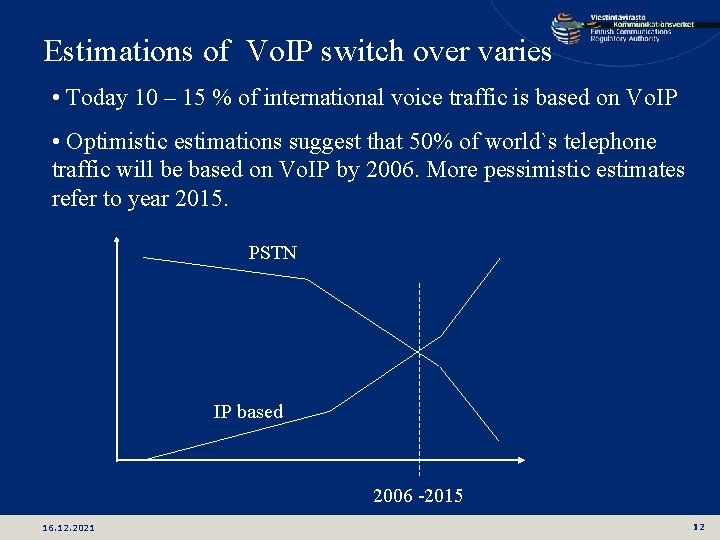
Estimations of Vo. IP switch over varies • Today 10 – 15 % of international voice traffic is based on Vo. IP • Optimistic estimations suggest that 50% of world`s telephone traffic will be based on Vo. IP by 2006. More pessimistic estimates refer to year 2015. PSTN IP based 2006 -2015 16. 12. 2021 12
Comments on regulatory issues 16. 12. 2021 13
Regulatory discussions have started USA -FCC published a proposed rulemaking in March 2004 - several state regulators are considering the issue. New York Public Service Commission issued decision (in May 21) on Vonage´s Voi. P EU - Ficora made regulatory decision on Telia. Sonera`s Vo. IP service in October 2003 - Several EU countries are establishing national working groups or about to launch national consultations on the issue - EU Commission plans to put document on Vo. IP regulatory aspects for public consultation 16. 12. 2021 14
Categories of Vo. IP services from regulators point of view 1. Outside of regulatory concern • Corporate internal use on business LAN/WAN • IP phone – IP phone, self provided 2. In principle under regulation (end user services) • Carrier internal use 3. Inside regulatory concern • IP phone to PSTN phone • PSTN phone to IP phone • IP phone – IP phone service provided by operator 16. 12. 2021 15
Dimensions of regulatory issues on Vo. IP a) Consumer protection USO directive: PATS definition / obligations? b) Market / competition control, for example • Relationship with relevant markets – substitute to PSTN voice telephony? • Interconnection / termination - regulatory costing? • Retail prices – location / distance independent? 16. 12. 2021 16
Definitions in the USO Directive • Electronic communications service (ECS): A service normally provided for remuneration which consists wholly or mainly in the conveyance of signals on electronic communications networks… • Publicly available telephone service (PATS): a service available to the public for originating and receiving national and international calls and access to emergency services through a number or numbers in a national or international telephone numbering plan… 16. 12. 2021 17
Basic regulatory questions Are Vo. IP (which of Vo. IP services) classified as publicly available telephone services (PATS) and thus regulations set for traditional telephone service apply ? If yes, can the obligations be obeyed ( due to technical restrictions) in practice ? Note: see as an example list of obligations set in the Ficora`s Vo. IP decision 16. 12. 2021 18
Emergency calls Emergency arrangements do not fit calls over internet, because the nature of internet • customer is able to register at any access point in any country • service provision can be controlled from any point world wide Basic problems • problem with reach the emergency centre • problem with wrong or lack of caller`s location information 16. 12. 2021 19
Vo. IP quality • Mainly affected by transmission delays, delay variations, packet losses (and bandwith) • Quality classes defined by ETSI/TIPHON for end to end quality • ITU has technically standardised 5 Qo. S classes. Two first are regarded acceptable for Vo. IP service • Current international Vo. IP is mainly based on “Best Effort” 16. 12. 2021 20
Legal interception • Difficult to administrate due to (international) location independence of IP • Vo. IP also makes use of encryption more easy • ETSI is working on the issue concerning technical arrangement Communication security • Network integrity /service availability (power failures, terminal closing due to spam and network overloading) • Communication confidentality 16. 12. 2021 21
Numbering issues • Vo. IP numbers in national numbering plans • Is there reasons to aim specific number series for Vo. Ip service ? • Is there need in future for common URL to identify for emergency services (for example SIP: SOS@ home-domain) ? Universal service issues • review USO models including Vo. IP ? Extra territorial issues ( services coming outside Europe) • influence of possible unsymmetric regulation ? • obligations for services coming outside of EU ? 16. 12. 2021 22
Ficora`s decision on Sonera`s Vo. IP service in Finland 16. 12. 2021 23
Vo. IP regulation in Finland • Telia. Sonera’s Vo. IP Service (”Sonera Puhekaista”) • service is offered only to Telia. Sonera’s broad band users • offered as a subsitute for PSTN connection • FICORA’s decision in October 2003 • www. ficora. fi/englanti/document/Sonera. Puhekaista. pdf • Telia. Sonera’s Vo. IP service was considered to be PATS because • the service is available to the public • the service is offered through a number in the Finnish numbering plan • users can originate and receive national and international calls and use emergency services • the service was also considered to be offered at a fixed location 16. 12. 2021 24
Telia. Sonera’s Vo. IP service has to comply with the obligations set for PATS in the national regulation, main obligations beeing (1): • ensure that users are able to make international calls using access code 00 • ensure that users are able to access the emergency call number 112 and other special emergency number free of charge • on request of user , free of cost, arrange a categorised barring service • free of charge provide itemized bills • ensure that user`s nme, address and telephone number is collected and published in telephone directory 16. 12. 2021 25
Telia. Sonera’s Vo. IP service has to comply with the obligations set for PATS in the national regulation, main obligations beeing (2): • equip its communications network and communications service with technical facilities that allows legal interception • service that recipient can see calling number (CLI) • ensure that its activities can continue under exceptional circumtances • ensure that network and service satisfies the quality requirement of the Act • follow provision of the Act on protection and Data Security in Telecommunications (for example regulation how to treat , store and use call data) 16. 12. 2021 26
IRG / FN WG / Vo. IP subgroup • Just starting the work, first meeting on Monday June 21 th • Co-operation with • Commission • IRG End User group • CEPT / ECC / TRIS group • ” / NNA – Vo. IP PT • Follow • National regulatory development in Europe • USA (and Japan) regulatory development • Work of other organisations (OECD, ECTA, etc) • Standardisation work (ETSI, IETF, etc) 16. 12. 2021 27
- Slides: 27