
Voice Over IP Presented By Jas Ahluwalia Tony
Voice Over IP Presented By Jas Ahluwalia Tony Chen May 29, 2003 1
Introduction Voice has been transmitted over PSTN (POTS) since 1878. n U. S. Long-Distance Market is $100 billion a year n $100 billion? !! Businesses and consumers wish to reduce this cost. n Over the last decade the emergence of the internet has caused a significant investment in IP based networks n n Can we use these IP based networks for voice? 2
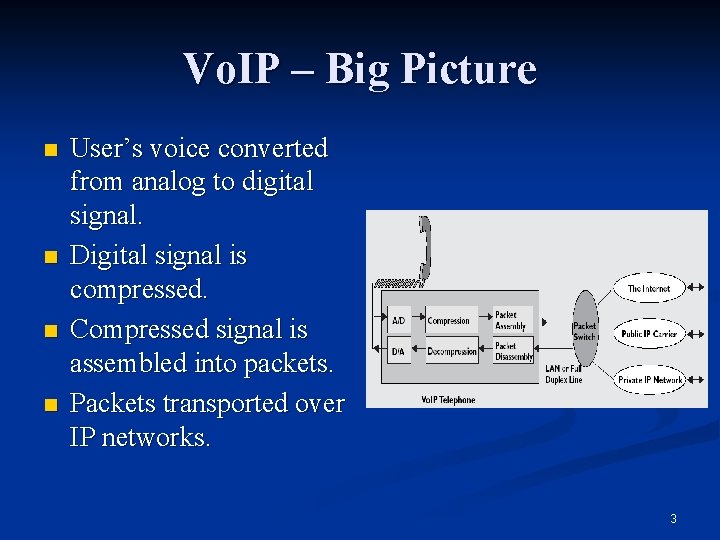
Vo. IP – Big Picture n n User’s voice converted from analog to digital signal. Digital signal is compressed. Compressed signal is assembled into packets. Packets transported over IP networks. 3
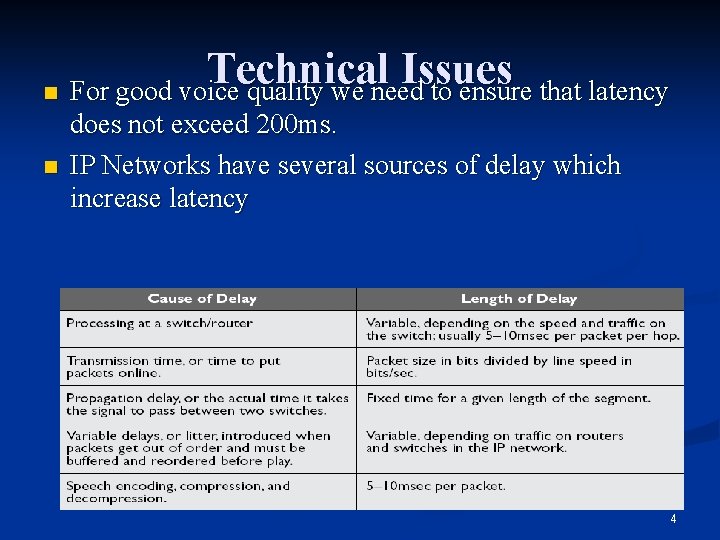
Technical Issues n For good voice quality we need to ensure that latency n does not exceed 200 ms. IP Networks have several sources of delay which increase latency 4
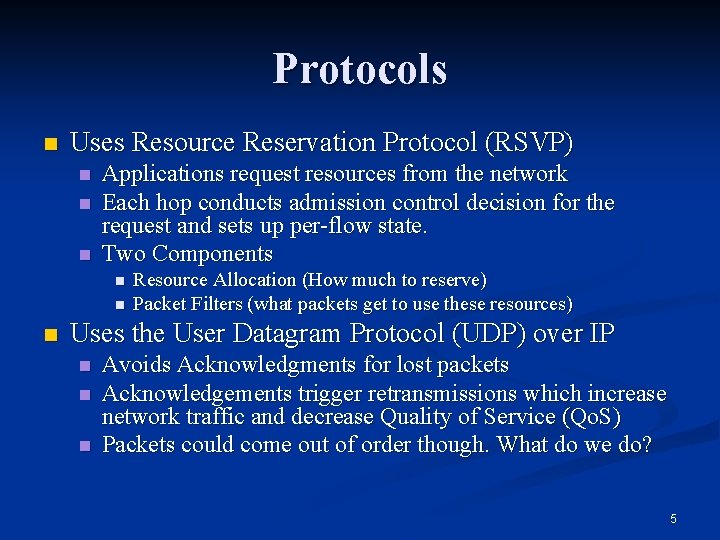
Protocols n Uses Resource Reservation Protocol (RSVP) n n n Applications request resources from the network Each hop conducts admission control decision for the request and sets up per-flow state. Two Components n n n Resource Allocation (How much to reserve) Packet Filters (what packets get to use these resources) Uses the User Datagram Protocol (UDP) over IP n n n Avoids Acknowledgments for lost packets Acknowledgements trigger retransmissions which increase network traffic and decrease Quality of Service (Qo. S) Packets could come out of order though. What do we do? 5
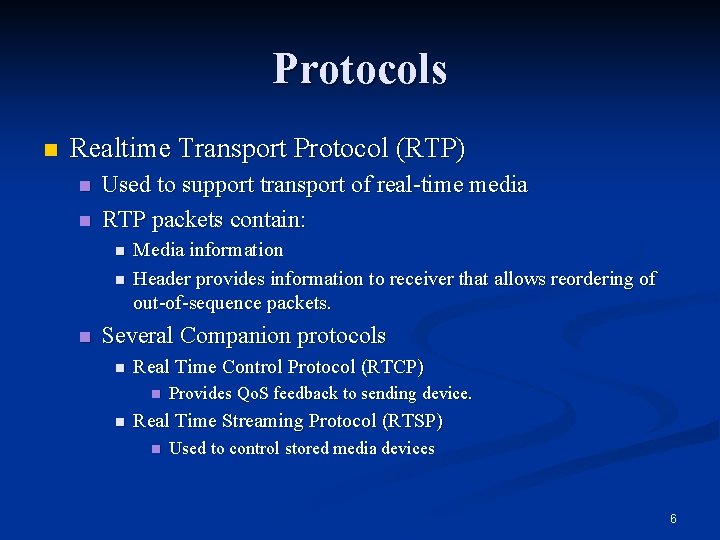
Protocols n Realtime Transport Protocol (RTP) n n Used to support transport of real-time media RTP packets contain: n n n Media information Header provides information to receiver that allows reordering of out-of-sequence packets. Several Companion protocols n Real Time Control Protocol (RTCP) n n Provides Qo. S feedback to sending device. Real Time Streaming Protocol (RTSP) n Used to control stored media devices 6
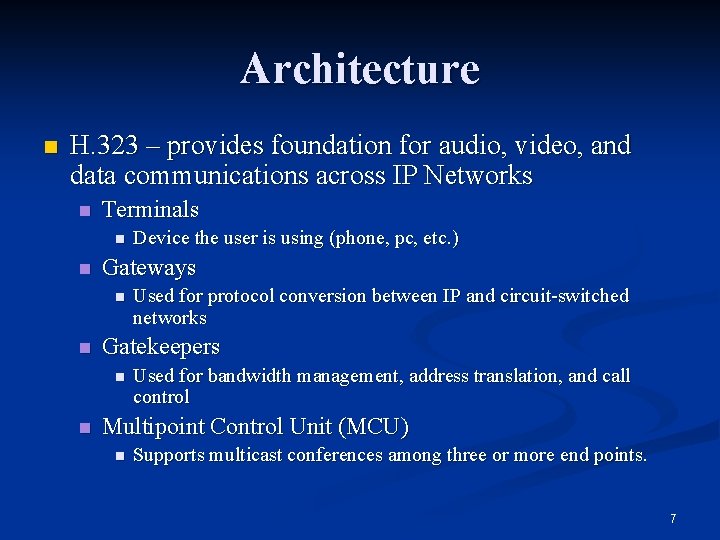
Architecture n H. 323 – provides foundation for audio, video, and data communications across IP Networks n Terminals n n Gateways n n Used for protocol conversion between IP and circuit-switched networks Gatekeepers n n Device the user is using (phone, pc, etc. ) Used for bandwidth management, address translation, and call control Multipoint Control Unit (MCU) n Supports multicast conferences among three or more end points. 7
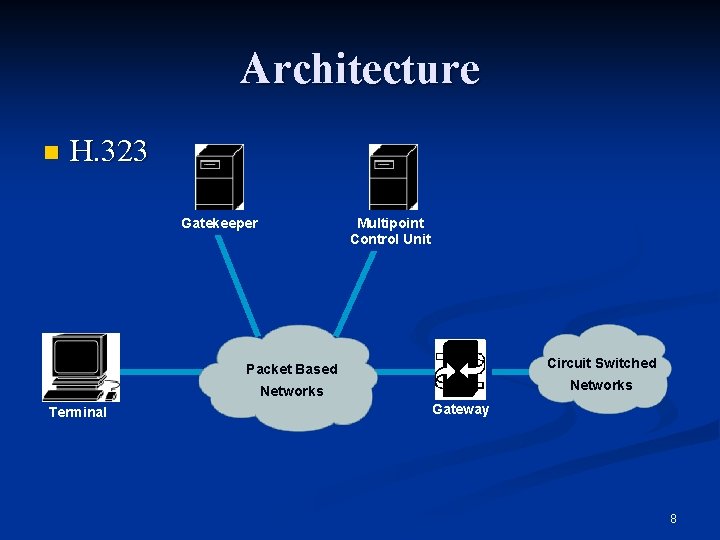
Architecture n H. 323 Gatekeeper Terminal Multipoint Control Unit Packet Based Circuit Switched Networks Gateway 8
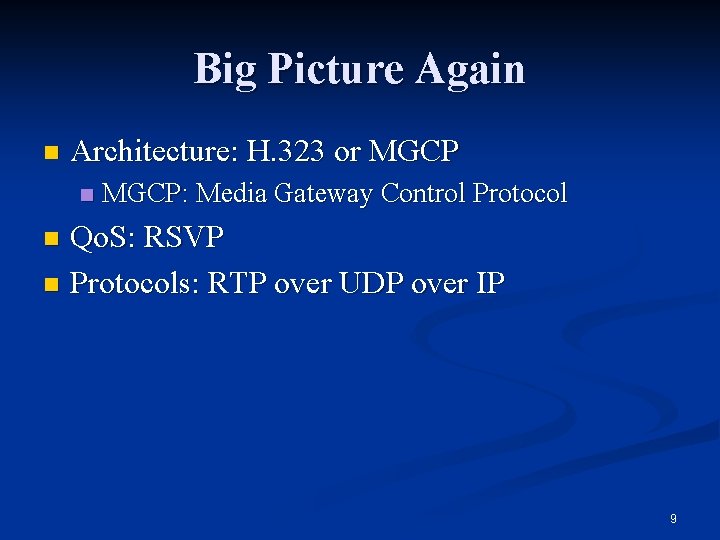
Big Picture Again n Architecture: H. 323 or MGCP n MGCP: Media Gateway Control Protocol Qo. S: RSVP n Protocols: RTP over UDP over IP n 9

RTP over UDP over IP 10
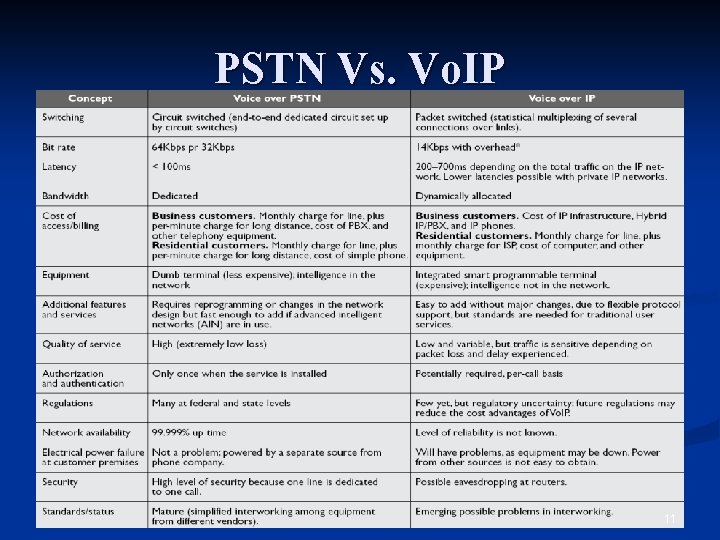
PSTN Vs. Vo. IP 11
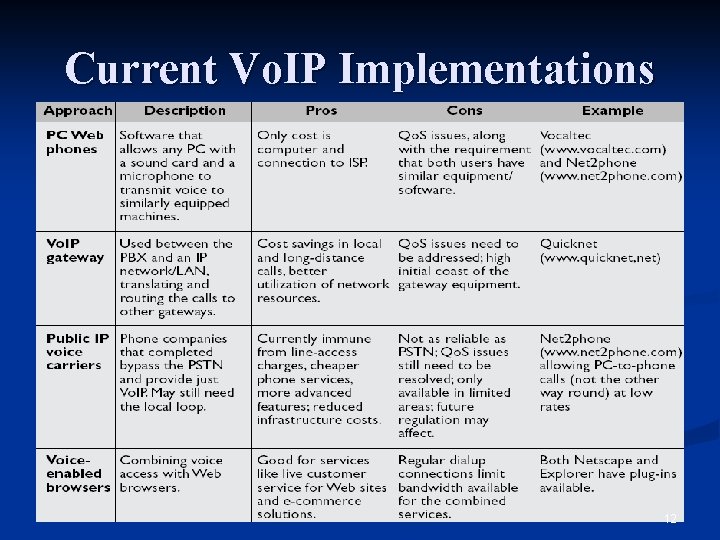
Current Vo. IP Implementations 12
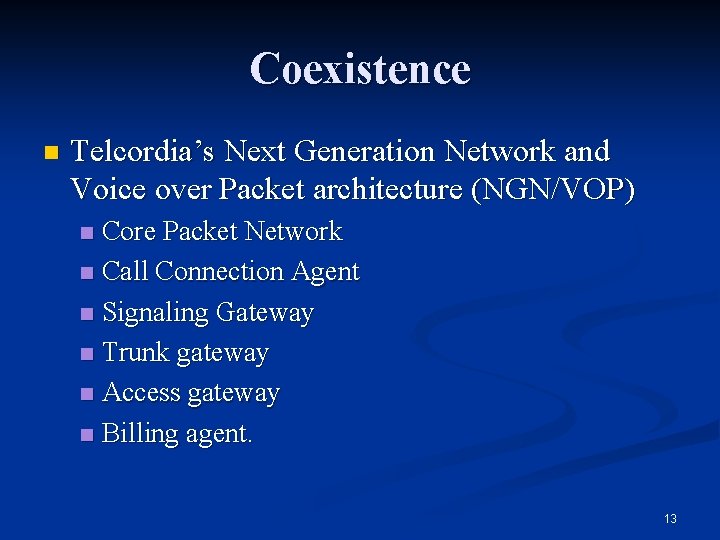
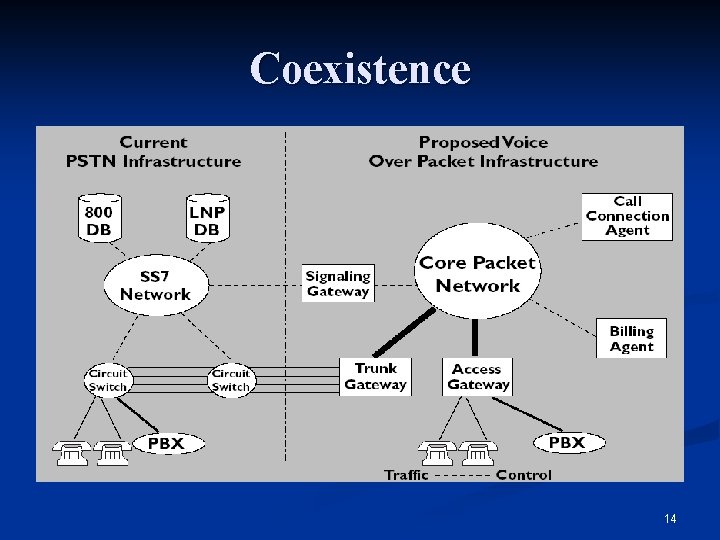
Coexistence n Telcordia’s Next Generation Network and Voice over Packet architecture (NGN/VOP) Core Packet Network n Call Connection Agent n Signaling Gateway n Trunk gateway n Access gateway n Billing agent. n 13
Coexistence 14
Veraz Networks n n n Provide Carrier Grade Solution for companies like AT&T, MCI, etc MCI creates dedicated IP network for voice traffic termed “Engineered IP Network” Benefits of Engineered IP Network: n n n A 20, 000 Telephone Line Exchange costs $12 -$14 Million Exchanges are huge and require special housing (protection for fire, flooding, etc. ) Next Generation Solution cost $2 -$3 million and is small (desktop size). Call between LA and NY goes over several nodes in telephone sytem. Only one Next Generation Solution is needed for same call. 15
Veraz Networks n 2 part solution n Softswitch n Software brains of the system n Make/break connections, etc. n Media Gateway n Interface to existing telephone system n Interface to IP Network. n Veraz/Nexverse wish to bring about the same evolution that the computing world saw. n Smaller, more powerful, cheaper computers 16
17
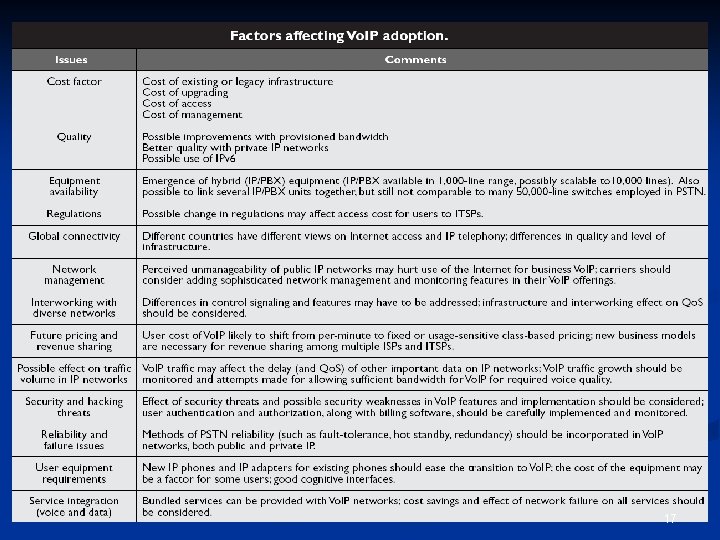
Conclusion Vo. IP provides a cost effective solution n Can envision a wide array of applications that can complement Vo. IP n However, previous slide shows several issues that need to be resolved before widespread deployment. n 18
- Slides: 18